


Latest News

Lacrosse, Sports

Redbirds lacrosse edges out Carleton Ravens in a thrilling battle of the birds

On the heels of a massive 9-2 win over the Bishop’s Gaiters (0–2), the Redbirds (2–1) faced off against the Carleton Ravens (1–1) for their first home game of the season on Sept. 16. After taking a 10-5 loss in their Canadian University Field Lacrosse Association (CUFLA) regular-season opener against the Ravens, the win over Bishop’s––McGill’s only CUFLA opponent within Quebec––gave the Redbirds a much-needed boost ahead of their re-match. 

“We had a little bit of an effort issue and I thought yesterday [against Bishop’s], we really brought the effort,” head coach Nicolas Soubry told The Tribune. “We had a lot of alumni reach out and tell us stories about when they played versus Bishop’s. [They’re] our ingrained rival and I thought that really changed the motivation for the team.” 

However, the game did not start out the way McGill had hoped. An early goal from Carleton set the tone for a dominant first quarter where the Ravens would go up 3-0 just six minutes into the game. After the third straight Carleton goal, the Redbirds called a timeout, attempting to reset the tone. In the dying minutes of the opening quarter, midfielder Dylan James got McGill on the scoreboard, swaying the momentum back in the Redbirds’ favour. 

Three minutes into the second quarter, midfielder Joshua Jewell buried McGill’s second goal of the night and with just under four minutes remaining, James found the back of the net again to tie it 3-3. 

“This is a game of runs. It’s a game of big ups and big downs, and it’s less about the individual performance and more about just getting the team going,” James said in a post-game interview. “Tying it up with that goal, it was an honour.” 

The third quarter opened with back-to-back goals for the Ravens, giving them a 5-3 lead. But this lead would not last for long as attacker Mark Symon and midfielder Rowan Birrell brought the score back to even and midfielder John Miraglia gave the Redbirds their first lead. With the score 6-5, the Ravens came roaring back to tie the game and reclaim their lead with 14 seconds remaining in the quarter. 

Entering the fourth quarter 7-6 in Carleton’s favour, the game was far from over. Jewell scored to tie the game 7-7 and with just over seven minutes remaining, Miraglia netted his second of the night to give McGill a 8-7 lead. As McGill fans anxiously cheered on their team, a turnover allowed Carleton to tie it up with just one second on the clock. 

The opening minute of overtime looked bad for the Redbirds as Cartleton quickly gained control of the ball, rushing on a two-on-one towards McGill’s net. However, an errant pass allowed McGill to break back into Carleton’s zone and for his third assist of the night, James connected with midfielder Owen Howard who buried the game-winner on a masterful behind-the-back shot.   

Despite his personal excitement, Howard accredited the win to McGill’s improvement from their first game against Carleton. 

“Today we were moving it around, the whole team was getting involved and we had the crowd to pump us up,” Howard said. “It just kind of felt electric, [the game had] a whole different vibe going into it than the last game.” 

The Redbirds hope to carry this momentum into their game against the undefeated Trent Excalibur (3–0) on Sept. 23. 

Moment of the game: After turning the ball over in a play that allowed Carleton to tie the game, Howard was not supposed to be on the field to start overtime. However, unbeknownst to his coaches, Howard snuck onto the field in a move that allowed him to score the game-winner for his team. 

Quotable: 

“We’re a team that rides the highs and rides [the] lows. We’re a team with character and pride now. That’s something that I think we lacked in the past and now that we have it, this team can go places. 

–– Midfielder Dylan James

Stat Corner: James led the team in points with two goals and three assists. 

Features

Shifting perspective and starting again

Bridging my uncertainty through the arts of science.

My journey with art began at the age of eight in a small, local studio in Toronto. Colourful surrealist and impressionist artwork coated the walls, wooden easels bordered the fringes, and fluorescent lights shone softly across the quaint, narrow room. After watching me draw with printer paper and crayons at home, my parents decided to enroll me in art classes, and I was beyond thrilled to try my hand at formally learning fundamental art techniques. After months of practice, I discovered my niche in both a talent and a passion for realism. Replicating the intricacies of the delicate human eye and the more structured forms of hand sketches was enthralling. I would practice drawing delicate wisps and bold brush strokes, their motor movements integrating themselves into my subconscious. However, despite my enthusiasm, I always feared that while I was artistic, maybe I wasn’t creative like everyone else in class seemed to be. I could envision known objects, but when it came to creating original concepts, I struggled. And as I got older, any previous creativity continued to diminish, forgotten and unattended.

I considered my strengths: An aptitude for spatial reasoning, which I gained through learning to draw and think about my subjects; surprising memorization skills, which I found after I realized I had unknowingly committed numerous books to memory upon a single read-through, including a 300-page illustrated animal encyclopedia; and a deep interest in visuals and diagrams. So, I found myself drawn to life sciences such as anatomy and chemistry, fascinated by the patterns in life and the interconnection of seemingly different topics and beings. I loved seeing how nature could perpetuate patterns and designs in virtually everything: Waves and spirals, branching and symmetry, dispersion and diffraction. I adored seeing innate art and beauty in science.

But with every complex calculus equation and convoluted signalling pathway I encountered as my journey in science progressed at McGill, I found my original passion for learning life science had dissipated. A subject that once left me enthralled, now left me uninspired. With every class that followed, I felt that the art in science had been reduced to just a premeditated formula.

As I advanced through my post-secondary science education, I began to realize that these formulas demanded rigidity from their creation, leaving no room for imagination or creativity apart from the minds who created them, with us only to input the calculations. I encountered a dilemma: Should I have just pursued art from the beginning? 

Upon identifying my feelings, a resentment for science surfaced. I thought my choices were limited: It was either art or science—always shown to be innately disconnected. But why did I feel an obligation towards a single, linear path? Perhaps I felt too drawn to the appeal of an academic career, with all its rigour and praise. But more importantly, what was stopping me from trying again?

Approval: The illustrious idea of standardized intelligence

The craving for approval did not make an explicit appearance. It crept up slowly, manifesting itself during high school with the growing pressure to get into a university, and has lingered since. Parasitically leeching off of the praise that came with the rigorous path of science, I found myself unwillingly wishing for some unknown being to see my work and deem it, and by extension, myself worthy. 

Perhaps the fear was less about being undistinguished or “ordinary”, but more so about not mattering enough to be remembered. The thought of insignificance in both my artistic and scientific efforts haunted me, along with the worry that I was bound to be forgotten.

Time: The feeling it passed me by

Time: Another aspect that plagued me. I worried that changing my path would make all the time, money, and energy spent on science ultimately futile. Was I wrong about myself and my capabilities? But then, I remember my father’s story, of how he wanted to study computer science but didn’t win the raffle for his study permit. Instead, he redirected his efforts to becoming an industrial engineer. But with his dreams ever-present, he continued studying independently; now, he has been in IT for the past fifteen years. His circular journey took him on different, unexpected paths that led him back to where he always wanted to be. Only now, he arrived at the start again with a different experience, a new perspective, and the knowledge that his drive and determination are the few aspects of life he can control. His story made me consider, if we leave, can we ever come back? I think yes: We return in distinctly different ways.

Fear: The Ubiquity of Failure

In high school, it took me some time to settle on what I then considered to be my path. But after extensive deliberation between my two passions, the lustre of science and research ultimately won me over. I feared not being able to decide on one specific discipline, forever teetering on the border of two fields, halfhearted on both. But, I have found that an interdisciplinary path would have been more rewarding for me. I was not satisfied with science alone as a stoic, unimaginative discipline, and I wanted my art to be critiqued on its ability to communicate an informative purpose rather than my personal creativity or style. I wanted to dedicate myself fully to both. By merging art and science, so many options were open to me: Scientific illustration, graphic design in the medical field, 3D prosthetics, conservation photography. And no matter my apprehension about being too ordinary in my art, or too uninspired in my research, all I can do for myself is be willing to fail as often as I am willing to try again.

My time in university has allowed me to find others who share these conflicted feelings; I have met so many others who struggle with the same: Painters, potterers, and poets—all with a wonder for STEM, but a longing for the return of art in our lives. I wondered, when did I fall under the false guise that these two fields were so vast, that there was nothing connecting them? I have come to realize otherwise.

Interconnecting these Forces: 

Creating art can require many skills. Any piece requiring precision and accuracy, or even work that strays from the realm of the feasible, demands the comprehension of the subject’s anatomy, reasonable physics of motion, and logic in perspective. These components are imperative in the realms of physics, life sciences, thinking, and reasoning.

Mathematics can uncover incredible patterns, beautiful laws, and phenomena when we visualize numbers and formulas: Colliding blocks encode pi; prime numbers create spirals; material forms unravel, extending their reach like the branching of trees, river beds, our capillaries and bronchi, all working together to create something the other requires. The spirals in Nautilus shells, unfurling ferns, galaxies, and fingerprints. These elements demonstrate an intrinsic link between the bounded realms of logic and numbers and the free field of subjective creativity—where we bend the rules. There are infinite ways these dimensions can—and should—be intertwined. Why do we think we can only be limited to one discipline, when the world itself shows us how reliant these fields are on one another?

I decided I might be unsure of my decisions. Dissatisfied with my path. I may even be unhappy. How can we go back to something we were? Something we always wanted to be? For myself, I know that I’ve let fear hold me back for too long: The longing for approval from something I believed to be “greater” than myself, that time could never allow me to return to something I used to love. But having been trapped with this sentiment for so long does not make it binding. Like meanders in nature, which transform their linear paths into sinusoidal curves, taking longer routes to accommodate their sheer force and power, we are not always meant to have an unchanging path.

Now, I make space for art: On my walls, in my books, and within my heart. And I decided to approach science with optimism and excitement, knowing these fields have an integral reliance on each other. My journey with art and science might not look like what is typical or expected, but I know now that I can approach it in a multidisciplinary fashion, with all its exhilarating surprises, monotonous moments, and vastly unexpected circumstances. Both are fine by me. I know I can try again as many times as time allows me, and I’m excited to see how my path changes along with me.

Rugby, Sports

Redbirds rugby suffers loss against ÉTS Piranhas in home opener

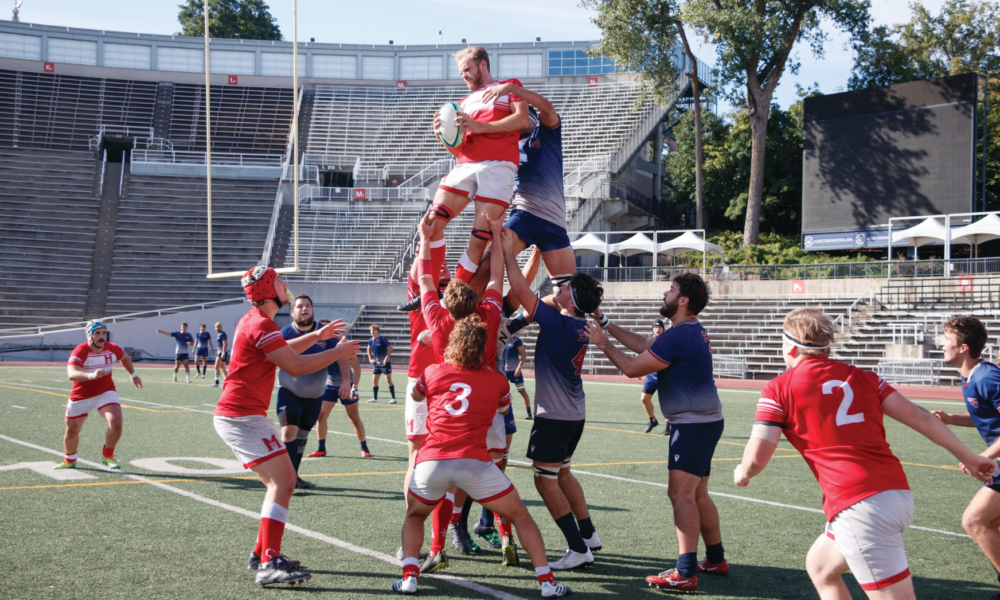
After a dominating 77-3 victory over the Carleton Ravens in their Réseau du Sport Étudiant du Québec (RSEQ) season opener, the McGill Redbirds rugby (1–1) faced off against the École de Technologie Supérieure (ÉTS)’s Piranhas (2–0) on Sept. 16 at Percival Molson Stadium. In a hard-fought match, the reigning RSEQ champions were unable to repeat the offensive prowess of their first game, falling to the Piranhas with a final score of 20-3.

The midday sun burned hot and bright as the teams took to the field for the game in front of a rowdy crowd of 925 attendees. The game started on a rough note for the Redbirds as the Piranhas scored their first try and secured their conversion for a five-point lead just three minutes into the game. However, soon after, McGill outside centre Martin Laval successfully converted a penalty kick to make the score 5-3. The Redbirds’ efforts were not enough to keep ÉTS from advancing their lead—the opposing team’s successful penalty kick put the score at 8-3 by the end of the first half.

At the start of the second half, both teams hit the field with renewed energy. As the sun began its descent toward Mont-Royal, the Piranhas extended their lead with a pair of tries and a successful conversion. Though McGill’s forwards took valiant attempts to break into the ÉTS try zone until the final moments of the game, ÉTS displayed solid defense and prevented the Redbirds from scoring a single try. 

The atmosphere at the stadium grew tense as several physical altercations between McGill and ÉTS outside of play sparked cries of protest from the crowd. In a post-game interview with  //The Tribune//, head coach Ian Baillie explained that the aggression displayed during the game was nothing unusual, but that ÉTS used it strategically to slow the pace of play. 

“We play a hard sport,” Baillie said. “Very, very physical. There might be a push or shove here or there just guys trying to take advantage or exert a little authority [….] To [ÉTS’s] credit they were able to slow the game down a good bit when they were in the bin, so good on them for that.”

In McGill back row Ian McDowell’s opinion, the loss will not stop the team from achieving their goals of winning the provincial RSEQ championship and qualifying for the national championships, just as they did in the 2022-23 season.

“Obviously we’re driving for an undefeated season, but we didn’t do it last season, and we just got better and we finished really high, right?” McDowell said. “It’s a blip in the season, it just means we need to get back to practice, work hard, and work from here.”

McGill flanker Dakota Stevenson also spoke of the loss to ÉTS in reference to their 2022-23 season to highlight that the team can still succeed through hard work and practice. 

“We had a historic year last year and we lost a game we should’ve won early on in our season,” Stevenson explained. “All we got to do is take this on the chin and improve. Sometimes the best teams need to lose together to achieve their goals.”

McGill will next play University of Ottawa (1–1) on Sept. 24 at Matt Anthony Field.

Moment of the game:

Midway through the first half, Laval captured the ball from an ÉTS kick and ran it up the sideline, swiftly dodging several of the opponent’s defense to emphatic oohs from the crowd. 

Quotable:

“I don’t think this changes anything. Our goal is always, finish [on] top [….] This may affect our standing, this may affect how we place at the end, but it doesn’t change our end goal which is winning RSEQ again and going to nationals.”

–– Ian McDowell on how the results of the game impact the team’s goals.
Stat Corner: Three yellow cards were issued throughout the game, all of which went to ÉTS.

Editorial, Opinion

The CPC’s fear and hate cannot dictate federal policy

On Sept. 9, members of the Conservative Party of Canada (CPC) voted to approve a handful of new socially conservative policies, meant to levy an attack against so-called “woke ideology.” Though in recent years the right have co-opted the term to refer to anything they dislike, the term “woke“ initially signified the need for Black Americans to stay aware of police brutality, racially motivated violence, and the dangers of white supremacist North America. Focusing on transgender health care, vaccine mandates, and “race-based” hiring, the CPC’s policies call back to the age-old rhetoric of “protecting our kids.” This thinly-veiled attack on some of Canada’s most vulnerable communities only shows that the Conservative Party has no qualms with promoting fear and hate.

One of the party’s biggest proposals is limiting access to transgender health care for minors, citing a lack of maturity and a false narrative about detransitioning. This fear mongering inherits the hate of older right wing movements, where adults have used children in opposition to human rights, as racist, classist, and homophobic symbols of innocence. To protect themselves from the freedom of others, conservatives have consistently silenced children and exploited their image to support their agenda. The ‘Save Our Children’ movement, for example, launched in Florida in the 1970s as a counter to the gay rights movement, and attempted to conflate the queer community with sex offenders and pedophiles. 

We must recognize the long-established history of transphobia and its underlying misogyny to understand the new policies CPC delegates agreed upon. Oftentimes, transphobia centres around questions of who is allowed to be a woman. Policies that target trans women, such as bathroom bills or testosterone limits in sports play into the broader conservative agenda of controlling women’s bodies. 

In their attempt to do away with all vaccine mandates, the Conservatives argued that Canadians should have bodily autonomy––an idea that contradicts their other attacks on individual choice. Ironically, vaccine mandates are inherently about group immunity, public health, and protecting the immunocompromised, while gender-affirming care does not directly affect anyone except for the individual receiving it. In fact, it can be extremely dangerous to deny people gender-affirming care, putting an already-vulnerable group at even greater risk.

In pursuing a political agenda that puts an end to race-based hiring policies in federally funded jobs––agreed upon by 95 per cent of the caucus––the Conservatives purposefully ignored Canada’s history of settler colonialism and racism, and provided companies a legal way to continue in their bigotry. People of colour in Canada have been historically excluded from many of these spaces, and taking away policies made to restore justice will only reinforce inequalities of the past. A federal government that is truly representative of the diversity the country holds cannot and will not be achieved unless past harms are not only acknowledged but redressed to create an equitable society. Skipping this step will exacerbate the systemic discriminations that comprise all of our institutions, including prisons, schools, and the workforce.  

However, conservatives are not the only ones to blame. The incumbent Liberal Party, along with the rest of the political apparatus, is not innocent. Staying silent in the face of injustice allows the CPC to build and solidify their harmful agenda. The Liberal Party must look back at the last eight years, which have seen both progress and regression, and recognize that they must continue to fight for rights for all Canadians.  

Canadians must re-imagine their current conceptualization of inclusion into the state, and make their voice heard through the countless ways democracy affords them. Individual action cannot be underestimated any longer when human rights are threatened: Individuals must take to the streets, write to their Members of Parliament, and use their vote to defend their values. 

Forgetting the power students hold is easy, but change can be made anywhere they are ready to make it. Within the McGill community, supporting and participating with queer and trans groups on campus is an important first step toward working alongside marginalized people. It is time we take up, protest, and speak out—in order to move toward liberation for everyone.

Off the Board, Opinion

Filling the massive hole in my life left by 15 years of competitive sports

There are many different ways to cope with anxiety. Some go for runs, others meditate––I tryout for sports teams.

Until the fall of 2020, I was never an anxious person. Between the baseball diamond, the hockey rink, the gym, and the classroom, my day provided no break to dwell on my lack of social life or post-undergrad plans. Even in the odd moment where I mulled over my future, there was always one certainty I could look to for comfort––that I would play a sport in university. 

In my younger years, I thought I would play Division I hockey in the States, just like my dad did at Dartmouth. When I stopped taking hockey as seriously and began to focus on baseball in 10th grade, I transitioned to thinking about small Division III liberal arts schools in New York. In grade 11, I became more realistic and began considering my options to play at Canadian schools. But I was met with an unanticipated twist: Playing a male-dominated sport had become more of a chore than a pleasure. I no longer wanted to play baseball in university. 

Grade 12 was dedicated to making friends, playing on every sports team my school offered, and anticipating the day I would move into my dorm at McGill. But that day never came. Instead, I spent a year living at home, watching burnt-out professors through a screen and debating what school I would transfer to so I could play softball. 

No part of me wanted to play softball until the slowness of late 2020 settled in. The rise of COVID-19 cases and the inability to connect in person left me fearing what was to come when I moved out, with no team sport to ground myself in. I emailed the coach of the University of Toronto softball team, and explained how well I thought my baseball history and natural athleticism would transfer. He told me I had a spot on the team––provided I actually switched schools. Obviously, I didn’t. 

Shortly thereafter, I reached out to the McGill rowing coach, who happily told me they would be restarting their novice team once COVID-19 restrictions relaxed. I had only rowed for a few weeks when my dad thought that rowing crew was the solution to my post-quitting-the-sport-you-love anxiety. I never ended up trying out for the rowing team, but the comfort of knowing I had the option soothed me. 

In the weeks leading up to moving to Montreal for my second year, I had never been more anxious. My roommate went to Concordia and I had no idea how to find my place in a new city. So, naturally, I tried out for the women’s hockey team. 

I didn’t make it––an unsurprising result given I hadn’t played competitive hockey in three years––but it reminded me that the solution to my lack of belonging in my early months at McGill was to find a team. So, I joined the intramural free-agents Facebook group and made myself a hockey team filled with players who were much better than me. We won two mugs in the three seasons we played together. I also joined an intramural ultimate frisbee team organized by my cousin––we went on to win a mug in our first season together. 

It turned out winning wasn’t enough, and I found myself trying out for McGill’s golf team at the start of my third year and the ultimate frisbee team at the start of my fourth––both successful endeavours (what can I say). Clearly, there is something in trying out for a varsity sports team that calms my pre-fall-semester anxiety. If filling the void left by playing competitive sports for 15 years is something I’m forced to do for the rest of my life, trying out for a new varsity sports team every year really isn’t so bad. And now that I have realized how much I enjoy it, there is a world of opportunity for the impending varsity tryout leading into my final year at McGill––the real puzzle will be coming up with a new coping mechanism for when I graduate. 

Arts & Entertainment, Internet, Pop Rhetoric

How “girl dinner” could fight the patriarchy

Content Warning: Discussion of disordered eating

“Girl dinner,” a recent TikTok sensation, reveals what’s lurking in the backs of refrigerators and cupboards at dinnertime when you have procrastinated grocery shopping. An experience resonating with people of all genders, it shows creators poking fun at makeshift meals. While “girl dinner” started as a simple internet trend, it has led to spin-offs such as “girl math” and, intriguingly, “girl hammers.” It also raises questions about the immediate popularity of a simple (and controversial) label, especially now that people are starting to move away from a reliance on gender-based speech. 

“Girl dinner” originated from a TikTok posted by user Olivia Maher on May 12, 2023. In her simple meal of bread, cheese, pickles, and grapes, she coined the phrase in relation to a “medieval peasant” dinner. Fast-forward four months, and it now denotes a meal consisting of assorted foods requiring little cook time and no advanced planning. For example, my personal “girl dinner” might include hard-boiled eggs, Cheetos, fruit roll-ups, and an apple. Videos of people showing off their “girl dinners” started popping up everywhere. For many, this trend was a way to poke fun at a surprising commonality: Eating whatever is available after a long day of working, studying, or just living. People rejoiced in the realization that others too took off-nights from planning meals and ate whatever fulfilled their immediate needs. 

However, the trend has also met some backlash, as some consider it an encouragement of eating disorders. Critics have noted the unhealthy eating styles being depicted, pointing out they could be used to promote counting calories or limiting nutrition. These are valid points. The key to approaching this with a healthy mindset is to make sure one’s “girl dinner” is nutritionally satisfying, while also recognizing that the trend promotes occasional scenarios rather than a lifestyle.

Let’s get into semantics, though. What do people mean when they pair “girl” with a noun or verb? It can be empowering, such as “hot girl walk,” or reductive like the age-old phrase, “You play like a girl.” While it may appear nit-picky or overly sensitive to critique a phrase made in jest that women around the world use, the meanings behind and consequences of gender-specific language should always be analyzed and critiqued to avoid misogyny.

Another example is the now-viral “girl math,” which originated from a New Zealand radio show, “Fletch, Vaughan, & Hayley.” “Girl math” entails justifying the purchase of exorbitantly priced items by estimating how many times it may be used or how a person may be saving in other ways. “Girl math” has no real rules, but rather rationalizes purchases otherwise considered frivolous. 

The modifier “girl” is reminiscent of roles historically considered “women’s work” – essential tasks deemed mentally trivial but which required ingenuity and resourcefulness. Some people view these non-academic reasonings about how humans actually function as ‘less than.’ This also ties back to women when one considers the traditional roles women inhabited in the domestic sphere.

These alternative “girl” ways of operating push against traditional, often male-dominated, ways of conceptualizing common-day occurrences. Dinner is supposed to be the main meal of the day and requires effort, planning, money, and time to create. “Girl dinner” is more realistic to the lifestyles of time-crunched individuals living busy lives; a “snack dinner” or more tapas-style meal is nutritionally satisfying for the individual and saves time and money. “Girl math” is also practical; if you use an expensive hair dryer every day, then it’s worth the cost. 

These trends aren’t invalid or frivolous. They make use of what people have on hand and represent it in a humorous and self-reflective way. They show the power of alternative ways of thinking. By using “girl” as an identifier, it represents a break from the “normal” approach to an idea.

While using gendered terms is not ideal, as some consider it reductive, it also moves us toward recognizing unconventional approaches to work. So the next time one references “girl dinner” or “girl math,” think of it as a small act of rebellion, toward normalizing resourcefulness in search of social transformation for eating, living, and being.

Commentary, Opinion

New French language funding cannot be a tool of linguistic domination

Tension over the use of French and English is nothing new for the city of Montreal. Decades of disputes between self-appointed defendants of French and those who recognize language laws’ discriminatory nature have brewed a debate so polarized that middle ground seems like a fantasy. Plowing straight through this precarious political territory is French Language Minister Jean-Francois Roberge, who announced on Sept. 1 that Quebec will grant the City of Montreal 1.5 million CAD to improve various programs to promote the language amongst the city’s business community, new arrivals, and young people over the next three years. Balancing calls from the Mouvement Québec français for stricter legislation protecting the French language and human rights concerns from Quebec liberals, this funding, if allocated correctly, could be exactly what the city needs to pacify both sides of the debate. 

Quebec is famous for its distinct character from the rest of Canada. Quebecois culture has allowed Montreal to blossom into the hub for French-language companies and arts including theatre, radio, film, and multimedia. However, more and more anglophones have migrated to the city resulting in it having the highest English-language concentration in Quebec. Due to this, many believe that the French language is at risk of disappearance. With 80 per cent of Quebec’s population speaking French, it is unsurprising that non-French speakers would be attracted to the city where there is the most diversity in languages and the most access to opportunities and services. This makes the targeting of Montreal particularly controversial as some fear that promoting the French language will result in further marginalization of the non-French-speaking population who already face tough restrictions due to the recent passing of Bill 96. Such legislation erases Indigenous peoples and migrants by institutionalizing the assimilation of non-Francophone minority groups. Bill 96 does not offer a helping hand in learning French—it imposes language onto people and walks the fine line of prioritizing language rights over human rights by obstructing access to necessary services for anglophones and allophones. 

However, unlike previous French-language laws that have diminished opportunities for non-Francophones, this initiative is unimposing to English speakers. Instead, the investment aims to provide resources that will smooth the transition to Bill 96 for businesses and provide language programs for immigrants to decrease barriers surrounding employment and education. Speaking French opens up opportunities for higher-level jobs as well as increased chances for placement in French school systems. Having these kinds of support resources for refugees and immigrants could make entering a new city with such a distinct environment less daunting. This funding, though, must also support Indigenous anglophones, by working in tandem with Indigenous language funding initiatives.

Despite the promise of this new investment, the real question lies in whether the programs will allocate the funding according to plan or push for French language domination and further exclusion of non-Francophones.  It is one thing to be proud of a culture and hope that people will continue to celebrate it, but it is another to let the desire to uphold tradition restrict individuals from opportunities through a difficult language barrier. 

Even if all does not go as designed, this new funding will at least serve as a way to avoid more aggressive methods of promoting the French language. With the most recent census showing a slight decrease in the percentage of Canadians who speak French at home, the Mouvement Québec français is advocating more than ever for stricter legislation, claiming the new funding is not a strong enough action. If this funding can curb the intense demands for legislation and offer a more peaceful solution to promoting the French language without increasing monolinguistic oppression, it may just be what Quebec needs. 

Arts & Entertainment, Music

The Tribune has cut off Scooter Braun as their Social Media Manager

Music Manager Scott “Scooter” Braun is notorious for buying his ex-client Taylor Swift’s master recordings in 2019, preventing her legal access to the licensing and royalty rights for music she wrote. When this news went public, Braun’s other famous clients, namely Demi Lovato and Justin Bieber, defended him on social media. Now, it seems that Braun’s reputation is on the line—Lovato and Bieber, as well as Ariana Grande, Idina Menzel, and Carly Rae Jepsen, have cut ties with Braun. These departures all occurred in August, sparking speculation: Is this a case of established musicians deciding to go solo? Or are these the consequences of Braun’s rumoured mistreatment of his clients? 

Despite his public image as the manager of the 21st century’s biggest stars, Braun is believed to be a controversial character in private. Former clients such as Todrick Hall have stated that Braun behaves in a hostile manner to colleagues and clients alike and prioritizes himself and his legacy. He also neglects his clients, not putting in effort to the point where their careers dwindle—such as when Carly Rae Jepsen’s album Emotion was commercially unsuccessful

His feud with Swift has only further ignited these rumours. In her song “Vigilante Shit,” Swift sings, “While he was doin’ lines and crossin’ all of mine/Someone told his white-collar crimes to the FBI.” These lyrics are supposedly about Braun, as he faced a $200 million dollar fraud lawsuit in 2021. Although the case was resolved privately, it has not stopped the widely popular and derisive narrative of Braun’s nature from spreading. In the wake of these separations, Braun’s persona reveals his risky misunderstanding of the manager as a role in a star’s life. When should a manager overtake a star? How far could Braun climb before he fell?

Braun was also Ariana Grande’s manager for a decade, but sources have since revealed that Grande fired Braun for a six-month period following her split from Pete Davidson in 2018. The reason? Braun was intruding in her personal relationships—which seems far out of his job description. A source from Business Insider said that even Davidson was surprised at how much management was involved, because it prevented their relationship from truly getting a chance to develop. Although Grande cited their final separation as “friendly,” Braun’s involvement in his clients’ lives could be what put pressure on other departures. Braun was a “quasi-parental figure” to Bieber, for example, involved in all aspects of Bieber’s personal life, including his relationship with Selena Gomez.

In 2021, Braun sold his media investment company Ithaca Holdings to HYBE Entertainment, known for creating the K-pop group BTS. According to the corporate filing, Braun received 462,380 shares totaling US$86.2 million. In Jan. 2023, Braun was conveniently named CEO of HYBE America—so he doesn’t need to worry about his clients leaving him because of his wealth. He’s even joking about it on X. Braun still has his departed clients on his website though, stating that they are “past and present clients,” which only adds to his ongoing tragedy. 

After Braun denied Taylor Swift the opportunity to repurchase her masters from him, she took matters into her own hands. Swift re-recorded the tracks that Braun bought, and her versions outsold the originals. Coincidentally, after firing Braun, Grande and Lovato are also releasing re-recordings. Grande released a 10th-anniversary edition of her debut album Yours Truly, while Lovato released Revamped, which includes re-recorded rock versions of her songs. Whether these are a nod to the Braun-Swift feud or not, it is exciting to see artists standing on their own, because it appears that a career under Scooter Braun exceeds the boundaries of a typical manager-artist relationship. All cases considered, the nature of Scooter Braun’s celebrity has influenced this decision’s reception and circulation. Most importantly, and luckily for us, The Tribune has separated from him.

Student Life

Bored on campus? Try going to a random lecture

Have you ever felt like you wanted to try out every class McGill has to offer?

If you’re a keener like me, you just spent the first two weeks of school trying out random classes, switching up your schedule so much that you have burnt the Visual Schedule Builder (VSB) page into your screen. You’re desperately scoping out courses that vaguely relate to your program with the hopes that you can get them to count toward your major. The broad nature of Urban Studies is both a blessing and a curse. 

Even outside of add/drop, I love learning, so it only seemed natural for me to accompany my friend to her philosophy class, both out of a curiosity for a topic I haven’t studied since high school and for a lack of anything better to do. This is something I’ve been doing since I was a kid. I sat in on my first random class when I was five years old, accompanying my mother to her dietetics lectures on days I didn’t have school. I still remember learning about the chemical composition of food colouring, curiously watching a blue M&M dissolve into water in a Mac campus auditorium. 

Try stepping out of your comfort zone. 

I decided to sit in on PHIL 375: Existentialism. As I make my way toward the elongated Strathcona lecture room where it’s taught, I find myself discovering a part of campus that is unfamiliar to me. A small anatomy museum neighbours the lecture room, displaying cross-sections of diseased livers and ectopic kidneys. Why doesn’t Burnside, the building I spend the better parts of my day in, have something this interesting?

Class begins, and I am but a lone geographer in a crowd of philosophers. The TA, in lieu of the professor, starts speaking into a microphone that muffles and buzzes with every word she pronounces. She reaches toward the class for interpretations of the assigned text, and with every hand that shoots up, the overachiever in me sheds a silent tear, desperately wanting to participate; unfortunately, I had not done the readings, nor do I know enough about The Death of Ivan Ilyich to say something out loud. 

I resolve to sit quietly and listen. On the screen, the assigned reading was projected big enough to allow me to read excerpts of Tolstoy out of context, like little windows into existentialist literature. I grasped at what I did not understand, wishing I had more knowledge on the topic, trying to make connections with the absurdist literature I loved so much as a teenager. 

If you don’t understand what’s going on, try to see if others do. 

If anything, going to a random lecture can be an opportunity to people-watch. On the last day of add-drop, some students scroll through Minerva, double- and triple-checking their schedules. One person moves classes around on the VSB; another browses the syllabus of a different course. I couldn’t help but wonder if they, like me, would not be back for another lecture. 

Amidst the insightful comments, it felt nice to sit back and reflect, without having to take any notes, simply listening to the content and enjoying the opportunity to learn. Would I say it’s good background noise for doing work or catching up on readings? No, not really. If you can separate yourself from the discussions going on around you, maybe. But I always like to listen. I’ll probably keep going to random classes this semester, even if I don’t have to write a piece on them. What can I say? I’m a keener. 

Arts & Entertainment, Books

Roll Out the ‘Rouge’ Carpet: Mona Awad’s Newest Gothic Fairytale is Here

Conversations buzzing, drinks flowing, and books in hand, eager readers livened the Mile End’s beloved bar and venue La Sotterranea on Wednesday, Sept. 12. Here to celebrate the launch of her new novel Rouge, Mona Awad stepped out onto the stage alongside interviewer Heather O’ Neill. Awad’s sparkling, Dorothy-esque red heels tapped away on the stage as she walked, and I knew from that instant that Awad’s creativity and ingenuity go far beyond her writing; her storytelling extends to the reality in which she lives. 

Mona Awad, author of 13 Ways of Looking at a Fat Girl, All’s Well, and her most well-known piece of work, Bunny, has distinguished herself by her sharp, witty commentary in the midst of intricate and thrilling storylines. Her conversational partner for the night, O’ Neill (BA ‘94), is an award-winning Canadian author known for her short stories, essays, and her recent release, When We Lost Our Heads

Bunny quickly rose to fame after its publication in 2019, receiving praise from Vogue, the ScotiaBank Giller Prize, and TIME magazine. Earlier this year, it was optioned by J.J. Abrams’ production company, Bad Robot. And production company Fremantle and Sinestra is currently optioning her newest book, Rouge, prior to the release of the novel. 

As she introduced Awad, O’Neill described her writing as loud and full of risks. In Rouge, Awad uses the fairy tale structure as a stylistic device to explore desire and give voice to powerlessness. Drawing inspiration from Snow White, Awad explores themes of colourism, existentialism, and soul exploration in her clever and fascinating modernization. The book begins with  the lead character Belle, a dressmaker, moving from Montreal to Los Angeles following her mother’s mysterious death. On a search to find answers, Belle finds herself entranced by a cult-like spa, promising unique solutions to achieve an eternal glow. The story analyzes a culture that is hypnotized by youthfulness and external beauty while keeping the readers invested in the characters’ fates.

When Awad began writing this piece, she immediately knew that it would be called Rouge. In fairytales, the colour red represents warning, Awad noted. She further stated that the colour red, or “Rouge”, informs the tone of the story. In the novel, she touches on Disney’s literalization of Snow White’s purity by associating it with her pale skin. In a culture that is built on eurocentric beauty standards, Awad writes on the struggle of young women of colour in seeing beauty when looking in the mirror. Dichotomous themes of enchantment versus envy, and hopefulness in contrast to powerlessness are embodied in this work. 

The voice of reason within this bizarre yet fascinating modern twist of a tale is Awad’s commitment to honesty within each piece she writes. When asked about her relationship with the main character Belle, Awad notes that no piece of her work could be written without a part of herself attached to it. In this novel, the main character “Belle” shares Awad’s half-Egyptian heritage, suggesting an autobiographical reinterpretation of her own struggles in her gothic yet playful fairytale. In All’s Well, the main character suffers with chronic pain, something that the author has spoken about in her real life as well.  

At the end of the night, I lined up to meet Awad and have her sign my copy of Rouge. Next to the signing, the artist No Joy played on stage, performing a psychedelic, shoegaze, dreamy mirage of a set. In a trance-like state after giving Mona Awad my pen when hers dried out and experiencing an extremely intimate conversation about beauty and colour, I walked out of the room feeling slightly more seen and slightly more hopeful. In a reality which is sometimes difficult to navigate, Mona Awad and her novel provide a brilliant and honest escape to a world that strangely mirrors our own. 

Read the latest issue

Read the latest issue