Latest News

Ask a Scientist, Science & Technology

Where nature meets technology: Machine learning as a tool for climate action

With the dangers of continued fossil fuel use and environmental mismanagement unfolding before our eyes in the form of intense heat waves, droughts, and wildfires, it’s obvious that dramatic, transformative action must be taken.

Throughout the pessimistic debate about the effectiveness of climate change policy and methods of pollution mitigation, almost every solution under the sun has been proposed. Some have suggested the widespread use of carbon capture technology, while others, like Boyan Slat, have developed ways to remove garbage from our oceans. But one technology has the potential to revolutionize climate action: Artificial intelligence (AI).

In a recent paper spearheaded by professor David Rolnick of the Department of Computer Science, researchers studied the application of machine learning to climate science in great detail. Each section of the article explored a specific sector—including electricity, industry, or infrastructure—and explained the ways machine learning could be used to reduce the sector’s impact on the climate. 

Machine learning is an offshoot of AI. While the aim of AI is to develop computers that can “think” like a human, machine learning is more about training computers on experiences and data to recognize patterns and make decisions.  

“Machine learning is looking at large amounts of data, finding the patterns that are common across that data and linking those to what the algorithm is asked to do,” Rolnick said in an interview with The McGill Tribune.

Uses for machine learning fall into a few categories, according to Rolnick: Monitoring, optimization, simulation, and forecasting. Take, for example, how forecasting can be applied to the study of electricity.

“Machine learning is used to predict the amount of electricity that will be in demand at a given point in time so there is enough supply to meet that but not more than there needs to be,” Rolnick explained. “Understanding how much power is needed and how much power is available is important to make sure the grid is running effectively and without waste.”

Since AI cannot plant trees or pass legislation, its practical application may seem abstract. However, its effects are tangible: AI has been used to increase crop yield in India, improve electricity efficiency on wind farms by planning for weather, and improve data centres’ efficiency.

“Most of the technologies that I am talking about are at some level of deployment. For example, the U.K.’s national grid has already integrated deep learning models into forecasting supply and demand of electricity and has greatly increased efficiency as a result,” Rolnick said. “The UN uses AI to guide interventions in flooded areas [….] These are not just research projects and it’s fundamentally important.”

Although AI is an incredibly promising technology, there are a couple of drawbacks to be addressed. One of these drawbacks is human bias—since humans write the algorithms and supply the human-collected data to train machine learning, these tools can replicate human biases. To prevent these biases, then, human bias needs to be corrected—there is no software fix. 

“We cannot technology our way out of most biases,” Rolnick said. “The solutions to biases in technology are the same as solutions to biases in any other part of human endeavour. That means they are hard, but they are solvable via human choices.” 

This technology also requires enormous quantities of energy for algorithms to be trained and maintained, but the energy can be minimized by designing efficient algorithms and planning applications carefully. 

“It’s also worth noting that most of the negative climate impacts of AI globally come from how it is used, not the direct energy consumption,” Rolnick wrote in a follow-up email.

Although machine learning models can be quite energy hungry, the models Rolnick uses are not exceedingly energy-intensive. With careful planning, scientists hope that the emissions benefits from these models outweigh their energy consumption.

Student Life, The Viewpoint

Handwritten vs. typewritten: An argument for the old-fashioned way

Picture this: You’re in a classroom, looking alive as the lecture drones on. About half of the students, typing their notes quickly, seem to be outpacing those who choose to write the old-fashioned way. Where do you stand in this faultline?

The sea of laptops that flood most lecture halls today tells us that typed notes are the obvious choice for most students. By the numbers, notetakers on their laptops or iPads take the lead—writing notes by hand reaches a meagre average of 13 words per minute, while typewriting allows for an average of 40 words per minute

Clearly, the speed and efficiency of typewritten notes make it easy and uncomplicated to summarize a lecture; however, being too comfortable with easy approaches to studying can dilute active involvement in your own education. Typewriting can be a double-edged sword: On the one hand, it allows you to copy everything down efficiently, but on the other, it enables mindless transcription without you processing the content. Although taking notes by hand is more work, here are a couple of reasons why you should give it the “old college” try. 

Staying focused in class

Resisting the urge to doze off in class can be a real battle, but it’s no easier when you get email notifications or have to fend off the urge to scroll through Twitter on your laptop. 

Cella Wardrop, U1 Arts, explains that she writes on paper as a way to keep herself attentive in lectures.

“For me, writing [by hand] is more of a tool for paying attention in class. It does seem like taking notes on a computer is a little distracting,” Wardrop said in an interview with The McGill Tribune.

Signy Sheldon, professor of psychology and the head of McGill’s Sheldon Memory Lab, explains that having distractions available to us in our learning environment can make paying attention more taxing. 

“Laptops are so many things to us; they’re entertainment, they are social, and they’re also used for our work and school. So, if you are on your computer taking notes, you might think that ‘Oh, it’s okay if I stop and use this device for its other functions, I might check what’s going on in my email, or look at social media,’ and offering that distraction can really be harmful,” Sheldon said.

“So, not only are you distracted, but the fact that you know that those other functions are there in your computer means that you have to inhibit that information and that requires a lot of cognitive processes and it takes away from paying attention to your lecture.” 

Not only does the temptation to check your inbox on your device affect your attention, but distractions out of your control—like looking over a classmate’s shoulder at their online shopping—throws off your focus during lectures. Although it is impossible to eliminate all distractions from a lecture hall, you can minimize them by taking notes by hand. 

In an interview with the Tribune, Jessica Taylor, U1 Arts, discussed her experience with a professor who prohibited devices from her lecture hall, forcing students to try their hand at pen and paper note-taking. Creating a device-free environment had a positive effect on Taylor’s overall concentration. 

“I feel what made [a device-free lecture hall] less distracting was that it was a unanimous thing.” 

Importance of meaning in note-taking

The benefits of handwritten notes go further than just heightened concentration in class, with psychological evidence that handwritten notes may help you cut down on review outside of lecture hours. Sheldon says that due to the levels of processing model, a theory stating that the depth of processing during encoding affects your retention of that information. 

“When you’re studying or learning something, you want to process that information at a deep level,” Sheldon explained. “When you connect it to things you already know, you’re going to form a stronger memory, and you’re going to be able to retrieve it more easily during an exam or later on.”

Typing the lecture slides verbatim is an example of shallow processing, a superficial method that observes surface-level material but does not account for meaning. On the other hand, having to summarize the lecturer’s information into handwrite-able bites of information allows for deeper processing—you are adding meaning to the lecture content at the moment of encoding. According to the levels of processing theory, remembering what happened in class should be easier for deep, meaningfully processed information compared to shallow information. 

“Often, when you’re taking notes by hand, [you] will connect what is being said […], or you will interpret what’s being said with your own language and with your own knowledge. So you’re more deeply encoding that information,” Sheldon said. 

A little extra effort to take handwritten notes in class may help shave time off your exam review––more time at the end of the year for the activities that might have distracted you otherwise. 

The embodied experience of handwriting

Anyone who cares about typography knows about the connection between the body and the text. In the shallower processing of typewritten notes, the kinesthetic motion of forming letters by hand versus tapping keys creates a significant advantage. Isabel McQuilkin, U1 Arts, who takes handwritten notes throughout all her classes, suggests that the physical experience of writing notes by hand comes in handy when reviewing a lecture. 

“I feel like I remember the information better when I am physically writing it out. I like that I can colour-coordinate and visualize what I’ve just learned,” McQuilkin said. “By writing each individual word, I can kind of remember how it felt when I was writing it.”

McQuilkin can use visual and somatosensory tools from her written notes to help her recall content, asking herself what the word started with or how it felt to write out the letters by trying to visualize her lecture notes. 

Sheldon echoes the embodied aspect of handwritten notes: “[If taking typed notes], I would be concerned that you’re engaging in more habitual forms of memory, rather than if you’re writing or taking notes in which you have to slow down.”

While typing gets the information down (a legitimate benefit), tapping keys does not create mental connections like forming letters by hand can. Habitual memory is a physical or mental skill that does not require conscious thought, like riding a bike. So, as your professor lectures, you can transcribe what they are saying without thinking about the meaning behind it. By hand, though you can also reproduce your professor’s exact words, you can’t keep it up for anywhere near as long as typing before resorting to summation. This critical difference distinguishes students who leave the class clueless from those with a solid understanding of the material.

While taking notes by hand may be an adjustment, it is worth trying out. Although parting ways with typed notes may feel unfathomable, the extra effort in lectures will pay off when exam season rolls around.  

“My suggestion is during a lecture, instead of splitting your time between trying to furiously write down what’s being said,” Sheldon says, “listen to what’s being said, take selective notes, and then the key is what you do after with the knowledge you get from that lecture.”

Features

Vive le Québec multilingue

Living in Montreal certainly has its perks. The city is home to multiple world-renowned universities, Michelin star-worthy restaurants, countless museums, a great nightlife scene, and, perhaps most importantly, a mosaic of diverse cultural communities. The island has historically and continuously been a landing spot for immigrants from across the globe: Around 150 languages are spoken across the city, and over 200 religions practiced. Its multicultural and multilingual character is visible in the numerous cultural festivals celebrated throughout the island, from the energetic Carifiesta to the colourful and vibrant Holi, and it resounds in the array of languages spoken by its residents, from the grocery store to the metro.

Born in Montreal, I was raised to be bilingual. My parents, although anglophone, tried their best to speak both English and French with my sister and me so that we would grow up with the set of tools becoming progressively more important in Quebec. Being able to speak French was something I always took for granted; I didn’t learn it because I wanted to, but because I had to. Now as an adult, though I am much more appreciative of my grasp of the French language, I am equally plagued by an ever-increasing sense of dread as I watch some of my friends contemplate leaving this beautiful city due to its repressive language policies.

I do not blame those who wish to leave. Thanks to Quebec’s government, this province that so many of us call home is becoming increasingly hostile towards those who don’t speak French. Premier François Legault and his cabinet have introduced a slew of legislation that strangles the human rights of linguistic minorities in the province.

One of the Quebec government’s most recent—and perhaps egregious—acts was the adoption of Bill 96, an amendment made this past June to the already controversial Charter of the French Language (1977). The Bill, which many activists have vehemently opposed, limits the use of English in public services and courts of law, grants language inspectors powers of search and seizure without warrant, caps enrollment at English CEGEPS, and imposes stricter francization requirements for businesses with 25 to 49 employees. Under these new regulations, businesses must serve their customers in French, ensure all public signage in non-French languages is less prominent than its French translations, and present all hiring documents in French unless otherwise requested.  

The effects of Bill 96 on language education at the CEGEP level threaten not just anglophone rights, but multilingualism’s ability to thrive in the province. Starting next fall, students without English eligibility certificates will have to take a French exam to graduate, meaning that their courseloads will be more French-heavy. Teachers and students at Vanier College, an English-language CEGEP, spoke to CBC recently about their fear that other language courses will slowly be pushed out of the curriculum, and those seeking to reconnect with heritage languages may not get the opportunities they once had. 

The addition of required French courses at the CEGEP or junior college level is particularly detrimental to  Indigenous students’ access to higher education and academic success. The Bill will worsen the Quebec government’s continued neglect of Indigenous leaders’ calls for the decolonization of the Education Ministry’s pedagogical curriculum and preservation of Indigenous culture and languages.  Because many Indigenous students are already bilingual (mother tongue and English), the burden of having to master a third language can be  taxing and weaken their quality of education and academic performance. 

The government’s introduction of Bill 96 reveals a glaring neglect of the province’s linguistic diversity. Despite how much the Quebec government likes to proclaim that the French language is under attack, they often do not tell the whole truth. Recent statistics show that the proportion of French speakers in Quebec fell between 2016 and 2021 from 79 per cent to 77.5 per cent, while the proportion of English speakers rose from 12 per cent to 13 per cent. These findings are the product of a biased census, in which people who identified English as their mother tongue were lumped together with people who have multiple mother tongues, including but not limited to French. This skewed the results to propagate the victimization of the French language. The census also focused overwhelmingly on Montreal residents, which tends to be more anglophone or multilingual than cities such as Quebec City, or suburban areas throughout the province. Recent research by Jean-Pierre Corbeil, a sociology professor at the University of Laval, however, concludes that the typical categories used to measure language identity—mother tongue and language spoken at home—insufficiently capture the multilingualism of linguistic environments such as Quebec. As most Montrealers know, the boundaries of language use are not so clearly divided in daily life. 

By focusing on the false narrative that the French language is under threat by immigrants, Legault’s government ignores the actual socio-economic conditions required to learn a new language. 

Jessie*, a master’s student in psychology who is originally from India, could not find the time to study French while balancing her academic responsibilities. 

“I did French in high school, and I did it because I really loved the language, but that was six years ago and I lost most of it after finishing [high school],” Jessie said. “Here in Montreal, I tried picking French up again [but] during my master’s I simply didn’t have time to take classes.”

Learning a language can be a full-time job in and of itself, requiring long hours and hard work. When an international student or immigrant packs up their belongings, moves away from their family, and settles into a new environment, time constraints on learning a new language should not be added to the duress of survival. Bill 96’s language regulations on businesses exacerbate the barriers international students and immigrants face when job-searching, compounding financial and mental strains. Shruti Kumaran, a master’s student in physical therapy at McGill, who also moved here from India, has yet to find any part-time work in Montreal. 

“My parents had to take a loan to help me pay my tuition […] it’s ridiculous how expensive it is for international students, on top of having to pay for housing, food, and so on,” said Kumaran. “I wanted to work part-time here to help cover some of the costs, or at least to help pay my parents back, but I don’t speak French, which has made finding a job almost impossible. Part of me regrets moving here when I could have gone somewhere like Toronto… or Vancouver even.”

Newcomers’ relationship with French is also negatively influenced when attempts to engage with the language are met by xenophobic remarks and overt micro-aggressions.  

“I was waiting for the bus once when I had an older lady approach me and she started talking to me in French,” said Jessie.  “I told her ‘Anglais s’il vous plaît’ and ‘Je ne parle pas le français’. I was being very kind […] she kept asking me why I’m not learning French […] I said sorry and she just rolled her eyes and sighed, and gave me this disappointed look as if there was no point in talking to me.” 

Unfortunately, this is not uncommon for non-French speakers to experience, and in a culture where our own government is actively trying to discourage multilingualism, incidents like Jessie’s may only become more frequent.

One of Jessie’s other French experiences with strangers demonstrates the alternative. Instead of treating others with a passive-aggressive air of linguistic superiority, the government should encourage  the embrace multilingualism with patience and compassion. 

“I remember once I had to call H&R Block, and the woman on the phone spoke in French to me,” Jessie said. “I speak very little French and she spoke very little English, yet we had this cute little moment of trying to communicate, and she was encouraging me in a very patient way which was a pleasant change.” 

But as hopeful as this interaction was, Jessie is now planning on moving to Toronto, as they would need to pass a French exam to be able to practice counselling in Quebec. 

In addition to Bill 96’s regulations, those who wish to move to Quebec permanently must obtain a Quebec Selection Certificate (CSQ), which is dished out by the Ministry of Immigration, Francisation and Integration. One of the requirements for obtaining a CSQ is, unsurprisingly, a demonstration of proficiency in the French language. With many choosing to settle in other provinces instead, sociologists and politicians alike have raised concerns about Quebec’s “brain drain”, as talented and educated individuals who contribute to the province’s economy and society are leaving en masse to avoid the cultural asphyxiation caused by Quebec’s French legislation.

Nishanth Manickam, a third-year student at Concordia, was born and raised in Montreal. As his parents immigrated here from Sri Lanka and do not speak French, he fears that Bill 96 will make life in Quebec increasingly difficult for them. 

“Both my parents and grandmother speak Tamil and a bit of English, but they’re not able to communicate or understand French,” Manickam said. “Bill 96 is kind of scary for them because they feel as if they will not be able to live in this province comfortably […], especially in terms of legal proceedings and health care, they would prefer to have the freedom to choose which language they use. This fear has led to them wanting to move to Toronto with the rest of our family because they are more accepting of English speakers in Ontario.”

Nishanth’s family settled in Dollard-des-Ormeaux, home to a sizable Tamil community. The temple he frequents is close to his house, where he has come to know some of his neighbours.  He worries that should he and his family move to Toronto to avoid the language laws here in Quebec, he will be alienated from his religious and cultural community in the neighbourhood. 

“There are a lot of Tamil people in Toronto too, but it would feel like we’re starting all over and we’d lose touch with the community here that we’ve been a part of for so long,” Manickam said. “I make a quick visit to the temple every day before I go home. I sit outside in my car and pray and it’s something that means a lot to me. It gives me hope even when everything seems to be going wrong. From a young age, my parents have tried their best to make sure that I don’t lose touch with the Hindu and Tamil cultures and I feel like I’ll do the same with my children.”

Nishanth is just one of many who take pride in expressing their heritage across the vast multicultural landscape of Montreal. But, like many, he has serious concerns about the growing intolerance towards those who do not fit neatly into Quebec’s predetermined francophone identity. 

Jessie, Shruti, and Nishanth’s experiences show that a coercive approach to “protecting” the French language like Bill 96 does not actually give non-French speakers the capacity to learn the French language healthily and productively, but rather pressures them into doing so by taking away their access to essential public services and job opportunities. This most often affects low-income immigrants and Indigenous peoples, forcing them to sacrifice their cultures and communities or establish their future elsewhere. 

We should not buy into the government narrative that English and French are in  competition for linguistic supremacy. The real-life linguistic habits of Montrealers cannot be categorized into strict unilingual boxes and, by doing so, we threaten to erase the multilingualism inherent to Montreal’s history and interconnected society—in turn, forcing important community members out of the city. Non-French linguistic communities across the province do not degrade Quebec culture—they enrich it, and remain an integral part of what makes us Quebecers.

*Jessie’s name has been changed to preserve their anonymity.

Montreal, News, The Tribune Explains

Tribune Explains: Doing taxes as a student

Tax season is in full swing and the May 1 deadline to file is fast approaching. Typically, the deadline is April 30, though this year it falls on a Sunday, giving taxpayers an extra day. In an attempt to make the process less stressful, //The McGill Tribune// compiled answers to frequently asked questions and a list of resources offered by McGill.

How do I file my taxes?

While filing taxes varies from case to case, there are some general rules to follow. Anyone with an income must file taxes. Before starting, anyone filing a tax return needs to have certain forms on hand, such as a T4 from their employer or T2202 from their educational institution, their Social Insurance Number (SIN), and other personal details, like an address. 

For students working in Canada, filing taxes is not only a legal obligation but also an opportunity to get tax refunds, which come from the money that is deducted from paychecks when initially issued. Employers are meant to issue both federal T4 forms and the Quebec provincial equivalent, Relevé 1 forms, to their employees. Workers should receive these forms in February from every one of their employers over the past tax year. 

Another common tax form for students is the T4A slip. These are issued to students who received scholarships or bursaries. T4A slips, Medical Insurance Receipts, Relevé 8 forms, and T2202 slips are all tax documents that can be accessed by students through Minerva under the Student Accounts tab. 

Once all the forms are in order, it’s time to file. Taxes can be filed either online or on paper, but the Canada Revenue Agency (CRA) recommends filing online, which requires a CRA-certified tax software like TurboTax or H&R Block. Residents of Quebec have to file both federal taxes to the CRA and provincial taxes to Revenu Québec.

If doing your own taxes is too overwhelming, you have other options. Students can authorize a parent or representative to do their taxes for them. In addition, many students may be eligible to get their taxes done at free tax clinics. These clinics are organized by the Income Tax Assistance Volunteer Program and can be walk-in, drop-off, or by appointment.

What kinds of deductions or credits can I get as a student?

Taxes are notoriously complicated and it can be difficult for people with low incomes, such as students, to maximize their tax returns and save money. When filing taxes, students can consult Revenu Québec’s website to find student-specific information regarding tax credits and deductions.

Depending on a student’s individual situation, they may be eligible for credits such as the federal Goods and Services Tax Refund or the Quebec Solidarity Tax Credit—both are issued quarterly to those who qualify. Deductions can be claimed for certain student-related costs such as moving expenses, tuition costs, or interest paid on student loans. 

Students with no income or people making money that is non-taxable are not required but are encouraged to file a tax return because of potential income tax refunds. In some cases, as with the GST credit, students can have no income but still get money back from the government.

What should I know if I am an international student?

Taxes in Canada are dependent on residency, not citizenship. As such, international students who work must file taxes in Canada. Just like Canadian students, international students can benefit from filing taxes even if they have no income. One benefit is a tuition credit which can be carried forward, reducing the amount of taxes that one owes in future years. Tuition credits can also be used by Canadian students. 

International students should also keep in mind that they have to declare any international income, that is, any income that may have been made in their home countries. 

What resources are there for students?

Scholarships and Student Aid, a subsection of McGill Student Services, provides workshops on how to do taxes for both Canadian and international students. For international students, International Student Services (ISS) has lists of resources that can be consulted.

Aside from McGill resources, the CRA has a step-by-step guide, including videos, which explains the details of filing taxes.
Financial savviness underlies much of the taxing tax reporting process. While people in higher income brackets have more access to help such as personal accountants or financial assistants, students often have to figure it out for themselves. To help, the Scholarships and Student Aid Office also offers workshops on budgeting and general financial literacy.

Ask a Scientist, Science & Technology

Pushing back against anti-Blackness to improve health for all

In the realm of public health, researchers and health practitioners are reckoning with the pervasive anti-Blackness in the global health community and how it impacts the health policies, quality of care, and well-being of people around the world.

In Fall 2022, Dr. Madhukar Pai, a professor at the McGill School of Population and Global Health and associate director of the McGill International Tuberculosis (TB) Centre, attended a tuberculosis conference in Nairobi, Kenya. He and his co-editor-in-chief of the PLOS Global Public Health journal, Dr. Catherine Kyobutungi, hosted a panel on anti-Blackness in global health. Following the panel, several of the researchers who participated penned an opinion article with the hopes of combating the pervasive anti-Blackness in public health research.

Doctors Marie-Claire Wangari and Samuel Oti, physicians and global health advocates from Kenya, participated in the panel and co-authored the subsequent article, published in PLOS Global Public Health

“We define anti-Blackness [in the article], but at the heart of it is the hierarchization of races driven by the Western hegemony that places Black people at the bottom of humanity’s food chain,” Oti said in an interview with The McGill Tribune.

Wangari and Oti expose the reality that global health, from colonial times, to the early 1900s, to now, is structurally anti-Black, and centres on Europeans with power and privilege.

A long-standing issue in global health is the visa apartheid that impacts potential conference attendees, especially anyone from Nigeria, Ethiopia, Kenya, and other African nations. Already, fundraising for a visa application is challenging because a visa application to Canada costs $100 CAD and the entire biometrics, travel fees, and online applications can cost upwards of $1,100

“Practical examples include the persisting issue of visa discrimination to attend global health events such as the IAS [International Aids Society Conference] in Montreal and the HSR [Health Systems Research Conference] in Bogota in 2022,” Wangari told the Tribune

While 58 per cent of HIV incidence globally is in sub-Saharan Africa, many of the primarily Black folks from affected regions are advocating for health equity, but can’t do so at events such as the IAS Conference.

Wangari, Oti, and even their more senior Black colleagues have run into difficulties with visas for conferences.

“On a personal level, my ambitions to hold higher positions in a global medical students’ association faced a premature death,” Wangari explained. Due to her inability to attend international conferences, her experiences were deemed too “Afro-centric,” compared to her wealthier, more well-travelled colleagues.

“At some point, I got so fed up that I called on African experts to boycott global events,” Oti added.

Visa discrimination is not the only way anti-Blackness manifests in global health. Of the seven institutions granted $30 million USD by the U.S. President’s Malaria Initiative in 2021, not a single one was based in Africa. There is also inadequate access to vaccines against viruses such as HPV and mpox (formerly known as monkeypox).

“Africa is the only continent where [mpox] has been endemic for years,” Wangari said. “However, when there was an outbreak, the priority countries to get the few vaccines available were the countries that had the financial muscle to purchase them.”

Given these deeply entrenched power asymmetries, there is a growing call to decolonize the global health and development sectors. 

“As individuals, we might not have sufficient power or influence to change things. However, as a continent, we are over one billion people strong. That is why I appreciate and support [the] Africa CDC’s call for a New Public Health Order.”

-Doctor Samuel Oti

Africa’s New Public Health Order calls for capacity building for African institutions and health workers, the expansion of locally manufactured health products like vaccines, increased domestic investment in health, and promoting partnerships inter-, and importantly, intra-continentally. 

“As the African saying goes, he who wears the shoes knows where it pinches the most,” Wangari said. “It starts with something as simple as acknowledging that African experts not only deserve to have a seat at the table but also have the expertise to shape health reforms and mutually collaborate as we all work towards health for all.”

Features

Making a new world as we go

In 1960, the Queen of Jazz made a mistake. Performing the song “Mack the Knife” in West Berlin, Ella Fitzgerald forgot the lines. The weight of global expectations stood on her shoulders as one of the first Black women to sing this piece—and in front of a white, international audience, no less. The lyrics failed her––no matter. Error did not create an obstacle, but an opportunity. Mid-tune, she sings, “Oh what’s the next chorus to this song, now?” and carries on with her performance, scatting, putting new words together, and constructing syncopated possibilities from the traces of the song. The show must go on. 

She improvised the rest of the lyrics, belting out her own version with her signature wit, creativity, and self-assurance. At the third-ever Grammy awards ceremony, Fitzgerald would receive two Grammys for Best Vocal Performance Album and Single Record. Interestingly, despite her talent and brilliance in technique, the ceremony categorized her performance as pop, not jazz.

At the end of 2022, the frantic fall semester disappearing from my horizon, I listened to this performance again on Spotify. I wondered how Ella did it and what I could glean from this work. I wanted to dream and improvise my way out of the institutional and individual racism I had faced that semester. The notes and chords of this piece assembled themselves in my hasty composition: Cutting up the constant microaggressions and racist gestures and assumptions, adapting with other people of colour faster than our institutions could erase and exhaust us, and living in unpredictability and inscrutability, beyond our patterns, to evade white supremacy. I asserted this world-making ability of jazz with the Black thinkers I look up to: Toni Morrison, Langston Hughes, and Angela Davis, among many other radicals and jazz artists who move them in tandem. Jazz could move us from the alienation of individual life to the refuge of collective solidarity.

When I spoke with Eric Lewis, a professor of philosophy at McGill and the site lead for the International Institute for Critical Studies in Improvisation (IICSI), he explained that collective jazz improvisation can be thought of as a “listening trust”––a strain of thinking shared by Black feminist theorists like bell hooks.

“When I have trust in my fellow improvisers, that’s the precondition for taking risks. That’s the precondition for making mistakes [….] And for me, what distinguishes an improvising jazz ensemble from being a member of a symphony orchestra is that in the improvising ensemble, I take ethical and moral responsibility for the complete sound structure created,” Lewis said. “I think when I walk off the stage, I am responsible for every sound that was produced, not just my own contribution. I’m not gonna say ‘the oboes: they were off today, right?’ We each are responsible for every sound that was produced. And so there’s a pedagogy of collectivity and trust when it works.”

But I didn’t have the tools––of improvised musical invention. I’m demanding too much on praxis that isn’t actually musical practice, imposing my social imperatives onto a form I not only can’t play but should be approaching with an ethical eye, not an extractive one. I remember my many years playing classical piano, the choice I made for classical over jazz even when jazz aligned more with my interests. I think of the mistakes I made on the small platforms I received, in the competitions I took part in, in Royal Conservatory exams, or when just trying out new pieces. To do what Ella did in 1960 seems, still,  impossible. 

The ethos of jazz could apply to other forms, too: Writing, politics, and resistance. Just as artists can subvert a song that contains white supremacist lyrics (Lewis points me to Nina Simone’s active mash-ups of “My Sweet Lord” and a radical poem by the Last Poets), we could listen, improvise better, and embody resistance in the texts and performances that structure our everyday lives.

Growing up playing classical piano and performing as an improv comedian, these two worlds orbited each other, desperate for contact until my mom, who keeps jazz in my life, told me about Ella’s Berlin performance. This story—that I now frequently think of, repeat, and rework for guidance—reminds me that jazz may serve as a network beyond the limits of our expectations for music and as an insight into what the history of Black (musical) adaptation and improvisation would offer me for the rest of my life. 

If I couldn’t play jazz, then I’d have to actively learn from it. I’d need to model the close listening performed by Black artists in order to foreshadow new political formations, especially across lines of race, gender, class, and sexuality. Discussing Nina Simone’s lyrics and performativity, Bessie Smith’s willingness and vulnerability to talk about Black queer identity, and Jeanne Lee’s experimental efforts to undermine both externally imposed identities and jazz lyrics, Lewis outlined to me how jazz can be a potent site for critical and philosophical work beyond canonical pages. 

“Jazz, particularly collective jazz [and] improvised music is often seen as a crucible for experimentation in new social forms,” Lewis told me. “Because a jazz ensemble, insofar as it’s grounded in community, is a site for coming to discover the other dialogue across various silos or boundaries of difference, and experimenting in new social structures. 

“Music could oppress as well as it can liberate. Jazz can oppress as well as it could liberate. And many vanguard Black women theorists and musicians have done much to critique both of these possibilities, right, and make us aware that it’s not liberatory per se, as much as it has a strong liberatory potential.”

We’re in the city for jazz. Montreal’s internationally-renowned jazz festival brings the best and brightest stars from around the world. But jazz history didn’t just start here with the spectacular—Black people laboured to make their art against the city’s segregation and racial surveillance. The government of Maurice Duplessis revoked the liquor license of Rockhead’s Paradise, founded in 1928 by Rufus Rockhead, a Jamaican-Canadian porter (among other Black, Jewish, and Chinese establishments). This anticipated the passage of the 1937 Padlock Act that allowed the government to close down any establishment––mostly those of Black and racialized proprietors––who promoted and were suspected of communism. We might remember Rockhead’s for how it attracted Fitzgerald, Louis Armstrong, Billie Holiday, and Sarah Vaughn, but we can’t separate it from the long history of state intervention in jazz. Jean Drapeau won an election in 1954 on a promise to clean up the city and with it, take down Black-owned nightclubs and modernize, gentrify, and destroy Little Burgundy. Can we be proud of something that could have been erased?

We went on a family trip to Montreal in 2010. I reminisce on this trip because we met up with my grandfather, who immigrated from Jamaica to study here, to see the Miles Davis exhibition at the Musée des Beaux-Arts. We stood in this exhibition’s riches of multimedia displays, and I felt the inkling that I’d follow my grandfather’s past in this city, a kinship that only the streams of jazz, of Davis’ quintets, of a Black expression mixing the visual, archival, written, material, and ephemeral could underwrite. 

In this space between choosing classical over jazz and jazz always existing as spectre, opportunity, hope, and life-as-otherwise, there emerges a Black history of Montreal. In the early 20th century, as immigrants from Nova Scotia, the Caribbean, and the United States arrived in the city to work in the docks, industrial sector, and railroads, jazz clubs began popping up. This is a history and archive that DJ, activist, and educator Andy Williams, BEd ‘97, knows well and helps shape through his public writing and teaching. Working to fill the gaps in music’s social history, Williams has penned articles on Ajax Records, the first Black Canadian music label in Montreal, and Montreal as the “Harlem of the North.”

“[Jazz in Montreal] became really popular because of the prohibition. And, so in Montreal, we were able to drink until endless hours,” Williams told me. “A lot of the Black workers, whether they were porters or just musicians, were playing from 9 p.m. onward.” 

In his more than 10 years of experience playing music across the world, Williams finds that listeners tend to be unaware of the full picture of jazz history in the city. For example, it’s one thing to know Oscar Peterson, but many people don’t know his mentor Lou Hooper or the greater influence beyond the “quiet legacies” of Daisy Peterson Sweeney, his sister. 

“We realize a lot of the musicians were taught by the Black women in Burgundy because their husbands were at war,” Williams said. “And two of the women, Daisy Sweeney and Emily Clyke [Viola Desmond’s sister], in particular, were important to this. They ran this through the Union United Church in the 1940s […] what happens is it turns into a Christian-based self-empowerment group and the Universal Negro Improvement Association (UNIA).” 

Williams broke down the history for me. After World War II, community members who couldn’t afford music lessons could pay 25 cents for a course with Sweeney. Borrowing instruments and using donations given to the Negro Community Centre (NCC), she and Clyke in turn relied on the community to foster its next generation of musicians. 

“Sweeney and Clyke would go to the thrift shop and get kids clothes,” Williams said. “It was kind of like finishing school, in a welcoming way.”

The work of Sweeney, the UNIA, and the NCC demonstrates to me that in the face of precarious living conditions for Black Montrealers, mutual aid worked as a practice of community formation. The global connections between Sweeney’s teaching and the pan-Africanism espoused by the UNIA remind us that jazz is a global form. In recording their improvisations over time, artists incorporate African, Indigenous, and European music traditions. Just as Lewis pushes me to think about listening in collective improvisation, jazz as a form asks us to learn from one another, to consider and transcend difference, collectively.

As I thought through the global reach of jazz, I returned to a weekly presence in my life: Café Latino on JazzFM 91. My mom first introduced me to the show, and we would listen together in the car, on the radio at home, captivated and attuned by the music and the selections of host Laura Fernandez. Saturdays from 4 p.m. onward, we would feel transported to a place far from our suburb. When I asked Fernandez about the sense of community her show creates, she spoke to me about approaching the show with reciprocity. Often, she thinks of curation, circulation, and reception itself as a form of art and conversation.

“As a host, I have responsibility for sharing all the different permutations and giving light to new talent, but also to put the music in context of what came […] before it,” Fernandez said. “It’s easy to look back and, and see how salsa and Boogaloo came to be for instance, in Latin music, but if I didn’t relate it to what came before salsa, which was Boogaloo, you [wouldn’t] understand how it kind of merged into salsa […] and how salsa kind of started integrating political lyrics where it had never been done before.” 

Fernandez, a producer and performer who has been immersed in the Latin jazz tradition for over 16 years, told me that the exploratory and improvisatory nature of jazz deeply affected her own bravery as a musician. 

“I sometimes cover some of the songs that I hear and that I play,” she said. “I have tried to play Bebo Valdés’s little licks and his things that he does on the piano and integrate it into my own music [….]  I tend to present [jazz] as a person who is discovering the music. And I’m discovering it not just as a listener, but I’m discovering it as a player and as a writer [….] I try to translate that kind of excitement to the audience because I get excited about it.” 

But Latin jazz and music overall manifest towards different directions in each country and community—from Venezuela to Colombia to Argentina to Brazil and beyond.  

“[A] lot of the Spanish music was influenced by North African and African roots as well,” Fernandez said. “So it just brings everybody together into one big world community [….] So I try to bring that out to the people.”

Having been introduced to various influences and styles by her parents, Fernandez thinks of jazz as a compass, a form that works in relation and in direction with multiple genres. When Fernandez started the show, she says it was more strictly bound by her own imposition of what Latin jazz meant. As she learned more about the genre’s varied historical influences, her broadcasts completely expanded to give audiences “a little bit of a map of how to discover the music.”  

“[I] realize[d] that really, it’s a fusion of many elements, that you just can’t leave the other stuff out. It wouldn’t tell the whole story. So I like to broaden it,” Fernandez said. “You can’t exclude that, because that is the […] progression of the genre [….] I feel that by putting it in context, with the whole trajectory of the form that, it just helps people engage better with it. 

When I listened to Fitzgerald’s live recording a decade after visiting the Davis exhibition, I might have regretted the years of classical piano. The rules, the orders, the grammars of the line where I’m too committed. I have to graft the privileges and the progress that allowed me as a young Black pianist in an upscale, white music academy to choose what my icons such as Nina Simone could not––and against their genre too. I’m wondering if, as I mull over this decision in this city, I can curate a life that works to collaborate with my fellow citizens, past and present, who deserve redress in a global, free world. But I refuse to approach this alone. It’s in solidarity and community with those around me, with jazz artists and thinkers, that I hear a future––where we groove, too. 

Commentary, Opinion

SSMU must tackle its low election turnouts head-on

The Students’ Society of McGill University (SSMU) executive elections and Winter referendum took place last week, and I think it’s time we address the elephant in the room: No one gives a toss. 

Voter turnout came to a meagre 16.7 per cent, a slight rise from 12.9 per cent the year before. Students have also appeared disinterested in the elections on social media, with SSMU’s Instagram posts receiving bot-like engagement. 

But it’s not just student voters showing little interest: SSMU’s interest in driving election engagement has also been neither and nothing, lacking teeth and intent, like a frat boy’s desire to learn basic hygiene. 

This year, every executive position, bar one, ran unopposed. After a couple of hours, the election then restarted because of a “confusing question”—how’s that for effective election preparation? And despite candidates having the ability to spend up to $300 on campaign materials, among other resources, the communication and in-person campaigning in the run-up to the election was scarce. 

Low turnout in student government elections is not a new trend across Canadian universities. Is it the students not caring that causes SSMU to be uninspired, or does SSMU’s lack of election leadership lead to student apathy? I’d argue it’s the latter.

Of course you should want to vote. SSMU collects $2,600,000 from students, after all, and if you’re involved with a club or a regular at Gerts, SSMU is relevant to your student experience. But it’s not your responsibility to care: That responsibility rests with SSMU.

And the problem with SSMU’s approach is it’s surface level; it lacks both incentives and effectiveness. The incentive for students to vote is “the election has opened, check your inbox,” and then an expectation that students vote. It’s a “you come to me” approach, and it doesn’t work. 

Student politics is dull at the best of times; it demands an injection of energy if anyone is to take it seriously. The organizers need to take the campaign to the students. This means better organization, head-turning incentives, and a cohesive drive to persuade students to care. 

For starters, let’s do away with unopposed elections. In this year’s election, all the races were unopposed apart from the vice-president (VP) Internal—and this isn’t a new trend; the VP Finance’s race also ran unopposed in 2022. Having just one candidate run calls into question why voters need to vote in the first place. It reduces the incentive for both voters and election candidates to engage, as the outcome is predetermined. Ensuring choice also gives students different ideas to think about and mull over. And this is the gravy of any election, whether in SSMU or elsewhere: Giving voters something to vote for.

Currently, a candidate needs 100 signatures to get onto the ballot, which is fine, especially relative to the number of Instagram followers everyone has. But mark my words, getting someone to sign your SSMU campaign is a timbit harder than getting them to like a recent picture of you dancing down a Punta Cana beach. 

Let the 100 signatures be the marker to be guaranteed, but take the top two candidates no matter what in order to ensure there’s competition. And if just a single candidate is running, regardless of the 100 signatures, there must be additional time mandated to entice more candidates and ensure that students are given a choice.

Now that we have some choice on the table, let’s get some incentives in place—both during the campaign period and the voting. Simply, let’s make a thing of this and put on a show for voters. 

It starts with more general campaigning around campus, but to make this more effective, SSMU must go beyond tabling: Social events, debates, and, crucially, incorporating an incentive to vote. As the expression goes, provide pizza to the polls

Aside from putting in more meaningful drive and creative ideas, this is also when the student media comes in. This could include interviews, hosting election debates, and even general meet and greets for the candidates. 

But these efforts will fall short without ignition from SSMU. And if they don’t provide it, I’m afraid the outcome will be inevitable. Ne’er a student casting a vote.

Sports

McGill figure skating celebrates comeback year with end of season show

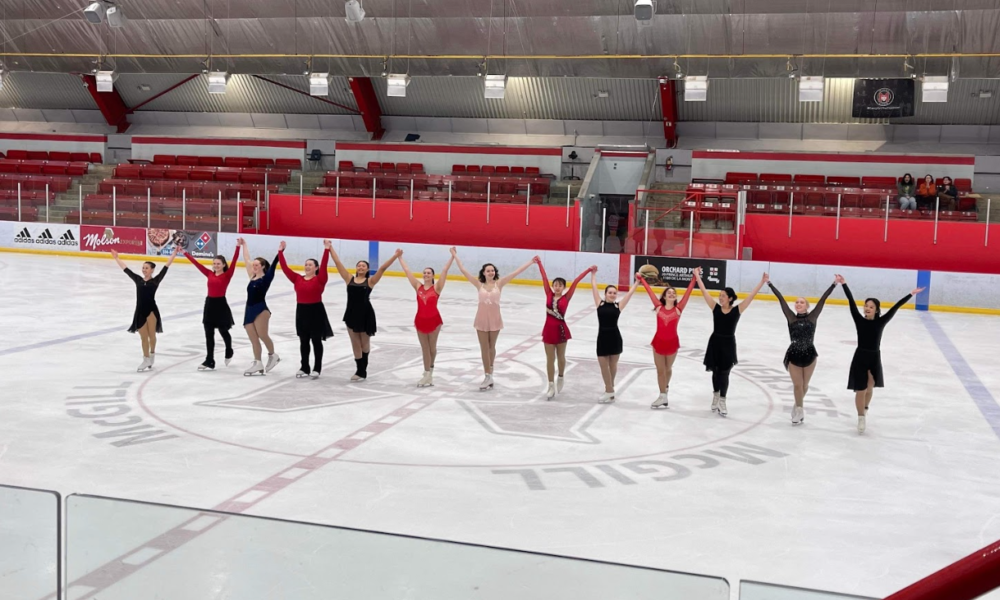
On March 17, McGill’s Figure Skating Club hosted its end-of-season show at McConnell Arena in front of a lively crowd. The performance was a fitting finale to the season, with each teammate showcasing their individual and synchronized skills. 

“I think we just enjoy skating with no pressure and sharing what we’ve been working on and how we’ve improved with all those who come to watch,” first-year Arts student Elisia Wong told The McGill Tribune. “[The] show definitely lived up to expectations for us and we’re hoping that everyone in the audience enjoyed it as much as we did.” 

Like many other McGill teams, varsity and otherwise, the figure skating program took a hit during the COVID-19 pandemic—their 2020-21 and 2021-22 seasons were cancelled, leaving the team without any competition. Despite the disappointment, the club rallied for the 2022-23 season, competing in the Ontario University Athletics (OUA) Fall and Winter Invitationals. The team performed well for their first competitive season in two years, and won gold in the Fall Invitational women’s freeskate as well as silver in the star 10 women’s event during the Winter Invitational. 

Unfortunately, the figure skating team’s lack of varsity status prevented them from competing in the OUA championships, so the skaters decided to host an exhibition performance at McGill to showcase their achievements. Although the show was not a competition, the team felt it was a fun and entertaining way to end their comeback season. 

“The mood amongst the skaters was very light and fun,” said third-year biochemistry student Jessamine Mattson in an interview with the Tribune. “There was no pressure to be perfect and we were able to cheer for each other in a way that can’t be done on practice ice.” 

The show got off to an energetic start with a number of synchronized and individual performances, each one more daring than the last. The low stakes allowed the skaters to fearlessly attempt their best skills and the crowd was rewarded with a number of jumps and spins, with a few axels mixed in. Each performance was met with boisterous ovations from the crowd and applause from the team, who all stayed rink-side after their performances to cheer on their teammates. 

Halfway through the show, there was an emotional moment when the graduating skaters were celebrated at centre ice, marking a new era for the team. 

“All the team members are different now, and after the graduating members leave, there won’t be anyone on the team who was on the last team before COVID,” Wong said. “We want to focus on building the team and showing up as strong competitors to each competition.” 

The second half of the performance proceeded much like the first: The team continued to showcase their skills as individuals, pairs, and even quartets. When the show concluded, the skaters received a final thunderous round of applause from the crowd as they made their way to the stands, officially bringing the season to a close. In the aftermath, the figure skating team is already setting their sights on improving their competitive edge for next year. 

“Next season, we hope to continue to foster an inclusive and fun environment where team members can continue to work and train in the sport they love,” Mattson said. “We hope that these efforts will show at competitions as we strive to work our way up the rankings.”

Wong echoed her teammate’s statement. “We want to recruit more skaters and hopefully regain varsity status from McGill,” she added. “We’re definitely looking to take home more medals and higher placements, so we’ll be working hard and doing our best to improve in the coming season.”

While the McGill community will have to wait and see if the team can live up to expectations, it is clear that a new era in McGill figure skating has arrived.

Arts & Entertainment, Pop Rhetoric

Pop Dialectic: To Ed Sheeran, or not to Ed Sheeran?

In defence of Ed Sheeran – Sarah Farnand

When I was an angsty, emotional teenager, I regularly listened to Ed Sheeran’s music. My entire family found his music to be heartwarming and relatable. I won’t lie, when my grandma passed away, I may or may not have listened to “Visiting Hours” on repeat while sobbing in my bed. Sheeran’s music is basic, sure. But with remarkable accuracy, he can capture feelings that we all experience like grief, love, and joy. Sheeran also regularly authors songs for other artists. And when traditionally attractive artists like One Direction sing songs written by Sheeran, they suddenly receive less criticism. Now, this is not to say that Ed Sheeran is Perfect. I’m sure we are all sick of hearing “Shape of You” or the discourse surrounding the questionable decisions that he’s made in his personal life. But does that really make him deserving of ridicule more than any other celebrity?

When I ask people who are self-proclaimed Ed Sheeran haters what their issues with the English singer are, most bring up, directly or indirectly, his failure to meet conventional beauty standards. The memes about his wide-set eyes or ginger hair are funny, for sure. And a singer making that much money couldn’t likely care less what jokes are made at his expense. But to me, it brings up a deeper issue. If Ed Sheeran was a woman, he would not be famous. Despite having talents in singing, songwriting, and performing, women singers become as much a spectacle for the public to look at as they are to listen to. Ed Sheeran is a talented artist with a catalogue of quality songs. He can take the memes about appearance. But liking and sharing such mockery perpetuates the idea that a singer’s appearance—especially those of women singers—is what matters most.

In defence of memes – Michelle Siegel

If there’s one thing that avocado-toast-loving millennials, technologically hapless baby boomers, and Gen-Zers have in common, it’s this: As much as they try, none of them will ever really know the real Ed Sheeran. Yet as they traverse the chaos of the Metaverse, celebrity memes may be one of the few silver linings that appeal to all users alike. French literary theorist Roland Barthes struck a distinction between a work, the physical space of media, and a text, the metaphysical, social space that carries the more genuine, inherent meaning of a story. Sheeran’s online ridicule can be broken down the same way—his songs and public persona are his work, and the memes about him are a natural public reaction. When you put enough content and music out into the public consciousness, internet reactions gear toward the collective, implied authorship of a persona, not Sheeran or other writers themselves. 

It’s simply incorrect to say that people only make fun of Sheeran for his appearance—not only is he far from the only ginger to face immature taunting, but looking at his album covers forces consumers to confront a difficult subject—mathematics. The basis of these jokes may not be deep, but the logic of the quips still stands: From his negative impact on tattoo artists to cringy Game of Thrones cameos to Dennis The Menace-esque property disputes with his neighbours, Sheeran’s public presentation has rightfully rubbed people the wrong way. These jokes, however, ultimately do not aim to genuinely tear Sheeran down a peg—they serve as comfort to the envious witnesses of Sheeran’s expanding wealth and influence.

Even if the Ed Sheeran discourse was actually rooted in appearance shaming, it still could never offset his lavish lifestyle. When one has seven BRIT Awards, four Grammys, three People’s Choice Awards, and a net worth of around $200 million, isn’t Sheeran always the one getting the last laugh?

Artistic Swimming, Know Your Athlete, Sports

Know Your Athlete: Catherine McGee

Growing up, Catherine McGee’s interest in anything aquatic, combined with their dance background, ignited their love for artistic swimming. She held her passion close throughout her school years and eventually, it landed her at McGill. 

“[Being in the water] just felt so calming for me, almost therapeutic, if that makes any sense,” McGee explained in an interview with The McGill Tribune. “When you go under there, everything just kind of goes still and you’re really just able to ground yourself and be a lot calmer.” 

Through artistic swimming, McGee pushes herself to her physical limits by learning and mastering new techniques. 

“When I’m swimming, it’s the physical part and the athleticism that I appreciate [more],” McGee said. “As a spectator, […] you have a greater degree of appreciation for the craftsmanship that goes into making the routines and performing them as well.” 

McGee joined the McGill team that was revived after a two-year, COVID-19-induced hiatus. The Martlet squad is composed overwhelmingly of first-years, with only four returning swimmers for the 2022-23 season. When preparing routines, the team’s young core was a source of creativity, but also required added attention to bring cohesion and unity to the routines. 

“Everyone brought a different perspective on the sport based on their own experience,” McGee explained. “We had to take a lot of time learning how to swim with each other because we’re new at it […] Before you can even focus on polishing the routine, you need to finalize that kind of degree of comfort within a team. We have to take time to learn how to be a team.” 

Community is central to artistic swimming: Coordinating choreography with eight individuals requires a great deal of confidence and cohesion. According to McGee, the kindness of  Lindsay Duncan, the team’s coach and associate professor of kinesiology, has been crucial to creating a welcoming environment at the pool.

As strong as McGee’s passion for artistic swimming is, the pitfalls of the sport remain in the back of their mind. 

“I don’t think the sport inherently promotes any sort of disordered behaviour and when I say that, I mean the construction of the sport itself,” McGee explained. “I do think that the way that we’ve presented artistic swimming, or some of the standards that artistic swimmers are held to, particularly regarding your body and eating habits, are just not sustainable and they’re not fair.”  

Their personal experiences in the sport have made them critical of how artistic swimming is promoted, especially compared to other sports with an emphasis on aesthetics over skills.

“Artistic swimming is very much a performance sport, right, similar to that like ballet or dance,” she admitted. “I think the way that artistic swimming has been marketed, even from the get-go, has made us lose out on a lot of global awareness that we could have gained.”

Looking toward the future, McGee is excited by the increasing inclusivity of artistic swimming, both when it comes to gender and to financial and outreach programs that connect low-income communities to artistic swimming and swimming in general. 

“I think that we’re definitely moving in the right direction, especially in terms of inclusivity with men in the sport,” McGee said. “It would be a great idea to continue some outreach programs with artistic swimming.” 

As the McGill team is entirely self-funded, McGee is acutely aware of the costs of the sport, between the costumes and bathing suits, as well as transportation when the Eastern Championships or Nationals are held out of province. 

“It’s really important for us to raise as much money as possible to minimize the cost for the students because we want to make artistic swimming at McGill as much of an economically inclusive environment as possible,” McGee said. “It’s just such a shame to think about the fact that finances or cost of the sport [are] what’s in the way of people who might be really interested in the sport from trying it.” The McGill artistic swimming team will head to the University of Toronto for the Canadian University Artistic Swim League National Championship on March 24.

Read the latest issue

Read the latest issue