


Latest News

Basketball, Sports

A Canadian guide to March Madness 2023

The 2023 NCAA basketball tournament kicked off on March 12, and it’s already shaping up to be one of the most memorable in March Madness history, with several shocking upsets in the first three rounds. A record 53 Canadians round out the men’s and women’s brackets and have already turned in incredible performances, fuelling fans north of the border. In honour of this historic year, The McGill Tribune ranks the top two upsets and Canadian players of the tournament so far. 

Upset #2: Princeton 59-55 Arizona

Three years counting, the 15-seed has defeated a number two seed, but that doesn’t take away from Princeton’s miraculous achievement. Arizona entered the tournament in great form after winning the Pac-12 championship and boasting a top-15-ranked offence. Over a quarter of all brackets had Arizona going to the final four. Instead, 111th-ranked Princeton held Arizona to just 55 points––their lowest all season––breaking millions of brackets in the process. Princeton did not stop there: They beat seventh seed Missouri two days later to become the fourth 15 seed to reach the sweet 16 in March Madness history. Princeton eventually lost to Creighton in the next round, but their incredible underdog run won’t soon be forgotten. 

Upset #1: FDU 63-58 Purdue

Sixteen-seed Fairleigh Dickinson pulled off perhaps the greatest upset in March Madness history by beating first-seed Purdue—the second time this has ever happened. On paper, the two teams could not have been more mismatched; Purdue entered the tournament as Big 10 Champions, led by 7-foot-4 Zach Edey, whereas FDU was the shortest team in Division I and ranked 301 out of 363 teams. Despite their advantage, Purdue’s offence struggled the entire game and FDU shot the ball decisively in the second half, allowing them to take the lead and hold on for the shocking victory. FDU lost in the next round, but their victory over Purdue will make them legends in college basketball lore. 

Honourable mentions:

In the women’s bracket, ninth-seed Miami took down first-seed Indiana in the second round thanks to Destiny Harden’s clutch basket with three seconds left. On the men’s side, 13-seed Furman stunned fourth-seed Virginia in a thrilling game—Virginia had possession and the lead with five seconds left, but a wild pass led to a Furman victory on a deep three-point shot. Finally, fifth seeds San Diego State and Miami knocked off first seeds Alabama and Houston respectively, making this the first men’s tournament where no number one seed has progressed past the sweet 16. 

Canadian #2: Ryan Nembhard

Edey and Marcus Carr entered the tournament as the most recognizable Canadian players, but once the tournament began, Creighton guard Ryan Nembhard stole the show. Born and raised in Aurora, Ontario, Nembhard had a stellar 2022-23 season with Creighton, leading the team in both assists and steals. But Nembhard brought the tournament to another level. In three games, he recorded 13 rebounds and 49 points, including a career-high 30 points in Creighton’s upset win over Baylor. If Creighton makes it to the final four, Nembhard’s hard work will be a big reason why. 

Canadian #1: Aaliyah Edwards

University of Connecticut (UConn) forward Aaliyah Edwards took women’s college basketball by storm this season, leading UConn to a second-seed placement in the tournament. Hailing from Kingston, Ontario, Edwards dominated both sides of the ball this season, leading UConn in both points and blocks. Her seismic performances have continued during March Madness—she’s recorded six assists, 11 rebounds, and 47 points while shooting over 80 per cent from the field in two games so far, allowing UConn to cruise through to the sweet 16. UConn’s tournament ended in the next round, but Edwards’ career is just getting started. 

Honourable mentions:

Despite riding the bench for most of the season, South Carolina forward and Mississaugan Laeticia Amihere stood out in this year’s tournament. In two games, she’s had eight rebounds and 21 points, making her a big reason why South Carolina is the best team in the women’s bracket. On the men’s side, Carr has played outstandingly well for second-seed Texas: His eight rebounds, 13 assists, and 45 points in three games have been instrumental to the team’s success. Finally, despite their shocking first-round loss, Purdue centre Edey deserves a special mention, as he is expected to be the first Canadian to win the prestigious Naismith College Player of the Year award.
By the Numbers, McGill, News

By the Numbers: Reporting at McGill

The annual reports of the Policy on Harassment and Discrimination and the Policy Against Sexual Violence were presented to the McGill Senate on March 22. Both policies are handled by the Office of Mediation and Reporting (OMR), which oversees inquiries and reports made under the policies. The McGill Tribune breaks down the annual reports and examines the 2022 numbers. 


Policy on Harassment and Discrimination 


McGill’s Policy on Harassment and Discrimination outlines how one can seek redress after an incident of harassment or discrimination. 

Per the Policy, harassment is defined as “any vexatious behaviour […] in the form of repeated hostile or unwanted conduct, verbal comments, actions or gestures, that affect the dignity or psychological or physical integrity of a Member of the University Community.” 

Discrimination refers to illegal discrimination under Quebec law on the basis of “race, colour, sex, gender identity or expression, pregnancy, family status, sexual orientation, civil status, age (except as provided by law), religion, political conviction, language, ethnic or national origin, social condition, a disability or the use of any means to palliate a disability, which results in the exclusion or preference of an individual or group within the University community.” Under the Policy, it can include “both the actions of individual members of the University and systemic institutional practices and policies of the University.”

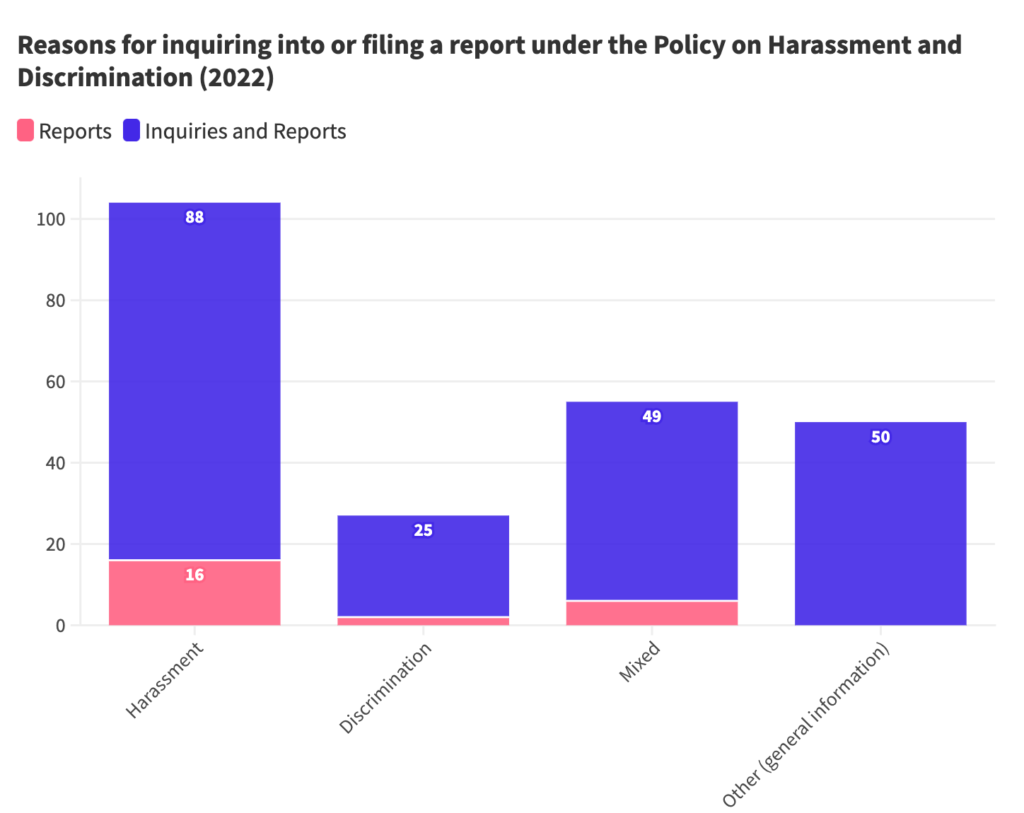
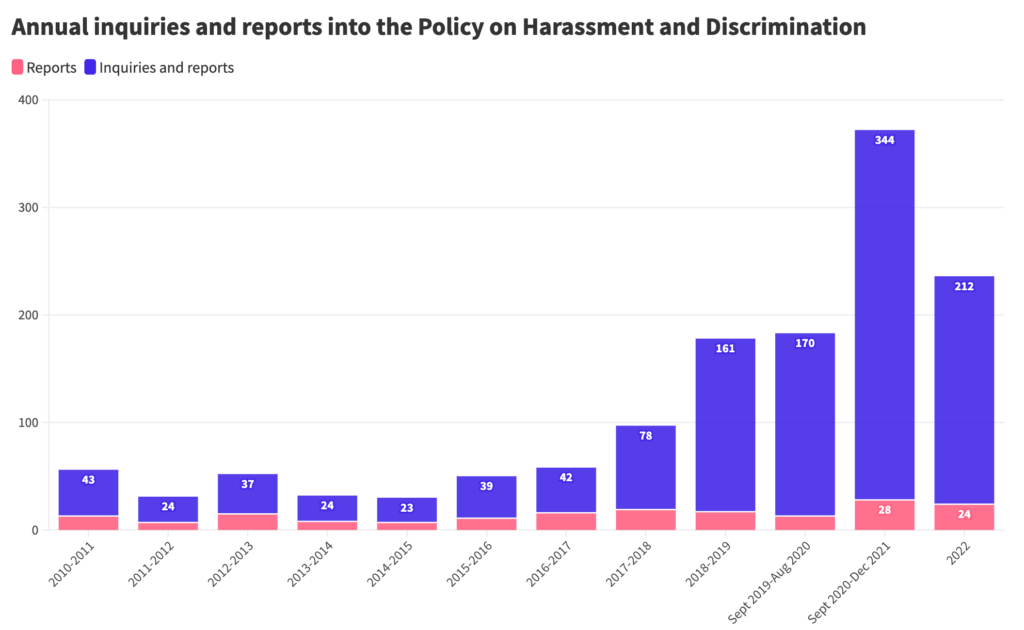
The reporting process starts at the OMR, where any member of the McGill community can inquire about filing a report or accessing support services. Between Jan. 1 and Dec. 31, 2022, the Office received 212 inquiries about reporting under the Policy.

Associate Provost (Equity & Academic Policies) Angela Campbell, whose office is in charge of preparing the annual reports, told the Tribune that the numbers show an uptick in the Policy’s usage. She attributed the upward trend to increased awareness about available reporting channels. 

“The trends show […] that there’s an increase in the uses of the policies for sure. And an increase in accessing the services at the university, especially around seeking information,” Campbell said. “So if you look at the number of people who [request] information, that’s certainly gone up over time.” 

*The reporting period of 2020-2021 was 16 months, as opposed to the regular 12 in order to align the Policy’s reporting period with the calendar year. 
**Reporting periods 2010-2011 until 2018-2019 also include complaints of sexual violence. 

The majority of inquiries, however, do not lead to formal reports. Out of 212 inquiries in 2022, only 24 reports were filed. 

Ultimately, 12 reports were eliminated because they either went beyond the Policy’s scope—meaning they did not occur in the McGill context with both parties as members of the McGill community at the time of the report and the alleged incident—or the issue was resolved through a different internal conflict-resolution channel identified as more appropriate by the OMR.  

Campbell noted that though 12 reports might seem small compared to the McGill population of 50, 000, the number is still consequential.

“Twelve reports is 12 people […] who felt that the matter was serious enough, and were able to muster up the strength to be able to file a report and go through a full investigation,” Campbell said.

A person filing a report can choose between two processes: Mediation or investigation. Mediation is a process where a mediator facilitates discussion about the reported incident between the parties involved to reach a resolution that all parties believe is appropriate. An investigation is a formal process that can result in disciplinary action against the respondent if university assessors—typically OMR full-time staff—find that harassment or discrimination did occur. 

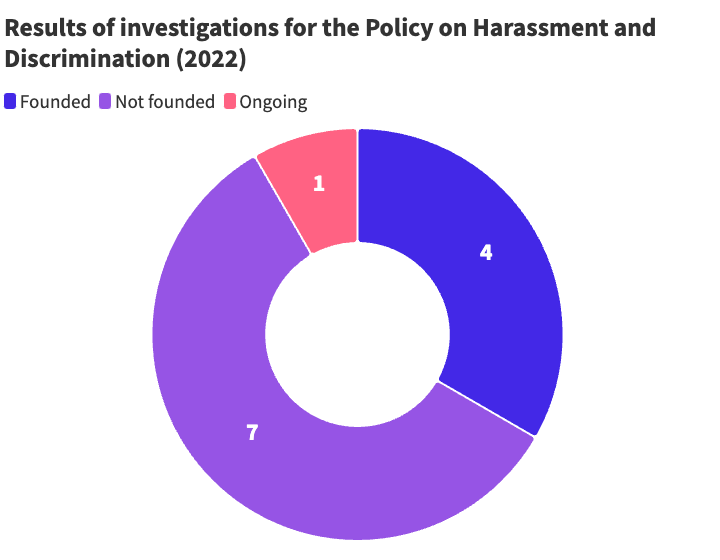
Of the reports filed in 2022 that fell under the scope of the policy, eight were about harassment, one about discrimination, and three fell into the “mixed” category. All of these reports proceeded to an investigation, meaning none of the reporters withdrew their report or reached an agreement  through mediation. 

If an investigation finds that harassment or discrimination as outlined in the Policy took place, the Provost will then refer the case to university disciplinary authorities for next steps. In 2022, all founded reports resulted in disciplinary action for the respondent. 


Policy Against Sexual Violence


The Policy Against Sexual Violence covers McGill’s educational initiatives around sexual violence, procedures for reporting, and the activities of McGill’s central sexual violence support service, the Office for Sexual Violence Response, Support, and Education (OSVRSE). 

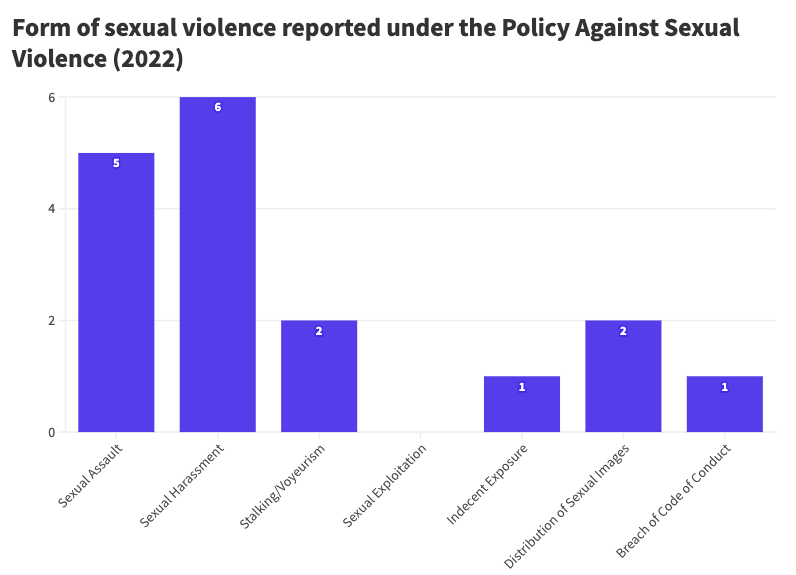
McGill recognizes seven categories of sexual violence: Sexual assault, sexual harassment, voyeurism/stalking, sexual exploitation, indecent exposure, distribution of sexual images, and breach of the Code of Conduct (sec. 8). 

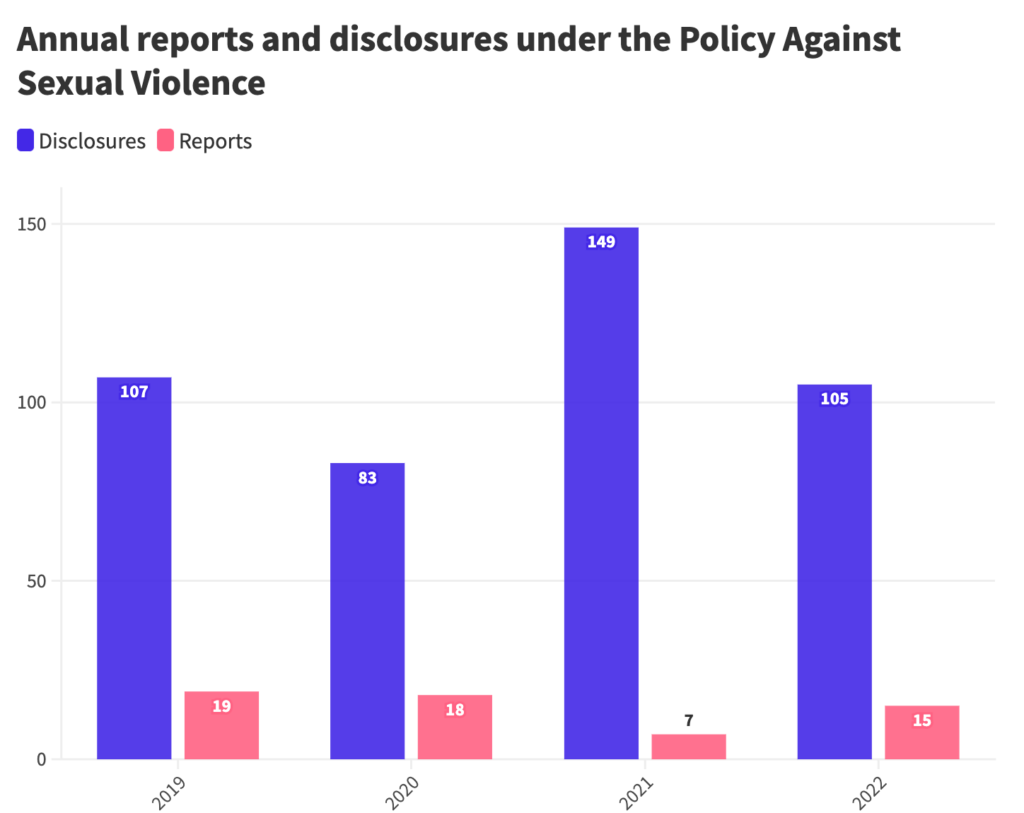
In 2022, there were 105 disclosures of sexual violence. Although the Policy outlines OSVRSE as the main body in charge of receiving disclosures, beginning in mid-October, the Office of the Dean of Students took over the responsibility as OSVRSE was closed

Just like the Policy on Harassment and Discrimination, the majority of people who disclosed an incident of sexual violence decided not to file an official report. Only 15 out of 105 disclosures became reports in 2021-2022, three of which were out of the Policy’s scope. 

*There was a slight overlap between the 2019 reporting period (April 2019 – March 2020) and the 2020 reporting period (Jan. 2020 – Dec. 2020)

After a report is filed, the OMR will review it and decide whether the university has jurisdiction to pursue an investigation.  

If a report falls within the university’s jurisdiction, an independent special investigator (SI) will begin an investigation process to determine if an incident of sexual violence occurred. 

Most reports were filed under the categories of sexual assault (5) and sexual harassment (6).

*One report under the Policy can contain more than one form of sexual violence.

Although SIs are given 90 days to complete their investigation, only three investigations were wrapped up within that period. The university can provide an extension in complex cases or “where the parties or a witness delay meetings with or responses to the investigators.” 

Two of the delayed investigations concluded within a week of the 90-day deadline. The third required an additional 120 days because the survivor withdrew from the process.

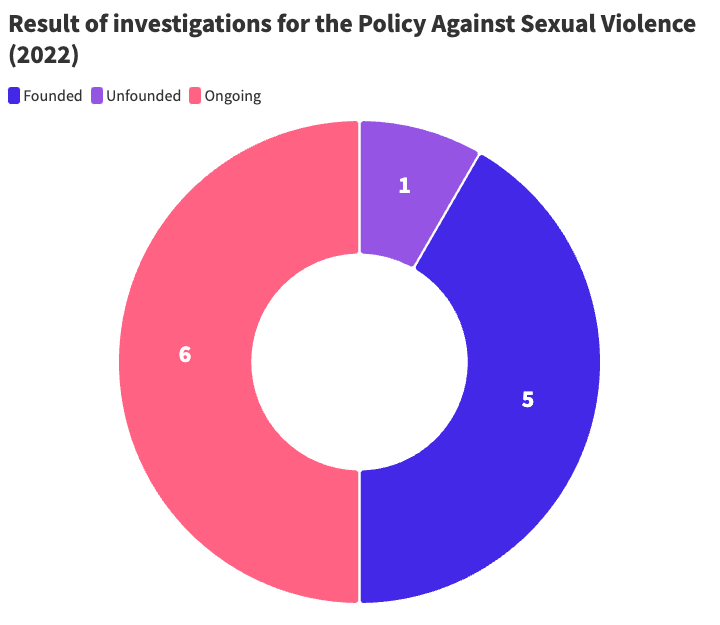
Of the 12 reports investigated this year, five were founded, one was unfounded, and six were ongoing by the end of the reporting period.

Disciplinary measures were imposed in all cases, except for one where the respondent left McGill. In the single unfounded case, authorities also imposed disciplinary measures as they  found that the respondent’s actions during the alleged encounter constituted a breach of the Code of Student Conduct and Disciplinary Procedures. 

In an interview with the Tribune, senior employment equity advisor Sarah Pierre said she was “encouraged” that an increasing number of community members were accessing the OMR.  

“All of the awareness and campaigns have shown that the OMR is more top of mind for people and they know that there is somewhere they can go for formal reports,” Pierre said. “I think people are more aware of their rights as well as feeling more empowered to actually come to the OMR with their stories and with their questions and concerns.”

Although reporting and investigations are complex, Campbell expressed that she was confident  in McGill’s procedures. 

All graphs were produced by Juliet Morrison.

Off the Board, Opinion

Reporting on what I’ve gained from campus journalism

There’s a certain rush that comes with writing an important story. The words stream out as you find the quote that reveals the essence of the piece. Bits of reporting you collate together into a story that guides the public and exposes the truth. I’ve been thinking about this rush a lot as I stare down the end of my third year at McGill and ask myself whether I want to pursue journalism professionally. 

Three years ago, the idea of doing journalism intimidated me. Journalists were really smart people who wrote on ridiculous deadlines and put themselves in harm’s way for the sake of telling a story. I didn’t really know how to write or deal with sources, and I didn’t really know how to pull a story together. The perfectionist first-year me, afraid of trying something new, didn’t want to try and fail.  

But I got over myself. On a visit home in January, I happened upon The Fourth Estate, a documentary that took an inside look at The New York Times during the first year of the Trump presidency. I was immediately drawn to the fast-paced environment that featured inquisitive people bustling around and grappling with how best to convey breaking issues to the public. Whatever was happening in that newsroom, it seemed like those reporters were at the centre of the world—and I wanted in. That night, I emailed McGill’s student papers to learn how to contribute. 

Campus journalism, of course, isn’t The New York Times. The stories you write are rarely breaking news and don’t typically cause broad shifts in public opinion. But I’ve found that covering campus life, administrative decisions, and student movements is unique and important work in and of itself. Doing this kind of journalism has informed my university experience and self-perception in turn. 

Entering McGill during the height of COVID-19 drastically limited my exposure to student life. But through chasing stories every week, my world opened up. Every time I researched a new story or conducted an interview, I learned something new about McGill. Through my reporting, I became acquainted with my community through their eyes. 

Student journalists are in a unique position. We have a different sort of responsibility to our community than professionals. We face these issues every day and are often directly affected by the administration’s decisions, like our sources. Reporting in a smaller community also changes your relationship with pieces—the stories you’re writing unravel in front of you. And rather than moving on after a piece gets published, your idea of “campus” shifts.

McGill is a fascinating place. The university is a large and powerful institution with a very real impact on people’s lives. At times, I’d argue, even more so than the provincial or federal government, because it’s closer to us students. Being a campus journalist has forced me to pay attention to the institutional harm and negligence that occurs every day—whether it’s pursuing legal action against students filing access to information requests or neglecting to tell the community their central sexual violence support service has been shut. And seeing these struggles up close has been formative for my own political awareness. 

While journalism is ultimately the practice of speaking truth to power, the most important skill I’ve gained has been learning to listen. News reporting forces you to take a backseat. Your singular voice, your opinion on these issues doesn’t matter in comparison to accurately conveying someone’s, or a community’s, story. It’s humbling. I learned that pretty quickly through all of those nights of huddling up at the Law Library, two hours before deadline, listening back to my interviews in search of the truth. 

I’m still not sure if I want to be a journalist after graduation. With cuts across the industry, tenuous employment, and increasing rates of harassment, violence, and repression, it’s not the most ideal time to pursue this career path. But reflecting on my experience, it’s hard to say no when practicing journalism has taught me so much. 

I might have to keep chasing that rush. 

ABCs of Science, Science & Technology

SEDTalks showcases the wonders of McGill graduate student research

The Trottier Institute for Sustainability in Engineering and Design hosted the fifth annual edition of SEDTalks, a program where three graduate students work throughout the winter semester to present their research to the public in an accessible, engaging way. This year’s students presented a wide array of research in public health, sustainable energy, and detecting the impacts of pollution. 

Can blueberries help ward off superbugs?

Fathima Afsal, PhD candidate in the Department of Civil Engineering and Applied Mechanics, is researching superviruses that proliferate in the human gut. According to Afsal, one of the most pressing risks facing humanity right now is the development of pathogens that are resistant to antibiotic treatments

“The next health crisis is not going to be a surprise,” Afsal said during her talk. “In fact, it is going to be due to antimicrobial resistance.” 

To better understand how these antimicrobial-resistant pathogens may be developing inside of the digestive system, Afsal studies the human gut biome in all of its complexity. 

“Over the past year, I have built in the lab an artificial human digestive system,” Afsal said. “We have tried to give it a very creative name: The ‘gut-imulator,’ consisting of different compartments ranging from the stomach to the small intestine.”

The gut-imulator is fed three times a day, with pH levels and bacteria presence carefully monitored in each compartment. Using this technique, Afsal can study how specific chemicals called anthocyanins affect the proliferation of resistant bacteria. Anthocyanins, commonly found in blueberries, are believed to help ward against microbial resistance, but a comprehensive study into its effects has yet to be carried out.

Using rocks to store energy sustainably

Hamidreza Ermagan, a PhD candidate in the Department of Mining and Materials Engineering, is studying a new way to store energy for later use: Heating rocks in an insulated chamber and releasing that heat later, in the form of energy. According to Ermagan, this could be the key to harnessing the full potential of renewable energy. 

“Renewables are not always available when needed and they’re not always needed when available,” Ermagan said during his presentation. “We need to find a way to address this mismatch between energy supply and demand.”

Current energy storage methods, like lithium-ion batteries, are expensive and require the mining of toxic chemicals. Simple rocks, on the other hand, are cheap and abundantly available. They also have several beneficial properties for energy storage. 

“Rocks do exceptionally well at withstanding really high temperatures, and that is really important for us, because we are not only interested in storing heat as heat, but we also want to transform it to electricity,” Ermagan said. 

Detecting nanoplastics in our environment

Arav Saherwala, a master’s student in McGill’s Department of Chemical Engineering, is currently developing a reliable method of detecting nanoplastics—small particles that break off from plastic products and pollute the environment. 

“These nanoplastics that we’re generating can be smaller than one micron in size,” Saherwala explained. “This is much smaller than a red blood cell and orders of magnitude smaller than a hair.” 

This makes them extremely difficult to detect, but using a new technique called enhanced darkfield hyperspectral microscopy, it may be possible.

“What’s high-tech about this microscope is that we get two types of information, we get spatial information, as well as spectral information,” Saherwala said. “For every single pixel that’s on this image, we get a spectrum. And this spectrum is much like a fingerprint, as it’s unique to every element.”

Using this spectral data to identify each material in a sample, Saherwala could identify the precise types and locations of nanoplastics, getting us one step closer to understanding how widespread they are and what impacts they may be having on our environment. 

Campus Spotlight, Student Life

Shining at the AUS Awards Ceremony

Two hundred and three feet in the air, looking out over the silhouette of Montreal through blue-lit steel, the lights of the city seemed to gleam. Funnily enough, they weren’t as bright as the stars in the room behind me.

This year, the Arts Undergraduate Society (AUS) hosted its annual awards ceremony at the Montreal Biosphere. The zero-waste environment museum is more commonly recognized as the huge, geometric, metal dome just across the river from the Old Port—it glows electric blue at night.

The night overflowed with jubilant feelings of celebration. The semi-formal theme was brushed past: Red lips, floor-length gowns, and the highest of heels took to the Biodome that night. Rihanna’s old hits were playing, and the dances in the room were easy and light. People  came together from different programs, finding time (as Arts students do) to “just consider the other side of a debate” before splitting off again to find new partners and stories.

The night was a heady mix of elegance and excitement. High cocktail tables stood throughout the room, with plush couches scattered along the perimeter—the atmosphere inviting people to mingle. The entire space was wrapped in floor-to-ceiling windows, which allowed for a moment truly worthy of the word “breathtaking” when the sun dipped below the Montreal skyline. Side tables were filled with cheese platters, fruit platters, gourmet cookies, and chocolate dipping sauce. Bartenders were mixing up vibrant-hued drinks, and, with what looked like a waffle-maker, frozen shots. Photographers circled the room, conversations punctuated by the flash of cameras. Despite the night being a little chilly, more than one person ventured out onto the surrounding balcony, taking in a close-up view of the dome and the city, and snapping a couple shots for the ’Gram. 

To kick off the ceremony, AUS vice-president (VP) Communications, Britney Vu, called it a night of celebration and recognition, a night to applaud all of the hard work, dedication, and passion that came from each department. With the hoots and hollers that rose up for every honourable mention and award called, the energy in the room was palpable. Of course, attendees came in with hopes for their own shining glass plaque, but there was also something like a collective pat-on-the-back going throughout the room. It was a night for everyone, all together and individually, to look back on their contributions at McGill and  simply appreciate it.

The History Students Association (HSA) took home the final prize of the night, for Most Outstanding Departmental Executive Team. To receive an award, Arts undergraduate departments nominated members of their executive team. After nominations, prizes were voted upon by the AUS team, and when there were conflicts of interest, the AUS secretary-generals voted in their place. AUS’s VP Academic, Nick Rieck, U2, told The McGill Tribune that they tried to make the decisions as equitable as possible

With AUS missing a VP Internal, Rieck took it upon himself to put together the awards ceremony this year. With preparations beginning as early as November and continuing through until Friday night, it was a daunting project for Rieck, but feelings of gratitude propelled him.

“There are so many cool events and things that go on with the different departments […] what we really want to do is honour the work that our departments do,” he explained. 

After seeing firsthand how the departments positively contribute to Arts students’ experiences at McGill, Rieck said that the night was a way of giving back to the students who work to make that happen.

Somewhere between the bright blue lights of the night, the frozen shots being doled out at the bar, and snapshots being taken, an inspiring sense of pride and appreciation flowed throughout the room. There was a sense of teamwork—between departments, and between everyone in the Faculty of Arts. The dome’s blue lights and camera flashes that night shone bright. But that feeling…it shone the brightest of all. 

McGill, Montreal, News, SSMU

Meeting on affordable housing brings together students, unions, advocacy groups

Students and community organizers filed into the Students’ Society of McGill University (SSMU) Ballroom on March 21 to talk about the housing crisis in Montreal. The two-hour annual general meeting (AGM), held by the SSMU External Affairs (EA) office’s Affordable Student Housing Committee (ASHC), showcased booths from eight guest organizations and a brief presentation from Unité de travail pour l’implantation de logement étudiant (UTILE).  

Members of ASHC sought to collect testimonies about students’ housing conditions, which will be compiled in a report for distribution to student media outlets, various student associations, and the student body via the SSMU listserv. 

In an interview with The McGill Tribune, ASHC member William Li shared that ASHC has limited data about off-campus housing, which limits the committee’s advocacy work almost entirely to on-campus housing. ASHC recommends that McGill develop new methods and technologies to gather data about off-campus housing.

Association of McGill University Support Employees (AMUSE) team members, who represent floor fellows, were also present at the event to speak with students about housing access and equity. 

In an interview with the Tribune, AMUSE president James Newman shared his frustration with McGill for raising the rent of its residences year after year. Although Quebec landlords can annually increase rent prices in accordance with the Tribunal administratif du logement’s (TAL) yearly calculations, Newman believes it’s the university’s prerogative to keep rents stable. 

“It’s disheartening as a union to see our employer replicating some of the same precarity-worsening practices that we’re seeing landlords do,” Newman said. “They often say, ‘Oh we’re special, we’re an academic institution.’ But you’re replicating so many of the worst evils you see in the private sector. It’s a real shame.”

Comité logement du Plateau Mont-Royal (CLPMR) member Alain Deschamps shared how the committee can help students deal with the various abuses they may face as a vulnerable population in the housing sector. The organization helps defend tenant rights and advocates for the development of social housing. In an interview with the Tribune, Deschamps explained that tenants often hesitate to stand up for their rights against landlords due to the power dynamics at play. 

“To have your rights respected, you have to sometimes take a confrontational attitude. You have to threaten […] that you’re going to take them to court,” Deschamps said. “But now you have a relationship dynamic where your landlord might get pissed off at you and they can retaliate in all sorts of stupid, annoying, petty ways.”

Other organizations present included ECOLE, a sustainable housing cooperative situated on University Street that also operates as a rentable community event space; the Concordia Student Union’s Housing and Job Resource Center, a legal support clinic that hosts workshops for students to learn skills ranging from finding their first apartment to refusing rental increases; and Syndicat de locataires autonomes de Montréal, a tenants’ union that strives to hold landlords accountable. 

Other attendees included members from Comm-un and The Open Door. The Open Door provides subsidized housing options to Montreal’s unhoused community, who are often victims of the privatized housing market, exclusionary landlords, and general accessibility issues. Comm-un works in tandem with The Open Door by providing a collective space for unhoused Indigenous individuals to combat isolation and build community.

The event also hosted a brief presentation from UTILE, an organization that provides non-profit housing for students. UTILE team member Marianne Lamoure spoke about their current partnership with SSMU in which UTILE is developing an affordable student housing complex on the corner of Boulevard St. Laurent and Rue Ontario East. In an interview with the Tribune, Lamoure shared that the non-profit organization is currently waiting on approval from the city of Montreal, which could take anywhere between six months and two years. 

“The lot we found, we can’t build any higher than four floors up. Our whole concept depends on density, doing a lot of apartments in one place so that each apartment can cost low, so [the approval] will take time,” Lamoure said. “We’re hoping this project will be ready by 2026.”

Editorial, Opinion

Montreal must offer community encampments anti-colonial housing solutions

On March 22, the Mobile Legal Clinic and associated lawyers went to court demanding that the provincial government stop its eviction of more than a dozen houseless people under Montreal’s Ville-Marie Expressway. The encampment has been occupied for over six years, during which the residents were subject to police raids and violence from local residents seeking to push them out. The group’s legal support claimed that the province’s attempt to raze the camp was a violation of the Charter rights to life, liberty, safety, and dignity. The plaintiffs, including a pregnant woman and a terminally ill man, requested the government grant them an injunction against Quebec’s Transport Ministry, which wants to clear the camp to begin repairs to the underpass. 

The province agreed to pause the eviction and to find housing solutions for the plaintiffs. But the event illustrated the persistent negligence and failure of the municipal and provincial governments to provide for the city’s unhoused population. Housing is a basic human right which cities across the country are neglecting to make affordable, while actively destroying the communities unhoused people form within encampments. The provincial government must go beyond their legal obligations to find housing for the city’s most vulnerable, through greater support to harm-reductive shelters, stricter regulations on skyrocketing rents, and a humane, anticolonial approach to housing people without destroying communities.

An Indigenous person in Montreal is up to 27 times more likely to experience houselessness than a non-Indigenous person, and an Inuk is almost 80 times more likely. The ongoing legacies of colonial projects, such as the High Arctic relocations of the 1950s, and unceasing systemic discrimination are the primary risk factors of Indigenous housing precarity. Each of the government’s violent attempts to break up the networks and support systems of Montreal’s unhoused people reproduces this intentional destruction of Indigenous communities and again, fails to offer adequate state care and redress. Any solutions must therefore be rooted in Indigenous-led practices of community care, and institutions such as the police, an actor of colonial violence, should not be employed to interact with the houseless, who are unjustly ticketed for simply existing in public space  

The COVID-19 pandemic revealed the extent of the government’s criminalization and disgraceful mistreatment of Montreal’s unhoused people. The province’s draconian curfew rules did not exempt the city’s houseless, despite the dramatically reduced capacities of shelters in the city, and resulted in the death of Raphaël André, an Innu man whose body was found in a portable toilet steps away from a shelter. The city cleared numerous encampments, seized tents, and disposed of people’s winter clothing under the guise of public health and safety. Following Joyce Echaquan’s death in September 2020, an overt case of systemic medical racism, Premier François Legault refused to recognize the existence of systemic racism in the province. While Montreal’s mayor, Valérie Plante, has criticized the insufficient funds to housing in Quebec’s new budget, she continuously allocates exorbitant funds to public “safety,” the police.

The government, the police, and even its hospitals are rooted in systemic violence, surveillance, and discrimination. The city’s violence towards its unhoused population also manifests materially, as it incorporates hostile designs and exclusionary architecture restricting houseless people’s access to public spaces. Installing metal armrests and shallow seating on benches means that Montreal’s unhoused cannot lie down to rest. The city must end its dangerous, exclusionary, and racist design models, and instead actually invest in projects that foster community in public spaces. 

As McGill students, we interact with unhoused people every day, but many of us are so desensitized to government failure that it strikes us as normal. Individuals living in Milton-Parc without a safe, warm place to sleep at night will never be normal or just. While the municipal and provincial governments must work towards holistic solutions, students must treat their unhoused neighbours with respect and dignity and at the same time advocate for change. 

The precarity of Quebec’s unhoused population has been and remains manufactured by the government. Any efforts to resolve this crisis must address, through culturally responsive and historically comprehensive recognition of, the structural violence that Canada’s colonial systems have enacted.

McGill, News

Senate expresses concern regarding immigration and French fluency for students and faculty

McGill’s Senate convened for their third session of 2023 on March 22 in the Robert Vogel Council Room of the Leacock Building. The meeting was Christopher Manfredi’s last as interim Principal and Vice-Chancellor; H. Deep Saini is set to assume the position by the following session in April.

Most of the meeting was devoted to discussion after Secretary-General Edyta Rogowska presented the Policy on the Use and Quality of the French Language, which had several amendments added following its presentation at the February Senate meeting. A working group comprised of Legal Services, the Secretary-General and the Vice-Principal (Communications and External Relations) amended the policy to focus on providing student-focused support for mastering French by the end of a degree and to mandate that all McGill communications amongst civil administration bodies and legal enterprises in Quebec be conducted in French. In spite of the prior feedback and changes, several members still questioned if the scope of the policy was inclusive enough.

“I was struck that there’s nothing in the policy about resources for faculty to acquire French,” professor and Faculty of Arts Senator Eran Shor said. “In particular, what is the university doing to support new faculty who do not speak French, given new hurdles for obtaining permanent residency?”

Shor also brought up the university’s recent efforts under the Action Plan to Address Anti-Black Racism to recruit new Black faculty members, referencing the large number of American hires who need more substantial support with learning French to confirm and maintain their legal residencies in Quebec. 

The Senate then passed motions to appeal the university’s 2004 edition of the same policy and adopt the 2023 iteration, both of which will be carried to the Board of Governors for secondary approval, before final ratification from the Ministry of Higher Education.

Josephine Nalbantoglu, Associate Provost of Graduate Education and Dean of Graduate and Postdoctoral Studies, presented the Annual Report on Graduate and Postdoctoral Studies, noting that many international students faced legal struggles when entering Canada. 

“We have many international students and those students had great difficulty entering the country,” Nalbantoglu said. “No matter what we did as a university—through International Student Services, through the government relations office, through local MPs [Members of Parliament]—many of our students did not get a visa and could not join us, so that’s what really impacted our numbers.”

Senators participated in an open discussion about reinvigorating McGill’s PhD programs, with small-group conversations preceding an open-floor debate. Key points included ensuring that academic and professional skills could be flexibly incorporated into specific degree curricula so that students can integrate more easily into the workforce post-graduation. 

“How are we ensuring that our students understand how to translate the skills that they’re developing during their PhD for employers?” asked Darlene Hnatchuk, director of Career Planning Services (CaPS). “Those skills develop during the PhD—that does stand for a certain skill set that is valuable within [the] industry.”

Professor and Associate Provost (Equity and Academic Policies) Angela Campbell presented updates on both McGill’s Policy against Sexual Violence and Policy on Harassment and Discrimination

“The University has been devoting quite a lot of attention to these two different policies with a view to preventing these forms of harm rather than dealing with them after they arise,” Campbell said. 

Moment of the Meeting:

When presenting the Annual Report on Enrollment and Strategic Enrollment Management, Deputy Provost (Student Life & Learning) Fabrice Labeau noted that while the Senate had agreed on a planned deficit of $9.4 million with a $20 million contingency, the expected deficit for the end of financial year 2023 is $4.9 million.

Soundbite: 

“The OSVRSE closure back in October seems to have caught a lot of people off guard, and I want to make sure that this never happens again.”

—Sam Baron, Arts Senator on the lack of attention paid to OSVRSE operations

Current News Editor Juliet Morrison is an upcoming Arts Senator for 2023-2024, but was not involved in the production of this article.

Ask a Scientist, Science & Technology

Where nature meets technology: Machine learning as a tool for climate action

With the dangers of continued fossil fuel use and environmental mismanagement unfolding before our eyes in the form of intense heat waves, droughts, and wildfires, it’s obvious that dramatic, transformative action must be taken.

Throughout the pessimistic debate about the effectiveness of climate change policy and methods of pollution mitigation, almost every solution under the sun has been proposed. Some have suggested the widespread use of carbon capture technology, while others, like Boyan Slat, have developed ways to remove garbage from our oceans. But one technology has the potential to revolutionize climate action: Artificial intelligence (AI).

In a recent paper spearheaded by professor David Rolnick of the Department of Computer Science, researchers studied the application of machine learning to climate science in great detail. Each section of the article explored a specific sector—including electricity, industry, or infrastructure—and explained the ways machine learning could be used to reduce the sector’s impact on the climate. 

Machine learning is an offshoot of AI. While the aim of AI is to develop computers that can “think” like a human, machine learning is more about training computers on experiences and data to recognize patterns and make decisions.  

“Machine learning is looking at large amounts of data, finding the patterns that are common across that data and linking those to what the algorithm is asked to do,” Rolnick said in an interview with The McGill Tribune.

Uses for machine learning fall into a few categories, according to Rolnick: Monitoring, optimization, simulation, and forecasting. Take, for example, how forecasting can be applied to the study of electricity.

“Machine learning is used to predict the amount of electricity that will be in demand at a given point in time so there is enough supply to meet that but not more than there needs to be,” Rolnick explained. “Understanding how much power is needed and how much power is available is important to make sure the grid is running effectively and without waste.”

Since AI cannot plant trees or pass legislation, its practical application may seem abstract. However, its effects are tangible: AI has been used to increase crop yield in India, improve electricity efficiency on wind farms by planning for weather, and improve data centres’ efficiency.

“Most of the technologies that I am talking about are at some level of deployment. For example, the U.K.’s national grid has already integrated deep learning models into forecasting supply and demand of electricity and has greatly increased efficiency as a result,” Rolnick said. “The UN uses AI to guide interventions in flooded areas [….] These are not just research projects and it’s fundamentally important.”

Although AI is an incredibly promising technology, there are a couple of drawbacks to be addressed. One of these drawbacks is human bias—since humans write the algorithms and supply the human-collected data to train machine learning, these tools can replicate human biases. To prevent these biases, then, human bias needs to be corrected—there is no software fix. 

“We cannot technology our way out of most biases,” Rolnick said. “The solutions to biases in technology are the same as solutions to biases in any other part of human endeavour. That means they are hard, but they are solvable via human choices.” 

This technology also requires enormous quantities of energy for algorithms to be trained and maintained, but the energy can be minimized by designing efficient algorithms and planning applications carefully. 

“It’s also worth noting that most of the negative climate impacts of AI globally come from how it is used, not the direct energy consumption,” Rolnick wrote in a follow-up email.

Although machine learning models can be quite energy hungry, the models Rolnick uses are not exceedingly energy-intensive. With careful planning, scientists hope that the emissions benefits from these models outweigh their energy consumption.

Montreal, News, The Tribune Explains

Tribune Explains: Doing taxes as a student

Tax season is in full swing and the May 1 deadline to file is fast approaching. Typically, the deadline is April 30, though this year it falls on a Sunday, giving taxpayers an extra day. In an attempt to make the process less stressful, //The McGill Tribune// compiled answers to frequently asked questions and a list of resources offered by McGill.

How do I file my taxes?

While filing taxes varies from case to case, there are some general rules to follow. Anyone with an income must file taxes. Before starting, anyone filing a tax return needs to have certain forms on hand, such as a T4 from their employer or T2202 from their educational institution, their Social Insurance Number (SIN), and other personal details, like an address. 

For students working in Canada, filing taxes is not only a legal obligation but also an opportunity to get tax refunds, which come from the money that is deducted from paychecks when initially issued. Employers are meant to issue both federal T4 forms and the Quebec provincial equivalent, Relevé 1 forms, to their employees. Workers should receive these forms in February from every one of their employers over the past tax year. 

Another common tax form for students is the T4A slip. These are issued to students who received scholarships or bursaries. T4A slips, Medical Insurance Receipts, Relevé 8 forms, and T2202 slips are all tax documents that can be accessed by students through Minerva under the Student Accounts tab. 

Once all the forms are in order, it’s time to file. Taxes can be filed either online or on paper, but the Canada Revenue Agency (CRA) recommends filing online, which requires a CRA-certified tax software like TurboTax or H&R Block. Residents of Quebec have to file both federal taxes to the CRA and provincial taxes to Revenu Québec.

If doing your own taxes is too overwhelming, you have other options. Students can authorize a parent or representative to do their taxes for them. In addition, many students may be eligible to get their taxes done at free tax clinics. These clinics are organized by the Income Tax Assistance Volunteer Program and can be walk-in, drop-off, or by appointment.

What kinds of deductions or credits can I get as a student?

Taxes are notoriously complicated and it can be difficult for people with low incomes, such as students, to maximize their tax returns and save money. When filing taxes, students can consult Revenu Québec’s website to find student-specific information regarding tax credits and deductions.

Depending on a student’s individual situation, they may be eligible for credits such as the federal Goods and Services Tax Refund or the Quebec Solidarity Tax Credit—both are issued quarterly to those who qualify. Deductions can be claimed for certain student-related costs such as moving expenses, tuition costs, or interest paid on student loans. 

Students with no income or people making money that is non-taxable are not required but are encouraged to file a tax return because of potential income tax refunds. In some cases, as with the GST credit, students can have no income but still get money back from the government.

What should I know if I am an international student?

Taxes in Canada are dependent on residency, not citizenship. As such, international students who work must file taxes in Canada. Just like Canadian students, international students can benefit from filing taxes even if they have no income. One benefit is a tuition credit which can be carried forward, reducing the amount of taxes that one owes in future years. Tuition credits can also be used by Canadian students. 

International students should also keep in mind that they have to declare any international income, that is, any income that may have been made in their home countries. 

What resources are there for students?

Scholarships and Student Aid, a subsection of McGill Student Services, provides workshops on how to do taxes for both Canadian and international students. For international students, International Student Services (ISS) has lists of resources that can be consulted.

Aside from McGill resources, the CRA has a step-by-step guide, including videos, which explains the details of filing taxes.
Financial savviness underlies much of the taxing tax reporting process. While people in higher income brackets have more access to help such as personal accountants or financial assistants, students often have to figure it out for themselves. To help, the Scholarships and Student Aid Office also offers workshops on budgeting and general financial literacy.

Read the latest issue

Read the latest issue