Latest News

Research Briefs, Science & Technology

Ball python pigmentation research is coloured in by crowdsourced data

When you think of genetics research, what animals first come to mind? Fruit flies? Mice? Our understanding of genetics is defined by a small number of model organisms—the ones used to study a particular biological phenomenon because of how similar their genes are to humans. 

Mice are the most common model animal, while reptile species have been largely ignored in genetics research. . Because our slithery friends have been left by the wayside, researchers needed to get creative with their data collection. In a recent study, McGill scientists turned to hobby breeders to help fill the knowledge gaps in understanding the genetic basis for the distinctive colour patterns in ball pythons.

In the field of genetics, the ultimate goal is to connect a genetic profile, a genotype, to a specific physical characteristic, a phenotype. The genetics of colouration, the variation in colour and pattern between animals, are a popular target for genetic studies because of how easy it is to observe changes caused by mutations.

“[Colour variance is a] trait of ecological evolutionary relevance, and one that’s relatively easy to study,” said professor Rowan Barrett, interim director of McGill’s Redpath Museum and one of the authors on the paper, in an interview with The McGill Tribune

Barrett, who is also the Canada Research Chair in Biodiversity Science, and his team were specifically interested in the genetic origins of piebaldism in ball pythons, a colour pattern where snakes have large blotches of white scales offset by brown-green hue. 

In animals, colour is determined by a cell type called a chromatophore. Mammals and birds have one type of chromatophore called melanocytes, which produce the brown and black pigment melanin. Reptiles, however, have multiple types of chromatophores: Melanocytes, xanthophores, which make yellow to orange pigments, and iridophores, which have crystals that determine colour via structural correlation—when the microscopic structure of a crystal changes how light reflects off a surface to determine its colour. 

However, studying pythons presented a problem: There just isn’t as much data on snakes as there is on mice. So the researchers turned to a group that did collect that kind of data: Private breeders of ball pythons. 

Commercial ball python breeders keep extensive records of the lineages of their snakes to breed for rarer, more valuable colour patterns.

“The colour morphs the pet hobbyists have created are an amazing catalogue of variation,” Barrett said. “[It] would have taken decades [for us] to develop all the different morphs used in the study.”

Python breeders provided samples of snakeskin, which were sequenced and analyzed by the Barrett lab. By analyzing the sequences and the data from the breeders, the researchers found that piebaldism was correlated with a mutation that renders the TFEC gene, a transcription factor involved in gene expression, non-functional.

Determining whether the TFEC mutation directly caused piebaldism would require the deletion of TFEC from pythons to see what effect its knock-out would have. Unfortunately, the technology required to edit genes in snakes does not yet exist. Instead, the researchers used brown anole lizards, the only reptiles to be successfully modified using the CRISPR system. 

The modified lizards showed reduced pigmentation in their skin and black eyes, suggesting they lacked iridophores but retained melanophores. Meanwhile, the eyes of unmodified lizards had iridophores but not melanophores, indicating that TFEC could be required for iridophore development. 

Because of the huge potential for variation in non-traditional model animals, working with breeders and enthusiasts could be key to filling the gap between genotype and phenotype and unlocking the genetic secrets of nature.

Features

To strike a chord

As far back as I can recall, music has been capable of evoking incredible emotion and overwhelming comfort unlike anything else. It has protected me from tough-to-swallow, unnamable feelings, and even made me aware of ones I didn’t know were possible to experience.

My parents were my earliest introduction to music. I would watch my mother dance and clean while she played salsa and Mexican baladas on the speaker, and catch my father falling asleep at the end of a long workday to nueva trova cubana and the occasional alternative rock seeping through his headphones. As I progressed through my early childhood, my taste diverged from their individual influences. I gravitated to bubbly pop and electronic dance music (EDM), always noting how starkly its electric, neon brightness contrasted with my mother’s warm, swaying, romantic melodies, and my father’s soft, political folk favourites.

During my adolescence, I found solace in vastly different genres. The emotional edge of 2000s emo and late 20th-century rock helped soothe the flurry of anger and distress I felt during this period. As I grew older, I wished to step out of the narrow genre I had enclosed myself in to determine which style of music felt most authentic to me. It would turn out that I still loved the early 2000s’ head-banging hits, but I discovered many more of its different flavours and families: Midwest emo, pop-punk, new wave, experimental, and so many others. 

All these different genres, despite their diverse array of affect, pacing, and melody, shared something else in common: They allowed me to close my eyes, tune out to the melodies, each with a different vibe, and envision I could be somewhere else, past or future. Across beats, music revealed sentiments that couldn’t be surfaced by anything else. Whether it reminded me of years gone by and people I would never see again, or held the promise of memories to come and experiences not yet lived, I found music to be a tether to the nostalgic past, ever-moving present, and dreamy future. Music could articulate what words were unable to, process experiences and move forward, whilst simultaneously being an anchor to return to the past through different lenses.

Jess Rosa, lead singer and ukulele player for their New York-based punk band, JessX, can relate to the complex affective response that music evokes. 

“Even without lyrics […] being able to express a feeling through […] a chord and even just strumming is so beautiful,” Jess told me. “You hear a song, and even without lyrics you can already feel things […] and I think that’s […] the beautiful thing about music.”

During the most difficult days, I found that the experiences most worth living for were simple, mundane even, but always involved music in one way or another: A sunset walk with headphones on, a sunrise car ride with music on the AUX, or even the drunk walks home from friends’ places, during which I would hear a different rhythm emanating from each passing nightlife venue.

While language attempts to reduce emotions to singular notes, music can capture their full nuance and complexity. I have tried to identify obscure synonyms for the feelings that arise when listening to certain songs. Sonder, melancholy, nostalgia? But no matter how much I search in any language, I can never seem to find the right word to describe what I’m experiencing.

It’s the feeling under your left rib and in the middle of your sternum when you hear road trip music, the stereo playing songs that feel like fleece and firewood smoke with campfire warmth against your blankets. Akin to taking photos of your friends, you click the shutter button and come to recognize that good things are finite. Like a fleeting memory or a photograph, a song engulfs you wholly and completely for an instant in an enigma of potent, bursting emotion. But, unlike viewing a photograph from a distance, listening to music is more of an embodied means of reaching through to the past. I’d venture that music is perhaps the nearest embodiment of memory that exists. 

My experience in Montreal mirrors the feeling of listening to music. These years coming of age in university feel both eternal yet transient, like both an era and an instant. The endless Canadian winter and the monotonous daily ritual of university encapsulate the majority of the time I’ve had, but I realize I’ll see this time differently upon reflection. The scattered, sparkling moments of seeing magic in mundanity, the ephemeral hours spent with friends, and the exhilarating headrush of running past loud venues: These are the moments that will prevail in my recollection. 

I found I was not alone in being drawn to the city. I felt a tug to the art, the culture, self-discovery, along with the promise of new experiences. I yearned to acquaint myself with my own individuality, while making space to discover my own community.


Drawn by the siren song of open door bar concerts and music-lovers moshing, alt-indie rock band, NERiMA from Toronto, also followed this creative calling to Montreal. Last year in July, they played a show at Blue Dog, a bar on St. Laurent that frequently hosts local musicians.

“[It’s] the type of scene where people just walk in to listen to live music,” said Vee Nicole, drummer for NERiMA.

They found the process of booking venues and playing shows to be more accessible here than in Toronto, where the music scene can be next to impenetrable for newer artists. 

“It’s hard to break your way in,” NERiMA’s singer and guitarist Lexi Oriaf said. “The Toronto music scene is already so established and has so many expectations. But Montreal is very welcoming to emerging acts.”

Iconic Montreal-born acts like Arcade Fire, The 222s, and The Normals have seen their lineage continue in the city’s bustling punk scene.  Last April, Jess drove in on tour from New York along with Television Overdose, another heavy punk rock band, to perform at Bar L’Escogriffe. They too felt called upon by Montreal’s creative spirit and enthusiastic crowds. 

“Montreal [was] the best show out of the whole tour because those fucking kids […] don’t fuck around,” Jess said.  “They came for fucking punk music. The crowds they pulled [were] insane.”

Montreal’s music-lovers’ enthusiastic energy has inspired them to return to tour their future music, which follows a more mature, but still “baby-faced” petty sound authentic to the band. 

“That one show we had in Montreal […]  made me immediately want to go back,” Jess said.

The art, community, history, and spirit that are at the heart of Montreal’s creative presence allows emerging artists and independent creatives to flourish. Indie concert venues such as Turbo Häus, Bar L’Escogriffe, and L’Hémisphère Gauche nourish the city’s artistic scene by offering musicians and creatives their own, individual spaces to build and captivate an audience. In recent years, though, such venues have struggled to survive under pandemic losses and forced closures. Even as the pandemic individualized our practices of consuming music, we can’t forget the necessity of the collective and community music scenes we forge and share in together. But as I’ve learned, nothing in life is permanent, and as we did with the pandemic, the collective music scene will continue to change and evolve as time progresses.

The universal lyric 

Though my time in Montreal is fleeting, I know that I’ll always be able to return to these transient moments by using music as a tool to map out the city. Various artists bring different seasons to mind. Hearing Sløtface’s punk-rock, political sound in my headphones transports me back to spring-time walks in the Plateau, the smell of sidewalk cherry blossoms and cool spring breeze encompassing my senses. Playing Willow Smith in Mont-Royal reminds me of the precarious time it took to find myself during my first semester at McGill. Lorde brings flashbacks of B.C. mountains and ancient trees that have witnessed (and will continue to witness) more life than I will ever experience.

But music brings more than reminders—it makes tangible the inexplicable complexities of our emotions. I feel the sharp stab of hurt when I listen to heavy metal, and find euphoric excitement in EDM. Laying in bed, I draw my heart out to alternative-indie, and dwell in the dull ache of midwest emo nostalgia. I love words, but they so often fail me when it comes to naming emotions: Where I fall short, music rises to the occasion.

As a songwriter, Jess relates to using music as a timeless, personal language. They are continually inspired by songs they’ve written about the past, and how their perspective on it evolves over time. 

“When I listen to that song, it still brings me a present feeling,” Jess said. “It might not necessarily be about the person I wrote it about, but it’s definitely a recurring feeling and I think that’s the beautiful part of it, too. You write for what it is at that time but you hear it a year or two later and you’re like, ‘Whoa, I resonate this to [my] present self.’” 

“Music has made me so much more comfortable with who I am becoming…[it] changed everything [….] Music is so infinite.” 

Lexi from NERiMA shared how music has shaped her, not only as an individual, but as an active creative in sonic communities. “I would not be the same person, and I already know who I would be,” Lexi said. “[I] would be so lame without music.”

In the end, there is no definitive conclusion to the argument I make, nor can there be. Music itself is and will always be bigger than any words I have, and the collective emotions it draws from a crowd are greater than my individual feelings. 

But my hope is that you, the reader, walk away from this piece looking at seemingly quotidian things a little differently, knowing that music can bring ordinary moments, such as chores or homework, to life. And perhaps you might discover music to be more than what you originally thought it to be, or find comfort in knowing that others share in this feeling—the pleasure of hearing music as more than mere sound, but as a compendium of emotion and the embodiment of experience. Maybe the only language we might ever have in common is the feeling of music.


Baseball, Sports

The World Baseball Classic: What you need to know

Flashback to 2017: The World Baseball Classic (WBC) is underway in Los Angeles. Javy Báez and Marcus Stroman are the stars of the show as the United States defeats Puerto Rico in the gold medal game. Six years and one pandemic later, the most electrifying baseball tournament in the world is back. 

Tournament Format

While the top four teams from each pool in 2017 earned automatic berths into this year’s tournament, Panama, Czechia (Czech Republic), Great Britain, and Nicaragua had to earn their spots by competing in a qualifying tournament in 2022. Each team is composed of the best baseball players their country has to offer, with some exceptions for injuries, insurance issues, and personal reasons

The 2023 WBC is set to open on March 8 with Pool A match-ups taking place between Taiwan (Chinese Taipei), Cuba, Italy, the Kingdom of the Netherlands, and Panama in Taichung. Pool B, comprising Australia, China, Japan, Korea, and the Czech Republic, will begin game play on March 9 in Tokyo. 

Pool C will open on March 11 with Canada, Colombia, Mexico, the United States, and Great Britain playing in Phoenix, while Pool D, comprising the Dominican Republic, Israel, Puerto Rico, Venezuela, and Nicaragua, will hash things out on the same day in Miami. 

During pool play, each team will face off against the other four teams in its pool once and the two teams with the best records will advance to the quarterfinal round. The advancing teams will be placed in a single-elimination eight-team bracket, where the last two teams standing will play in a championship game in Miami. Most importantly, the tournament will not include pitch clocks, bigger bases, limited pick-offs, limited timeouts, or a shift ban—all new rules adopted for the 2023 MLB season. 

Team Canada 

While missing some of the country’s top stars such as Joey Votto and Josh Naylor, Canada’s WBC roster has no shortage of talent. Finishing 15th overall in 2017, Canada is ranked 12th overall heading into this year’s competition. 

The team is filled with young talent. Montreal’s very own Otto Lopez will likely be the Canadians’ starting shortstop. Owen Caissie, a second-round draft pick in the Chicago Cubs system, hopes to slot in as designated hitter or in the outfield, while Texas Rangers prospect Mitch Bratt hopes to find himself as the number two in the starting rotation after the Cleveland Guardians’ stud, Cal Quantrill

As for players with greater accolades, the Los Angeles Dodgers’ Freddie Freeman, a six-time all-star and former Most Valuable Player, will serve as the team’s first-baseman. Tyler O’Neill, the St. Louis Cardinals’ two-time gold-glover, will prowl the centrefield while Matt Brash, a cheeky righty with the Seattle Mariners, slices up hitters on the mound. Along with Quantrill, the Cleveland Guardians will lend rookie catcher Bo Naylor, the second of three baseball-playing Naylor brothers, for the tournament as well. 

While not in the running to win it all, the plethora of young talent leaves plenty of hope for the future of Canadian baseball. 

Who else to watch?

Team Japan 

With a mix of superstars from MLB and the Nippon Professional Baseball Organization (NPB)—Japan’s professional baseball league—the team is overflowing with talent. From MLB stars Shohei Ohtani and Yu Darvish, we know what we’re going to get: Five pitch mixes, dirty strikeouts, and remarkable two-way play from the unicorn, Ohtani. It doesn’t end there. The batting lineup is supported by reigning NPB Most Valuable Player, Munetaka Murakami—a 23-year-old lefty slugger who slashed .318/.458/.711 with 56 home runs last season. Other names to follow are NPB pitchers Yoshinobu Yamamoto, the winner of back-to-back Sawamura Awards (NPB’s Cy Young equivalent) and Rōki Sasaki who pitched a 19-strikeout perfect game in April 2022. 

Team Dominican Republic

As the favourite for many heading into the tournament, the Dominican Republic may have put together the best WBC roster ever. Rafael Devers. Manny Machado. Juan Soto. Jeremy Peña. Wander Franco. The list goes on and on, and that’s just the bats. The pitching staff hosts reigning National League Cy Young winner Sandy Alcantara along with World Series champion Cristian Javier. Needless to say, the Dominican Republic is a must-watch when they take the field this year. 

Where to watch

Games will be available on Sportsnet in English and TVA Sports in French. 

Recipes, Student Life

No more wasted groceries

As college students, we have a lot on our plates. When we’re balancing attending classes and completing assignments to working part-time jobs and managing our social lives, we can’t always prioritize grocery shopping. As a result, you might tend to make quick grocery runs once or twice a week, only buying enough ingredients to make a couple of meals. However, this habit hurts our wallets and often lets unused ingredients go to waste. Here are some innovative ways to minimize food waste, use leftover food, and maximize your meal-prepping potential.

In the aisles

A well-balanced diet includes fruits and vegetables, fibre-rich carbohydrates, proteins, and fats; we must include all of these in our groceries. When going food shopping, think ahead and select versatile ingredients that will fit into many different recipes. Start by stocking up on staple carbs with a longer shelf life, such as rice, pasta, and potatoes. These ingredients can be used in many different meals, making them a great choice for any student on a budget. 

When it comes to vegetables, consider buying frozen. Vegetables tend to spoil quickly, and frozen veggies can last much longer, ensuring that you always have your dose of greens on hand. For proteins and fats, such as meat, dairy, and fish, don’t buy them too far in advance, as they don’t last very long. If you do end up buying them ahead of time, store meat or fish in the freezer. 

Some commonly leftover ingredients that hide at the back of our fridges include fresh vegetables like onions or tomatoes, as well as herbs like basil or parsley, eggs, meat, and pasta sauce. If any of these are left over and you’re thinking of throwing them down the chute, don’t! Instead, consider using them in some of these quick and easy recipes. 

Veggie Omelet

Grab two leftover eggs, a tomato, an onion, basil, and a cup of frozen spinach, or any veggies kicking around. Dice up your onion and mix all your ingredients in a large bowl. Add a pinch of salt and pepper. Sprinkle some oil or a teaspoon of butter in a pan, and set on very low heat. Add your egg mixture to the pan, and let it cook any way you prefer—Western, French, or American! And there you have it, the perfect well-rounded omelet you can eat for breakfast, lunch, or dinner. 

Spaghetti and Meatballs

Remember that minced meat you bought and never ended up using? Now is your chance to recreate your favourite childhood meal, in just under 20 minutes. Start by bringing a pot of water to boil and cook about a handful of spaghetti. Then grab your minced meat, a leftover egg, fresh parsley, ½ an onion (diced), some garlic powder, salt, pepper, and Montreal steak spice. My secret ingredient is a dollop of ketchup, and some bread crumbs if you have them. Mix everything in a large bowl and form meatballs. In a large pan, add some butter or oil, and set the heat on low. Pan-fry your meatballs for 7-10 minutes (or until they brown), add the cooked spaghetti and canned tomato sauce (as desired), and voilà: Dinner is served! 

Gnocchi & Vegetable Tomato Soup

Try getting rid of your tomato sauce with some gnocchi instead of the typical long noodle. In a bowl, mix ⅔ cup of your favourite tomato sauce with ½ cup of frozen spinach or broccoli. Sautée half a chopped onion in a pan, and add the sauce mixture. Meanwhile, bring a pot of water to boil, and add ½ cup of gnocchi—homemade or prepackaged. When the gnocchis rise to the surface of the pot, they are cooked! Finally, add the sauce to the gnocchi and serve. 

When in doubt, turn to these well-balanced, nutrient-rich recipes that will help you clean out your fridge! 

Out on the Town, Student Life

Montréal en Lumière makes its long-awaited post-pandemic return

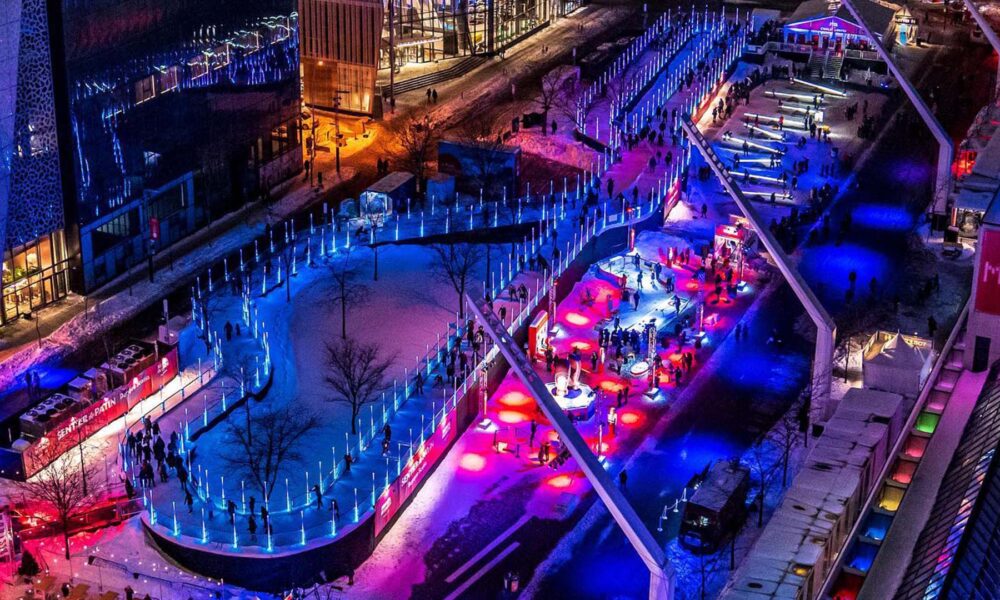
The long, gloomy days of February aren’t for the faint of heart. But, amid the never-ending winter, Montreal brought some life and light—quite literally—back to the city. On Feb. 16, Montreal’s Quartier des Spectacles opened its doors to Montréal en Lumière, welcoming teenagers, students, and parents looking to keep themselves busy over spring break. 

Located steps away from the Place-des-Arts metro station, this 18-day-long festival included an array of events catered to foodies, concert lovers, and outdoor-activity fanatics. Skating rinks, concerts, shows, DJ booths, food trucks, and outdoor exhibits lined the intersections of Jeanne-Mance, Balmoral, St. Catherine, and de Maisonneuve Ouest. Most of the outdoor activities were free and open for hours on end, making the festival accessible to those with varying schedules. And, for students like myself, with a small budget and some extra time to kill during Reading Week, this was the perfect occasion to ditch the books and get a taste of Montreal’s cultural scene. 

Establishing an action plan prior to my arrival would’ve been appropriate considering the festival’s popularity, but, alas, it had completely slipped my mind. As I wandered into Place des Arts at 9 p.m., skates in hand, my friend and I were baffled to see how the length of the queue for the skating rink—or skating “loop,” as it was described—rivalled that of McGill’s Activities Night and how, by 10 p.m., it seemed to be primarily composed of eight to 12-year-olds. After much shivering and endless back-and-forths between the rink and the central fire pit to warm up, we finally made it onto the main rink.

Most of the fun had less to do with the actual skating—or participating in any given activity—and more to do with simply enjoying the ambiance. MingXi Gu, U1 Science (and first-timer at Montréal en Lumière) quickly came to realize this. 

“I’ve never seen the city so lit up,” he said. “The energy was amazing—the lights and music truly made the city feel magical.”

Braving the cold and the interminable lines called for a must-needed wintery treat—good thing for Beaver Tails, Tim Hortons, and the event’s signature maple taffy. Although $9 for a Beaver Tail seemed a little bit pricey, nothing beats the feeling of wolfing down a piece of Nutella-coated fried dough after shivering in the -13-degree-Celsius weather for a few hours.

Beyond the radiating energy of the festival, what was most enjoyable was getting outside in the wintertime, which can otherwise be very difficult. Colder temperatures are often an excuse to stay indoors, but Montréal en Lumière’s objective was to make spending time outdoors more appealing to all, despite the colder temperatures of the season. The festival’s various activities and creative ways of keeping participants warm was its way of doing just that.

“Despite people’s general lack of motivation and the season being so dreadful, everyone really came together to make Montreal feel alive again,” Gu shared.

For locals, Montréal en Lumière is an excellent reminder of all the city has to offer and the benefits of getting outside and enjoying the wintertime, even when it seems impossible to do so. But, for international students, it can provide even more—an understanding and appreciation of the city and its culture beyond the few neighbourhoods surrounding McGill’s downtown campus. Conveniently located and low-cost, Montréal en Lumière is a pit stop for those looking to combine fun, accessible, affordable, and creative pastimes. 

Unfortunately, the festival—with all of its shimmery lights and loud music—came to an end on Sunday. But, for those who missed out or who are looking for a similar taste of Montréal en Lumière, the city has similar—albeit warmer—events lined up in the upcoming months, including Quebec’s International Film Festival, starting in April, the Jazz Fest, which kicks off on June 29, along with its comedy-centred Just for Laughs festival, which takes place in July.

McGill, News

Open letter urges McGill to make statement about devastating earthquake in Türkiye and Syria

A 7.8 magnitude earthquake hit northern and western Syria and south central Türkiye on Feb. 6, claiming an estimated 50,000 lives, injuring an estimated 100,000, and causing tremendous damage in a region already struggling through the more than a decade-long Syrian civil war and subsequent refugee crisis. Millions of people have been displaced, humanitarian aid has been limited in Syria, and health-care services are scarce as several hospitals and clinics collapsed following the quake. 

In light of the devastating earthquake and aftershocks, students and professors in the McGill community have rallied to support those affected.

On Feb. 15, an open letter calling on the university to issue an official statement of support for people in Türkiye and Syria was sent to Interim Principal and Vice-Chancellor Christopher Manfredi. Initiated by Aslihan Gürbüzel, assistant professor at the Institute of Islamic Studies, and Ipek Türeli, associate professor at the Peter Guo-hua Fu School of Architecture, the letter urges the university to raise awareness within its community by sharing information about the main organizations trying to provide relief. The letter has since collected over 300 signatures from current students, faculty, staff, and alumni.  

Türeli explained that she and Gürbüzel did not receive any response from the Principal about the initial letter, so a follow-up was sent on Feb. 22. They then received a response from Associate Provost (Equity and Academic Policies) Angela Campbell, explaining that the administration would not be issuing such a statement. Instead, Campbell wrote that the McGill Reporter would publish an article as it would have “further reach.” 

Türeli explained that she was disappointed in the administration’s response in an email to The McGill Tribune

“The university has sent many MROs of the nature we are seeking, […] for example, in the case of the war in Ukraine, both the Principal and the Provost sent out MROs,” Türeli wrote. “The McGill Reporter article that eventually came out on [Feb.] 15 celebrates what McGillians are doing to help, and it is not about the humanitarian disaster that is unfolding [….] Why is McGill not standing in solidarity with the Turkish and Syrian universities in the affected region?”

McGill media relations officer Frédérique Mazerolle informed the Tribune that following the Feb. 6 earthquake and aftershocks, the Office of the Dean of Students reached out to all Turkish and Syrian students to offer support and share resources that they can turn to in case they require help. 

“The health and well-being of our community remain our top priority,” Mazerolle wrote. “The University continues to amplify the efforts made by members of our community to collect donations for survivors in the area by sharing them through our channels.”

Berfin Simsek, a Turkish U2 Arts student, explained that she felt “let down” and “uncared for” by McGill because she had expected a statement of solidarity addressing the situation. 

“It makes me feel like people from my background, from where I’m from, are not worthy of their attention or time,” Simsek wrote in an email to the Tribune. “We have been struggling so much mentally and emotionally […] we needed to hear that they were there for us. We needed to feel like school was one thing we did not need to worry about. But they failed to do that.”

Gürbüzel explained that it would not be too late for McGill to issue a statement of solidarity as the crisis is still unfolding and it will take time for the region to fully recover. She thinks that an acknowledgment of support would mean a lot to affected students and members of the McGill community. 

“I believe that a statement of support that emphasizes the long-term nature of the destruction and recovery processes is going to make a strong impact now as we observe the attention and solidarity to the Turkey-Syria earthquake slowly dwindle,” Gürbüzel wrote. 

McGill, News

Arts students vote in new executives, strike down motion to raise AUS fees

Undergraduate students in the Faculty of Arts, the university’s largest of 11, voted in next year’s Arts Undergraduate Society of McGill University (AUS) executives and representatives in a ballot that ran from Feb. 20 to 24. A referendum also took place during the same period, where students decided to continue funding the McGill Journal of Human Behaviour (MJHB) but struck down a proposed AUS fee increase.

According to AUS, 1,102 people—13.1 per cent of the electorate—voted in the 2023-2024 elections. Those who did vote decided that Matthew O’Boyle, who is currently an Arts representative to the Students’ Society of McGill University (SSMU), will be the next AUS President. 

“Working between SSMU and AUS this year, I’ve developed a pretty good understanding of what powers each institution holds and how these powers can be enacted to serve the interests of students,” O’Boyle wrote by email to The McGill Tribune. “I look forward to overseeing the various portfolios of the AUS and offer my institutional knowledge to help get things done efficiently and effectively. I worked under both Adin Chan and Ghania Javed, the AUS presidents these past two years, and […] I learned a lot from both of them and am eager to carry this knowledge forward in my new role.”

Julia Widing was elected as the vice-president (VP) Finance, Suzanne Levandier as VP Internal, Sophia Weiqi Li as VP External, Lauren Hicken as VP Communications, Sarah Jiang as VP Social, and Nick Rieck as VP Academic.

Three Arts representatives to SSMU, who will sit on the SSMU Legislative Council, were elected: Keith Baybayon, Quinn Porter, and Aishwarya Rajan. Two Arts Senators, who will represent students in the faculty at the McGill Senate, the university’s highest democratic governing body, were also elected: Sophia Garofalo and Juliet Morrison*.

In addition to elections, Arts students voted on two referendum questions. According to AUS, 877 students—or 10.4 per cent of the electorate—participated in the Winter 2023 referendum.

A question regarding raising the AUS fee from $16.50 to $17.50 for full-time Bachelor of Arts (BA) students, and from $8.25 to $8.75 for part-time BA students failed, with 60.9 per cent of students voting against it. Current AUS President Javed found it “a bit disappointing” that the fee increase did not pass, explaining that the additional funds would have gone toward higher wages for AUS employees.

“The most important reason behind the fee change, or fee increase, was because of the minimum wage increase,” Javed explained in an interview with the Tribune. “So it went from $13.[50] last year to $14.25 this year. That’s what we’re operating with, and it’s going to change again in May to $15.25 [….] The fee has not been increased for years.”  

“So the meaning of this fee increase was so we could pay our staff adequately. We do have a lot of stipend and hourly wage staff […], a lot of them work anywhere from 10 to 20 hours a week.”

The MJHB fee, which was also up for a vote, was approved with 59.1 per cent of voters in favour. The student-run Journal publishes a wide array of “exemplary” work by Arts students twice a year.

“Our goal is to foster conversations that transcend disciplinary boundaries to better understand why we act the way we do,” MJHB Editor-in-Chief Sophie Cleff wrote in an email to the Tribune. “The implementation of the MJHB fee as decided by the AUS referendum will not only allow us to continue running our publication, research fellowship, and speaker series, but also expand our operations with even more ambitious projects.”

*Morrison is currently a News Editor at the Tribune and was not involved in the publication of this article.

Commentary, Opinion

How (not) to leave home

A joke of history: North America is the centre of the modern world, so it can never truly feel international. Inane metaphors––melting pot, mosaic, salad bowl––only distract from the inexorable crush of the market and the English language. Even Quebec’s vaguely nationalist slogan, “//Je me souviens//,” today feels without content, as separatist dreams dissipate into a cultural project with little imagination beyond its own borders.

But in the decrepit cradle of empire, something stirs with life. Europe, hoary and fossilized, its immortal meaning shaped by primordial violence. I return to it like a worm to mulch.

I’m going to Berlin. I’ve been “going to Berlin” for several months now; my semester abroad begins in the middle of McGill’s winter semester. My home, classmates, and partner returned to their routine after the Christmas break, but I could not––I am elsewhere, almost. I pass the time watching German television and practicing the language online. //Babylon Berlin// and //Kleo// are both fun watches set during pivotal moments: The fall of Weimar Germany and the Berlin Wall, respectively. Both are crime thrillers, and I wonder sometimes if this will shape my grasp of the language, breathing wit and intrigue into those harsh words.

In my desire to be anywhere but here, I’ve assiduously avoided the Western hemisphere in my studies at McGill. But my German is still shaky, so I’m enrolled in the Free University of Berlin’s only department offering reliable English courses: The John F. Kennedy School of North American Studies. Of course, “North American Studies” refers to the U.S. of A. Should I be offended that Canada has yet to enter history, or comforted? Here I prepare, I read Karl Marx and listen to The Threepenny Opera. In Berlin, I will study Hemingway and the New Deal at a conspicuous remnant of the Cold War. 

Walter Benjamin wrote: “The past can be seized only as an image which flashes up at the instant when it can be recognized and is never seen again.” The philosopher died later that year fleeing the Gestapo. What to make of these flashes of memory? My mother visited Poland as a young woman. She was warned to never, ever mention the trip to her grandparents. They are gone now, along with most of their generation, and their fear and fury hide in the debris. Am I a disloyal son, seeking rebirth on the graves of my ancestors? But I forget: Berlin is a city of memorials and museums, not of graves. Like any good empire, Germany exported its violence.

I leave soon. I am preoccupied with the petty business of preparation, with baggage, clothes, face creams, antidepressants, and the opaque mysticism of McGill’s transfer-credit system. It’s exhausting, of course, but what a miracle of bureaucracy! I travel across the globe and a 20-year-old paper trail follows me, all for the sake of something new. Then I will go through the same steps as I return, and McGill will snatch me back up, richer by 15 credits and half a language.

My partner and I walked through Jeanne Mance in the snow. We had said goodbye before, and have said it many times since, but we did not speak as we walked. Our hoods were up, and the snow swallowed every noise. No cars. No music. The world seemed shapeless and made new. We struggled through it with our heads down and our feet scrabbling for purchase.

A truth hides in the crime thriller: Whatever last episode’s revelation, the mystery only deepens, the cloud of cigarette smoke only grows thicker. No one really gets over anything. There will be no rebirth, no spark of newness buried with the dead, only accretion, only sediment. History collects like dandruff. When the page is saturated with ink, we continue in another colour. I leave Montreal with love and anger packed between my molecules, so I can never really leave Montreal.

Commentary, Opinion

McGill’s academic freedom policy is rude-imentary

Last April, to appease their older rural voters, the Quebec government unveiled a new policy concerning academic freedom in schools and universities: Bill 32. 

Naturally, the policy had little to do with Quebec’s rural population and very much to do with enforcing its definition of academic freedom upon universities, prompting some 130 professors to sign a petition against the bill. 

You see, central to Bill 32 is free speech, it seems, at all costs. 

To comply, McGill has drafted a new academic freedom policy touching on what you should be allowed to say (anything), trigger warnings (not compelled), and the various procedures for academic complaints (a small, secret committee). 

The draft’s biggest problem comes back to the straightforward question: How can you facilitate academic freedom without respect? 

It was the Centre for Human Rights and Legal Pluralism’s welcoming of Professor Robert Wintemute, who opposed a U.K. policy to improve the legal recognition of transgender people that really did it for me, and showed McGill’s true colours. Hiding behind “free speech” is the constant mantra of those who want to guise hate as debate. And for McGill, it’s snorting a line of danger.  

And look, being able to speak freely and question ideas must be the university’s bread and butter. But if that speech incites hate or violence, how can we expect an environment of academic debate to prosper? 

It’s at this point that Interim Principal Christopher Manfredi might throng the university’s policy on equity and inclusivity in my face. Or perhaps he’ll show off the article he wrote in The Montreal Gazette last year about academic freedom and equity going hand in hand, no doubt framed in his office. 

But not so fast, Sir. The notion that universities can defend unchecked speech while advancing equity and inclusion is a thought which didn’t get past one glass of Chardonnay. 

To defend academic freedom, equity and inclusivity guidance must be ingrained within the institution. While it’s a question of enabling freedom of speech, it’s also a question of what type of community McGill seeks to shape. And without guidance on how to create an environment where everyone can freely participate, the policy becomes nothing more than a used tissue. 

Take the recent hosting of Wintemute. He opposed the legal recognition of someone because of their identity—no different from race, sexual orientation, and place of birth. These views, first of all, violate the university’s own equity policy. Second of all, from an academic freedom perspective, it’s ludicrous to expect that those he targets will feel able to contribute to the discussion when he insinuates bigotry.   

And the real kick up the backside with McGill’s draft policy is that instead of providing direction for respect, it does the opposite. 

Point 20 in the draft states how the university will not compel instructors to provide content and trigger warnings. 

This measure, I think, is to align the university with Bill 32’s new policy. But it’s phrased all wrong. Because McGill can comply with the law and still endeavour to ingrain best practices. 

A professor shouldn’t feel like they have the barrel to the head about using content warnings. . But just like you eat with your mouth closed or don’t by way of introduction yell obscenities at strangers, giving a heads-up about a sensitive topic is good manners—and it facilitates an environment where everyone can engage freely, and from which academic freedom can flourish.  

Ingraining respect and fostering an environment of inclusivity is currently omitted from McGill’s draft, and it would be wise to rethink, or at least for the Deans to talk about it over a full bottle of wine, instead of just the glass. 

Academic freedom can only come by creating conditions where all individuals can join the discussion. Because that’s the thing—McGill’s job is not to produce academic content or discussions. It’s to facilitate them. 

Arts & Entertainment, Music

Artist Spotlight: Bibi Club shines in vibrant performance of their debut album

Bibi Club is a growing force amongst Quebec’s burgeoning alternative pop scene—a scene that has seen the likes of Men I Trust and TOPS achieve global acclaim. 

The Montreal dream-pop duo’s debut record, Le soleil et la mer, represents the most fully realized version of their sound, widening their sonic palette from the analog synths and drum machine grooves of their 2019 self-titled EP. 

“It’s not driven by performance abilities. It’s driven by instinct,” said guitarist Nicolas Basque when describing their debut album in an interview with The McGill Tribune. “Labels are tough but at the same time they help you describe what you’re doing [….] I think now indie-pop is anything that’s done in an arts and crafts way musically […] I’m not uncomfortable with that.”

The band’s music cuts through the predictability that often characterizes so-called “dreamy” music. Le soleil et la mer is marked by its dynamism: Basque’s sparkly guitars playfully interact with Adèle Trottier-Rivard’s synth lines and warm, alluring vocals, underpinned by danceable drum loops. In marrying these elements, Bibi Club’s songs resist staticism, rising and falling in swells of shimmer and reverb. Fittingly, Trottier-Rivard and Basque have also been a couple for seven years, balancing their musical lives with raising their children. 

Ahead of their Feb. 9 homecoming gig at Quai Des Brumes, Basque noted how the band enjoys presenting a heavier, more raucous version of their music live. On the night, they eased into proceedings with the track “Le Balcon,” featuring tranquil guitar-picking and wind chimes, before Basque fulfilled his end of the promise and slammed on his effects pedals and drum machines. 

“It’s a bit like listening to the record really loud,” Basque said. “There’s a more, dare I say, punkier energy.”

Meanwhile, Trottier-Rivard stood at the helm of a Prophet 6 synth, surrounded by an array of cymbals and percussion, providing an organic touch to the group’s predominantly electronic setup. The band leaned on material from Le soleil et la mer through their set, with highlights like the unrelenting beats on “La Plage” and the layered vocals and scratchy guitars on the frenetic “Femme-Lady.” The bouncy, glitched-out “Parasite” was particularly well-received by the enthusiastic crowd, morphing from an uptempo bop into a serene half-time groove, over which Basque tastefully soloed on guitar. Ultimately, Bibi Club’s performance style communicates the sense that its members thoroughly enjoy playing as a central facet of their artistry. 

“It’s never heavy in the studio when we work together,” Basque said. “We always try to find a tension between two things […] like being awake and being asleep […] we’re looking for tension but without going into a depressing, darker mode.” 

Much of the band’s playful sound has also been shaped by their schedule as a family, fitting ad-hoc improvisatory home sessions around Trottier-Rivard and Basque’s children. 

“A lot of the sparkle for a song comes from a guitar and vocals jam […] when the kids are in bed,” Basque said. “Then the shape and timbre of the song come to life in the studio.” 

Bibi Club centres community in their musical approach. The band sees the aesthetic aspects of their album art and live performances as opportunities to collaborate with Montreal creatives. They enlisted local artist and painter Mégane Voghell to produce Le soleil et la mer’s cover art, interpolating a childhood image of Trottier-Rivard behind a drum kit into an abstract painting. Such collaborations have become symbiotic, with Voghell even contributing backing vocals on “Le Matin.”

“It brought the record further than what we had done with just the music,” Basque said. “The collective work made it cooler and added depth for me […] even when I play live now, it informs a lot of the process.” 

In the future, Bibi Club plans to keep evolving their craft, and Basque is keen to explore how much minimalism they can incorporate while maintaining a rich sound. With the band returning to the studio this month, Bibi Club’s fans can look forward to hearing the fruits of this sonic experimentation shortly. 

Read the latest issue

Read the latest issue