

Latest News

Science & Technology

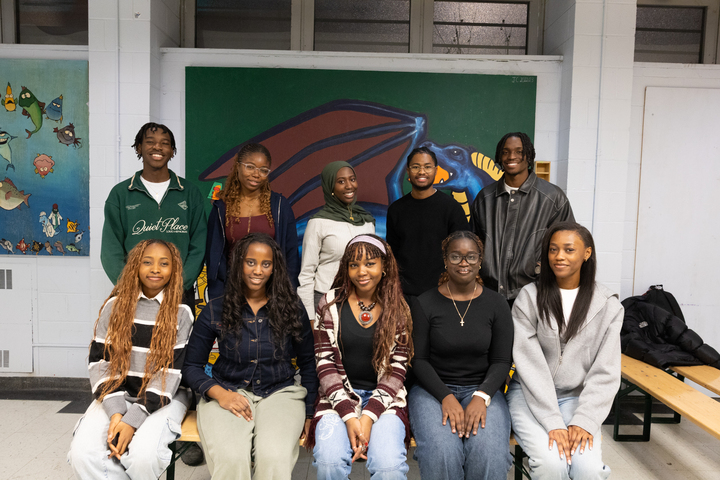
Inside McGill’s chapter of The National Society of Black Engineers

For many Black engineering students at McGill, finding community can be just as important as academic success. The McGill chapter of the National Society of Black Engineers (NSBE) aims to provide that support through camaraderie, mentorship, and leadership.

One of the students helping lead these efforts is Fatima Janneh, a third-year student in McGill’s Department of Bioengineering, and the current Vice President of NSBE McGill. Janneh has been involved with NSBE since her first year at McGill, but her connection to the organization began even earlier. While still in high school, she attended a summer program at the University of Toronto (UofT) and heard a guest speaker—then president of UofT’s NSBE chapter—talk about how the organization provided networking and professional opportunities. At the time, Janneh was interested in STEM but unsure about pursuing engineering. Seeing Black engineers, particularly women, changed that perspective.

“People of colour, Black people like me, a woman who wears a hijab—I was not seeing that in engineering,” Janneh said in an interview with The Tribune. “Other people in that panel who were also Black inspired me to pursue this career. I was 16 years old at the time. Fast forward a couple of years, and now I am in my first year of university.”

One of NSBE McGill’s most anticipated events is the Black Legacy Dinner, held annually during Black History Month. The event brings together students, professionals, and sponsors from across the Greater Montreal Area to discuss experiences in the professional world as Black individuals. This year’s dinner will take place on Feb. 16, and is themed “Yes We Can”—a reference to former U.S. President Barack Obama. The dinner features up to 100 participants and a panel of speakers from different backgrounds, including engineering, social work, philanthropy, and startups.

Janneh also discussed how NSBE’s internal culture plays a central role in its impact. General meetings include informal discussions about members’ weeks and shared experiences, alongside event and logistic planning, which helps create an environment where members feel comfortable speaking openly.

NSBE McGill collaborates regularly with other Black student organizations at McGill, including the Black Student Network, the African Students Society, and the Caribbean Students Society. These collaborations aim to bring together different Black student communities at McGill through social and cultural events.

NSBE McGill is also connected to other chapters across North America. Each year, members attend the NSBE Convention, which brings together more than 10,000 students. This year’s convention will take place in Baltimore from March 17 to 22. The event offers networking opportunities with major companies and allows students to connect with peers from other chapters. Additionally, NSBE McGill participates in the East Canada Zone conference and was recently named Chapter of the Season for its involvement in student life.

While NSBE McGill has grown since its founding in 2005, Janneh noted that challenges related to representation remain.

“When I walk in a room, not many people will know the feeling of being a Black student. The Black identity can be very different for others [….] There are certain prejudices that people might have in their minds but that they will never voice, though you can still feel them,” Janneh explained. “In the past, NSBE had to struggle with visibility and member count. But now, every single year, I see it grow more.”

Janneh stressed that her presence at McGill is tied to a broader sense of responsibility.

“I am here for more than just my degree. I am here to learn, grow, develop my skills [….] There is a pressure on me to be able to grow. I know my parents came here for us to have a better education, for us to have a better future. I can’t just throw this down the drain.”

To first-year students who may be questioning their place in engineering, Janneh offered one piece of advice: Avoid isolation.

“Just because you do not see representation in your class does not mean you won’t find representation anywhere else. I know it is difficult to go to those events when you don’t know anybody, but reaching out will bring you where you need to go.”

Student Life, Student of the Week

Student of the Week: Aya

In February of 2025, following the completion of her honours-level Bachelor’s degree in clinical nutrition in Gaza, Aya was admitted to McGill’s M.Sc. thesis program in Human Nutrition. Now, a year later, she remains trapped in Gaza, unable to provide the necessary biometric data to complete her application. 

Because of limited border crossings in Gaza under Israel’s genocide and the lack of a visa application centre (VAC) in Palestine, Aya was forced to defer her admission to McGill to the Winter 2026 semester, and then again to the Fall 2026 semester. With the former now well underway, she has yet to receive the support she needs to provide her biometrics. This would result in a third deferral, after which she will lose her offer of admission. 

“This opportunity [to attend McGill] represents years of hard work finally being recognized,” Aya said in an interview with The Tribune

Aya is one of 130 Palestinian students who have been accepted into Canadian universities but remain barred from travel to begin their studies; 70 of these students, like Aya, are trapped in Gaza even after the ceasefire, while 30 have evacuated to Egypt.

The biometric requirement that holds Aya in Gaza has already been circumvented by a number of countries—including the United Kingdom, France, and Ireland. These countries have all established programs to either evacuate students to Egypt or Jordan to obtain biometrics, or to waive the biometric requirement entirely, with the understanding that students in Gaza face exceptional circumstances and cannot be held to standard visa stipulations. In 2022, under this same logic, Canada—rightfully—waived the biometric requirement for some Ukrainians fleeing Russia’s war in their country. The same support has not been extended to Palestinian students.

“I know students who got scholarships from other countries and [have] been evacuated and started their degrees, but there’s [still] no action [from the] Canadian government to help us get evacuated from Gaza,” Aya said. 

While awaiting political action from the Canadian federal government and Immigration, Refugees and Citizenship Canada (IRCC), Aya is working full-time as a nutrition officer with an international non-governmental organization (NGO). 

Though the famine has subsided, malnutrition persists in the Gaza Strip as food remains expensive and insufficient—a scarcity created and upheld by Israel’s continued restriction of food supplies into the region. Her days involve supporting malnutrition screening, food distribution, and medical treatment, while her evenings are spent taking independent online courses to supplement her work. 

“Living in Gaza, we continue to struggle under extremely difficult conditions, as there is still severe food insecurity [….] A lot of children and pregnant, lactating women are malnourished. The struggling is still the same,” Aya explained. “Even when food enters Gaza, prices remain extremely high, converted to before the genocide, and most families have no source of income.” 

From Aya’s nutritional perspective, the food in Gaza is not just deficient in quantity, but also in quality. 

“Even what enters Gaza is for commercial use, a lot of snacks, a lot of […] energy drinks,” Aya said. “It’s not high-quality food, [like] vegetables and fruits, to resolve the malnutrition impact in children, in elderly people.”

In Gaza, expertise in clinical nutrition like Aya’s saves lives. By failing to facilitate Aya’s education and research at McGill, the Canadian government and IRCC are denying a lifeline to those in Gaza, where Aya plans to return after her studies. 

“These delays affect far more than one individual future,” Aya said. “When opportunities like these are lost, the impact extends to [the] entire community, as my goal has always been to return and help my community in Gaza.”

For Palestinian scholars in Gaza today, education is not so much a personal undertaking as it is an imperative responsibility to their Palestinian homeland and those who remain in it. 

“That’s why we are looking for this opportunity,” Aya said. “It’s not a choice. It’s mandatory to have a good education.”

The future of Gaza lies in academic expertise capable of rebuilding from the ground up. 

“Supporting our ability to study,” Aya said, referring to all prospective Palestinian students and scholars, “is also an investment in the future recovery and resilience of our community.”

Science & Technology

How systemic barriers hinder the integration of African immigrants in Quebec’s labour market

Immigrants contribute significantly to Canada’s socioeconomic growth in undeniable ways, yet many of them are excluded from job opportunities for reasons unrelated to their qualifications. A complex interplay of racial discrimination, social isolation, and systemic inequalities shapes the experiences of Highly Skilled African Immigrants (HSAIs) joining the workforce. This raises a pressing question: Despite arriving with strong educational backgrounds and adequate training, why do HSAIs remain so alienated from the labour market?

In a recent publication in the Journal of International Migration and Integration, Jacob Kwakye, a PhD candidate in McGill’s School of Social Work, examined the experiences of HSAIs in the Quebec labour market. He hopes his findings can shed light on the systemic racism Black communities face and inform policy-making moving forward.

“[The] majority of the findings in the study had to do with racial perception,” Kwakye said in an interview with The Tribune. “Although Canada is doing its best and Quebec has a lot of policies in place that try to address issues of racism, there are still certain issues that are perpetuating these kinds of perceptions.”

Kwakye’s study interviewed 16 participants using a qualitative approach, intentionally focusing on those who spoke different languages, held a Bachelor’s degree or higher from a Canadian or African university, and had lived in Quebec for three or more years.

“We’re just trying to look at meaningful narratives, and to be able to get those, you need to reduce the sample size in order to get in-depth knowledge from your participants,” Kwakye explained.

While language barriers were shown to play a role in HSAIs’ reduced ability to gain employment, racial biases held a more significant influence: Racism usually overrides language proficiency in the decision to hire HSAIs.

“The issues of language [as a barrier] also came up because, for the Quebecois context, the language is predominantly French. [The] majority of the participants stated that yes, language is a concern, but it does not supersede issues of racial perception.”

Kwakye also discussed how having a Bachelor’s or Master’s degree still puts them at a disadvantage when looking for work.

“They feel that they are more overqualified [than what the job demands] and that employers feel that because of their higher qualifications, they will not be able to engage them at the workplace,” Kwakye said. “So it’s either you need to reduce your qualifications in order to match the portfolio that is being advertised, or you must hide some of your qualifications to be able to be considered for a particular position.”

The study also revealed that the labour market favours the skills of those with local roots—an upsetting yet unsurprising finding given that it has always been easier for individuals born in Quebec to integrate into the workforce.

“When [HSAIs] are not able to conform and don’t understand the cultural dynamics, they will not be able to fit into these workplaces,” Kwakye said.

Kwakye also highlighted a participant’s experience in the workplace, where biases, racial discrimination, and assumptions about cultural competence directly affected HSAIs’ professional credibility.

“One lawyer said that sometimes some of the Quebecois clients felt unsafe to bring their matters to them or felt that they would not be the best person to help solve their problem, because they perceive [HSAIs] to not understand the Quebec context.”

As Quebec continues to rely on immigration to address employment shortages, Kwakye’s study highlights the contradiction of Quebec’s labour market—a system rooted in discrimination, perpetuated by systemic barriers, yet dependent on immigrant talent. 

Addressing these dynamics is important to create awareness and influence policy-making that does not disadvantage Black communities. Moreover, creating more equitable hiring practices and recognizing foreign credentials as valuable is a critical step to help prevent HSAIs’ exclusion from the workforce. 

Arts & Entertainment, Exhibition

‘Aunties’ Work: The Power of Care’ spotlights Black matriarchs

In many Black communities, ‘auntie’ is not just a family title, but a mark of respect given to women who serve as pillars of their community, regardless of blood ties. They serve as nurturers and mentors to the youth, creating protected spaces where members of their community can dare to dream. Though their labour often goes unacknowledged, its impact is deeply felt by their loved ones. Aunties’ Work: The Power of Care at the McCord Stewart Museum, created by fashion designer and researcher Nadia Bunyan, honours the resilient care networks forged by these matriarchs in Montreal’s Black communities. 

As the founder of Growing A.R.C., a nonprofit that builds community through interaction with material culture and sustainability practices, Bunyan designed the exhibit to embody the core values that guide her work. She made community collaboration central to her creative process, working closely with Montreal’s Black community. Through 21 audio interviews, Bunyan invited members to share their own experiences with their aunties and reflect on the impact of their care. This process gave her a clear understanding of how these figures keep their community united through acts of love and care.

The exhibit’s first section, “Bodies of Care,” features three spotlighted mannequins, each representing a different decade: the ‘70s, ‘80s, and ‘90s. Bunyan explained in a conversation with Alexis Walker, hosted by the museum, that the mannequins and their placement recreate the comfort and safety of entering a room and being greeted by one’s aunties. A lace doily motif decorates the wall behind the mannequins, a detail Bunyan’s interviewees consistently recalled seeing in their aunties’ homes. As a result, the doily motif appears in every section of the exhibit. The mannequin embodying the ‘80s wears a yellow blouse and pants ensemble that once belonged to Bunyan’s mother, adding a personal touch to the installation. 

The “Materialities of Care” section displays borrowed belongings, including garments, books, and CDs, revealing how Black matriarchs influence different facets of life for their loved ones. A touchscreen also allows visitors to gain further insight about the pieces—their source, the stories they tell, and their cultural significance.

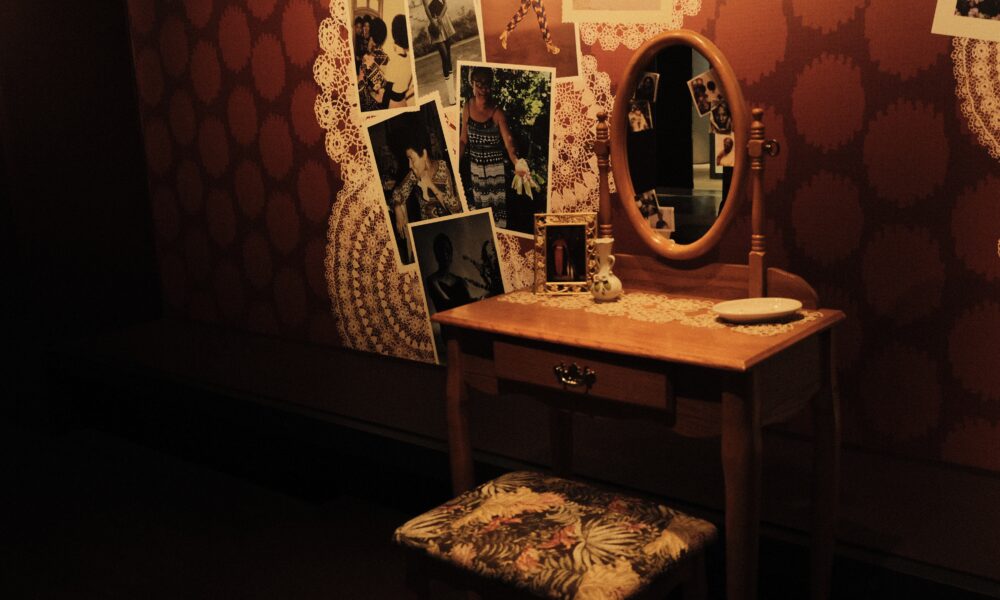
A vintage vanity anchors the “Reflections and Continuity of Care” section. The piece sits within a halo of pictures of various aunties, dating from the ‘70s to the present day, creating a sense of being watched over by these nurturing figures. The vanity’s mirror reminds visitors that they, too, are a reflection of the work of aunties and invites them to consider how they can continue the cycle of care for the generations to come.

Lastly, the “Discussions of Care” section features a video projection of a roundtable discussion between some of Bunyan’s interviewees. As one walks through the exhibition, the voices of community aunties and of the people who have directly felt the impact of their care can be heard. In the interview clips, they share their fondest memories with these matriarchal figures. 

Bunyan’s overall work also touches on a social, cultural and political facet of Black communities. While the selected pieces represent symbols associated with aunties, they equally reflect the respectability politics present within the Black community, under which the social scrutiny Black people face manifests in a concern with self-presentation. However, through the love and care that the aunties impart, this deep attention to their appearance shifts into a sense of pride surrounding their identity.

At the end of the exhibition, a private nook offers notebooks and pens for visitors to write down their own reflections on how aunties have shaped their personal lives. Bunyan explained that this section positions itself as a contrast to the ephemerality of art expositions. Through the words on the pages, the experience of the exhibit is immortalized.

Aunties’ Work: The Power of Care runs until April 12, 2026, at the McCord Stewart Museum, located on rue Sherbrooke.

Sports, Winter Sports

Team Canada’s medal makers: Five stories to watch in Milano-Cortina

From frozen rinks to mountain peaks, Team Canada’s brightest stars are preparing for their biggest stage yet. At Milano-Cortina 2026, these five athletes and teams carry not only medal hopes, but years of sacrifice, resilience, and pride.

Connor McDavid and Men’s Hockey

For more than a decade, Olympic men’s hockey has been missing its brightest stars. This year, in Milano-Cortina, National Hockey League (NHL) players are finally back—and no performance is more anticipated than Connor McDavid’s. After watching from afar in 2018 and 2022, the world’s most electrifying player will finally don the maple leaf on the sport’s biggest stage, alongside fellow superstars Nathan MacKinnon, Nick Suzuki, and Cale Makar.

For a generation raised on Sidney Crosby’s golden goal, this tournament signals a new era. Canada enters as a favourite, with a likely showdown against the United States looming. McDavid’s Olympic debut gives him a chance to define his legacy beyond the NHL and lead his country when it matters most.

Marie-Philip Poulin and Women’s Hockey

When the pressure is highest, Marie-Philip Poulin rises like few can. The Canadian captain remains the only hockey player—men’s or women’s—to score in four Olympic gold-medal games. Her two goals in the 2022 final against the United States secured her third Olympic title and reaffirmed her ‘Captain Clutch’ reputation.

She arrives in Italy alongside dozens of Professional Women’s Hockey League (PWHL) players, representing a new era of women’s hockey since the league’s inception in January 2024.

Since women’s hockey debuted in the 1998 Nagano Olympics, gold has never left North America. Nearly every final has been a Canada-USA showdown, decided by inches and nerves. 

Canada will once again chase greatness in women’s hockey’s fiercest rivalry with Poulin at the helm.

Flag bearers Mikaël Kingsbury and Marielle Thompson

Few athletes embody sustained excellence like Mikaël Kingsbury. The most decorated male moguls skier in World Cup history, he arrives with three Olympic medals, nine world titles, and 100 World Cup wins—yet still chases perfection on every run.

Alongside him stands Marielle Thompson, one of ski cross’s most consistent and courageous competitors. Since winning Olympic gold in 2014, she has remained a fixture on podiums around the world, collecting more than 70 career top-three finishes and multiple Crystal Globes.

Chosen as flag bearers, Kingsbury and Thompson represent longevity, resilience, and relentless ambition. In sports where one mistake can end everything, they have remained elite through injuries, pressure, and changing generations. In Italy, they carry not only the flag, but a deep legacy of Canadian winter sport excellence.

Ski half-pipe phenom Cassie Sharpe

Cassie Sharpe’s return to elite skiing is one of Team Canada’s most inspiring stories. The 2018 Olympic halfpipe champion and 2022 silver medallist stepped away to become a mother, unsure if she would ever return.

Two years later, she is back and thriving. In her first season returning, Sharpe earned World Cup podiums, won X Games gold for the first time in six years, and became the first mother to claim the title.

With her daughter watching from home, Sharpe now competes with renewed purpose. Her journey reflects both the unseen challenges athletes face and the courage it takes to chase greatness again.

Figure skaters Deanna Stellato-Dudek and Maxime Deschamps

At an age when most figure skaters have long retired, Deanna Stellato-Dudek is just getting started. In 2024, alongside partner Maxime Deschamps, she captured Canada’s first world title in pairs skating in six years. She completed this feat at age 40.

Once a teenage prodigy, she was forced into early retirement by injuries. Years later, she faced a defining question at a 2016 retreat: What would she do if she could not fail? Her answer—win Olympic gold—pushed her back onto the ice weeks later to begin training in pairs.

After moving to Montreal, the duo steadily climbed the ranks before breaking through on home ice in 2024. Their story is proof that perseverance has no expiration date.

Off the Board, Opinion

A love letter to ‘Tribune’ haters

Content warning: Mention of The Tribune and its absolutely horrible takes

I cannot count on one hand the number of times I’ve mentioned that I’m an editor at The Tribune, only to receive an eyeroll. In fact, there is a Reddit discussion post that affectionately calls our paper the “least terrible of the bunch.” I get it: If you think The Tribune isn’t perfect, I can assure you that you’re not alone. Whether you fall asleep at night dreaming of our next issue, or you walk past our newspaper stands on campus muttering something PG-13, I must thank you—at least you’re paying attention.

A campus paper that only affirms what you already believe or want to believe is not a newspaper, but a propaganda machine. The Tribune exists to challenge and question the status quo. Even if you don’t agree with us, your criticism sharpens our perspective, and your hostility does not derail us from continuing to write and uncover unspoken injustices.

Nonetheless, this doesn’t stop some from criticizing us for being ‘selectively aware,’ that we care loudly about some issues while staying silent on others. But I implore you to consider: We have, usually, 27 pieces to publish in print every week. Every issue is a matter of editorial judgement. To select one story over another is the nature of journalism, not ignorance toward other injustices. 

We must choose carefully what we cover if we want to maximize our leverage in the community. While geographical distance does not make global injustices matter any less, The Tribune’s inherent job is to cover stories of interest and impact to the McGill community. When we write about McGill’s complicity in Israel’s genocide in Palestine, it’s because we know the student empire has the power to influence institutional behaviour. When we write about McGill’s inadequate efforts in reconciliation, it’s because we recognize our paper has the power to inform students about McGill’s lacklustre initiatives.

And when we receive your criticism, it urges us to reconsider our journalistic angle. Not only does your attention direct us to what the community cares about, it informs us of where our coverage succeeds and where it falls short. This way, we can sharpen our lens and take responsibility for our choices.

And then comes the accusation that we are a biased paper. There’s no disagreement there—bias is a prerequisite to journalism. Stories carry perspective, perspective carries judgement, and judgement contains bias. The Tribune is inherently biased, and so are other media outlets—even if they claim honest reporting.

There is no unbiased reporting. We are biased, and we are proud of it. As a matter of fact, our Anti-Oppressive Mandate clearly states that “we centre anti-oppression in our coverage, our editorials, our hiring, and our workplace practices.” But this is more than a badge we wear; it is a commitment to holding ourselves accountable to readers. Our mandate demands ongoing reflection, compassion, and a willingness to recognize that harmful biases exist—and that our paper strives not to perpetrate those biases through our words, or replicate them through the stories we choose to platform. Our mandate is a responsibility, not just a slogan.

Now you may ask, whose side are we on? The truth is, we don’t glorify anyone or anything for that matter. But we do stand with those who have been silenced or sidelined. Those that the mainstream media institutions have neglected or ignored. Those who were systemically oppressed. And, cliché or not, history is—after all—his story. It is up to us journalists to disrupt this narrative and make it their story—by listening, reporting, and frontlining accountability.

If you have made it this far, I would like to seize the chance, one last time, to say thank you, from the bottom of my heart. Loving The Tribune doesn’t require agreeing with every headline—I know I don’t. It doesn’t entail trying to out-woke everyone. Loving The Tribune simply means caring enough to stay engaged.

After all, we are a newspaper, not a dictatorship. We didn’t ask for unconditional agreement, just engagement.

McGill, Montreal, News

Indigenous justice workshop explores Indigenous rights and activism in the Americas

McGill Faculty of Law’s Centre for Human Rights & Legal Pluralism (CHRLP) hosted a workshop titled “Revitalization of Indigenous Justice in the Americas” over Zoom on Thursday, Jan. 29. The event featured three speakers active in Indigenous rights advocacy, including attorney Elizabeth Olvera Vásquez, McGill BCL/JD candidate Tarek Maussili, and Peruvian grassroots organizer Elsa Merma Ccahua

The event explored the meaning of justice for Indigenous Peoples in the Americas, with a focus on community responsibility, the relationship between land and life, and collective repair. The speakers examined how these concepts exist in the context of marginalization, capitalism, and land dispossession, with an emphasis on current Indigenous efforts to challenge these systems of power. 

Vásquez began the discussion by emphasizing the importance of Indigenous communities being familiar with their family origins and history. She explained that, through an understanding of family history, Indigenous people can more effectively integrate into their communities.   

“It is important [for Indigenous people] to know that their children are part of the community itself, because they know [their family] background will imply responsibility in a determined moment,” Vásquez said. “So it is important to know where to find that.”

Maussili continued the talk by criticizing Canadian society’s treatment of Indigenous Peoples, using his childhood as an example of the country’s historic and continuous erasure of Indigenous cultures and identities.

“Being Indigenous in Canada was never a good thing up until 2015 or 2016. I went through high school and I finished around 2015 and I remember being Indigenous was the most horrible experience,” Maussili said. “You’re treated as subhuman. You’re not treated with respect, and this is still the case today. Justice means reclaiming our identities and reclaiming our strength as a people. We’re losing our position in this country as Indigenous people from our respective nations. This is the goal of Canada, to assimilate our people, to dispossess us of our lands.”

He expressed the need for the younger generation of Indigenous people to get involved in activism, stressing the vitality of broader action against Canada’s attitude towards Indigenous rights. 

“Getting the youth active is something that I would like to see for our people,” Maussili said. “When I was in Peru, I saw the youth and all the young activists getting involved in protesting against the government and asserting their rights, and that sort of thing is what we need to see here in Canada [….] You can still clearly see that it’s not in Canada’s best interest to assert or to respect Aboriginal rights and titles. The future doesn’t really look good for us if we continue down this path.”

Ccahua spoke next, underlining the central role of land and territory in holding Indigenous communities together in the face of corporate advancement.

“We have been fighting with a mining company for many years,” Ccahua said. “I belong to an impacted and affected community, and we have a very long history. For our people, justice is defending [our] territory, water, and life. We live in a productive community that lives off the [land], and [our people] see those products as capital for their daily living and for supporting their families.”

She concluded the workshop by stressing the role of Indigenous activism as a tool for autonomy against governmental agendas of cultural assimilation.  

“In spite of all of the negative [experiences] our communities have gone through, I strongly believe that something that continues to be very present is resistance and the ways of resistance in which communities have found their own political [and] judicial strategies,” Ccahua said. “Why speak about Indigenous justice? It enhances the self-determination and autonomy of Indigenous Peoples.”

Montreal, News

MAW hosts roundtable discussing Bill 94’s violation of human rights

On Jan. 27, Muslim Awareness Week (MAW) hosted a roundtable on the dangers to civil liberties that Bill 94—passed in October 2025—would bring. 

Quebec lawmakers allege that Bill 94 is intended to reinforce secularism in the Quebec education system and bring several legislative reforms. The bill requires any worker providing services to students, as well as students themselves, to keep their faces uncovered within public or private institutions, and to refrain from wearing any visible religious symbols. This restriction does not apply to coverings worn for medical reasons or by people with disabilities.

The author of the bill, former education minister for the Coalition Avenir Québec (CAQ) Bernard Drainville, argues that these measures are meant to promote Quebecois and democratic values such as gender equality and a secular state.

The roundtable convened at the Centre communautaire de loisir de la Côte-des-neiges and was composed of three panellists: Ligue des droits et libertés Coordinator Laurence Guénette, Professor of Law at the Université de Québec à Montréal (UQÀM) Ndeye Dieynaba Ndiaye, and UQÀM Political Science Master’s student Nour Amjahdi. The panel was overseen by MAW President and Co-Founder Samira Laouni

Laouni began by acknowledging the ninth anniversary of the Jan. 29 mass shooting at the Islamic Cultural Centre of Quebec City, emphasizing the importance of fighting Islamophobia. She then introduced the main concern with Bill 94, noting that it excludes Muslim women from working in the public sector, given that many of them choose to wear hijabs for religious and cultural reasons. 

“While pushing the fundamental value of gender equality, [the government] is violating the right to work of certain women,” Laouni said. “How can gender equality be achieved without the financial independence of women?”

Laouni then passed the microphone to Guénette, who began with an assessment of the Quebec government’s actions since the Act respecting the laicity of the State (Bill 21) was passed in 2019. She noted that Bill 94 expands the restrictions of Bill 21, and adds to the existing violations of certain marginalized groups’ rights. 

“The religious neutrality of the state [is] meant to allow everyone to practice their religion freely without fear of compromising their convictions and with respect to the right to equality,” Guénette stated.

She continued by explaining that the CAQ adopted Bills 21 and 94 despite opposition from several feminist and human rights organizations. She also noted that the restrictions on face coverings in Bill 94 represented flagrant violations of both the Canadian and Quebec Charters of Rights and Freedoms. Guénette ended by warning that the CAQ’s use of the notwithstanding clause to override constitutional protections should worry everyone in society. 

Next, Amjahdi discussed how she was directly impacted by the ban on face coverings. After Bill 21 was passed, she could no longer teach music as she had intended. More recently, she lost her job leading a children’s choir because of Bill 94. 

“It was very violent,” Amjahdi said.  “I was quite lost and my life turned upside down. I felt that my identity was shaken. This law put an end to my musical identity.”

Amjahdi explained that, despite being a product of the Quebec francophone school system, she now questions her identity as a Quebecoise. She concluded by calling for allies of the Muslim community to join them in protesting these bills. 

Dieynaba Ndiaye, the fourth panellist, discussed the importance of speaking out against constitutional injustices.

“In certain societies [like Quebec], filing grievances has an important moral value. We must do it when rights are violated in Quebec,” Dieynaba Ndiaye affirmed. “We have the Commission des droits de la personne et des droits de la jeunesse.”

According to Dieynaba Ndiaye, Bill 94, along with several other pieces of legislation, represents a rupture of this social contract. 

“It’s very important [to understand] that people come here with competencies, with experience,” Dieynaba Ndiaye said. “People choose Quebec just as Quebec chooses people.”

*All quotes were translated from French.

Out on the Town, Student Life

Must-try Black owned restaurants in Montreal

As we celebrate Black History Month, it is important to recognize the vast ways to support and uplift the Black community in Montreal, not just in February, but year-round. One way is to explore the cuisine of Montreal’s many fantastic, diverse, Black-owned restaurants.  With this in mind, The Tribune has curated a non-exhaustive list of Black-owned restaurants to kickstart an exploration into all that Montreal has to offer. 

Lloydie’s

Lloyd Tull first opened Lloydie’s in the early 1990s, bringing Caribbean flavours and his famous Jamaican patties to the Quebec culinary scene. While Lloydie’s has since greatly expanded, it remains a family-owned Montreal institution. Today, the restaurant is managed by Tull’s son, Nathan, alongside his childhood friend Julian Chemtov. Taste classic Caribbean delicacies at two locations, one in Saint-Henri, and the other in the core of the Mile End. Their menu is simple but classic: Plantains, oxtail, and jerk chicken. Try their jerk chicken poutine for a delicious fusion of Quebecois and Caribbean flavours. And if you can’t get enough of Lloydie’s classic Jamaican patties, find them frozen in a series of local grocery stores

Restaurant Queen Sheba

If there is anything students yearn for in the depths of Montreal winter, it’s a warm family-style meal. Find respite and cure homesickness with a trip to Restaurant Queen Sheba for a nourishing Ethiopian meal. Located at the intersection of av. du Parc and av. du Mont-Royal with a range of vegan options and an array of braised and stewed meats, Queen Sheba has something for everyone. Enjoy one of their many shared tasting menus that blend vegan and non-vegan options, and connect with others in the most rewarding way—over a warm meal.

Chef Paul Toussaint

The culinarily diverse Time Out Market is home to an authentic Haitian restaurant, Chef Paul Toussaint, named after its founder,  Paul Toussaint. Find shelter from the Montreal winter there with the tastes of corn, yuzu, and lime—all found in a fresh ceviche for $16 CAD. If seafood isn’t your fare of choice, try their griot sandwich or goat curry. A mere 5-minute walk from McGill’s downtown campus, escape to the tropics by treating yourself to an elevated lunch out in between lectures. Once hooked on Toussaint’s cooking, check out one of his other restaurants scattered throughout downtown Montreal and Little Italy.

Kwizinn

Kwizinn Vieux-Montreal is in the heart of old Montreal, offering a fusion of classic Caribbean flavours and modern culinary methods for a menu that is both authentic and innovative. Order their octopus carpaccio, served on a bed of grilled guacamole and topped with a habanero and ginger sauce, to truly appreciate their creativity. In addition to dinner, Kwizinn offers brunch on the weekends, jazz nights every Thursday from 6:00 to 9:00 p.m., and a late-night DJ on Saturdays and Sundays. Kwizinn is also home to a not-so-secret speakeasy that’s available for private events, and is awaiting the opening of a food truck in April 2026.  

Le Virunga
A previously recommended Tribune pick, Le Virunga brings vibrant Congolese cuisine to the table with fresh Quebec produce. Chef Maria-José de Frias and her daughter Zoya have built an intimate and delicious restaurant where Congolese spices produce the ultimate Montreal fine-dining experience. For a mouth-watering meal, start with the seared walleye fillet that comes with mashed cassava and an eggplant mousse, and try the guinea fowl leg confit as your main. Le Virguna was a 2025 Michelin guide pick, and features a 100 per cent South African wine list. While a more expensive option, Le Virguna is certain to provide an unforgettable culinary experience.

McGill, Montreal, News, PGSS, SSMU

PGSS members lose access to Free Lunches Program

On Jan. 19, the Students’ Society of McGill (SSMU) revoked Post Graduate Students’ Society (PGSS) members’ access to the Free Lunches Program. This decision follows PGSS executives opting out of the meal fee, which previously went towards the now-closed Midnight Kitchen (MK), but since closure has gone towards the program. Postgraduates previously paid $2 CAD per student per term, while undergraduates pay $8 CAD. 

In a written exchange with The Tribune, the PGSS executive team declined to comment on the motivation behind their decision to suspend the fee or the state of ongoing negotiations.

SSMU President Dymetri Taylor explained in an interview with The Tribune that discussions between the two student societies led to the suspension of the fee, stating that PGSS felt they should have been consulted in the decision to close MK. 

According to Taylor, PGSS cited the change in structure from MK to the new Free Lunches Program as their reason for suspending the fee. PGSS executives informed McGill of this decision. In response, the university responded that PGSS executives could not unilaterally decide to opt-out without their members’ say-so. This led to a compromise wherein PGSS would not collect the fee until May 18, when the results of a referendum moving to permanently suspend the meal fee are announced. 

“Because there was a reorganization planned for that service, for the provision of meals to be increased and continue to be provided, the SSMU at the time believed that there was no incentive to reach out to PGSS about it. It’s a change of the service, but it’s not a removal of it,” Taylor said. “So, [the PGSS] had a meeting with the [SSMU] executives, in which case they had a riveting discussion to say the very least. And there was certainly some interesting perspective shared by PGSS regarding Midnight Kitchen and the reorganization, so that has led to them wanting to remove the fee in general.”

Upon learning of PGSS’s final decision to suspend the fee, Taylor put forward a motion during the Jan. 15 Legislative Council meeting to restrict PGSS members’ access to the program and the SSMU food pantry. He stated that it is in the best interest of undergraduate students to stop subsidizing the cost of free lunches without a contribution from PGSS. The motion was passed unanimously. However, SSMU Vice-President (VP) External Seraphina Crema-Black later proposed an amendment to allow PGSS members to retain access to the food pantry until the referendum results are announced.  

Crema-Black explained the motivation behind this amendment at the Jan. 20 Board of Directors meeting, stating that discussions with PGSS Secretary-General Sheheryar Ahmed and SSMU’s in-house council led her to believe a compromise was reachable.

“I want to know whether that’s something that they would consider before we pull access, especially because it’s used disproportionately by PGSS members, and food insecurity is a very important issue,” Crema-Black said. “I think I will be doing right by the company in my capacity as VP External, knowing that we’ve been talking to PGSS.”

An email motion granted the amendment, allowing PGSS members to continue accessing the food pantry for the remainder of the Winter 2026 semester. 

Students are now mandated to provide McGill identification proving that they are undergraduates before accessing the Free Lunches Program. If the motion to annul the fee fails, postgraduate students will again have access to these services but will have to pay an $8 CAD per-semester fee in order to match the contributions made by SSMU members. 

Taylor told The Tribune that removing PGSS access to the daily free lunches is the required course of action until the referendum, as the program will have less funding due to the executives’ decision to suspend their fee. Without funding from PGSS, the program cannot serve as many students as it does currently.

“[The PGSS executives] believe that it is better that no fee should exist and that their students should not have access to a meal service that’s recurring every day of the week, […] especially because the PGSS has no plans to institute any food accessible initiatives of their own at the present time,” Taylor said. “And now it’s up to their members to decide what is better, what is worse.”

Read the latest issue

Read the latest issue