


Latest News

Student Life

To read or not to read?

Montreal’s independent bookstores offer readers a hearty supplement for their cultural and intellectual curiosities. Walking into each store feels like meeting a new character, each built from the ground up with unique qualities they hope to share with readers, if you’re willing to get to know them. 

To show you where to start, The Tribune has compiled a guide to some of the best independent bookstores scattered across the city so you know exactly where to find the next comfort read to keep in your rustic messenger bag. 

The Word

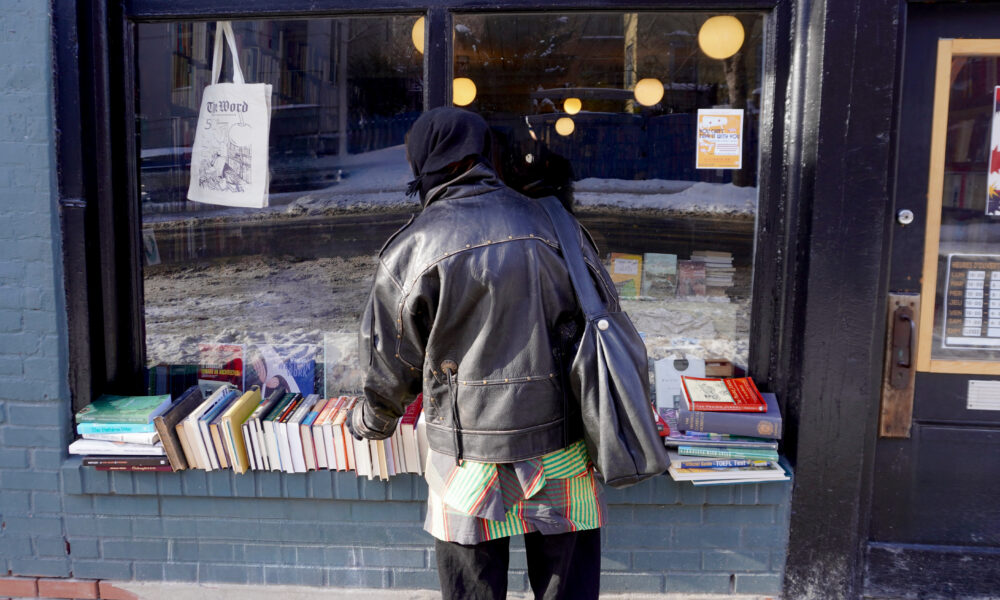
The Word, located just a few steps from McGill’s downtown campus on rue Milton, has been selling secondhand books since 1975. The store itself is small but plentiful, with floor-to-ceiling bookshelves stocked with every genre, from classics to music, fiction, and history. Rare first-edition, antiquarian, and collectible tomes sit among copies of Harry Potter and The Hunger Games. The gas stove that rests against the wall of the store is a testament to its timeless nature, despite the ever-changing variety of books available. 

L’euguélionne

L’euguelionne (pronounced: ler-gay-lee-onn, for novice French speakers) is located a bit further from campus on Rue Beaudry in The Village. The store is named for its specialty: French feminist literature; its name is aptly taken from Quebec’s first feminist novel, L’Euguélionne: roman triptyque (1976) by Lucile Durand under the pen name Louky Bersianik. As a non-profit solidarity co-op, its values radiate through its collection of new and used books, zines, and print art. The store’s diversity of media effectively conveys its commitment to anti-racism, anti-colonialism, feminism, and queer-positive principles. 

Librarie MAKTABA 

MAKTABA (meaning ‘bookshop’ in Arabic) awaits you in Montreal’s Old Port, cobbled into the neighbourhood’s stony aesthetic. Inside, a vast red Persian rug adorns the space for comfortable and effective reading. MAKTABA seeks to open visitors’ eyes with its collection of English-language books curated from far corners of the world. If you happen to be looking for an analogue soundtrack to accompany your reading, vinyl records are also sold in-store.

Librairie Gallimard

Looking for a great Francophone establishment? Ouais! Librairie Gallimard is nestled in Montreal’s Plateau-Mont-Royal district with an excellent selection of books en français. Its bright red exterior is hard to miss if you pass by, and the books inside are sure to ensnare you as well. Literary essays, philosophy, history, youth, Quebec history (if you don’t know where you live), and more line the shelves. Be sure to check out their website for literary events like their recent Against excess – Authoritarian excesses in America discussion with Jonathan Durand Folco, Mark Fortier, and Alain Roy.

Librairie Anarchiste L’Insoumise

Do you swing both ways? Librairie Anarchiste L’Insoumise is perfect for bilingual speakers with a propensity toward sudden and vigorous anarchism. Nestled down on boul. Saint-Laurent, be sure to bring cash, not card, because this store’s commitment trickles down to its accepted payment methods. After all, who else will fight against the ever-expanding power of the plastic card owned by the banks and corporations who seek to control you? Be sure to stop at Librairie Anarchiste L’Insoumise for radical and subversive texts rooted in the Libertarian Socialist movement. 

Physical media allows us to be conscious of worlds, languages, and cultures that we would have otherwise never touched.  Without this consistent supply of maps to the foreign from independent bookstores, we run the risk of sleeping through the changes that seek to suffocate us into unconsciousness. 

Art, Arts & Entertainment, Made at McGill

The ‘New at McGill’ exhibit showcases over400 years of history

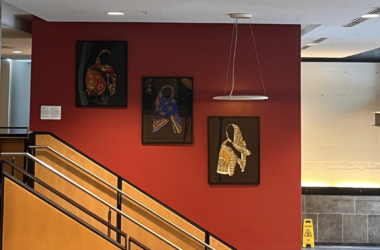
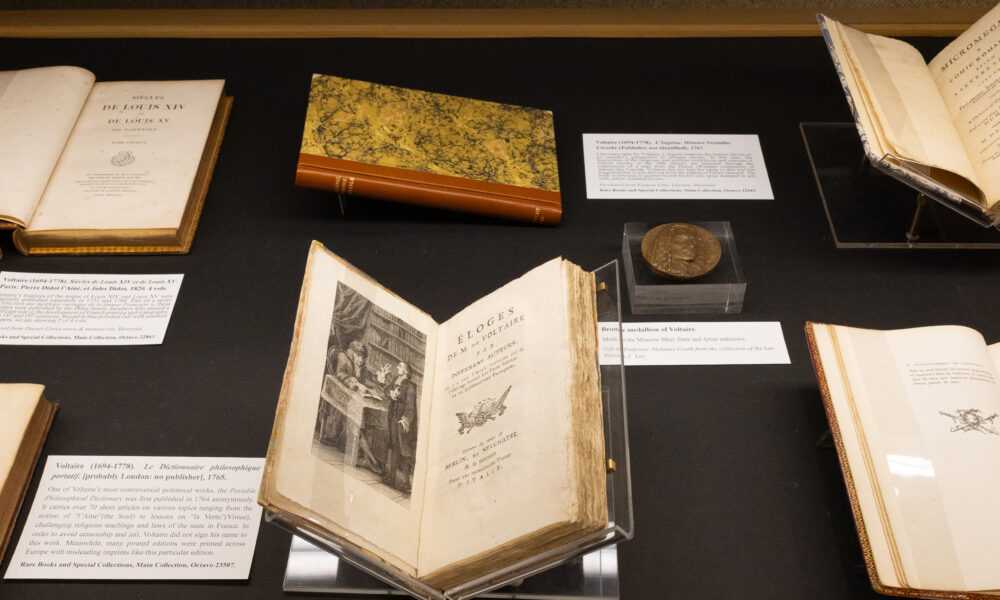
Most students don’t realize that one of McGill’s McLennan Library’s fourth floor’s Reading Room houses extensive historical archives. Its New at McGill exhibit features a wide variety of subjects ranging from Voltaire’s literature and modern architecture plans, to embargoed letters and natural science collections in astronomy and botany. The collection’s diversity is a testimony to the careful work of the Rare Books and Special Collections (RBSC) team. 

When funding is limited, archivists must determine whether an item truly adds value to the collection before acquiring it. This careful selection process makes the exhibit special, with objects from different periods placed side by side. It features modern works, such as a pop-up book made by Collette Fu from her 2008 to 2023 project titled We Are Tiger Dragon People and presentation models of the Mangaf Beach Development Project in Kuwait from 1996. Elsewhere in the exhibit, you can view Icones Historiarum Veteris Testamenti, published in 1547, which is in near-mint condition. 

I initially browsed the exhibit, walking through the Reading Room and reading the captions in the two rows of cases on display. I started with the left case, where Monica Ong’s 2021 Planetaria, a work of visual poetry about astronomy, was juxtaposed with a perpetual calendar from 1810. 

Among the most striking items are letters by Canadian short story writer Mavis Gallant. Canadian filmmaker and journalist William Weintraub, a close friend of Gallant, donated the letters to McGill in 2002 under embargo. The embargo expired in 2025, allowing the shipment to be opened for the first time. Eve Majzels, one of five curators of this exhibit, was given the honour of opening the collection and now manages it. Inside were 118 letters and six postcards from the William Weintraub fonds. These letters offer a peek into the private life of Gallant, an important literary figure of Montreal, with the letters’ topics revolving around Quebec politics, personal matters, and her and Weintraub’s careers. Among these letters, Majzels selected two for display in the exhibit because of the quality of their writing and Gallant’s humour.

The exhibit also nods to the expansion of women’s literacy and education. L’origine des fleurs and Hommage aux dames are two beautiful, handcrafted books on display that were published for a female audience in the 19th century. These books are evidence of women’s increasing access to literature at the time.

For the botanical collection, the curators chose a 1910 book of pressed flowers detailing the locations from which they were picked. The page displayed counts three flowers: Heather, foxglove, and pomegranate, each gathered from different locations in Italy. Another book on exhibit, British Sea-Weeds, published in 1872, introduced women and non-scientists to the study of algae. Lauren Williams, the curator of this case, said during a recorded presentation that botany “was one of the few subjects to be appropriate for women to engage with at the time.” 

When the exhibit closes, archival items will return to archival storage on the fourth floor’s shelves or to their designated collection locations. While they won’t be publicly displayed anymore, individuals can request to see some of the materials on display in McGill’s Archival Collections Catalogue. However, the majority can be found in the McGill Libraries catalogue. Ursula Charmichael, one of two coordinators of New at McGill, emphasized that the team is constantly working to expand their collections to support teaching and research at McGill and across Montreal. The recently unveiled Gallant letters are a prime example of McGill’s role in presenting new discoveries to the global research community. 

New at McGill allows us to recognize collection development as a crucial role of librarians and archivists. If you need a break from studying, consider visiting this exhibit. Not only will you find significant relics of history on display, but you will also see the dedication and teamwork that went into putting the collection together.

New at McGill is open to the public until March. 2nd.

Science & Technology

Goat and sheep milk allergies point to underlying cow’s milk allergy…Most of the time

Despite the meteoric rise of plant-based milk’s popularity over the past few years, cow’s milk continues to dominate the global milk market. It is an excellent source of vital minerals, vitamins, and proteins, and is often recommended for young children—that is, assuming they are not allergic. Even with all of its essential nutrients, cow’s milk allergy remains the most common food allergy among children. Furthermore, this allergy is typically cross-reactive with goat and sheep milk due to similarities in the milks’ proteins, although this is not always the case.

In a recent report published in Allergy, Asthma, & Clinical Immunology, Dr. Michael Aw, a resident physician in Internal Medicine at McGill University, detailed the unusual case of a 27-year-old Mediterranean man who developed an allergy to goat and sheep milk, but not to cow’s milk. Despite having no issues with goat and sheep milk for most of his life, the patient later experienced anaphylactic reactions after having goat- and sheep-milk-based cheeses. Doctors later confirmed his allergies with skin prick tests, and it was during these tests that they discovered the lack of cow’s milk sensitization.     

In an interview with The Tribune, Aw explained how this co-occurrence of cow, goat, and sheep milk allergies typically works.

“Goat milk and sheep milk allergies are not a very rare thing. It’s a relatively common allergy, but almost always it’s because people were pre-sensitized to milk allergy,” Aw said. “We were often exposed to milk protein because of our diets, and definitely in a Western society. Milk, cheese, and all sorts of even pre-made or dried products contain cow’s milk. And often people who get allergic to one type of food can get sensitized to a bunch of foods within the same family, because the protein structure that you’re allergic to is very similar between the different animals or the different species.”

Aw further explained how the initial sensitization to cow’s milk occurs, pointing in particular to the milk’s immunogenic proteins, which can induce an immune response and cause an allergic reaction. In the case report, the patient appeared to be sensitive only to immunogenic proteins in goat and sheep milk, not to those in cow milk. 

“The main two classes [of milk proteins] are casein and whey,” Aw said.“Whey protein, which is a collection of different proteins, loses some of its allergenic properties when you heat it up because you denature the protein. The protein and its structure become deformed, and it’s no longer as immunogenic, versus casein, which can maintain [its structure]. With milk allergy, some people are sensitized to particular epitopes, or parts of the protein, of the casein within goat milk that is just different enough to cow’s milk, that they don’t react [to cow’s milk].”

When conducting a literature search on isolated goat and sheep milk allergies, Aw found that the vast majority of studies corroborated the hypothesis of sensitivities to particular casein epitopes. They noted that these kinds of goat and sheep milk products are typically consumed after being made into cheeses, which is a process that denatures the whey and leaves only the immunogenic casein behind.

Another factor that made this case slightly unusual was that the patient developed the allergy in adulthood. While it is not uncommon to develop allergies later in life, children are more susceptible to them. 

“A lot of things in immunology are unknown, but proposed hypotheses or mechanisms are, just how a baby’s developing, its immune system is developing, and it’s not very well educated,” Aw said. “So an immune system that’s not well educated isn’t very specific or well-adjusted [….] It’s getting exposed to all of these different allergens and antigens, and it doesn’t really know how to differentiate between good and bad. And that’s why children often react to foods which they then outgrow, because as their immune system matures, they are better able to tolerate it.”

As infants, our immune systems are hyper-aware of differences in the nutrients we ingest because these substances are relatively new to us; this potentially contributes to our tendency to develop allergies during those years.

“​​There’s a distinction between cow’s milk and human’s milk, where it’s just different enough that your body is used to human’s milk, and the extra proteins that you don’t see in human’s milk that you see in cow’s milk kind of freaks out the immune system [….] If you get exposed to it enough times and nothing bad happens, sometimes the immune system forgets and develops what we call a tolerogenic profile, amongst other factors that can cause you to ‘outgrow it,’” Aw explained.

However, as mentioned, for our patient of interest, this was no childhood allergy.

“Allergies can occur, unfortunately, at any time in life, and it just takes a bit of bad luck to just have food at the wrong time, the wrong place, with the wrong co-factors that caused you to get sick or to cause you to develop an allergy,” Aw noted. 

Aw also pointed to the diversity of circumstances under which adult allergies can develop.

“Sometimes it’s people who have never seen a food or an allergen for many years, and then when they get re-exposed, the immune system overreacts,” he said. “But sometimes, it’s people that work with the same chemical, the same food their whole life, and then just one day, the immune system decides, you know, ‘Enough is enough, and we’re going to be allergic.’ To really see why it happens is very nuanced and a poorly understood mechanism. But yeah, it just happens.”

While this case was certainly interesting, Aw noted that randomized control trials and further meta-analyses of said trials would need to take place in order to make any general statements about differences in milk allergies overall.  

“With a case report, people like to get excited [and think], ‘Oh, is this going to be the next big thing?’ I always like to highlight the fact […] that a case report is the lowest level of evidence in any medical reporting [….] We’re just saying, ‘This is what we observe.’ It’s very hard to draw conclusions from this. I think the big takeaway from this paper is to be aware that it exists.”

Aw clarified that the purpose of a case report like this, at least in his view, is to provide clinicians with an unusual case of milk protein sensitivities they can keep in the back of their mind. This can be useful if they witness something similarly odd in their own practice.

“Just because someone can tolerate cow’s milk may not necessarily mean they can tolerate goat milk or sheep milk. Do we recommend that you target a test specifically for that? No, not necessarily, but […] just know that it’s possible that they may not tolerate goat and sheep milk.”

Immunology is one of the most misunderstood fields in medicine, by both the general public and the medical community. Myths circulate long and widely enough that they become difficult to eradicate, so much so that they become accepted as truth—a phenomenon worsened by the fact that there is sparse allergy-specific training in many medical and residency programs. It is therefore essential that case studies such as Aw’s and the larger trials that he mentioned receive the resources and funding they need to continue unravelling the mysteries of the immune system.

Student Life, Student of the Week

Student of the week: Nada

After completing a Bachelor’s degree in Information Technology (IT) from the Islamic University in Gaza, Nada stayed on to begin an IT Master’s program in September 2023. By Oct. 11, 2023, the Israel Defense Forces (IDF) had razed her university to the ground

“I felt like, ‘Okay, […] I can’t go back. I cannot go back there now,’” Nada said in an interview with The Tribune.

In May 2024, Nada evacuated the Gaza Strip to Cairo, Egypt, with her family. From there, she applied to McGill. With funding and application support from the Palestinian Students and Scholars at Risk (PSSAR) network and McGill Computer Science Associate Professor Paul Kry, she was accepted to the Computer Science Master’s Program in July 2024. 

“[McGill] was my first choice because it’s one of the top universities in Canada, and I’ve heard a lot of good things about it,” Nada told The Tribune. “So I felt like,I’m going to be welcome there.’”

She submitted her student visa application in December 2024, and today, more than a year later, Nada remains stuck in Cairo, working as a remote lecturer for students in Gaza. She is currently waiting for Immigration, Refugees and Citizenship Canada (IRCC) to approve her visa in time for the Fall 2026 semester. Without the visa, her McGill admission will be revoked.

Nada is one of 130 Palestinian students accepted into Canadian universities but barred from travel to begin their studies. 70 of these students remain trapped in Gaza even after the ceasefire, while 30 have evacuated to Egypt. For those in Gaza, where there is no visa application centre, obtaining the biometric data required for a visa application is impossible. But even those who, like Nada, evacuated from Gaza and submitted the requisite biometrics, still find themselves paralyzed by IRCC’s discretionary impunity.

When asked about the value of education for her, Nada set aside her long list of personal accolades to explain that the pursuit of education lies at the heart of being Palestinian.

“[Pursuing higher education is] actually not unusual, and it has nothing to do with the situation that we’re in right now. Most of the [Palestinian students] are looking for postgraduate degrees. We have one of the highest literacy rates in the whole world,” Nada said. 

Gaza has an illiteracy rate of 1.9 per cent, making it one of the most literate territories in the world. In fact, literacy has continued to improve despite Israel’s genocide in the Gaza Strip.

Today, all twelve universities in Gaza have been destroyed by the IDF. Still, Palestinian students and scholars have only redoubled their efforts to attain an education that now reflects not only a hunger for learning, but an investment in the reconstruction of Gaza—their home. 

“Most of the people who are looking for opportunities to study abroad [are] looking to have, like, two years or three years outside to see the world and then come back to their normal life, their people, their community, or their house and everything that they own,” Nada explained to The Tribune

“I want to live the experience of studying abroad and getting the knowledge from a very different perspective than the one that I know [….] And I really, really want to take this back, and I want to share it with my students. I want to share the information. I want to share the knowledge.” 

But before the ongoing advocacy for Palestinian students and scholars admitted to Canadian universities can elicit substantial results, Palestinians must be afforded individuality independent of their relationship to suffering. 

“When it comes to the situation that we are in right now, whether it’s the students who are still in Gaza or the students who are outside of Gaza, we all are stuck waiting for something to happen, for a miracle,” Nada said. “I guess I would love for the people to see us as individuals.”

When asked what she looks forward to upon eventually landing in Montreal, Nada smiled. 

“I’m very excited for feeling a new beginning,” she said. “I’ve been feeling stuck in Egypt for the past two years, and I’ve been waiting and waiting and waiting [….] If I got my visa accepted and I was able to come to Canada, I feel like [there would] be so much joy [from] having a new beginning, and having a new experience, and having an actual life.”

Behind the Bench, Hockey, Sports

Taking the NHL by storm: The habits behind 19-year-old Macklin Celebrini’s breakout

Before Macklin Celebrini became one of the National Hockey League (NHL)’s most electric young phenoms, he was a kid running up a hill.

Not a metaphorical hill—an actual one. 

At the end of workouts in their North Vancouver neighbourhood, Celebrini and his brother Aiden would finish with a routine: Sprint up the hill near their house, jog back down, repeat. Five minutes was normal. 10 minutes was the limit. But one day, 10 became 12. 12 became 15, then 20.

This was not about cardio. It was about mindset.

Celebrini’s father, Rick, is known for having a favourite phrase: “One more.” One more rep. One more drill. One more time up the hill. The family learned quickly that asking when a workout would end was a great way to keep it going. 

It sounds intense—and it was—but it says everything about who Macklin Celebrini is now: A teenager who plays professional hockey like he’s already been through every trial you could imagine.

Celebrini’s upbringing was deliberate. His family’s world revolved around training, recovery, and the small details that make elite athletes different. Rick Celebrini is a highly respected athletic trainer who now works as the Vice President of Player Health and Performance for the National Basketball Association (NBA)’s Golden State Warriors. Macklin’s mother, Robyn, captained her university soccer team. Aiden was drafted by the Vancouver Canucks and played with Macklin at Boston University. His sister, Charlize, plays competitive tennis.

When people ask why Macklin Celebrini looks so calm—why the moment never seems to overwhelm him—the answer might be simple: He was raised to outlast discomfort. The hill that others may have seen as punishment, Celebrini saw as a tool to build discipline. 

That tenacity now shows up every night on NHL ice.

Celebrini is 19, but he plays with the composure of someone far older. Hockey moves fast, and for most young players, the NHL looks like chaos: Bodies flying, passes missed, mistakes punished instantly. Celebrini slows the game down when things get frantic, speeds it up when defenders hesitate, and makes the simple play at exactly the right time.

It also helps explain his jaw-dropping numbers. In his second NHL season, Celebrini has already become the essence of the San Jose Sharks’ offence. Earlier this month, he factored into 50.8 per cent of his team’s goals, meaning he either scores the goal himself or assists it more than half the time. That rate is the highest ever recorded by a teenager in NHL history. For context, it is even higher than what Wayne Gretzky and Sidney Crosby produced at the same age—two players who eventually became faces of the sport. 

The Sharks need him, too. Celebrini has become “hockey’s ultimate one-man show,” carrying an otherwise underwhelming team into an unexpected playoff spot.

He plays both offence and defence. He wins loose puck battles. If he loses possession, he does not give up; he fights to get it back. His relentless work ethic is what separates flashy talent from true greatness. Coaches have described him as someone with the skill, intelligence, and drive to become an elite two-way centre, and even a future captain. 

His rise also feels bigger than statistics because it is happening in real time. Celebrini is not just having a strong sophomore campaign—he is changing the direction of a franchise. As the Sharks’ number-one overall draft pick in 2024, he was expected to be their future. He became their present almost immediately.

Now, with Hockey Canada’s Olympic program calling, Celebrini’s story is ready for its biggest stage yet in Milano-Cortina. The next chapter will bring brighter lights and tougher competition, but if the hill taught him anything, it is that difficult moments on the ice are not something to fear. They are something to chase.

The points and accolades speak for themselves. But Macklin Celebrini’s habits—his routines, his discipline, and his calmness—speak louder.

Commentary, Opinion

Montreal’s public transit is in crisis due to underfunding

Lost jobs, accumulated tardies, and expensive Ubers are just some of the effects of the Société de transport de Montréal (STM) strikes that froze public transit from 2025 until the beginning of 2026. On four separate occasions, bus drivers, train operators, and maintenance workers, led by their respective unions, went on strike. The strikes followed over 100 failed negotiation efforts between unions and the STM, with employees seeking a 25 per cent wage increase and compensation for time spent doing peripheral tasks such as snow-cleaning or moving from station to station, which the STM currently does not recognize as salaried labour.  

On the surface, it seems the STM strikes merely hurt the public and farebox revenue, as ridership dropped approximately 6.4 per cent compared to 2024, and monthly pass sales dropped 10 per cent between June and December 2025 alone. 

However, to avoid labelling the strikes as merely an inconvenience or aberration, it is important to look at not just their effects but the grievances from which they arise. These concerns—low salaries, private subcontracting, and overtime—are all consequences of the systemic underfunding of the STM; the root source of rider discontentment is the transit system’s budget failings, not the decision of workers to strike.

The STM’s $1.8 billion CAD budget announced for 2026—and funded almost entirely by the Autorité régionale de transport métropolitain—includes major austerity measures, eliminating 300 jobs. Although maintenance cutbacks address budget deficits, they counterintuitively put further strain on metro assets, 42 per cent of which are already in poor condition. Furthermore, STM projects aimed at modernizing transit offerings—repairing aging infrastructure (tunnels, stations, and MR-73 trains), electrifying buses, extending the Blue Line, and making every station accessible—are in need of funding. Given that day-to-day operation of the transit system is shrinking, the STM’s service interruptions and drop in ridership that these infrastructure projects are trying to address will only deepen. 

The STM depends on provincial and federal funding for these infrastructure projects. Under the 2025-2035 Quebec Infrastructure Plan (QIP), $14.5 billion CAD is allocated for public transit. This is $258 million CAD less than the STM requested for supporting the metro system, and $21.3 billion CAD less than was allocated for road networks. An additional $37.8 billion CAD in public transit investment is allocated under the QIP, but these funds are designated for electrification and the Metropolitan Express Network (REM), not asset maintenance in the STM. In fact, only $2.8 billion CAD out of the $15.2 billion CAD designated by the STM as priority investments in maintenance and service has actually been confirmed. 

The Legault administration has prioritized flashy non-QIP projects over the basic functioning of the transit sector: Projects like the REM are designed to be profitable, whereas the STM, which is a public good, is less so. 

A solution that avoids deepening Quebec’s deficit is to reallocate a portion of provincial and federal funding currently devoted to road systems toward both the infrastructure and the operations of the STM. Any shortfall in road funding can then be covered through congestion pricing for vehicles driving on busier, downtown streets. These fiscal reforms would increase the reliability and expansiveness of the transit system while simultaneously reducing traffic in cities and decreasing the costs of road maintenance. 

The reason you are late to your class is not because of strikers, but because our government has not invested in you getting there on time. 

Arts & Entertainment, Film and TV, Pop Rhetoric

Why we forgive holiday movies

When winter arrives and snow piles up outside, a strong, familiar urge tends to overtake us: The desire to curl up with a good holiday movie. Whether with family, friends, or snuggled up alone, the act feels mandatory. Even solitary viewings feel like a communal experience, one grounded in shared rituals and familiar lines. The film selection becomes essential to capturing the essence of the merry spirit. But what is this seasoning that constantly makes us return to the same prototypes? Why are we so forgiving when rewatching the same tropes and predictable pinnacles over and over again? 

Watching holiday movies feels more like a ritual than a true discovery of an old classic. Nothing is ever particularly jaw-dropping, nor is it meant to be. Most of the time, we are watching not to critically analyze but rather for the feeling that these films revive. With Home Alone’s enduring popularity, the exaggerated performances and implausible scenarios are not flaws of the film, but part of its charm. We are tied to that first experience, the one of initial discovery that made us feel so comfortable and cozy behind the TV. In a sense, it is a way of coming home: Looping back to an old version of ourselves and spending a bit of time with them. This familiarity explains why we condone so much of what we would otherwise be so critical of. Poor performance? Awkward dialogue? Formulaic and foreseeable ending? You name it, we let it slide. Holiday movies act as emotional safety nets, and it is difficult to tear yourself away from something that promises warmth and reassurance.

This genre of movies is, more often than not, about community, love, and friendship. Their narratives weave these familiar spheres together, usually by introducing some anxiety or emotional distance at the beginning and resolving it neatly by the end. Conflict is rarely permanent; misunderstandings are easily forgiven, and loneliness does not linger very long. Love Actually crystallizes this objective: Its narrative and tone consistently shift, yet audiences still love it for its mosaic of affection and reconciliation. 

Resolution often relies on an idealized version of reality, where viewers get to escape their own lives for a couple of hours and indulge in comforting fantasies. This escapism becomes particularly relevant during politically or socially anxious times, when the holidays, and by extension holiday movies, offer the mind a chance to rest and disconnect.

However, these idealized narratives tend to promote the same values: Generosity, forgiveness, and the preservation of a compact family unit. While these themes are comforting, their repetition raises questions about who is included and excluded from the holiday ideal. The insistence on traditional structures can promote a subtle form of conservatism, reinforcing the status quo and sidelining alternative family models or lived experiences. In this way, the very predictability that makes holiday movies comforting can also limit their representational scope. 

Temporality also plays an important role in shaping our outlook on holiday films. Part of what makes them pleasurable is not only what is on screen but the conditions under which we watch them. Being bundled up under the blankets while it’s snowing outside enhances the experience; the same movie would feel strangely hollow after a sunny day at the beach in the middle of July. Holiday movies are inseparable from their season. They are designed to slow us down, to match the rhythm of winter, and to invite a collective pause. 

No matter when you come looking for them, the seasonal classics will always be there for you when you need them. It may be that the secret ingredient in their success lies less in cinematic quality than in their ability to accompany our emotional agendas, and that is, perhaps, what truly makes a good holiday movie.

Commentary, Opinion

Quebec language laws over-police bilingualism instead of protecting the French language

Since the Legault administration adopted the 1977 Charter of the French Language, only students possessing a Certificate of English Eligibility can attend anglophone elementary and high schools. Not possessing the certificate has further limited access to anglophone education at the Collège d’enseignement général et professionnel (CEGEP) level since the passage of Bill 96 in 2022. With Legault’s resignation this January, the next Premier now has an opportunity to preserve linguistic heritage without fostering a narrative of division. Strategies framing English as an adversary to French are unsuitable in a province where bilingualism is vibrant, and linguistic plurality should, as a result, be particularly celebrated. 

The Coalition Avenir Québec (CAQ) government uses education to advance a francophone protectionist agenda. Requiring an English eligibility certificate limits students’ right to choose their language of instruction in a bilingual province. This restriction is part of a wider trend of reforms that suppress linguistic plurality in a misguided attempt to preserve francophone culture. 

Students can only obtain an English eligibility certificate if they have attended an anglophone school in Canada for the majority of their education, or if a parent, sibling, or close relative has received their education in English in Canada. 

Students holding the certificate have priority admission to anglophone CEGEPs and, if admitted, complete their education by passing the English Exit Exam. Non-certificate holders, //even if attending anglophone CEGEPs//, are instead required to pass the French Exit Exam—and take additional classes to prepare for it. This adds an unfair workload and undue stress for non-certificate holders, making it harder for them to succeed academically. 

The certificate requirement impedes students from choosing which language they will use to pass their exams, and which language to strengthen through mandatory language-learning classes. It also hinders students from accessing specific CEGEP programs simply because they might only be offered in English.

With a certificate requirement, education goes from being a choice to a product of cultural inheritance. First-generation Anglophone Canadians are thrust into an education system in a language they may not be proficient in on account of their families not meeting the historical criteria for English education. In a system where the right to study in English is inheritance-based, immigrants whose families received their education in English outside of Canada do not meet the requirements for certificate eligibility. This lowers their chances of accessing English CEGEPs, and the pressure to be fluent in French complicates their adjustment to a new environment. 

Pushing Francophone students to receive their education in French also disadvantages them if they aim to improve their English by attending an anglophone CEGEP. Regardless of how fundamental the French language is to Quebec’s culture, the government cannot disregard the province’s prevalent bilingualism nor undermine the importance of English as a skill in academia, work, and international communication. 

The certificate policy also affects teachers in English CEGEPs who lack French proficiency—at risk of losing their jobs if they cannot switch to teaching in French. Additionally, if Anglophone students do not get their certificate in time, they lose the right to pass eligibility on to their children, further entrenching the difficulties of accessing education in English.

Policies that promote French learning are necessary in an unequivocally bilingual province. However, the CAQ government has repeatedly opted to actively disadvantage the anglophone community in their mission to defend French as the sole official language. Bill 96 imposed enrollment caps on English CEGEPs, cut their funding to support French CEGEPs, and raised international tuition at English-speaking universities like McGill to deter non-Francophones from applying. The certificate is yet another policy that weakens Anglophone institutions in favour of Francophone ones—deluded in its idea that protecting French requires suppressing English. 

A government confident in its linguistic heritage would invest in French fluency without foreclosing students’ access to English—recognizing that in a bilingual province, the two languages can coexist and even strengthen one another. After all, attending an English CEGEP does not isolate students into a purely English-speaking community—and forcing Anglophone students to study in French will not erase their original linguistic identity. 

Behind the Bench, Sports

Sports are political: Standing up for Azeez Al-Shaair

On Jan. 12, the Houston Texans dominated the Pittsburgh Steelers en route to a 30-6 victory in the Wild Card playoff game. After the game, Pro Bowl linebacker and defensive captain Azeez Al-Shaair appeared on ESPN for an interview with the words “Stop The Genocide” written in white letters across his eye black. 

Al-Shaair was fined $11,593 USD by the National Football League (NFL), which called his show of solidarity a “violation of the NFL uniform and equipment rules.” This is the standard fine for a first-time violation of the personal message policy—the same fine that San Francisco 49ers star Nick Bosa received for wearing a Make America Great Again hat during a post-game interview, and also the same fine Dallas Cowboys receiver George Pickens received for writing “Open Fucking Always” on his eyeblack. 

The NFL is notoriously strict on uniforms. Former NFL lineman Isaac Rochell shared that he had been fined twice for uniform violations, totalling over $11,000 USD—once because his socks were not covering his knees, and on another occasion because his undershirt was visible below the cutoff of his jersey. The league’s most infamous fines came against two Pittsburgh Steelers in October 2015. Defensive back William Gay received a fine for wearing purple cleats as a show of support for domestic violence victims—Gay’s mother was killed by his stepfather when he was seven years old. Meanwhile, running back DeAngelo Williams was fined for writing “Find the Cure” on his eye black, honouring his mom who died of breast cancer.

Al-Shaair knew the fine was coming, and seemingly accepted it as the price of his activism. He has consistently been a vocal advocate for peace in the region, being one of only two NFL players to sign the Athletes for Ceasefire letter directed toward U.S. President Joe Biden in 2024. Additionally, he supported the Palestine Children’s Relief Fund during the NFL’s My Cause My Cleats campaign. 

Al-Shaair has received criticism for his activism online, with author Kevin Deutsch going so far as to say that Al-Shaair’s message is one spread “by those who seek a genocide of Israelis” and that his message has “helped fuel widespread discrimination, vandalism, harassment, and violence against Jews globally.” Al-Shaair has publicly condemned the attacks of Oct. 7 and violence against Israel, stating, “on either side, people losing their life is not right. In no way, shape or form am I validating anything that happened.” He simply does not want to see children die because of where they were born, stating “I have no affiliation, no connection to these people other than the fact I’m a human being.”

Despite Al-Shaair and Bosa’s differing views, both should be allowed to use their platform to speak about politics. The NFL has tried to remove politics from sport in order to appease a certain ‘shut up and dribble’ crowd, something that is, frankly, wrong. Sports, as a source of soft power, are political in nature. Whether it is the NFL constantly pushing the American flag and military imagery upon fans or nation-states attempting to distract from abhorrent human rights violations, sports are constantly used for political gain. Qatar hosted a World Cup in stadiums built by exploited migrant workers through a system akin to modern-day slavery. Meanwhile, Saudi Arabia is trying to become the global centre of sport while simultaneously killing its own citizens in order to clear land for megaprojects. Even in 1936, Nazi Germany hosted the Olympics as a massive propaganda campaign to make Germany appear peaceful. 
Even in less intentional examples, such as Canada winning the Four Nations Faceoff or Shai Gilgeous-Alexander winning NBA MVP, sports have the power to make us proud of where we come from and shape national identity. Sports are woven into the fabric of our societies, as are the politics that shape them. Al-Shaair understands that his activism may make sports fans uncomfortable, but his opinions should never cost him thousands.

Off the Board, Opinion

Pics or it didn’t happen

If I met Timothée Chalamet in Bushwick and didn’t post a selfie of us on Instagram, did I even meet him? Pics or it didn’t happen

At the heart of this question lies the same trepidation: Whether experience exists without witness. 

Galileo Galilei says, “Tastes, odors, colours, and so on […] reside only in consciousness. If the living creature were removed, all these qualities would be wiped away and annihilated.” 

On consciousness, Immanuel Kant says, “I have no knowledge of myself as I am but only as I appear to myself.” Is consciousness starting to predominantly exist in the digital world? Did I even go on a run if I didn’t make a Strava post about those 10 kilometres? 

Ocean Vuong writes, “I touch the world not as myself but as an echo of who I was. Can you hear me yet? Can you read me?” 

By nature, experience is fleeting. We are not meant to remember each and every moment perfectly, but the desire to commemorate endlessly is encapsulating. Now that it is possible to capture, track, log every event on the internet, to do so has become almost addictive. 

Unlike a scrapbook, documenting our lives on social media inherently invites feedback from those around us—the validation that what we did was cool, fun, appealing. The innate desire to remember our lives has rotted into the desire to be remembered for these events. Music, movies, experiences, hobbies all become intertwined with identity itself: A friend once told me, “My Instagram is my whole identity.” 

In an attempt to immortalize human experience, digital tracking has transformed how we understand our experiences. As a society, we are moving towards a Black Mirror-esque lifestyle where the concept of 24/7 recordings through our eyes is not totally unfathomable. By making ourselves overly digitally accessible, we are losing the essence of real human interaction. Spending a concert recording it, to post with a tastefully placed emoji later, strips you of the experience of closing your eyes, throwing your hands in the air, and truly feeling the music with a bunch of strangers who all have at least this one thing in common. The authentic human experience is being boxed into a digital consciousness that ceases to exist beyond the online realm. After all, it really is that damn phone

Instead of keeping track of every like and dislike, logging every book, movie, or running trail, we need to start leaving our day-to-day lives up to the imagination of those around us—no more Spotify Wrapped or Goodreads reading challenge. 

Jean Baudrillard skillfully warns, “We live in a world where there is more and more information, and less and less meaning”—a condition reflected in our compulsive need to document rather than experience.
Between ChatGPT and Instagram feeds and hours of doomscrolling on TikTok, it is easy to fall victim to the endless information at our fingertips. In a time where anything and everything is accessible with one Google search, find solace and meaning in disallowing yourself to float into the infiniteness of digital consciousness. Do not let your human experience exist solely in the ripples of social media. Live with intention and lean into the analog life.

Read the latest issue

Read the latest issue