


Latest News

McGill, Montreal, News

Kanien’kehá:ka kahnistensera take McGill to federal court over suspected unmarked graves under New Vic Project

A group of Kanien’kehá:ka kahnistensera (Mohawk Mothers) went to federal court against McGill University, the Ville de Montréal, the Quebec Government, and Stantec, on Jan. 14. The group is seeking an order to halt construction of the New Vic Project until a Mohawk-led investigation into potential unmarked graves on the previous Royal Victoria Hospital site is conducted. The New Vic Project is McGill’s proposal to transform a part of the Royal Victoria Hospital into a research, teaching, and innovation hub dedicated to Sustainability Systems and Public Policy—an interdisciplinary approach to environmental sustainability. The kahnistensera suspect that there may be unmarked graves of Indigenous children on the site, after it came to light that Dr. Donald Ewen Cameron experimented on a number of victims in the 1950s and 60s at the Allan Memorial Institute, which was then a part of Royal Victoria Hospital. 

In an interview with The McGill Tribune, Kahentinetha, a kahnistensera applicant in the court case and founder of Mohawk Nation News, said that evidence for the unmarked graves comes from oral history passed down in her community.

“We knew about the children in the school that disappeared,” Kahentinetha said. “We were never told what happened to them. Nothing. Not a word. We’ve always suspected, we always heard things like that from our grandparents and great-grandparents.” 

In a statement to the Tribune, McGill media relations officer Frédérique Mazerolle wrote that, based on a 2016 archaeological survey of the site, the administration believes it is unlikely that there are unmarked Indigenous graves. 

“According to this study, it is unlikely that Indigenous remains will be found on the New Vic Project site,” Mazerolle wrote. “However, McGill remains committed to collaborating with the government and First Nations communities regarding potential vestiges. Should such vestiges be found, it will be made public immediately, the work will be suspended.”

Kahentinetha explained that the Mohawk Mothers’ argument rests on the larger claim that McGill and the New Vic Project are situated on land that was never ceded to Canada and is, therefore, still subject to Indigenous law. Kahentinetha’s interpretation of section 35.1 of the Constitution Act, which reads, “The existing aboriginal and treaty rights of the aboriginal peoples of Canada are hereby recognized and affirmed,” is that this clause makes Indigenous law the highest law of Canada. She also referenced section 52.1, which “reaffirms constitutional supremacy,” as evidence for the sovereignty of Indigenous law.  

“Therefore, all the laws of Canada that are not recognized by our law and other true Indigenous laws are of no force or effect,” Kahentinetha said. “We are the very first people to ever bring this [section] to the court.”  

Sacha Delouvrier, the Students’ Society of McGill University (SSMU) vice-president External Affairs, told the Tribune that SSMU does not support the New Vic Project, nor do they support the McGill Administration in the court case against the kahnistensera.

“As soon as the Mohawk Mothers spoke up, we definitely saw an opportunity to help them,” Delouvrier said. “We have to do what we can to strive toward the ideal of reconciliation, which is why we will support whatever position the Mohawk Nation takes.”

So far, the kahnistensera, the Ville de Montreal, the Quebec government, and Stantec have attended a two-hour court hearing on Zoom on Jan. 14, but the kahnistensera says the opposing parties are attempting to delay the proceedings by overwhelming them with court documents.

“They are using the protocols and documents to push us into the protocol swamp,” Kahentinetha said. “They don’t want the big question to come up […] about [sections] 35 and 52.”

Kahentinetha also explained that the kahnistensera are refusing to use lawyers in the court case because it goes against their traditional forms of justice, explaining that lawyers are part of a colonial system that oppresses Indigenous people. 

“We don’t want a lawyer because a lawyer has taken an oath to the exact thing we’re fighting right now, which is the laws that are killing and oppressing us,” Kahentinetha said. “We have to do this by ourselves and we have to do it according to our ways.”

McGill, News

Staff and students face difficult trade-offs as they transition back to campus

Following 2.5 weeks of online classes spurred by the Omicron wave, the administration’s decision to transition back to campus for the remainder of the Winter 2022 term has stirred up both positive and negative reactions amongst staff and students. Many eating spaces on campus do not respect provincial health guidelines and there is currently no compulsory distancing in classrooms—factors which have fostered ongoing discussions of how McGill could better protect the health and safety of those returning to campus. Despite this, students are appreciative of the opportunity to once again learn in person.. 

In an attempt to aid in the transition back to in-person teaching, the administration offered professors the option to spend up to 20 per cent of the term—two weeks—teaching remotely. The grace period ended on Feb. 7 for professors who continued teaching solely online after the Jan. 24 return to campus. 

Samuel Guertin, U2 Management, noted that many professors in his faculty have opted to make material available both in-person and online, even after the grace period elapses. With factors such as zoom fatigue, isolation, the inability to concentrate, and a lack of mental health support, Guertin finds that grasping course material can be more difficult over Zoom than in person.

“A lot of profs in the management faculty teach hybrid, so they have Zoom open and students can either go online or in-person, but you are missing some things if you don’t go in person,” Guertin explained. “I feel like in-person is better for the learning, it’s better for the atmosphere, it’s better for the participation. You feel like you’re a real student.” 

Not all students, however, have found the transition to in-person instruction comforting. Executives from the Students’ Society of McGill University (SSMU), the Arts Undergraduate Society (AUS), and the Post Graduate Students’ Society (PGSS) feel that there has been a lack of preventative safety action on the part of the administration, creating a sense of distrust between the student community and administration. Claire Loewen, a McGill media relations officer, stressed that the administration is persistently working to implement protective measures for those on-campus.  

“The health and well-being of our community remain our top priority, and all necessary health and safety measures will continue to be implemented to ensure that our campuses remain safe places to learn and to work,” Lowen wrote in an email to The McGill Tribune. “Throughout the Summer and Fall semesters, ventilation in classrooms (and exam spaces) was optimized, and CO2 levels were measured in rooms without CO2 monitors already built-in.” 

The current ventilation system, MERV 13, was implemented prior to the pandemic and is capable of trapping less than 75 per cent of air particles that are 0.3-1.0 microns in size. Coronavirus particles are 0.1 microns in size. 

In an interview with the Tribune, Loïck Lépin, U2 Arts, explained that it has been difficult to remain on campus for extended periods of time due to the regulations around eating. In the few spaces designated eating spots on campus, social distancing is often not adequately practiced due to overcrowding and a lack of table separators. The administration has also removed many microwaves on campus, adding another barrier for students who pack food.

“Eating on campus seems like a logistics operation,” Lépin said. “You would think that more than two microwaves would be available to the 40,000 students on campus.” 

Library security, tasked with enforcing proper masking and “no eating” regulations, have faced disrespect from select students who do not wish to, or care to, comply with COVID-19 rules. 

As Quebec begins to loosen COVID-19 provincial restrictions, the administration plans to follow suit. Starting on Feb. 14, gyms in Quebec will be allowed to reopen at 50 per cent capacity and in-person extracurricular activities with up to 25 participants will be able to meet. It is currently unclear when, and to what extent, McGill will act in accordance with these provincial relaxations. At this time, SSMU continues to advocate for increased safety measures and accommodations directly from the administration. SSMU has compiled a crowdsourced list of accommodations provided by professors in over 60 courses, and continues to accept submissions for more. 

McGill, News

AUS General Assembly fails to reach quorum, blocking motion to strike for hybrid learning

On Feb. 2, the Arts Undergraduate Society (AUS) convened for a General Assembly (GA) to discuss a motion to strike in opposition to McGill’s current reopening plans. The GA was scheduled after a petition organized by former Students’ Society of McGill University (SSMU) President Bryan Buraga received the required 200 signatures. Since the beginning of the pandemic, Buraga has been vocal about his disapproval of McGill’s COVID-19 management and of the school’s decision to resume in-person activities amid the Omicron surge in Quebec. 

According to the AUS constitution, the quorum to hold a GA is 150 AUS members, while the quorum to pass a resolution for an AUS strike or boycott is 500 students. At the GA, the number of attendees oscillated between approximately 145 to 160 students, prohibiting the motion to strike from being put to a vote and at times, when less than 150 members were present, pausing the entire assembly. 

Dhruv Mehndiratta, U1 Arts, consulted with Buraga in developing the petition to hold the GA and campaigned in favour of a strike. Mehndiratta believes that despite the GA’s inability to reach a quorum, the number of attendees reflects an increase in student willingness to participate in McGill politics. 

“Having 145 people consistently for the better part of two hours on a Wednesday night [during] midterm season is definitely an achievement,” Mehndiratta said in an interview with The McGill Tribune. “It definitely shows that the student body as a whole is getting more active in McGill politics.”

Since the motion to strike could not be put to a vote, it was amended to demand a well-defined stance from the AUS on the return to in-person learning instead. The amendments call on the AUS to oppose McGill’s current reopening plans and to affirm its solidarity with striking student associations. The new motion also demands that a COVID-19 Safety Mobilization Committee be established, with a mandate to organize a demonstration to advocate for safer in-person learning and hybrid options for immunocompromised students. 

The amended motion passed with 124 in favour, nine against, and 30 abstaining. The resolution is now awaiting ratification, which is done through an online ballot sent to all AUS members. The referendum ballot was emailed to the student body on Feb. 7 and will close at 5 p.m. (EST) on Feb. 10. 

Shlomo Enkin Lewis, U2 Arts, also campaigned for an AUS strike. Lewis believes that institutional flaws restrain collective movements in the AUS. 

“While I was canvassing for this GA, I spoke with lots of students who were very supportive of the need for hybrid options, but did not know that the GA was taking place,” Lewis said in an interview with the Tribune. “There are real barriers both to how information spreads through the Arts faculty and the absence of the existing organized institutions taking charge and spreading this message.” 

Buraga was responsible for moving the motion to strike and for amending the motion for an AUS response. He believes that there are systemic barriers to organizing a strike in the AUS.  

“In the cases of the School of Social Work and the Faculty of Law, the way that those [faculty associations] are organized makes it so much easier for collective action,” Buraga said in an interview with the Tribune. “The Faculty of Law requires a referendum and a GA for discussion, whereas in the AUS having 500 people show up to a GA rather than just going to referendum poses an institutional challenge to organizing people collectively.”

Despite the GA’s inability to reach quorum, Buraga remains optimistic about the future of the strike movement. 

“I wouldn’t characterize [the low number of attendees] as the strike movement losing steam,” he said. “I would challenge this narrative and say that the strike movement is coming up along institutional barriers that have been set for them.”

Recipes, Student Life

When in doubt, eat out (of your fridge): Veggie leftovers soup

We all know the crushing feeling of opening the fridge and finding nothing to eat—with the exception, of course, of your leftover scraps, some languishing vegetables, and a bunch of mystery containers. Instead of giving in and going out, here’s how to save money, clean out your fridge, and minimize food waste by turning those random ingredients into a warm bowl of soup. This recipe is designed to be flexible, so you can use whatever ingredients you have lying around.

Part 1: The Broth

This is where you can get rid of any scraps left over from the last time you cooked, or any vegetables that aren’t looking so fresh––don’t worry, a bit of withering or staleness will not affect the broth’s flavour much. If you don’t want to spend too much time in the kitchen and just want to whip up a quick meal, skip to Part 2 to go straight to making soup with store-bought broth. 

Ingredients: 

  • Water

Possible additions:

  • Chicken—legs, wings, necks or back bones; with or without meat (If you are using chicken bones, split them open to maximise flavour)
  • Celery, including leaves
  • Carrots, including peel
  • Onions 
  • Mushrooms
  • Potato, including peel
  • Herbs (parsley, cilantro, etc.), including stems
  • Good seasoning options: garlic, bay leaves, rosemary, thyme, pepper

Steps:

  1. Cut all of your desired ingredients into medium-sized pieces.
  2. Put all of your ingredients into a big pot.
  3. Fill the pot with water until the vegetables start to float (it should be about ¾ full).
  4. Bring this to a boil and then let it simmer on low heat for at least 30 minutes. The longer you simmer, the more flavour the broth will have, so keep the broth on the heat for around 60 minutes for maximum umami.
  5. Strain the broth into a container. This broth will keep for 4 days in the refrigerator and 3 months in the freezer.

Tip: Start collecting your vegetable scraps instead of throwing them out. Keep a bag of kitchen scraps in your freezer and once the bag is full, make it into broth!

tasty.co

Part 2: The Soup

Your pre-made broth will be the base of your soup, bringing together any remaining leftover vegetables and miscellaneous ingredients. If you’re in a rush to eat, you can also use store-bought broth instead.

Possible ingredients: 

Possible ingredients: 

  • Any fresh vegetables: Onions, carrots, celery, potatoes, cabbage, etc. 
  • Frozen vegetables: Peas, corn, etc.
  • Canned tomatoes
  • Beans
  • Tofu
  • Meat
  • Cooked rice, noodles, quinoa, etc.
  • Seasoning: Some great options include garlic, fennel, black pepper, salt, and red pepper flakes

Steps:

  • Cut any large vegetables you have into bite-sized pieces. 
  • In a big pot, sauté vegetables in oil on medium heat for about 10 minutes or until soft.
  • Add your seasoning and stir.
  • Pour in the broth (and canned tomatoes if you have them).
  • Stir in any additions (tofu/meat, or rice/quinoa/noodles) and smaller vegetables (peas, corn, etc.). Bring the soup to a boil, then partially cover the pot with a lid and reduce the heat to a low simmer.
  • Simmer for 20 minutes or until the vegetables are tender. 

This soup will keep for three to five days in the refrigerator and one month in the freezer. Enjoy, and rejoice in your newly available fridge space!

This recipe is adapted from the following sources: tasteofhome.com, inspiredtaste.net, tasty.co

Student Life

Tackling the strenuous art of the cover letter

Cover letters often prove to be a challenge to write. With no straightforward structure to follow and only a blank page to stare at, they can leave students racked with nerves. However, with a solid foundation of guidelines and a couple rounds of careful proofreading, perfecting your cover letter doesn’t have to be such a stress-inducing process; it can be an opportunity to express yourself and highlight your assets. 

The McGill Tribune sat down with Linda Cicuta, a career advisor at the Career Planning Service (CaPS), to get advice on how students can write an impactful cover letter that accurately reflects their personality and accentuates their skills.

This interview has been edited for clarity.

Chloé Kichenane (CK): Writing a cover letter can be overwhelming when we don’t know where to start. What would the structure of a good cover letter look like?

Linda Cicuta (LC): I think the perfect structure starts with self-reflection, starting off by the introduction of who you are and how you stand out. Starting off with a bang is important. An opening line could easily be: “As a second year McGill student in economics, with six months experience in ‘x’ or in a related field, I’m confident I would be a great asset to your team.” Right away you’re different from everybody else. It also empowers you and builds your confidence, because in the end, you have to believe you can do this.

CK: It can sometimes be difficult for students to express what makes them stand out. Do you have any unique advice for writing those personal strengths into a cover letter?

LC: What sets you apart is everything outside of your degree: Soft skills are huge. Whether you’ve developed leadership skills or communication skills, those are fantastic things to highlight, and set you apart as well.

CK: What are the highlights of a good cover letter?

LC: I think it needs to be engaging, but it has to reflect your personality, […] and it needs to be in line with the industry and the position that you’re applying for. I think the highlights are proper

formatting and making the connection between you and [your potential employer].

CK: What are the things to avoid while writing your cover letter?

LC: Don’t be generic, that’s for sure. Be confident. Passive words like “think,” “feel,” and “believe” aren’t as confident as just stating you would be a good candidate, or you are a good candidate. But again, it has to reflect your personality, and you have to be comfortable writing it. A taboo thing would be to say “I” all the time. Don’t forget to proofread: Many times students have forgotten to change the name of the company, that will blow their application out of the water for sure.

And you don’t use pronouns if you are not sure. Don’t include the word “yours” at the end: You don’t belong to anybody.

CK: Any final tips?

LC: There’s nothing wrong with being bold and forward if you’re comfortable with it. No matter who you are, you have a lot to offer, U0 to U4. You’re all incredible students, you

all come from different backgrounds and you all have your own outstanding skill sets to offer.

For a more detailed guide to getting started on their cover letters, students can refer to McGill’s Career Planning Service guide. 

Student Life

EDRSC event explores junctions of mental health, chronic illness, and eating disorders

Content warning: disordered eating

On Jan. 29, the Students’ Society of McGill University’s Eating Disorder Resource and Support Centre (EDRSC) hosted the panel, “Intersection of Mental Health, Chronic Illness, and Eating Disorders.” The virtual event gathered four specialists to discuss how individuals’ backgrounds can affect their experience with eating disorders. 

Speakers included Dr. A.J. Rubineau, a family physician with experience working with people exploring their gender identity while struggling with eating disorders, as well as Jenna Jones, a social worker and psychotherapist specializing in eating disorders. Also joining the panel was Josée Lavigne, a representative from Anorexie & Boulimie Québec (ANEB), and Laura Ramesey, a content creator on social media who raises awareness for avoidant/restrictive food intake disorder and obsessive compulsive disorder. 

The event started off by addressing the common misconceptions regarding eating disorders and mental health. 

“The biggest misconception is that it has to do with food,” said Jones. “Eating disorders [are] ultimately a coping mechanism—[an] iceberg scenario. The eating disorder is what you can visibly see, but there’s all the factors leading up to the eating disorder.” 

Contrary to mainstream depictions, eating disorders are not always visible to the naked eye. This lack of clarity around what disordered eating looks like can stunt the journey to recovery.

“I think the biggest misconception is that dramatic weight loss and concern for your body image are required for an eating disorder diagnosis when they are not,” Ramesey said. “This is really damaging to those who need to get help.”

There’s also the dangerous myth that recovery is impossible. 

“If there’s one misconception I want to knock down, it’s that you can’t get better, because that’s just not true,” Rubineau added. “Treatment works, period.” 

The panellists went on to discuss the intersections of personality, genetics, and gender identity in the development of disordered eating. Researchers have hypothesized that certain personalities are more vulnerable to eating disorders than others.

“When it comes to anorexia nervosa, perfectionist tendencies have a strong link, and for bulimia nervosa, impulsivity is a link,” Jones said.

Genetics also play a factor. Lavigne explained that a person is more likely to get an eating disorder if others in their family have had eating disorders or other mental illnesses.

“Genetics loads the gun, and environment pulls the trigger,” Rubineau said. 

Certain personal experiences can also come with an associated risk. Drawing from her background working with those exploring their gender, Rubineau noted that transgender people are typically more vulnerable to eating disorders.

“Being a trans person in a body that’s not the body they feel at ease in understandably affects how food feels to [them],” Rubineau said. 

For many individuals, chronic illnesses can also intersect with eating disorders. These illnesses are defined as conditions that have long-lasting effects, such as postural tachycardia syndrome (PoTS).

The panellists discussed the difficulties of having to restrict certain foods due to chronic illness while also struggling with eating disorder-related restrictions. It can be easy, for instance, to be tricked into being afraid of a certain food because of its effects on your body due to a chronic illness. 

“I think the question is, how do you know when it’s your eating disorder [telling you to restrict], versus when it’s some other problem?” Rubineau said. 

Ramesey shared advice coming from her own personal experience with chronic illness. 

“I tell myself that the food isn’t the enemy […] the food isn’t necessarily bad, it’s just not the best thing for me,” Ramesey said.

Conversations during the panel also centred on changing the way we talk about eating disorders. People of varying ethnicities and body types experience eating disorders. But the importance of portraying that accurately in media is often overlooked. There is ultimately no single “look” to experiencing disordered eating. 

“I would also really encourage you to be inclusive of different types of disorders,” Ramesey said, referring to her own diagnosis of ARFID as an example, a condition associated with what may look like extremely picky eating to others. 

For those on their own recovery journey, Ramesey gave some advice.

“Since we are rewiring pathways in our brains each time we don’t avoid something, it eventually does become easier. It might take it a while [….] But the more you do it, the easier it gets. You will not be this scared the whole time, I promise.”

Resources for transgender and gender diverse people experiencing disordered eating: https://fedupcollective.org/. Support groups at McGill: https://edrsc.ssmu.ca/services/

Student Life, Word on the Y

Word on the Y: Romantic moments at McGill

With Valentine’s Day fast approaching, love is in the air of McGill’s downtown campus. Through the highs and lows of university, reflecting on little love stories can bring comfort, hope, and fun to our lives. Students shared some of their most memorable miniature moments of love at McGill.

The (political) science behind a study date

I was in my first political science conference in Leacock and didn’t have any friends in the class. I walked in late and sat next to a cute guy who didn’t seem to be paying attention to me, so I thought nothing of it. Afterwards, I was walking to the elevator when he tapped me on the shoulder, said he agreed with all of my contributions in the class and asked me to help him with the upcoming paper due. He asked for my number and said he couldn’t wait for our “study date.” –– Ainsley Dong, U0 Arts

The beauty of bagels

We sat next to each other in Russian history class, and, in between the professor speaking, we would always chat about little things. We found out we had the same favourite bagel shop and then I finally got up the courage to ask him out. We had a lovely date at a bagel shop in the plateau. –– Olivia Ardito, U1 Arts

“Falling” in love

It was my first January on campus when I slipped while walking to the McConnell Engineering Building. I fell really badly––it was quite embarrassing. When I looked around, though, I thought no one had seen, but when I was getting up, a guy came running up behind me to ask if I was okay. However, he then slipped on the same icy patch as me and fell. Both embarrassed, we laughed about it and ended up walking to class together! –– Emma Smith, U0 Arts

Cafe compliments

It was my fourth day living in my student residence. After coming here knowing no one, during meals I was left to sit alone, too anxious to ask anyone if I could join their table. Meals passed and I was alone watching others make friends while I couldn’t bring myself to show vulnerability by asking to join them. Then, during my second week here, the cutest guy I have ever seen came and asked if he could sit with me. He said that he had been watching me for a few meals, clarifying that he didn’t mean it in a creepy way. I laughed awkwardly but then realized that he seemed really genuine! We sat together every dinner for a week when he finally asked to take me out on a real date. We had the best time! –– Yael Benmor, U0 Arts

Stargazing had never been more amazing

One of my favourite memories with someone was when she and I left a party to walk around for hours, talking with each other while she wore my hoodie. We eventually ended up at a lookout point where we lay down on the grass and watched the stars together before ending the night. To this day, it is still one of my favourite memories that I’ve shared with someone, and I will never forget it. –– Anonymous

Dumpling darlings

We went to the Musée des Beaux-Arts and laughed at the Renaissance babies. Afterward, she asked if I wanted to get dinner. I said yes, and we went to a dumpling place. We both burned our tongues on the soup dumplings and laughed about it the rest of the night. –– Anonymous

McLove-in McLennan

I was in McLennan Library when this handsome guy and I made prolonged eye contact. As he was about to leave, he came up to me and asked for my Snapchat. We talked for a bit, then a couple of days after, we went thrifting at Eva B and had a good time. It felt like a modern-day fairytale trying on all these fun accessories. –– Anonymous

Caffeine courtship

We sat together in our sociology class for a couple of weeks, but we never really talked. I always thought he was cute, but I was too nervous to approach him, so we just said quick hellos, and that was it. Valentine’s day was approaching when he asked me if I wanted to go out for coffee and just walk around (keep in mind the city was still in lockdown, so we were only allowed to order out). We talked a lot and got to know each other, and after a couple more dates, he asked me to be his girlfriend. It’s now almost been one year, and we are planning on moving in together for our third year! –– Anonymous

Arts & Entertainment, Fashion

Remembering André Leon Talley’s and Thierry Mugler’s iconic fashion legacies

Thierry Mugler, the iconic French designer, and André Leon Talley, the former creative director of Vogue, both passed away at the age of 73 last month. Both renowned for their work in the fashion industry, the loss of such great talents was tremendously felt by all those who knew them and their work. The McGill Tribune looks back at some of the most iconic pieces from both designers. 

Venus Dress – Isy Stevens

Venus Dress (elle.com)

Without a doubt one of Mugler’s most legendary designs, The Venus Dress melds timeless elegance with Mugler’s signature architectural style. This shell-shaped gown embodies a powerful sense of femininity—fitting, considering that the late designer drew inspiration from Botecelli’s The Birth of Venus. Featuring a blush satin lining, matching gloves, and a sheer bodysuit, the piece was first modeled by Mugler’s longtime muse Simonetta Gianfelici at the designer’s 1995 couture show. In 2019, the gown re-emerged from the archives when American rapper Cardi B wore it to the Grammy Awards, delighting fans and fashion critics alike. The Venus Dress’s unwavering popularity throughout the decades is a true testament to the empowering nature of Mugler’s designs and his immeasurable reach across the fashion industry—both of which will continue to inspire for years to come. 

La Chimère – Suzanna Graham

La Chimère (mbam.qc.ca)

Unveiled in his haute couture Autumn/Winter 1997-98 show, La Chimère epitomizes avant-garde fashion. The creation is one of the most expensive dresses in fashion history, consisting of individually painted latex scales, bright feathers, and even animal hair. Designed in collaboration with Jean-Jacques Urcun and Mr. Pearl, a legendary corset maker, the dress caused quite a buzz upon its unveiling when it turned model Adriana Karembeu into a part fantasy, part fetish icon. The dress’ legendary status was confirmed during its feature in Mugler’s 2019 exhibit at the Montreal Museum of Fine Arts—it remained the most popular exhibit in Canada that year. Although bizarre and garish, Mugler’s garment exudes an air of power. The gold corset—a historically restrictive item—appears as armor, transforming it into a symbol of bodily and sexual autonomy. In this sense, La Chimère’s otherworldliness combines Mugler’s fantastical imagination and empowering ideals into a mythical being. 

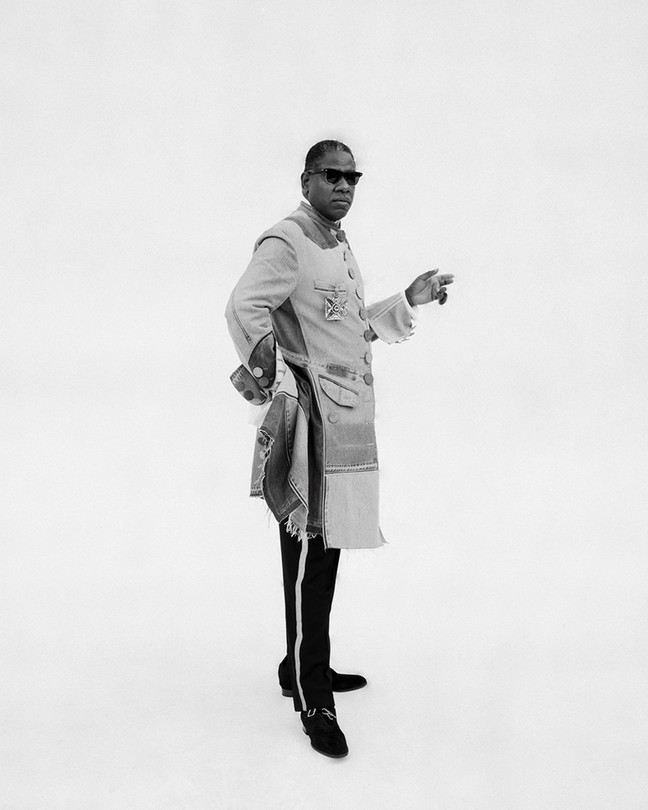
Andre Leon Talley – Ella Gomes

His Own Personal Style

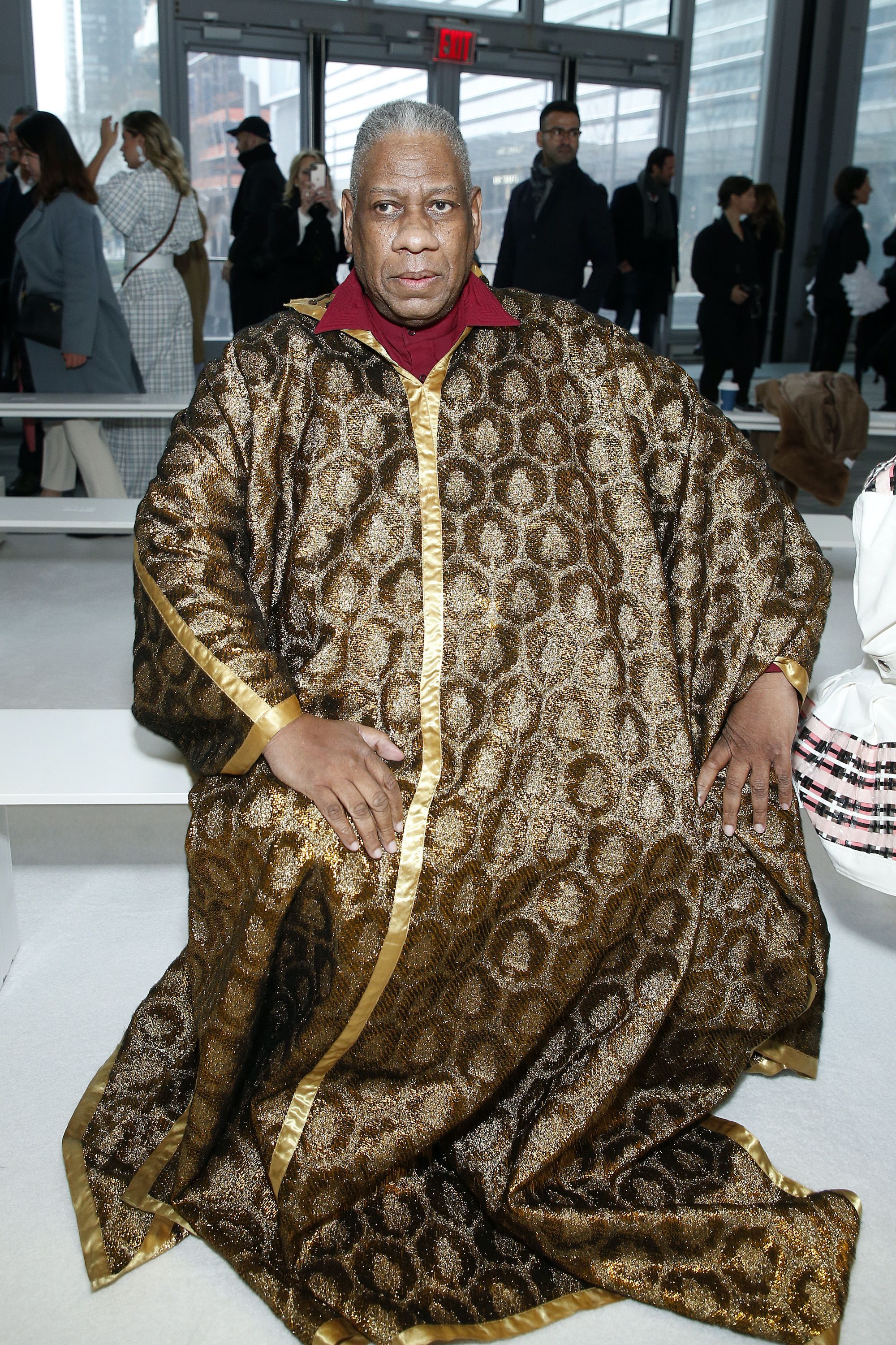
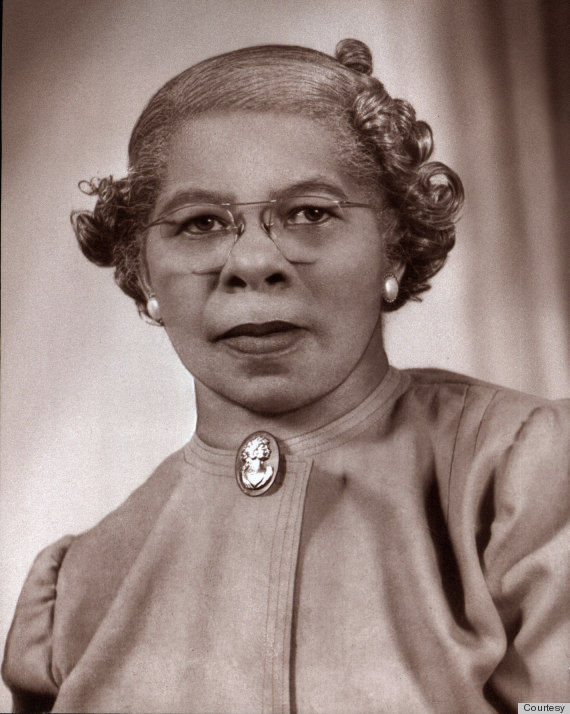
Throughout his work as Vogue’s first Black creative director, some of André Leon Talley’s most iconic outfits are the ones that he styled for himself. In his later years, the extravagant designer was rarely seen without a gloriously patterned caftan to spice up a classic suit. During his youth, Talley already had a knack for expressive dressing, favouring timeless pieces inspired by the fashions of those he admired: the Kennedys, the models gracing the pages of Vogue, and, most significantly, his own grandmother. Growing up in the Jim Crow south, flipping through fashion magazines and perfecting his own style served as an escape from the world around him. As he navigated the fashion industry, Talley often donned exquisite dress wear, including cable knee socks and dapper suits—a look that Talley would later refer to as his “armor” against the racism and bigotry he faced during his rise to prominence in the predominantly white industry. Throughout his career, which was marked by his eloquent writing and sharp knowledge of fashion history, Talley continued pushing to expand representation both on the runways and in the ateliers.

André Leon Talley was one fly guy. (theatlantic.com)

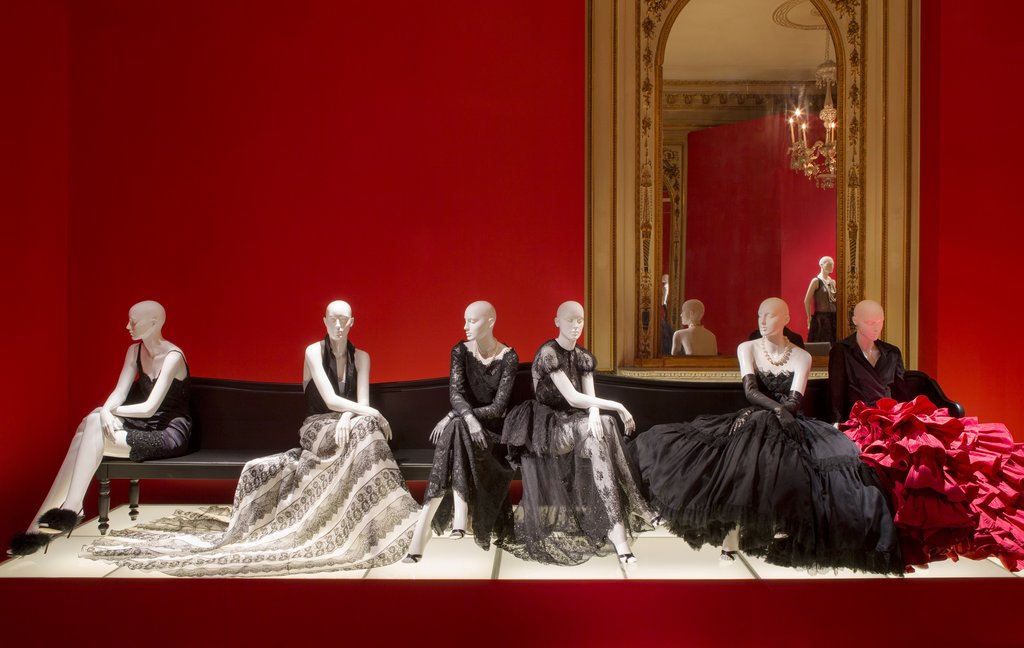
“Little Black Dress” 

While Talley was most known for his long-running career in the field of fashion journalism, his passion for museum curation was palpable in every exhibition he put on. In 2012, at his eponymous gallery in the Savannah College of Art and Design’s Museum of Art, Talley curated the “Little Black Dress” exhibition, housing iconic black dresses donated by the likes of Vera Wang, Rihanna, and Marc Jacobs. A majority of the donations came from Talley’s close friends in the industry, demonstrating his incomparable ability to connect with others through glamorous photoshoots or casual conversation. In discussing his inspiration for the show’s theme, Talley professed that “The little black dress expresses a moment of freedom and individuality every time.” A proud presenter of SCAD’s André Leon Talley Lifetime Achievement Award in Fashion, Talley maintained a close relationship with the college, fueled by his passion to support young creative voices of colour from his same southern roots.

McGill, News

OSVRSE hosts week-long ‘Knock Down the Walls’ campaign addressing sexual violence at McGill

Content warning: Sexual Violence

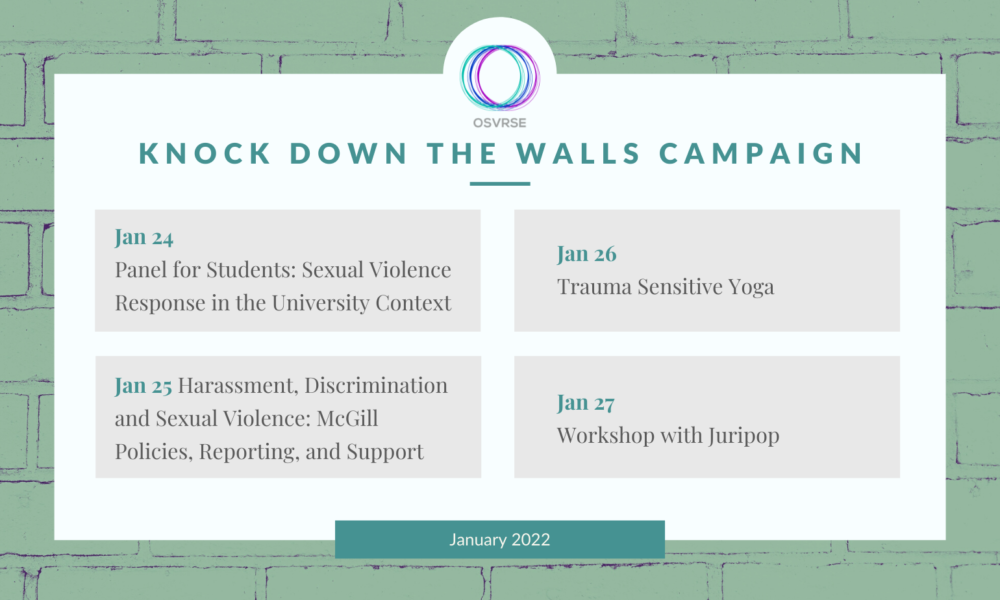
Each term, the Office for Sexual Violence Response, Support and Education (OSVRSE) hosts a week-long event with the aim to educate the public about resources available to survivors of sexual violence. This semester’s campaign, titled “Knock Down the Walls,” ran from Jan. 24 to Jan. 28. The week of virtual events included a “Panel for Students: Sexual Violence Response in the University Context” on Jan. 24, an information session called “Harassment, Discimination, and Sexual Violence: McGill Policies, Reporting, and Support” on Jan. 25, “Trauma-Sensitive Yoga” on Jan. 26, and a legal information workshop titled “Workshop with Juripop” on Jan. 27. 

“It was suggested that a panel be held regarding the university response to sexual violence, where students could ask questions to key administrators on the processes and roles of different offices in responding to cases,” wrote Maha Cherid, Sexual Violence Education Advisor at OSVRSE, in an email to The McGill Tribune. “OSVRSE wanted to supplement this panel by providing information about the [Office for Mediation and Reporting] (OMR) and the provincial context. We therefore decided to focus our annual January campaign on making information about reporting and resources more accessible to students.”

Some of the “Knock Down the Walls” programming served as a response to criticisms from students regarding the administration’s response sexual assault allegations. The campaign’s sexual violence response panel, in particular, was focussed on addressing student concerns about the reporting procedure.

Isabella Kalarickal, U3 Arts, is the president of It’s On Us, a student group that has been committed to empowering survivors and ending sexual violence on campus since 2017. After controversy surrounding the allegations of repeated sexual assualt in New Residence Hall in Decemeber 2020, It’s On Us took a critical role in pushing for more transparency and communication from the McGill administration.

“Last year, It’s On Us decided to do several open forums where students could come in, and it’s a space for them to vent their frustrations, bring up concerns, ask questions, and just have a discussion amongst peers as to how […] this lack of response from administration is affecting them,” Kalarickal said. “It’s On Us compiled these concerns and questions, and we sent them off to McGill administration, just so hopefully one day they’ll look at it and they’ll realize what students are asking for and what students need.”

The “Sexual Violence Response in the University Context” panellists, including Émilie Marcotte, Sexual Response Advisor at OSVRSE, Fabrice Labeau, McGill Deputy Provost, Maha Cherid, Sexual Violence Education Advisor at OSVRSE, Robin Beech, McGill Dean of Students, and Sinead Hunt, Associate Director of the Office of Mediation and Reporting (OMR), responded to questions from the It’s On Us’ open forums, along with other student questions sent in via Google Form.

In an interview with the Tribune, Beech explained his belief that much of the frustration toward the response process comes from a place of miscommunication and speculation, especially as a result of the confidentiality required by the process.

“What was said on social media was extremely different to what was happening in reality,” Beech said. “There may be situations where a student finds themself in a class with somebody they believe […] is rumoured to have conducted sexual violence. If that happens, those students should contact me, and I can provide mental health support and advice and things, but I will not be able to release information about whether what they’re saying is true or not, for example. So, a lot of the problems come from the fact that [the process] must be confidential, and rumor-ville just goes wild.”

Though Kalarickal acknowledges that hosting the Sexual Violence Response panel is a positive step from administration, she still feels that their response process is inadequate.

“[It’s On Us] took the initiative and we sent them things that students had sent to us,” Kalarickal said. “So, it didn’t really come across as a genuine effort to connect and to address students [….] When we brought up the concerns from students saying that these policies are a bit lacking and don’t really ensure the survivors’ safety, they shifted a lot of the responsibility to Quebec law and to survivor autonomy, but that’s not really conducive to creating a safe space on campus. It’s not the survivor’s responsibility to ensure their protection.”

A virtual recording of the panel will be released shortly, and It’s On Us will link it on their social media platforms.

Sexual violence support is offered to the McGill community through McGill’s Office for Sexual Violence Response, Support and Education (OSVRSE), the Office for Mediation and Reporting (OMR), or the Sexual Assault Centre of the McGill Students’ Society (SACOMSS). OSVRSE can be reached at 514-398-3954, the OMR can be reached at 514-398-6419 or [email protected], and SACOMSS can be reached at (514) 398-8500 or [email protected].

Read the latest issue

Read the latest issue