

Latest News

Arts & Entertainment, Dance

Sensual dance show ‘Whip’ premiers at MAI

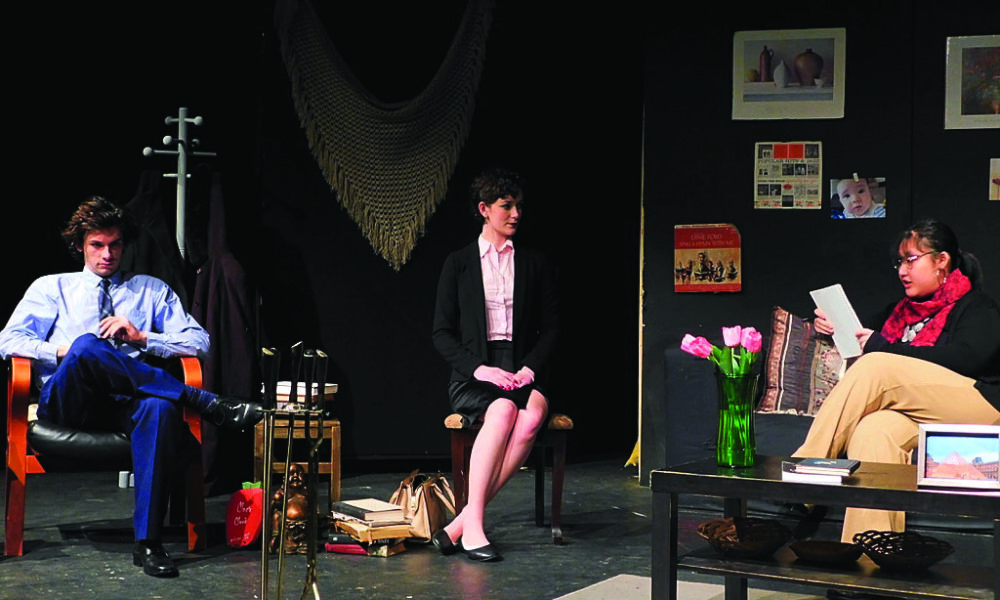
Whip is a nuanced dance performance that fuses touch, sound, space, light, and above all, the relation of one human to another. The production, which ran from Nov. 3 to 6, was co-produced by Montreal Arts Interculturels (MAI) and dancer Ralph Escamillan’s performance company FakeKnot, with Escamillan and Daria Mikhaylyuk performing the routine. The show features the two dancers leaping, crawling, and twirling across a 20 by 20 feet square stage—but with one vital twist: They can’t see. Five-foot-long leather hoods obscure their vision entirely. The long, phallic hoods, paired with the intimate choreography, create a sensuous performance that explores the giving and taking of consent. 

The two performers start off in beige clothing and stark black headpieces, with leather cylinders veiling their sight. Their hands extend tentatively, and then finally make contact. The silence is interrupted by a sudden music cue as “Every Breath You Take” by The Police begins playing. A sophisticated hand dance erupts, reminiscent of childhood handshakes. The rapidity and synchronism in their movements are especially impressive considering the dancers’ obscured vision, and the tangle of hands speeds up to the point where it becomes difficult to track whose arms are whose. 

Whip features substantial give and take; each dancer has their turn in the spotlight, while the other feels their way across the edges of the stage. The lithe and graceful movements are breathtaking and culminate in brief moments of impassioned contact. In the middle of the show, the dancers undress themselves while still heavily enmeshed in each other. During this moment of heightened vulnerability, spotlights on other parts of the stage leave the dancers’ location in relative darkness, creating a sense of privacy in a completely public space. 

The next transformation after the removal of clothes occurs when the dancers shake the leather hoods so that they unfurl to extend down to their feet, while still covering the faces of the dancers and preserving their anonymity. The dancers spin their heads several times so that the leather slaps the ground, creating a violent, whip-like snap. This suggestion of danger combined with the actors’ obscured vision is enthralling to bear witness to. While the majority of the dance was marked by suspenseful, independent movement, the concluding portion of the dance was remarkably sensual and intense. The juxtaposition of such elements gave a liveliness to the intermittent moments of touch.

Equally interesting as the contrasting elements of Whip is the artistic process behind such a show. Escamillan, the artistic director and choreographer, described his creation of the show as a reversal of the expected process—that is, he let light, sound, and costume inform the movement. Originating from the four different corners of the square stage, the pulsing music orients the dancers. The soundtrack maintains tension with the pulsing and bellows of a deep base. Stefan Nazarevich, the score’s composer, chronicled his musical journey as a back-and-forth with the dancers. The conversation between technical elements and dance adds yet another dimension of the reciprocity involved in the show’s artistic processes. 

Whip showcases the joy of physical relations between two individuals. Yet, as was made evident by the cohesiveness found in the technical aspects, interdependence extends beyond the performers to the sonic cues and expressive lighting. When placed together, the final impact is a breathtaking narrative, from the first uncertain touch to the final unclothed (with the exception of the leather hoods), whip-snapping spectacle. 

Arts & Entertainment, Film and TV

DannyBoy: A practice in the absurd

Warning: This review contains spoilers. 

Every once in a while when the moon is hanging high and my coffee tastes especially bitter, I come across a special kind of movie, one that is so strange that I can’t look away. To say that DannyBoy is an example of this phenomenon would be an understatement of the highest magnitude—akin to claiming that Montreal rarely has construction or that Tinder is great for making friends. DannyBoy is a coming-of-age story that follows 19-year-old Daniel (Darrah Byrne) as he attempts to navigate 1980s Ireland, hoping to find love and maybe even a job to support his family along the way. Released in 2020, Irish filmmaker Ferdia MacAnna’s newest film won the Best Feature Film award at the Birmingham International Film Festival. Despite its commendable efforts, this low-budget story ultimately proves amateurish and mind-boggling. 

In order to enjoy this film, you can’t take it too seriously. The film reads like a fever dream. Whether it’s the scene where Daniel paints his face white and performs what I can only assume is a satanic dance to win back a love interest Donna (Lucy Jones), or the moment when Daniel pretends to be a dog in a ploy of seduction—and it works. There is no logical coherence in these scenes whatsoever, but it’s still entertaining. 

A certain sense of dissatisfaction permeates the film; each of the characters believes that as long as they attain one thing, one person, or one dream, they’ll finally be happy. But of course, that’s rarely the case. The unique setting is also a major draw, since 1980s Ireland isn’t a typical milieu for modern films. Still, the film falls short of its potential.  

To call DannyBoy a perfect storm of abnormalities, or perhaps incompetencies, would be harsh, but true. The wardrobe tries to be ‘80s chic, but often feels bloated and repetitive, much like last-minute Halloween costumes. While the camera jumps from wide angles to close-ups, certain shots lack any sort of rhyme or reason, disorienting the audience in the process. And—not to pour gasoline over a dead horse—the acting was similarly underwhelming. There were a few commendable moments where you could see genuine remorse and regret in a character’s eyes, but they were muddled in a sea of fumbled words and exaggerated expressions. This is best illustrated by heated arguments in the film, which felt almost comedic—the actors yelling their lines at one another while their faces remained frozen. 

Despite all its shortcomings, DannyBoy definitely has certain satirical elements. Rather than succumb to its low budget, it creates exaggerated props in a few scenes to look more like arts and crafts projects, presumably to add character. Therefore, the film is clearly aware of some of its technical flaws, and even mocks them, but it is not enough to save its integrity. Self-awareness doesn’t necessarily equate to wit, especially when in so many moments the characters go against themselves, and even reason, to push the plot forward. 

Nonetheless, DannyBoy does deserve props for one thing: Potentially the greatest pickup line ever conceived. In one delightful scene, Daniel turns to Donna and seductively asks, “What’s for dessert?” a moment after they had literally eaten dessert, which is beyond the realm of my sanity. 

The hilarious yet head-scratching DannyBoy can be found on-demand on Apple TV.

Rugby, Sports

Concordia overwhelms McGill to capture RSEQ men’s rugby title

The beautiful autumn afternoon seemed a good omen as any to the sold-out crowd of McGill (6–2) and Concordia (7–1) fans who gathered at Percival Molson Stadium on Nov. 6 for what they hoped would be a competitive bout of RSEQ rugby. But despite the turnout, the Redbirds fell 33-0 to the Stingers in an unfortunate end to an otherwise stellar season for McGill. 

From the get-go, both teams hungered for victory, playing at a faster pace than any other game this season. The first 20 minutes were contained around the centre line, with neither team making much headway before losing the ball on a knock-on. Unfortunately, things went downhill for the Redbirds midway through the first half when Concordia’s Jean-Christophe Vinette opened up the scoring with the Stinger’s first try. Minutes later, McGill came close to scoring a try with a slew of high-quality chances at Concordia’s try line, but fell victim to tackle after tackle and could not capitalize. At the half, the scoreboard read 21-0 for Concordia. 

McGill came back a renewed team at the start of the second half, holding their ground defensively but with nothing to show for it in points. Just over midway through the half, Mohammed Al Moallim of Concordia charged through a gap in the Redbirds formation and touched down on an incredible breakaway. As if to add insult to injury, the Stingers piled on another try in extra time, with Stan Blazkowski scoring and Arthur Du Chauffaut converting to end the match 33-0.

If disheartened McGill fans were hoping to trudge out of the stadium immediately following the end of the match, they were woefully optimistic. As Concordia celebrated their win, RSEQ officials trotted out victory medals. However, a fire alarm set off by a stray flare forced the confused crowd to exit the stands, saving any McGill fan from watching an almost perverse awarding of medals to the Stingers. 

Scrum-half Owen Cumming, who led the Redbirds in points scored this season, expressed his frustration with the outcome.

“Today was tough, we had a game plan and it just wasn’t executed how we would have liked it,” Cumming said. “It was a physical and fast-paced game. We sadly just couldn’t get the job done.” 

The Redbirds finished their season second in the RSEQ standings, with a 6-2 record overall. The club had not beaten Concordia this season, with their only matchup ending in a narrow 14-6 win for the Stingers. Two years ago, in the last season before the pandemic, Concordia conquered McGill in the finals, making Saturday’s game a difficult pill to swallow—especially for the graduating seniors. Team captain Karl Hunger, whose younger brother, Brad Hunger, is also on the team, is hopeful about the future of Redbirds rugby.

“Unfortunately, it’s my last year so the time has come for me, but I know I’m leaving the club in great hands,” Hunger said. “We’ve got an amazing group of young guys that I’m so excited to see develop their game.”

Hunger talked about the brotherhood, both literal and figurative, that has developed on the team, and expressed his gratitude toward the teammates he now calls his best friends.

“I’m so proud of the boys for their dedication to the club this season,” Hunger said. “I’ve loved every moment I have shared with my teammates, past and present. I’ve [made] best friends and formed brotherhoods that will last a lifetime. I wouldn’t have it any other way.” 

Cumming shared his teammate’s sentiments and was grateful for the show of support from the McGill crowd, despite the loss. 

“We’d especially like to thank our fans, it was such an amazing atmosphere and we hope to continue that in the years going forward,” Cumming said. “We’ve got a great program here, and we will certainly be back.” 

Stat Corner: 

The last time McGill men’s rugby finished a game scoreless was in 2012 against Queen’s University.

Quotable: 

“Concordia is a good team, and they were certainly the better one on the day. All we can do from this is grow and have more and more guys say they know what being in a final is like going forward. Experience is everything in this league.”  —Fourth-year scrum-half Owen Cumming 

Moment of the Game: With 17 minutes left on the clock, a belligerently drunk McGill student shouted “Number 24 looks like a pumpkin spice kind of guy!” Number 24 Arthur Du Chaffaut gave the fan a knowing look, caught a turnover, and punted the ball forward for a spectacular try, bringing the score to 31-0.

Science & Technology

Alzheimer’s disease: More than a century later

In 1901, Alois Alzheimer noticed an abrupt change in his wife August Deter’s behaviour. Though only 50 years old, she began suffering from memory problems, paranoia, and bouts of aggressive behaviour. Five years after being admitted to a psychiatric ward, she passed away a completely different person from the woman he once knew. The experience inspired Alzheimer to conduct years of clinical research that eventually led to the discovery of dementia and Alzheimer’s disease, a lethal brain condition that affects memory and cognitive functioning, mostly among the elderly. 

While there remains no cure for this disease, researchers at McGill’s Stop-AD research centre have been at the forefront of prevention research for several years. They have learned that Alzheimer’s is not a disease that appears suddenly, but one which develops over the course of a lifetime. By the time symptoms are evident, 70 per cent of neurons are already dead.

The team at Stop-AD was among the first to conduct a long-term study on the brain development of living patients with a high risk of developing Alzheimer’s. Approximately 350 people with a mean age of 63 participated in the study from 2011 to 2017, and their data now informs some of the leading research into Alzheimer’s disease in universities around the globe.

Before this study, Alzheimer’s research was typically conducted in mice or on cadaver brains. Scientists had previously focussed on the buildup of tau and amyloid proteins in the human brain, which were thought to be the main cause of Alzheimer’s, but many treatments targeting these proteins have failed in humans. 

Judes Poirier, a professor in the Department of Psychiatry at McGill University, is an Alzheimer’s researcher and the director of the Molecular Neurobiology Unit at the Douglas Research Centre.

Though the mouse and cadaver models seemed promising to many at the time, Poirier and others have always insisted that Alzheimer’s is a uniquely human disease. In order to test on mice, genes from humans had to be inserted into their DNA. Moreover, many of these genes were only associated with rarer, early-onset forms of human Alzheimer’s and were unrelated to the late-stage forms that affect 98 per cent of patients.

The problem stemmed from researchers assuming that protein buildup led to symptoms of dementia. Instead, Poirier’s research has found that toxic proteins called amyloid beta 42 accumulate in the brain more as a result, rather than a cause, of the disease.

“Like tombstones, there are plaques where cells have died,” Poirier said in an interview with The McGill Tribune. “However, it is not because there is a tombstone on top of all dead people in a cemetery that it is the tombstone that killed them all.”

This realization, Poirier explained, has steered the field of Alzheimer’s research in a new direction.

“For the vast majority of scientists in my field, the toxic protein spreading is no longer the solution to AD treatments,” Poirier said. “More than 20 amyloid and tau-based treatments tested in humans [have] systematically failed in humans these past few years [even though they] succeeded in the mouse models.”

Now, Poirier says funding is being funnelled toward methods of prevention rather than cure, with a particular focus on maintaining patients’ cardiovascular health. According to a Stop-AD study, the biggest determinants for a person’s predisposition to Alzheimer’s have little to do with pharmaceuticals, but with the lifestyle choices made years before the disease hits. Links have also been found between the E4 allele of apolipoprotein, a plasma protein which helps regulate cholesterol, and the progression of Alzheimer’s.

Many other diseases, such as diabetes, hypertension, and high cholesterol, can increase the risk of Alzheimer’s. A healthy diet, regular exercise, and the absence of these other diseases have been shown to delay the onset of Alzheimer’s by anywhere from a few months to five years. For researchers and doctors, this presents a golden opportunity.

“A 10-year delay in Alzheimer’s would result in [a] 93 per cent reduction of cases. This is feasible,” Poirier said.

If scientists could achieve this, elderly patients with underlying Alzheimer’s would likely pass away long before the disease could affect them, eliminating its impacts for those prone to suffer. Though the research of past decades may not have been as fruitful as hoped, this new direction makes a world without Alzheimer’s seem like a near possibility.

Arts & Entertainment, Poetry

Thinking through race in anthropology through poetry

On Nov. 3, the McGill Anthropology Graduate Student Association (AGSA) organized the workshop Thinking Through Race with Ethnographic Poetry as part of an ongoing series on racism and racial justice within anthropology. Ethnographic poetry is a research method where anthropologists study an individual’s poetic works in an attempt to understand the poet’s relationship with their culture, community, and audience. This workshop in particular aimed to showcase poetry’s anthropological applications and reveal how reading poetry can help anthropologists avoid potential racial biases—a pervasive problem in the field. 

“The Anthropology Graduate Student Association recently started a working group called the Racial Justice Working Group,” Alejandra Melian-Morse, one of the event’s organizers, said in an interview with The McGill Tribune. “We have been reflecting on and trying to take more responsibility for racial inequality in our anthropology department. We wanted to do something that was more creative, to help people think in different ways about a topic that is very difficult to approach for many people.”

Justin Wright, a sociocultural anthropologist, performance poet, and the current Poet-In-Residence at SAPIENS Magazine facilitated the workshop. Wright discussed how reading poetry is an important component of research methodology in anthropology because it details history through emotional language. They described how poetry can capture the writer’s emotions at a precise moment in time in a way that the factual language used in historical documentation cannot. They also explained how their work as a sociocultural anthropologist examines the many ways Black people experience individual and communal trauma. 

“I think of anthropology as a method for tending to Black life,” Wright said. “Poetry also works in that way, as a tool to uncover the unvoiced truth of our past. [A poet] is responding to [their] world, to what is happening at [their] time. A poem is not just a piece of poetry where it’s solely for the author. [A poet] is doing this in service of [their] community, in order to help push them along in a certain way.”

Wright explained their “six questions method” to read poetry as ethnographic material: One must ask themselves who the author and audience are, what the subject of the work is, when and where the work was written, what context pushed the writer to compose the poem, and how it has been received historically.

“[Poetry and creative prose] often speak directly to the author’s lives and rights, to their experiences and their cultures,” Wright said. “We can’t dismiss those kinds of works as anything other than rich experiences, as history’s ways of being. Poetry is a meaning-making language. When we’re talking about reading poetry as ethnographic material, […] we’re talking about heavy research, about engaging its questions in a scholarly manner, in service of ethnography and in service of anthropology.”

Wright fuses their knowledge of anthropology and poetry to explore explorations of Black historical traumas with contemporary representations of Black experiences. They explain the use of such anthropological methods as a means to widen their understanding of different cultural considerations.

“Anthropology helps me figure out a way to orient my poetic devices to get to a certain point, a certain kind of emotional logic, a certain argument,” Wright said. “Anthropology has helped me think about what I’m specifically doing with [my poetry].”

This workshop was one of many other upcoming events in a series exploring the intersection of racial justice and anthropology. Other events include film screenings, creative workshops, as well as interviews with podcasters and content creators.

Editorial, Opinion

U of T’s divestment sets a low bar that McGill refuses to reach

On Oct. 27, the University of Toronto (U of T) announced that it would divest from all its direct fossil fuel investments in the next 12 months, with plans to divest from all indirect investments by 2030. It also stated that it will take steps to curb more emissions than it produces to become a “climate-positive campus.” The university is the latest post-secondary institution to get on board with divestment, with Concordia and Harvard having recently made similar announcements. Yet McGill lags behind. Despite numerous performative measures and a steadfast commitment to preaching sustainability at every turn, McGill continues to operate like a business, prioritizing short-term profit above genuine concern about the future of the planet. With the climate crisis worsening with each passing day, it is increasingly important for the university to divest and take aggressive climate action––not in 10 years, but immediately. Calls for divestment are not new—in fact, they almost feel worn out. The clock is ticking for the McGill Board of Governors to divest but it might already be too late.

Rather than divesting, McGill’s response to the climate crisis prioritizes individual action, innovation, and technology. Reusable water bottles or early-stage “green tech” solutions have their merits, but are not enough on their own. The term “sustainability” has turned into a vapid buzzword, and it finds its way into many of McGill’s PR campaigns. This approach is, however, a hollow one. Band-aid sustainability efforts risk becoming a facade for meaningful climate action: Real commitment necessarily involves a thorough and immediate restructuring of systems and institutions—and that starts, but does not end, with divestment and sustainability initiatives. 

For a university that places such heavy emphasis on its global standing, it is ironic that McGill shows little interest in being a leader on critical issues like climate change. McGill’s alleged commitment only manifests when it serves to benefit the university’s reputation. For example, McGill had COP26 attendees Dr. Courtney Howard and MSc. Candidate in Bioresource Engineering and Climate Mitigation William Gagnon take over their Instagram account this week. That McGill would showcase sustainability advocates while refusing to yield to student demands to remove the James McGill statue or divest from fossil fuels is a testament to this proverbial facade. Indeed, McGill cannot simultaneously ignore students’ pleas for divestment while also taking credit for the climate-conscious students who they position to represent the university favourably on the international stage. 

The university’s repeated refusal to divest despite constant pressure by the student body reveals a wider structural issue. The fact that these motions continue to fail at the Board of Governors after their approval at every other level of university governance reveals a major discrepancy between students’ views on McGill’s responsibilities and the views of the board—many of whose members have backgrounds in business. Although the bureaucratization and corporate focus of post-secondary institutions is not unique to McGill, the university should nevertheless not be absolved from moral scrutiny.

Commitments to divest from various universities across Canada and the United States are necessary, especially as the window to act on climate change rapidly closes. In the context of U of T’s announcement, the choice to finally divest after years of student activism is not one that should garner applause. Divestment is long overdue for all universities—but especially those apathetic institutions that have yet to even take that first step. McGill needs to pass motions to divest, and soon, because if anything is to be taken from the “Change the Name” campaign, it is that change takes time, and time is exactly what is running out

News, SSMU

SSMU hosts successful second Activities Night after failed first attempt

The Students’ Society of McGill University (SSMU) held Activities Night 2.0 from Nov. 1 to Nov. 3. Independent student groups, clubs, athletics groups, and others set up booths on the fourth floor of 2200 Centre Mont-Royal between 4 p.m. and 8 p.m. to showcase the breadth of student life at McGill and to encourage students to get involved.

The event was the second Activities Night of the Fall 2021 semester. The first edition, held virtually on the Gather.Town platform, was unsuccessful after a system-wide crash shut down the event. SSMU vice-president (VP) Student Life Karla Heisele Cubilla explained why she decided to host Activities Night 2.0 in person in an email to The McGill Tribune.

“Regulations have significantly changed since Sept. 1,” Heisele Cubilla wrote. “Vaccine passports were implemented, one-metre distancing became possible, and there is a limit of attendees at conventions and conferences. Given these circumstances, an in-person fair event was possible, and it did not violate any health regulations currently placed by the government.”

Due to the ongoing COVID-19 pandemic, SSMU implemented several protocols, including physically distanced booths, hand-sanitizing stations, and mandatory vaccine passports. There was also a hybrid option—students could join a virtual fair on Zoom to visit all the different booths. Many of those who attended the in-person evening, like Jordan Cowie, U1 Management, felt that it was a welcome change. 

“The layout is super cool,” Cowie said in an interview with The McGill Tribune. “[SSMU] designed it very well, and the space is really close to campus, which is fun [….] Through COVID, we really missed that [in-person] communication, so now we are getting that and it is really fantastic.”

Despite Activities Night being held later than usual in the semester—typically it is held mid-September—Cowie was still happy to attend.

“I’m just looking at all the clubs McGill has to offer,” Cowie said. “[McGill] boasts a really robust student body, and I think our clubs represent that. It is really cool to see what everyone else is involved in.”

For many students, the in-person event was their first opportunity to get to know the different clubs at McGill in one place. For some brand new groups, such as the McGill Students’ Blood Donation Association (MSBDA), Activities Night 2.0 was their first chance to introduce themselves to students. 

“It is really important to start to build out that network, that community, so [that] we can reach out,” said Gian-Carlo Buonamici, U2 Management and MSBDA VP Finance, who tabled for MSBDA. “Eventually, once we have grown and fundraised for our own blood drives on campus, hopefully we will have that basis of support already there.”

Buonamici, who attended the first two nights as a visitor, echoed Cowie’s statement about participating in the event in person. 

“I’ve come for the past two nights as well, and it just feels really good to get a feel for what the McGill community is really like, especially after a year all online,” Buonamici said. “It is nice to see people in person, seeing what people are passionate about, seeing what people are putting their energy towards.”

After two Fall semester Activities Nights, Heisele Cubilla says the SSMU student life team has learned a lot about planning events during the pandemic.

“Activities Night 2.0 was a very successful hybrid event (the first hybrid event of this size at McGill since the pandemic started),” Heisele Cubilla wrote. “Moving forward for the Activities Night Winter 2022 planning, the SSMU team has a structure to build upon and improve the hybrid experience for the next event [….] The event [also] needs to be carried [out] at the beginning of the semester to maximize attendance and participation.”

Off the Board, Opinion

Me and my board: Penny-boarding through Montreal

I have always been a cautious person. Though I can bring myself to take risks in many areas of my life, when it comes to physical activities I am usually the one who stays behind, choosing instead to sit inside with a good book. It is for this reason that I never considered picking up a skateboard.

On top of the physical risks of the sport, there is the intimidation factor: The skateboarding community can come across as intense. I had also imagined skating to be one of the activities that can only be learned at a young age. In my head, there was nothing more embarrassing than a 21-year-old skateboarder in full knee pads, elbow pads, and a hot pink helmet. Not only were these thoughts limiting, they were also untrue.

Although skateboarding initially seemed daunting to me, when I started practicing seriously I was able to pick it up within a few weeks. Freshly home from a trip and stuck in quarantine in June 2021, I took a leap and ordered a penny board online. Then came learning. I took it out to the backyard to give it a try, and I won’t lie, it was scary. The first few times, I could not let go of my boyfriend. Soon enough, however, I was slowly gliding down the parking lot.

I then started skating with a friend in parking lots and quiet streets, still away from the public eye. She taught me to skate one foot at a time and in just a few days, I was making significant progress. The frustrating thing about skateboarding when you are a woman—thus not the “typical skateboarder“—you tend to draw attention to yourself, resulting in many awkward and sometimes creepy conversations. I have had to fend off many unwanted comments and dismiss the prying eyes of passers-by. Luckily, I was the one on the skateboard, and I could quickly speed away in the opposite direction. 

I eventually started skating to campus, which had been my aim all along. But by August, when I still had not made as much progress as I had wanted, I thought my goal remained out of reach. I feared that perhaps it would never happen. That said, on the first day of school, I showed up with my board in hand. 

Aside from the obvious benefit of a sport that doubles as a form of transportation, it is also a social one. My boyfriend has a longboard, and some of the best times we had in the summer were spent racing down Montreal bike lanes in the pitch black of night together.  

Unfortunately, daytime skating involves the added consideration of cars, whose drivers often do not feel like collaborating with pesky, unpredictable skateboarders. 

In addition to the dirty looks from drivers, skateboarders face another inconvenience: Montreal’s poor road quality. Every time I go over a bump, I pray I do not fall off. 

I have fallen off my skateboard three times: The first time I twisted my ankle, the second time I bruised one knee, and the third time, the other one knee. Although I admit that I am still only a beginner, I place most of the blame on the unpredictable nature of the pavement; skating here is a challenge at the best of times.

Despite this, I keep getting back on the board, and I now consider skateboarding to be one of my favourite activities. As the skateboarding season comes to a close—at least for those of us who do not want to be gliding through the snow—my advice to anyone interested in taking up the sport is to not be afraid to try it out. Contrary to popular belief, you do not have to look a certain way or be fearless to skate. If you want to skate, then skateboarding is for you. Take my word for it—it is never too late to try.

Campus Spotlight, Student Life

Catching up with Mobilizing for Milton-Parc

What a difference a year—and a pandemic—can make.

In the fall of 2020, during the months when COVID-19 raged, concern for unhoused neighbours in the area surrounding McGill prompted Sophie Hart to found Meals for Milton-Parc, a student-led meal-share initiative that provided food and care packages. 

The group recently shifted its mission and took on a new name—Mobilizing for Milton-Parc (M4MP)—in order to meet the changing needs of unhoused people.

In its early days, M4MP focussed on getting food to those in need and making sure Milton-Parc’s unhoused neighbours felt cared for. Meal distribution was a cornerstone of that effort.

“I felt like we were not doing enough to support vulnerable people in our community,” Hart said. “With the pandemic, services were closing down due to public health requirements.” 

What followed was an outpouring of support from the McGill community, much of it driven by social media. In the period between October 2020 and August 2021, M4MP raised close to $20,000 and distributed some 3,000 meals.

With services for the unhoused community returning to full working capacity as pandemic restrictions loosen, M4MP is now shifting gears to focus on supporting both Indigenous-led and non-Indigenous-led organizations in Montreal.

“We started our project because there was a need for us to meet,” Hart said. “But as the pandemic has begun to wind down, the organizations in our community have been able to get back to full capacity. We want them to know how much we appreciate the work they do, and that they have our community supporting them when they need it.”

M4MP now gives financial and material support to organizations such as The Open Door, The Montreal Indigenous Community Network, The Native Friendship Centre of Montreal, and Plein Milieu, to name a few.  

With this shift in vision, M4MP has become a conduit for funds, food and material support, community building activities, and settler education projects.

The group runs community building activities for residents of the Hotel Dieu shelter, which is open 24/7. Since October 2021, M4MP has held art, self-care, and pumpkin-carving events.

“These activities, in my mind, are important to create connections among neighbours as well as to have some fun,” Hart said. “I think people forget that at the end of the day we all like to have fun, connect with neighbours, and talk to new people.”

Much of this programming has been made possible thanks to crowdfunding efforts through M4MP’s Instagram page. This year, M4MP started an “Education Team” that uses its online platform to educate settlers, and to stress the responsibility that they have in amplifying and supporting the voices of marginalized communities.

“[The past year] has made me realize how much can be done when caring people work together,” Hart said. “This year has also made me realize how broken the systems in place to support vulnerable people are. I’ve learned so much in such a short time, but what has stood out to me most is that we really need more people to join the care and community field.”

Individuals interested in volunteering can join the Mobilizing for Milton-Parc Interest Group on Facebook and watch the volunteer training video. Donations may be e-transferred to [email protected].

McGill, News

McGill ends COVID-19 emergency response, transitions to recovery response

The McGill administration announced on Nov. 1 that its Emergency Operations Centre (EOC), the administrative body coordinating the university’s COVID-19 response, had been deactivated. The announcement, sent in a university-wide email, explained that the university is officially transitioning to a “recovery and resumption” response, with all COVID-19 matters now to be headed by the new Recovery and Operations Resumption Committee (ROR). 

The McGill administration cited the community’s high vaccination rates as well as the Quebec government’s recent announcement that it expects to end the province’s state of emergency in early 2022, as contributing factors behind the decision to transition from the EOC to the ROR. 

In an email to The McGill Tribune, Frédérique Mazerolle, a McGill media relations officer, explained that the “recovery and resumption” transition would transfer all COVID-19 matters under the university’s pre-pandemic administrative structure. Mazerolle stressed that the transition from the EOC to the ROC signals a step toward a post-pandemic environment. 

“This new structure was chosen to better align with the university’s day-to-day governance structure and allow for a smoother transition to regular governance processes as the pandemic continues to evolve in the coming months,” Mazerolle wrote. “We do […] feel confident that we have reached a point where we can shift our focus from emergency response to recovery planning.”

The EOC, composed of senior administration officials with expertise in emergency planning, had been coordinating McGill’s COVID-19 response since January 2020. The COVID-19 pandemic is the longest crisis the EOC has dealt with; previously, it had only dealt with crises lasting mere  days or weeks. 

However, many members of the McGill community questioned the implementation of the EOC for the COVID-19 pandemic when it was initially being rolled out. Richard Gold, a professor in the Faculty of Law, criticized the administration for its lack of transparency and engagement with the wider community in its operations. 

In a statement to the Tribune, Gold welcomed the deactivation of the EOC, arguing that while the members of the EOC may have been diligent in their planning, they did not have adequate knowledge on medical or legal affairs to make COVID-19 related decisions—and that they “refused to listen to experts at McGill who did.” 

“[The EOC] provided the administration an excuse to take on powers that it does not rightfully have under McGill’s statutes and regulations,” Gold wrote. “The administration ruled by edict during the pandemic, failing to engage the campus and to be transparent as to the reasons for its actions [….] I hope that the ending of the emergency response signals a return to collegial governance, which has been suspended since spring 2020, and an actual engagement with campus.”

Arts Undergraduate Society (AUS) vice-president (VP) Social Affairs Sam Baron also expressed relief in not having to go through the EOC to get approval for community events, citing communication issues with the EOC when he was planning for Frosh 2021 . 

“I, frankly, thought it was ridiculous that a fully anonymous body had the final say in almost all decisions made on campus,” Baron wrote in a statement to the Tribune. “Every time I wanted to get something done, I had to ask the EOC for permission. They clearly had too much on their plates to deal with, as I know that my emails to them […] went unanswered for weeks or months at a time.”

SSMU VP Internal Sarah Paulin also pointed out the administration’s lack of engagement with students and faculty in the decision-making around COVID-19 protocol. However, Paulin questioned the university’s decision to end the emergency response. 

“I think the decision was very rushed,” Paulin said in an interview with the Tribune. “It would have been nice to have seen more prudence from the university [….] Especially since they have provided very little support for faculty and students who have felt unsafe with the way the university is currently operating. [The administration is] very set in their ways.”

Read the latest issue

Read the latest issue