

Latest News

McGill, News

Minimal turnout at McGill’s second COVID-19 vaccination clinic

McGill held a second walk-in vaccination clinic in Redpath Hall from 1 p.m. to 6 p.m. on Sept. 28 as part of its ongoing effort to make vaccines accessible to the student body. The university currently estimates 10 per cent of students have yet to be fully vaccinated against COVID-19. According to the event announcement, the clinic had the capacity to administer 250 doses—whether a first, second, or a booster shot—of the Pfizer-BioNTech vaccine during its five opening hours. 

This clinic saw a lower student turnout than the university’s first vaccination clinic held on Sept. 14, when students waited in line all day and many were turned away. This time, there was no line for most of the afternoon. An hour and a half in, McGill sent a university-wide email reminding students of the clinic’s re-opening. The email stated that five public health service nurses would be accepting walk-ins until 6 p.m. 

Carter Nagy, U1 Education, who arrived at the clinic early, told The McGill Tribune he anticipated a long line because of his experience at McGill’s first clinic, but was pleased to discover no line at all. 

“I was here the first time they did the clinic, and that’s when I got my first shot,” Nagy said. “I came around this [same] time [for the first clinic]. It’s obviously not the same today, but I saw what it could be like so I made sure to come here early.”

Nagy got his second shot after waiting around 45 minutes, less time than the one and a half hours he waited in line at the first clinic. Nagy said that it was important for him to get vaccinated from a public health standpoint, but also because he does not want to put up with the vaccine passport restrictions in Quebec.

“My family is pretty anti-vax,” Nagy said. “But, I am here [at the clinic] because I think it is important and I want to be able to do things that I would not be able to […] do if I did not get vaccinated.”

Dr. Anne Gatignol, professor in the Department of Medicine and senior investigator at the Lady Davis Institute for Medical Research, believes on-campus vaccination clinics play a vital role given their convenience and potential for spreading knowledge on the vaccine.

“It is certainly beneficial for McGill to hold a COVID-19 vaccination clinic on campus and for students to have another place to get vaccinated,” Gatignol wrote in an email to the Tribune. “Although most Canadian students have had access to a vaccination clinic within the last few months, it may not be the case for international students. This is important for them to have […] easy access to vaccination. Furthermore, several students might still have hesitancy to get vaccinated and this is a good place to ask questions and get answers.”

Gatignol believes that McGill should keep holding clinics as long as there is demand for vaccination and suggested the university reduce clinic hours or create a sign-up system as demand wanes. She also stressed the importance of getting vaccinated amidst the spread of the Delta variant. 

“The vaccination is the best way to get protected against the Delta and all variants,” Gatignol wrote. “In young people, the decrease in efficiency against the Delta variant for mRNA vaccines is no more than five per cent and it protects against all severe forms. The increasing presence of the Delta variant should encourage students and everybody even more to become vaccinated to avoid severe complications.”

Many students have already heeded McGill’s calls to get vaccinated. Ana Maria, U1 Arts, said she knew about the clinic but did not need the service because she was already vaccinated. Maria speculated the low turnout was because others were in the same position. 

“I got [an] email but I did not pay attention to it,” Maria said. “I think people knew [about the clinic] but, like me, already […] got their vaccines someplace else.”

In an email to the Tribune, McGill media relations officer Frédérique Mazerolle drew attention to the importance of vaccination and emphasized McGill’s ongoing efforts to vaccinate the community.

“COVID-19 cases in the province have been on the rise, but fully vaccinated individuals are still much less likely to get COVID,” Mazerolle wrote. “By having the majority of our students, faculty, and staff vaccinated, along with properly following McGill’s health and safety guidelines, McGill will remain a safe place to learn and work.”


Student Life

Spots for shut-eye: Where we sleep on campus

Shirley Xu, Contributor

The sun warm on your face, the grass a soft cushion, the faint murmur of students passing by—what more could you ask for in a napping spot? That settles it––my go-to location to nap is Three Bares Park. During the 30-minute breaks between my classes in first year, this was the perfect location to drift away and, thanks to its proximity to Leacock 132, maximize my nap duration. My favourite sleep position is simple: Head on backpack, hat over face, phone alarm in hand, lying on the incline. The best part was the warm sunlight, and as we move into chilly October, I can’t help but reminisce about those September naps. Napping during school hours was something I never had never done before university, but it’s a great way to re-energize between long classes and catch up on missed sleep when schoolwork and extracurricular life becomes hectic. In fact, researchers at McGill encourage napping!

Wendy Zhao, Student Life Editor

During the school year, the hours of sleep I get in my apartment every night never feel like enough. Even with my yearly goal to schedule in the recommended eight hours each night, friends, schoolwork, and odd corners of the internet regularly keep me up into the wee hours. When exhaustion hits, a library desk and the fold of my arm provide enough comfort to put me to rest for a few minutes. For a longer nap, the couches on the upper floors of the Music Library are a haven. Facing away from the study spaces and instead toward the large glass windows, you are both hidden from other students and warmed by the sunlight. To assuage the fear of having my things stolen, I hug my backpack while I sleep. 

But setting alarms in a quiet atmosphere can be tricky, so I’ve resorted to using my earphones. Sudden blasts of noise streaming into your ears can be a terrible way to wake up, especially when enjoying a sweet dream, but I’ve decided it’s a price I am willing to pay for a few added minutes of midday rest. 

Holly Wethey, Student Life Editor

I used to find it really hard to nap in public and I definitely would never have been caught dead napping on campus in my first year. However, over time, I’ve gradually come to realize the necessity of rest, even if that has to happen away from home. Key to this realization is the fact that no one really cares when you nap in public; everyone is simply too busy with their own day to notice someone curled up in a corner snoozing. This is why I have taken to lying in the lower field, with my head on my tote bag and resting my eyes. In all honesty, I usually go there to try to study, but this proves to be difficult when you’re lying on your stomach in the grass. It’s a dangerous game, and I often give up and close my eyes while people rush busily by on the Y-intersection.

Kennedy McKee-Braide, Managing Editor

Anyone who has ever travelled with me has likely been filled in on the fact that I struggle to sleep in places I’m not “meant to”––even on red-eye flights, I usually end up staying wide awake. My ideal napping set up involves my bed and a good set of blackout curtains. 
However, as I’ve gone through more of my degree, naps have become more necessary, and I’ve had to try and adapt. In my first year, I found I was able to doze off on the––admittedly disgusting––couches in the Arts lounge in Leacock basement. Once the iconic spot shut down for renovations, however, I found some other spots, including the Ferrier lounges’ homely couches. While my on-campus naps are still rare, a good couch does wonders when needed.

Student Life

Fantastic felines of McGill

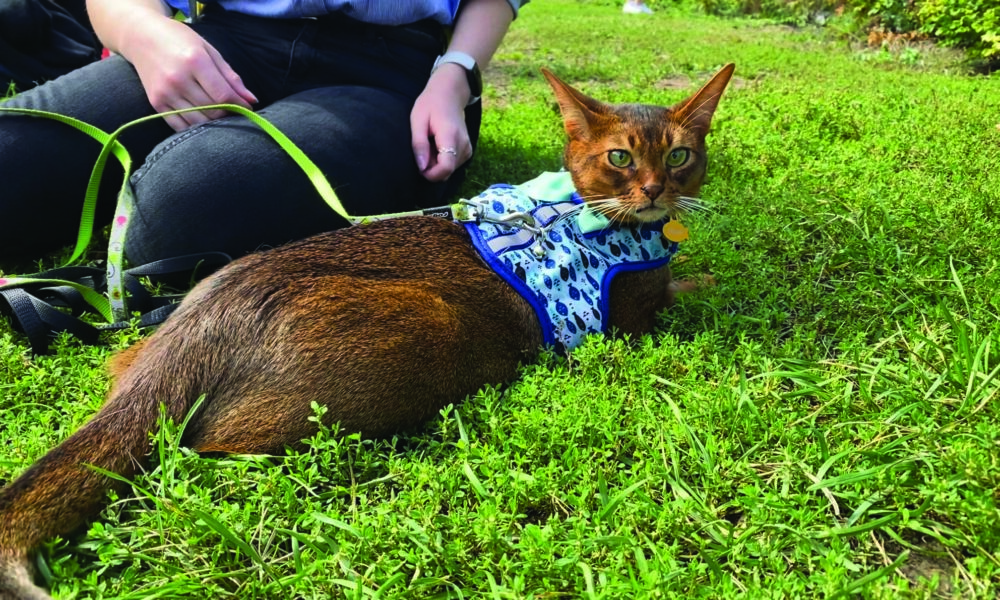
As I studied on lower field the other day, something strange happened: I was approached by a small, golden cat. As it turns out, this cat’s name was Keanu—yes, after the famous actor. His owner, a McGill student, frequently walks him to campus, often drawing crowds of admirers.

Cassia Nasralla, U4 Arts, adopted the one year old Abyssinian in early January 2021. She spoke with The McGill Tribune about how having a pet helped her cope during the pandemic. 

“I really needed a ‘COVID kitty’ because I was down in the dumps and not feeling too good being locked up and isolated,” Nasralla said. 

Though Nasralla is a full-time student, she doesn’t find that pet ownership interferes with her academics. In fact, it’s quite the opposite.

“It’s very nice to be able to […] just take him out for walks,” Nasralla said of Keanu. “I get that break between my class time and then bring my cat, so he helps keep the work-life balance.” 

Aside from helping Nasralla manage her time, her cat—who once provided much-needed companionship in a time of isolation—now gives her a sense of purpose.

“It’s so nice to just come home to someone who loves you,” Nasralla said. “That’s the best thing and then when you wake up in the morning, you’ve got this other being to look after on top of yourself, and it just keeps you going […] because they need you and you need them.”

Nasralla isn’t the only student who recently adopted a cat—Eve Cable, U4 Arts, and Chloe Maclagan, U3 Arts, have been fostering their cat Sundae since the summer. Cable, who had wanted a pet ever since she was little, decided that it was the right time to foster a cat after moving in with Maclagan.

Whereas dogs require a lot of attention, cats are more independent. Researchers at the University of Bristol found that degree-holding adults tend to own cats rather than dogs, because cats better suit those who commute and work late. 

“Cats are definitely more manageable in university,” Maclagan said. “They can be left alone [longer].”

The experience of looking after an animal is also something that Maclagan and Cable cite as an important step toward independence.

“I feel like it’s a really rewarding thing to do, especially as students [are] gaining a bit more independence for the first time,” Cable said. “I think having your own cat is really one of the first steps in adulthood.”

Both Maclagan and Cable also appreciated the experience of cat-ownership.

“It’s like having a silly little kid around who makes a lot of the mess,” Cable said. “She loves to play with yarn, which is a very traditional thing, but […] she has hours of fun with just a piece of string. I bought her some cute, nice toys and her favourite thing is just this piece of yarn with a hair tie.”

Each animal also comes with its own quirks and discovering these traits can be a small pleasure amid the stress of university life.

“She likes to sit at the window and look out […] which is kind of cute, because you can see little kids sometimes stopping and pointing,” Cable said. “She [also] likes to eat her food when you’re in the room with her. I feel like she really appreciates us.”

Football, Sports

Redbirds homecoming football game a soggy nightmare

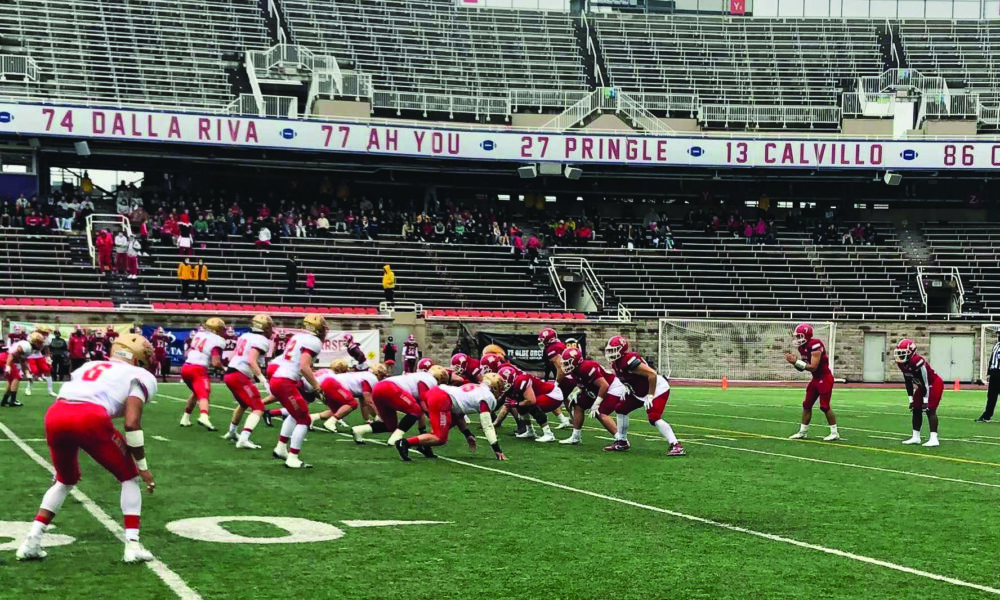
Rainy weather and grey skies set the mood for the Oct. 2 homecoming game as the Laval Rouge et Or (3–⁠2) dominated the McGill Redbirds (1–⁠4), coming away with a 55-2 win in their second encounter of the season. Despite the 2,000 game tickets sold, the crowd was meagre, huddling under the rain cover in the bleachers. The low energy seemed to trickle down onto the field. 

The Rouge et Or opened up the scoring with a touchdown by receiver Kevin Mital just over a minute into the first quarter. After Laval jumped to a 9-0 lead, McGill managed three first downs in a row, edging their way up the field with strong rushes by first-year running back Elijah Williams and an impressive pass reception by second-year wide receiver David-Amani Kabwe

Trouble kept adding up for the Redbirds as quarterback Dimitrios Sinodinos made several incomplete passes and narrowly avoided a turnover when Laval fumbled a pick. Two overshot snaps by the Redbirds led to turnovers, giving Laval more opportunities to move up the field. Laval forced six McGill safeties throughout the game, as the Redbirds tried to fend off their rivals’ ever-growing momentum, which eventually turned into an insurmountable lead. Unfortunately, the Rouge et Or outran McGill several times, making few errors and a lot of headway on the scoreboard. 

Coming out of the half, Laval led 42-0, but McGill managed a 13-yard safety in the third quarter that prevented a complete shutout. 

Overall, the second half proved to be more of an evenly matched game, with the Rouge et Or only outscoring McGill 13-2 in the final two quarters, a much better showing than the first half. 

Laval was never going to be an easy team to beat—this game followed the first two-loss streak the team has had in almost 20 years, and they were desperate to turn things around.  

Wide receiver Kabwe was disappointed with the result, but said he is looking forward to the opportunity for redemption. 

“It was an embarrassing game for us, because we know that we can compete with any team,” Kabwe wrote in a message to The McGill Tribune. “You have to remember that we played Laval in our first game of the season and we showed up, unlike yesterday.”

Williams shared Kabwe’s sentiments, noting that the poor weather conditions may have dampened their mindsets. 

“Things just didn’t go as planned for us,” Williams said. “I felt the weather brought the energy and tone down, [while] the other team was simply there to play. But football is a tough sport and you have to be prepared for whatever comes your way. Most importantly, we have to execute more on special teams.”

The team hopes to redeem themselves next weekend against Sherbrooke on Oct. 9. The away game is their only remaining chance to make the playoffs, as Sherbrooke and McGill have matching 1–4 records and either could qualify. Kabwe is confident that the Redbirds have more than enough fight left to challenge the Vert et Or. 

“We are a young team, so it’s normal to be inconsistent right now,” Kabwe wrote. “Once we are consistent, we will be able to cause many surprises in the league.” 

QUOTABLE

“We have a very good team and a great coaching staff, I’m not really worried about the next few games. I’m pretty excited to face this adversity!” — Second-year wide receiver David-Amani Kabwe

MOMENT OF THE GAME

The Redbirds paid tribute to McGill Football alum Michael Soles at a reception before the game. Soles passed away in July at the age of 54 after a 16 year battle with ALS. After playing for McGill, Soles went on to play professionally for the Edmonton Elks and Montreal Alouettes. Many of his teammates and family members were in attendance for the pre-game ceremony.

STAT CORNER

Elijah Williams led McGill in yards rushed, carrying the ball 12 times for a total of 60 yards.

Recipes, Student Life

Meal-prepping for hibernation: Student-friendly autumnal recipes

Sweet-and-spicy roasted tofu and squash (vegan)

Squash never fails to bring comfort and delight. This recipe is an ode to the vegetable in all its curvaceous glory, which together with baked tofu makes for a protein-rich addition to a bed of rice or spinach. 

smittenkitchen.com

Squash never fails to bring comfort and delight. This recipe is an ode to the vegetable in all its curvaceous glory, which together with baked tofu makes for a protein-rich addition to a bed of rice or spinach. 

Ingredients

  • 1 block extra-firm tofu
  • 2 lbs acorn or butternut squash, halved and seeded
  • 1 ½ tablespoons soy sauce, more to taste
  • 1 tablespoon sriracha or other hot sauce
  • ¼ cup peanut oil
  • 2 tablespoons maple syrup
  • 1 tablespoons toasted sesame seeds
  • 2 tablespoons chopped cilantro for garnish

Steps

  1. Preheat the oven to 425 degrees fahrenheit. Slice tofu into 1/2-inch-thick slabs and cut squash into 1/2-inch-thick half-moons. Cut each slice in half again.
  2. In a small bowl, whisk together soy sauce, sriracha, and a pinch of salt. Whisk in peanut oil. Spoon three tablespoons of the mixture into a separate bowl and set aside for later. Whisk maple syrup into the original mixture. 
  3. Sprinkle squash lightly with salt and pepper and toss well. Spread slices of squash out on a large baking sheet lined with parchment and pour the maple-soy mixture over it. Roast for about 20 minutes or until golden. Flip the squash and roast until uniformly golden and soft, around 10 minutes more. Transfer squash to a large bowl.
  4. Adjust the heat to broil and position a rack just below the heating element. Toss tofu with reserved soy mixture and arrange in a single layer on a baking sheet (you can use the same one you used for the squash). Cook until crispy and golden, about two minutes on each side. Toss hot tofu with squash and sesame seeds, adding more soy if desired.

Hot tip: Try adding other seasonal vegetables like sweet potato, beets, or Brussel sprouts alongside the squash to make your plate a rainbow.

Creamy Mushroom Ramen (Vegan)

‘Twas the night before midterms, so it’s crucial to always have a quick meal on hand. Enter: Instant ramen. Ready in under 15 minutes, this recipe is elevated by an unlikely but budget-friendly ingredient: coconut milk! Be sure to use the full-fat kind to ensure the broth is rich and creamy. 

budgetbytes.com

Ingredients:

  • 1/2 tablespoon vegetable oil 
  • 4 oz. mushrooms, sliced
  • 1.5 cups vegetable broth
  • 1 handful fresh spinach, or frozen equivalent 
  • 1 package ramen noodles

Optional Garnishes:

  • 1 green onion, sliced 
  • 1 tablespoon sriracha 

Steps

  1. Add oil and sliced mushrooms to a small sauce pot and sauté over medium heat until the mushrooms are soft and dark, and all the moisture at the bottom of the pot has evaporated.
  2. Add the vegetable broth, turn the heat up to medium-high, and bring the broth up to a boil. Once boiling, add the ramen noodles to the broth. Cook the noodles in the boiling broth for about 3 minutes, or until tender.
  3. Turn the heat off, add a heaping handful of fresh spinach, and stir until the spinach is blanched (about 30 seconds). Pour the coconut milk into the pot and stir to combine.
  4. Optional: Garnish with green onion or sriracha.

Hot tip: Toss in any leftover veggies, like carrot or beans, before adding the noodles to clean out your fridge and add more substance to the broth. For non-vegans, try topping your ramen with a fried egg.

Golden Apple Crisp  

Take advantage of the apple harvest season by making this non-finicky apple crisp. An autumnal staple, each spoonful will be a perfect combination of crunchy oats and pillowy apple. 

bonappetit.com

Ingredients: 

  • 6 medium-sized tart apples, peeled and sliced (Pink Gala, Lobo, Spartan, McIntosh, etc.)
  • ½ cup packed dark brown sugar
  • 6 tablespoons unsalted butter, melted
  • ¾ cup old fashioned oats 
  • ⅓ cup whole wheat flour 
  • ½ teaspoon ground cinnamon 
  • ½ teaspoon kosher salt 

Optional: 

  • ​​One handful each of black and white sesame seeds

Steps

  1. Preheat the oven to 350 degrees fahrenheit. Mix apples, ¼ cup brown sugar, and 2 tablespoons of butter in a baking dish. 
  2. Mix oats, sesame seeds if using, whole wheat flour, cinnamon, salt, remaining ¼ cup of brown sugar, and remaining butter in a bowl until no oats are dry. Sprinkle oat mix on top of apples and bake until golden brown on top, around 50 to 60 minutes. Let cool for 10 min.
  3. Enjoy hot from the oven or with ice cream. 

Hot tip: If you are far from a microwave, pour some fresh coffee on top of the crisp for added warmth and a subtle bitter note. 

These recipes are adapted from the following sources: Roasted Tofu and Squash, Creamy Mushroom Ramen, Apple Crisp

Arts & Entertainment, Theatre

‘Black and Free’ reflects on identity and community in theatre

In what ways can Black theatre advance Black liberation in the 21st century? No doubt a loaded question, and one that the virtual event “Black and Free: Theatre & Conversation’” explored with nuance and care. Co-hosted by McGill’s Department of English and York University’s Department of Theatre, the night began with an acapella performance by Naila Keleta-Mae, an associate professor at the University of Waterloo with expertise in race, gender and theatre performance. Repeating the evocative refrain, “Black and Free. Black and Free. Black and Free,” Keleta-Mae’s simple but concise performance was a powerful reminder of the event’s purpose: To centre the fight for Black liberation in theatre.

Equal parts performance and conversation, the event opened with a stage reading of an excerpt from No Knowledge College. Written and scored by Keleta-Mae, the play follows four Black women pursuing their graduate degrees who come to face a striking revelation on the eve of their thesis defences. Play readings over Zoom come with inherent challenges, such as communicating character relationships, engaging audience members, and navigating technical difficulties. Still, the creative team worked the medium to their advantage; one performer manipulated laptop camera angles and lighting for added spectacle, while another played both the student and her condescending teacher in the same scene. Altogether, performers Uche Ama, isi-bhakomen, Kamana Ntibarikure, and Chelsea Russell portrayed the fictional students of No Knowledge College with humour and depth, imbuing their characters with sincerity as they navigated tokenism, affirmative action, and Black identity.  

Quincy Armorer, the artistic director of the Black Theatre Workshop; Rawle Gibbons, a Caribbean theatre artist and educator; and Djanet Sears, an award-winning playwright joined Keleta-Mae for a Q&A session after the reading. Unexpectedly, all but one of the discussion questions that followed did not reference the topic of Blackness. 

“This is intentional,” Keleta-Mae said during the panel, expressing that Black theatre artists tend to only receive questions related to race, whereas their non-Black counterparts are asked other questions, such as insights into their artistic process. Instead, Keleta-Mae asked open-ended questions, allowing the night’s panellists to define the relationship between their Blackness and their art on their own terms. 

 “My hypothesis is that the nuances of Blackness and Black life will inevitably be embedded in our guests’ answers,” Keleta-Mae said. 

Given the passionate discussions that followed, it’s safe to say that Keleta-Mae’s hypothesis was correct—the influence of Black identity on the artists’ responses to broad questions like “why do you make theatre?” and “who is it for?” was distinctly present. The panellists emphasized, in particular, the importance of authentic representation. 

“I wanted to see more Black stories in the theatre,” Djanet Sears said in response to a question about why she makes theatre. “Because there were not a lot, I began to write. I write in order to add my voice to a chorus of Black voices speaking about their various experiences and adding it to the Canadian arena of theatre.”

Citing his own efforts to make art that represents parts of the Black diaspora, Trinidad and Tobago-born artist Rawle Gibbons’ response to “who is it for?” proved a simple yet powerful statement: “For me, it’s for the Caribbean people.”

Together, the panellists of “Black and Free” discussed their personal performance-making processes and artistic visions, interspersed with reflections on their experiences as Black theatre artists in Canada. Looking ahead, they expressed optimism toward the future of Black theatre, provided that concrete efforts are made to dismantle deeply rooted systemic racism in the industry.

Keleta-Mae ended the night by leading audience members in a reprise of the opening refrain. Though Zoom left much of the audio crackly and disjointed, watching audience members turn on their cameras to sing “Black and Free” was the perfect encapsulation of an earlier comment by Djanet Sears: “Theatre creates community best.”

Out on the Town, Student Life

Pandemic on the dance floor: The changing scene of Montreal’s nightlife

While the Quebec government designated Montreal a green zone in June and implemented a vaccine passport system in September, all indoor dancing in Montreal nightlife venues is prohibited. Montreal is one of few cities across Canada with such regulations in place; nearby Toronto and Halifax permit dancing if distanced and masked. 

Throughout the pandemic, Legault has avoided mention of nightclubs in public health updates. In response, nightclubs have had to identify their operations as either bars, breweries, taverns, or casinos in order to remain open. Josh Breton, a part-time employee at TRH bar on St-Laurent Blvd, spoke about how the restrictions have influenced their nightclub in an interview with The McGill Tribune

“It’s changing us into something we’re not,” Breton said of the adaptations the bar has made. 

TRH’s space is designed to accommodate dancing and free movement through the room, and has limited seating. To re-open, they had to impose seating onto the dancefloor, resulting in a clumsy configuration. 

While TRH bar may have been able to re-open—although not in the way they imagined—Cafe Campus, a nightclub on Prince Arthur just off St-Laurent, has remained closed. 

“Our typical mode of operation, that of an interior discotheque with a large, open dance floor, cannot be realized under the current regulations,” they wrote in a statement via Facebook in June 2021. Even under Quebec’s recently integrated vaccine passport system, they remain closed.  

Mathieu Grondin, director of MTL 24/24, a non-profit organization advocating for the revival of Montreal’s nightlife, believes that the closure of these venues may be leading to an increase in unsafe, unregulated parties. 

“[Students are increasingly turning to] outdoor events in parks, abandoned buildings, [which] rarely enforce sanitary measures,” Grondin said in an interview with the Tribune

Some students who are sticking to the typical bar scene, such as Sasha Nuttall, U0 Arts and Science, and Lauren Arbuck, U0 Arts, say they are getting bored of their options. 

“Boycott Tipsy [Cow]!” Nuttall joked in reference to the bar’s recent popularity among first-year students. 

According to Nuttall and Arbuck, first years’ exposure to Tipsy Cow began with the in-person frosh events at the bar. The venue, minutes away from New Residence Hall, has since become a bar that students visit nearly every evening. Other popular destinations include Cafe Frappé and Bar Bifteck. Bar-goers frequently defy restrictions and dance inside the venues anyway, sitting down only when police arrive to check adherence to COVID-19 regulations. Alternatives such as house and frat parties, which consistently flout restrictions and rarely check vaccine passports, have also seemed to increase in popularity. 

Nightlife is deeply woven into the fabric of Montreal’s culture and has been for the past century—it remains to be seen how the culture will change over the next few years.

Science & Technology

10 McGill researchers selected as members of the Royal Society of Canada

The Royal Society of Canada (RSC) recently announced that 51 new members would be inducted to The College of New Scholars, Artists and Scientists, among which are 10 McGill researchers whose hard work and excellence will be recognized at the RSC Celebration of Excellence and Engagement on Nov. 19, 2021. In exclusive interviews with The McGill Tribune, four inductees discussed the inspirations behind their groundbreaking research that afforded them this honour. 

Frédéric Charbonneau  

Department of French Literature 

Born in Montreal to a family of artists and academics, Frédéric Charbonneau was motivated by family role models to pursue a career in academia. His parents were both philosophy professors at Collège Ahuntsic and his uncle, also a professor, was once elected to the RSC. As for himself, Charbonneau studied sciences in college, then studied East Asian and Chinese studies at McGill, only later pursuing French literature at Université de Montréal and in Paris. It was not until he started his university studies that Charbonneau realized that he wanted to focus his research on The Old Regime—the political and social system of France prior to the French Revolution—which eventually led him to complete a master’s and doctorate in the field. 

Part of Charbonneau’s research links literature and medicine, analyzing how these two seemingly different fields have been historically connected.

“It was in the 19th century that science and language were separated and became the two independent subjects they are today,” Charbonneau wrote in an email to the Tribune

Charbonneau’s eminent passion for literature drove him to pursue a career in academia, publishing dozens of books and holding the William Dawson Research Chair in 18th Century Literature position for ten years.

“[People should] choose a subject that they have a strong personal interest in, to the point of necessity, because research is an exploration of the self,” Charbonneau wrote.

Greg Matlashewski  

Department of Microbiology and Immunology 

Greg Matlashewski completed a PhD at the University of Ottawa and later conducted postdoctoral research in London, England, where he studied viral genes that cause cancer. However, Matlashewski holds one particular topic dear to his heart: Research on leishmaniasis, a deadly, parasitic disease found in several countries around the world such as India and Nepal. 

He started researching this disease at McGill when he joined the Institute of Parasitology in 1987. In Peru, between 1998-2006, alongside Dr. Alejandro Llanos of Cayetano Heredia University, Matlashewski developed a treatment for a particular type of Leishmaniasis called cutaneous Leishmaniasis

However, his research didn’t stop at McGill laboratories; Matlashewski led the visceral leishmaniasis elimination program at the World Health Organization (WHO) between 2009 and 2011. “I realized the major problem in this part of the world was not the lack of effective drugs, but the lack of good surveillance to ensure that people who needed treatment were treated,” Matlashewski wrote in an email to the Tribune.

Rowan Barrett  

Department of Biology

Rowan Barrett knew that he loved biology and spending time in nature from a young age. Barrett conducted postdoctoral research at Harvard, eventually becoming an assistant professor in the Department of Biology at McGill. Barret teaches courses such as BIOL 305 (Animal Diversity) and his research primarily focusses on genetics and evolution.

“[My passion lies in the] detective work involved in observing a pattern in nature and then trying to devise ways to test hypotheses about the mechanisms that generated it,” Barrett wrote in an email to the Tribune

Barret believes that one of the most important characteristics of a researcher is being able to identify and learn from mistakes. 

“Don’t be afraid to make mistakes, we often make the most progress when we try to do things that are hard!” Barrett wrote.

Anna Weinberg 

Department of Psychology 

Anna Weinberg did not take the conventional route to becoming a psychologist. After studying English and studio arts at Wesleyan University in Connecticut, and working as a journalist for several years, Weinberg made the switch to an academic career in her late twenties. Weinberg started taking classes at night and working in psychology labs at Columbia University during the day. 

The terrorist attacks of Sept. 11, 2001 changed everything for her. Living in New York and witnessing the tragedy with her own eyes, Weinberg was motivated to work on a project with other psychologists to understand why some people struggled with PTSD and other mood disorders after experiencing traumatic events, and others did not. 

This proved a pivotal moment for Weinberg as she decided to pursue a career in clinical psychology. Weinberg then went on to pursue a PhD at Stony Brook University and eventually became a member of the Department of Psychology at McGill in 2015, where she founded the Translational Research in Affect and Cognition (TRAC) lab. In her lab, she studies neural responses that reflect vulnerability to certain mood disorders, specifically, anxiety and depression.

Experts have always debated whether genetic or societal factors play a larger role in mood disorders, but Weinberg believes that neither should be studied in isolation.

“Our genetics lead us to seek out certain environments,” Weinberg wrote in an email to the Tribune. “[We are] demonstrating that genes and environment are not independent of one another, both are extremely important and we have to consider both.”

Commentary, Opinion

When being deemed ‘non-essential’ threatens cultural existence

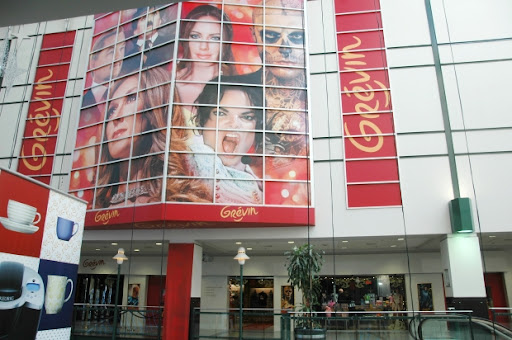
On Sept. 16, Grévin Montréal, the famous Montreal wax museum, permanently closed its doors. It had been temporarily closed since March 2020 as public health protocols forbade non-essential activities like cultural exhibitions from fully opening. Numerous Black-owned businesses faced similar circumstances after being deemed “non-essential,” exposing how such arbitrary labelling can be damaging to cultural institutions.  

Grévin, a popular tourist attraction, was meant for the general public. It was the closest visitors could get to “seeing” their favourite celebrities or historical personalities; to grazing Marilyn Monroe’s perfect posh hair, or feeling the weight of history while standing next to Nelson Mandela. It was an imaginative world of endless opportunities. Culture is a way of life, shared by a group of people. It is forged by their behaviours, beliefs, and values, passed down from past generations through communication and imitation. Cultural institutions are considered non-essential services, even though they are essential vectors for social growth. Works of art render history into the present, stopping time and breathing colour into everyday life. Such timelessness is hard to put into words. 

When the Grévin museum reopened in February 2021, it saw a decrease in attendance due to travel restrictions: prior to the pandemic, 30 per cent of visitors were international and a sizeable amount were Quebecers from outside of Montreal. 

Some believe that  art and culture is best appreciated by the wealthy elite or those capable of interpreting it through an intellectual lens. But this is not true. Art and culture are what is left to us when everything else is lost; it is an escape.

Similar to cultural institutions, Black-owned businesses have faced exceedingly hard times over the pandemic, as many of their businesses have been deemed non-essential. At the same time, these enterprises have faced increased difficulty receiving loans and have limited access to credit. 

Institutionalized racism is still deeply rooted in society. Those who are supposed to help save struggling businesses by giving out loans are the same people who discriminate, leaving Black entrepreneurs with double the challenge. Meanwhile, the federal government’s programs to support Black business owners, such as “The Black Entrepreneurship Program,” are vague and inaccessible. Many have criticized their unclear terms of repayment, their lack of transparency, their failure to communicate, and most importantly, their intrusive questions regarding business-owners’ sexuality. Answering invasive questions about one’s intersectional identities should not determine whether or not a Black-owned business is able to remain open.


The closure of Grévin Montréal is only one example of a larger problem. In general, the question of who has the right to determine what should be deemed essential or not must be called into question. While unprecedented fear and uncertainty continues to impact students, businesses, and artistic spaces, it is culture that offers us peace, inspiration, and hope. Whether by sharing and exchanging our own, or supporting Black-owned initiatives like “Black-Owned Canada,” or “Black North Initiative,” it is our responsibility as McGill students to uphold cultural institutions and believe in their importance.

McGill, News

Student-run contact tracing initiative shut down by McGill administration

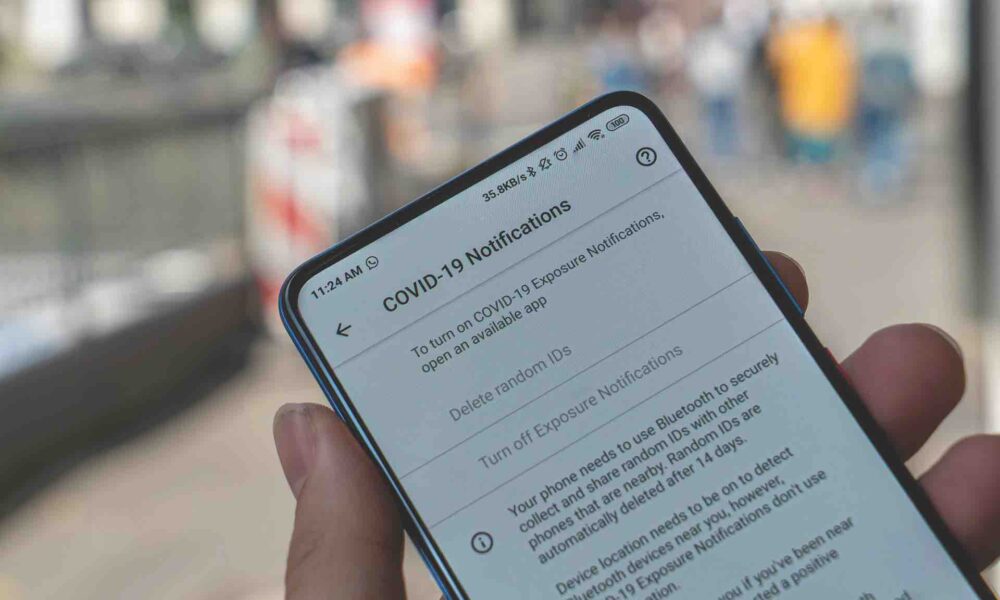
Concerns over the adequacy and transparency of McGill’s COVID-19 contract tracing system led the Law Students Association (LSA) to organize their own initiative at the beginning of the semester. The project, which collected entries through a Google form, accumulated only a couple of submissions before it was shut down by the McGill administration over concerns that it would disrupt McGill’s internal COVID-19 contact tracing procedures

The student-run initiative began as a rumour, circulated on a Facebook group, that students had tested positive in law classrooms. Having not been notified of these cases by McGill’s COVID-19 Case Management Group (CMG) and being frustrated by the lack of concern about the safety of their classrooms, Emma Sitland, 3L explained that the LSA became motivated to start their own initiative. 

“It was created as an immediate response to student concerns,” Sitland said. “The Law Students Association said, ‘okay, if there’s going to be COVID positive cases in class and McGill’s not going to tell you, we’re going to try to let you know.’” 

Sitland emphasized that the initiative arose out of student concern for lenient COVID-19 health measures on campus. 

“I think it is great that the LSA [organized a contact tracing initiative],” Sitland said. “I think it is an excellent example of student mobilization and solidarity, but it’s not their job. As a student organization, as a bunch of volunteers, they do not have the capacity to do that, they do not have the expertise to do that [….] It should be McGill [administration] who is actually taking initiative in doing this.”  

In an email to The McGill Tribune, McGill’s media relations officer Frédérique Mazerolle stressed that, in keeping with McGill’s public health requirements, contact tracing on McGill campus should be done through the university, hence why McGill shut down the LSA’s project.

“McGill continues to work closely with public health officials to adopt policies and put into practice measures to protect students, staff and faculty,” Mazerolle wrote. “Universities in Quebec have been mandated by public health authorities to do contact tracing and follow-up internally, and therefore it is essential that members of our community use our McGill process for reporting cases. Contact tracing is handled by McGill and can only be done if all cases are reported properly.”

Richard Gold, a professor in the Faculty of Law, wrote in an email to the Tribune that McGill’s lack of transparency in contact tracing runs contrary to its mission as an institution. 

“McGill seems to be pursuing a strategy of minimum communication and transparency,” Gold wrote in an email to the Tribune. “This is a cynical position that is not in line with the mission of McGill to serve the public. In the absence of any transparency […] students [and staff] were driven to do something to protect each other. The mere fact that students were driven to [organize their own contact tracing] is an illustration of the failure of the central administration to be transparent and truthful.” 

In an email sent on Sept. 22, Deputy Provost Fabrice Labeau clarified McGill’s procedure for alerting students of COVID-19 cases in classrooms. Its procedure currently details that all students will be notified by email if a person who tested positive for COVID-19 sat in the classroom within 48 of developing symptoms. 

In the same email, McGill mentioned that they received reports from professors that students who tested positive contacted them, but those in classes with positive COVID-19 cases had not received notifications. Labeau explained in an email to the Tribune that this may have been because either the student was not in class 48 hours prior to developing symptoms or testing positive, the student may not have reported their case to McGill, or the student may have received a negative test. 

To date, McGill remains the single channel for contact tracing on campus.

Read the latest issue

Read the latest issue