

Latest News

Campus Spotlight, Private, Student Life

A feathered allure: Flocking to McGill’s birding community

The founders of the McGill Students’ Birding Club (MSBC) met six years ago while taking WILD 420, an ornithology course at McGill. Since the club’s creation, birders of the McGill community have had a place to congregate and share their love for our feathered friends. 

On the club’s Facebook group, members share photos and videos of their sightings as well as news on conservation threats to local bird habitats. Members sometimes request the community’s help in identifying a certain species spotted outside their window or a specific high-pitched call heard on a hike. A few months ago, one member posted an audio recording of bird sounds they recorded on Mont-Royal and said they planned to use it in composing a piece for the McGill Symphony Orchestra. 

One aspect that unites those who flock to the bird-watching community is a curiosity for the environment, explained Anthony Zerafa, M.Sc.’22 and one of the club’s four founders.

“I’ve always had a deep fascination in the natural world, not just birds,” Zerafa said. “[Bird watchers] are interested in the world around them and want to learn more.”

With such an appreciation for the wild, many bird watchers are either already involved in environment conservation efforts or have become involved through birding. 

“When you start to appreciate and learn about the wildlife that can be found around you, you then want to ensure that that wildlife is protected,” Zerafa said. “You want the place you like to go birdwatching, where you may have had many fond memories, to continue to be a good habitat for the birds.” 

After an excursion, birders will often post about their experiences and list the species they spot, taking care to note rarities. Though a successful birding trip requires patience, quiet, and more observance than action, the excitement lies in the accumulation of experience and knowledge. 

“It really can be overwhelming at times when you first start out, but once you start to get a sense of the different birds that are in the environment and what you can see at different times of years, it quickly becomes addictive,” Zerafa said. “It’s very much like Pokemon Go, but in real life.” 

Even as someone with no birding experience, I was reeled in by the passion and flair with which the bird watchers recounted their sightings. As each encounter is unpredictable, the accounts can resemble action adventures, keeping both the birder and reader hooked. 

“Guess it’s time to head home,” one member wrote in a post shared to the Facebook page. “But no! The surprise: A ring-necked pheasant saunters out of the nearest shrubbery, to hang with his buddies the Fox sparrows. Much celebratory dancing.”

In the U.K., birding’s allure is only sometimes a relaxing pastime—other times, it is channeled into aggressive fervor. British twitching, extreme competitive birdwatching, leads to fierce rivalries, “twitcher madness,” and even tricks of sabotage. 

However, for McGill’s community of bird watchers—and for most elsewhere—the hobby remains rooted in a communal appreciation of the vast number of species waiting to be admired. 

“I mean, who cares in reality, if you’ve seen the most birds,” Zerafa said. “It’s mostly just personal competition, trying to challenge yourself to see as many species as possible.” 

Prior to the pandemic, the club hosted weekly bird watching outings and annual day trips to farther birding locations, including Amherst Island in Kingston, Ontario or Victoriaville, a two-hour drive from Montreal. They hope to resume excursions in the upcoming weeks. 

Beginner’s Guide to Birding in Montreal 

Locations

Montreal Botanical Garden: The Garden’s diverse mix of habitats attract a large variety of species and is free to visit during the winter months. 

Mont Royal Cemetery: The Cemetery’s many fruit trees make it a prime spot for bird watchers. 

Morgan Arboretum at MacDonald Campus: The Arboretum has one of the highest numbers of breeding species on the island. 

Tools 

Binoculars: Scan for movement, then train your binoculars when you believe you have spotted a bird. 

Mentor: In order to identify a bird from sight, sometimes only sound, prior knowledge is needed. Zerafa recommends joining others’ excursions or having an experienced mentor provide guidance. 
Merlin Bird ID App: A popular app among bird watchers, Merlin helps identify bird species through visual cues and sound.


Out on the Town, Student Life

Uncovering Montreal’s indie coffee shops

Coffee has long been synonymous with university life—students rely on caffeine boosts to fuel up for early morning classes or power through late-night study sessions. Luckily, those in pursuit of a perfect study spot and cup of coffee can explore Montreal’s many indie coffee shops and roasters. //The McGill Tribune// highlights the distinct stories and features behind a selection of these shops.

1. Le Brȗloir – 318 Rue Fleury Ouest 

Le Brȗloir, roaster and coffee shop, prides itself on providing high-quality coffee products to customers. Since its opening 10 years ago, Le Brȗloir has become a centrepiece of its neighbourhood,  fostering a of community of local coffee lovers. It has subsequently expanded to include Le Petit Brȗloir, a smaller sister shop, located a short walk away from the McGill campus at 8485 St. Laurent Boulevard.

Vincent D’Aoust, the owner of Le Brȗloir, enjoys seeing community members from all walks of life enter the cafe. 

“The essence of our coffee shop is bringing people together,” D’Aoust said in an interview with //The McGill Tribune//. “[We provide] a very warm atmosphere [with a] close-knit, eclectic clientele that ranges from young students to neighbouring families to retirees.”


Le Brȗloir has a unique roasting process: it uses an in-house roaster to produce its coffee, where coffee beans are heated to different temperatures based on the type of roast, allowing the shop to create a variety of flavours. 

Le Brȗloir has built close relationships with farmers in Honduras, whom they purchase their coffee beans from. In supporting individual small-scale farmers, Le Brȗloir hopes to help support an ethical supply chain. 

“We serve coffee, but we understand the supply chain,” D’Aoust explained. “Having relationships [with the farmers] makes us more passionate about what we do.” 

2. Pikolo Espresso Bar – 3418b Park Avenue

If you’re in need of a caffeine boost or a study space located just minutes away from McGill’s main campus, look no further than Pikolo Espresso Bar. Pikolo is a quaint, timeless coffee shop known for its rich lattes, lightly roasted coffees, and delicious baked goods.

Pikolo Espresso Bar’s founder, Marie-Eve Laroche, has been passionate about coffee for years. After working in a coffee shop in Whistler, British Columbia as well as on a coffee plantation, Laroche opened up Pikolo in July 2011.

Laroche’s time working on a coffee plantation was a major turning point for her love of coffee and knowledge of the craft. 

“That’s really where I went deeper into understanding coffee from crop to cup,” Laroche said. “I realized, ‘Wow, this is what I wanna do.’”

Pikolo’s unique environment and community, fostered by students, are its greatest attractions. The shop hosts a warm, cozy, and comfortable ambience, with old-fashioned, rustic undertones.

“[Pikolo’s atmosphere] is very vintage and industrial, which really fits with the neighbourhood and the old building,” Laroche said. “It has a lot of character, and a fun, young energy.”

3. Structure Coffee Roasters – 460 McGill Street

Structure Coffee Roasters, located just outside of Montreal’s historic Old Port, is a community-oriented roaster and coffee shop. 

One of Structure’s co-owners, Marco Dieckmann, discovered his passion for coffee after visiting locally owned coffee shops across 40 different countries.

“There’s no better travel guide to a city than getting to know a local coffee shop,” Dieckmann explained. “[Structure] is our Montreal take on specialty coffee [….] Our coffee is both roasted and packaged with care in Montreal.” 

Incorporating elements of Japanese and Scandinavian style into its design, Structure blends the heritage of its location with its modern ethos. 

“While being in a century-old building, we wanted to give a contemporary approach to presenting the coffee,” Dieckmann said.

Above all, Dieckmann recognizes that the cafe is about more than just the coffee and values the close relationships Structure has fostered.

“The whole coffee business is about people [and] the relationship between the baristas and clients,” Dieckmann said. “Coffee connects the people.”

Art, Arts & Entertainment

‘Human Weighted Blanket’ experiment aims to smother anxiety through platonic touch

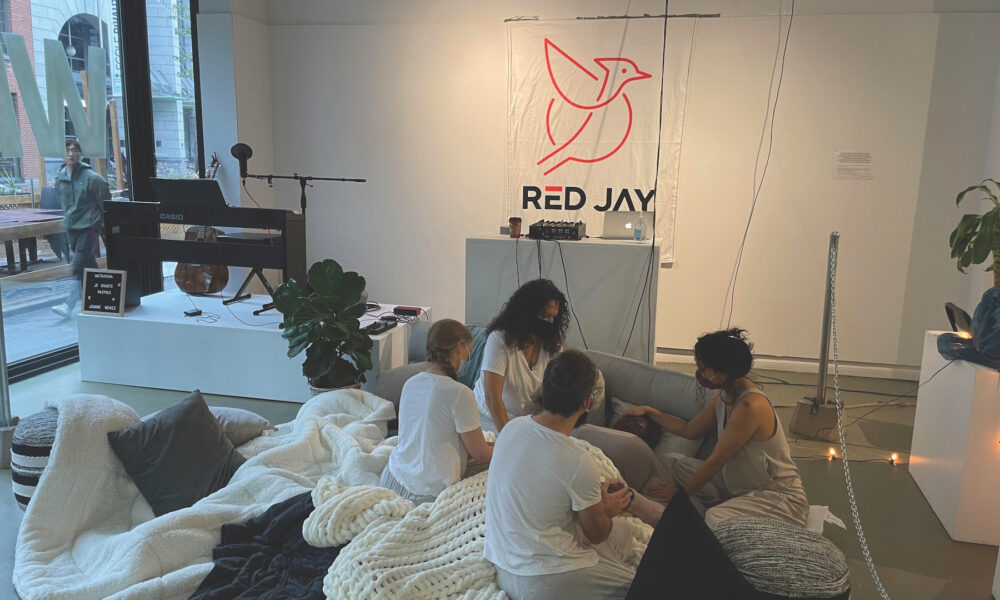
After months of strict isolation and social distancing regulations, many are missing the comfort of a good hug. Self-proclaimed “Artivist” Red Jay, a.k.a. Joshua Oliver, has created a remedy for the loneliness the pandemic has fostered. On World Mental Health Day, October 10, Red Jay presented a two-part exhibit called the “Human Weighted Blanket,” which offered a professional platonic touch workshop both in person and online.

Red Jay was inspired by a viral tweet about two nurses’ ingenuity in an ICU ward in Brazil. To soothe COVID-19 patients whose illness made it impossible for loved ones’ physical comfort, nurses filled gloves with warm water to simulate human touch, calling it “the hand of God.” Jay also drew inspiration from the 1950s “happenings” movement, which implicated viewers in performative and situational art forms. These acts of creative kindness led him to create his own performance piece to highlight—and help ease—mental health struggles. By gathering a group of professional touch therapists, Red Jay hosted a space for people craving human touch.

One half of the exhibit is a short video, which Jay calls a “virtual hug.” The film depicts three participants affected by anxiety, depression, and complex post-traumatic stress disorder who are invited to test a “special” weighted blanket. Unbeknownst to them, the “blanket” is a session with four professional touch therapists who specialize in somatic bodywork, massage, and cuddling—quite literally a “Human Weighted Blanket.” From there, they calm the participants through a combination of group meditation and massage therapy. Although each participant’s time with the touch therapists is short, the participants visibly relax. One participant, named Bella, described how their struggles with gender dysphoria caused them to associate their body with pain. However, after their experience with the “Human Weighted Blanket,” Bella realized their potential to heal and associate positivity with their body. 

The exhibit’s other half sees participants—chosen at random from consenting bystanders at the exhibit—and viewers get to see the therapists and the “Human Weighted Blanket” in action. Each participant starts their session by talking with the therapists. The professionals ask how they can be helpful and also give a quick overview of the types of therapies they offer. The participants lead the session, deciding their positions, setting boundaries, and communicating with the professionals throughout the entire process. 

“The way to make a cuddle good is by expressing what it is that [the participant] desire[s], but the most important thing is establishing communication and trust,” professional touch therapist Sharon Lopez said in an interview with The McGill Tribune

Given that the experience is a collaboration between the experts and participants, the therapists adapt to the person’s needs and comforts. By constantly checking in with their participant, the therapists can maintain consistent consent, making it a positive experience for both parties.

Although the idea of being cuddled by strangers may seem odd, participants find comfort and peace in the trusting warmth of the “Human Weighted Blanket.” At a time when human interaction is scarce, Red Jay celebrates the healing potential of physical platonic touch that was taken away during the pandemic.

After months of strict isolation and social distancing regulations, many are missing the comfort of a good hug. Self-proclaimed “Artivist” Red Jay, a.k.a. Joshua Oliver, has created a remedy for the loneliness the pandemic has fostered. On World Mental Health Day, October 10, Red Jay presented a two-part exhibit called the “Human Weighted Blanket,” which offered a professional platonic touch workshop both in person and online.

Red Jay was inspired by a viral tweet depicting two nurses’ ingenuity in an ICU ward in Brazil. To soothe COVID-19 patients whose illness made it impossible for loved ones’ physical comfort, nurses filled gloves with warm water to simulate human touch, calling it “the hand of God.” Jay also drew inspiration from the 1950s “happenings” movement, which implicated viewers performative and situational art forms. These acts of creative kindness led him to create his own performance piece to highlight—and help ease— mental health issues. By gathering a group of professional touch therapists, Red Jay created a space that gives “hands of God” to non-COVID affected people who are craving human touch.

One half of the exhibit is a short video, which Jay calls a ‘virtual hug.’ The film depicts three participants affected by anxiety, depression, and complex post-traumatic stress disorder who are invited to test a ‘special’ weighted blanket. Unbeknownst to them, the ‘blanket’ refers to four professional touch therapists who specialize in somatic bodywork, massage, and cuddling. From there, they calm the participant through a combination of group meditation and massage therapy. Although each participant’s time with the ‘blanket’ is short, the participants visibly relax. One participant, named Bella, described how their struggles with body dysphoria caused them to associate their body with pain. However, after their experience with the ‘Human Weighted Blanket,’ Bella realized their potential for healing and associating positivity with their body. 

The exhibit’s other half is the actual ‘Human Weighted Blanket,’ where participants—chosen at random from consenting bystanders at the exhibit—and viewers get to see the therapists in action. Each participant starts their session by talking with the therapists. The professionals ask how they can be helpful and also give a quick overview of the types of therapies they offer. The participants lead the session, deciding their positions, setting boundaries, and communicating with the professionals throughout the entire process. 

“The way to make a cuddle good is by expressing what it is that [the participant] desire[s], but the most important thing is establishing communication and trust,” professional touch therapist Sharon Lopez said in an interview with The McGill Tribune

Given that the experience is a collaboration between the experts and participants, the therapists adapt to the person’s needs and comforts. By constantly checking in with their participant, the therapists can maintain consistent consent, making it a positive experience for both parties.

Although the idea of being cuddled by strangers may seem odd, participants find comfort and peace in the trusting warmth of the ‘Human Weighted Blanket.’ At a time when human interaction is scarce, Red Jay celebrates the healing potential of physical platonic touch that was taken away during the pandemic. 

Chill Thrills, Student Life

Falling for Montreal

With a winning combination of abundant outdoor activities and cultural events, Montreal thrives during the fall season. The McGill Tribune has compiled a list of seven ways to enjoy the city this autumn—none of which include pumpkin spice lattes.

1. Go apple picking

Though there will be no apple picking at Macdonald campus this year, other farms nearby offer this same iconic fall experience. Among these are Dunham Fruit Paradise in Dunham, Apple Heart orchard in Frelighsburg, and Verger Denis Charbonneau orchard in Mont-Saint-Grégoire, all an hour out from Montreal. When you get home, bake your apples into a delicious pie and pair it with a delightful autumnal recipe.

2. Explore the Gardens of Light

Though the Botanical Gardens are breathtaking at any time of the year, the same location houses the breathtaking Gardens of Light until October 31. Featuring hundreds of colourful silk lanterns in the Chinese garden, this attraction provides the perfect atmosphere for a fall walk. 

3. Have a fall picnic

With the leaves changing colour and filling the city with golden hues, fall is a great time to explore Montreal’s parks. If you’d like a more active walk, hike up Mont Royal. Consider climbing to the top to watch the sunrise at the observatory or the sunset from this lookout point. Other beautiful spots to visit include Parc La Fontaine or Parc Jean Drapeau, where you can look out over the city. Bring along a blanket, some snacks, and some sweet apple cider or this rich mulled wine for the ultimate picnic experience.

4. Attend a spooky event

Spooky season is officially upon us, along with a multitude of Halloween-themed events. If you don’t mind driving, visit La Ferme Forget’s corn maze in Laval, which is open at night from 6 to 11 p.m. For those who prefer to stay in the city, a Haunted Montreal ghost tour is sure to give you chills. Alternatively, head over to St. Helen’s Island for La Ronde Fright Fest, a festival that takes place every weekend from October 2 to 31, to delight in haunted houses, plays, and rides. 

5. Get ready for Halloween at a local thrift shop

If you’re looking for a unique Halloween look but don’t want to break the bank on a costume, try shopping for your costume at a thrift store. Lots of thrift stores close to McGill and offer a wide selection of vintage items. Eva B also notoriously stocks up on Halloween costume items close to the end of the month. However, if a traditional costume doesn’t appeal to you, try out one of these McGill-themed choices, or an even more obscure costume option from the Tribune archives.

6. Stock up on pumpkins 

If you’d like to add a splash of seasonal decor to your apartment, consider going pumpkin picking. Les Citrouillards is a pumpkin patch in Saint-Eustache, only a 35-minute drive from McGill. Carve out creative designs or whip up a pumpkin pie. Funk and Pumpkins, running from October 1 to 31 at the Botanical Gardens, also showcases a large variety of plants from the squash family, and hosts a variety of other spooky activities. 

7. Bask in fall flavours at a local market

Take the metro or BIXI to Jean Talon Market to get your fix of fall produce and other seasonal foods. If you’re keen to head in the other direction, check out Atwater Market. Or, if you’d like to stay close to campus, pay a visit to McGill’s very own farmer’s market. Vegetables in season include squash, turnip, and rutabagas, among others. When you get home, try out one (or all!) of these nine creative takes on squash recipes

Basketball, Sports

Slow but promising start for McGill women’s basketball

On Oct. 17, the McGill women’s basketball team (0–1) faced off against the Windsor Lancers (1–1), in a high-energy game that resulted in a 67-54 loss for the Martlets. After the pandemic halted games for over a year, the team was eager to be on the court. With a tipoff by centre Amelie Rochon that almost hit the referee in the face, the horses were out of the gate. 

Early into the first quarter, it was evident that the Martlets’ strength lay in their offence, with defence struggling to prevent the Lancers’ early attempts to score. However, the first points of the game went to McGill, with two free throws by first-year guard Iman Ibrahim

Though they initially had the lead, the Martlets quickly lost it, and remained just behind their opponents throughout the first quarter. In the closing seconds, as coaches, teammates, and spectators began to count down, the Martlets scored two three-pointers in a row—both from Ibrahim. Cheers erupted throughout the gym at her incredible shots.

The second quarter was a period of strife for the McGill team, with a score of 34-17 at the halfway mark. Their vivacity did not diminish until just before halftime, when lost shots and ball fumbles began to dim the team’s spirit. 

Emma-Jane Scotten, a first-year guard, agreed that morale was not at its peak.

“The energy was okay,” Scotten said. “I just think we need to be a little bit more positive on the bench and in the game, just bring in more energy and really play as a team.”

Yet, the end of the quarter saw McGill score 10 points in three minutes, ending the first half only seven points behind, with a score of 37-30. 

After a slow and steady comeback at the end of the second quarter, the team had the opportunity to turn the odds back in their favour. Unfortunately, Windsor’s defence was strong, and McGill stayed at 32 points for half of the third quarter. 

After many successful shots, guard and forward Maddy Colpitts was forced to sit out after an ankle injury that left her unable to play the rest of the game. Before the end of the third quarter, Scotten and guard Jessica Salanon scored a field goal and three-pointer respectively, leaving the score at 53-39 for Windsor.

Martlets defence struggled to contain the Lancers. Scotten said that the team will need to communicate and work cohesively to improve their defensive strategies. 

“I think that’s what hurt us today,” Scotten said. “We haven’t played in a while, but we still find we’re getting beat a lot. We really have to work on our on-ball defence [and] getting in the gaps.” 

In an email to the //Tribune//, new head coach Rikki Bowles pointed out that the team this year is almost all fresh blood with strong potential. 

“Our team is young this season, with 13 of our 14 players in their first or second year of eligibility,”  Bowles wrote. “We are focussed on getting better each day, learning from the Windsor game as we prepare for Ottawa this Saturday.” 

With a final score of 67-54, the game went to the Windsor Lancers. The Martlets, however, ought not to be dismissed too early. With a team of energetic and committed players, the long season ahead holds much promise for McGill.

Moment of the game:

Ibrahim scored two three-point field goals back-to-back after a points dry spell for McGill, bringing back the spirit of the whole crowd.

Stat corner:

With 16 points, Iman Ibrahim dominated the number of points and successful field goals scored by all players.

Quotable:

“We really want to work on helping each other out. We’re all connected when we play, so we have to play together as a team if we want to improve.” — First-year Emma-Jane Scotten

McGill, News

McGill cancels all Winter 2022 exchanges and independent study abroad programs, students start petition

In an email sent to students on Oct. 5, Deputy Provost Fabrice Labeau announced that all outgoing exchange and independent study abroad programs would be cancelled for the Winter 2022 semester.  

Labeau attributed the decision to the ongoing uncertainty surrounding public health regulations, vaccination rates, and restrictions, all of which vary from country to country. In addition, the email cited the federal government’s Global Level 3 travel advisory ranking, which warns against all non-essential travel outside of Canada.

Frédérique Mazerolle, a McGill media relations officer, stated that one of the reasons for cancelling international exchanges was due to the university’s inability to monitor students’ adherence to health guidelines abroad.

“Traveling for […] university-sponsored activities in the context of the pandemic inherently presents a higher risk than in a normal situation,” Mazerolle wrote in an email to The McGill Tribune. “Due to the significant planning and logistical requirements involved, [the decision] will not be subject to change based on public health developments in the coming months.”

A petition on change.org created by McGill students and named “Students for Winter 2022 Exchange!” has been making its rounds on social media in response to the announcement. The approximately 800 signatories as of Oct. 13 include a wide range of individuals, such as parents of students, students who were set to study abroad in the winter, and would-be inbound exchange students. 

Juliette Debray, U2 Arts and one of the creators of the petition, said she was surprised by the abruptness of the announcement and was skeptical about McGill’s rationale for cancelation. 

“I was really taken aback,” Debray said in an interview with The McGill Tribune.  “McGill did not really give a warning that there was a possibility of cancellation. Logically speaking, it does not follow through. Their main reason was the varying public health landscape in different countries, but wouldn’t [a] logical follow-up in that case be to do a varying response?”

Labeau’s email emphasized that McGill students will not be able to take online courses with their host universities. Debray pointed out that many Canadian universities, including Concordia, UQAM, and Queen’s University, have chosen to pursue a more flexible approach, such as granting students the option to do online classes abroad or process exchange nominations on a country-by-country basis.

“I just found out today that UQAM also canceled their winter semester exchanges, but are allowing exceptions for students whose host universities are [in] their home country or for students who have only this year left to do an exchange,” Debray said. “They’re also allowing students to do online exchanges if they want to, so clearly it’s possible.”

Labeau clarified in the cancellation announcement that exemptions may be made to students who wish to pursue an Independent Study Away that requires no travel and is completed in the student’s home country.

Cameron Bailey, U3 Arts, had been making arrangements to attend the University of Edinburgh this winter. Bailey expressed frustration with McGill’s handling of the decision, highlighting McGill’s failure to reimburse the exchange fee deposited by students.

“They made a blanket call instead of looking into COVID-19 policies for different countries which drastically differ […] and they also kept our $150 deposit,” Bailey said. 

Max Garcia, U3 Arts, created the change.org petition alongside Debray. While Garcia is doubtful that McGill will reverse its decision, he hopes the petition might encourage the administration to consult students in future exchange-related decisions.

“To be honest, I do not foresee any changes really happening,” Garcia said. “I am not even the person who is the most angry about this, but this petition is for those who are angrier than me and would like to see something done. Maybe [the university] will not rethink their decision, but who knows, maybe McGill will start including students in the decision-making process.”

Arts & Entertainment, Poetry

Mcsway takes a breath of fresh air at “Poetry in the Park”

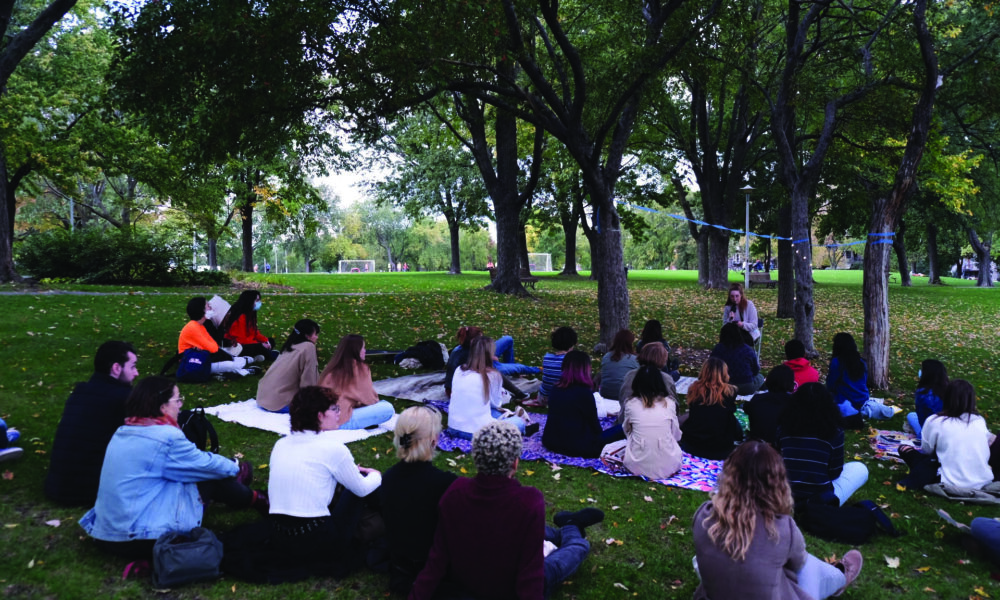
Voices came alive at Jeanne Mance Park on Sept. 30 with Mcsway Poetry Collective’s first open-mic night of the semester, “Poetry in the Park.” Gathered around a tree strung with lights that acted as a stage, the audience sat on blankets, listening to poets valiantly share their words and their hearts.

“This is our first time [hosting an open-mic] in the park, but it is an effort to create the spaces we were creating before the pandemic, [spaces] where people can gather and feel comfortable to share,” said Mcsway vice-president Amanda Ventrudo, U3 Arts. “A lot of people will share […] spontaneously at the end, or it will be their first time reading, so it’s just nice to have a space to do that.” 

Though it was the group’s first time holding a poetry night in the park, Mcsway created a welcoming, non-judgemental space where people felt safe to express themselves in an intimate and emotional way. 

“I think it’s just different to share physically what you’ve written and have people [react]. You can see and feel people respond to it in real-time,” Ventrudo said. “A lot of the time [it] is cathartic to read something that you wrote out loud, instead of just leaving it in its written form.”

A nervous excitement swept the atmosphere as each performer stood up and made their way to the stage. Some were more nervous than others, but as the excited and welcoming audience clapped and whistled in their honour, they visibly relaxed. 

Although there were technical issues with the microphone that made it difficult to hear the performers, many used their physicality to convey the spirit of the poems. Some were more faint, while others worked with the audience to improve their projection. 

It was moving to see initially nervous performers open up and embrace being vulnerable in sharing parts of their world with the audience. Some performers showcased poetry they had written before the pandemic—a striking reminder of how distant and detached the last year and a half of quarantine felt—while others shared poems about personal and intimate struggles. Writers also discussed the meaning and circumstances behind their poems, giving the audience further insight into their words. 

This event allowed all who attended to sit, share, and connect in a profound way that only sharing poetry can produce.

“For me, [poetry] is one of the most effective ways to express yourself because anybody can do it and there are not really any tricks or skills that you need,” Ventrudo said. “I think making it accessible and normal to share those kinds of things is really [important.]” 

Mcsway looks forward to hosting more open-mic-nights, as well as poetry shares and workshops—the first of which will be occurring in October. Find their Instagram and Facebook here.

Album Reviews, Arts & Entertainment, Internet, Music

Where do I begin?: Anthony Fantano and ‘The Needle Drop’

When Sacramento-based hip hop collective Death Grips released their debut studio album The Money Store in 2012, the culture of music consumption began to shift. The aggressive, experimental ethos of Death Grips’ LP was powerful enough to inspire change in tastes among fans and creators alike, but internet music enthusiast and notorious critic Anthony Fantano was a catalyst for the move toward the popularization of such experimental hip hop. Fantano’s YouTube channel, “theneedledrop,” with its classic jargony, essay-like approach to album reviews, handed Death Grips the elusive 10/10 rating—the first to ever receive the honour in the then-three-year-old channel’s history.

Since that fateful day in 2012, only a handful of records have tasted the glory of a Fantano 10. Fantano himself, now at the helm of a two-channel empire, has become a cornerstone of internet music culture. He reviews albums almost daily, providing unfiltered criticism and, on occasion, enthusiastic praise. His other video segments include his first-time listens and reactions to individual tracks, the interactive “Let’s Argue” and “Reading Your Comments” bits, and a number of weekly and yearly round-ups summarizing and celebrating recent releases in the music world. Fantano navigates his reviews quickly, bouncing from detail to detail while unpacking the core elements of each record, generating an atmosphere of controlled mayhem that builds towards a decisive conclusion.

Fantano’s channel has become a breeding ground for some of the most inexplicable interactions on the internet—the “you had to be there…for the last five years” type of stuff. Sarcasm, esoteric references, and callbacks to his channel history litter the comment sections. A casual scroll-through can leave an unfamiliar viewer feeling like they have just opened a forbidden door. Among many other, and occasionally much darker, trends that exist in Fantano’s comment section, there is also a surplus of lighthearted nicknaming and inside jokes: Fans endearingly call Fantano “melon,” referring to his famously bald head, and comment on the subtle but meaningful Easter eggs—including Fantano’s choice of flannel shirt, which he uses to foreshadow his thoughts on a record. Amidst all the chaos, however, arises genuine, thoughtful discussions focussed on why, and why not, some music deserves a listen. 

Fantano’s rise to YouTube stardom places him in a relatively unoccupied echelon of the internet, preserving a space for active and opinionated music enthusiasts within music intellectualism’s brash, reactive, and often self-contradictory zone of the internet. Few web personalities have acquired such a far-reaching and potent influence over their viewers—even reaching a point where other music fans satirize his most devout supporters, who notoriously defer to “theneedledrop” for the majority of their musical opinions. Fantano is but one part of a sweeping revolution in music consumption whereby internet discussions and the tastes of web strangers make their way into popular discourse. Fantano’s willingness to review a plethora of diverse music has allowed a number of underappreciated and experimental artists to permeate the playlists of the more “mainstream” listener, like Danny Brown, Charli XCX, FKA Twigs, and others.

As the backbone of the online music-loving community, Fantano will inevitably continue to scour the musical landscape, finding underground gems and giving fan-favourite albums a 6/10, but viewers should take no insult. After all, Fantano has never hesitated to remind us that, “Y’all know this is just my opinion, right?”

Editorial, Opinion

Action is due against sexism in SSMU

On Sept. 22, The McGill Daily published an article shedding light on a long-standing culture of sexism and misogyny rampant within the Students’ Society of McGill University (SSMU). The article featured many accounts of past and present SSMU members who called out a culture of sexism within the Society. In response, SSMU’s vice-president (VP) Internal Affairs, Sarah Paulin, sent out an email that did not cite the article and only made vague reference to its contents. Although this is not the first time women have spoken out about their treatment within student government at McGill, it would appear that little improvement has occurred over the past several years. The article exposes only a fraction of a larger systemic failure, laying bare the need for urgent change in the immediate-term, and a cultural overhaul over the long-term. Structural change is imperative and while this is ultimately SSMU’s cross to bear, the organization will only take concrete action if students refuse to let these pervasive issues go unresolved. Students must move away from the accepted—and even expected—culture of apathy toward SSMU and reject its normalized toxicity to make substantive change possible. 

Upon entering McGill, many first-year students are taught, whether by upper-years or frosh leaders, that SSMU is a deeply flawed organization not worth engaging with. This rhetoric does have some backing to it—historically, SSMU has been both untrustworthy and inaccessible to students. The union’s lack of transparency leaves students disengaged and though candidates almost always run on platforms promising change, this problem continues to manifest. Scandals frequently end with no action or accountability, only empty promises and vague messages to the study body. Executives and other SSMU members have managed to get away with this, as many McGill students have come to accept that their student union is irredeemable. Students must mobilize and demand change, whether by attending the Legislative Council meetings, casting votes in elections, or demanding that SSMU executives give public updates on measures being implemented. SSMU is supposed to represent the entire McGill community, and it is unacceptable that it is an unsafe space for women and other gender minorities. 

While students at large have a responsibility to hold SSMU accountable, internal structural change is still clearly necessary in the short-term. It is telling that current and former student representatives felt the need to reach out to campus media to have their complaints taken seriously. As reported in the Daily article, SSMU’s human resources (HR) reporting structure is dangerously flawed. With the SSMU Board of Directors overseeing HR, there is limited separation of power, meaning that when representatives file complaints, they must grapple with the possibility that their superiors could see it. Furthermore, the mechanism to hold high-up executives accountable is ineffective for the very same reason. The mere presence of students in these roles exacerbates the lack of confidentiality and trust within both SSMU’s HR system and its approach to equity.

Although most students are unaware of the extent to which they shape SSMU, they possess the ability to radically improve its operations. For example, students can rally around proposals to pay SSMU representatives. It is disappointing that a motion to provide financial compensation for SSMU representatives failed in 2020, because it could have helped to address some of the union’s structural inequities. Compensation would make SSMU positions more accessible to a wider range of students, moving away from the ‘certain type of student’—particularly, those who have the financial privilege of not having to work during school—that these unpaid roles usually attract. This move would also allow SSMU representatives to unionize, providing an added level of protection and further empowering them to fight exploitation. 


Asking students to take a stand for SSMU’s benefit is gruelling, especially when their representatives uphold a toxic sexist culture while refusing to provide transparency about how they plan on addressing it. The women who have been affected by SSMU’s misogynistic and demeaning culture deserve more than meaningless statements lacking concrete action. Most of all, these individuals deserve to have their experiences valued. The SSMU executive team says they have made a pact to fearlessly “change the system,” and students must be equally involved in overseeing this necessary cultural shift.

A previous version of this editorial incorrectly stated that SSMU executives oversee the HR Department. In fact, the SSMU Board of Directors administers the policy through its HR department and committee, and may involve the SSMU president or any other staff, on a case-by-case basis. The Tribune regrets this error.

Science & Technology

Cut, tuck, lift: Tracking the rise of cosmetic surgery

Blown-up shots of smooth skin, cinched waists, and tight bums are hard to avoid and even harder to look away from. Whether appearing on social media feeds or on seedy pornography websites, idealized bodies are on display on virtually every device with a screen. Bombarded by unrealistic beauty standards, more and more people, particularly women, have sought to modify their bodies via surgical means.

According to the American Society of Plastic Surgeons (ASPS), the total number of cosmetic surgical procedures, including breast augmentation and liposuction, remained relatively constant between 2000 and 2018 in the United States. However, minimally invasive cosmetic procedures, such as Botox and chemical peels, have increased 228 per cent in that same time period. Ninety-two percent of all these procedures were performed on women.

In an email to The McGill Tribune, Mario Luc, a plastic surgeon at McGill’s Department of Surgery and also a private practitioner, has been following the rising demand for cosmetic procedures and anticipates there will be advancements in the field in the near future.

“The demand will keep increasing for several more years,” Luc said. “The field of aesthetic surgery will continue to improve itself to provide reliable results and safety with refined techniques, protocols, and guidelines to increase patient satisfaction and safety.”

Many aspects of the pandemic have spurred an increase in procedures, including widespread weight gain and the ability to recover from surgery while shielded by a mask or computer screen.

In addition to these factors, social media may also be playing a role in the plastic surgery uptick. A notable example is the high volume of videos promoting plastic surgery to young, impressionable audiences on TikTok: Videos showing off rhinoplasties, the ubiquitous nose job, are particularly common, with over 3.2 billion views under #nosejob.

These 60-second videos often lack nuance, failing to acknowledge the significant cost and risk of cosmetic procedures. According to the ASPS, average prices can range from $400 for a Botox procedure to $7,600 for a facelift, or rhytidectomy.

More invasive surgical procedures have higher risks. Brazilian butt lifts, whose hashtag #BBL also boasts over 3.2 billion views on TikTok, is the most dangerous cosmetic surgery, having a death rate of 1 in 3,000. As for minimally invasive procedures, even a Botox shot lists symptoms ranging from headaches to permanent muscle paralysis.

Plastic surgeries often aim to emulate and exaggerate a specific body type, though the ideal is prone to changing like any other fashion trend. In addition, surgeries often attempt to recreate white, European features, such as smaller button noses or double eyelids. One notable exception is the Brazilian butt lift, which emulates the hypersexualized stereotypes of Black women, but is only truly attainable through surgical lifting for most. 

Many factors are at play in an individual’s decision to undergo a cosmetic procedure. In a survey conducted by realself, a healthcare marketplace that connects consumers to physicians and research about aesthetic treatments, revealed that the most common motivations for cosmetic procedures included wanting to improve self-esteem and confidence, and to look younger.

In a society where 53 per cent of girls are “unhappy with their bodies” by the age of 13, it is unsurprising that there is a large demand for such procedures. When standards of beauty come to impact all spheres of life—whether in the dating pool, the workplace, or the courtroom—there can be great pressure to conform.

Although cosmetic procedures always come with risks, having realistic expectations and opting for restorative procedures like facelifts instead of nose jobs are linked to greater psychosocial well-being. Consulting with recognized, trustworthy, and qualified surgeons is also crucial.

“We only use known safe and standard techniques and we keep everyone up to date in the latest safety protocols and measures, surgical techniques with constant and regular medical education,” Luc said.

Read the latest issue

Read the latest issue