Latest News

Art, Arts & Entertainment, Exhibition

Art exhibition ‘Comfort and Indifference’ invites a reflection on shielded spectatorship 

In a world where scrolling past tragedy has become routine, the Montreal Museum of Contemporary Art’s (MAC) latest exhibition Comfort and Indifference asks us to reflect on the human cost of ignoring suffering while surrounding ourselves with comfort. On view at the Montreal Museum of Fine Arts, which made one of its exhibition spaces available to the MAC during its renovation, it features works by 22 Quebec artists.

Drawing on Denys Arcand‘s 1981 documentary bearing the same title, the exhibit explores the connection between past and present social detachment. Quebec’s first referendum on independence was held in May 1980; Arcand’s film, released a year later, traces the province’s struggle for political sovereignty. More importantly, it highlights a broader phenomenon in which Quebecers, preoccupied with their material wealth, found themselves increasingly detached from political matters. 

By defining success through ownership rather than social contribution and prioritizing personal gain over community well-being, they allowed lifestyle choices to shape political realities despite complaining about them. The exhibition similarly examines this shift from collective values to individual priorities, prompting us to reconsider our approach to worldwide crises. 

Western societies have increasingly pursued individualism, with the escalating use of cell phones contributing to a growing sense of isolation and detachment from social injustices. At the heart of these privileged spheres remain politically detached individuals. 

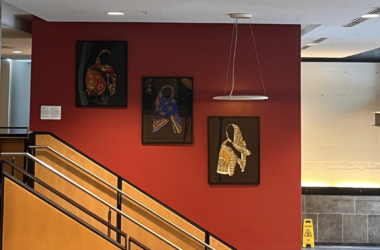
Through a selection of works temporarily on display, acquired by the MAC between 2020 and 2025, visitors encounter a wide range of pieces, each encouraging reflection on notions of comfort and indifference. On one exhibition wall, artist Joyce Joumaa presents five circuit breaker boxes that she transformed into light boxes. Inside each, she places photographs of various domestic or commercial spaces that illuminate at specific, predetermined times. This series of works reflects Lebanon’s energy crisis since the 1990s, which has worsened in 2021 due to the global oil shortage. Each box lights up according to the energy schedules of the places it depicts in the country, turning on when electricity is available and off when it is not. 

The scale of these works ultimately prompts us to reconsider our material comfort and privilege while approaching it with a more considerate lens. Following this objective, artist Michel Huneault shares a piece from his series Roxham titled Sans titre 1. The series depicts the Royal Canadian Mounted Police intercepting asylum seekers on Roxham Road in Montérégie, a central point of unofficial entry from the United States, which is now closed. Huneault specifically uses fragments of images instead of photographs, adding a layer of anonymity and speculation to his reflection, emphasizing the human consequences of immigration policy.

Walking around the gallery evokes a range of emotions. The varied nature of the works leaves no fixed route to follow; instead, you drift from one piece to the next. Each work brings its own flavour and originality, inviting you to slow down, immerse yourself, and get to know the story behind it. From paintings to life-sized sculptures, the different mediums successfully provide a rich variety of ways to explore the exhibition’s key themes of comfort and indifference, inviting you to pause and reflect. 

Comfort and Indifference does not offer simple answers or solutions. Instead, it leaves you with a series of lingering questions about what it means to feel comfortable while others bear the consequences. The exhibition suggests that indifference is never just a private feeling, but a position with real effects on other people’s lives. What we do with that realization is left up to us.

Comfort and Indifference runs until May 3rd, 2026.

A previous version of this article stated that the exhibition was one from the Montreal Museum of Fine Arts. In fact, the exhibition is organized and curated by the Montreal Museum of Contemporary Art, though it is on view at the Montreal Museum of Fine Arts. The Tribune regrets the errors.

McGill, News

The Unity Flag: A conversation with Tekarontakeh

McGill’s Media Relations Office (MRO) confirmed in a written statement to The Tribune that from Oct. 23 to Oct. 30, McGill raised the Kanien’kehá:ka (Mohawk) Unity Flag to celebrate the newly-unveiled Tsi Non:we Onkwatonhnhets project at the university’s Y-Intersection. Designed by artist Louis Karoniaktajeh Hall in the early 1970s, the Unity Flag depicts a man in profile against a red background and a sun, wearing one feather in his hair. 

Despite The McGill Reporter stating that the Unity Flag on campus represented McGill’s “ongoing partnership with Indigenous communities,” Tekarontakeh, a knowledge keeper of the Kanien’kehá:ka from Kahnawà:ke, reported that he was not informed of the flag’s display at the university, despite being a member of the Rotisken’rhakéhte (Mohawk Warrior Society) who first used this banner. 

In an interview with The Tribune, Tekarontakeh contextualized the significance of the Unity Flag for Mohawk communities. He made sure to distinguish the Unity Flag from another iteration of Karoniaktajeh’s work, colloquially known as the “Warrior Flag,” which depicts a man with three feathers in his hair, rather than just one.

“[Karoniaktajeh] put [the Unity Flag] together because he wanted Native people [to] have a symbol […] to help to bring our people back together,” Tekarontakeh explained. “The reason he put only one feather in the [man on the flag’s hair] is to symbolize […] that we are one people. Even though we speak different languages, […] we’re all saying the same thing [….] We are all part of creation [….] What is being done to one is being done to all of us.”

Tekarontakeh also touched on the importance of the Unity Flag’s creation and original use. It was initially employed when Indigenous communities across Turtle Island were fighting for land sovereignty, particularly during the Mohawk reclamation of Ganienkeh in 1974. 

“We used that Unity Flag when we went and reoccupied lands in the Adirondack Mountains so that we could build a new community and not live under the Indian Act or Canadian law, or [United States] federal Indian law, or the [United States] Constitution,” he stated. “We wanted to live in accordance to who we are, and we asserted our right to do this [….] We made the choice that we would physically, politically, spiritually, do what we must do in order to ensure that there [would] be a future for our children.”

Today, the Unity Flag acts as both a specific Mohawk symbol of pride and existence and a broader, global sign of resistance against colonialism, oppression, and genocide. Tekarontakeh referred to the flag as a “psychological medicine”—an antidote to actions like McGill’s against Indigenous communities, both locally and internationally.

“McGill University […] did experiments on Native children,” he stated. “McGill was involved in working with the [Canadian] government to assimilate our people, [and McGill is] still a corporation [who has] made money [through] the exploitation of people’s lands.”

Tekarontakeh further referred to McGill’s decision to uproot a white pine tree from the Lower Field in November 2024 as reflective of the university’s ongoing colonialism. Kanien’kehá:ka women planted the tree during a Haudenosaunee peace ceremony in solidarity with the pro-Palestinian Encampment at McGill. The university removed the tree within a day of its planting.

“This tree was a symbol of the people about unification,” Tekarontakeh emphasized. “The question should be asked of McGill, ‘If you’re going to fly that flag, are you prepared to plant that tree back?’ Because they go together.”

Tekarontakeh emphasized that he does not disagree with the flag being flown on campus—as long as it is flown with true awareness, care, and sincere desire to do right by the Indigenous communities McGill continues to exploit.

“If [the] flag is being raised by people who truly support and respect that flag, I don’t have a problem,” he stated. “But if McGill is going to be raising that flag to try to pretend that they care about our people, I think that’s wrong [….] [The Unity Flag should not just be flown at McGill] to give the impression to Mohawk students or Native students [that], ‘Hey, look, we support you.’”

In an interview with The Tribune, Philippe Blouin, a PhD candidate in McGill’s Department of Anthropology and an associate of the Kanien’keha:ka Kahnistensera (Mohawk Mothers) fighting McGill for access to potential unmarked Indigenous graves at McGill’s New Vic site, described McGill’s performativity in flying the Unity Flag.

“It seems like cultural appropriation,” Blouin stated. “If you’re just [displaying] symbols, without any true means for reparation of [simultaneous] historical harm, that’s cultural appropriation [….] [McGill is] actively fighting against members of the traditional families that are represented by that flag.”

In a written statement to The Tribune via the MRO, McGill’s Office of Indigenous Initiatives (OII) affirmed that the Unity Flag was erected in collaboration with Indigenous individuals and groups from the McGill community and the Greater Montreal Area.

“The redesign of the Y-Intersection, along with all planning for its launch, was guided by an Indigenous Advisory Committee,” the OII wrote. “The flag included in the Y-Intersection event and installation was chosen as a gesture of respect and acknowledgment of our host and most proximate First Nation of Kahnawà:ke.”

Blouin shared in a written statement to The Tribune that, according to his Kanien’kehá:ka associates, proper representation of Kanien’kehá:ka symbols such as the Unity Flag at McGill requires more consultation with, and consensus from, the community where the flag originated.

“My associates say it’s really not a matter of criticizing the choices of other community members [who participated in flying the flag], but insisting that the flag being raised at McGill does not reflect an endorsement from the community, but remains a private initiative,” he wrote.

Tekarontakeh expressed hope that McGill and other colonial actors will start to honour their stated commitments to Indigenous communities such as the Kanien’kehá:ka. He shared that the Unity Flag is a way to reaffirm and celebrate Mohawk survival and identity for Kanien’kehá:ka communities and their proven allies.

“[The Unity Flag] is showing the world that we are not extinct,” he affirmed. “Even [when] Canada [tries] to pass laws to legislate us out of existence, […] we will continue to maintain who we are and to pass this on to our children [….] We are still prepared to work towards harmonization of all peoples [….] We’re alive. We can still tell the truth.”

Science & Technology

A world in decline: Can ecological restoration reverse the damage?

Human activity has degraded or destroyed many ecosystems; an estimated 75 per cent of the Earth’s land surface has been significantly altered by human activity. This degradation contributes to climate change, reduces water quality, degrades soils, and disrupts pollination patterns. Restoration of degraded ecosystems may serve as a solution to recover the services that these ecosystems provide.

Catherine Destrempes, a McGill graduate alumnus working in the Bennett Lab from the Department of Natural Resource Sciences and the Bieler School of Environment, worked with collaborators to investigate whether ecological restoration can restore ecosystem services. She conducted an analysis at the landscape level in the Montérégie administrative region, located south of Montreal and primarily covered by croplands. With ecosystem service modelling, she determined how increasing the scope of natural ecosystems in Montérégie would affect seven ecosystem services, including pollination, water quality, recreation, maple syrup production, and food production.

But what is ecological restoration?

The Society for Ecological Restoration defines ecological restoration as “the process of assisting the recovery of a native ecosystem that has been degraded, damaged or destroyed.” Restoration typically aims to guide ecosystems toward a reference system, often their pre-disturbance state. It is a nature-based solution for sustainably managing ecosystems, complementing conservation— which focuses on protecting existing ecosystems—in the overarching goal of safeguarding biodiversity.

Together, restoration and conservation are complementary approaches to preserving biodiversity. While the former rebuilds degraded ecosystems, the latter protects biodiversity and prevents extinctions.

Ecosystem recovery is particularly important in biodiversity hotspots—regions with high biodiversity and threatened by human activities. In the 36 hotspots identified by Conservation International, which range from the Atlantic Forest in Brazil to the North American Coastal Plain, less than 30 per cent of the historical ecosystems remain. By increasing the habitat extent for species, they will be more resilient to global change.

The restoration of ecosystems can also improve the connectivity of fragmented habitat patches. This is crucial for allowing species to migrate and facilitating natural flows, thereby making systems more resilient to climate change. It is also generally accepted that creating suitable habitats within any natural patch of land can increase the resilience of species and populations.

Restoration ecology is an interdisciplinary field that draws knowledge from various disciplines, including economics, social sciences, and ecology, to assist in the recovery of ecosystems and the services they provide.

How does ecological restoration work?

Ecological restoration projects begin by setting realistic, measurable, and socially acceptable goals. Since it is typically not possible for ecosystems to recover to their exact pre-disturbance state, it is crucial to determine the target reference state and identify the ecosystem services this state will include. Such services include flood control, pollination, recreation, mental well-being, and climate change mitigation.

To establish goals, key stakeholders must agree on restoration objectives. Local communities must be directly involved so that the objectives align with their needs. Destrembles’ research may bridge the gap between the environmental landscape and human needs.

“[Our] research was more about how we can use [the degraded land] we presently have available and take the most benefit out of it, for nature and for us,” Destrempes said in an interview with The Tribune.

Destrempes also supported the connection between social sciences and environmental sciences. For example, to recover ecosystems in farmlands, the farmers’ perspectives on the project must be taken into account.

“The first thing is getting farmers’ opinion on the subject,” Destrempes said. “What do they want to do? What are they willing to be part of? At the end of the day, it is their land. They are the ones deciding. They know these pieces of land way better than we do, and they might have insights from our spatial analyses we would never know.”

Before implementing any intervention, restoration project managers assess the type and magnitude of human disturbances responsible for degradation. Severely degraded systems, such as former mining sites and areas with a history of extensive fires, typically require intensive interventions

When an ecosystem has not been severely degraded, natural recovery is usually effective and cost-efficient. However, it is less effective in the presence of invasive species, such as weedy grasses. Sometimes, small interventions are required. For example, if fires prevent the growth of native species, fire management will aid the ecosystem in natural recovery.

When natural recovery is inefficient, more active strategies can be implemented. Restoration project managers must gather knowledge about the ecosystem’s functioning to help determine better strategies.

Let us compare two case studies: The recovery of a drained peatland—a wetland where dead plant materials accumulate due to slow decomposition—versus the recovery of a deforested tropical rainforest. The restoration of the peatland requires the recovery of its hydrological flows. In the tropical forest, the lack of animal-mediated seed dispersal hinders forest regeneration, indicating that facilitating seed dispersal or introducing plants may be more effective.

Most active restoration strategies have historically focused on vegetation recovery, as plants form the foundation of habitats. Revegetation can occur through nursery-grown seedlings, direct seeding, or encouraging natural seed dispersal by installing structures that attract animal seed dispersers. Local communities can participate in the management of the nursery, tree planting, and seedling maintenance.

“When people are on board, they will take care of these pieces of land,” Destrempes said.

Farmers may be reticent about restoring parts of their land because patches of natural habitats can decrease agricultural yields by increasing shading; however, this may be compensated for by increased pollination and resilience against extreme events. For example, wetland ecosystems store a significant amount of water and can provide water to surrounding areas during droughts. To support farmers in Montérégie, the Alternate Land Use Services (ALUS) Montérégie program can help farmers restore parts of their land.

Environmental monitoring is essential after any intervention, yet it remains one of the weakest aspects of restoration practice. Community involvement has the potential to strengthen this stage.

Importantly, ecological restoration projects should be carefully managed with a landscape-level perspective in mind to ensure that the recovery of one ecosystem does not lead to the degradation of another—a phenomenon referred to as a spillover.

Overall, restoration projects lie at the intersection of social and ecological dimensions. Although these projects are grounded in ecological principles, their success depends on the involvement of local people throughout the process.

How may ecological restoration help ecosystem services?

Surprisingly few studies have rigorously measured the impact of ecological restoration on ecosystem services. Weak monitoring of restoration projects, combined with the use of inadequate monitoring indicators, has limited the evidence base for effective restoration practices.

It is in this context that Destrempes’ study comes into play. She found that the recovery of ecosystems can yield benefits across the landscape.

“The main thing that we found that was very interesting is that, when we restore a piece of land, […], it actually has an impact […] in the zone of restoration but also around that zone […],” Destrempes said. “To say it plainly, if we restored [one] field, the surrounding field also had increased ecosystem services [….] We can use [the spillover effect] to our advantage. We can […] put restoration patches [across the landscape] to have a compounded effect.”

She also found that ecosystem services had different responses according to the extent of the area that is restored. Some services were significantly increased by implementing very few restored areas. This suggests that, depending on the specific services targeted for improvement, extensive land restoration may not always be necessary.

A meta-analysis also found that increases in ecosystem services were linked to increases in biodiversity, and that tropical ecosystems typically yielded higher increases in ecosystem services than temperate ecosystems.

It is also important to acknowledge that ecosystem recovery can be a slow process. For example, secondary forests—forests that have regenerated after being destroyed—may require a century to recover their original biomass and around 50 years to recover species diversity.
Altogether, carefully managed and targeted ecological restoration is promising for meeting biodiversity conservation targets. Major global restoration projects are currently underway, such as the Bonn Challenge, which aims to restore 350 million hectares of degraded landscapes by 2030. From social scientists and economists to ecologists, there is a place for everyone in restoration ecology—be part of the movement!

Behind the Bench, Hockey, Sports

The fights that made hockey: Revisiting the NHL’s most legendary brawls

In the final seconds of a tight National Hockey League (NHL) game between the Detroit Red Wings and the New York Rangers, Detroit’s Mason Appleton shot the puck near centre ice a half-second after the game’s final buzzer blared. Rangers goaltender Jonathan Quick instigated a fight in retaliation; within moments, gloves littered the ice, and a rare bench-clearing brawl erupted in front of a stunned arena.

In today’s NHL, an era polished by speed and analytics, the sight felt almost prehistoric. And yet it was electric. It reminded fans of something the sport has never fully outgrown—fighting and its complicated place in hockey’s identity.

In the NHL’s early decades of the 1920s to 1960s, fights acted as a self-policing mechanism. They protected stars, upheld rules, and allowed players to settle disputes with their fists rather than the rulebook. Fans embraced it as part of the game’s raw, unfiltered culture. There was no need to explain it: Fighting was simply how hockey governed itself.

By the 1970s and 1980s, that fighting norm evolved into full-blown enforcer culture, rife with intimidation and designated tough guys whose sole job was to unleash chaos on command. Brawls became ritualistic, woven into the fabric of bitter rivalries. 

Nowhere was this more palpable than in Quebec, where the Montréal Canadiens and Quebec Nordiques transformed hostility into theatre. Their notorious 1984 clash—the Good Friday Massacre—became one of the bloodiest nights in Canadian sports history as decades of tension spilled across the ice. The Massacre brought 252 penalty minutes and multiple ejections, as players threw punches, swung their sticks, and went back for round two.

This time also produced one of the most surreal moments in NHL lore: The Boston Bruins and New York Rangers fan fight of 1979. After a late-game scrum, a Rangers fan struck Boston’s Stan Jonathan with a rolled-up program. Within seconds, Bruin Terry O’Reilly and his teammates scaled the glass like soldiers breaching a fortress to retaliate. Mike Milbury famously ripped off a spectator’s shoe and used it as a weapon against its owner. The scene remains a mix of shock, chaos, and dark comedy unmatched in league history.

The 1990s brought choreography to the chaos. Fighting became tactical—heavyweights squaring off in predetermined showdowns—but the decade also birthed one of the league’s most emotionally-charged feuds: The Red Wings vs. the Colorado Avalanche. Colorado’s Claude Lemieux’s bone-crushing hit on Detroit’s Kris Draper in 1996 fractured more than Draper’s face—it fractured two franchises. Detroit’s retribution came in 1997, when Darren McCarty hunted down Lemieux, dragged him to the ice and pummeled him as both teams’ benches erupted. A year later, tensions flared again in a cinematic moment: Opposing goaltenders Patrick Roy and Chris Osgood skated the length of the rink to collide at center ice in a flurry of punches. 

The 2000s delivered their own brand of mayhem with the Philadelphia Flyers vs. Ottawa Senators in 2004. Their matchup devolved into a rolling storm of violencepre-meditated fights off every faceoff, a goalie duel, and enforcers squaring up like gladiators. When the dust settled, the game’s score sheet showed an absurd 419 penalty minutes: Still an NHL record.

By the mid-2010s, however, the landscape shifted. Concussion research, chronic traumatic encephalopathy awareness, and the rise of speed-first roster building meant fighting dropped dramatically league-wide. Salary-cap realities squeezed out one-dimensional enforcers, and new rules—the fight strap and penalties for removing helmets—further dampened the spectacle. Even brawls like the 2011 New York IslandersPittsburgh Penguins melee, leading to 346 penalty minutes, feel like artifacts of a fading culture.

Today, fighting survives, but with purpose. It is context-driven: Meant to protect a star, swing momentum, or spark a lethargic bench. Modern enforcers like Ryan Reaves, Arber Xhekaj, and Matt Rempe are skilled enough to justify their roster spots beyond their fighting abilities. 

Still, the bench-clearing chaos seen in the recent Rangers-Red Wings clash feels almost archaic. It reminds us that beneath the modern polish, hockey’s wilder heartbeat still pulses, forging identity, accountability, and culture, and allowing fists to say what words or whistles still cannot.

Arts & Entertainment, Film and TV

Messy mothers in the movies

The 2025 Oscars season features the struggles of parenthood throughout many of its award-nominated films. One Battle After Another, the frontrunner for Best Picture, follows aging stoner revolutionary Bob (Leonardo DiCaprio) as he races to save his daughter from his nemesis. And yet, the lead performances that stuck with me most were the intimate ones by Rose Byrne and Jennifer Lawrence as mothers at their breaking point. 

Mary Bronstein’s film If I Had Legs, I’d Kick You follows Linda (Byrne), a therapist left to care for her chronically ill daughter as her life collapses around her. The film balances comedic moments—look out for a key scene involving a hamster—and a highly stressful pace as her days worsen. From the opening scene, a close-up of Linda’s face, the film keeps the audience physically close to her. Told solely from her point of view, with her daughter pointedly kept out of frame except for her voice, Linda’s exhaustion and frustration are unmistakable. Byrne does not play a ‘good’ mother, but rather one who consistently makes poor parenting decisions. But this is precisely what makes her performance so daring; she treads the line between unredeemable and empathetic, playing a woman society often shames. 

Jennifer Lawrence delivers one of the best performances of her career in Die My Love. Adapted from Argentine writer Ariana Harwicz’s novel, the film follows Grace (Lawrence), a new mother who moves to rural Montana with her partner, played by Robert Pattinson. Fans expecting Katniss Everdeen x Edward Cullen fanfiction will be bewildered by the peculiarity of Lynne Ramsey’s latest film. Lawrence fearlessly embraces the rawness many women experience after childbirth, navigating her relationships and place in society whilst postpartum. From crawling through the grass on the prowl to ripping up wallpaper with her bare nails, it is impossible to look away. Lawrence’s chemistry with Pattinson is undeniable, even as their relationship goes up in flames. 

This lineage of complex depictions of motherhood on film traces back to Gena Rowlands’ formidable performance in A Woman Under the Influence, released in 1974. Directed by her husband, John Cassavetes, Rowlands played a free-spirited housewife, unable to deal with society’s standards, which leads her towards a mental breakdown. The tension between her and her husband, as well as his desperation to rein her in, parallels Pattinson and Lawrence’s relationship. In both films, the wives are admitted into hospitals, showing society’s historical tendency to pathologize ‘insane’ mothers.


Releasing later in November, Hamnet stars the current frontrunner for Best Actress, Jessie Buckley, who plays the wife of a fictionalized William Shakespeare. The film reimagines the creation of his masterpiece, Hamlet, as a response to the loss of their young son Hamnet. In another standout performance, Amanda Seyfried is drawing awards buzz for her work playing the creator of the Shaker movement, also a mother, in The Testament of Ann Lee

It is intriguing that a burst of acclaimed female-led and directed films depicting the very real struggles of motherhood emerges alongside the rise of conservatism. In online spaces, the infamous tradwives broadcast their marriages and children through the lens of traditional gender roles. Many of these women have large families but hide the real difficulties that come with motherhood to avoid controversy and successfully promote their fantasy of the nuclear family to sell products. 

While tradwife culture tries to flatten the difficulties of motherhood into a marketable brand, films like Die My Love and If I Had Legs, I’d Kick You insist on showing its realities. They restore mothers’ agency to break free from reductionist stereotypes, such as the ‘good,’ ‘bad,’ or ‘mad mothers.’ Despite being a heavily mediated medium, cinema remains one of the most effective tools to represent the human experience.

Arts & Entertainment, Music

Wednesday on a Friday

“I saw Wednesday on a Friday night” sounds like the setup to a classic riddle, but don’t be deceived. Fresh off the explosive release of their sixth studio album Bleeds, North Carolina’s resident alternative country band Wednesday stopped in Montreal on Nov. 15 and lit up Club Soda for the evening.

I must admit—I hold a particular bias against Montreal crowds. I saw Kaytranada at Parc Jean Drapeau last year and was shocked to be surrounded by marble statues and frozen corpses. Since then, I have often mourned the freedom to dance as an artifact of the past, an archaic custom dating back to before the self-perpetuated surveillance state of cellphones. 

Suffice it to say, I was surprised when, mere moments into Wednesday’s set, an unseen force tugged me forward. A sweaty, dancing mass swallowed me as hundreds of voices joined frontwoman Karly Hartzman in singing “Reality TV Argument Bleeds,” the semi-titular track from Bleeds.

Many listeners held a falsely sweet expectation for Bleeds upon the May release of the album’s first single, “Elderberry Wine.” In this lilting love song—penned like a classic country standard—Hartzman waxes poetic about the thin line between a love that’s just right and one gone bitter. “The pink boiled eggs stay afloat in the brine,” she sings, blending the Appalachian culture of her upbringing with the belief that rotten eggs float. Hartzman wrote the song amid a breakup with Wednesday guitarist and solo artist Jake ‘MJ’ Lenderman, whose playing is featured on the album but who has since been replaced in the tour lineup by Jake ‘Spyder’ Pugh. Anyone noticing a trend? No, me neither.

While other tracks on Bleeds lean towards alternative rock and away from the softer melody of “Elderberry Wine,” the album remains firmly rooted in Hartzman’s memory through regional details. “Townies” reflects the bitter gossip cycle of a small town and shows how people weaponize sexual rumours against young women, as they once targeted Hartzman and a close friend. “Phish Pepsi,” a rerecording of a track on the 2021 Guttering EP, depicts high school loserdom through minute details, referencing Four-Loko-fueled bike rides and a makeshift Pepsi can pipe. In “Wound Up Here (By Holding On),” Hartzman sings about antlers mounted in the kitchen and a dead boy’s jersey hung in a trophy case, two gruesome souvenirs that fade into mundanity. Her lyrics present a sharply realist twist on the southern gothic, deftly illuminating the grotesque in the everyday and finding humour in the dark.

After cycling through a few upbeat tracks, some from Bleeds and others off of previous records, Hartzman paused to introduce the next song, hinting that it was named after the current month. Someone in the crowd exclaimed, “October,” and we all laughed as Hartzman second-guessed herself. After a few jokes about the time-bending properties of touring, the band dove into the soft chords and muffled vocals of “November,” a shoegazey single from their second album. The crowd fell into a trance, gently swaying, eyes alight. We weren’t corpses or statues; we were hypnotized. Just as we relaxed into the lull of the soundscape, Wednesday transitioned into “Twin Plagues,” loud and gritty, and everyone leapt in unison to the heavy Loveless-style drop. 

Strangers opened the pit again and again, circles ebbing and flowing. A beanied man crowd-surfed to the stage, hugged Hartzman, and surfed back into the distance. As Wednesday took advantage of the audience’s raucous energy and played straight through their planned encore, I threw myself into the crowd with renewed faith. The writhing mass of dancing bodies didn’t feel anachronistic; instead, the steel guitar and thudding bass ushered the crowd into a new age, fresh branches growing from deep roots. 

Good music is alive and well in the hands of Hartzman. Dancing never dies. And it turns out Montreal still knows how to have a good time on a Friday night.

Montreal, News

Recap: Solidarity Across Borders Montreal condemns Canada’s Bill C-12

On Oct. 8, Canada’s House of Commons announced Bill C-12, which builds on Bill C-2 to majorly expand Canada’s power to revoke immigrants’ existing visas, permanent residency status, and work or study permits. This bill would allow mass deportations of these migrants without due process, in the name of public interest.

In response to Bill C-12, Solidarity Across Borders (SAB) Montreal, an anti-colonial migrant justice network, organized a caravan to the offices of four Montreal-based federal Members of Parliament (MPs) on Nov. 13: The Liberal Party of Canada’s Steven Guilbeault representing the Laurier—Sainte-Marie constituency, the Liberal Party’s Majorie Michel for Papineau, the Liberal Party’s Patricia Lattanzio for representing Saint-Léonard—Saint-Michel, and Le Bloc Québécois’s Mario Beaulieu for La Pointe-de-l’Île. The caravan read a letter at each MP’s office demanding that the officials reject Bill C-12. 

In a written statement to The Tribune, an organizer with SAB Montreal who wished to remain unnamed explained how the bill will increase pressure on Canada’s immigration system, rather than improve it as the government claims.

“Without any way of regularizing their [residency] status, many people would remain or become undocumented,” they wrote. “Borders would become more deadly [….] Undocumented people will be pushed even further to the margins, unable to access basic services in fear that this could lead inadvertently to their deportation.”

During the SAB action, demonstrators waved banners and signs, gave speeches, and handed out informational flyers to onlookers. The organizer highlighted some of Bill C-12’s student-specific impacts, describing how students from countries experiencing violence will be prevented from applying for refugee status to stay in Canada if they have been in the country for over a year without already doing so.

“International students could see their study permits cancelled en masse, without any individualized assessment or means of appeal,” they wrote. “If a student were to come out as queer, or transition, and it is dangerous or illegal to be queer or trans in their country of origin, they would nonetheless be barred from filing a refugee claim in Canada.”

The organizer concluded by encouraging people to participate in SAB’s upcoming events and to generally join the fight for migrant justice.

“If not already impacted personally, all students have someone in their lives who will be impacted by [Bill C-12],” they wrote. “Whether [a] friend, a loved one, a neighbour, [a] TA, […] [Bill] C-12 and the current rise in xenophobia is really an attack on all of us.”

Student Life

Borderless World Volunteers raises funds for Sudan genocide relief through Battle of the Bands

If you walked past rue McTavish Friday night, Nov. 21, you most likely heard the sounds and vibrations of live music emanating from Gerts Bar. Borderless World Volunteers (BWV) is a McGill club focused on empowering undergraduate students to lead and assist in development projects in Montreal and abroad. Their most recent fundraiser was a lively Battle of the Bands to raise money and awareness of the ongoing genocide in Sudan

Vice Presidents of External Fundraising Angélique Gouws, U3 Arts, and Anna Nogael, U4 Management, organized the event. Gouws expressed the club’s motivation and thought process behind the event in an interview with The Tribune

“There is a huge crisis in Sudan and [it] doesn’t have a lot of news coverage at all, so I thought we might as well try and see if we can get some funds going towards [those affected].”

Borderless World Volunteers donated 15 per cent of all ticket sales to Ethar Relief, an organization focused on supporting refugee crises in regions that have been neglected by the international community through comprehensive development projects and aid. Ethar is currently focused on addressing crises in Sudan, Yemen, and Djibouti

Gouws shared that it was important to her and BWV to make a contribution to an organization that would have an impact on the ground in Sudan. 

“I tried to find an organization that […] we can see that there is tangible evidence of them going in and having a real impact in the communities,” Gowan said. 

Six bands played at Gerts for the event, and all were happy to contribute to the charitable cause that BWV was supporting. 

“It was cool, there were quite a couple bands that I reached out to and they all seemed willing to do it. They all were really chill with the fact that we didn’t pay any of the bands, they were all happy that it’s a fundraiser,” Gowan said. 

Gowan emphasized BWV’s awareness of how development projects can often slide into neocolonial interventions with underlying presumptions of white saviourism, a problematic tendency the organization is conscious of circumventing. 

“A big issue with development projects is that it ends up pushing a kind of neocolonial agenda, and that’s something that we’re really trying to make sure we’re not doing. We’re really trying not to do that by sending people to other countries,” Gowan said. 

Adrienne Calzada, U4 Arts student and Co-President of BWV, illuminated the club’s mission and origins. 

“The club was founded in the early 2000s so we have been at McGill for a while [….] It was founded with the intention of giving undergraduate students opportunities to apply what they learned. The point of the club is essentially to bridge the theoretical learnings that we learn at McGill.” Calzada said.

While the club initially catered to students studying international development, it has expanded over the years to include the broader McGill undergraduate community. 

“What we’ve done over the years is […] branch out to other faculties because there is […]  a space for every faculty in this sort of movement,” Calzada said. 

Calzada also shared what BWV is looking to achieve this year both locally and abroad.

“Right now we’re working with a women’s shelter in the city and are in the process of finding an NGO that we want to work with this year, and our end goal is to raise enough money to send a couple students abroad over the summer so that they can take place in like grassroots sustainable initiatives,” she explained. 

Fundraising events like the Battle of the Bands not only generate tangible financial support in the face of violence and destruction but also make Sudan’s genocide—which remains vastly underreported in mainstream media—more visible within the McGill community.  It serves as a critical reminder that awareness itself is the first step in resisting international neglect and apathy.

McGill, Montreal, News, Recap

Recap: Quebec’s Bill 2 sparks alarm among McGill medical students

On Oct. 25, Quebec adopted Bill 2, legislation that changes the funding model for physicians so that 10 per cent of doctors’ salaries are tied to provincial performance targets. Bill 2 was introduced after the provincial physicians’ unions rejected four government offers to reconfigure their collective agreement with the province.

These rejected proposals sought to deregister patients from family doctors and to implement a colour-coded system prioritizing red patients with severe or complex health conditions, making access to family doctors nearly impossible for green patients with less urgent needs.

At McGill, medical students are worried about how Bill 2 might affect their education. Giuliana Zambito from Medical Direction, McGill’s pre-med society, expressed concern in a written statement to The Tribune about the long-term impacts the bill will have on physician training.

“If more physicians leave Quebec or reduce their involvement in teaching, there will be fewer preceptors available for clinical placements,” Zambito wrote. “This may limit the quality and variety of training experiences and place more strain on the clinicians who remain. Students fear that some residency programs could face reduced capacity, fewer training sites, or diminished learning opportunities, particularly in fields such as family medicine that already experience burnout and recruitment challenges.”

The Fédération médicale étudiante du Québec president Maxence Pelletier- Lebrun voiced similar concerns regarding medical students’ rights and recruitment in a written statement to The Tribune.

“We have received multiple legal opinions indicating that Bill 2 poses risks to medical students’ freedom of speech, […] notably regarding any strike vote, which could expose local student associations to fines in the hundreds of thousands of dollars—jeopardizing their very survival,” he wrote.

Students are also uneasy about restrictions in the bill that may affect academic freedom and advocacy, according to Zambito.

“The vague wording around concerted action, combined with the possibility of substantial fines [for striking], raises concerns about whether trainees could face consequences for speaking up about their education or working conditions,” Zambito wrote. “The idea that advocacy might carry personal risk is deeply unsettling.”

Lebrun also warned that the bill may discourage students from remaining in the province after graduation. 

“The measures introduced in Bill 2 [make] Quebec the most restrictive place to practice in Canada,” he wrote. “This may lead more students to choose to practice in other provinces.”

Commentary, Opinion

When Ottawa cuts, Kahnawà:ke pays

Through Bill C-5’s ‘Building Canada Act,’ the Carney administration aims to achieve extensive economic development projects—though without respect for Indigenous rights and sovereignty. When critical funding for Indigenous services is placed on the chopping block, Indigenous communities have no choice but to take sovereign action to secure for themselves what the Canadian government has repeatedly refused to provide. 

In an effort to achieve the goals of Bill C-5, Prime Minister Mark Carney has pledged to cut 15 per cent of the annual budget, amounting to approximately $4.5 billion CAD over the next three years. These cuts amount to a 2 per cent reduction in funding for Indigenous-Crown Relations and Indigenous Services Canada (ISC). While 2 per cent may seem insignificant, it will remove nearly $2.3 billion in funding from ISC by spring 2030. By making steep cuts to Indigenous Services Canada, the Carney government signals that economic goals outweigh its Charter obligations to protect Indigenous rights and livelihood.

In response to the funding shortfalls caused by Bill C-5, Kahnawà:ke Grand-Chief Cody Diabo is seeking to impose tolls on Highways 132, 138, and 206, routes which link the Island of Montreal and the South Shore by passing through Kahnawà:ke. The tolls are expected to cost around $4.60 CAD.

Roughly 120,000 vehicles travel these routes every day, traversing the Mohawk reserve on their commutes. If Canadians wish to enjoy the benefits of public infrastructure, since public infrastructure is a major focus of Bill C-5, the Mohawk community should also be empowered to charge tolls on the roads that pass through their land. This is not only because these roads rely on sovereign Kahnawà:ke land, but because their funding comes at the direct expense of essential services for Indigenous communities. 

Given that the Quebec government did not expropriate Kahnawà:ke reserve lands to create these roads, it is undeniably within the Mohawk council’s authority to enforce its own road safety and tolling codes in the regions where the highways cross into its territory.

Diabo asserts that this change is not intended to punish Canadians but to push the federal government. Ultimately, Indigenous communities must take measures to prioritize their needs when the government refuses to do so. 

While achieving economic development and infrastructural goals under Bill C-5 is undoubtedly important in light of Trump-led tariff pressure, actualizing these goals must not come at the expense of Indigenous communities’ Charter rights. This approach by the Carney government—positioning the bolstering of Indigenous services and economic growth as somehow incompatible with other legislative goals—perpetuates a vision of governance in which Indigenous communities remain subjects of regulation. If fiscal restraint were truly the motivation, its burden would be distributed evenly across departments. The refusal to enshrine funding for the ISC represents a political choice, not a budgetary necessity. Especially given Canada’s history of violent colonialism and settlement, providing federal funding for Indigenous Peoples to acquire crucial services is the bare minimum if the government has a genuine commitment towards reconciliation.

The Mohawk community’s proposed tolling system is not yet established or installed. Grand-Chief Diabo has stressed that he wishes, first and foremost, to make things ‘right,’ and that this plan will not be completed for the year to come. 

The tolls are not a provocation—they are a clear assertion of Indigenous rights in the face of federal neglect.

Read the latest issue

Read the latest issue