


Latest News

Student Life

Tribune Tries: Wine Tasting

On Oct. 14, the McGill Wine Society held WINE 101: Intro to Wine Studies, a virtual lecture for beginners on the intricacies of wine tasting. After the original McGill wine tasting club dissolved in 2016, Noah Gundermann, U3 Management, and Zachary Goldenberg, U2 Management, founded the McGill Wine Society in February 2020. During the “course,” the Wine Society provided students with supplemental readings and a course materials list for the at-home lab portion, which involved wine tasting.

“I hope the students learned something new about wine and the industry,” Gundermann said in a message to the Tribune. “As most students have very basic to no knowledge on the matter, we wanted to supply them with an introductory and interactive experience with the help of former LCBO [Liquor Control Board of Ontario] director and wine expert Michael Fagan.” 

The turnout for this virtual event exceeded expectations, and each student had a unique experience with their chosen bottle of wine. Members of The McGill Tribune’s Student Life section share their thoughts from the tasting. 

Willm Alsace Riesling 2019, Leyla Moy

Noting the course materials section of the Wine 101 event page, I opted for the only riesling at my local Société des alcools du Québec (SAQ). This French wine was remarkably smooth and easy to drink, a far cry from the acidic depanneur wines I’m accustomed to. It was also a relatively safe choice: As Fagan mentioned, many less-experienced wine drinkers start with sweeter white wines. I detected fruity, citrusy notes immediately, and deeper apple and grape flavours with more scrutiny. 

Le Réservoir Pinot Noir, Alaana Kumar

Though I gravitate toward sweeter white wines, in the interest of higher education, I chose to try a dry red wine—and it was a mistake. During the lecture, Fagan explained how younger red wines are often criticized. His explanation summed up my entire experience perfectly. 

“If you’re drinking red wines that are young, they can be really tannic, really sharp, and maybe not all that pleasant,” Fagan said.  

In the wine-tasting portion of the afternoon, Fagan demonstrated the correct way to extract the maximum amount of flavour from a bottle of wine with our senses. I knew his techniques were working when my terribly flavoured wine only got worse. I learned a lot from Professor Fagan, particularly how unadventurous my personal wine habits are. I look forward to using these new skills again—preferably with a fruity, sparkling, and sugary white wine. 

Les Artisans du Terroir Prémices d’Automne 2018, Katia Lo Innes

Luckily, letting this SAQ steal swish around my tastebuds for an extended period did not—in my case—bring out any unpleasant flavours that the wine might have hidden upon a quicker gulp. I went with this Quebecois white wine, mostly because of the price tag, but was pleasantly surprised by how much I enjoyed my choice. Based on what I could understand from the presentation, I could detect notes of licorice and some sort of zesty fruit—or maybe this was simply just a really cheap, overly sweet wine.

For the sober/underaged, ET Wu

Though the “course” was open to all McGill students, the tasting “lab” component was not. Instead, Fagan suggested drinking tea as a way to transition into the wine tasting hobby. He compared the transition from smoother to more bitter teas to the transition from off-dry to dry wines. I started with smoother teas such as Jasmine tea or chamomile, and transitioned to more fragrant teas such as chrysanthemum or earl grey. I even developed a liking for Japanese sencha and Iron Buddha (tieguanyin in Chinese). After developing a taste for teas at this level, I moved on to Vietnamese green tea, which is highly potent. I still have trouble with the potency of Vietnamese green tea.

The McGill Wine Society hopes to host more cultural and social events around wine, including in-person events when it is safe to do so. For upcoming events, check out their Facebook page.


McGill, News

Robin Beech announced as new Dean of Students

McGill’s Board of Governors has appointed Robin Beech as Dean of Students, though his five-year term is not set to begin until Nov. 1 2020. Beech will be replacing the current interim Dean of Students Glenn Zabowski, who has held the position since the departure of the former Dean of Students, Christopher Buddle, in January 2020. Zabowski will resume his role as Associate Dean of Students upon Beech’s appointment.

Christopher Buddle, who left the Dean of Students position after being appointed to Associate Provost (Teaching & Academic Programs) at the end of 2019, worked on revising  the Charter of Students’ Rights and the Code of Student Conduct and Disciplinary Procedures during his term. Notably, he broadened the definition of the “university context” and removed intent as a requirement for accusations of harassment. 

Following in Buddle’s footsteps, Robin Beech received his Joint Honours BSc in Genetics and Biochemistry from the University of Nottingham and a Ph.D in Molecular Population Genetics from the University of Edinburgh. He joined the McGill Institute of Parasitology in 1992 and assumed the position of Associate Dean of Graduate and Postdoctoral Studies in 2015.

In a statement to the McGill community, Provost and Vice-Principal (Academic) Christopher Manfredi expressed that Beech’s previous role as an associate dean is a key factor for his selection. 

“In addition to [Beech’s] extensive experience in student advising, supervision, discipline and policy, he is skilled in conflict resolution, mediation and creative problem solving,” Manfredi wrote. “Following interviews and deliberation, the Committee unanimously agreed to recommend the appointment of Prof. Beech.”

Beech was then appointed by McGill’s Board of Governors on Oct. 1, a decision supported by Zabowski. 

“Prof. Beech […] brings the graduate student perspective along with a wealth of experience as an Associate Dean and Disciplinary Officer in Graduate and Postdoctoral Studies,” Zabowski said.

Beech agrees with Zabowski on this point and believes that his previous work as an associate dean has given him the necessary tools to succeed in this new position. In an interview with the Tribune, Beech explained what he learned in his former role. 

“I found many problems could be solved by paying attention to what people say, and listening,” Beech said. “I believe this experience can be a great asset.”

The Office of the Dean of Students (ODoS) plays a vital role in student life: It oversees issues concerning student rights, academic advising, academic integrity, the student disciplinary process, and crisis management. The ODoS has been behind many McGill initiatives such as the Sexual Violence Education program, the Indigenous Affairs Work Group, and the Mary H. Brown Fund. In addition, the office acts as a referral service for students who need mental health support, financial assistance, and academic accommodations. 

Beech is entering this position during an unprecedented era in global history as the COVID-19 pandemic and the subsequent transition to online learning has presented new challenges for the ODoS. While Zabowski has laid the groundwork in shifting ODoS services to remote delivery, some of the biggest challenges for Beech, such as the looming mental health crisis, financial problems facing students, and changes to the disciplinary procedures, still are yet to be addressed. 

“I will certainly need some time to learn how [to] best serve the McGill community,” Beech said. “We are learning together how to make the most of these [circumstances], and some of our most talented people with creative ideas are students.” 

In a statement to the Tribune, Manfredi made clear that despite the switch to remote learning, the mission of ODoS remains intact. 

“They will address all issues brought to their attention—big or small.”

 To get in contact with ODoS or to learn more, visit their website.

McGill, News

Tribune Explains: SSMU’s Judicial Board

What is the Judicial Board?

The Judicial Board (J-Board) is the official dispute resolution body of the Student Society of McGill University’s (SSMU) Board of Directors (BOD), the body responsible for the supervision of the management of SSMU. The committee is made up of seven student representatives, the majority of whom are students in McGill’s Faculty of Law. These seven justices are appointed by the Nominating Committee and serve for a one year term or until their successors are appointed.

What falls under J-Board’s jurisdiction?

All members of  SSMU have the right to petition the J-Board on matters falling within its jurisdiction. The J-Board’s duties include interpreting the SSMU Constitution and its Internal Regulations and policies. The board also has authority over the SSMU Legislative Council’s motions and resolutions, procedures, questions and results of all elections and referenda, the constitutions of clubs and services of the Society, the interpretation of any other governance documents of clubs and services of the SSMU as requested, and any equity complaints.

As the J-Board is a committee of  SSMU’s Board of Directors (BOD), it does not have the authority to bind the Board of Directors through its decisions. After the J-Board makes a ruling and communicates the results through a motion at a BOD meeting, the BOD must ratify the J-Board’s decision before it can come into effect.

For instance, although the J-Board ruled that the SSMU constitution students voted on in Winter 2020 was invalid, the SSMU BOD ultimately decided not to ratify this ruling. 

‘Governance Appellate Committee’ or J-Board?

The current version of the SSMU Constitution, ratified in Winter 2020, refers to the J-Board and the Bylaw Appellate Committee interchangeably. 

The Comprehensive Governance Review Committee (CGRC) submitted the initial report to the SSMU legislative council, outlining the proposed amendments to the constitution. As justification, CGRC cited that changing the name to Governance Appellate Committee would better recognize the J-board’s non-binding power and be more truthful to its function as a legal counselling body.

On Oct. 16, ballots closed for the 2020 SSMU special referendum. One of the three amendments proposed to officially change the name of the Judicial Board to the ‘Governance Appellate Committee’. 

However, with only 12.8 per cent of SSMU members3,117 out of 24,278casting a vote, the election did not reach the required quorum of 15 per cent. Therefore, the results do not stand and the changes to the constitution were not ratified. 

Filing a Petition

The bureaucratic structure of J-board can make the process of filing a petition inaccessible for students. While the board does not entertain what it determines to be petitions of a frivolous nature, the process is still available to all members of the McGill community who may wish to voice their concern about the operations of SSMU or its subsidiaries. 

When filing a petition to the board, the petitioner must agree to submit the petition only to the J-Board and to abide by its ultimate ruling on the matter. A petitioner can change their mind at any point before the hearing and withdraw their petition by written notice to the J-Board. 

Recent Rulings

On Jun. 6, the J-Board made its final ruling in a case concerning the Education Undergraduate Society (EdUS). In this case, the petitioners asked the J-Board to review EdUS’s decision to disqualify their candidacy for Vice-Presidents (Academic) of the EdUS, a disqualification made on the grounds of alleged violations of the society’s bylaws by the petitioners. The J-Board sided with the petitioners on this matter. 

On May 19, a petitioner argued that improper procedure was taken following the resignation of Moses Milchberg from his position as Science Undergraduate Society (SUS) representative to SSMU. The J-Board ruled that sending proxies to fill Milchberg’s vacancy was invalid and that the SUS should have appointed a new representative or held elections.

Erratum: An earlier version of the article stated that “The Judicial Board (J-Board) is the official dispute resolution body and legal counsel of the Student Society of McGill. University’s Board of Directors.” In fact “The Judicial Board (J-Board) is the official dispute resolution body” and not the legal counsel for the Student Society of McGill. University’s Board of Directors. The Tribune regrets this error. 

Soccer, Sports

Facing the consequences of the second wave in the Premier League

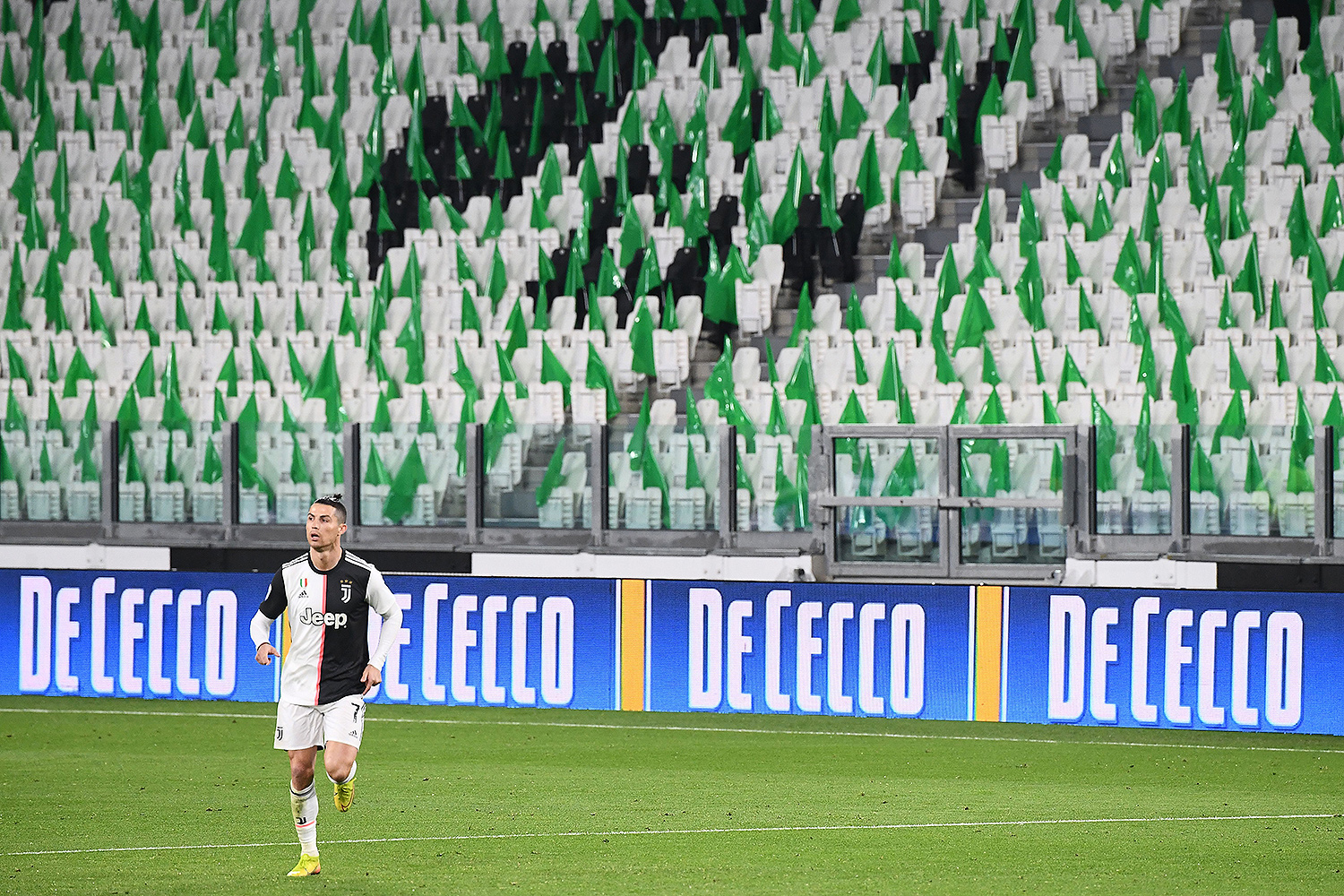
On Oct. 13, The Portuguese Football Federation (FPF) announced that Cristiano Ronaldo had tested positive for COVID-19. Before the test results were released, Ronaldo had been with the Portuguese national team playing in the UEFA Nations League. He has since returned to his home in Turin, Italy, where he is self-isolating. 

“Ronaldo was released from the work of the National Team after a positive test for COVID-19, so he will not face Sweden,” the FPF said in a statement. “The Portuguese international is doing well, without symptoms, and in isolation.” 

Although Ronaldo’s diagnosis attracted significant media attention, it is just one event in a series of adverse COVID-19 consequences for professional soccer in Europe. Due to the pandemic, soccer leagues across Europe have had to readjust how the game is played. In addition to having no spectators, these adjustments include rescheduling league matches and mandatory COVID-19 testing for players and staff. 

The onset of the second wave of COVID-19 in Europe means that soccer leagues must take place in empty stadiums. The United Kingdom government’s directive of spectator-free stadiums has been in place since May to prevent the spread of the virus. Soccer games without spectators have significantly impacted players’ motivation. Dimitar Berbatov, a retired Manchester United striker, believes that playing in empty stadiums affects player performance. 

“[Playing behind closed doors] can affect your performance when you go out there, and there are no fans,”  Berbatov said in an interview with Betfair. “[Even though] it’s a serious game, your body and mind can tell you it’s a practice game, which can lead to bad games and performances.” 

According to a University of Reading study, matches ending in a home win fell from 43.8 per cent to 41.2 per cent after fans were no longer allowed to attend games. Joshua Kimmich, a defender and midfielder for Bayern Munich, noted these differences.

”[When the stadium is full], you [feel] more [excited] when you score a goal,” Kimmich said in an interview with Psychology Today. “It’s more emotional when there are fans.”

The pandemic has also revealed the vulnerabilities of clubs in the lower leagues. Many clubs are struggling to survive, as their primary source of revenue comes from spectators. The Premier League acknowledged clubs’ financial fragility in the lower leagues and has devised an action plan to support those in need. 

“League One and League Two clubs rely more heavily on matchday revenue and have fewer resources at their disposal than Championship or Premier League clubs, and are therefore more at risk, especially at a time when fans are excluded from attending matches,” said the Premier League in a statement. “This offer [of financial assistance] will consist of grants and interest-free loans totalling a further $50 million pounds on top of the $27.2 million pounds in solidarity payments already advanced to League One and League Two this year.”

The mental health of athletes, whether in soccer or any other sport, must also be considered during this unusual season. Managers and clubs need to start paying attention to mental health as leagues across Europe persevere through the ongoing pandemic. Many players are away from their home and playing in foreign countries. Pundits and critics, who remain overly critical of players’ performances, do not always consider that these players are working in an unprecedented situation. The pressure to win should not be an excuse to neglect the mental wellbeing of players.

 “Your athletes are more resilient when they know how to manage their emotions,” Dr. John Sullivan, a clinical sports psychologist, noted in an interview with CBS Boston.

As in every other field, officials of the top soccer leagues in Europe need to understand the changes in the game at a deeper level. The impact of this pandemic goes beyond just headline-grabbing diagnoses of major stars like Ronaldo. The effect of spectator-free stadiums on players, the financial viability of clubs in lower leagues, and players’ mental health are key areas for management to work on as the restrictions with the pandemic continue for the foreseeable future.

Features

From across the fence

Don’t lie—I know you’ve observed your neighbours without them knowing. I do it, too. Montreal is full of neighbours peeking into each other’s lives, often without acknowledgement; after all, we are all strangers thrown into a shared space and compelled to coexist. And we all have windows, so naturally, we look out and look in.

Cait: “The neighbour above us often can see into our window because we don’t close our shades, and he mentioned to our friend, who’s his coworker, that he just sees us doing things all the time. We have dinner at our kitchen table, we sit on the couch, we make breakfast in our underwear and it’s not a big deal to us, but he just sees all of it. I don’t feel like I’m being watched, but there is [always] an element of ‘Oh, Mateo can see us anytime.’”

Science & Technology

Taking a virtual tour of McGill’s stones and fossils

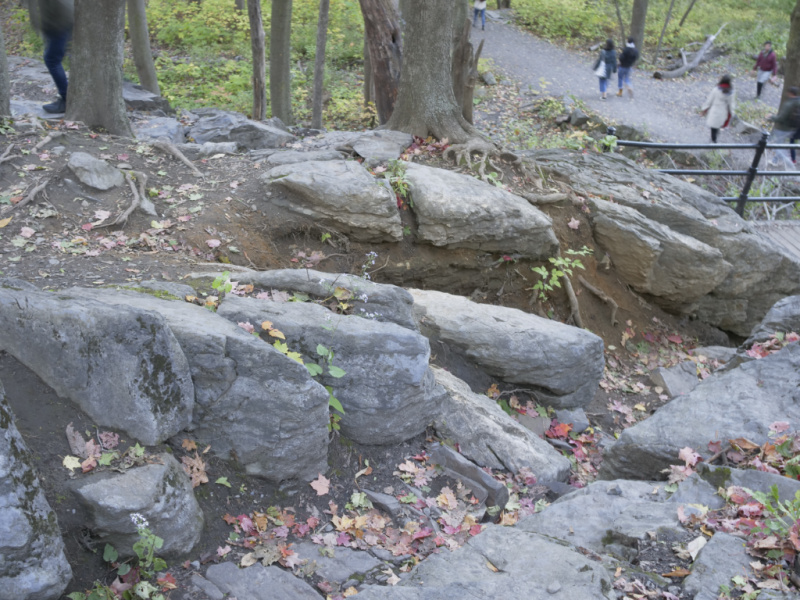
The earliest forms of life on Earth date back approximately 4 billion years. In an attempt to uncover the events leading to the development of life, scientists study sedimentary rocks and the fossils contained within them to uncover and map the history of living organisms through the ages. In Montreal, evidence of this complex history is present in the stones used to construct some of McGill’s most famous buildings. These buildings preserve evidence of fossilized creatures, some of which are over 250 million years old.  

On Sept. 26, McGill’s Redpath Museum hosted a guided online walking tour of building stones and fossils led by Ingrid Birker, Public Program and Education Co-ordinator at the Redpath Museum, and Meghomita Das, Ph.D. candidate in the Department of Earth and Planetary Sciences. The virtual tour began at the Redpath steps and took the audience around McGill’s downtown campus and the surrounding area, discussing various fossils and the geological periods in which they were formed.

Das presented the audience with images of various stones containing fossils. As she pointed out, Trenton limestone, one of the materials used in the construction of the Redpath Museum and other buildings in downtown Montreal and across Canada, contains shells from a group of invertebrates called Brachiopods.

“Trenton limestone is very commonly used for building purposes and is about 470 million years old,” Das said. 

Next, the tour moved to the geological rock garden situated right outside the museum’s steps. Ammonite, an invertebrate fossil that dates from the Jurassic period 200 million years ago was one of the many displays in the garden. The modern-day relatives of this fossil are cephalopods like squids and octopi.

Heading down McTavish Street to the McGill Faculty Club, Das explained the geological history of the materials used to make the building.

“[The Club] has red clay bricks, which were left to dry in the sun, and some cat from 100 years ago decided to walk on it and left behind its paw prints,” Das said.  

Though the clay bricks that compose the building’s facade are synthetically produced, Das pointed out that, under close observation, some naturally formed fossils are still apparent. 

“Blemishes that stand out enable differentiation of fossils from normal rocks,” Das said in an email to The McGill Tribune. “The purpose of this tour was to guide people and show them how the intricate patterns and shapes of fossils give an account of their history.”  

Demonstrating this idea, Das showed the spirals of a sea snail present along the sidewalks of the Mount Royal Club.

Holt Renfrew on de la Montagne Street, the next stop on the virtual tour, provided another example of captivating patterns. 

“Looking closely at the sidewalls, tiny broken calcite discs can be seen, which belong to crinoids, also known as sea lilies,” Das said. “[The] closest Crinoids today are urchins and sea cucumbers.”

Moving on to the Le Chateau Apartments on Sherbrooke Street, Das expressed her excitement for the location’s many potential fossil hiding spots. 

“This [is] my favourite fossil hunting spot,” Das said. “Every wall has a different kind of fossil, namely gastropods, corals, cephalopods, all from different time periods.” 

Das also pointed out the brown patches on the wall, which were burrows made by animals that eventually became fossilized. 

The tour concluded at the Peter Lyall House, which was built using 260-million-year-old sandstone brought to Canada from Scotland in 1889. Though the stones of the Peter Lyall House do not have fossils, Das explained that the building has other geological features that make it significant to scientists. 

“It has an interesting weathering pattern like an onion peel,” Das said.“This pattern is often developed due to continuous freeze thaw cycling action.”

In closing, Das provided her own expert advice for amateur fossil hunters.

“For anyone [interested in] fossil finding: If you do find one, take a picture, if [that’s] possible.” Das said. “Identify the shape and use guides online, which sometimes help you load images, thereby identifying what fossil it is.”

Commentary, Opinion

McGill’s funding system harms international students

In 2018, Quebec controversially deregulated tuition for international students at the province’s universities, allowing schools to set their own rates. Over the past several years, McGill has gradually raised international fees, a trend that has continued during the COVID-19 pandemic. While tuition this year for most McGill programs increased by 3.1 per cent, some international graduate students have seen their dues rise by 30 per cent. International students bear the brunt of tuition hikes because of both the way McGill is funded and Quebec’s political history, but a more equitable solution is possible: International students can pay more affordable tuition fees if Quebec raises its education budget, and if McGill spends its funds more responsibly.

At first glance, tuition discrepancies based on residency status seem reasonable. The university’s three largest revenue sources are, in order, the provincial government, student tuition, and the federal government. Quebec residents pay the lowest amount in tuition fees since their families already pay both provincial and federal taxes. Students from other Canadian provinces also pay reduced tuition, although it is more expensive for them than for in-province students. Since international students and their families do not pay provincial and federal taxes, it seems only fair that they pay a higher rate to fund the university. 

However, part of the reason why McGill has to rely on international students for such a large percentage of its funding is that in-province tuition remains disproportionately low, even after considering taxes. Although Quebec residents pay among the lowest in-province fees in the country, they have made it clear that they are opposed to significant increases by protesting the provincial government’s attempts to implement hikes. Had the proposed increase of $325 per year for five years been enacted in 2012, by 2017, Quebec’s tuition would have still been the second-lowest in Canada for in-province students. The unwillingness of Quebec residents to pay more has left their province’s universities underfunded. If Quebec’s higher education budget was raised to compensate for its students’ low fees, it would lighten the financial burden of Quebec universities on international students. 

Fundraising from student dues is further hampered by Quebec’s agreements with France and Belgium, which allow French and francophone Belgian undergraduates to pay the Canadian out-of-province tuition rate rather than the international rate. Graduate students from these countries are charged even lower in-province rates. French and Belgian students make up over 14 per cent of McGill’s international student body, and McGill has to recover the money it loses due to this policy by increasing tuition for other international students’ tuition. It is understandable that Quebec wants to promote the French language through immigration from francophone countries, but It would be fairer to eliminate this policy so that having all international students pay an equal rate would be fairer and more sustainable. Lower international prices will ensure that Quebec remains a popular  destination for the students who pay the most.

The university has struggled with funding for years. It needs more money during the pandemic to remain operational and continue offering support services, such as career planning and student health care, and an excellent education. One way to offset these costs without additional tuition hikes would be using more of the funds raised by campaigns such as “Made by McGill” to help students pay for their education. At the moment, only 30 per cent of the campaign’s $2 billion goal is dedicated to scholarships and bursaries. If more funding was used for these initiatives, it could help students who might find additional costs financially challenging.

The nature of McGill’s revenue streams and economic stressors resulting from the pandemic has forced the university into a difficult financial situation. However, McGill cannot expect international students to pay even more when others do not pay enough. To make McGill more affordable, administrators and students alike should demand increases in Quebec’s higher education budget, equal tuition for all international students, and a change in the distribution of funds raised by campaigns. 

Read the latest issue

Read the latest issue