


Latest News

Science & Technology

Discarding waste in McGill labs

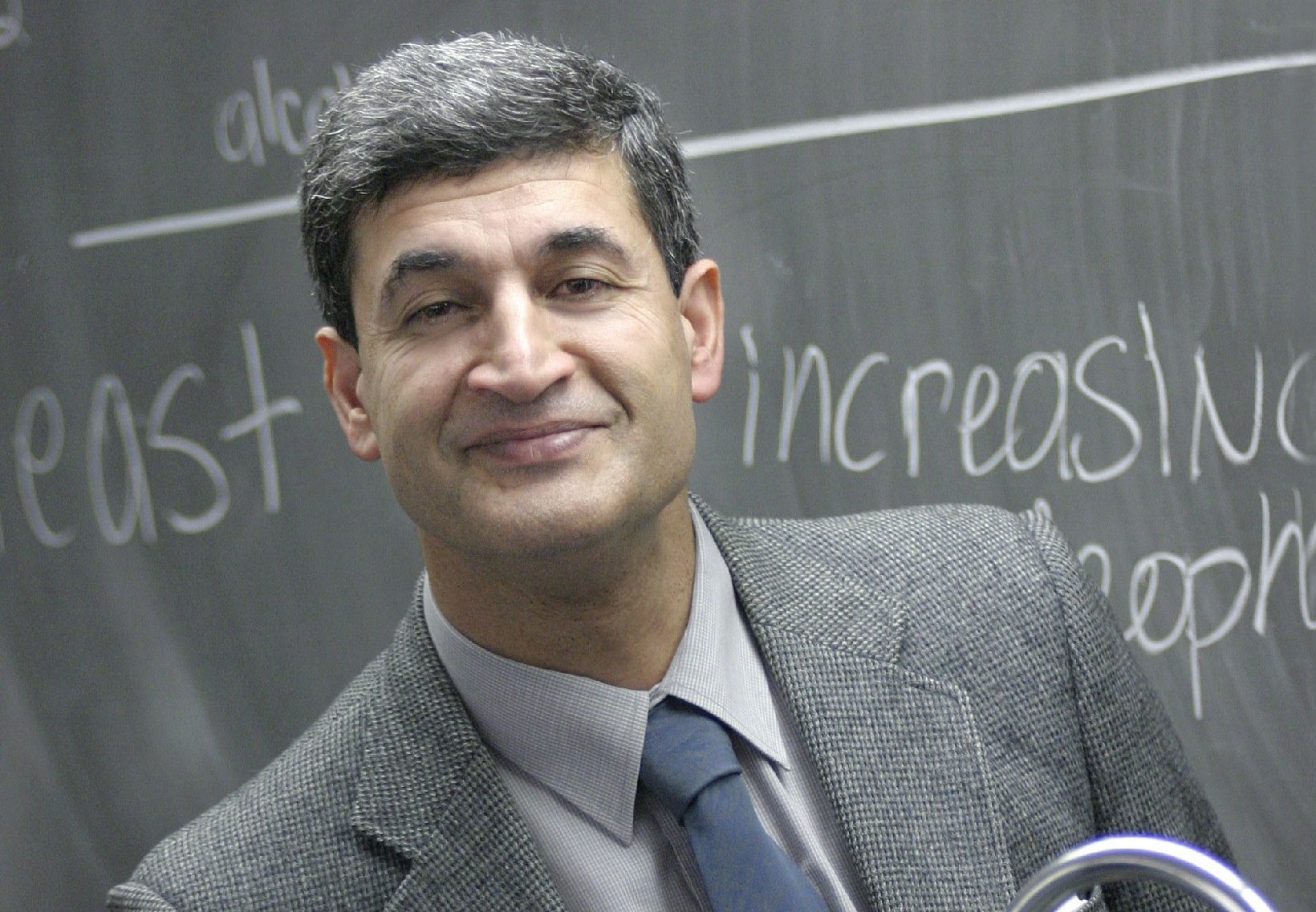
During the relocation of Macdonald Campus in 1978, lab manager in the Department of Food Science and Agricultural Chemistry Ebrahim Noroozi was tasked with the transfer of thousands of chemicals. That year, the campus was moved from its old buildings in the John Abbott College complex to its current location. Not all of the chemicals made it to the new buildings, however, as many were long expired.

“There were chemicals from before World War I, from 1905,” Noroozi said in an interview with The McGill Tribune. “You’d go to every corner, and there were a lot of chemicals, a lot of hazards, a lot of pesticides.”

This undertaking at Macdonald Campus was one of many experiences that contributed to Noroozi’s interest in occupational health and safety. He went on to dedicate his career to promoting safe practices, both through his position as the lab supervisor for the Department of Food Science and Agricultural Chemistry and through educating others in workshops and lectures.  

The progression of Noroozi’s career has coincided with an increased interest in safety, both in industrial and academic settings. Today, hazardous chemicals are no longer left forgotten for years in the far reaches of Macdonald Campus buildings. 

Noroozi explained that the Waste Management Program, which operates under the Environmental Health and Safety unit at McGill, collects regular chemical waste bi-weekly. This type of waste is made up of corrosive chemicals and solvents, such as hydrochloric acid and sodium hydroxide, that are collected in 25-litre plastic disposal jugs. At collection time, physical hazards are also gathered, as well as radioactive waste, including solid waste such as latex gloves and glass pipettes that have handled liquid radioactive waste. Biohazardous waste, which contains infectious or potentially infectious material including human tissue, animal waste, and microbiological waste, is collected as well.

However, some chemicals cannot be collected in these jugs. In the case of a cracked bottle, expired chemical, or solid substance, hazardous waste is stored in the lab until it is packed up for an annual collection. Should the substance be explosive or otherwise require immediate removal, labs can call on the waste management team. 

“If it’s urgent, even for a bottle, they may come to pick it up,” Noroozi said. “Or if it’s a large amount which occupies a lab.” 

Noroozi has always associated safety with sustainability in his labs. Over the years, he has encouraged researchers to share chemicals between their labs and scale down certain experiments to prevent the use of excess chemicals. He has also developed chemical recovery systems.

“In some labs, students […] do an extraction and distillation [a boiling process that separates substances from a liquid], and I can reuse the same substance and redistill it later on for another group because they’re not going to drink it or test it,” Noroozi said.

While Noroozi’s efforts to bring safe and sustainable initiatives into his workplace stands out as an impressive example to other scientists, he stresses that the work and dedication of others is essential. He can provide information and management strategies, but everyone must play their part to contribute to a safe working environment. 

“I am not a policeman,” Noroozi said. “Safety is a shared responsibility. So that is what we promote […], not acting like the police. Encourage, so people see the benefit of it and try to do it.”

Art, Arts & Entertainment

‘El Perdido’ documents our forgotten landscape

The archetype of the wandering artist is a familiar one, emphasizing that the freedom of the road, and the directionless travel that follows is a catharsis that allows an artist to create as freely as possible. For Patrick Beaulieu, the very act of losing yourself on the road is a means to an end, and the documentation of “lost places”—the neglected and decaying areas one finds during a journey—is the art itself. Beaulieu set out in a camper van, “El Perdido” [The Lost], in 2017 and travelled across the United States in search of “The Forgotten Road,” which he described as an ambiguous destination discovered only in the process of searching for it. Running until Oct. 26 at Art Mûr, El Perdido showcases Beaulieu’s photos and videos of his travels, which explain how he set out to lose himself.  

To achieve a state of disorientation, which Beaulieu described as a feeling of isolation brought on by the unfamiliar landscape, he often explored undocumented areas of rural decay. His imagery of grey skies and ruined housing allude forgotten places as being lifeless. For Beaulieu, though, the path to losing oneself in the abandoned margins of a map always involved engaging with other people throughout his travels.

“I started in a small town in Oklahoma called Lost City. From [there], the trajectory was generated, influenced, by all the information, the directions, the orientations that the people gave to me. It was kind of a chain reaction from one person to another to try to find these non-existent places,” Beaulieu said. “Specifically in this project, the encounters and relations were essential, because the idea was to try to find a destination that doesn’t exist.” 

Along with his interactions, the exhibition displays other tools that Beaulieu imagined as being helpful in losing oneself. On one wall, Beaulieu has two ‘70s-era road maps unfolded and framed. In the creases of the maps, routes end or become misaligned with the adjacent sections, and these segmented images become what Beaulieu refers to as “road map collages,” now rendered useless when considering their original purpose.

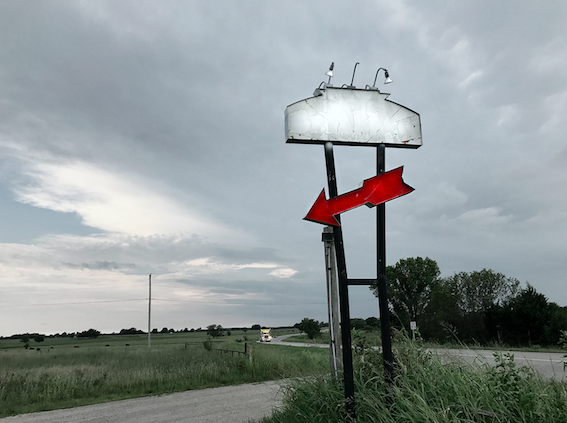
In another corner of the exhibition, Beaulieu displays a series of confusing signage and dilapidated billboards that he found during his travels. Here, arrows pointing to nowhere, illegible road signs, and inverted detours create the ignored landscapes that led him to his “Forgotten Road.” Being lost meant embracing the disordered and illogical routes that led to the “modern-day ruins” of rural life, areas often abandoned and erased in an increasingly urban world.

Though Beaulieu often used his environment as a means of becoming lost, he also noted how he could turn to his collaborator Alexis Pernet, who navigated and recorded their travels as diary entries, as a source of disorentiation. He referred to himself and Pernet as “co-perdidos” and explained how he asked Pernet, his navigator, to intentionally misguide the pair while on the road. One video, in which Beaulieu repeatedly stops, starts, and switches directions in the middle of an intersection conveys this process of broken navigation.

Throughout all his efforts at becoming lost, Beaulieu noted that though he’d had no expectations before beginning the project. He’d now arrived at a more personal definition of what being lost meant. Calling the project a ‘long term and monumental performative state,’ Beaulieu likened himself to a tourist whose self-inflicted sense of being adrift had led him to a forgotten world, itself a figurative space that reflected the lost people it attracted.

“As much as possible, I was trying to be lost,” Beaulieu said. “When you are trying to lose yourself, you find a lost people and you find lost places.”


Private, Sports

#SheTheNorth: Bianca Andreescu’s meteoric rise hits a new high

There’s still nothing like appointment television, even if it means sitting in a Plateau apartment with a laptop on a Saturday evening. All across Canada, sports fans cleared their calendars for 19-year-old Bianca Andreescu’s run to the 2019 US Open championship match. It took just over two hours on the afternoon of Sept. 7 before the Mississauga-born tennis phenom raised her hands in victory, making history and creating one of Canadian sports’ greatest moments.

In the thrilling two-set (6–3, 7–5) victory, Andreescu defeated 23-time Grand Slam champion Serena Williams. The two battled it out in a close match, with surges of adrenaline coming through for both. Andreescu’s shouts of “come on” pierced through a raucous pro-Williams crowd after big shots. When that final stroke came through for Andreescu, it was a powerful forehand in the open court ending Williams’ rally from down 5–1.

Although Andreescu and Williams’s history is short, it’s filled with significant matches and mutual respect. At the Rogers Cup in Toronto in August, an injured Williams retired during the championship match down three games to one, giving Andreescu a title on home soil. 

When the two met again one month later, both healthy and ready, the fans got the match they wanted. It ended with Andreescu winning the first major singles title in Canadian tennis history. (Genie Bouchard and Milos Raonic had previously come up short in finals matches at Wimbledon.)

“If anyone could win this tournament outside of Venus, I’m happy it’s Bianca,” Williams told ESPN’s Tom Rinaldi when she accepted her finalist’s trophy. Williams had praised Andreescu’s poise and maturity after the Rogers Cup.  

While Williams has been on the finals stage many times, Andreescu took home the title in just her first appearance in a major final.

“I’ve never received this much [money],” Andreescu said when handed the prize money cheque of $1 million. She remained calm and composed, even in the most emotional moments of the biggest match of her career so far, and it literally paid off. 

Andreescu’s complete game forced Williams to dig deep and play from behind for most of the match. The Canadian teenager put one of the best in tennis history on her heels, and it was obvious: Williams struggled to make shots with her backhand for much of the match. Even Williams’s strongest weapon—her serve—fell short, and she double-faulted eight times. 

Ultimately, with the massive victory, superstardom arrived for Andreescu. Even if it feels as if this has come early, it certainly has not. Ranked 152nd in the world at the beginning of the calendar year, Andreescu moved to the fifth spot in the World Tennis Association rankings with her championship title. While her rise is astounding, it is well-earned. Andreescu talks often about visualizing such peaks and how her mind prepares her for these moments.

“The mind is an incredible tool,” Andreescu told Joe Wolfond of The Score in August. “You basically can create your own reality with your mind.”

And this reality is hers: Andreescu is a major champion, and Canadian tennis gets its biggest moment yet. There’s more to come, though. When asked about the potential for fame and whether she is okay with being recognized on the street, Andreescu contemplated her new reality.

“My goals have just been to win as many Grand Slams as possible, become number one in the world, but the idea of fame never really crossed my mind,” Andreescu told reporters in the post-match press conference. “I’m not complaining, though.”

Later, Andreescu and her coach Sylvain Bruneau posed for photos with their new trophies. Bruneau joked that this felt new for him, and Andreescu smiled.

“Get used to it,” Andreescu said.

frosh
Commentary, Opinion

Frosh sends troubling messages about drinking culture

Following a significant backlash in past years regarding the toxic nature of many Canadian Frosh weeks, McGill has made attempts to improve the experiences of incoming students. Frosh coordinators across faculties have, in consultation with staff and the administration, implemented new policies that seem to have improved student well-being and safety during Frosh. In recent years, the university has emphasized consent education and renewed its commitment to inclusivity through programs like Access Allies, where leaders receive additional training sessions to welcome first years. While many aspects of the week have changed, McGill remains one of the few Canadian universities to continue to promote the consumption of alcohol during Frosh. In continuing to legitimize wet Frosh weeks, McGill introduces students to an inextricable link between intense alcohol consumption and social events during students’ undergraduate tenures.

Faculty Frosh weeks aim to plan safe and inclusive orientations, including extensive Frosh leader training that involves discussions with the Milton-Parc Citizens’ Committee and the Service de police de la Ville de Montréal (SPVM). While training educates leaders and prepares them to take care of groups of 20 to 30 freshmen, there remains a consistent disconnect between knowledge and practice of safe alcohol consumption habits.

For many, alcohol serves as a social stimulant that helps them mingle and socialize. For others, wet Frosh weeks create an environment that produces intense social pressure to overconsume, often to the point of blacking out. While Frosh events never require alcohol consumption, pre-games and bar crawls often include chanting, drinking games, and chugging contests that glorify it. From day one, students are taught that drinking alcohol at events is correlated with social success.

Although Frosh Week is not an introduction to drinking for all incoming students, in the absence of parents and guardians, it presents an opportunity to escalate previous drinking habits. With newfound freedom, first years have the opportunity to let loose in a seemingly safe environment. The drinking culture at McGill tends to celebrate students who can consume the most, the fastest. At pre-games, Froshies praise each other for pushing their limits by challenging the number of drinks they can consume before blacking out. The next day, they shrug off a lack of memories because their peers share similar experiences.

While Frosh serves as an introduction to McGill’s work-hard-play-hard attitude, the cultural pressure does not end there. McGill offers countless opportunities for students to drink and socialize, including student-run bars and drinking events like Hype Week and Winter Carnival that take place throughout the semester. Early on, attitudes towards drinking prompt students to use the ability to bounce back from dangerous alcohol binges as criteria for success. 

Frosh remains a formative experience for many, but for it to maintain students’ health, Frosh must put an end to the normalization of binge drinking. Faculty Frosh weeks can take notes from their alternative counterparts, such as Rad Frosh, which emphasizes safety and inclusion through workshops, walking tours, and accessible dance parties. It is time for students and the administration to acknowledge the damaging impacts of McGill’s work-hard-play-hard culture and the need to tackle it at the macro-level. The habits that students acquire today have the potential to set the tone for future drinking practices and health outcomes.

Future Frosh planning must address attitudes toward drinking at McGill as a whole and how the school can shift toward a culture of moderation. Instead of emboldening students to adopt dangerous consumption habits, Frosh organizers should teach incoming students how to incorporate alcohol in a safe manner by supporting non-drinkers at wet events and offering additional dry events. Students should be taught to feel comfortable speaking candidly about how alcohol affects them and understand that their ability to recover from a blackout or the speed of their chug time is not a measure of their worth.

Commentary, Opinion

Remembering McGill’s past to progress its future

With the new school year starting, many students prepare to fall back into their routines on McGill’s campus. Among the new classes and experiences to be had, many look forward to a fresh start in the Fall semester. While it may be tempting to leave the issues of last year in the past, it is important to remember the McGill administration’s insufficient action and shortcomings over the past year to continue working towards a better future by actively pursuing unfinished initiatives.

Last year, McGill saw several student-led protests take a stand on issues of social justice on campus. One of these protests, led by McGill’s social work students, questioned McGill’s labour practices. McGill’s Bachelor of Social Work program, in adherence with Quebec provincial policy, mandates that two unpaid internship placements be held during the last two years of the degree, each 400 hours long. To require that upper year undergraduate students work uncompensated for 400 hours while balancing academic responsibilities is unreasonable, and as mentioned by the President of the Association of McGill University Support Employees Ella Hartsoe, experience does not pay rent. While McGill is not alone in maintaining such a requirement, students remain unhappy with the administration’s inability to effectively communicate with provincial offices regarding the issue and the lack of a reparative policy offering some sort of compensation. Currently, no resolution has been reached between the protestors, McGill, and the Ministry of Education. McGill’s continued hesitancy to accomodate the needs of the social work students is yet another reason why student activism remains vital.

In addition to the November 2018 social work student protest, many students also protested the McGill Men’s Varsity team name. Thanks to student activists such as Student’s Society of McGill University (SSMU) Indigenous Affairs Commissioner Tomas Jirousek, the previous team name was changed. Principal and Vice-Chancellor Suzanne Fortier announced last June that a new name will be decided by the beginning of the sports season in Fall 2020. The #ChangeTheName campaign is an example where student led activism has resulted in administrative response, resulting in a palpable change. Change resulting from student activism is possible within the walls of McGill, as long as the social issues addressed by past students are not forgotten or ignored by the incoming class. 

In April 2018, McGill’s mismanagement of sexual misconduct allegations motivated students to  stage a walkout to protest the administration’s handling of sexual violence cases from staff. In July  2019, McGill launched a mandatory online course regarding sexual misconduct alongside a revised sexual violence policy, and a new special investigator to look into new allegations. McGill has made significant progress all because of the student activists who worked tirelessly to make the campus a safe and inclusive space for survivors of sexual violence. Although some of these new policy developments still fall short of making campus fully safe and inclusive, McGill activists have spearheaded commendable progress. 

Student protests have the power to improve the university’s values, the quality of student life and safety, and create real policy changes. While some of these protests have direct payoffs for students, many are still not given the attention they deserve by the McGill administration. Going into this new school year, McGill students and faculty alike must remember the pressing issues lingering from past school years and take action to address them once and for all.  This is especially important for the first-years joining McGill, to acknowledge all the changes made from tireless work from student activists. Progress made by past generations at McGill will continue to have a meaningful impact for future students.

Editorial, Opinion

I’d rather be a Martlet

On April 12, McGill students received a monumental email: Principal and Vice-Chancellor Suzanne Fortier had reached a decision on whether or not to change the controversial Men’s Varsity Team name. Fortier wrote that, with respect to Indigenous students who felt alienated and disrespected by the name, the Mens’ teams names would be replaced. While this decision represented a major victory for the Indigenous students and allies who had protested and spoken out against the injustice, the email also mentioned that McGill would not announce a new name for the team until the beginning of the Fall 2020 semester. The McGill mascot, the Martlet, is already the name of the Womens’ Varsity teams, which means that a gendered divide remains between the two groups. It makes sense for McGill to adopt the Martlet name unanimously for all school teams, and the administration must both increase transparency and make greater efforts to involve the student body in the process.   

Fortier’s email outlined that a steering committee would be formed to lead a consultative process for choosing a new name, and mentions that details about this process would be communicated in the months ahead. That email was in April. The student body has been left hanging over the summer months and it’s not clear that McGill will now change its approach and proceed with apposite transparency.

 At McGill and in varsity sports more generally, there is a historical sexist and transphobic divide in team naming and participation. The administration’s failure to publicly consider adopting the Martlet name seems to represent this larger issue. In the same manner that the original men’s team name ostracized and disrespected Indigenous students, this binary divide alienates transgender students who may feel unsafe and uncomfortable participating in gendered sports. 

Right now, McGill stands at a precipice from which they can challenge the inequitable separation through false gender-binaries in college sports, paving the way for other institutions to do the same and uniting the McGill community under a single name for which the student body already feels an association. Failing to do so would be a disservice to both current and future students and athletes. 

Student-organized protests spearheaded by the Indigenous community at McGill brought about the name-change in the first place. Therefore, the administration must make a greater effort to engage those who a decision this monumental should be up to. Given this history, it makes ethical and logistical sense to involve Indigneous students, and the rest of the student body, in choosing the new name. The administration can poll the student body, allowing students to vote on which name they want for the men’s team to fully understand interest. The decision making process shouldn’t be bureaucratic and inaccessible. 

While a year is a long time to make a decision, it may make sense to present a new name at the beginning of a fresh sports season. Additionally, this is a delicate decision that needs the thought and care it deserves. However, during that time, students deserve insight into the decision process. Whether this means publishing the minutes of working group meetings or sending regular email updates, transparency must be increased. In the meantime, in honour of the students who spearhead the #ChangeTheName campaign, students should continue to support Indigenous initiatives on campus: For example, from Sept. 16 to 27, the Indigenous Education Advisor alongside the First People’s House are hosting Indigenous Awareness Weeks, with numerous free events, talks, and activities on campus. McGill has an opportunity to set a towering precedent for inclusivity in university sports and if it fails to do so, it will simply be exchanging a name that represented racial injustice to a name that continues to represent gender inequity. 

Basketball, Behind the Bench, Sports

Behind the bench: Kevin Durant’s injury shows how fans affect athletes

NBA player Kevin Durant received relentless scrutiny following his 2016 decision to leave the Oklahoma City Thunder for the Golden State Warriors. The decision came after the Thunder infamously gave up a 3–1 lead in the Western Conference Finals to Warriors, and fans have continued to express their disapproval of his decision and its consequent creation of a Warriors super-team. However, few have considered how this decision affected Durant’s personal life. The dynamic between Durant and basketball fans has highlighted a larger issue in sports: How the dehumanization of superstar athletes negatively affects their dynamic with fans and their own personal wellbeing.

The destructive relationship between fans and athletes was recently displayed when Durant strained his calf during Game 5 of the 2019 NBA Western Conference Semifinals. A month later, in Game 5 of the championship finals, Durant ruptured his Achilles tendon after only 14 minutes of play—an injury that threatens his career. Analysts and fans alike immediately sought to place blame, linking the injury to the calf strain. Some believed that a negligent medical staff was responsible for his premature return; others surmised that the Warriors organization pressured Durant to be on the floor. Largely unnoticed, however, was the potential impact NBA fans had on Durant’s decision to return to the starting lineup.

Fans glorify professional athletes due to their unparalleled talent, nationally televised presence, and huge salaries. In so doing, they inadvertently forget that athletes are human, too. This can lead fans to place immense pressure on athletes, affecting both performance and decisions like whether or not to play.

“[W]e’re idolized as superstar athletes, not human beings,” Golden State centre Demarcus Cousins said to reporters after Game 5. “It’s always about what we can do between those lines. That’s it.”

The significance of Durant’s two NBA Championship titles and Finals MVP awards have been diluted given his elite teammates, and his move to the Warriors has been condemned as the weakest by an NBA superstar. This may have culminated in desperation to consistently prove himself, an impulse which he has displayed in the past by using fake Twitter accounts to defend his reputation against criticism from fans. 

Durant’s injury now carries an even greater significance due to the fact that many Toronto fans cheered when he went down, despite the Raptors players urgently waving for the crowd to stop. At this moment, the crowd’s desire for a championship and inability to relate to the man on the floor presented a concerning picture: Fans can become so distant from professional athletes that they forget the compassion that they would normally show their peers.

Two-time champion and Finals MVP Kawhi Leonard of the Toronto Raptors may know better than anyone the feeling of such immense pressure to return: The San Antonio Spurs cleared the forward to play earlier than he felt appropriate after a mysterious quad injury. Despite mounting pressure, Leonard did not give in, opting to sit out almost the entirety of the 2017-18 season and seek independent treatment. 

Durant’s injury invites fans to reflect on how they treat players, bridging the gap between excessive idolization and empathetic understanding. For athletes to retain their humanity, the standard must not be that they either win a championship, as Leonard did, or destroy their body in the same pursuit, as has been the case for Durant. Spurs guard DeMar DeRozan is among a group of players who have taken a great first step by opening up about their depression to help fans understand just how human professional athletes are. It is a two-way street, however, and fans need to meet athletes halfway by respecting, honouring, and loving them not only as competitors, but as human beings.

Sports

Women’s hockey players stand up, sit out

On March 29, the board of the Canadian Women’s Hockey League (CWHL), an organization that previously consisted of six teams, voted to disband the league due to its financial inviability, irreversibly changing the state of women’s hockey in North America. 

The United States-based National Women’s Hockey League (NWHL) thus became the only professional women’s hockey league on the continent; however, despite first being founded as an alternative to the CWHL, players have seemed unwilling to accept it as the sole remaining league. On March 31, dozens of players tweeted a statement using the hashtag #NoLeague to express their disappointment and apprehension of the future. This was just the beginning, as in the three months since, female players have taken bold actions to fight for control of their own future, even if it jeopardizes their present.

Two days after players first expressed dissatisfaction with the NWHL, reports of an increased financial contribution to the NWHL from the NHL of $100,000 surfaced. This development does not, however, reflect an increase in the NHL’s financial contribution to women’s hockey: Both the NWHL and CWHL received $50,000 each from the NHL last year, so the NHL simply transferred the CWHL’s funding to the remaining league. This contribution is also only 14 per cent of the $700,000 minimum salary for a single NHL player.

On May 2, over 200 female collegiate and professional hockey players in Europe and North America tweeted identical statements announcing that they would not play hockey in North America until a sustainable league with a living wage and health insurance was created. Among these players were superstars like Hilary Knight, Marie-Philip Poulin, and Kendall Coyne Schofield.

This movement, usually referred to with the hashtag #forthegame, is certainly bold and may put some players’ careers at risk. It might seem like a long shot, but it is not a step backward for women’s hockey. Those involved in #forthegame are pausing to consider the best way to improve the sport for both current and future players. Girls deserve to dream of a hockey career in which they can simply play hockey, without worrying about affording equipment or missing practice because of their day job. Every player involved should be commended for having the bravery to speak up and sit out one season in order to ensure the long-term growth of the sport.

On May 20, the CWHL Players’ Association’s Twitter account was renamed to the Professional Women’s Hockey Players Association (PWHPA). Instead of merely creating a loose hashtag movement, the players showed how serious they are by taking legal steps to band together. The PWHPA lists the organization’s goals as creating one viable professional North American women’s league, providing support to players who are sitting out, and advancing the game. Currently, the account is spreading word about hockey camps to ensure that, even without the ability to see their favourite stars play, young girls will still be able to develop their skills and pursue their passion.

The creation of the PWHPA shows that the players involved do not think that the NWHL is sufficient, and that they have good reason to be skeptical. While the NWHL said in April that it would expand to Montreal and Toronto for the upcoming season, a May 30 press release tentatively pushed the expansion back to the 2020-2021 season, with no guarantee that it will happen at all. Additionally, two NWHL teams have recently lost their connections with the NHL, halving the number of official connections. By separating from NWHL teams, the NHL may send the message that it does not believe in the league’s model, or that it fears the NWHL may go the way of the CWHL.

Neither the PWHPA nor the NWHL is perfect, but one thing is certain: There are many female hockey players involved who are fiercely passionate about making their sport better for future generations. Whether the right path forward is with the NWHL, a possible NHL-backed women’s league, or something completely different, players are taking charge and they’re not backing down.

Arts & Entertainment, Music

The best of Roy Juno is yet to come

From a band that seems so effortlessly cool, one might expect a certain degree of aloofness from the members of Boston-based dream rock project Roy Juno. Seated around a plastic table in a dusty canvas tent, however, all four members were positively glowing with pride following their Aug. 2 performance at Osheaga.

“It’s one of those stories I’ll tell my grandkids,” songwriter Sayak Das said in an interview with The McGill Tribune of the experience of recording Roy Juno’s first EP Gone Mad from his house in Boston, Massachusetts. “[…] You know, like about how I was pretty much naked in my room with the AC off so I could record vocals properly—it was so hot and it was so muggy that we barely get anything done […] or about how these guys cleared out the living room and set up the drum set, and they all recorded at the same time! Which is badass!” 

Indeed, though the band is barely a year old, Roy Juno’s story is already one worth hearing. Following the dissolution of their two-person project, Dreamer and Son, Das and drummer Josh Parra met bassist Henri Young at an audition for a wedding band. Having recently graduated from the Berklee College of Music, Das and Parra were searching for a team to realize an artistic vision they’d been unable to achieve on their own. Their connection was near instantaneous, and it was not long before the three musicians were writing and recording together. Lead guitarist James Marino would become the final piece of the puzzle when he joined Roy Juno in Dec. 2018.

 The creative chemistry between Roy Juno’s four members is immediately apparent from their recordings, and it is always a pleasant experience to encounter that same chemistry live, on stage, and in conversation. 

“Every aspect of every skill that we have is showcased in this band,” Das said.“[…] and that was a tough thing for me, working collaboratively, but the reality is, [the band] has great ideas.”

The emphasis that Roy Juno places on their creative independence is integral to their creative process. Their first three singles were recorded in Das’ house and produced in part by the musicians themselves.

“It’s the band’s mission statement,” Young said. “[…] we just want to accomplish as much as we can ourselves, on our own.”

Having recently graduated from one of the more esteemed music schools in North America, Young, Parra, and Das also spoke about the process of navigating their musical identity beyond the university context.

“This band is all about freedom,” Das said. “It’s really amazing to be able to use an institution like that independently, away from it […] a lot of the things I’ve learned there […] I have to think of them as tools not rules.”

 The band also spoke about their disappointment in the general cynicism surrounding the music industry, citing much eschewed tools like recording software and music streaming services as being constructive, and even essential, to their creative process.

“It’s never been easier, in terms of musical generations, to express yourself, to get your ideas out there […] I think the people who say the internet is holding them back, I think that’s an excuse,” Young said.

Roy Juno’s members admit that they are not sure quite what to make of themselves yet. Their current body of work is a representation of their musical journey and consists largely of members’ older material that they had reworked together. Now that they’ve established a relationship and a unique sound, the band looks forward to crafting something that is entirely their own.

 “These are going to be the first true Roy Juno songs,” Das said. “[…] phase two of Roy Juno is a blank slate.”

Roy Juno’s music is available to stream on Spotify. 

Arts & Entertainment, Music

In the kitchen, and on stage, with Munya

Osheaga 2019 saw no shortage of exciting acts from around the world, so Québécoise singer Josie Boivin, better known by her moniker Munya, found herself at home at Parc Jean-Drapeau. Hailing from Saguenay, Quebec, Boivin trained professionally in opera, and then briefly in jazz voice at the Université de Montréal (UdeM) before leaving to embark on her solo career.

To the casual listener, Boivin’s time spent in the UdeM practice rooms may not be apparent at first. But Boivin’s soprano stretches with ease on tracks like “Des Bisous Partout” and “Trop Tard,” and Boivin attributes her music’s  dreamy quality to her use of major and minor sevenths. It’s clear that she has technical sophistication as well as musical ingenuity.

Boivin’s education and influences have resulted in a sound that she aptly dubbs “new synth folk.” Though she features prominently on the synth keyboards, the meandering guitars and the delicate vocals that accompany them evoke pastoral drives and charming love stories. Boivin attributes her preoccupation with dream pop to her parents’ musical taste.  “As a kid, my parents really liked French music, so my mom loved Francois Hardy, and I think she’s still a big influence in my music. I love the ‘60s and ‘70s,” Boivin said in an interview with The McGill Tribune.

All the while, Boivin’s traditional education in music has informed her work. She cites classical composers, such as Claude Debussy and Erik Satie, as well as jazz legends Ella Fitzgerald and Bill Evans as her musical influences.

Though Boivin underwent a conventional formal musical education, her beginnings as Munya were less typical: As booking space was slim, she set up her own studio in her sister’s kitchen.

“She would go to work from 9 to 5, [and] I would put my stuff on the table, and just make sure everything [was] perfectly back to normal when she got back,” Boivin explained. “I just started making music in the kitchen and had no expectations. I was just following my heart and making some beats.”

This determined, do-it-yourself tenacity served Boivin well, propelling her to produce three EPs—North Hatley, Delmano, and Blue Pine—in less than a year. Drawing energy from her family, the Montreal music scene, and her friends, Boivin sees her homespun roots as fundamental to her craft and performance.

“For me, right now, I feel like [honesty is how] I can best introduce myself to my audience and my crowd, and that’s also how I make music. Just with my guitar and my keyboard, my sampler, and I feel good about it,” Boivin said. “Because, it’s just like who I am. Really, there’s no b-s. That’s how I make music.”

Though Osheaga brands itself as Montreal’s largest music festival, Boivin sees it not as her final victory, but a springboard for more opportunities.

“Last year, when I released my first EP, I had no expectations, and now here I am, I just played the Jazz Festival, [and] I’m playing at Osheaga, like, ‘What the hell?!’” Boivin said. “Playing with all the other bands—I love Beach House, Mac Demarco, all those—it’s so inspiring for me and a good support for me. Like, people like my music, okay, I’ll just make more songs then!”

Munya will be opening for Charlotte Cardin Aug. 17 at Église St-Matthews New Hope Luther in Sudbury, ON, presented by SiriusXM. Her music is available to stream on Spotify and Bandcamp.

Read the latest issue

Read the latest issue