


Latest News

Montreal, News, Private

Uber JUMP e-bike–share service competes with BIXI in Montreal

The ‘bike-share boom’ continues to grow in Montreal this summer, as Uber-owned JUMP bikes enters the market dominated by BIXI Montréal.. However, seasoned cyclists are wary of bike-share users’ lack of attention to road cycling safety, as this unmindful behaviour leads to more road confusion and bike accidents. 

According to Onur Koçer, a volunteer at McGill’s Flat Bike Collective and ‘all-season’ cycling commuter, Bixi customers often ignore road rules like proper passing procedures.

“If I am [cycling] and a Bixi is trying to [pass me] from my right side, I am really confused, and that happens quite often,” Koçer said. “You need to be aware that you are also responsible for other people who bike and yourself at the same time. I don’t really feel that so many people show that kind of awareness of responsibility toward other people.”

JUMP bikes are pedal-assisted electric bikes that can travel up to 32 kilometres per hour. The system is ‘dockless’: Users can pick-up and return bikes from any bike rack within the service area, in addition to at designated docking stations. Users can reserve and pay for bikes by using the Uber app. 

Emily MacLean, another volunteer at The Flat Bike Collective, is concerned that disregard for road rules will worsen as e-bikes, which are more powerful and faster than traditional bikes, become more widespread. 

“[E-bikes] will take the problems with Bixis and exacerbate them. Bixi has lots of pros, but I don’t know how many of those pros will go along with [e-bikes],” MacLean said. “I am a little bit wary about the e-bikes. [But], they could be helpful, maybe they will surprise us.”

Although widespread bike sharing may create safety concerns, these services also offer an alternative to driving that is non-polluting, time-saving, and more active. Robert Couvrette, the McGill associate vice-principal of university services, says that bike shares are a welcome addition to campus life. 

“The increased accessibility of such modes of transportation is good news, as it likely encourages more members of the McGill community to use active transport,” Couvrette said. “Cyclists are asked to always be vigilant and respectful of pedestrians, who have the right of way on the downtown campus.”

In a 2016 study at the Technical University of Denmark, researchers found that riding style is a crucial factor in e-bike user safety and that e-bikes carry a specific set of safety implications. According to the study, e-bike trips are on average shorter, faster and more frequent than those taken on traditional bikes, and other road users often underestimate the bikes’ speeds. 

Presently, the Quebec Ministry of Transportation has not passed any regulations limiting the speed of e-bikes, however, the Highway Safety Code mandates that riders wear helmets. Furthermore, the City of Montreal released new regulations to ensure dockless bike-share vehicles are still properly managed by their companies.

“The City of Montreal is only responsible for the supervision of the parking of dockless vehicles and their operating licences,” Serge Tsoto, the City of Montreal press correspondent wrote in an email.

Science & Technology

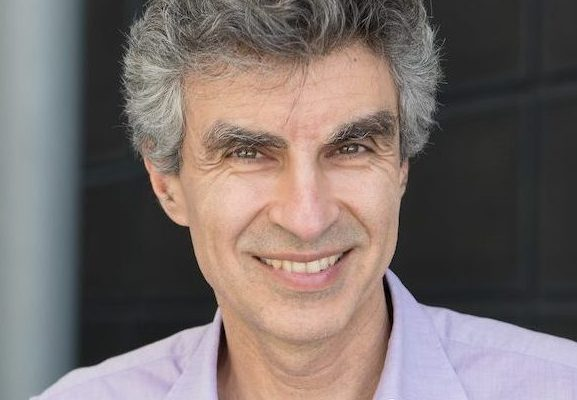
Yoshua Bengio on the future of AI

Turing Award recipient and McGill alumnus Yoshua Bengio, best known for his seminal work on artificial intelligence (AI), is the latest recipient of the Killam Prize, a $100,000 award given to outstanding scholars. Bengio is the founder of the Montreal Institute for Learning Algorithms (Mila), a world-renowned AI research institute. 

He attributes his success, in part, to Canada’s investment in curiosity-driven research. 

“We have been successful in AI […] in great part because we have a research funding system that allows professors to learn some subject that no one cares about, but that may have great potential in the future,” Bengio said in an interview with The McGill Tribune. “I would like there to be more of it, but at the same time, I realize that we’re really lucky in Canada to have the system we have.”

Bengio has been a vocal opponent of autonomous, AI-driven weapons. In 2017, he co-authored an open letter with other prominent AI researchers calling for the Canadian government to support an international ban on the use of lethal autonomous weapons—which operate without meaningful human control—at the United Nations.  

Another recent concern with AI is deepfakes, which are artificial—but highly realistic—videos created using generative adversarial networks (GANs). GANs were developed by Bengio and colleagues in 2014, and essentially use two competing neural networks to produce novel data that resembles existing data. In light of a recent fake video of Nancy Pelosi, digital policy pundits fear that both crudely manipulated videos and more sophisticated deepfakes will be used in further smear campaigns against political candidates. 

“It’s an issue right now in the courts and media—people take for granted that if there’s a picture, it’s true,” Bengio said.

According to Bengio, deepfakes are currently easy to detect, but the arms race between deepfake producers and detection software will continue. A researcher behind a recently developed method of identifying deepfakes conceded that although it will be especially difficult, deepfake-makers will likely adapt to the new technique. 

Deepfake texts also pose a problem. The creators of a revolutionary AI text-generator called the GPT-2 model refused to release their entire research for fear of potential misuse. Despite these concerns, though, Bengio remains optimistic about the future of AI.

“Think about how access to the Internet is increasing our ability to have access to more knowledge,” Bengio said. “It is going to depend on how we choose to deploy these [tools]. If we do it in a mindful way rather than just driven by maximizing profits, I think we could do something pretty good for society.”

Recent strides made in AI research are advancing various areas of science and technology. Last year, a study published in Nature Medicine revealed that Google DeepMind’s AI can interpret 3-D eye scans and make more efficient referral decisions than expert physicians. DeepMind is also being trained on weather forecast data to predict the power output of wind turbines up to 36 hours in advance, leading to increased energy efficiency. 

Bengio believes that the future of AI will benefit from collaboration.

“Having more people at the intersection of some domain and AI is something that society will need a lot in the future,” Bengio said.

He also promoted the power of self study, urging university students to leverage free and open-source tools for learning instead of simply relying on professors or courses. Bengio offered a final piece of advice for students interested in pursuing a research-oriented career.

“I hope people will take the time to think because big advances in research actually come from a place where you have quiet and time to think and you’re not in the rush of producing something tomorrow,” he said. 

Science & Technology

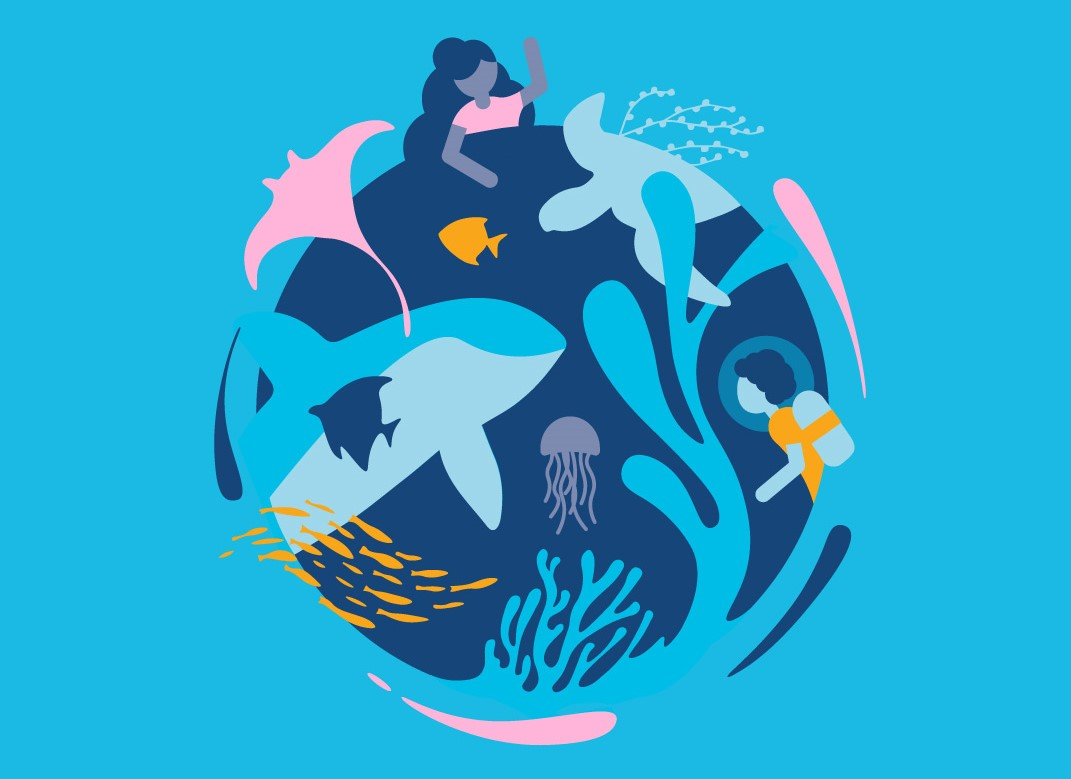
World Oceans Day highlights pressures on marine environments

On June 8, humans dumped 13,000–15,000 pieces of plastic into the ocean. At the same time, we were celebrating United Nations (UN) designated World Oceans Day, which raises awareness about oceans’ importance to humanity. It also connects people worldwide through social media, encourages participation in partner organizations, and inspires year-round action to protect and restore marine ecosystems. 

Covering 71 per cent of the planet’s surface, oceans are a major source of food and medicine, provide most of the world’s oxygen, and act as a sink for carbon dioxide. World Oceans Day is a harsh reminder of the major threats posed by pollution, overfishing, climate change, and habitat destruction.

Pollution

Annually, 13 million tonnes of plastic are dumped into the ocean, killing 100,000 marine animals that often die after tangling themselves in or ingesting plastic debris, leading to internal injuries and starvation. Plastics also introduce chemicals into the water and greenhouse gases into the air. These chemicals can remain intact for centuries or instead degrade into microplastics, which introduce toxins into the food chain. 

Other man-made pollutants, such as chemical fertilizers, enter the food chain after small marine organisms consume them. Nitrogen-rich fertilizers result in massive algal blooms that rob the water of oxygen, creating ‘dead zones’ where only a few species can survive. Meanwhile, oil spills can poison animals and destroy the insulating capability of fur and the water repellency of feathers, causing mammals and birds to die of hypothermia. Noise pollution from ships disrupts the migration, communication, and reproductive patterns of whales, and it can even kill invertebrates like squid.

Overfishing

Over the past century, humans have depleted the majority of the planet’s fish stocks, leaving fewer fish and marine invertebrates to reproduce and sustain healthy populations that can withstand future fishing efforts. Size-selective fishing, often used as a conservation measure, lowers genetic diversity, while trawling along the seafloor can destroy fragile environments. Additionally, millions of animals not targeted by fishermen—referred to as bycatch—are caught, though technologies that exclude non-target species are now required in some areas. Aquaculture, the world’s largest-growing food industry, comes with problems of its own but is increasingly viewed as a sustainable alternative to fishing for many species.

Climate change

Arguably, the biggest threat to the oceans is climate change. Aside from sea level rise, global warming is making oceans hotter, reducing oxygen levels, and forcing species to relocate to new areas. Furthermore, extreme and unpredictable weather associated with climate change can damage coral reefs and other coastal ecosystems. 

A striking effect of this ocean warming is coral bleaching, a stress response to environmental changes that has become more common in recent years. When under stress, algae leaves the coral, causing it to turn white and making it more vulnerable to future pressure. Coral is also bleached by acidification, the result of large quantities of carbon dioxide dissolving in oceans, which makes water more acidic and threatens the growth and survival of organisms with calcium carbonate skeletons and shells, such as corals and shellfish.

Habitat destruction

Coastal and marine habitats are home to a wide range of organisms and are essential for the overall function of ecosystems. Coastal development and aquaculture can destroy vital habitats and fish nurseries, such as estuaries and mangroves, while destructive fishing techniques like deep-sea trawling scrap entire habitats from seamounts and underwater mountain ranges. Pollution, tourism, and climate change also destroy marine habitats.

While World Oceans Day is a reminder that humans are dangerously threatening the marine environment, all is not lost: Through education and global coordination, the event inspires the development of new and ongoing solutions to mitigate humans’ impact on the earth.

Arts & Entertainment, Music

Overlooked at Osheaga: Four acts you shouldn’t miss

With big acts such as Tame Impala and Kaytranada gracing the Osheaga main stages, it is easy to overlook the lesser-known artists who are playing the afternoon slots. All the while, this year’s lineup boasts a breadth of up-and-coming artists covering diverse genres and styles, and it would be remiss to discount them. The McGill Tribune has compiled a list of promising Osheaga acts that shouldn’t be missed.

Teke::Teke

Aug. 2, 3:45-4:30 p.m., Scène des Arbres

Seven established Montreal artists; one tribute band to the legendary surf rock guitarist Takeshi ‘Terry’ Terauchi. Though it started as a side project between friends, Teke::Teke has evolved into a force to be reckoned with. Fusing the sounds of Japanese eleki music with modern genres such as shoegaze, noise, and post-rock, Teke::Teke’s sound is entirely their own. It’s rare to find a band with such a unique sound playing a major festival, so this set is definitely one to catch.

Where to start: Their debut album Jikaku

(TEKE::TEKE / YouTube)

MorMor

Aug. 3, 2:20-3:45 p.m., Scene de la Vallée

Plucked from obscurity by none other than Daniel Cesar, Toronto local Seth Nyquist, who performs under the moniker of MorMor, is one of the most exciting up and coming Canadian artists to grace the stage this festival season. Combining refined and urbane beats with gritty guitar riffs, MorMor’s sound is familiar yet fresh. Overtop the sophisticated noise, Nyquist layers pensive, poignant lyrics, resulting in an all-encompassing musical experience.

Where to start: His song “Heaven’s Only Wishful,” accompanied by a beautiful music video. 

(Samuel Engelking / nowtoronto.com)

Bambii

Aug. 4, 2:00-3:00 p.m., Scène de l’Île 

Bambii’s no stranger to the Montreal music scene, as she has graced Igloofest, Piknic Électronique, as well as the ever-shifting Moonshine stage a handful of times. This Toronto DJ is on a mission to reclaim the dance floor from what she saw as traditionally misogynistic customs, such as bottle service and restrictive gendered dress codes, and free up space for everyone in the groove. Expect an intricately mixed set that draws from her Carribean heritage and a myriad of other inspirations including dancehall, house, global music, and more.

Where to start: Her Boiler Room set in London, U.K.

(BAMBII / AFROPUNK)

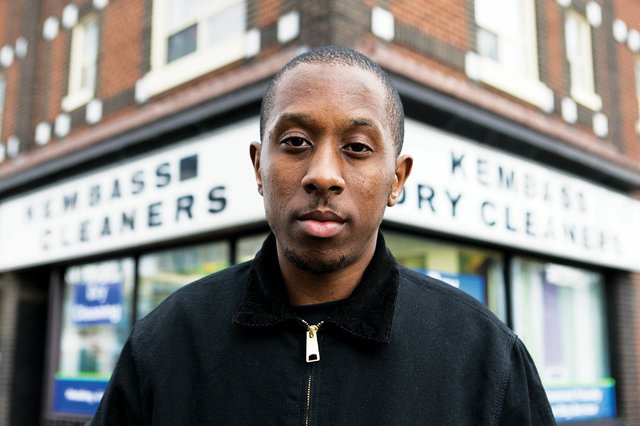
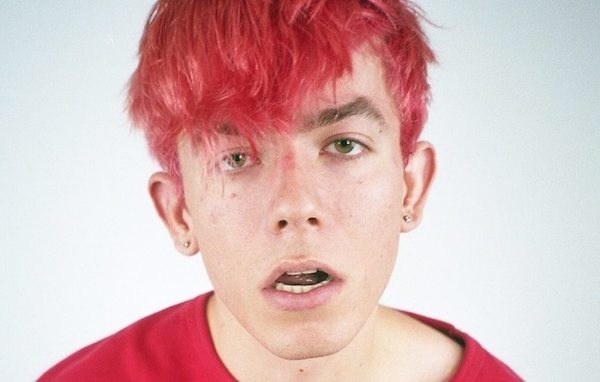
Roy Blair

Aug. 4, 2:20-3:00 p.m., Scène des Arbres

Although he might not be a household name (yet), Roy Blair has cultivated a dedicated following, thanks in part to his background vocals on multiple songs in BROCKHAMPTON frontman Kevin Abstract’s album American Boyfriend. Now, Blair boasts over 12 million SoundCloud streams, and a debut album of his own, 2017’s Cat Heaven. Blair’s woozy tracks on suburbia, grief, and adolescence are sure to resonate with the under 20-Osheaga audience.

Where to start: His track “Thunder,” a SoundCloud gem. 

(www.coupdemainmagazine.com)
Arts & Entertainment, Comedy

Listen up: Comedy podcasts take over Just for Laughs

The comedy world is dynamic and, at heart, an audial medium. On July 27 at the Just for Laughs festival, podcasts You Made It Weird With Pete Holmes and How Did This Get Made? presented live shows. The McGill Tribune saw—and heard—it all, and here is a breakdown of the two standout podcasts.

You Made It Weird With Pete Holmes

The lovable Pete Holmes was like a Swiss Army knife at the 2019 Just For Laughs festival: In addition to his own club show, he hosted the annual New Faces showcases and even brought out his ‘Mean Pete’ alter ego for midnight roast battles with Pistons basketball-player-turned-comedian Blake Griffin. When it came to his podcast, his flexibility continued to shine through. Noticing a pair of children in the front row, Holmes quickly engaged the pair in the show and learned that the 12-year-old’s favourite swear word was ‘double-dicking.’ He then shifted gears and brought out Saturday Night Live alum Fred Armisen for a goofy conversation, chock full of impressions and sing-along songs. To round out the evening, Holmes brought out several more guests—comedians Chris Fleming, Alonzo Bodden, Sam Jay—and one from the audience, the ‘Roastmaster General’ Jeff Ross. The group enjoyed lightly jabbing each other; for one, Bodden interrupted Holmes’ and Fleming’s conversation about the musical Grease with a comment about the show’s inherent whiteness. The musical, and the discussion of race, came up once more when Fleming name-dropped musician Bruce Springsteen.

The show concluded with a discussion of the grander nature of life itself. The spiritually-minded Holmes enjoys discussing God and the afterlife on his podcast, and the night’s enriching discussion touched on topics such as self-worth and learning to deal with superstitions. 


How Did This Get Made?

The moment host Paul Scheer took the stage at Olympia Saturday night, the crowd roared. Scheer, along with co-hosts Jason Mantzoukas and June Diane Raphael, spent over 90 minutes discussing a terrible movie. They warn live crowds a week in advance, so as to allow their audience to watch along and enjoy the group’s nitpicking for all its worth. This show centred around the 1982 action film Megaforce, which was particularly terrible as its impossible-to-understand story of warring nations was poorly edited. The three hosts highlighted the low-lights, discussing Megaforce’s plot holes, star Barry Bostwick’s tight costume and headband, and the film’s many vehicles with lasers.

The podcast has an almost cult-like following at this point, and with over a thousand people in attendance, the crowd had risible energy. The movie may be bad, but the company is good: Scheer, Mantzoukas, and Raphael know how to lead a good time. From the moment the show began, they had their crowd enthralled and engaged—Scheer even travelled around the room and up to the balcony to take questions and comments from passionate fans, some of whom wore costumes to match the film.  Somehow, the energy in the room only went up throughout the night.


Student Life

Understanding summer success in the era of FOMO

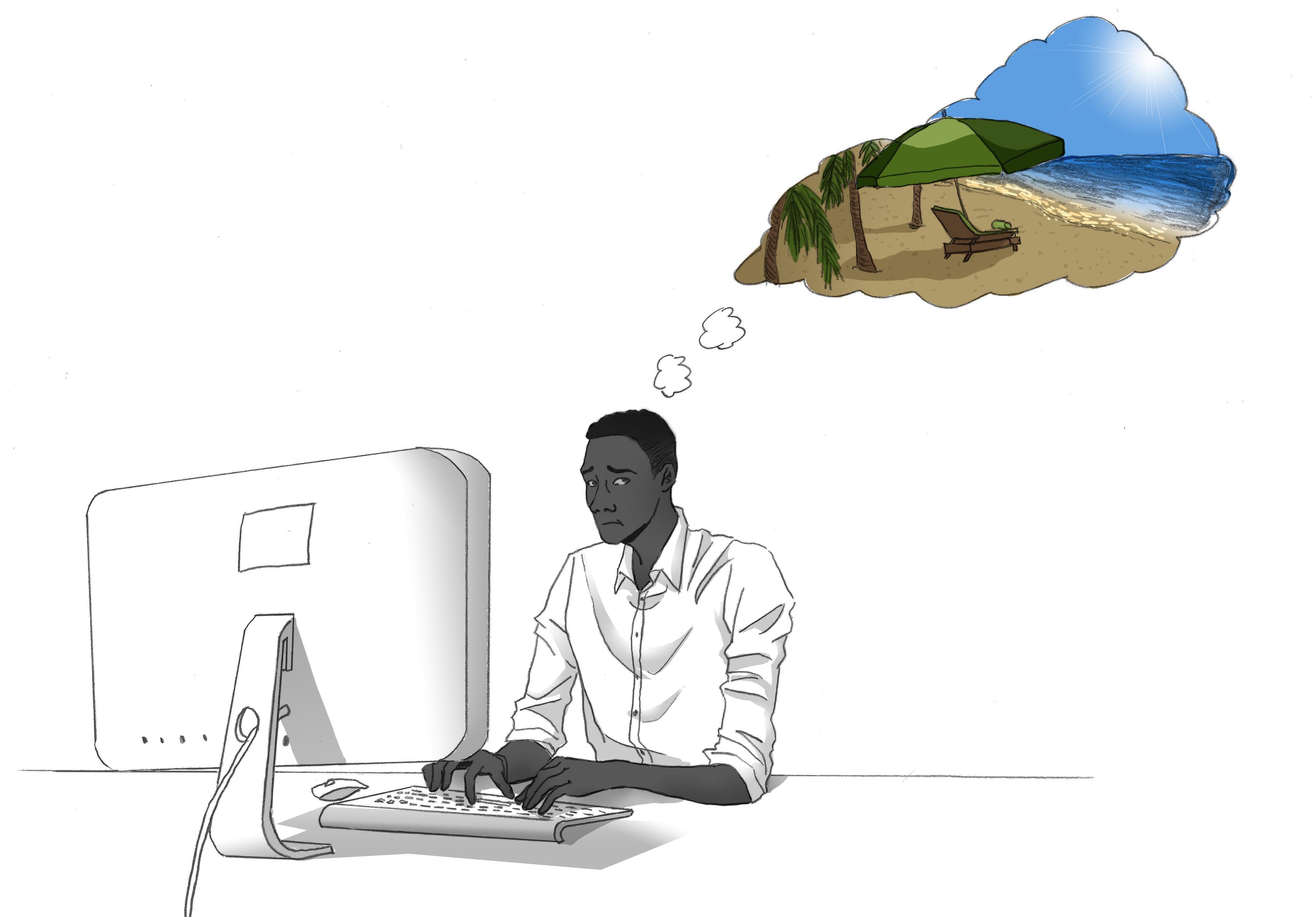
It is a Tuesday morning in London, England and I am working on the third floor of a monstrous glass building. Meanwhile, thanks to worldwide internet access and the reach of social media, I am made fully aware of the fact that a group of high school friends are lounging on a beach in southern Spain. The drastic difference in summer plans highlights an important challenge that many university students, particularly at this time of year, are plagued with: How to balance the competing pressures of work responsibilities and a social life, while also navigating financial restraints. There seems to be no pathway to a perfect summer. However a student chooses to spend their summer, ‘FOMO’—the fear of missing out—is almost inevitable.

Compared to the constant activity of the academic year, the relative leisure that summertime affords may be a catalyst for self-reflection, discovery, and planning for the future. This extended period of time can lead to anxiety-inducing comments from peers and parents surrounding summer plans; not only is there pressure to find the ideal summer job or internship, but also to live a unique experience that can be the metaphorical cherry on top of a CV. This pressure is exacerbated by social media, as one is constantly exposed to the seemingly amazing summer break that others seem to be having and inherently becomes trapped in a downward-spiraling FOMO trajectory. 

For many university students, summer is the time when the journey to success is simultaneously challenged and promulgated. After months of juggling extra-curricular activities, exams, and papers, students are sprung into the world of internships, short-term employment, and precarious labour by a mixture of necessity and pressure. In today’s corporate culture, there is still largely a belief that success can be measured by the number of hours you put into your office job. A 2016 article published by the World Economic Forum argued that the usual understanding of success normalized two assumptions: Firstly, that those who strive to reach the top are inherently better than those who do not, and secondly, getting to the top is the only thing that matters. At McGill, this mentality manifests in an intense, work-hard-play-hard environment.

Yet, there is also an emphasis on ‘self-care’ that emerges during the break, one that encourages students to relax and take time off from work. The expectations of both options are then hyper-exaggerated through social media platforms that advocate for either 50-hour work weeks or month-long jaunts to the coast. The pressure to have an amazing, Insta-worthy summer is just as poignant as the insistence cultivated during the academic year to obtain a 4.0 GPA. In both scenarios, success is shaped by societal views that convince people they are either not living up to their full potential or are fundamentally missing out on something. 

While the value of hard work, personal success, and subsequent compensation cannot be discredited, it is extremely important to expand on society’s definition of success. Students must diverge from the antiquated status quo where office work and pulling long hours are seen as the key to obtaining a “good life.” This life cycle devalues taking time off and contributes to feelings of FOMO in people who are stuck balancing their duties and pleasure. Yet, when discussing success, students should strive to pursue what they perceive as valuable, beyond the confines of what is deemed successful. In the simplest of terms, finding a healthy relationship between work and a social life comes with balance. So when people ask me what I did this summer, I’ll take a moment and say: “It was a success” –  not because I went on some earth-shattering voyage or got the work experience of a lifetime but because I finally acknowledged a balanced lifestyle which helped me accept and even enjoy my day to day.

Commentary, Opinion

Suffering in silence: The media’s neglect of the Sudan massacre

On April 15, every news channel blared with the breaking story about the fire that damaged the Notre Dame Cathedral in Paris. Within days, 900 million euros in donations were pledged, at least $500 million from notable billionaires, to help rebuild the cathedral. The media has the capacity to spread news quickly, one would expect a humanitarian crisis as large as the one in Sudan to receive the same amount of attention. Currently, there is a political uprising in Sudan, and the Sundanese people continue to pay the price. The lack of coverage surrounding the Sundanese crisis is deplorable. Western countries have used Sudan’s reputation as a developing nation to justify turning a blind eye to its suffering. 

This lack of international media coverage parallels that for other political crises in developing nations worldwide. For instance, when 100 women gathered to protest election result in Côte d’Ivoire in 2011, they were met with a military attack. The story had potential to be a groundbreaking news story, yet media companies failed to provide coverage of the massacre. 

The Sudanese crisis began shortly after the burning of the Notre Dame cathedral in Paris.  Within hours, media coverage of the fire prompted millions of dollars in donations and messages of solidarity from world leaders. In contrast, the Sundanese crisis received little attention when it started. Thousands of dollars went towards publicizing Notre Dame fire, revealing the priorities of the international media to be geared toward the preservation of   history. The three historically black churches that burned down in Louisiana just one day after Notre Dame were given little coverage, further revealing the Eurocentric priorities of global media.

Due to media blackout, it is impossible for Sundanese journalists to publicly discuss the country’s issues. This is why it is the responsibility of influential countries, such as the U.S., to spread awareness about the massacre occurring in Sudan, and to take action to help stop it. 

In recent months, there has been an increase in awareness regarding the crisis in the U.S. and Canada. While international media coverage lacked, American influencers took matters into their own hands to share the news. A social media movement sparked as a result of celebrities like Rihanna using their platforms to advocate for Sudan, causing social media users to “blue out” their avatars to promote awareness about the crisis. Activism in the age of social media has become a huge way to share world issues, with the blue out movement becoming a large reason that Sudan is receiving the attention it deserves

This is not the first time celebrities have done the job of international media, and further reveals the failure of multi-million dollar global news companies to actually report on world news in a timely manner. The responsibilities of a social media influencer are not the same as the responsibilities of the actual media in terms of sharing news. Yet, it could be that the Western world places more importance about global issues if they are reported by influential celebrities rather than actual news outlets, revealing the dependence that first world countries have on social media as a source for world news.

As the people in Sudan continue to fight for basic human rights and the systematic political oppression in the North African country grows, the Western world has a responsibility to use its resources to help alleviate the problem and is called to take action as the media fails to provide adequate coverage. The problem runs closer to home if McGill’s international student population is considered. McGill houses students from all over the world, Sudan and South Sudan included. The implications of the Sundanese crisis extends beyond Sudan’s borders, impacting the families and extended families of those directly enduring the wrath of the Sundanese government.  As a renowned intellectual and academic community vested in the arts, history, and politics, McGill has a responsibility to lead the way in calling out human rights violations, advocating for the voiceless on a world stage. As a result, McGill has a specific responsibility to call attention to the Sundanese crisis. It is crucial that the students of McGill, and the rest of North America continue to advocate for civilian rights in Sudan and act as the voice of the Sundanese people as they continue to be silenced. 

Montreal, News

Montreal anti-colonial group claims responsibility for vandalism

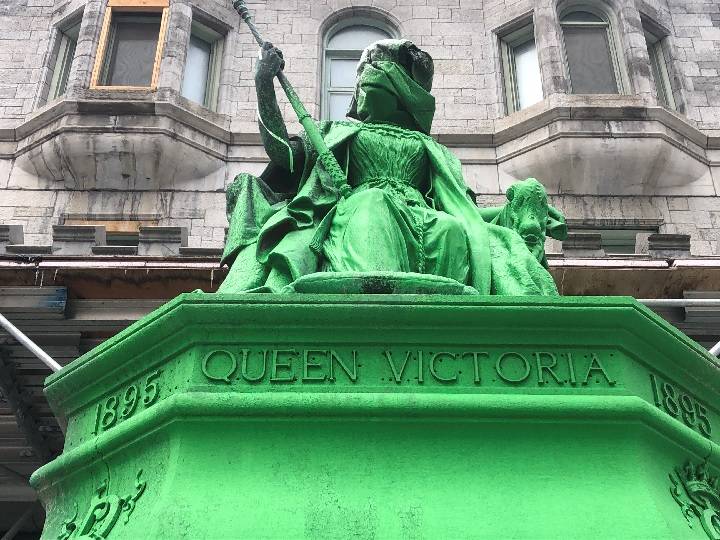
In a May 17 press release, the Montreal May Anarchists (MMA) claimed responsibility for vandalizing the statue of John A. Macdonald in Place du Canada and the statue of Queen Victoria in front of the Schulich School of Music on Sherbrooke street. According to their statement, the group doused the statues in green and red paint, choosing these colours for their anti-colonial and anti-imperial connotations, in response to the encouragement of another anti-colonial activist group, ‘Brigade de solidarité anticoloniale Delhi Dubin.’. 

The Queen Victoria statue, along with another statue of the monarch at Square Victoria, was previously vandalised with green paint in March. The anti-colonial group ‘Brigade de solidarité anticoloniale Delhi Dubin’ claimed responsibility for both acts in an online statement . According to the statement, the Brigade also planned a demonstration on March 24, close to St. Patrick’s Day, because of their belief that the statues, in their glorification of colonial figures, are an insult to the legacy of Irish freedom fighters.  

“Our action is [an] expression of anti-colonial and anti-imperialist solidarity, and we encourage others to take similar action against racist monuments,” Brigade member Udham Connolly wrote in the statement. 

The MMA responded to the call, recognizing the Brigade in its press release following the most recent act of vandalism, as well as #MacdonaldMustFall, another activist group that previously spray-painted the Macdonald monument on the International Day for the Elimination of Racial Discrimination on March 21. 

“The Macdonald Monument and the Queen Victoria statue should be removed from public space and instead placed in archives or museums, where they belong as historical artifacts,” the MMA wrote in their press release. “Public space should celebrate collective struggles for justice and liberation, not white supremacy and genocide.” 

Preservation of controversial historical figures in public spaces has long been the subject of debate, particularly on college campuses. Suzanne Morton, a professor in the McGill Department of History, believes such monuments are significant in that they reflect how we choose to represent and pass down our history.

“There is the actual person […] being commemorated, the history of the monument itself, and the way that current concerns interact with how [people] understand the [person] in the present,” Morton said in an interview with The McGill Tribune. “[Statues of Macdonald were] vandalized in the 1960s as a symbol of English Canadian domination of Quebec, and today, as a symbol of colonialism often associated with Indigenous peoples. The particular issues of criticism change over time.” 

Though she acknowledged that it is difficult for a single monument to represent an individual’s multifaceted legacy, Morton hopes that, the McGill community is up to the task of making our monuments more accurately represent the nuances of our history.

The push to eliminate reminders of colonial legacies also fuelled the recent #ChangeTheName campaign, which sought to scrap the former name of McGill’s men’s varsity teams. As organizers of #ChangeTheName, representatives of McGill’s Indigenous Students Alliance (ISA) are sympathetic to the principles espoused by off-campus anti-colonial groups. .

“The ISA stands in accordance with the message that vandalizing colonial artifacts on Indigenous territory sends,” Ella Martindale, former co-chair of the ISA, wrote in an email to the Tribune. “They do not belong on this land, and hopefully one day, those who oppose colonial violence, Indigenous peoples included, will be able to have these particular statues taken down.”

Commentary, Opinion

Missing and murdered Indigenous women and girls deserve justice, not language debates

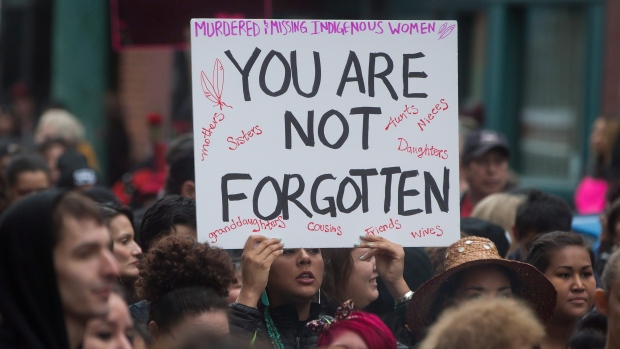
On June 3, the National Inquiry into Missing and Murdered Indigenous Women and Girls (MMIWG) released its final report. The volume, which is over 1000 pages long, concludes that Canada’s treatment of Indigenous people amounts to genocide and requires immediate action. Since the findings were released, much of the surrounding media coverage has disproportionally revolved around the use of the term ‘genocide’ instead of the report’s other findings and recommendations. Sadly, the MMIWG report has resulted in a political uproar among non-Indigenous politicians, with unaffected parties arguing over languages instead of processing the expert testimony and lived experiences featured in the report and developing plans for effective action. In the face of this ongoing injustice, it is easy to feel powerless and blinded by these debates. Rather than becoming lost in these debates, those concerned should work to develop their understanding of Indigenous issues, which go beyond the scope of the National Inquiry’s report.  

There were over 2380 participants in the ‘Truth Gathering Process’ that formed the report. Of those, nearly 1500 of those were survivors or family members, 819 contributed ‘artistic expressions,’ and 83 were ‘experts, knowledge-keepers, and officials’ who provided testimony. Throughout the report, one can find devastating personal accounts, in-depth analyses, and 231 calls to action. It further solidifies the fact that Indigenous women are far more likely to be victims of homicide, sexual violence, and domestic violence than any other demographic. In fact, Indigenous women are 12 times more likely to go missing or be murdered than any other demographic of Canadian women, and their cases are too often mishandled by police and the courts. These facts require attention but have been largely overshadowed over what constitutes genocide. 

Published with the final report was a  47-page supplementary document that contains an explanation for why the term ‘genocide’ is the most appropriate way to describe these injustices. However, the National Inquiry does not claim to have the authority to formally declare that Canada has committed genocide, and it acknowledges the complex and contested nature of the term and its implications. Socially, the word tends to only be associated with the widespread and systematic murder of a group of people: However, the word’s actual definition and original meaning is far more complicated, and according to the United Nations (UN) definition of genocide, it can include other actions such as physical or mental harm, the forced transfer of children, and ‘group conditions of life’ meant to cause physical destruction of the group ‘in whole or in part.’ Expanding the scope of the term does not discount the gravity of its meaning, especially when this renewed understanding still fits within the boundaries of the UN’s widely accepted definition. This nitpicking takes up too much of the conversation concerning the treatment of Canada’s Indigenous groups. These trivialities distract from the need to develop plans which sufficiently address the severity of the situation.

The report’s conclusion has attracted a range of opinions, many from people unaffected by its findings. Andrew Scheer, leader of the Conservative Party of Canada, argued that although the treatment of Indigenous people is a tragedy, it does not qualify as genocide, but rather as a unique issue which requires attention. The hypocrisy in this statement is evident—under former Prime Minister Stephen Harper’s leadership, a committee was set up to look into MMIWG cases but failed to call for a national inquiry into the issue, despite long-standing demands from Indigenous groups.

On the other hand, current Prime Minister Justin Trudeau accepted the genocide conclusion while highlighting the need for action, something he claimed his government is already focused on. However, this is also hypocritical: Trudeaumetre, a website started in 2015 to track Liberal campaign promises, documents how the government has failed to uphold many of its promises when it comes to Indigenous issues, such as providing them with a veto over their territories. Canadian politicians have consistently failed to produce results that match their supposed commitment to the wellbeing of Indigenous peoples.

Ultimately, whether or not politicians agree on the use of the term ‘genocide,’ no one can dispute that Indigenous women and their families continue to suffer greatly. The report’s release is an opportunity for non-Indigenous people to develop a deeper understanding which they can use to make more informed political decisions and be mindful of the suffering of the Indigenous peoples of Canada going forward. The upcoming federal election will surely prompt politicians to make promises to improve the lives of Canada’s Indigenous population, many of which will be empty. If able to vote, people must be mindful of who is promising what and how these promises align with their past actions, be them in the form of votes in Parliament or otherwise. If anything is going to change for Indigenous peoples on a systemic level, politicians need to be held accountable.


Those requiring immediate emotional support can contact the MMIWG support line 24/7 at
+1 (844) 413-6649. Long-term mental and cultural support is accessible through Indigenous Services Canada and other support networks. If interested, you can help by volunteering with or donating to one of Montreal’s many Indigenous programs and services.

Arts & Entertainment, Comedy, Film and TV

Rachel Bloom discusses mental health and musical comedy in Crazy Ex-Girlfriend

Article contains minor spoilers for Crazy Ex-Girlfriend’s fourth season.

Comedian Rachel Bloom has every right to be tired. After her musical comedy television series Crazy Ex-Girlfriend aired its finale in April 2019, Bloom went on tour across the US,  performing some of the show’s most popular songs alongside her former cast members. As if that doesn’t sound tiring enough, Bloom’s latest tour, What Am I Going to Do With My Life?, will also feature songs from Crazy Ex-Girlfriend alongside the comedian’s own original stand-up. One of her upcoming stops is in Montreal for the Just For Laughs festival.

One might expect that writing, starring in, and producing four seasons of a musical comedy would leave a person absolutely exhausted. Yet, in a phone interview with The McGill Tribune, Rachel Bloom feels refreshed. She speaks with energy and care; she pauses before answering each question. She takes frequent breaks to laugh. She looks forward to seeing her fans in Montreal.

“Our fans are some of the smartest and kindest people I’ve ever met,” gushed Bloom. “At live shows […], no one’s ever clamouring over other people […] Everyone’s incredibly kind and polite to each other.”

In Crazy Ex Girlfriend, Bloom plays Rebecca Bunch, an ambitious East Coast–lawyer who relocates to California to chase after her childhood boyfriend. Initially, Rebecca channels all her energy into winning her crush back, but as the series progresses, she comes to learn valuable lessons about love, responsibility, and self-care.

In the show’s third season, Rebecca Bunch is diagnosed with borderline personality disorder. Showrunners worked alongside mental health professionals to ensure a sensitive and accurate portrayal of the mental illness, 

“At this point, a quarter of the people who I meet after live shows have borderline,” shared Bloom. “It’s a lot [more than…] just taking a selfie and being done. [Fan interactions] almost require me to be as present as when I am on stage. I want to listen and be there for them […] it’s wonderful […] but it’s an intense experience.”

Bloom graduated with a Bachelor of Fine Arts in Drama from the Tisch School of the Arts at New York University in 2009, and she later performed sketch comedy at the Upright Citizens’ Brigade Theatre. Her YouTube music videos and work on Crazy Ex-Girlfriend fuse her musical theatre talents and her dry, comedic wit. 

“I was a musical theatre major who started to do comedy, and for a couple of years, I found it hard to marry the worlds [….] Doing musical comedy was my way to finally bring the humanity and vulnerability to the sketch comedy that I wanted to do. It’s very personal for me.”

Crazy Ex-Girlfriend deals in difficult themes with tact and humour, and Bloom understands the enormous power of comedy in addressing mental illness. 

 “Comedy exposes the dark underbelly about how we all feel,” Bloom said. “I once read a book about comedy [….] [It said that] laughter is basically suppressed aggression. I don’t know if that’s true, but I do think there’s something about the communal release of comedy.”

In addition to addressing mental health, Bloom’s work often candidly discusses female sexuality. She initially became YouTube famous for a Britney Spears parody about being turned on by science fiction novels. In the pilot of Crazy Ex-Girlfriend, Bloom sings a raunchy and riotous number about gendered beauty standards. Although the songs in Crazy Ex-Girlfriend can be vulgar, the lyrics aim to humour and educate.

“I was a bullied kid, and I’m really, really cognizant of being a bully. I never want to be a bully. It scares me […] When you’re an outsider, the last thing you want to do is put down other outsiders.”

The title of Bloom’s upcoming tour (What Am I Going to Do With My Life?) pokes fun at her career’s uncharted trajectory as she transitions from Crazy Ex-Girlfriend to other creative work. The actress shared what aspects of her character, Rebecca Bunch, she wants to carry over into future endeavours. 

“I got a tattoo of the last lines of the show: ‘This is a song that I wrote.’ I think the point [of the line] is that you make your own destiny. Your life is a song that you write, you are in control of your life, and you don’t have to live the life other people want you to live. I got that on my body to remember that, and that is what I will be taking with me for the rest of my life.”

Rachel Bloom will be performing at Just for Laughs from July 23-27. Visit hahaha.com for more details about showtimes.

Read the latest issue

Read the latest issue