


Latest News

News, The Tribune Explains

Tribune Explains: Students’ rights

McGill is a school with a massive student population as well as a reputation for thrusting independence upon its first year students, both factors which can lead to an alienating experience. For this reason, clear information becomes an invaluable commodity for all students. This week The McGill Tribune spoke with the student members behind the Student Society of McGill University’s (SSMU) “Know Your Student Rights” campaign, in hopes of helping students to advocate for themselves.

How are student rights protected?

Student rights at McGill can be divided into two domains: Academic rights, which ensures that professors fairly assess their students’ work, and personal rights, which guard students’ dignity and security. Many of these rights come from policies and regulations developed by McGill’s Board of Governors and Senate. However, as SSMU Vice-President (VP) University Affairs Madeline Wilson explained, it’s SSMU’s responsibility to ensure students are prepared to assert their rights. 

“Students come to this university for academics, and therefore, its [in] their best interest to ensure that their academic situation is as equal and as equitable as possible,” Wilson said. “This campaign ensures that students have the tools to make sure that they are able to defend their own rights if they need to, or to help them reach out to someone that is more equipped to fight for their rights alongside them.”

How does fair grading work at McGill?

McGill’s Charter of Student Rights affirms that all students have the right to a quality education, including a right to be assessed in an equitable and reasonable way. This right is implemented through the University Student Assessment Policy, which protects any student that receives any form of assessment. During the first week of classes, professors should have given students syllabi for all of their courses stating how they were going to be assessed (e.g. whether there will be a final or a class participation component), and how these assessments will be weighed when calculating their overall grade. Students also cannot be punished for worked they missed during add-drop if they were not registered in the course at the assessment’s due date. Finally, students cannot be forced into writing multiple final exams within a short time span: For example, students cannot write four finals in two days. These rights are afforded to all students; in return, students have to uphold certain responsibilities, one of them being to uphold academic integrity by avoiding plagiarism or cheating.

How are student’s personal rights protected?

The charter also states that students have the right to be protected against ‘vexatious conduct’ displayed by McGill members. Therefore, McGill and SSMU have implemented policies that both protect students against violence and punish McGill community members who perpetrate these acts. In the past year, two new policies focused  sexual violence on campus have been put into place: SSMU’s Gendered and Sexual Violence Policy (GSVP), and McGill’s revamped Policy Against Sexual Violence (PSV). Wilson says that these two policies work together to protect survivors across different situations.

“The [PSV] covers [anyone] at McGill or within the McGill context,” Wilson said. “For example, if a McGill student is a respondent, and they’re on a co-op, and survivor is a [Concordia University] student, the respondent can still be charged under the policy. The SSMU GSVP operates within the SSMU context […] it covers executives, casual and permanent staff, and members of SSMU clubs or independent student groups. There are instances where a report can be filed under both the GSVP and the PSV.”

Where do students go if they believe their rights have been violated?

Adrienne Tessier, SSMU’s students’ rights researcher and advocacy commissioner, said that students can contact three individuals if they have questions about their rights. 

“You have myself, as the Students’ Rights Commissioner [as a contact] for issues on academic rights,” Tessier said. “For example, ‘my professor posted my syllabus and it doesn’t say what percentage my final is.’ Then we have an anti-violence commissioner, who you can contact if you have questions about your personal rights under the [GSVP]. Both of us work in collaboration with [Wilson], who can intervene and act as another layer of support for students.”
Men's Varsity, Sports

McGill men’s rugby dominates Harvard 47-15

McGill men’s rugby (20) is looking strong heading into the regular season after a resounding 4715 win against Harvard (01). In the 38th annual Covo Cup, McGill’s final preseason game before RSEQ competition begins, McGill came out with a tenacious defensive showing and exciting play. 

“We played hard defence, we didn’t let them get the ball, and I think we had a great game,” third-year prop Jeremy OckoMichilak said in a post-game interview with The McGill Tribune

While McGill’s play was commanding throughout the game, an especially strong first half gave them a 263 lead at halftime, with Harvard’s only points coming from a penalty kick at 33 yards. Fourth-year right winger Joshua Worden opened scoring for McGill with a try in the third minute of the game that was converted by first-year winger Jack Tucker to give the home side an early 70 lead. Second-year 8-man Andreas Dionisopoulos added two tries to the scoreboard for McGill and had two more erased on penalties.

“I was playing on the right wing, and I normally play in the centre, so it was a new position,” Worden said. “I was really happy with [the first try] and had a couple of really nice tackles.”

This victory against Harvard is McGill’s second win in two preseason games leading up to the 2019 RSEQ season, and their 8th consecutive win in the Covo Cup. Saturday’s match also brought McGill’s lifetime record in the Cup to 24 wins in 38 matches. This year’s iteration of the Covo Cup was popular with the fans as well. 1,560 people filled the south stands at Percival Molson Stadium, breaking the previous attendance record for a rugby game at McGill set at the 2015 RSEQ championship game against the Université de Montréal Carabins. 

“It was an entertaining game,” Head Coach Ian Baillie said. “It looks like the crowd enjoyed it, the ball moved and there were lots of points scored.” 

The pressure of the large crowd certainly did not seem to be an inhibitor for the McGill players. 

“A lot of my friends showed up, and I was glad that we could fill up the stands,” Worden said. 

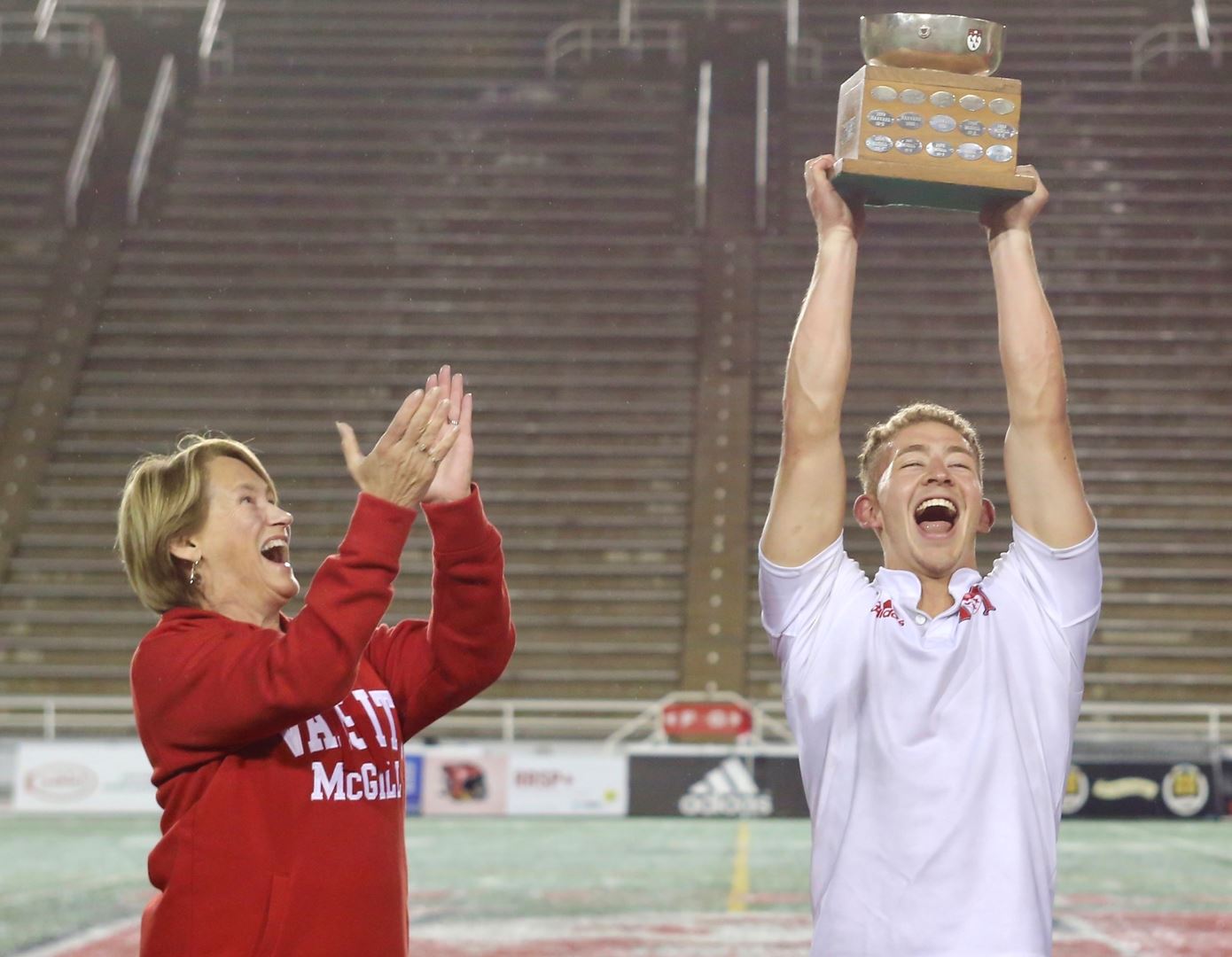
The eventful evening was capped off by McGill Principal and Vice-Chancellor Suzanne Fortier presenting the cup to McGill men’s rugby captain Jessen Gibbs, a fourth-year centre. The team is now looking ahead to the opening of the RSEQ season.

“Confident, I’m feeling confident,” Worden said. “We have a tough [match] next week against Concordia, but we’ll take it day-by-day.” 

McGill men’s rugby opens RSEQ regular season play against Concordia University at Concordia Stadium on Sept. 14 at 3:00 pm. 


Moment of the Game:

A try from fourth-year right winger Joshua Worden converted by first-year winger Jack Tucker put McGill ahead in the third minute of play and set the tone for the home side’s high scoring throughout the rest of the game.

Quotable:

“Concordia’s going to be tough, but I think we’re going to stomp them.” – Third-year prop Jeremy OckoMichilak on how he’s feeling as the team heads into regular season play.

Stat Corner:

McGill missed only one conversion, with first-year winger Jack Tucker scoring eight points from four of his five conversion attempts and first-year second row Ian McDowell scoring on both of his attempts. 


A previous version of this article stated that Suzanne Fortier is Vice-President of McGill University. In fact, she is the Vice-Chancellor. The Tribune regrets this error. 

Sports

Historic Mountain Bike World Championships held in Quebec

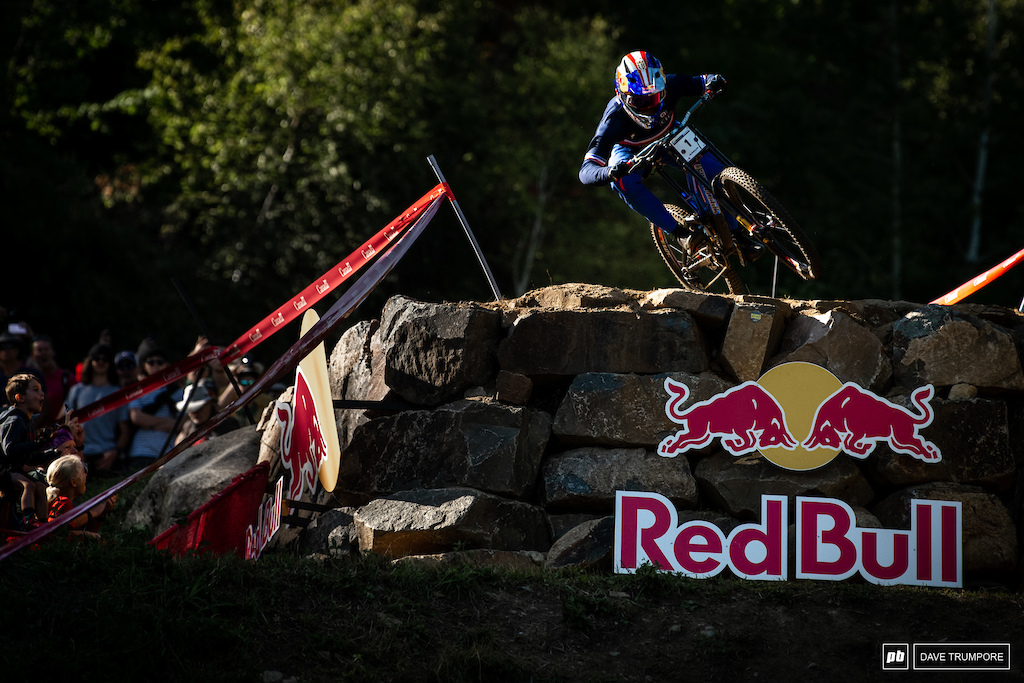
On Sept. 1, Mont-Sainte-Anne, Quebec hosted the Union Cycliste Internationale (UCI) Mountain Bike World Championships. The competition was a downhill race of historic proportions for riders, the sport, and Quebec alike.

For the uninitiated, downhill mountain bike racing consists of athletes riding full-suspension mountain bikes down intense, three-to-five minute tracks that reach top speeds of 80 km/hr, includes over 40 foot jumps, 10-foot drops, and an assortment of roots, rocks, and other obstacles.

The Mont-Sainte-Anne track is one of the longest, fastest, and most challenging in the world, a far cry from where the sport first started in the region. The original Mont-Sainte-Anne course was little more than a dirt access road. 27 years later Mont-Sainte-Anne boasts a beautiful track and plays host to World Cup races, making it the oldest downhill racetrack on the professional circuit.  

This year’s race marked the 30th World Championships and the first time the event has been held three times at the same venue. This is a prestigious honour that is indicative of the respect that riders, fans, and organizers alike hold for the course at Mont-Sainte-Anne.

While there are World Cup races throughout the summer racing season, there is only one World Championship race. This is because, for this single event, riders remove their sponsored team jerseys and instead wear the colours of their home country. National federations select riders to represent their country, which makes the World Championships especially competitive as does the honour of donning the World Championship rainbow-striped jersey in future races. 

Entering the 2019 World Championships, many expected the women’s competition to be a contest between France’s Marine Cabirou and Australia’s Tracey Hannah, as the two have battled back and forth throughout the season. However, the pair only managed to come third and fourth, respectively. Instead, it was Myriam Nicole, another French rider, who unexpectedly came down the course ahead of her closest competition by a margin of 1.2 seconds. This marks Nicole’s first ever win on the world stage.

On the men’s side, French rider Loic Bruni was the favourite, with victories in three of the last four World Championship races, as well as six podium finishes already this season. For this race, he did not disappoint. Bruni crossed the finish line just 0.581 seconds ahead of Australian Troy Brosnan to complete the sweep for France, crushing the Australian’s hopes for a first World Championship win.

Despite Canada’s top riders placing only seventh and eighth respectively in the men’s and women’s competition, thanks to the valiant efforts of Finn Iles and  Vaea Verbeeck, this year’s race in Mont-Sainte-Anne still held special significance for the host nation. The race honoured the memory of the first Canadian to ever win the World Cup overall championship, Stevie Smith, who passed away in 2016 from injuries sustained in a motorcycle accident. In his honour, members of the Canadian team rode custom-painted bikes, and the course organizers made sure to feature the “Stevie Smith drop”—one of the track’s most eye-catching features—as a testament to the legendary rider.

With another successful competition completed, fans of mountain biking in Quebec can look forward to next season, when the Mont-Sainte-Anne race is all but certain to continue making history in its 28th year on the professional circuit. And, with young athletes like Verbeeck and Iles on the heels of the world’s best, Canadians may soon see their flag wave again from atop the podium.

Arts & Entertainment, Film and TV

“Once Upon a Time in Hollywood” harkens back to a Los Angeles of yore

The first time I really saw Inglourious Basterds, Quentin Tarantino’s 2009 World War II revenge fantasy, I was with 20 other classmates at a high school screening. It wasn’t my first time seeing the film, but it was my first time experiencing it in a group. 

Seen in front of a large, enthusiastic crowd, Inglourious Basterds morphs into an entirely different beast. It’s as if the entire film sharpens into high relief; the edges are suddenly more distinct, the jokes funnier, the long, tense silences more nerve-wracking, and the violence infinitely more explosive. The same is true of almost all of Tarantino’s works: His films often resemble Frankenstein’s monsters, stitched together from the organs of a host of other movies and miraculously brought to life by the sparking energy of a crowd reacting to their uniquely thrilling, often gleefully violent twists and turns.

Once Upon a Time in Hollywood, Tarantino’s latest film, is no exception. It’s a film in which the audience’s reaction is a crucial part of the experience, and in that sense, it is classically Hollywood, a film whose true home is the movie theatre.

The film is centred around the 1969 Manson murders, when members of the infamous Manson family broke into director Roman Polanski’s house and murdered five high-profile Hollywood figures; most notable among them was actress Sharon Tate. In Once Upon a Time in Hollywood, Tate is portrayed as a near-angelic presence by Margot Robbie: Throughout the film she is shown strolling through her idyllic life, a source of awe for more than one of the film’s expansive cast of characters.  

The central focus of the film is the duo comprised of Rick Dalton and Cliff Booth, played by Leonardo DiCaprio and Brad Pitt, respectively. Dalton is an insecure, hard-drinking television star at the end of his career, teetering on the edge of despair. The film follows his character through a day of guest-starring on a Western TV show. Booth is Dalton’s cool, detached, and loyal stuntman, whose meanderings through the halcyon world of Los Angeles bring him face-to-face with the menace growing at its heart. The relationship between the two, is the emotional core of the film.

Once Upon a Time in Hollywood is a hangout film, a film that soaks its audience in the gorgeous sights and sounds of its era; automobiles tear down freeways at a comically ferocious pace, and, as the sun sets on the day of the Manson murders, the audience is treated to a grandiose, symphonic sequence in which the city’s neon signs burst into colour. It’s a swaggering, confident, and disjointed journey through 1950s Hollywood, complete with a period-piece soundtrack and rounded off by a spectacularly shocking, fiery climax.

The controversy that has surrounded the ending and many other aspects of the film is as much a part of its impact as the immediate audience reaction to its more divisive scenes. Tarantino remains a provocateur, and in Once Upon a Time in Hollywood, the provocations feel calculated, deliberate, and necessary. 

Whether audiences agree or disagree with his vision, nothing beats the feeling of walking out of a theatre with a group of people who have really been through something, who have been challenged, shaken, and confused, but ultimately come out on top. It is this collective experience that makes the film worth seeing, and worth seeing with a crowd, and it is a vision of the loss of this collective experience that ultimately justifies the poignant melancholy of its ending.

Science & Technology

Climate change has become a multi-faceted dilemma

The most recent report from the International Panel on Climate Change (IPCC) (drafted on Aug. 7) emphasizes the susceptibility of global food security to changes in climate and land use. The report highlighted that adaptive strategies to reduce total carbon production and preserve natural ecosystems are humanity’s best chance at mitigating the climate emergency’s effects on food production.  

The report stressed the extent of human dependency on land systems. Humans are currently using one quarter to one third of available land’s potential production capacities. Essential products that come from land use, including feed and natural energy sources such as fossil fuels, are crucial to agricultural yields and the sustainability of the food supply chain. 

“Land degradation is a general term describing negative trends in land condition, such as loss in biological productivity and ecological value to humans,” Margot Hurlbert, a Canadian coordinating lead author of the report, said in an interview with The McGill Tribune

Humanity is consuming resources at an unprecedented rate. Consequently, land has become exhausted to the point that it will soon be unusable. Human disruption of natural processes is leading to adverse, irreversible effects on Earth’s natural systems. 

“The use and emissions of carbon in agriculture is cyclical in nature,” Laxmi Pant, a contributing author to the report, said in an interview with the Tribune. “Modern agricultural practices such as tilling are a major source of carbon output into the atmosphere. But, to produce crops with greater yields, we require the input of carbon back into the land through synthetic sources such as fertilizers.” 

This pattern of replenishing lost carbon through unnatural supplementation disturbs the delicate balance of the Earth’s carbon cycle. As a result, more carbon is released into the atmosphere, leaving the soil unable to reabsorb excess outputs and increasing overall greenhouse gas emissions. As emissions increase, so do global temperatures, causing further water and land stress and exacerbating many of the problems associated with land use and food cultivation. 

The scientific community agrees that the climate emergency will have disastrous downstream consequences on all levels of society. As such, climate change has led to concerns not only of environmental sustainability, but of social stewardship. In reality, the two issues are inseparable. 

“The report takes into consideration people living in areas vulnerable to desertification and land degradation,”  Hurlbert said. “Around half of the vulnerable population resides in already vulnerable areas in South Asia, Central Asia, West Africa, and East Asia.” 

Food insecurity will pose additional problems to people living in susceptible coastal areas, who now face the immediate risk of losing invaluable agricultural and residential land to rising sea levels. 

Moreover, changes in food consumption patterns have created a global divide whereby approximately two billion adults are overweight or obese, yet an estimated 821 million people remain undernourished. Socioeconomic class and geographic location serve as the main determinants for the widening divide. Given sustained increases in mean global temperature, this divide will only deepen without rapid intervention from national governments and international organizations. 

“Socioeconomic choices can reduce or exacerbate climate related risks,” Hurlbert said. “A sustainability pathway with high income, reduced inequalities, and food produced in low emission systems have decreased risks of desertification, land degradation and food insecurity.” 

Exposure and sensitivity to climate change and extreme climate events can impact infrastructure and transport, and can cause direct and indirect changes to the income level and food purchasing power of low-income consumers.  Without a drastic reduction in greenhouse gas emissions or the implementation of carbon-reducing agriculture strategies, the cyclical patterns of poverty, malnourishment, and income inequality will become further entrenched into global society.

Student Life

Wisdom for the youth

Get involved and discover your interests

Leanne Young, Photo Editor

The first year of university is undoubtedly a busy time for students, but it is not just about getting your degree: It is also the best time to explore new interests and develop life long relationships. While you should not stretch yourself too thin, it’s important to keep an open mind, step outside of your comfort zone, and try new activities! Getting involved can help you discover yourself, meet new people, and take a breather from studying, all while giving back to the McGill community.


Drop out of political science, you dunce

Kevin Vogel, A&E Editor and former PoliSci bro 

I came to McGill with big aspirations: I would graduate with a political science degree; get a cushy, bourgeois government job⁠; maybe even become a big-city lawyer. Yet, these expectations failed to prepare me for the reality of student life. I dreaded political science classes, but told myself that things would improve if I kept with the program. When I finally accepted that I had no passion for my major, I had already taken 18 dismal credits in the program. Had I realized this sooner, I could have explored completely different disciplines instead of listening to centrists in international relations conferences defend military interventionism.


Take the classes you like

Gabe Nisker, Features Editor

At the end of my first-year, I sat in my dorm room and stared at my computer. I wanted to take a film studies class, but I needed to be a cultural studies major to take it. At first, I planned to major in economics, and I had circled the next set of economics classes as “musts” for my first U1 semester. However, the film studies classes I also wanted to take conflicted. I was bored by economic theory but pushed through it for the sake of future income and to please my parents. What I wish I had done instead was take the classes I wanted to from the get-go. Get the degree you want first; the job will come next.


Get some sleep!

Sophie Brzozowski, Arts & Entertainment Editor

Being a night owl by nature, I was instantly taken by  McGill’s many opportunities for nocturnal recreation: 24-hour libraries, 3:00 a.m. last calls at the coolest bars, and a selection of fast food joints that delivered, for no good reason, until four in the morning. At first, my sleeplessness was mostly due to the fact that everything was simply too exciting, but by midterm season, I was paying for it. Yes, Montreal is beautiful at night, 2Chow tastes the best at 2:00 a.m., and the upper floors of McLennan the most tolerable in the wee hours of the morning, but getting enough sleep is simply non-negotiable.


Lower your expectations

Keating Reid, Copy Editor

Lowering your expectations is the quickest route to happiness. It may sound cynical, but consider how freighted with cultural baggage our university years are: This is  the time when you’ll meet your lifelong friends and possibly your future spouse, discover your deepest passions, and sculpt the remainder of your time on this planet. Of course, none of this is necessarily true. Friends, partners, and passions don’t come and go on a schedule. The good news is that we’re people; we don’t have “best-before” dates. If the ‘university experience’ isn’t all you expected, don’t worry—they’re only the best years of your life if you let them be.


Ask for support

Abeer Almahdi, Managing Editor

In my first-year, I was constantly comparing myself and my success to other people, which took a toll on my mental health. It is important to recognize that everyone is on their own university journey, and that we are all going at different paces. It is important to ask for help and put you and your health first. Seek out safe spaces in clubs and cultural associations, or finding support from your floor fellow if you’re in residence, your advisor, group therapy, or counselling. Finding support networks is important, especially when McGill resources fall short of expectations.

Student Life

Best Looks on Earth: Student Style at OAP

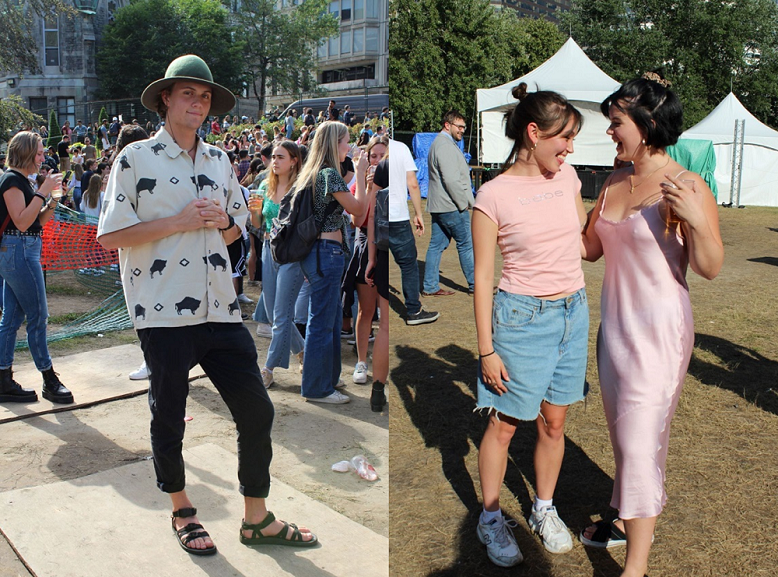
OAP is more than a back-to-school barbeque; it’s also the perfect opportunity to survey McGill’s unique brand of street style, which this year included an abundance of relaxed-fit pants, one-of-a-kind customized pieces, and lived-in sneakers.

The McGill Tribune spoke with OAP’s slickest students about their fashion inspirations, stories, and favourite pieces, as well as the stories behind their outfits.

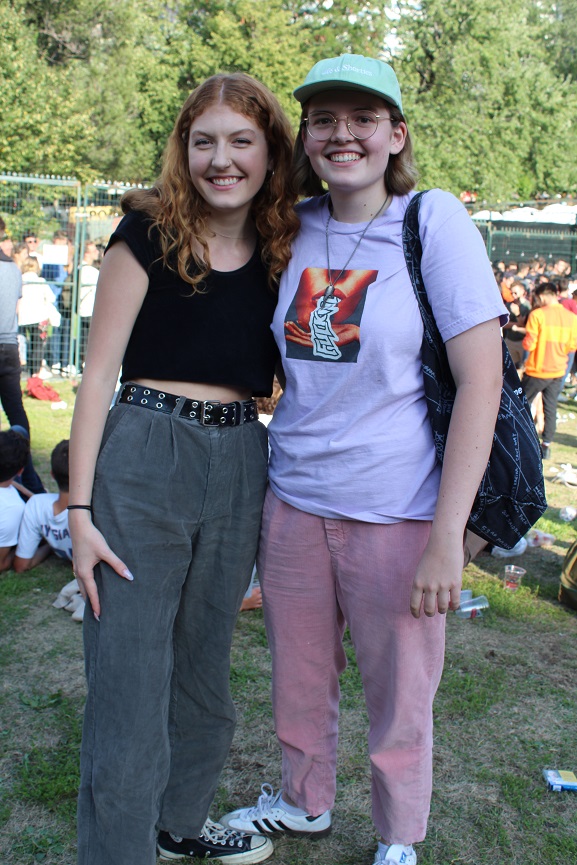
Colette Griffiths, U2 (Arts) and Matilda Sjöberg-Fox, U2 (Arts) 

“I love to go to Value Village ‘cause I love a deal. All my stuff is thrifted besides my shoes, socks, and my underwear. I love the 2000’s [and] I like big shorts ‘cause they’re more comfortable. I like baggy stuff.”

“I really like wearing lingerie inspired clothing. I like breaking the […] boundaries of showing off your body and being comfortable in that, and I love seeing other women do that [….] I’m also a diehard baby pink lover, so I always try to incorporate it. [My shoes are] slip-on Converse slides.”

Julia Kechnie, U3 Arts and Paige Kechnie, U1 Arts

“I walked out of the house in a skirt and high heels, and […] I was like, I have to turn around, it’s OAP! So this is the outfit that I chose: Corduroy pants and a crop top and my Converse All-Stars.”

“I love good streetwear. [My Supreme bag is designed by] Mark Gonzales, […] a skateboarder from the 1980s [and] black denim goes with everything. I got my pink cords from Urban; […] I love a wide fit. [My shirt is] another skate brand, [and] I have this keychain around my neck that is Saint Laurent. It says ‘Addicted to Love,’ ‘cause I am. I got this hat [from Off the Hook] in Montreal, and it’s 40’s & Shorties, […]  another skate brand. I’ve got the pastels going on today, that’s the vibe. It’s a pretty day, blue sky, colorful outfit.”

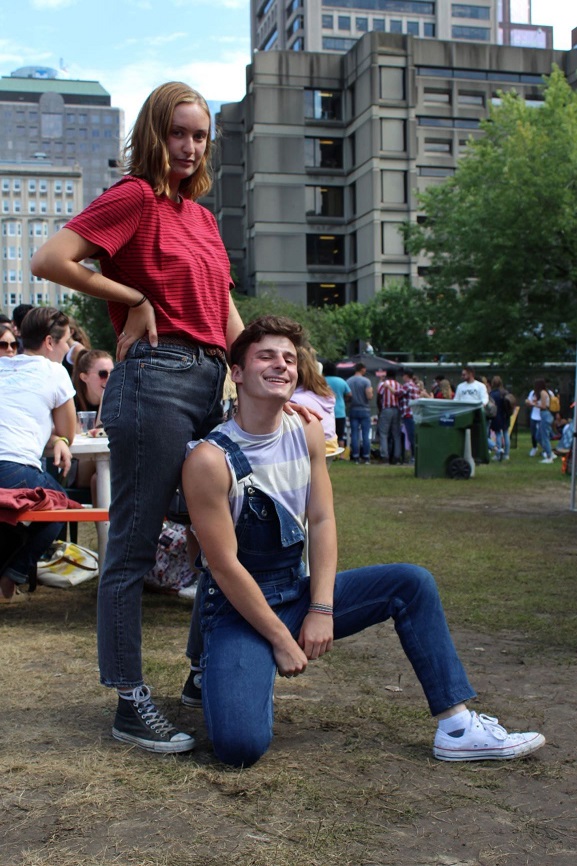
Cristina Venegas, U3 International Development and Ethan Mendall, U2 Cognitive Science

“I unabashedly, unironically love [VSCO girl and e-girl culture]. I love stripes because it’s bisexual/queer girl culture. Horizontal stripes? Lesbian. Chapstick with your hair up in a bun? Queer. [I always wanted to invest in Levi’s,] so I figured, drop the money on [jeans] that are gonna last me a lifetime. And then high-tops because I want the women to know that I like women.”

“So I have always been looking for the perfect pair of overalls, [and I found these] thrifting, […] and they were phenomenal except they were bell-bottoms, so [I] spent 6-7 hours hand-sewing the two legs, [but I sewed them too tight]. I was really upset, like I [had] ruined the dreamiest overalls on the planet. I took them to [one tailor who] was like, absolutely not. So I went to a second tailor, […] thrifted a pair of jeans that were almost the exact same colour, and he [sewed them] in this triangular panel. I’m so grateful that it worked out because I have a perfect piece of clothing that I’m really happy

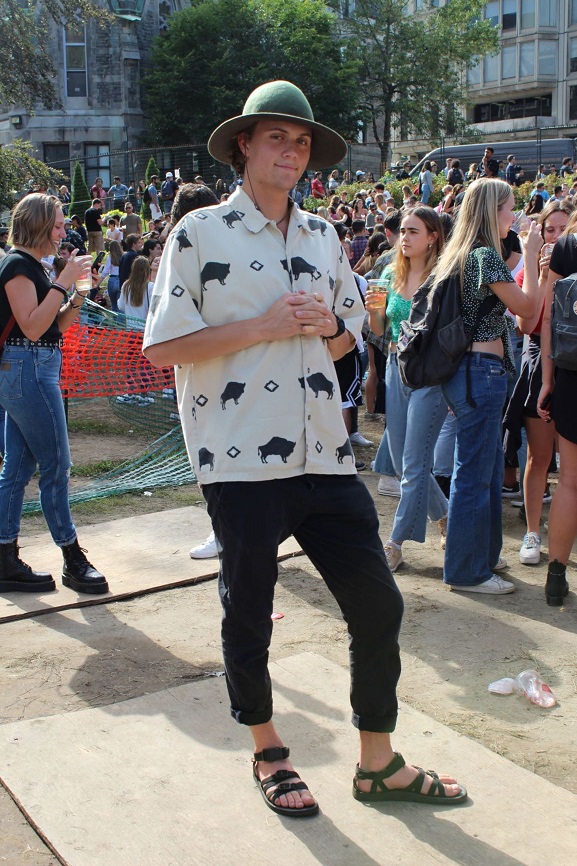
 Mitch Strong, U2 Psychology 

“[I got my hat when] I was visiting my brother, we were on St. Cat’s. The shirt is from a thrift shop in Bayfield, Wisconsin.”

McGill, News

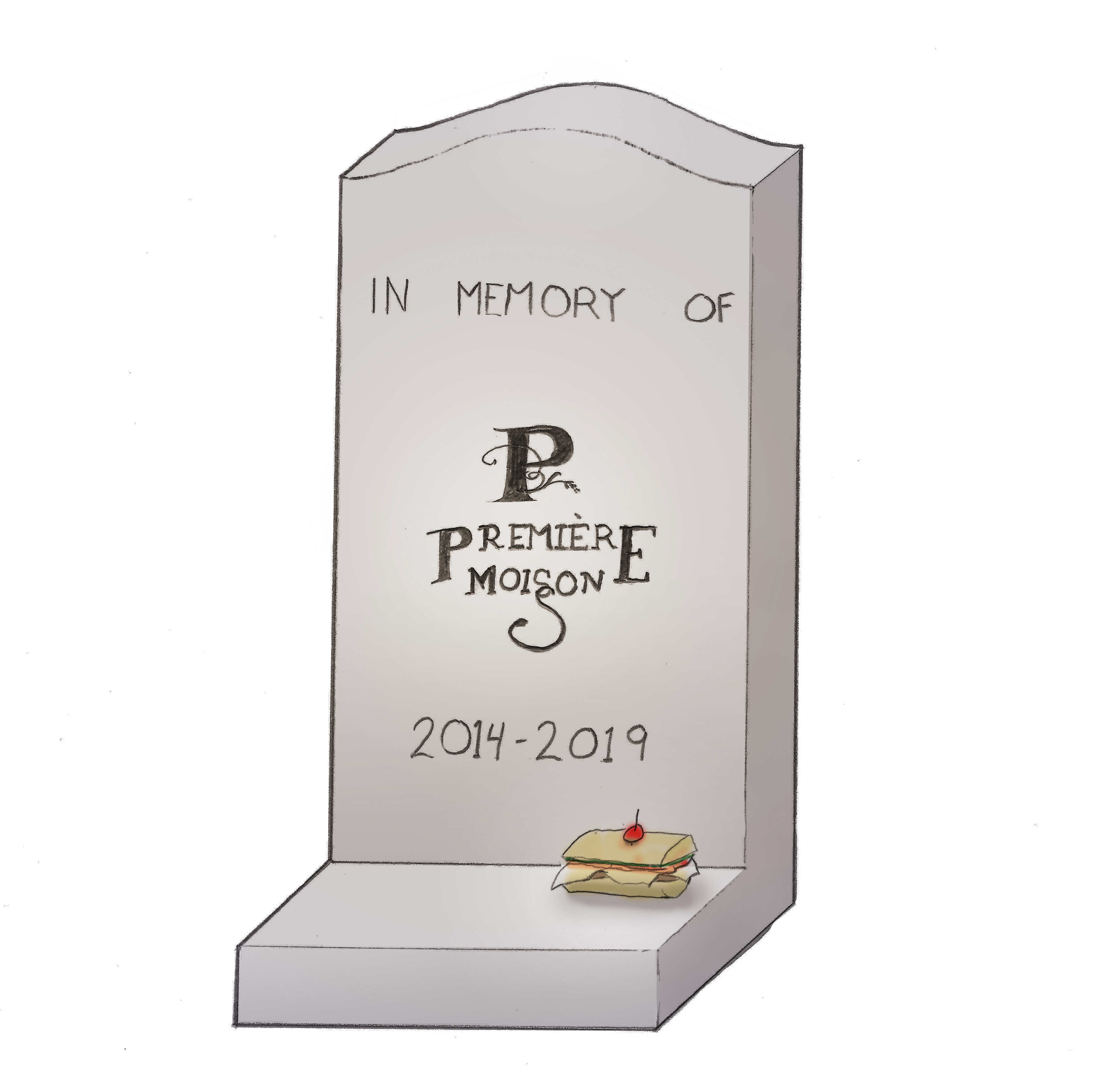
Première Moisson has served its dernier croissant

Redpath Café opened its doors on Sept. 3 after Quebec-based café and bakery chain Première Moisson failed to renew its lease at the end of the 2018-19 academic year. Canadian chain Toi Moi et Café will serve coffee and baked goods at the new venue, alongside Bento Sushi and Mandy’s salads.

Staff working at the previous Première Moisson location were offered the option to return to the new café in September. Meagan Toohey, who has been working in the Redpath-McLennan building for the past four years, shared her enthusiasm for the cafeteria’s new services.

“We [prepare all our products] in the kitchen each morning so [they’re] all fresh every day,” Toohey said. “We have a lot more fruits, [so the café is] not full of sugary stuff. We have a lot of snacks […] and there are a lot more drink options. Plus, we have the sushi place, which is very popular right now. And the coffee is also a lot cheaper than in the past.”

The Quesada and Bento Sushi locations in the Bronfman Building shut down in April 2018, due to construction on the first and second floors of the building. The work is intended to provide facilities for the Bensadoun School of Retail Management, such as classrooms, office and meeting rooms, and study areas. 

Food and Dining Services informed The McGill Tribune that these renovations, scheduled to end in Nov. 2019, will only include new academic spaces. Quesada has another location in Carrefour Sherbrooke, and Bento Sushi has several outlets across McGill’s campus and residences.

Many students have not yet had the chance to visit the new café in the Redpath basement. Elijah Wenzel, U4 Arts, has yet to form an opinion about the new additions.

“I do think the food is still alright and they still have coffee and tea, which is really what I want the most,” Wenzel said. “They’re still getting set up [….] I was told that soon they’ll have a better menu that shows really what they have […] so I’ll reserve some judgement until they’re really up and running. I [also] think the [pricing] is maybe a little lower, which I appreciate.”

In Jan. 2019, the Tribune conducted an informal survey, which found that only 29 of 314 respondents wanted Première Moisson to remain in the Redpath-McLennan library. However, now that Première Moisson has vacated Redpath, some students have expressed favourable opinions toward the café.

“I thought that Première Moisson was kind of expensive, but at least we had different options in terms of sandwiches or salads,” Clara Sedzro, U2 Arts, said. “I kind of miss Première Moisson. They also had more vegetarian sandwich options.”

Wenzel disagrees that Première Moisson was overpriced.

“I liked [Première Moisson],” Wenzel said. “I know some people thought it was kind of expensive, but I always thought it was a nice place to come down and get a cup of tea or coffee. […] I mostly miss the seats by the window because I really liked sitting there and looking out onto Lower Field.”

Research Briefs, Science & Technology

Hippocampus research introduces a new understanding of stress

In Aug. 2019, a team led by McGill professor and researcher Tak Pan Wong published a new study about the hippocampus and its ability to retain memories of stressful experiences. Published in the Journal for Neuroscience, the study detailed new connections to mental disorders such as depression and post-traumatic stress disorder. By exposing mice to social stress in the form of physical threats from other mice, Wong and his team found that negative memory traces were left on the hippocampus, the part of the brain primarily responsible for memory and spatial recognition.

In an interview with The McGill Tribune, Wong explained that the inspiration for the study was the growing interest in understanding the biological mechanisms underlying sensitivity to stress. Researchers originally predicted that increased sensitivity to stressknown to negatively impact learning and memory—was related to reduced hippocampal function.

“Surprisingly, using MRIs [magnetic resonance imaging] to compare [the] hippocampal volume[s] of mice that [were] either susceptible or resilient to stress revealed a bigger hippocampus in susceptible mice,” Wong said.

The hippocampus is a part of the brain located under the cerebral cortex in the medial temporal lobe. It plays a central role in long-term memory formation and spatial recognition, though the study focused only on the former. The hippocampus is thought to record memories of negative events, which leads to the activation of a group of neurons called engrams. The study found that mice that are genetically more sensitive to stressful environments experienced the overactivation of certain engrams in the hippocampus and were more likely to exhibit depressive and aversive behaviours, namely social avoidance.  

Wong explained that, though spatial orientation and recognition of the outside environment were likely not directly affected by exposure to social stress, the entire hippocampal region was put under distress. A 2018 paper showed that when put in a stressful situation, the neurons in the hippocampus responsible for getting an accurate image of one’s outside environment register poorly, influencing the long-term memory and reactivation when placed back in the same situation. The group of neurons for this place field are thus a lot less responsive when activated by stressful experiences. 

“These findings suggest the presence of distinct populations of neurons for accurate encoding of spatial information and fear memory,” Wong said.

New knowledge on the effect of traumatic memories on the hippocampus can offer new insights on the role that memory plays in people with depressive disorders. Depression is known to have cognitive symptoms such as difficulty concentrating, forgetfulness, and memory loss. In the study, repeated exposure to social stress in some mice led to overactivation in certain parts of the hippocampus, causing depressive behaviours like social avoidance. This is also a common symptom for those with depression or post-traumatic stress, as there is a fear of being judged or criticised. In his research, Wong found that activating engrams led to increased avoidance behaviours, while deactivating engrams reduced these behaviours, thus demonstrating a relationship between an overactive engram and depressive symptoms. 

Moving forward, Wong is interested in exploring whether functional changes to place cells may somehow also be related to stress sensitivity. 

Though the study demonstrated the results of stress exposure in mice, the mental and social abilities of humans are more complex. People experience, respond, and manifest stress in different and more subtle ways. Nonetheless, the study opens a new path for depression research and is a cornerstone to future studies regarding memory formation and depressive disorders.

Features

Signed and sealed

As soon as she heard the allegations, University of Windsor Law professor Julie Macfarlane felt as though she had to speak up. In 2013, Macfarlane learned of a fellow professor who had allegedly pursued predatory relationships with certain groups of students while alienating others. Yet, it wasn’t until early 2015 that the professor was terminated from his position at the university.

Read the latest issue

Read the latest issue