Latest News

Hockey, Know Your Athlete, Sports

Made in Mashteuiatsh: Mikisiw Awashish brings hockey home

The National Day for Truth and Reconciliation on Sept. 30 is a day of profound grief as the country remembers the violence the Canadian government and churches inflicted on Indigenous children in the residential school systems they ran. But it is also a day that celebrates Indigenous heritage. This celebratory aspect is exactly what Redbirds Hockey forward Mikisiw Awashish, a member of the Innu community in Mashteuiatsh, Quebec, wanted to emphasize and share with his teammates. 

Awashish had the idea to plan a match, called the Legacy Game, to commemorate reconciliation and his heritage through hockey. The Redbirds played the contest in Mashteuiatsh, some 450 kilometres north of Montreal, against the Université du Québec à Trois-Rivières (UQTR) Patriotes. The game was an exciting reunion for the two sides, who met in the Ontario University Athletics East quarter-finals last February. While the Redbirds fell to UQTR 5-2 in the Legacy Game, the match was tied going into the third period, making it a suspenseful and exciting watch for those in attendance. 

In an interview with The Tribune, Awashish spoke about the spark behind his vision for the Legacy Game. 

“[I first had the idea] three years ago. It was exactly on September 30th,” he explained. “I thought at the time [this day] was missing something.”

Awashish was inspired by Redbirds hockey legend Francis Verreault-Paul, who is also from Mashteuiatsh. Verrault-Paul, who was inducted into the McGill Athletics Hall of Fame in 2023, deepens the connection between McGill’s Legacy Game and the Mashteuiatsh community, as the match foregrounds the accomplishments of another local legend with ties to the university.

Hockey has always been an integral part of Awashish’s life. He spoke to how the game plays a central role in Indigenous communities like Mashteuiatsh. 

“In my hometown, especially in northern Quebec [and] in Indigenous communities outside of Montreal, hockey is the main sport,” he said.“My dad played hockey, all my friends played hockey, […] we had Indigenous tournaments that we [went] to, and the rink was [always] packed.” 

While the Redbirds travelled to Mashteuiatsh to play the Legacy Game, they also went to experience Indigenous culture and meet with Awashish’s local community. The team participated in collaborative learning experiences organized by Awashish, from hosting a youth hockey event to sharing a meal that included beaver, geese, and moose—a first-time experience for many of Awashish’s teammates. 

“It was very well welcomed by them, which was humbling, [and] they have my trust now because I opened my culture to them and they enjoyed it,” he reflected. 

The visit was packed with memorable events, but one moment stood out as the most meaningful to Awashish: On the morning of game day, both UQTR and McGill players met survivors of Canada’s residential school system. 

“There was a ceremony,” Awashish explained. “Three survivors of residential schools were there. [….] They [recited] passages in the Innu language, and we were all there gathering behind them in support. One of them was really saddened by [the] memories. [….] Even though [my teammates] could not understand what [the speakers] were saying, they could feel it. To be able to share that with them was special.” 

Ahead of a long year of hockey and travel, the time the Redbirds spent in Mashteuiatsh provided moments of gratitude and reflection that went far beyond the rink. Awashish shared not only his culture with his teammates, but also a life-changing experience that brought the team even closer. 

“They will use that experience […] for the rest of their life. [This] was also the goal of the trip,” Awashish reflected. 

With the Legacy Game being the Redbirds’ final pre-season match, the regular hockey season now begins at McGill. The Redbirds will play their home opener on Oct. 8 against crosstown rivals, the Concordia University Stingers, at McConnell Arena

McGill, Montreal, News

Mohawk Mothers seek new legal recourse against SQI and McGill regarding New Vic site

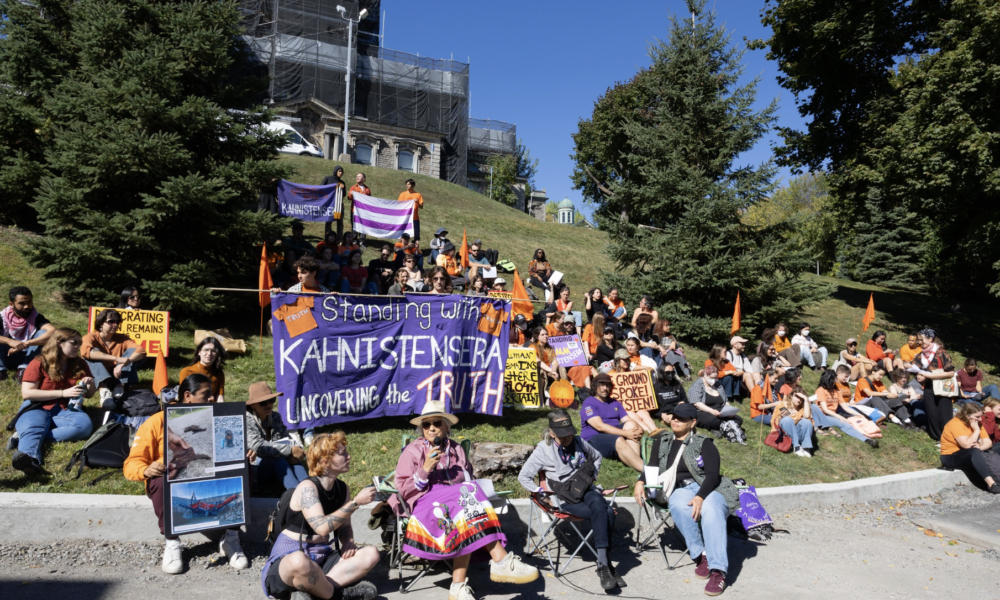
At approximately 11:30 a.m. on Sept. 30, Canada’s National Day for Truth and Reconciliation, three Kanien’keha:ka Kahnistensera (Mohawk Mothers) addressed a crowd clad in orange at McGill’s Allan Memorial Institute, describing their ongoing legal battle with McGill and the Société québécois des infrastructures (SQI). The Mothers’ fight concerns the potential unmarked graves of Indigenous children they believe to be present at and near McGill’s New Vic site. At the press conference, the Mothers discussed a new interlocutory motion they were planning to file against the SQI to prevent further excavations on the grounds. On Oct. 1, they announced they would not be filing the motion.

The Mohawk Mothers shared during the press conference that they will be returning to Quebec’s courts to pursue new legal action in hopes of preventing the SQI from excavating locations around the New Vic site— some of which have been newly identified—that are potential sites of human remains. 

Mother kwetiio emphasized in her speech that archeologists gathered evidence of newly-identified sites using three different technologies: Historic human remains detection dogs (HHRDDs), ground-penetrating radar (GPR), and a new S4 Subterra Grey probe designed specifically to detect human burials. 

“The search dogs identified three other areas with the scent of human remains, along with ground penetrating radar and a special probe designed to find burials,” she reported.

Philippe Blouin, a PhD candidate in McGill’s Department of Anthropology and associate of the Mothers, explained in an interview with The Tribune that despite these potential burial sites being outside of the zone of McGill’s construction, the Mothers worry that the SQI still plans to excavate the area. 

“The SQI […] announced that they will be coming into the zones where evidence has been identified […] to do excavations the same way they did in the past, meaning without any forensic precautions,” he said. 

He explained the importance of protecting these specific sites, in light of the Mohawk Mothers’ claim that McGill has previously destroyed evidence during construction. 

“[At McGill’s New Vic construction site], the damage was already done, and the Mohawk Mothers will be reserving the right to other legal recourses, […] for some sort of reparations,” he stated. 

The Mohawk Mothers announced that, in light of previous methods of excavation by McGill and the SQI at the New Vic Site—which the Mothers claim violated their shared settlement agreement—they will seek renewed legal action to ensure that the new sites will not be excavated, moved, or destroyed throughout the ongoing legal battle.

However, the day after this press conference, on Oct. 1, the Mohawk Mothers received new information that they were unable to discuss with The Tribune due to the ongoing nature of these legal proceedings. Instead of filing the interlocutory motion they planned, they will be switching gears to a new course of action for protecting the potential unmarked graves at the newly identified Allan Memorial Institute sites.

Blouin emphasized that the Mothers’ goals remain the same, despite their legal tactics changing. 

“We don’t know exactly how we will approach the interlocutory or emergency of protecting the area. We can’t state our strategy yet,” Blouin said. “But the same emergency stands, the threat to excavate the area with several pieces of evidence [in it] is still the [issue].”

Blouin also explained that the Mohawk Mothers have now been told that they should be ready for a full trial at the Superior Court of Quebec against McGill and the SQI by the end of March. The trial will discuss all the evidence of potential unmarked graves found on all sites and the question of whether McGill and the SQI have followed their obligations under their agreement with the Mohawk Mothers. 

“[The trial] will determine retrospectively what should have happened, and the pieces of evidence will be examined there,” Blouin stated. “But in the meantime, we are really adamant that the SQI should not touch the ground at all.”  

McGill’s Media Relations Office (MRO) said in a written statement to The Tribune that McGill has abided by their settlement agreement with the Mothers, and claimed that no evidence of human remains has ever been found on McGill’s New Vic construction site. 

“No study nor analysis conducted to date suggests a plausible risk of human remains on the site of McGill’s project,” the MRO wrote. “Should human remains be detected, McGill would act with the utmost respect, stop work immediately and abide by the Settlement Agreement signed in 2023.” 

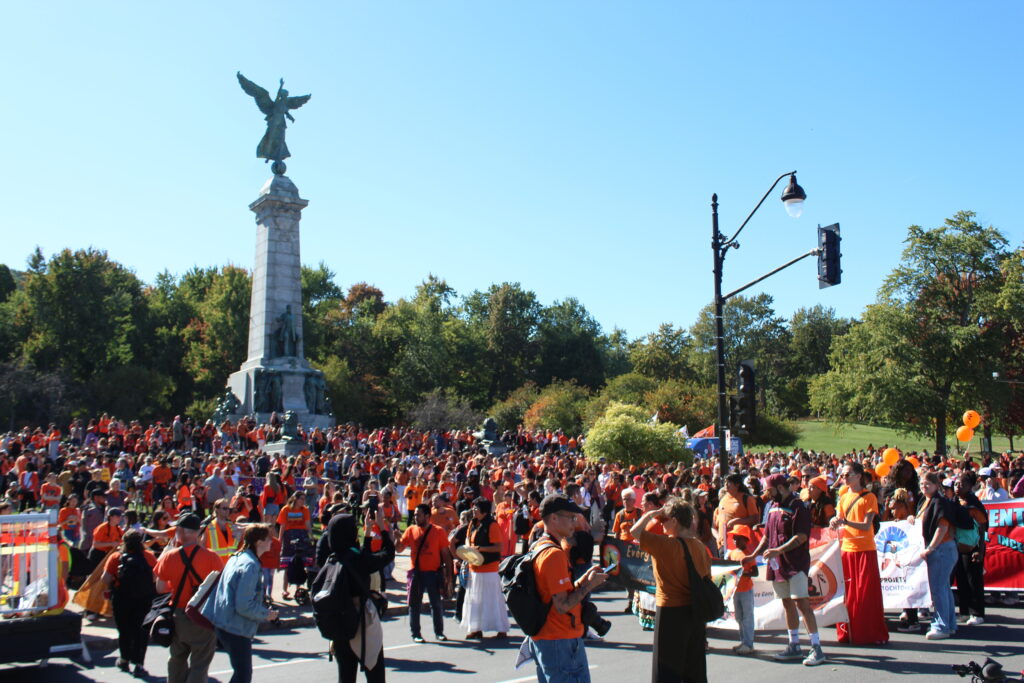
The Every Child Matters march on Sept. 30. (Armen Erzingatzian/The Tribune)

In her speech at the press conference, Mother kahentinetha shared how the Mohawk Mothers’ struggle with McGill and the SQI is a continuation of the struggle that Kanien’keha:ka Peoples have endured against colonialism for nearly 500 years. 

“[Genocide], the ominous crime against humanity that Canada has been committing against us, […] continues to this day,” she stated. 

kahentinetha explained that two years ago, after McGill dismissed the panel of archaeologists that was appointed to oversee excavations at the New Vic site, the Mothers obtained a safeguard order from the Superior Court of Quebec requiring McGill to respect their shared settlement agreement. However, McGill got the order overturned in the Court of Appeal in August 2024. kahentinetha emphasized how these actions stand in opposition to the principles of truth and reconciliation. 

“What we see [at the New Vic site] is not only the hiding, but the very destruction of truth,” she stated. “We faced unprecedented pushback and gaslighting whenever we tried to make McGill and the SQI respect their own law and the very experts that they [hired].”

Mother kwetiio also explained the ways in which McGill specifically mishandled evidence of suspected unmarked graves at the New Vic site, prompting their case for the safeguard order.  

“[The HHRDDs] found two small leather shoes in [the] soil,” kwetiio said. “Instead of sifting the soil immediately, it was left uncovered in big piles, rotting, exposed to the elements. Only four months later was the soil finally sifted, but not manually, as they were legally supposed to do. It was dumped into trucks and moved to another location to let McGill’s bulldozers in to start the New Vic project.”

Throughout the press conference, the Mothers reflected on their struggle in light of the National Day for Truth and Reconciliation, and implored the audience to do the same. 

 “[There is a] huge discrepancy between what this national holiday shows to the public and what is actually happening in real life for Indigenous people like us, trying to concretely protect and investigate the clandestine graves of our children,” kahentinetha said.

She directly called on the audience to think about what they can do to help the Mothers uncover the truth, by digging deeper into Canada’s full history. 

“There are mass graves all over Canada, and we need to find them,” kahentinetha stated. “We need you to help us, […] to open those doors. These are your doors.”

After the Mothers’ press conference, attendees walked to the Monument de Sir George-Étienne Cartier on av. du Parc for the Every Child Matters March

In an interview with The Tribune, McGill student Tarek Maussili, 2L Faculty of Law, shared the importance of attending the march and wearing orange on the National Day for Truth and Reconciliation. 

“I wear an orange shirt because, you know, I’m honouring my grandmother,” Maussili said. “I’m honouring my mom. Both went to residential school. [….] And it’s to remind ourselves that the war is not over, right? This is a war. Canada is committing genocide, and we’re here to remember those that [were forgotten].” 

Student Life

United we stand

We live in unprecedented times. As we continue our education in the university system, it is impossible not to notice the rising tide of ethnonationalism, fascism, colonialism, xenophobia, white supremacy, radical misogyny, and anti-2SLGBTQIA+ ideologies. For the past two years, we have witnessed Israel’s relentless genocide and ethnic cleansing of Palestinians in Gaza, a campaign intensified by the IDF’s recent ground invasion of Gaza City, and the detaining of activists aboard the Global Sumud Flotilla. At the same time, the ideologies of right-wing extremists have entered the mainstream, seizing control of online political content and attracting thousands to rallies in cities and university campuses across Canada and the United States. This comes at a time when social media makes us witnesses to these atrocities in real time, while simultaneously amplifying the ideologies driving them. Moreover, institutions meant to serve as forums for free speech and dialogue intensify their suppression of protest and outcry, as demonstrated by  McGill’s recent court filings to subdue on-campus demonstrations. True, hateful sentiments, extremist ideology, and genocide are not new in the annals of history, but never has the world been as it is now. Never before have we been caught in the intersection of these forces. 

In the face of rampant oppression, we must ask ourselves what we ought to do. Who are ‘we’ and what, precisely, can we do? As tuition-paying undergraduate students, we are all members of the Students’ Society of McGill University (SSMU), our student union, as well as our faculty-specific student societies. These associations represent our interests to the McGill administration, both at the undergraduate and wider-university level. Students, then, are a collective. As a collective, we have the power to shape and influence on-campus culture, decisions, and activities. But only if we share a commitment to change. —

Kit Carlton, U3 Arts, emphasized that compassion is key in acts of protest.

“Solidarity, to me, is about standing with your fellow man—people, who, even if you don’t have the same experiences, showing empathy for [them] and standing for them when maybe they can’t stand up for themselves.” 

In April 2025, hundreds of students passed a motion for SSMU to enact a student strike in protest of McGill’s investment in companies complicit in Israel’s genocide of Palestinians in Gaza, leading to a historic three-day demonstration which drew conflict between students and the university administration. This culminated in McGill’s attempt to terminate its Memorandum of Agreement with SSMU, as well as criticisms of both parties involved. Such a drastic measure from the administration exemplifies our power as a collective. When we act together in solidarity, we have an undeniable impact. 

Acting as a unified body is especially imperative to help protect our fellow students who are most vulnerable right now. Students on campus have faced violence and intimidation from increased security presence for their activism. 

“​​My friend [was] tear-gassed protesting for Gaza last October 7th,” said a student protester who wished to remain anonymous. 

Another student, who preferred to remain anonymous, added, “A lot of Indigenous students, Palestinian students, and Arab students don’t feel safe on campus right now. They don’t feel like campus represents their interests or their lives, even, and they feel threatened by the policies that are being enacted by McGill, so it’s important to stand in solidarity with them, especially.”

The forces we are up against are great, but together, we are not small. When we bear witness to hate, oppression, and systematic cruelty to any vulnerable group, we must act together. We must take every opportunity we can to make our voices heard, to cry out that these are transgressions against human rights that we will never tolerate. Not now, not later, not ever. This is the meaning of solidarity. It does not matter how hard bad-faith actors try to tear us down. When we are united in good faith, we shine brighter than the darkest forces and stand taller than the highest mountains.

McGill, News, SSMU

SSMU BoD abruptly closes Midnight Kitchen, community rally ensues in support 

On Wednesday, Oct. 1, McGill’s food accessibility collective Midnight Kitchen (MK)—largely known for its free lunch program—was dismantled by the Students’ Society of McGill University (SSMU)’s Board of Directors (BoD), who fired MK’s staff and locked the kitchen’s doors without warning. Later that day, the BoD sent an email to the student body announcing SSMU’s planned MK restructuring, attaching documentation of MK’s annual budgets from the last three school years. SSMU stated that the closure was due to MK’s failure to use its budget to meet their fee-mandated five meals per week, instead providing only two. 

SSMU President Dymetri Taylor discussed the society’s decision to close MK’s program in an interview with The Tribune

“Services are reviewed every single year, and in that first [re]view of the services it’s also a review of how they have done in preceding years, what their mandates are, whether those mandates are being followed,” Taylor said. “And in this instance, Midnight Kitchen was being reviewed to account for, particularly, [their] fee mandate of serving five meals a week, and also in comparison of how the service operated in the past.” 

Taylor described MK’s budget over the past few years, noting a gradual increase in the amount it has spent on food since 2022—with a budget of $7,500 CAD for food in 2022 and over three times that amount for this school year

“Again, [food is] budgeted for $25,000 [CAD], but then the amount of servings [MK provides] remains the same,” Taylor stated. “So then the question becomes, well, if the money is going up, but there’s no increase in the amount of servings, what is being done for students, when students are paying to get five servings a week?” 

Taylor continued to speak about how the Board’s decision to cut MK resulted from the release of the kitchen’s Fall term meal schedule, which outlined two meals per week. He noted that even though it is not ideal to halt the program a month into the school year, resulting in no MK meal offerings for the rest of the semester, it allows SSMU more time to plan for a revamped MK to open in January 2026, run by a newly appointed Food Services and Hospitality Manager.

Taylor addressed why the BoD decided to provide notice of closure to MK’s employees only on the day of their termination.

“There’s different manners [with] which you can go about it,” he outlined. “One, of course, is that you give an advanced notice, like you give notice a month in advance, and then for that entire month, more or less, that person is still mandated to work until it comes to effect. [….] [The con] is that there’s then all the negative mental aspects that come with knowing that. [….] It’s not a good environment for anyone to be stuck in. The other option in the collective agreement [between SSMU and its services] is that notice can be provided when [the closure] is occurring. [….] Then, that individual also gets paid for that week that they did not receive the notice.” 

SSMU’s decision to close MK sparked mixed responses from the student body. On Oct. 2, students rallied in front of the University Centre at 1:00 p.m. in support of MK, clanging cutlery, tupperware, and pots together. Some of MK’s previous staff then spoke at the rally, claiming that the BoD’s email to the student body spread misinformation and was purposefully deceitful. They mentioned that their budget does not accurately reflect the kitchen’s food intake, citing that they receive many of their ingredients through donations from Élèves des champs and Moisson Montréal.  

“Not only is [MK’s closure] based on a dire misunderstanding of how cooking operations work, like the need to pay for tools, kitchen upkeep, wages, transporting food, to name a few, most of our food is donated […] which offers free surplus food products in bulk which would otherwise be wasted,” one former staff member stated. 

The former staff continued by outlining unique anti-oppressive resources MK provides beyond its lunch service—offering free Solidarity Servings for community events, hosting workshops, and financially supporting social justice movements throughout Montreal—that could be endangered by SSMU’s kitchen takeover. 

“The Midnight Kitchen has an anti-capitalist, anti-oppressive political mandate,” another former staff member explained. “Many of our volunteers choose Midnight Kitchen because of our political stance and outspokenness on issues that affect students. We have so much community support because we support the community. The SSMU cannot recreate this network of mutuality on their own.” 

The same staff member noted that the Board not only neglected to provide advance notice of MK’s closure, but also promised days earlier at the SSMU’s Fall General Assembly on Sept. 29 that new SSMU hires’ contracts would be signed by the end of the week. Cecelia Callahan, U2 Arts and a recent MK hire, corroborated this statement in an interview with The Tribune after the rally. 

“[SSMU] said that my contract would start [around] three weeks ago, but they kept delaying signing off [on] my contract, and kept saying that it would occur, and it didn’t,” Callahan explained. “Dymetri Taylor told us that they’d be signed at the end of the week, but then we were fired two days later. But we weren’t actually fired. I actually never got a notice that I’m no longer working there, because I never officially worked there.” 

At the rally, Vice-President of SSMU’s labour union Alice Postovskiy spoke on SSMU’s restructuring of MK, expressing skepticism towards the intentions behind the closure. 

“Groups like Midnight Kitchen operate semi-independently,” Postovskiy said. “They’re legally part of SSMU, but they manage their own operations and their own governance. [SSMU] doesn’t understand [what] it takes to run a kitchen. They don’t care, and they don’t think that the people involved, the staff members and the volunteers, actually have relevant expertise and know what they’re doing. [….] They’ve been sanctioning groups for political reasons.” 

As SSMU plans to hire one person to oversee the refinanced kitchen come January, former MK staff members raised concerns at the rally that SSMU directors do not understand what exactly is needed to run a food kitchen. They described how The People’s Potato, a by-donation meal service at Concordia University, provides four meals a week—with a team twice the size of MK’s, wages $10 CAD higher per hour, and a significantly larger kitchen space. 

“The People’s Potato visited Midnight Kitchen last year and confirmed that expanding the number of meal services per week was not feasible given our budget, team size, and the size of our kitchen, and the SSMU wants to run Midnight Kitchen with a single staff member,” a former staff member explained. “Can you see how impossible this vision is?” 

Former MK staff members concluded the rally by expressing worries about the increasing austerity measures being taken at McGill, and the potential lifespan of a refinanced meal service designed and run by only one employee. 

“Costing students their jobs is not in student interest. Canceling free meals is not in our interest. Ignoring the needs and wants of students is not in our interest,” a former MK staff member concluded.

Editorial, Opinion

McGill, your students condemn genocide—so must you.

Today, Oct. 7, 2025, McGill students are striking in support of Palestinian liberation. On Sept. 29, the Students Society of McGill University (SSMU) held a Special Strike General Assembly (GA), in which Students for Palestine’s Honour and Resistance (SPHR) presented a motion calling for a strike for divestment. Students exceeded the Special Strike GA’s required quorum of 500 students, and the motion passed in nearly unanimous favour. The motion was ratified on Oct. 6 by an online student vote, with a record 9190 (36.3 per cent) voter turnout: 67.5 per cent in favour, and 32.5 per cent opposing. 

The motion calls on McGill to divest from companies involved in manufacturing weapons used in Israel’s ongoing genocide in Gaza, such as Lockheed Martin and Airbus, and cease research and financial partnerships with these organizations. Students are also demanding amnesty for peaceful pro-Palestine protesters who have been targeted by McGill’s disciplinary systems. This collective action represents something far more significant than just missing one day of class: it is a clear refusal to accept McGill’s institutional complicity in Israel’s genocide in Gaza. 

Canada’s recognition of Palestine as a state, alongside acknowledgments from 157 of the 193 UN member states—representing 81 per cent of the international community— has marked an unprecedented shift in international pressure to hold the Israeli state accountable for its incessant violence against Palestinians. The United Nations has only now begun to explicitly define Israel’s actions in Gaza as a genocide. This recognition, while significant, is long overdue. That it took this long for global institutions to apply the correct terminology does not mean the genocide only began when it was named; it reflects a decades-long failure to respond to Palestinian suffering. However, legal and symbolic recognitions have yet to yield meaningful consequences. International institutions, including the UN, have time and time again proven largely ineffective in halting Israel’s ongoing violence, the mass killing of civilians, the use of starvation as a weapon, the bombing of hospitals and schools, sexual violence, and the deliberate targeting of children. This failure is mirrored by McGill’s continued investment in corporations complicit in these atrocities, despite urgent calls from its student body to divest.

McGill has not only failed to acknowledge its own complicity in the genocide, but has actively and unjustly suppressed student activism calling for full divestment. Following last October’s protest, the university filed an injunction specifically targeting SPHR. It also imposed ID card scanning requirements during pro-Palestinian mobilizations in April, and again Oct. 7, 2024, intensifying surveillance of student organizers. In recent months, McGill has heightened police presence and threatened students with disciplinary action for participating in peaceful demonstrations. These tactics, which are codified further through McGill’s revised Memorandum of Agreement (MoA) with SSMU, conflate all forms of pro-Palestinian activism with violence, vilifying student protestors and undermining student freedoms of expression and assembly in the process.

The timing of the strike is not coincidental. Oct. 7 marks two years since the Hamas-led attack on Israel, a tragic event that Netanyahu and his cabinet have since weaponized to justify their ongoing genocide in Gaza. Oct. 7 also marks one year since McGill shut down its campus in anticipation of pro-Palestinian protests, citing ‘security concerns.’ Today’s strike represents more than defiance of McGill’s genocidal investment profile; it reclaims a date the university has since used to frame pro-Palestinian advocacy as dangerous, and declares that the Oct. 7 attacks cannot serve as a justification for Israel’s abhorrent and incommensurable brutality toward Palestinians. 

This strike’s power lies not in disruption for its own sake, but in its ability to reframe the classroom as a space for accountability. By walking out, students challenge the assumption that education is neutral. The strike is a signal to the administration that students will not remain passive when their university invests in mass violence. 


Today, Oct. 7, the student body must take the opportunity the strike presents for action—not merely by skipping class, but by participating in protests, having difficult conversations, and staying vigilant, knowing that meaningful solidarity demands discomfort. To faculty, the responsibility is twofold: accommodate students who strike, and stay informed on both student politics and McGill’s financial ties in aiding genocide. And to the McGill administration, the demands are clear: End retaliatory measures against protestors. Divest from weapons manufacturers. Cut ties with the Israeli state. Let this be the last time students must strike for Palestine.

Off the Board, Opinion

Protests are disruptive because they need to be

On Sept. 29, I had barely joined the cheers celebrating the passing of the Motion to Strike for Divestment from Genocide through the Students’ Society of McGill University (SSMU) General Assembly when SSMU Chair’s harsh voice cut through the crowd: “Decorum, decorum!”

The call for order echoed a contradiction at the heart of McGill and SSMU’s Sept. 4 joint statement, announcing the reinstatement of the two groups’ Memorandum of Agreement (MoA), which McGill attempted to terminate following a three-day strike for Palestine the previous spring. They proclaimed a “commitment to uphold students’ rights to freedom of expression and peaceful assembly,” before issuing an “unequivocal condemnation” of any protest involving disruption of “teaching, learning, research, and other core academic activities.” 

The insistence upon ‘decorum’ wasn’t just about noise; it was a command that each expression of collective power—or even shared exultation—remain palatable to those who hold authority over us. Therein lies McGill and SSMU’s shared message: Activism is tolerable, but only if it’s placid, convenient, and ignoreable. It is duplicitous to champion free expression and decry disruption in the same breath. One does not exist without the other, at McGill or anywhere else.

The university’s rhetoric—whether in statements, legal filings, or codes of conduct that further criminalize student activism—imposes an infantile vision of what protest is meant to accomplish. Effective protest has never been about making people comfortable or ensuring that business continues as usual. And no permitted protest or political plea will satisfy McGill when the quintessence of our demands lay bare the complicity behind the ‘core academic activities’ our university aims to shield from scrutiny.

Our calls to action strike at the very core of McGill’s moral authority. Severing research partnerships with Tel Aviv University—an institution that developed the Dahiya doctrine justifying disproportionate military force against civilians. This includes ending the Sports Adams Science Institute’s partnership, financed largely by self-declared ‘Israel ambassadorSylvan Adams, who has openly encouraged more murders of Palestinians and called for McGill to expel students opposing genocide. Terminating study abroad programs at Hebrew University—a centre for weapons research and military technology development that normalizes illegal occupation. Divesting from weapons manufacturers like Lockheed Martin and Thales—investments McGill capitalizes upon with our student tuitions through fund managers. These demands expose the university’s willing entanglement with violence. The truth is that no form of protest will make the administration comfortable with that reckoning, no matter how prettily it is packaged, orderly it is arranged, or quietly it is laid out.

This is the confine of moderation that McGill wishes us to incarcerate ourselves within, implying that some imaginary middle ground exists where we can politely and quietly ask McGill to extract itself from complicity in genocide, and they’ll simply agree. Moderation serves to prolong inaction. What compels change is a visionary, unyielding alternative.

While administrators would like to convince our community that disruptive protests only serve unproductively to polarize, McGill’s own history contradicts this. In 1985, student activists forged a pathway for McGill to become the first Canadian university to fully divest from apartheid South Africa, after years of sustained and contentious protest. Today, McGill proudly references this pioneering moment, while effacing the charges and criminalization students endured in forcing this change—celebrating the result while erasing the resistance. 

Lost in McGill’s condemnation of protests is the democratic deficit that necessitates disruptive action in the first place. Students passed divestment policies through the SSMU in 2022, 2023, and 2025 with over 70 per cent majorities—each blocked by the administration. They organized hunger strikes and alternative campus tours. They established a 75-day encampment; McGill responded with aggressive dismantlement. Following a three-day student strike last spring, McGill sought out court injunctions banning protests within five metres of buildings that criminalized “excessive noise.” When activism is suppressed, disruption becomes an increasingly necessary tool for democratic participation, stripping away what institutional routine normally obscures. 

The sanitized version of campus life McGill seeks to maintain—where learning occurs in pristine isolation from the moral urgencies of our time—represents a bleak imagination of education’s transformative potential. Disruption is not an unfortunate side effect of protest that can be remedied by joint statements that celebrate expression while condemning its exercise; it is itself the mechanism through which change is wrested from power. And perhaps that’s the education McGill fears most: Its students discovering that power yields not to polite reason but to unflagging pressure, that institutions change not when persuaded but when the status quo becomes untenable. Disruptive action is necessary to shift reality when order is causing inordinate harm; maybe the most vital lesson we can learn on campus is that we have the capacity to rupture it.

Lacrosse, Sports

McGill Redbirds triumph in Legacy Game, honouring Indigenous roots of lacrosse

The McGill Redbirds lacrosse team claimed their fourth consecutive win in the annual Legacy Game series, defeating the University of Ottawa Gee-Gees 13-9 on the evening of Sept. 30. Nearly 600 fans stood witness to the highly entertaining match-up at Percival Molson Stadium. While the scoreboard reflected another strong Redbirds performance, the Legacy Game carried a significance far beyond sport.

Held annually on Canada’s National Day for Truth and Reconciliation, the Legacy Game honours survivors of the residential school system and commemorates children who never returned home from these schools, promoting awareness of Canada’s history of violence against Indigenous Peoples and ongoing reconciliation efforts. For McGill, the game has become a way to blend athletics with thoughtful reflection, paying tribute to the Indigenous roots of lacrosse—the Creator’s Game.

The evening opened with inspiring remarks from Kanien’kehá:ka (Mohawk) Elder and Akwesasne Lacrosse Hall of Famer Mike Kanentakeron Mitchell, celebrated for his steadfast dedication to advocating for the rights and welfare of the Mohawk Nation and Indigenous communities at large. He reminded the crowd that lacrosse is more than competition: It is medicine, a gift from the Creator, and a way to resolve disputes without violence.

From the opening whistle, the Redbirds came out firing. Fourth-year attacker Rowan Birrell started their scoring, followed by tallies from midfielder Torsten Blodgett and attacker Zach Page. Page dazzled with a behind-the-back goal before adding two more to complete a first-quarter hat trick. By the end of the opening frame, the Redbirds held a commanding 6-1 lead. 

Ottawa, however, refused to retreat. The Gee-Gees battled back with three quick goals in the second quarter, capitalizing on a brief lull in McGill’s energy. By halftime, the Redbirds led 9-5, but momentum was shifting.

Halftime featured a performance from Kanien’kehá:ka artist DJ Pøptrt, who blended Mohawk sounds with contemporary electronic music, creating a lively atmosphere that emphasized Indigenous creativity and resilience.

McGill regained control in the second half of the match, sparked by Page’s fifth goal and a steady performance full of crucial stopping from goalie Henry Komosa. Admittedly, Komosa also had some luck on his side, as Ottawa struck the Redbirds’ goalposts an impressive seven times during the game. Blodgett added two more goals in the final minutes to seal McGill’s 13-9 victory. Despite Ottawa attacker Julien Belair’s stellar six-goal performance, the Redbirds improved to 6–1–0 and claimed the top spot in the East Division of the Canadian University Field Lacrosse Association

Redbirds head coach Nicolas Soubry, who is in his final year with the program, reflected on the importance of this game for his team in an interview with The Tribune

“We’ve been able to team up with McGill Athletics and the Office of Indigenous Initiatives to create an event that focuses on letting Indigenous voices speak and share, whether that’s a point of view, an anecdote, or even music,” Soubry said. “We’re lucky to play, but the bigger focus is learning and community.”

For Soubry, the Legacy Game is always about more than the scoreboard result. 

“No matter what we do in the season, once we get to this point, it’s about winning this game,” he shared. “But more importantly, it’s about honouring the game by working hard.”

In an interview with The Tribune, Benjamin Buzby, U3 Management student and Redbirds defender, highlighted a key turning point in the match.

“A big faceoff win from Luke Nickel, then a selfless play dumping it off to Page for the goal, that was a good moment,” Buzby described. “It got the boys fired up.” 

Midfielder Preston Norris, U2 Economics, emphasized the team’s unity during the game in an interview with The Tribune.

“From the defensive side, watching the offence move the ball really well as a unit and put it in the back of the net was huge,” Norris stated. “It reassured the whole team.”

Now in its fourth year, the Legacy Game has become a cornerstone of McGill’s Indigenous Awareness Weeks, aligning sport with the work of reconciliation. The handcrafted celebratory lacrosse stick awarded to the winning team stands as a symbol of community and respect for the sport’s Indigenous roots.

As fans filtered out of Molson Stadium after yet another Redbirds win, what lingered was not only the scoreline, but the sense of honouring something much larger. Lacrosse, at its core, heals through every movement, nurtures connection, and brings communities together.

Art, Arts & Entertainment

Powerful photographs and untold stories at the World Press Photo Expo

The main floor of the market consists of overpriced souvenir shops and a few artisanal stores, visited mostly by tourists. It feels disconnected, fake. However, on the ground floor, facing de la Commune street, you will likely experience something more honest and engaging than in any other museum, monument, or exhibition in Montreal. 

This year, the World Press Photo Expo returned to Marché Bonsecours for its annual exhibition. World Press Photo, celebrating its 70th anniversary this year, is an independent non-profit that aims to deepen understanding of the world’s complexities, promote dialogue on overlooked topics, and inspire action through photojournalism and documentary photography. The non-profit holds an annual contest and exhibits the winning photographs in over 80 locations worldwide.

The diversity and scope of the exhibition blow its audience away. It showcases the work of 42 photographers from 30 different countries, representing all corners of the world and centring a vast range of identities. The exhibition masterfully directs attention to the subjects and their stories in stand-alone photographs, such as Samar Abu Elouf’s portrait Mahmoud Ajjour, Aged Nine—which won World Press Photo of the Year—and photo series such as Protests in Georgia, by Mikhail Tereshchenko. These images tell tales of resilience, resistance, war, pain, love, politics, and climate change. Some draw their power from the scene’s beauty, while others capture the raw emotion of their subject. The best do both.

Through Ebrahim Alipoor’s Bullets Have No Borders, visitors walk with kolbars—border carriers—through the mountains of Iranian Kurdistan. These labourers carry heavy goods on their backs from Iraq and Turkey into Iranian Kurdistan under harsh conditions for little pay. The Iranian state’s marginalization of Kurdish people and the ensuing unemployment in Kurdistan leads many to pursue this line of work, deemed illegal by the Iranian government, putting them at risk of being shot by security forces and border patrols. Yet, many kolbars see this activity as legitimate, as they feel ties to Kurds across the Iranian state borders—boundaries that they do not acknowledge. 

Alipoor, like many other photographers at the Expo, tell accounts that escape mainstream media, providing his audience with a more intimate and emotional narrative than traditional media can offer. The gentle smiles and soft camaraderie of the kolbars lie in stark contrast with the harsh, blinding light and the ragged, cracked rock of the Kurdish mountains. Warmth emanates from the photographs despite the lack of colour. 

In Maria, photographed by Maria Abranches, we follow Ana Maria, a resident of Lisbon, Portugal, throughout her daily activities as a carer and domestic worker. At the age of nine, Ana Maria was trafficked from Angola under false promises of education. Abranches wields natural lighting to create a vignette that surrounds Ana Maria and her possessions across a series of five images, creating the illusion that light radiates from her. She has found warmth and comfort in her occupation in a world that has mistreated her.

While many photographs convey pain and trauma, they are not restricted to those experiences. A common thread that ties the stories together is fortitude, strength, and compassion. It’s found in the subtle act of resistance of Afghan women dancing to music in their home, in the crowds of Bangladeshi and Kenyan youth rising against oppression and corruption, in the hands of healthcare workers and family members tending to an injured Palestinian boy lying on the hospital ground, and in the eyes and the collaboration of Eritrean women who tend to each other in the face of pain, trauma, and loss.

The photographs exhibited in Marché Bonsecours act as windows into countless realities and draw out empathy, admiration, and anger from viewers, fueling discussion and inspiring action, just as World Press Photo aspires to do. 

Consult the critical and self-aware guide provided by the Expo for more reflection and visit before October 13th. 

Student Life

How and where to cut ties with apartheid 

As Israel continues its genocide in Gaza, it remains critical that students support the Palestinian people’s struggle for freedom. Central to this struggle is the Boycott, Divestment, and Sanctions (BDS) Movement, which uses global economic and cultural pressure to challenge systems of occupation and apartheid. This strategy allows consumers to take meaningful action with every purchase; each choice is intentional and impactful. To help you participate effectively and uphold your commitment to boycotting, The Tribune has compiled a list of responsible alternatives to companies targeted by the BDS movement.

McDonald’s

The BDS National Committee calls for a global boycott of McDonald’s, citing its support for the Israeli Defense Forces (IDF) through providing free meals and displaying complicity on its social media channels. The boycott is intended to put pressure on the company to sever ties with its Israeli franchisees for supporting genocide, and on its Malaysian franchisees for targeting and attempting to silence solidarity activists. For those looking for alternatives, Burger Bros on St.-Laurent offers juicy burgers, generous milkshakes, Lebanese poutine, and a wide range of halal options at affordable prices. Open as late as 3:30 a.m. on Fridays and Saturdays, it’s a solid choice for late-night fast food you can actually feel good about.

Coca-Cola

Coca-Cola’s Israeli franchise operates in illegal settlements and its subsidiaries profit from occupied land, making the company complicit in war crimes under international law. If you want to support a local, ethical alternative, look no further than Zamalek. Inspired by the vibrant Egyptian hibiscus tea karkadé, Zamalek offers multiple flavours from cola to hibiscus ginger. These refreshing canned drinks are available throughout the city—from supermarkets to restaurants. Beyond great taste, Zamalek’s partnerships reflect solidarity, from backing fundraising efforts for a family within the Gaza strip to sponsoring the Copa Palestina tournament. For another great option, consider supporting Salaam Cola the next time you’re eating out. From Mintar to Pumpui, restaurants all over the city stock this ethically-sourced cola, which pledges 10 percent of profits to charities supporting Palestine.

Domino’s Pizza

Domino’s Pizza stayed silent when its branches in Israel supported genocide and donated to the IDF. For those looking to support local alternatives, Fugazzi Pizza operates in multiple locations across the city. Fugazzi is known for its 12-inch artisanal pizzas, starting at just $11 CAD. The menu includes a well-priced lunch special featuring a pizza and drink for $11.95, ideal for a quick and satisfying midday option. Fugazzi also offers two combo deals that provide added value for those dining with others or looking to keep meals affordable. In addition to quality ingredients and creative flavours, choosing Fugazzi means supporting a local business that isn’t tied to international chains complicit in human rights violations.

Reebok

Reebok sponsors the Israel Football Association, which includes teams based in illegal settlements built on occupied Palestinian land. For a local alternative, Lolë is an activewear brand that offers functional clothing for physical activities like yoga and running. Founded in Montreal, this label also offers outerwear suited for the city’s unforgiving winters. Additionally, the company emphasizes sustainability: Lolë utilizes recycled plastics in its production processes, reducing the environmental impact of its products. Major brands like Reebok can be tempting because of their wide availability and heavy promotion, but Lolë has several locations in the Montreal area, allowing for a convenient—and ethical—shopping experience.

McGill, News, SSMU

SSMU General Assembly votes for motion to strike on Oct. 7 for divestment from genocide

Over 500 students gathered in person and over Zoom at the Sept. 29 Students’ Society of McGill University (SSMU)’s Fall General Assembly (GA) to vote on a motion to strike on Oct. 7 for McGill’s divestment from Israel’s genocide.

The one-day solidarity strike motion calls on McGill to accept the same three demands guiding the SSMU’s strike for Palestine in April 2025, all of which remain unmet. The first and second demands cite the SSMU’s Policy on Harmful Military Technology to demand that McGill divest from companies that profit from Israel’s military action in Gaza, and end any research or financial relationships between the university and these companies. The strike motion’s third demand calls on McGill to drop all disciplinary cases filed against students involved in popular organizing and advocacy for Palestine, and grant students immunity for similar future protests. 

These renewed demands follow McGill’s decision to file a court order in the summer of 2025 for an injunction which would have indefinitely banned on-campus protests impacting McGill students, faculty, or property, in response to the SSMU student strike for Palestine in April 2025. The Quebec Court rejected the injunction on Sept. 30, stating that its broad scope would leave ample room for arbitrary interpretation that could be weaponized to restrict freedom of speech. 

The GA began with a report from the Executive Committee presented by SSMU President Dymetri Taylor, which primarily outlined the requirements for applying for the currently vacant roles of Vice-President (VP) Finance and VP Internal on the SSMU’s Board of Directors. Chair Acadia Knickerbocker then introduced a questioning period wherein students expressed curiosity about the positions, specifically regarding the positions’ hours and why the roles are now hired rather than elected. 

After a 10-minute recess to address technical difficulties with link-sharing for the Zoom, the meeting met quorum, and the GA proceeded with a five-minute presentation on the strike motion by its mover, Sumayya Kheireddine. 

Kheireddine began by telling attendees that over the last 723 days that McGill has not divested from Israeli manufacturing, Israel has murdered over 65,000 people in Palestine using weapons produced by the companies that the university supports. Therefore, Kheireddine expressed, divesting from the corporations responsible is not just a political imperative, but a moral duty.  

“The F-35 and F-16 jets supplied by these companies have dropped more than 85,000 tons of bombs since October 2023, killing and injuring more than 179,000 Palestinians and obliterating Gaza,” Kheireddine said. “All of this is made possible by universities like ours, which collaborate in their research with [Israel], are invested in [genocide], and profit from it.”

After a motion-specific question period, the strike was passed with a large majority in favour, and the bill entered a ratification voting period. The vote needed to meet a quorum of at least 10 per cent of undergraduates in order to be put into effect. After a six-day voting period, the motion for a strike passed, with 67.5 per cent of voting students in favour. 

In an interview with The Tribune, one voter in favour of the motion, who attended the April special GA for a strike and corresponding demonstrations, stated that events like these encourage activists to continue fighting for divestment by demonstrating the strength in numbers that is necessary to create change.

“We want open negotiations [with McGill],” the voter, who wished to remain unnamed, said. “We want more transparency [from McGill], and by showing up we get that point across. Showing up as a collective does also increase our morale and makes us feel like we’re not alone in these thoughts.”

In an interview with The Tribune, a representative of Students for Palestine’s Honour and Resistance (SPHR) said that although this victory marks a positive trend towards divestment, students should remain consistently engaged with pro-Palestinian activism, as the fight for liberation is far from over. The representative, who wished to remain unnamed, also encouraged students to show their continued support for Palestine by attending a rally on Oct. 7, starting at 1:00 p.m. at Concordia.

“The students have proven time and time again that they stand with Palestine and they demand divestment,” the representative stated. “So when is McGill going to listen to the student demand?”

Read the latest issue

Read the latest issue