


Latest News

Arts & Entertainment, Made at McGill

Made at McGill: ‘Scrivener Creative Review’ revives its past

Scrivener Creative Review doesn’t save the good china for special occasions. Whilst sitting down over candlelit tea with Izzi Holmes, Jacob Sponga, and Isabella McBride, the respective Editors-in-Chief and Managing Editor of McGill’s oldest literary magazine, one thing was clear: This is a publication deeply invested in creating and maintaining a timeless aesthetic. 

The conversation began with a brief history of Scrivener.

Scrivener was founded in 1980 […] in the department of English. In our first few years, we published the likes of Leonard Cohen, Margaret Atwood, Louis Dudek, F.R. Scott, and P.K. Page. Scrivener seems to have continued pretty steadily throughout the 80s, 90s, and early 2000s, picking up such eminence as Anne Carson, Seamus Heaney, [and] Michael Ondaatje. It continued throughout the 2010s […] and then went dormant during the pandemic,” Sponga told The Tribune.

The current team relaunched its first issue last April and plans to release two new issues this year—one in the fall and one in the winter. They also seek to honour the magazine’s past, while looking towards the future, through its website. The Scrivener team digitally publishes key archival work, including an interview with Anne Carson from 1997 and four poems by Leonard Cohen from 1982. 

But their vision goes beyond nostalgia; they strive to build a community that connects readers and writers alike.

“We’re hoping to cultivate literary excellence, and perhaps even more than that, a sense of community both in Montreal and beyond,” Holmes said. 

Part of that vision is visual. Scrivener’s current design embraces a monochrome, minimalist, and intentional style that equally captures both its artistic value and literary merit. Sponga mentioned that the team is still experimenting with the design of the magazine, but it is clear that aesthetic cohesiveness remains key in their creative direction. 

But it is the team dynamic that best embodies the spirit of the magazine. With Scrivener’s storied history looming over the team, they delved into how it felt suited to take on this responsibility. In the spirit of true teamwork, each member answered for the other.

“Izzi, ever the industrious socialite, is a good fit for the magazine because she lends it a certain tempo,” said Sponga.

Homes in turn said, “I find Jacob’s care for language and aesthetics alike very impressive, and truly value his attentiveness to detail. Both make our magazine all the better.”

Holmes also singled out McBride, commenting on her work ethic.

 “I had Isabella in mind for Managing Editor because she puts the same amount of care into everything she does, whether that be sending emails, making schedules, or discussing the sentence structure of a short story.”

Scrivener’s expansive and diligent editorial board currently includes undergraduate students, graduate students, and PhD candidates across a number of disciplines at McGill. They collaborate over four sections: design, poetry, fiction, and nonfiction/interviews. 

A key moment for the team—and the culmination of their months of persistent work—was the launch party held on April 24, 2025, at Cardinal Tea Room.

Holmes said, “The launch was proof that what we were doing had worked and that we could reach an audience in real time. Everyone was excited about the contributors, with poems by Medrie Purdham and Derek Webster, as well as interviews with Montreal icons like Dimitri Roussopoulos and Gabrielle Drolet.” 

As someone who attended the launch, I completely understood Holmes; it was the perfect encapsulation of what it meant to be part of Montreal’s rich and dynamic literary community. The invited contributors, who had the chance to read their work aloud, were introduced by editors who had worked on the respective pieces, exemplifying the collaborative effort that went into publishing the magazine. Scrivener also invited other Montreal magazines—including Ahoy, Stimulant, and Soliloquies—to sell their own work. The launch truly showed Scrivener’s investment in art, literature, and most importantly, cultivating a sense of community with others who share these interests. 

Scrivener is accepting submissions for poetry, fiction, nonfiction, and art until October 6th. Copies of issue 46 are available at The Word Bookstore. For more, head to https://scrivenerreview.com.

Student Life

Blues on Blues’ policies 

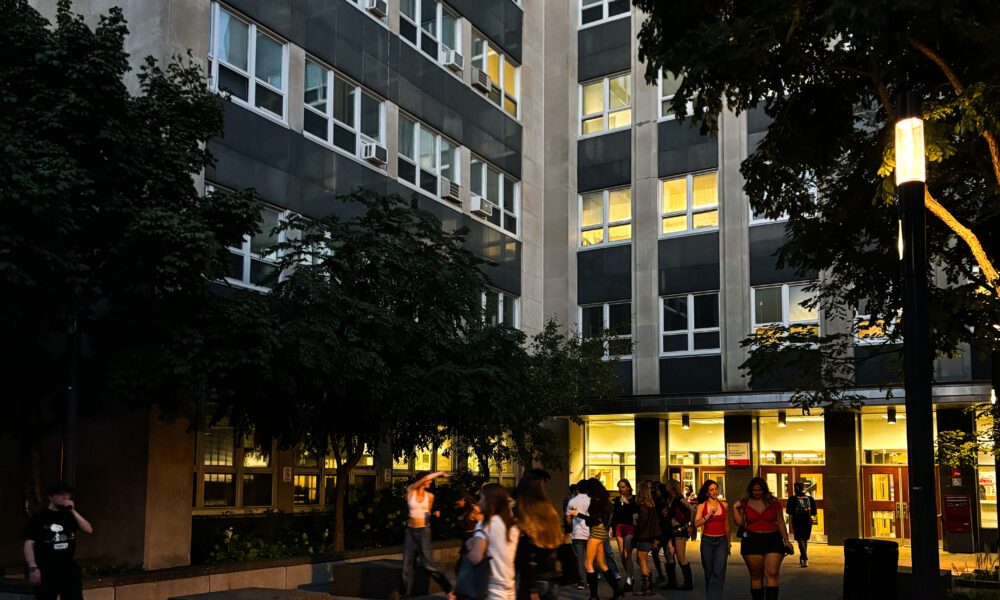
After Open Air Pub’s two-week bender of socialization, drinks, barbecuing, and dancing, students are looking to continue the party. While 4à7, Bar Des Arts, and Gerts are all up and running with the same schedule and system as last year, Blues Pub decided to switch things up.

This year, non-Engineering students interested in attending Blues are required to either RSVP for a ticket on Thursday to enter the pub on Friday, or be the plus-one of an Engineering student. This new system, intended to control capacity and reduce security implementation, seems to be stirring up controversy among the McGill student body—some approving, some neutral, and many disappointed. 

Frequent Blues participants like Dena Mathilde, U3 Arts, voiced strong sentiments against the new policy in an interview with The Tribune

“I absolutely do not support this decision […] because no other faculty bar is discriminating actively against other faculties with some sort of ‘legislation.’ In what world are you only allowing 100 [non-Engineering students]? What happens if 50 people come and it’s just lame? What are you gonna do?”

Mathilde stressed that adding a cap to entrees may disrupt the overall “fun and liveliness” of the event. She further explained that Blues is fun and popular because it’s “more [of] a spontaneous thing” to attend, and not a long ordeal that one has to prepare for days in advance. 

Juliette Whitecross, U2 Science, similarly questioned such faculty division.

“None of the other student bars have done this, so I don’t understand why they are doing it to [Blues] specifically. I know a lot of the Science kids will be disappointed, since Science students don’t have a designated bar that they can fall back [on].”

On the opposite side of the spectrum, Engineering students yielded mixed opinions. 

Aidan McKibbon, U3 Civil Engineering, detailed his approval of the new system, adding more context as to why Blues implemented these new rules in the first place. 

“I generally support the new admission system. I have non-Engineering friends and they just come with me and my Engineering friends. I like the idea that it’ll be less busy and I also enjoy spending time with my Engineering community so [….] I think it will encourage me to go more and see my Engineering buddies.”

Other Engineering students feel differently. In an interview with The Tribune, Romain Le Galliard, U3 Civil Engineering, said, “I’m against the policy because I feel like it’s just more fun when all faculties can get into Blues without tickets. I know that some people had trouble getting tickets because they sold out immediately when they came out.”

Le Galliard’s point suggests that the large number of interdisciplinary demographic students attending is what adds to the charm of the Blues experience. Once this barrier is in place, this diversity disappears. 

Across Engineering, Science, and Arts, students have mixed critiques of this system, voicing both costs and benefits. Most who expressed disapproval of the RSVP system also mentioned how this will discourage them from future appearances at Blues.

Mathilde added, “I actually don’t think that I will ever remember to [RSVP], and if this [system] continues I think that we will see a lot of people not be able to get in or make it to Blues this semester, which sucks because it’s really fun.” 

Only time will reveal the outcome of the new admission policy: Whether it succeeds in its mission, affects future turnout, or pushes Blues to evolve further into an Engineer-centric event.

Cycling, Sports

UAE Team Emirates wins Grand Prix de Cycliste Montréal for second consecutive year

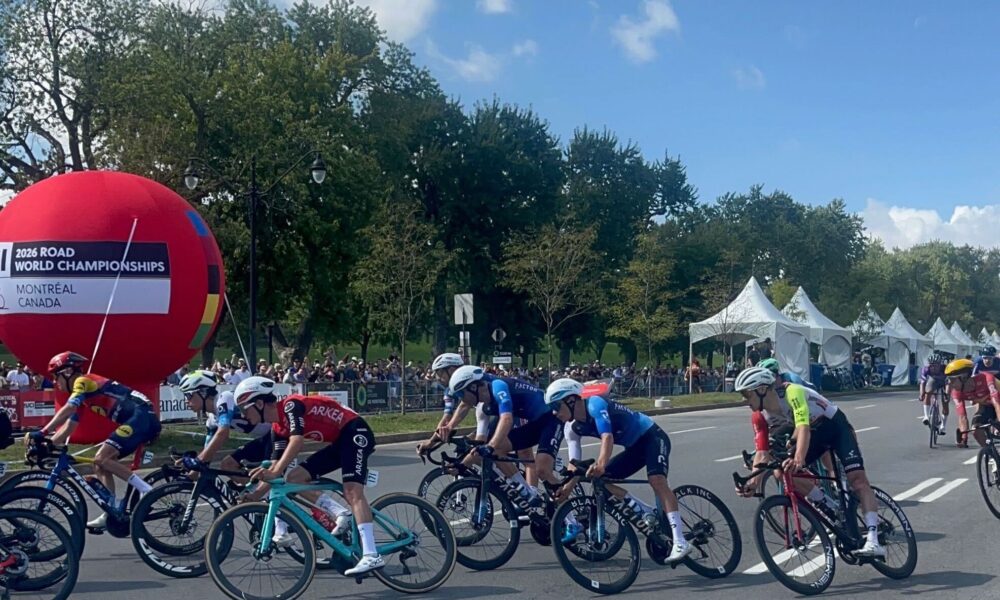
Both cycling fans and pro-Palestine demonstrators gathered in Montréal’s Mont-Royal Park and its surrounding area for the 14th annual Grands Prix Cycliste de Montréal (GPC de Montréal) on Sept. 14.

The GPC de Montréal is the only top-ranked professional cycling series hosted in North America, and is a Union Cycliste Internationale (UCI) registered road race. It consists of two events: a 216 km race in Quebec City and a 209.1 km race through Montreal. The Montreal course features 17 laps of steep, winding roads on Mont-Royal, with a total elevation of 4,573 m. This year, 207 riders competed, including nine Canadians—seven of them representing the Canadian National Team.

Teammates Brandon McNulty and Tadej Pogačar of UAE Team Emirates were the first to cross the finish line. The duo completed the race in five hours and 14 minutes. McNulty, an American racer, crossed ahead of the famed Slovenian cyclist, Pogačar, by a friendly few milliseconds. Pogačar, a two-time winner of the GPC de Montréal—in 2022 and 2024—also holds the 2025 Tour de France title, the 2024 UCI World Road Championship, and an arguable position as one of the greatest cyclists of all time. Pogačar’s performance on Sept. 14 shaved 14 minutes off his winning GPC de Montréal time last year, despite disruptions caused by a protest along the av. du Parc race section.

The top Canadian result came from Hugo Houle of Israel—Premier Tech (IPT), who finished 45th, 15 minutes and one second behind McNulty. IPT was at the center of the day’s demonstrations, where an estimated 200 protesters gathered along the race barriers on av. du Parc to call on the UCI to exclude IPT from competition in light of Israel’s continuous acts of genocide in Gaza. 

Israel—Premier Tech has close ties to Montréal. Sylvan Adams, who has since moved to Israel, is a Quebec-born billionaire with a strong affiliation with McGill University and co-ownership of the IPT team. Adams has heavily contributed to the development of IPT since its inception in 2014, and has long been the subject of criticism from pro-Palestinian groups, notably for his publicly made declaration as a “self-appointed ambassador to Israel.”

The IPT’s connection to the province also derives from its title partner and sponsor, Premier Tech, a Quebec-based agricultural technology company. Further, these ties echo a $29 million CAD donation made by Adams in 2022 to McGill University to establish the Sylvan Adams Sports Science Institute (SASSI). This funding established a partnership between McGill, Adams, and Tel Aviv University, drawing further concerns from pro-Palestinian campus advocates as they push the university to cut all financial ties to Israel

Supported by various pro-Palestine and Gaza-affiliated Montreal cycling clubs, such as Bikers for Palestine—who shared details about the protest through their social media accounts—the demonstration at the GPC de Montréal also garnered support from Montreal’s chapters of Students for Palestine’s Honour and Resistance (SPHR). 

The Montreal protest followed demonstrations at the Vuelta a España, a three-week UCI race across Spain, where a crowd of nearly 100,000 called for Israel to be barred from international sporting events. Following the disruptions, which cut the championship race short, Spanish Prime Minister Pedro Sánchez Pérez-Castejón publicly urged for Israel’s exclusion from global competitions. The team stripped its uniforms of any direct references to Israel in response to the protests at the Vuelta. They wore their adapted uniforms in Montreal on Sunday. 

Looking ahead, Montreal will host the UCI World Championship from Sept. 20-27, 2026. Last held in Montreal in 1974, the event is expected to be the largest sporting competition in the city since the 1976 Olympic Games, bringing together 1,000 elite cyclists from more than 75 countries

This year’s GPC de Montréal highlighted the city’s prominent role in international cycling in two important ways: Its world-class competition, and the political debates at play within the sport. As Montreal prepares to host the 2026 UCI World Championship, it faces the challenge of balancing athletic excellence with questions of accountability beyond the race course. 

Arts & Entertainment, Film and TV

‘Adolescence’ swept the Emmys and made history

The 77th annual Emmy Awards had its usual share of glamour and viral moments, from stunning red carpet looks to controversial money countdowns. But the most memorable of all were the eight Emmys awarded to the Netflix limited series, Adolescence.

Adolescence is a reflection on how life for today’s youth has changed since the  COVID-19 pandemic. Consisting of four episodes all taken in one shot, the show focuses on a 13-year-old boy named Jamie (Owen Cooper) who is arrested as a suspect for the murder of his classmate. The show dives into several topics, including increased knife violence in the U.K. and how misogynistic content impacts the behaviour of young boys on the internet. The show discusses Jamie’s beliefs about women, originating from this misogynistic Red Pill content

The use of consecutive one-shot episodes throughout the mini-series immerses the audience in this boy’s mindset. When Jamie’s underlying issues of self-loathing are revealed, he abruptly switches from acting scared to angry and manipulative. With the audience still unsure of Jamie’s innocence, Cooper is able to create sympathy for his character. Acting in a single take requires perfect memorization of lines without making mistakes for an entire hour, a testament to his strong acting skills. 

Cooper won an Emmy for Outstanding Supporting Actor in a Limited Series, making history as the youngest man to win at just 15 years old. Many TV series cast adult actors as teenagers, resulting in a lack of authentic teenage representation. Cooper’s performance as Jamie takes a realistic look at the mindsets of teenage boys with unlimited internet access. Many teens were left on their own during the pandemic, and online media usage dramatically increased. Because Owen Cooper was also a young boy during the pandemic, he can relate to this online childhood culture unlike an older actor. 

The series writer and co-editor Stephen Graham wanted to cast an unknown northern English boy to play Jamie, increasing the impact of Cooper’s win. Cooper said during his acceptance speech: “When I started these drama classes, I didn’t expect to be in the United States, never mind here.” Cooper’s win emphasizes that you do not need to be born with powerful connections or have film credits to your name to become successful in the acting world.

Graham won the categories of Best Lead Actor in a Limited Series, playing Jamie’s father, and Outstanding Limited Series with co-creator Jack Thorne. Actress Erin Doherty, who played Jamie’s psychologist Briony, won Best Supporting Actress in a Limited Series

In the series, Briony attempts to understand Jamie’s mindset, leading him to express a variety of emotions, ranging from arrogance to aggravation. The third episode depicts the last meeting between the accused and his psychologist, creating a sense of exigency in their conversation. The episode begins with her questioning Jamie, which soon turns into a conversation about the stabbing of his classmate Katie. Their final scene shows Briony breaking down into tears after Jamie reveals information about his consumption of disturbing online content. This final scene elicits an emotional response from the audience, grasping the impacts of the Red Pill content that many young boys consume.

The show generated popularity on its own; it became Netflix’s second most-watched English-language series ever. It has been shown across schools in the U.K. as a way to spark conversations with young people about harmful social media use. 

Stephen Graham told the Associated Press that he wanted to focus on the “relatively normal” life of people accused of crimes similar to Jamie’s. Graham said, “We’re all maybe accountable. School. Society. Parents. Community.” 

Hopefully, this recognition can provoke similar action among schools in other countries—especially in North America, where the Emmys are filmed and originate. With 7.4 million people viewing this ceremony, it may guide more people to educate themselves on the extremely relevant issues among youth today that are brought up in the show: Issues that can mean life or death.

Fact or Fiction, Science & Technology

Fact or fiction: Is your brain wired for a specific learning style?

You have likely encountered the idea that everyone learns best through a specific ‘learning style.’ Social media, classroom discussions, and even online quizzes often promote this claim, categorizing students as auditory, visual, writing and reading, or kinesesthetic learners. This conception sounds convincing, and after many years in the educational system, you may have identified a style for yourself.

However, according to neuroscience, the belief in fixed learning styles is a neuromyth—a misconception about the brain stemming from a misunderstanding of scientific facts that has been endorsed by the public and educators.

In an email to The Tribune, Armin Yazdani, academic associate with the Office of Science Education (OSE), and OSE’s resident neuroscientist, explained why this widely believed idea fails under scientific scrutiny.

“While we may have a preference for receiving information in one modality, we do not have good evidence that these preferences actually predict better learning. While brain cells in the eye may only respond to photons of light or brain cells in the ear may only respond to pressure waves, the brain as a system is multi-sensory,” Yazdani wrote. “Learning involves neuroplasticity or the creation of neural connections in various brain regions. Memory is distributed across brain regions that are highly interconnected in networks, and retrieving something requires the activation of these networks based on task demand, not [a] learner’s single sensory channel.”

Yazdani further dispelled this myth by pointing to a popular psychological experiment known as the Stroop effect.

“Imagine if I show you the word “RED” written in blue ink and ask you for the ink colour. To get to the correct answer, the brain recruits a wide range of neurons in the visual cortex, language areas, and attention networks.”

Learning works in a similar way: It involves the integration of information from distributed brain regions rather than dependence on a single sensory modality, despite the impression that only one sensory channel is at work.

Given that this theory is false, students may wonder how it still remains popular. Yazdani wrote that its appeal lies in its simplicity, making it easy for educators to disseminate.

“This myth is so pervasive because teachers propagate it mostly [….] It feels intuitive, which means teachers understand it and can explain it well to students. It’s also actionable, which means they can tailor their instruction to a student’s ‘learning style.’ Misinformation spreads faster and farther than facts, and we have been in a losing battle against this one.”

If learning styles aren’t the answer, what does neuroscience say improves learning, and how can students discover what works best for them? Yazdani highlighted three evidence-based strategies supported by cognitive neuroscience.

“It is context dependent, but we have evidence that dual coding may work better. This is where we use multiple complementary representations—visual and auditory—to create stronger memory traces.”

Yazdani also recommended spacing out study sessions to support memory consolidation.

 “If you are a student, I would highly recommend two other strategies. One is to space out your study sessions: Three one hour sessions are better than one three hour session. The second one is retrieval practice, where you actively recall information from memory—practice tests, flashcards.”

To help put these strategies into practice, the OSE offers a neuroscience-based program called SciLearn. Open to all undergraduates, participants explore research on the neuroscience of learning via workshops, lectures, and study sessions. SciLearn also focuses on debunking neuromyths, such as the theory of specific preferential learning styles.

“We have evidence that participating in even a short SciLearn guest lecture is beneficial. We start with unlearning by dispelling common myths and misconceptions. We then discuss evidence based study strategies based on neuroscience and our own research, which many students adopt. We know that SciLearners may also shift their mindset and better plan, assess, and monitor their learning,” Yazdani wrote.

Therefore, fact or fiction: Is your brain wired for a specific learning style? Neuroscience says no. Learning isn’t a fixed trait, but rather a skill.

McGill, Montreal, News

“Palestine on Campus” screening highlights security crackdown on Montreal student activists

On Sept. 16, The Rover—an independent, reader-funded news outlet in Montreal—hosted a screening and panel discussion to showcase their first-ever documentary, Palestine on Campus, at Collectif MTL’s St. Catherine location. The 30-minute film, created by The Rover’s managing editor Savannah Stewart and producer and videographer Justin Khan, follows the recent hostilities inflicted on pro-Palestine student activists by their own university administrations.

Through interviews with McGill and Concordia students—including former Vice-President External of the Students’ Society of McGill University Hugo-Victor Solomon, professors at McGill and Dawson College, and legal experts—Palestine on Campus portrays a recent security crackdown across Montreal higher education that targets pro-Palestine activists. 

The screening began with The Rover’s founder, Christopher Curtis, addressing the crowd of approximately 40 attendees about the importance of Palestine on Campus’s investigation.

“Almost all of the mainstream news stories about the Gaza encampment in Montreal perform mental gymnastics to avoid talking about the role that our institutions play in supporting genocide,” he said.

The documentary was followed by a panel, moderated by Stewart. One panelist, Gwendolyn Schulman, is a McGill alum who helped lead the successful anti-South African apartheid movement on campus in the 1980s and co-founded CKUT‘s long-running Amandla! program.

On the panel, Schulman noted the troubling differences between the anti-apartheid struggle and pro-Palestine activism for divestment from companies complicit in the genocide of Palestinians on McGill’s campus today.

“Even when we did our sit-ins and our demonstrations, […] the one thing McGill did not do ever was [call] the police, and it never used private security firms against us,” she stated. “In fact, it was the exact opposite. They were so concerned about their public image that they wouldn’t let the police anywhere close. [….] We were never criminalized for what we did. We were never threatened with being expelled.”

Joining Schulman on the panel was Rine Vieth, a sociolegal scholar who contextualized how the increasing risks university student and faculty activists for Palestine face are unfolding just as much in Canada as they are, very visibly, in the United States. They also discussed how McGill’s recent austerity measures have been accompanied by an incongruous increase in the amount of private security employed by McGill, reflecting the “neoliberalization of higher education.”

“McGill is ostensibly a public university,” Vieth stated. “These are our tax dollars being used to fund this.”

Vieth and Schulman spoke alongside Danna Ballantyne, the Concordia Student Union (CSU)’s External Affairs & Mobilization Coordinator. Ballantyne discussed the struggles the union has faced since Concordia launched an ongoing investigation into the CSU for allegedly violating administrative policies during a Special General Meeting in January 2025. During the meeting, approximately 94 per cent of attending undergraduates voted in favour of Boycott, Divestment, and Sanctions (BDS) protocols for Palestine. 

“There is absolutely nothing more dehumanizing than asking someone to talk bureaucracy while their friends and family are being murdered,” Ballantyne said. “The investigation is really not the main thing here. There’s a genocide happening. [….] Our friends are still dying at the end of the day. [….] You know, they call us a fringe minority, [but] most of us showed up to that meeting and [voted in favour of the BDS motion] when they said, ‘Do you want to divest?’”

Ballantyne concluded by describing how to address burnout as an activist, advising that “the more people in [one’s] entourage care, the less tired” they will feel continuing the fight for Palestine.

“If there’s one thing that all of us have, that everyone in Gaza needs right now, is connection,” she implored. “Please just make a friend from Gaza and talk to them. [….] Answer someone’s [Instagram] story […] and say, ‘We’re with you.’ [….] It makes every difference to them, and it’ll remind you what’s going on.”

Schulman also noted the importance of holding university communities accountable by preserving institutional memory.

“McGill celebrates itself for being the first Canadian university to divest. They never point out that they fought us tooth and nail and we won,” she proclaimed. “Eventually, [pro-Palestine activists] are going to win [the fight for divestment], […] and McGill is going to claim credit [again]. [….] We know what McGill was and what McGill has become, and what it needs to become down the road.”

Off the Board

Make libraries cool again

On Monday, as I was parting ways with a friend, she casually mentioned, “I’m going to the library to pick up a book for my research.” This phrase stuck with me—not because of what she said, but because of how rare it is to hear someone, especially a student, talk about going to the library not to study or kill time between classes, but to find a book that aids their current research interest.

The next day, when another friend of mine suggested we visit Westmount Library, I spontaneously agreed. After wandering through the greenhouse and settling into a cozy spot, I began drafting this piece. Writing in a beautiful, hushed corner reminds me that these library spaces are more than just quiet rooms with Wi-Fi and outlets.

As I enter my second year of university and transition out of introductory courses, I’m realizing that deep, rigorous research isn’t just about gathering sources; it’s about knowing where to look and how to think. With the convenience of the Internet at our fingertips, we’ve come to rely on quick answers—but at what cost? Have we sacrificed the ability to critically evaluate sources in favour of speed? In this digital age, libraries push us to slow down in our research, ask better questions, and dig beyond an article’s introduction.

But these questions also lead me to wonder: Have we collectively forgotten how to use libraries? Or worse—do we not value them anymore?

With the rise of online databases, academic search engines, and, most recently, AI tools like ChatGPT, the role of the library as a physical epicentre of reference sources and research materials is fading. Why trek across the city or even across campus when information is just a few clicks away? But, in our convenience-driven approach to knowledge, we don’t just fail to take advantage of free, physical books; we also miss out on the library’s ecosystem of services designed to help us in our quest for knowledge. 

Libraries are not just buildings that store books or offer an aesthetic place to study. They are the beating heart of research and scholarship. 

Beyond storing the books themselves, libraries are staffed with trained research experts—human search engines, if you will—who can point you toward resources you didn’t know existed, offer perspectives on a thesis you hadn’t considered, or guide you through citation databases you’ve never used.

With 10,834,072 physical and digital items at our disposal in the collection of the McGill Libraries, members of the McGill community have access to a vast range of materials from rare manuscripts to cutting-edge research journals. Beyond this impressive collection, McGill’s libraries also provide workshops such as the Introduction to Zotero workshop, teaching crucial skills for writing and managing citations. Or, if this article has re-ignited your interest in the library, the McGill library also offers a “Library Research Skills” workshop.

It is clear to me, as I sit in a library to write about libraries, that we need to shift the narrative surrounding these essential institutions. Libraries are not outdated—they are underutilized. If we, as students and emerging researchers, can reframe libraries as active tools in our academic lives, we’ll not only write better papers—we’ll become better thinkers.

So, let’s make libraries cool again. Not by plastering them with neon signs or turning them into Instagrammable study spots, but by using them, valuing them, pondering in the stacks, and remembering what they’re really for.

Baseball, Cross-Country / Track, Football, Golf, Lacrosse, Martlets, Men's Varsity, Rugby, Soccer, Sports

A month of McGill Sports leaves room for improvement

Sept. 22 marked one month since the start of the 2025-2026 McGill Fall Athletics season. So far, the Martlets and Redbirds are off to a rough start and are looking to regain their athletic prowess. 

Redbirds Football is at a tipping point, with their season locked up with two wins and two losses. They started the season strong with a home-field win against Université de Sherbrooke’s Vert Et Or on Aug. 22. However, they were unable to secure wins at either of their away games on Aug. 30 versus the Université Laval Vert Et Rouge and on Sept. 5 versus the Concordia University Stingers. Despite their subsequent home-field win against the Université de Montréal Carabins on Sept. 19, the Redbirds will have to learn how to capture victories on the road if they want a winning season. 

Soccer has experienced a similar start to the year, with both the Martlets and Redbirds having difficulty sealing wins. In their regular seasons, the Martlets are 2–1–4 and the Redbirds are 1–2–2, with both teams most recently tying the Vert Et Or on Sept. 19. However, both teams have seven matches left until the Réseau du sport étudiant du Québec (RSEQ) Semifinals, so it is not too late for them to end on top if they can start to outscore their opponents. 

Redbirds Lacrosse is in for another successful season this year, and has already earned a 4–1 record with much of their season left. Senior midfielder Joshua Jewell has spearheaded this accomplishment, scoring seven goals across the team’s two winning games and being named McGill’s Athlete of the Week on Sept. 15. Another senior midfielder, John Miraglia, scored a hat-trick during the Redbirds’ win against Trent University on Sept. 14

Redbirds Rugby are coming off a win in Sherbrooke versus the Bishop’s University Gaiters. This brings them to a 2–1 record. However, with such a short season, they will have to keep up the momentum in Ottawa this coming weekend to secure a home-field advantage in the RSEQ Semifinal. Martlets Rugby is having a tough time this season, having just come off a loss against Concordia on Sept. 21 to bring their season record to 0–4. The Martlets unfortunately have not finished within 20 points of any of their opponents, and have only two games left to prove themselves before the RSEQ Semifinal on Oct. 12

Redbirds Baseball is having a difficult start, with a 3–7 record. This past weekend, they broke even at Carleton University, beating the Ravens twice on Saturday, then falling to them twice on Sunday. On Saturday, rookie catcher Nathaniel Steffler snagged two runs, and catcher Robert Glusker earned two hits, a walk, and two runs scored. The team’s season is far from over, with 15 games left before the Canadian National University Championships, which are being held in Montreal this year.

McGill Golf have finished middle-of-the-pack in their past two tournaments, though star players have stood out. The Redbirds finished sixth of nine teams and the Martlets finished third of six teams in the teams’ first tournament, held on Aug. 24-25. During the second tournament, the Martlets secured the same ranking, and the Redbirds improved, finishing fourth out of nine teams. Martlets’ Astoria Yen has shone on the green and tied for first place out of 26 women players in the tournament last week, securing McGill Athlete of the Week on Sept. 15. Golf looks to improve its standings during the RSEQ Championships from Sept. 22-24 in Trois-Rivières, Quebec. 

The McGill Cross Country team started their season off strong at the McGill Invitational this past Saturday, Sept. 20 at Parc Mont-Royal. The Martlets runners came in first and the Redbirds finished fourth of nine teams. Most notably, Martlets’ Sienna Matheson earned silver in the women’s race. 

It is not the first month back that fans may have hoped for, but McGill’s Fall sports teams still have a chance to turn their seasons around, to get out of the dangerous middle range in their respective leagues, and to strive for the championship-bound path.

Author and Sports Editor Clara Smyrski is a member of the McGill Women’s Field Hockey team and thus cannot comment on their performance this season.

Commentary, Opinion

Maple-washing by grocery giants threatens the Canadian domestic market

The Canadian Food Inspection Agency (CFIA) confirmed 12 cases of ‘maple-washing’ between February and May 2025, a marketing tactic that exploits Canadian patriotism to encourage sales of imported goods. The agency caught multiple grocery chains promoting non-Canadian products using “Product of Canada” and “Made in Canada” labels, as well as a maple leaf symbol, thus threatening consumer trust, harming local businesses, and disadvantaging the domestic market in the process. 

The CFIA can fine offenders up to $15,000 CAD when they jeopardize access to Canadian goods on the market. Yet, the agency issued no fines over the recently observed cases of maple-washing, despite their clear violation of Canada’s advertising laws. The CFIA’s reasons for the lack of fines stay vague; it states that labels had been corrected and issues therefore settled. Grocers receiving complaints have tagged false labelling as mere errors—and the CFIA seem more than willing to ignore the corporations’ plausibly calculated intentions. 

However, incidents of false advertising deemed ‘simple mistakes’ have not gone away nor settled following the issuance of complaints. In fact, maple-washing saw a recent increase: The CFIA observed more than 70 complaints in July and August. Maple-washing’s rise in prevalence represents a strategic ploy by non-Canadian corporations. As Canadians attempt to promote the domestic market amidst tariff disputes and tensions with the White House, maple-washing offers a sly way to boost sales of boycotted imported goods. 

President Trump’s reiterations—in March and June—of his wish to colonize Canada as the U.S.’ 51st state, combined with new 35 per cent tariffs on Canadian goods implemented on Aug. 1, galvanized Canadians into promoting domestic industry. The ‘Buy Canadian’ movement emerged as consumers began to prioritize buying local: 45 per cent of Canadians state they actively boycott U.S. goods in response to tariffs, choosing instead to purchase Canadian substitutes. McGill students shopping around campus at Provigo and Metro may have been impacted by maple-washing, as they have an incentive to buy Canadian as a statement against Trump’s policies. 

Aware of these changes in consumer preferences, corporations have used maple leaf logos or “Made in Canada” labels to avoid market share decline. Riding the wave of Canadian patriotism to promote international products is a clever marketing strategy. However, it becomes an unethical one when companies weaponize nationalism for profit by lying to their customers about their products’ country of origin. 

The CFIA led a four-month investigation against Canadian grocery store Sobeys over imported avocado oil marketed as “Made in Canada,” but closed the case without issuing any penalties. The CFIA’s failure to act on recognized maple-washing pushes aside customers’ concerns and rights to accurate, truthful advertising. Consumers who have reported maple-washing cases say grocers have eroded their trust and demand punishment for misleading marketing patterns. 

Montreal lawyer Joey Zukran took matters into his own hands in mid-September by seeking court approval to sue Provigo, Metro, and Sobeys, among other companies. After witnessing the CFIA’s inaction, Zukran aims to show that systemic false advertising cannot go unpunished. 

As a result of maple-washing, Canada is losing an opportunity to benefit from its tariff war with the United States. By fearing a loss in capital, corporations have selfishly squandered Canada’s chance to capitalize on nationalistic momentum transparently and without threatening long-term market development. Instead, local companies remain overshadowed by imported goods even when citizens express a strong commitment to strengthening the national economy through their individual consumption choices. 

Labelling inaccuracies, when recurring and consistently made by multiple commercial corporations, are not mistakes. Companies falsely promoting products as Canadian should suffer a penalty: Normalizing incorrect labelling allows misleading advertising to secure its position in the food-selling industry. Until fines follow from fraud, the maple leaf risks regressing from a national emblem to a mere marketing gimmick.

Editorial, Opinion

True nation-building is rooted in our environment

A wave of reinvigorated commitment to infrastructural expansion is sweeping the uppermost echelons of Canadian government. On Sept. 10, as an extension of the Building Canada Act, Prime Minister Mark Carney released a list of five major ‘nation-building’ projects aiming to “turbo-charge” the Canadian economy and create jobs. Meanwhile, Quebec Premier Legault is calling to suspend environmental goals to make economic development the province’s top priority. Instead of prioritizing the environment and its inhabitants, powerful political leaders like Carney and Legault are promoting an image of national development rooted in spectacle and glorified extraction.

While Carney claims his proposed nation-building projects are geared towards “protecting Canada’s rigorous environmental standards,” their environmental impacts will be undoubtedly detrimental—an outcome Legault is eager to ignore. One of these five projects, for example, aims to double the production of liquified natural gas (LNG)—a greenhouse gas which is 80 times more potent than CO2 in the short term, and 30 times more potent in the long run. Two other projects aim to expand mines in Saskatchewan and northwest BC—an endeavour that destroys land, uproots ecosystems, and contaminates water and air with harmful sulfuric acid. 

Normally, such projects would undergo strict environmental assessment to ensure their alignment with Canada’s national sustainability standards and climate plan, such as reducing national carbon emissions by 40 per cent below the 2005 levels by 2030, and reaching net-zero emissions by 2050. However, Legault’s demands to speed up these assessment processes threaten to break this promise and reverse the decisive progress Canada has made in reducing CO2 emissions over the past several years.

Additionally, though Carney advertised the inclusion of Indigenous leaders in the planning process, the burden of ecological damage from these projects falls heavily on the shoulders of Indigenous and rural communities. Such damage reflects a long history of eco-racism against Indigenous Peoples in Canada who are already disproportionately harmed and displaced by extractive mining and the production of oil and gas. Rewriting ecological guidelines to enable destructive ‘nation-building’ projects does not uplift Canada’s national image—it corrupts it by uprooting Indigenous land, polluting public air and water with toxic sulphur, and eschewing Canada’s uniquely low carbon footprint.

A ‘nation-building’ agenda whose success relies on environmental destruction is neither people-first nor, in the long run, profit-first. A people-first agenda would not pollute or uproot the environments in which people live and upon which they depend. An agenda committed to long-term profit would not raze ecosystems irreversibly to the ground.

In fact, a truly people-first—and, in the long run, profitable—agenda is one that starts with an eye toward the environment. In the past ten years, the damages of climate change have cut $25 billion CAD off of Canadian GDP—a deficit which will compound over time if the country does not commit to nature-based climate solutions and damage control. Investing in the environment is the smartest choice Canada can make if it seeks to be truly nation-building, rather than risking its future for the allure of immediate profit. 

Despite the federal government’s demonstrated disregard for Canadian ecosystems—and thus Canadian people—McGill has risen to the occasion as a leader in sustainability, setting a crucial precedent for other institutions. Not only is the university publicly committed to the goals of zero-waste, carbon neutrality, and increased climate resilience, but it has taken tangible steps towards these goals

As students, we must familiarize ourselves with McGill’s sustainability plan and adopt actionable steps to push it forward. As an institution, McGill must not settle into complacency, but continue to be proactive in revising, adapting, and expanding its sustainability goals. 

At the federal level, Canada’s political leaders must reconceptualize the kind of nation they want to build, beginning with a reaffirmation of Canada’s legally-bound commitment to the Paris Agreement. Right now, Carney and Legault are sending a clear message that economically successful nation-building is, by design, in opposition to environmental sustainability. It is only when our leaders abandon this conviction that Canada can abandon nation-branding for true nation-building. By reassessing the relationships between human, environmental, and economic prosperity—beyond those assumed by capitalist political rhetoric—we find that, in fact, it is not hard to imagine a world in which the three are mutual beneficiaries, where the improvement and strengthening of one brings the same prosperity to the others. 

Read the latest issue

Read the latest issue