Latest News

Arts & Entertainment, content warning ed, Film and TV

Flashback: ‘Superstar: The Karen Carpenter Story’ is mandatory viewing for McGill students, administrators alike

Mental health issues, and eating disorders in particular—being consistently gendered feminine—are exacerbated, downplayed, and ignored by patriarchal institutions. Frustration on the part of the victimized is understandable, and art can justifiably be deemed escapist in essence. Conversely, I present to you: Superstar: The Karen Carpenter Story (1987), a movie that refuses to allow marginalized voices to be silenced, or their stories to go untold.

Todd Haynes’ (Carol (2015), Wonderstruck (2017)) film school debut takes an unconventional approach to the subject of famed pop star Karen Carpenter. As one half of the ‘70s brother-sister duo, The Carpenters, Karen’s meteoric rise to American pop icon status intensified pre-existing issues with body image. Coupled with a controlling home environment, her condition led to her eventual demise in 1983, when she suffered cardiac arrest from complications arising from anorexia nervosa. Playing off associations with oppressive standards of femininity, Superstar is cast entirely with Barbie dolls, complete with handmade props and real dollhouse sets.

Although his characters are developed with a warmth and compassion normally reserved for, you know, real people, Haynes never asks you to look past the soft vinyl cast of characters. As Karen’s initial insecurities and dieting spiral into laxative addiction and self-starvation, Haynes carved her figure down with a scalpel, scene by scene, to replicate the emaciated appearance of critical anorexic patients. His singular creative casting choice alludes to the oppressive body standards women face from infancy, and calls attention to the plastic-perfect ideological image of Nixon-era America that The Carpenters’ music came to represent. It’s difficult to imagine a better representation of The Carpenters’ white bread conservatism than Superstar’s Barbie/Ken-populated dollhouse.

Haynes splices his film with ‘60s style educational videos, featuring an eerily cheerful, somewhat robotic woman’s voice reading medical definitions of anorexia, and black-font captions, fading in and out of the moving background. Contributing a sense of documentary realism, these segments verbalize the film’s unabashedly feminist mission—insistently placing Carpenter’s body at the feet of twin-bros patriarchy and capitalism.

As a (former) casual Carpenters fan, approaching the iconic duo only through the equally iconic Simpsons Movie soundtrack (2007), the film’s use of their saccharine pop hits was nothing short of revelatory. Writer-director Todd Haynes—who would go on to pioneer the New Queer cinema movement of the ‘90s—made this film about Nixon-era harmful ideologies that resurfaced during his own Reagan-era film school years.

The film’s feminist sentiment rings true in our own context, with eating disorders clearly continuing to fly under institutional radars. Recently editorialized in The McGill Tribune’s opinion section, McGill Student Services’ September overhaul (read: Gutting) of its already much maligned Eating Disorder Program attempted to restructure the service with an eye to balancing accessibility and efficiency. Rationalized in a statement to the Tribune which reads better as a math equation than an apology, McGill’s handling of some of its most at-risk students can best be characterized as ruthlessly utilitarian. This recent maneuver fits snugly within McGill’s recent pattern of downsizing the care that the administration is willing to offer its students in need, and more broadly speaking, the inclination of patriarchal institutions to minimize the effects of mental illness on individuals. As McGill students can attest, Carpenter’s story is but one of many. But as long as patriarchal structures ignore these problems, artists like Haynes will continue to fight for space for those on the margins.

Removed from circulation in 1990 due to copyright infringement for its use of The Carpenters’ music, 'Superstar: The Karen Carpenter Story’ is available only in bootlegged form on YouTube and Dailymotion.


Features

Confiture unleashed

‘Confiture’ means ‘jam’ in French. At McGill, however the word has a different meaning: Confiture is a 40-kilogram Great Pyrenees dog, born in Japan, with a Facebook group that counts over 1,000 members. He loves walking into bushes and barks whenever his walker pauses for more than a few seconds. Since the Winter 2016 semester, he has kept a jam-packed schedule of walks by McGill student volunteers.

Arts & Entertainment, content warning, Theatre

TNC’s ‘Owners’ explores the dynamics of “dis/possession”

Tuesday Night Cafe Theatre (TNC) is a McGill theatre company run entirely by students. Its first production of this season, Owners, is a tragic exploration of love, temptation, and ambition in the age of late capitalism. Written by  Caryl Churchill in 1972, Owners is a a two-act play about obsession with power. In his directorial debut, Olivier Bishop-Mercier (U3, Theatre Studies and Math) brings the production to stage at Morrice Hall. Ambitious albeit amateurish, TNC’s production of Owners is not a stellar rendition—but not a total miss either.

As a part of ARTiFACT, TNC’s monthly interdisciplinary and inclusive performing space, Owners takes up this month’s theme of dis/possession. The plot sets up two main levels of exploring this theme. First is the gendered and financial conflict between Clegg (Andrew Young, U3 History), a misogynistic butcher, and his wife, Marion (Sara Harvey, U2 Theatre Studies), a well-off real estate agent, whom he is planning to kill. Simultaneously, we have Marion’s plot to force out poor tenants, Alec (Guillaume Doussin, U4 Management) and Lisa (Emily Sheeran, U1 Arts), to make way for a more profitable housing upgrade.

Compared to his cohort, Alec is uniquely unmotivated by desire. It is for this very reason that he is the most likeable of the characters. Alec’s arch balances borderline slapstick comedy—he dozes off after a major burglary, with more sinister plot points, such as revealing how he became disillusioned with his life, doing his character’s nihilistic disposition justice. The actors also pull off culturally-specific variations of an English accent; Young’s rough drawl adds credibility to his persona of the rowdy, controlling butcher. With a dominant stage presence, Harvey’s portrayal of Marion, the go-getter agent, is fiercely magnetic.

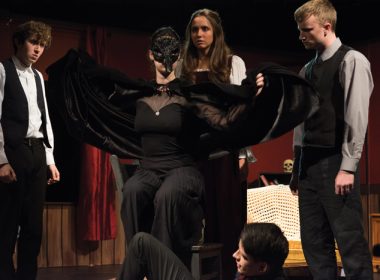
Set designers Riki Shimoda and Alizee Millot built compact interior spaces that created an insulating, claustrophobic effect. The muted red and yellow palette of the lighting (Shimoda) complements the grittiness of the set design. Additionally, the use of props is minimal, and their significance is not always clear. Alec’s mother (Asha Bittender, U2 Arts) wears a textured white mask throughout the play, but the production does not overtly elaborate on its meaning, nor venture into mask work with other characters.

Morrice Halls’s ample stage space feels underutilized at times, especially in scenes that involve multiple characters on stage at once. Their positioning is poorly choreographed, and actors sometimes walk behind each other, blocking their facial expressions and obstructing their speech. One scene, which takes place in a seedy strip club, stands out as an exception; Bishop-Mercier’s direction complements Marion and Worsely’s plotting at the downstage while Clegg enjoys a lap dance in the background, creating a meaningful scene that highlights the disjointed communication between the married but loveless couple.

TNC’s newsletter for Owners gives a content warning for “themes of mental illness and suicide.” Marion’s depressive employee (Sam Miller, exchange student Arts), makes one suicide attempt after another in an unsettlingly comedic fashion. Another major element of the play that viewers should be aware of before stepping in, however, are the patterns of gendered abuse.

At two hours long, the production sometimes feels slow paced; the shortening or removal of some scenes might have allowed for more compact storytelling. The climax of the story is not predictable, and its message is not hopeful; the play ends on a sinister note, but Bishop-Mercier’s rendition effectively undercuts the closing moment with a comedic irony that captures the heart of the plot. Characters in Owners do not learn any lessons by the end; in characteristic postmodern fashion, the play gives no clear answers, but raises challenging, subversive questions that its viewers can take home.

Owners runs from October 11-14 and 18-21 at Morrice Hall, Islamic Building. Tickets are $6 for students and QDF members (with card), and $10 for general admission. To reserve tickets, email [email protected].


ABCs of Science, Science & Technology

What’s under the hood? The ins and outs of your laptop

When most people think about computers, only a couple of images come to mind: A laptop or a desktop with internet-browsing capabilities.

However, a computer is much more than a tool for browsing Facebook feeds or doing school work. A computer is an information processor. It takes in raw information which is stored, later to be synthesized into a final result. This definition encompasses anything from a phone, to a digital camera.

First, an information processor takes in data in the form of an input. Inputs are any form of information given to a computer program. For example, the key strokes from your keyboard are keyboard inputs.

Next, the computer then stores this information in the form of memory until it is ready for use. There are two main types of storage that computers typically use: Solid state disk (SSD) storage and hard disk drives (HDD).

“A solid state drive is a larger, more sophisticated version of your traditional thumb drive,” Data Security, Inc.’s website states.

According to Data Security Inc., a SSD stores information on flash memory chips and thus is fixed while a HDD records data in the form of binary (0s and 1s) on magnetic disks. A HDD utilizes a mechanical arm and a spinning disk to read and write information to memory. Although both HDDs and SSDs both retain data when there is no power, most modern computers use SSDs due to their processing speed.

Once a computer is ready to work on some data, it will prompt the Memory Management Unit (MMU) to swap a copy of the information out of secondary storage (SSD or HDD) and into main memory, or Random Access Memory (RAM), where the processor can access the data more readily when needed.

After data is moved into main memory for processing, a microchip called the Central Processing Unit (CPU) will start performing rapid calculations on the information causing it to heat up. Finally, once the CPU is done processing the information, it will send the altered data out in the form of output.

Chris Woodford, a science author, explained how fundamental the process is to computer function.

“Everything a computer does, from helping you […] edit a photograph you've taken with a digital camera, to displaying a web page, involves manipulating numbers in one way or another,” Woodford wrote on his website.

A computer performs these calculations through an algorithm, or a series of instructions on how to solve a problem. Solving with an algorithm is like a recipe for baking a cake. In this way, a computer program is a series of instructions your computer follows automatically when prompted. This freedom seen in computer programs is what distinguishes software from hardware. Hardware is hard coded and difficult to change while software is malleable and promotes creativity.

The operating system (OS), or the ‘brain’ of your computer, manages all of the above functions, and controls the basic functionality of input, output, processing, and storage. Even the operating system has its own ‘brain’ called the kernel, which both handles low-level tasks such as memory management and interfaces between the OS and the hardware. Applications on your computer depend on the OS to carry out their chores and computations. For example, both playing an online game of solitaire and typing an essay on microsoft word rely on the OS to execute their functions.

Years of effort, research, and experimentation resulted in laptops as we know and love today, and users would benefit from understanding how these machines function.

Science & Technology

From beeps to dancing: The effect of the motor system on auditory input

In a recent study, Benjamin Morillon, a researcher at the Montreal Neurological Institute of McGill University and Sylcain Baillet, the head of the Lab at MNI that lead the study, took a look at the surprising relationship between the auditory system and the motor cortex of the brain. Both of these systems are just different ways to describe how the brain takes an input—like a compression of the eardrum from sound—and transfers it to the region of the brain where it can be deciphered and interpreted. Previous studies have shown that when the brain picks up on a sound and detects a rhythm, it’s physical pathways sync to that rhythm in order to process them.

Morillon and Baillet’s study aimed to disconnect an external rhythm from an internal representation, artificially separating noise stimuli outside the brain from the temporal rhythm inside the brain.

Baillet’s lab recruited participants and played two series of melodic beeps to carry out their study. The first beep-set was a melodic sequence of beeps that the participant had to keep track of, while the second placed extra beeps around the melodic target ones to act as distraction. The researchers observed participants’ abilities to judge whether the target melodies were higher or lower pitched than the reference beeps given beforehand. This test was performed two times, once as participants sat still, and the second with participants tapping their finger in a rhythmic fashion.

The lab then used a functional neuroimaging technique called magnetoencephalography, which measures magnetic fields created by naturally occurring electrical currents in the brain, to measure rhythmic neural activities in the participant’s brain.

“[Neuroimaging shows a] passive measurement of brain activity at the scalp level,” Morillon said. “Then, you have like 300 channels regarding electrodes [….] And then [you] try to guess where this activity comes from.”

Their results showed that simply activating the motor complex by tapping a finger sharpened the participants’ perceptions of sound and made it easier for them to correctly identify whether the target melodies veered above or below the  reference beeps.

When the motor cortex triggers motion in a rhythmic fashion, the auditory cortex can better predict when a sound will occur, and hence listen more carefully for it.

When the auditory input is simple, enacting the motor system doesn’t make a difference. It only gets activated when stimuli become more complex and varied.

Morillon noted that at cocktail hour, for example, when a noisy atmosphere makes concentrating on a single conversation challenging, head nodding or foot tapping  has been shown to increase attention to the conversation.

Another interesting time this connection can be observed is in a nightclub. When listening to music, the brain wants to focus on the sound input that it is receiving and decipher it.

When a song is in ‘the sweet spot’ and has a rhythm not too complex, nor too basic, the temporal lobe—the region of the brain used to decypher sound—figures out what it is hearing with help from the motor system.

“The music is grooving when the rhythm is a bit complex but you can still capture it,” Morillon said.

A more practical application of how this research will help people is in language rehabilitation, where the ability to focus on what is being said is crucial to the understanding.

A similar physical-auditory relationship does not occur with other senses, because other senses automatically use the motor system. For instance, when a person looks at something their eyes physically move to view it, when they touch something they move to touch it. When something is heard, it can be hard to control what specifically to pick up on.

In his next study, Morillon hopes to perform similar tests, using actual speech as opposed to beeps in order to gain a better understanding of how this relationship between sound and body occurs naturally in the environment around it.

Science & Technology

Three documentaries on Netflix to get you thinking about oceans

In an age where human interplanetary travel is nearing feasibility and our species occupies all corners of the earth, our fragile oceans still remain a mystery.

According to the National Oceanographic and Atmospheric Administration (NOAA), less than five per cent of the oceans have been explored. Documentary filmmakers everywhere have capitalized on the mysteries of the deep—and the not-so-deep—seas, where some of Earth’s most curious creatures are facing serious climatic hurdles.

The abyss of the Netflix catalogue boasts a large selection of marine documentaries; as a tribute to our evasive, albeit threatened, oceans, check out these three great documentaries to get water lovers with curious minds hyped about the deep blue.


Oceans (2009)

“The Mantis shrimp keeps a sharp lookout… he doesn’t take kindly to strangers.”—Pierce Brosnan, Oceans

Chock-full of unbelievable footage and filmed in 50 locations around the globe, Oceans is the Planet Earth of the underwater world. It features the incredible diversity of ocean life, ranging from predators like the Great White shark to the elusive Spanish-dancing sea slug.

For queasy viewers, the American version omits the usual horror-inducing predator-prey scenes to cater to all audiences.

Actor Pierce Brosnan performs the running commentary with well-timed wit and light-hearted humour to keep viewers on their toes. Oceans caters to anyone with a general interest in the ocean and the animals that live there.


Chasing Coral (2017)

“26 per cent of the Great Barrier Reef corals died in 2016.”Chasing Corals

Over 25 per cent of all marine life relies on coral reefs. Recent overwhelmingly disheartening news describes how these ecosystems have fared with rising global temperatures.

Chasing Coral, the successor to Chasing Ice, employs time-lapse cameras stationed all over the world to document the global coral bleaching events of the past few years.

Featuring never-before-seen underwater cameras—designed to withstand tropical storms and the ever-changing marine environment—it highlights one of the trendiest mapping projects underway: A 360-degree survey of the world’s coral reefs. Essentially an underwater Google Earth, the XL Catlin SeaView Survey substitutes a pricey vacation with a virtual snorkelling trip.

For those interested in how climate change impacts the ocean, this film offers visual proof of the devastation facing the world’s reefs and the hopes of saving them in astounding resolution.


Mission Blue (2014)

“[Jacques-Cousteau’s 1956 film] Silent World made me want to see what he saw: To meet fish swimming in something other than lemon slices and butter on a plate."—Sylvia Earle, Mission Blue

There’s no question that the oceans have changed drastically over the past 60 years. With a career spanning the better part of six decades, Sylvia Earle—marine biologist, conservationist, and ocean advocate—bore witness to these transformations.

This documentary focuses on Earle’s career, as well as the growth of her organization, Mission Blue. Mission Blue aims to create a global network of protected marine environments Earle calls “hope spots.” These protected areas are crucial to the health of the ocean, and identifying them is key in strategizing plans for future marine work. Revitalizing these damaged habitats can promote global stewardship toward the oceans.

As a woman in science, Earle has faced numerous challenges. At a time when academia was dominated by men, she proved her worth as the only woman—in a crew of 70—to work on the International Indian Ocean Expedition in 1964. Later in her career, she was the first woman offered the position of Chief Scientist to the NOAA.

With unrivalled enthusiasm, Earle gives a voice to that which cannot speak for itself. Mission Blue won the News and Documentary Emmy Award for Outstanding Editing in 2015, earning it a spot on any nature-documentary lover’s list.


Happy Netflixing!

 
Student Life

Top five places to cry on campus

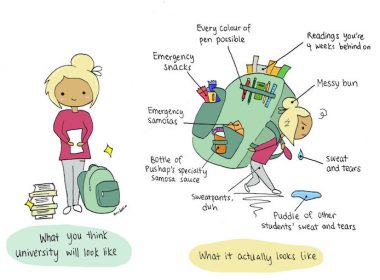
There are two types of McGill students: Those who admit to crying on campus, and liars. University is hard and stressful, and between the stress of navigating classes, extracurricular activities, and rough nights out, it’s cathartic to have a release a few tears when you need to. Crying on campus is by far the most time-efficient way of letting your emotions loose while also making it to your classes. However, McGill’s campus is huge, and finding the perfect spot to sob—that hasn’t already been taken—can be more stressful than your next midterm. To solve this dilemma, The McGill Tribune has compiled a list of the best places to cry on campus, for any occasion.

Cybertheque’s Premiere Moisson Cafe

Nothing heals a damaged spirit quite like a calorie-fest of bread, sugar, and chocolate. The Premiere Moisson (PM) in Redpath Library’s Cybertheque basement area makes it convenient for the occasions when you want to cry while eating a croissant. With their delectable desserts, fresh breads, and slabs of chocolate, PM is the perfect place to mend a heart broken by anything—from exes to exams. Order a hot chocolate and a slice of cheesecake, and proceed to fill the endless void in your life with carbs.

The steps of the Arts building

When you’re having one of those days—you know, when you’ve locked yourself out of your apartment, spilled hot coffee on yourself, and flunked your test—embrace the melodramatic side of your personality and the ultimate realization that life will always be painful and stomp on over to the Arts building. Maybe go inside first, play the score to Interstellar, and then walk out the main doors. Bonus points if you manage to slam the door on your way out. Throw a loud fit outside on the marble stairs: Tears, screams, the whole nine yards. If you’re lucky enough, a tour group or a throng of confused students might think that your tantrum is really a performance piece. They might even give you a couple dollars if you get really into it.

The SSMU lounge

Have you been pulling too many all-nighters and drinking too much coffee? Has your  ‘sleep-is-for-the-weak’ attitude led you down a dark hole of repeated long nights wasting away in front of your computer screen? Tears of exhaustion are a real, and unfortunately, very common thing to see on any university campus. It’s times like this when you need to get yourself to the SSMU building and cry, nap, then cry some more. Curl up on one of the couches or bean bags and let all that negativity out. If you’ve been too busy to eat, pop over to La Prep and grab a sandwich first. Either way, you can only enjoy SSMU’s luxurious amenities for another few months before its temporary closure—take advantage of it while you can!

The Macdonald Campus shuttle

Having an existential crisis? Don’t know what you’re doing with your life but feel like everyone else has it figured out? Take the shuttle to the Macdonald Campus, which comes in 35 to 45 minute intervals. The ride to and from the Mac Campus is over half an hour each way, and if you listen to sad music while crying and looking out the window, it’s almost like you’re in a music video. I highly recommend introspective songs, such as ‘The Climb’ by Miley Cyrus. Sing and cry at the same time, and at the same volume, and you just might make every other person on the shuttle feel as terrible as you do.

Your professor’s office

If you’re failing a class and have noticed exam season is right around the corner, it’s time to embrace Shakespearean dramatics. Barge into your professor’s office—preferably during office hours—and start bawling. Don’t say a single word; let the tears talk for themselves. Eventually, having a sobbing student in your professor’s office will weigh on their conscience and they’ll try to do everything they can to help, even if it’s just to get you to shut up. Fingers crossed that they remember you when grading and are a little more lenient, remembering your nervous—and awkward—breakdown.

Life at McGill is hard, and things will probably only continue to get worse over the course of your time here. So embrace your pain; go forth and sob. Just remember to make it to your next class on time.

Football, Men's Varsity, Sports

Concordia stings McGill Redmen football with Homecoming loss


McGill Redmen
10


Concordia Stingers
36


The fervorous crowds and cheerleaders at Molson Stadium for the Oct. 14 homecoming football game couldn’t help the McGill Redmen (1-5) overcome the Concordia Stingers (3-3). As the clouds eclipsed the only sunlight early in the second quarter, McGill’s momentum fell apart and Concordia ran away with a 36-10 victory.

The Redmen got off to a good start but fell behind due in part to poor discipline, committing 18 penalties for 150 yards by the final whistle.

“We had some good drives as far as offence and defence goes,” third-year linebacker Dane Wagner said. “It just comes down to the fact that we had way too many penalties. We didn’t play disciplined. You can’t win with that many penalties.”

Concordia got its first touchdown just three minutes into the first quarter after a 64-yard pass allowed a Stingers receiver to sprint uncontested into the Redmen endzone. McGill’s difficulty covering wide receivers hurt them in the first half, but the team managed to hold Concordia back in later standoffs.

“I think they completed early, then I think we buckled down and played some pretty solid defence after that,” McGill Head Coach Ronald Hilaire said. “Obviously the penalties hurt us a lot, with offsides and all that stuff keeping drives alive for them [….] We’ve got to be better.”

The Redmen had a brief surge of energy at the end of the first quarter and the start of the second, scoring a touchdown and a field goal back-to-back. However, flags nullified two of the Redmen’s touchdowns and killed their momentum, leading to 22 unanswered points by the Stingers.

“We could have played better for sure,” second-year defensive lineman Andrew Seinet-Spaulding said. “We were undisciplined, and it paid for Concordia, so we’ve got to be better next week on discipline because it really hurt us.”

Despite the sting from Concordia, there is still hope for the Redmen to make the playoffs this season. The Oct. 21 home game against The Sherbrooke Vert et Or will decide if McGill will make it to the conference semifinals. McGill won narrowly against Sherbrooke earlier in the season, but whether or not the Redmen can replicate that success is still up in the air.

“As usual, we’re going to do the film, we’re going to correct this and move on,” second-year wide receiver Jeremy Sauvageau said. “And then three good practices, or four even. We’ve got to win this one, so we’re going to do everything we can so that we can win this game.”


Moment of the Game

A failed field goal at the end of the first quarter landed in Concordia’s hands, but the Stingers fumbled and Redmen defensive back Vincent Dethier snatched the ball in the endzone for the first and only McGill touchdown of the game.


Quotable

“If we do our thing, we’ll beat anybody in this league” – second-year defensive lineman Andrew Seinet-Spaulding optimistic heading into the next game.


Stat Corner

Since joining the RSEQ conference in 2010, the Redmen have yet to win a homecoming game.


Arts & Entertainment, Film and TV

‘Blade Runner 2049’ sets a new standard for Hollywood sequels

For decades, it seemed like a Blade Runner (1982) sequel was doomed to be an artistic failure. Arguably Ridley Scott’s magnum opus, the cyberpunk cult classic lives on in major part because of its absolute disinterest in offering clear answers to the questions it raises. The prospect of a follow-up threatened to needlessly cast light on the cryptic ambiguities of the classic, dragging the original down in the process. Throw in the near-impossible task of both staying true to and expanding upon one of the most singular achievements in modern cinema, and it becomes unfathomable how anyone could be successful.

That’s where Denis Villeneuve comes in. Fresh off celebrated films Sicario (2015) and Arrival (2016), the Quebecois filmmaker has quickly become an unlikely Hollywood favourite, crafting artful box office hits out of increasingly grander genre experiments. Master of creating tension out of thin air, obsessed with the human condition, and renowned for his meticulous visual style, the French-Canadian director was born to helm Blade Runner 2049. It is his best film to date, and easily one of the greatest science fiction films since, well, Blade Runner.

The sequel takes place 30 years after the events of the original. It follows “blade runner,” K (Ryan Gosling, definitely in his Drive (2011) mode rather than La La Land (2016)). K is working for the LAPD in pursuing “retiring” (read: Murdering) rogue members of older generation replicants—bioengineered human-like androids that, after years of slavery, have been integrated into society to ensure humanity’s survival. A specimen of a newer brand of more subservient replicant himself, K discovers the bones of a once pregnant replicant while on a mission. Entrusted with the secret responsibility of finding the child and destroying all evidence of its impossible birth—replicants are believed to be infertile—he embarks on a journey in the footsteps of exiled veteran blade runner Rick Deckard (Harrison Ford, reprising his role with careworn panache) and draws him closer to the essence of humanity itself.

Hampton Francher, one half of the original’s screenwriting duo, is back 35 years later to once more transcend film noir, this time with an original work (Blade Runner was a loose adaptation of the Philip K. Dick’s Do Androids Dream of Electric Sheep? (1968) novella, for which the author never wrote a sequel). Widening the dystopian universe in clever ways, raising the stakes without going absurdly over-the-top (looking at you Marvel), introducing a handful of characters worthy of their predecessors, and deepening the original’s mysteries, Blade Runner 2049 effectively acts as guide on how to write a rewarding sequel.

Akin to the series’ first instalment, however, the film’s form is almost more important than its content. Scenes linger on, stretched to maximum capacity to allow the richly textured world of visionary cinematographer Roger Deakins to take center-stage: Be it a smoky, neon-blue Los Angeles forever mired in nocturnal showers, a sunbaked Las Vegas turned into nuclear wasteland, or an abandoned farm drowning in thick white fog, the visuals are consistently jaw-dropping. Coupled with a show-stopping sound-design that sucks viewers right into the screen, the film becomes an audio-visual experience for the ages, one that barely needs the narrative it supports. The cast, especially scene-stealing unknowns Ana de Armas (K’s hologram lover Joi) and Sylvia Hoeks (villain Niander Wallace’s (Jared Leto) chilling assistant Luv), is spectacular all-around. Cold, slow, and grandiose by every metric, Blade Runner 2049 perfectly recaptures the detached coolness of its predecessor.

With this new entry in his filmography, Villeneuve injects a much-needed dose of visual poetry and thematic complexity to a genre that too often seems to work against its lush, cerebral roots. It might not be the cinematic revolution Blade Runner was, but as far as high-end spectacle goes, 2049 sets a new standard.

Album Reviews, Arts & Entertainment, Music

Album Review: ‘There Is No Love In Fluorescent Light’ – Stars


Since the release of their first album Nightsongs in 2001, Canadian indie pop band Stars has centred its songwriting around strained love. Usually holding on by a thread, though interspersed with spells of enamoured enchantment and thrill, the band’s lyrics stare out on the brink of darkness, loneliness, and death. Lead singers Torquil Campbell and Amy Millan’s dual vocals and narratives often cast two characters trying to either understand or get over one another, as lonely, lovestruck figures so often do. While the five-person band’s instrumentals are always solid—the grit of the electric guitar in contrast with Millan’s soft, yearning voice forms album highlight, “Privilege”—the complementary, hypnotic vocals and haunting lyrics are what continue to make Stars so mesmerizing.

Released on Oct. 13, Stars’ latest album, There Is No Love In Fluorescent Light, plays off their melodic, conversational style. As Stars have matured, their focus has shifted away from captivating morbid fantasies, like older tracks “Calendar Girl,” “Dead Hearts,” and “I Died So I Could Haunt You,” to a more reflexive, nostalgic, and melancholic-yet-serene state.

“We Called It Love” epitomizes Stars’ signature duet style. Two ex-lovers reminisce about a failed yet inescapable past relationship from their respective—yet ironically similar—points of view. “I don’t suppose you remember me / I was the one who set you free,” sings Campbell to an ex. “We used to call it something / we called it love,” agree the two in pensive unison, simultaneously on the same page and talking past one another.

Conversely, “Fluorescent Light” is an upbeat attempt to rejuvenate a comfortable but fizzling relationship. Campbell’s persona is one of slight resignation and denial, while Millan’s attempts to spark the adventure that has been lost amid routines of daily monotony.

Some songs—such as “California, I Love that Name” and “Alone”—are a bit repetitive and lacking in depth. However, their content fits nostalgic threads to the album: “California, I Love That Name” longs for a time and place without worries and obligations—a kind of utopia “free from the past, and free from the pain.”

Stars continue to tackle familiar fears of desertion in songs like “Losing To You.” “On The Hills” exists in a dreamlike trance of loss and disbelief, with fuzzy, faraway, high-pitched vocals: “Could it be it was only a dream?,” asks Millan. Similarly, in “Hope Avenue”—a song with beats that seem to echo New Order, one of the band’s inspirations—the past mars the present, as memories continue to hold people back.

In the end, as the final track’s title indicates, we are all just “Wanderers.” Although not the most exciting melody, it sums up the album’s ephemerality and closes it on a note that is neither here nor there. Just as the opening number “Privilege” chides, you “Never got what you want / you forgot what you want.” It’s a story of two protagonists haunted and torn by roots of a shared past that both soothes and torments, which they can neither let go nor return to.


Read the latest issue

Read the latest issue