Latest News

Football, Know Your Athlete, Sports

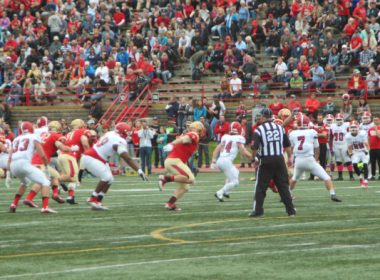
In conversation with NFL Director of Football Development Samantha Rapoport

“I’ve always known I wanted to work for the NFL,” Samantha Rapoport said. “It was a dream of mine since I was young.”

Rapoport, a McGill alumni, is the NFL Director of Football Development, a position tasked with developing the game in order to connect qualified people with NFL jobs. Born in Vancouver, Rapoport isn’t a typical candidate for a high ranking position within the league. Her position was previously occupied by former Baltimore Raven Matt Birk.

In her second year studying kinesiology at McGill, Rapoport tried to get a job in the NFL. After getting rejected, she decided to get creative and re-apply.

“[I] thought about how to stand out as a female from Canada with no connections to the NFL, other than that I just loved playing,” Rapoport said. “I kind of came up with a creative way to apply, [I literally] wrote something on a football and that’s how I obtained my first internship and then I went up from there.”

Rapoport’s father sparked her interest in Football. He was a die hard Dolphins fan and a quarterback on the McGill Redmen.

“My dad […] had two girls so he didn’t think we would become interested in football,” Rapoport said. “But he always says there’s a football gene and it must have gotten passed down to me.”

From a young age Rapoport played girls flag football before playing tackle football in her later years. Her successful sporting career eventually led to national honours.

“I played for the Montreal Blitz–the female tackle football team in Montreal,” Rapoport said. “I also played a flag football team since I was 12 years old. I played as quarterback for Team Canada and have just been so heavily involved in football […] so I wanted to stay on the football side of the business if I could.”

Over the years, Rapoport has worked extensively in developing youth and girls flag football programs. Between 2010 and 2016 she worked for USA Football where she oversaw youth engagement programs as well as the creation of the USAF-NFL Girls Football Program. In 2009, she won the NFL Commissioner’s Award for Innovation for developing a leadership program that enabled girls to start flag football programs at their schools.

Now, as the Director of Football Development, Rapoport has a mandate to connect qualified women with NFL jobs. She has had a positive experience with the NFL and wants to extend that experience to other women.

“This is my 14th NFL season and I honestly mean this, I have never experienced any feeling of not feeling welcome,” Rapoport said.

She is determined to break down perceptions of football as an exclusively male sport.

“The first step is to show them visually that females can fill these positions and that they have power in sport,” Rapoport said. “The second step is changing the culture of the hiring managers within the organization to show them that females can be very successful and explain to the them the benefits of having gender diversity within your organization.”

According to Rapoport, the NFL wants to encourage gender diversity.

“We are going to identify, train, develop and connect qualified women to the NFL so people stop thinking it’s an ‘old boys network,’” Rapoport commented. “Men in the industry are generally very open to the idea, it’s just that a lot of our head coaches are very busy guys and they just don’t know where to find these females.”

Rapoport believes the central issue with the lack of female representation in the industry stems from a shortage of interested and eligible women in close contact with leading NFL figures.

“We recognize that a lot of jobs across the board are all procured from informal social networks,” Rapoport explained. “A lot of the time it’s who you know […] it’s easy to just pick someone who looks like you.”

Alongside her mission to promote gender equality in the NFL, Rapoport will also be working to ensure equitable minority hiring practices in the NFL. The NFL implemented the Rooney Rule in 2002, which required that all NFL teams have to interview at least one minority candidate for head coaching positions. Recently, the policy has been criticized for producing modest increases in non-white head coaches since its inception.

“I think we’ve made waves,” Rapoport said. “There’s a debate about whether or not the Rooney Rule has been successful and I would say it has been successful [.…] I think our numbers can be better and that’s why we are dedicating this much programming to helping achieve higher numbers as far as minorities are concerned at the head coach, general manager, and other coach levels.”

Rapoport believes she is well positioned to give back to a game that has given her so much.

“I’ve always been in love with the sport and still am,” Rapoport stated. “I just knew that it’s what I was put on this planet to do. I was put here to help make the game better and stronger, so I’m really lucky to be in the position I find myself in now.”

If Rapoport’s mission is successful and more women join the NFL ranks, the future is bright for the sport. While it may seem unlikely today, having a woman calling the shots from the sideline might soon become a reality.

“I will be very excited to celebrate the first female head coach,” Rapoport said. “I believe we can achieve that in our lifetime.”


Favourite NFL team: “I grew up with a father who was a Dolphins’ fan and I was a Cowboys’ fan.

Favourite quarterback: “Troy Aikman. I got to work with him on an event […] and I had to pinch myself pretty hard.”

Favourite McGill professor: “Donald Taylor. He was a Social-psychology professor and always referenced so many interesting studies. So many of his theories stuck with me and I constantly find myself referencing them.”

Favourite study spot: “Second Cup on Parc, the library was too quiet for me.”

Montreal deli fan or New York deli fan: “100% Montreal deli, Montreal bagels [too.] I’ve been [in New York] for 14 years or so but I will never get used to New York bagels. Montreal is the best to me!”


A former version of this article incorrectly stated that Sam Rapoport had worked for USA Football between 2010 and 2013. She worked for USA Football from 2010 to 2016. The Tribune regrets this error.

Science & Technology

Federal government to impose contentious national carbon pricing: Pan-Canada climate plan provokes debate

“We [are] all united in our commitment to stepping up in the fight against climate change, to ensuring that we have a Canadian approach to climate change,” Prime Minister Justin Trudeau said in a press conference last November.

While Liberal government has made many statements on climate change, until now, there had been very few concrete strategies proposed.

To limit the private sector’s dependency on fossil fuels, Canada’s federal government plans to implement a minimum carbon price for provinces that do not have adequate carbon pricing schemes. The Canadian Minister of Environment and Climate Change, Catherine McKenna, said on Sept. 18th to CTV’s podcast Question Period that the federal government will present these plans to Parliament in early fall.

The Globe and Mail explained that the minimum carbon price that will be enacted would try to reach the United Nations’ 2030 goal of lowering greenhouse gas emissions to 30 per cent below 2005 levels.

According to the CBC, there are currently only four provinces that either have or plan to have a carbon pricing scheme. British Columbia and Alberta have a carbon tax scheme while Quebec and Ontario have a plan to implement a cap-and-trade system.

“Any system that puts its price on carbon is going to have the same exact effect,” Assistant Professor Christopher Barrington-Leigh of McGill’s School of Environment said. “So, the mechanics of whether it’s just a tax where everybody knows what the price is or it’s a cap where everybody knows what the amount of emissions is, […] in the end, they have a lot of similarity and to the extent that you can guess the price and what the price [is going to be] in the future, then they have the same incentive for businesses.”

The plan to have a minimum carbon price attracts criticism from all sides. Environmentalists believe that the Liberal Party’s carbon pricing plan is unambitious and that the federal government should set a higher target.

“To pick a target in 2016 that is the same one left behind by [former Conservative Prime Minister] Stephen Harper, that doesn’t fall due until 2030, is irresponsible and is an abandonment of leadership,” Green Party Leader Elizabeth May told The National Post.

The Liberals have responded that Harper’s government created the targets with no accompanying plan to reach their goals. The new carbon pricing scheme, by contrast, presents specific actions to reach the carbon level target.

Conservatives, on the other hand, believe that the government enacting a minimum carbon price shows that they have completely abandoned coordinating with provinces on carbon policy. The fiercest opposition comes from Saskatchewan Premier Brad Wall, who not only believes that the Liberals have abandoned their cooperation with provincial governments, but also are antagonizing the already struggling energy sector.

Meanwhile, Barrington-Leigh believes that imposing a clear federal pricing scheme would increase the transparency and clarity of incentives for private companies. The federal pricing scheme would make it easier for companies to look to more renewable energy sources while still reaching their emissions-reduction targets.

“You have huge amounts of capital [to] invest in […] multi-billion dollar projects,” Barrington-Leigh said. “Energy companies are diversifying, so if the incentives were clearer and stronger to invest in renewables, then that capital and the labour forces would be shifting smoothly and more gradually in the way they should. The less smooth and gradual it is the more […] the public will have to bear the cost of retraining [….] Then you would have more waste, layoffs, and capital doing the wrong thing.”

Despite the controversy surrounding a minimum carbon price, the Liberals plan to implement the policy before COP22, the United Nations summit in Morocco, in early November.


A previous version of this article incorrectly stated that Christopher Barrington-Leigh is an Associate Professor. In fact, he is an Assistant Professor. The Tribune regrets this error. 

Baseball, Behind the Bench, Sports

The end of an era: A tribute to the great Vin Scully

When Vin Scully first started broadcasting Dodgers games in 1950, baseball had just desegregated. Mickey Mantle and Hank Aaron were the league’s MVPs and New York had three baseball teams. Dodgers games took place in Brooklyn, far from the current swashbuckling, free-spending Los Angeles iteration of the team. In those days, Vinnie’s voice was the city’s summer soundtrack, filling a city that buzzed during the peak of the American Dream.

Scully’s six-decade tenure, which comes to an end on Oct 2, seemed to knit baseball’s various epochs together. The red-haired, Bronx-Irish tenor’s perfectly-inflected words transformed each baseball game into a gripping, unfurling narrative. 

During his Brooklyn Dodgers days, in the heyday of radio, Scully voiced the hopes of a whole borough with an eloquence surpassing his years. The young Scully was a recent Fordham graduate who had been in centrefield for the school team, while singing in a barbershop quartet and announcing football and basketball games. As soon as his voice rang out from the radio, Scully assumed the role of a familiar poet, an uncle-like figure to all those casually listening to a baseball game. 

Scully’s simple, descriptive storytelling captured listeners’ attention as though he were sitting in the bleachers and chatting with them. Scully’s commentary—unlike conventional colour-commentary broadcasters who stay silent during plays and then evaluate after the fact—ranged from player anecdotes to historical events. Some commentators build walls of jargon in front of the listener, barring them from appreciating the raw beauty of the game. Scully, however, speaks as though he’s shooting the breeze with an old friend. His ability to see the humanity in baseball elevated him above most commentators stuck in a uniquely baseball frame of mind.

With the Dodgers’ move to California, Scully shifted from the working-class bustle of Brooklyn to the glitzy stage of Los Angeles. His move westward connected a nation by spreading baseball from the eastern seaboard to the Californian beaches. Scully wasn’t so much a commentator as a frontiersman spreading the story of baseball. 

Scully’s timelessness rests in his extraordinary narrative ability. Of his repertoire, many incontrovertible touchstones of baseball history stand out: The Brooklyn Dodgers’ last championship in 1955, Sandy Koufax’s perfect game in 1965, Hank Aaron’s then record breaking 715th home run, to Fernando-mania, and of course, the “she is gone” Kirk Gibson home run in the 1988 World Series. He wears the laurel as baseball’s bard for a reason. He’s recorded baseball and American cultural history for generations of baseball fans. Grandparents are now telling their grandchildren about Vinnie from the Bronx, Vinnie from Brooklyn, and The Voice of the Dodgers. 

On Sunday Sept. 25, Scully’s last home game entered the ninth with the Dodgers down 3-2 to the Rockies. On their last out, presumable NL Rookie of the Year Corey Seager ripped a homer to right field to tie the game and give Scully a chance at a storybook ending. In a game where Dodger stars all tipped their helmets to the retiring legend, the dramatic ending came courtesy of career backup Charlie Culberson hitting a walk-off tenth inning home run—his first in two years—to clinch the NL West title.

It was inevitable, the Baseball Gods wanted to give Scully a chance to commentate one last memorable moment. 

When generations of young broadcasters look back for inspiration, there’s no doubt they’ll listen and learn from the greatest.


Check out what Jonah Keri had to say about Vin Scully in a Tribune exclusive podcast on mcgilltribune.com/sports


A former version of this article incorrectly stated that Brooklyn Dodgers's last World Series championship was in 1959. However, they moved to Los Angeles in 1957. Their last championship in Brooklyn was actually in 1955. The Tribune regrets this error.

Editorial, Opinion

Advertisements in SSMU: Brought to you by lack of funding

Observant students returning to campus this year may have noticed something different about the Students’ Society of McGill University (SSMU) Building. In response to continued budgetary constraints, SSMU has—among other initiatives—increased the presence of advertisements. However, the advertisements have been met with backlash from some McGill students, leading some to accuse SSMU of “corporatization.” Much of the criticism was fuelled by an incident at Activities Night, where the presence of a promotional booth from the bank Tangerine upset participants.

SSMU’s turn towards corporate advertising and sponsorship for revenue needs to be considered in a broader context. It is important to remember that the turn to advertisements is the result of continued budgetary problems at SSMU, for which the student body also bears a share of responsibility. The move is not a sign of increased corporatization within SSMU, but rather a reflection of the desperate financial state that has resulted in part from the growing student disengagement and distrust of SSMU.


Students are right to speak up if they feel that their student society is erring in the wrong direction, but they must pair their concerns with a willingness to work with SSMU to reach a favourable solution.

As a student society, SSMU is responsible for funding many of the valuable campus services students might take for granted. This funding is made possible through a base fee collected from the student body every semester. But, in a Winter 2016 referendum question, students voted against the $5.50 per semester increase to the base fee paid by students; the motion failed by the narrow margin of 0.3 per cent. The failure to pass the base fee increase was undoubtedly the product of the chronic disengagement that has plagued McGill student politics—only 17.5 per cent of eligible students voted in the online referendum in Winter 2016.

SSMU’s 2016-2017 budget implemented severe cuts to cope with the failure of the base fee question: The society is currently not accepting applications for new student clubs, and has scrapped its annual yearbook in an effort to cut $230,000 in spending. In order to avoid further budgetary constraints, the Society has been forced to resort to other revenue streams, resulting in the turn to corporate advertising in the SSMU Building this year. Those who chastise SSMU for turning to sponsorships to pay its bills must remember that student voters, or lack thereof, are responsible for the society’s pursuit of alternative revenue streams.

Furthermore, while the changes at SSMU involve corporate sponsors, such activity does not reflect corporatization. The charge of corporatization implies that SSMU is allowing corporate interests to dictate its decision-making process; however, the simple fact that SSMU now relies on corporate sponsors does not necessarily mean these advertisers wield any influence over SSMU’s policies. It should also be noted that any advertisement displayed in the SSMU Building must be approved by SSMU.

If anything, the agitation over corporate advertising in the SSMU Building should serve as a reminder that SSMU works best when the student body remains positive and engaged. Students are right to speak up if they feel that their student society is erring in the wrong direction, but they must pair their concerns with a willingness to work with SSMU to reach a favourable solution. If the student body is truly concerned about SSMU’s reliance on corporate advertising, then it must find an acceptable way to support their society financially. Likewise, SSMU can help address the issue by making clear that the rise in corporate advertising is directly due to the failure of the base fee increase while urging the student body to reconsider an increase in the future.

An understanding of the nature and causes of SSMU’s current predicament must form an essential part of any discussion of the society’s turn towards corporate sponsors. Both SSMU and the student body have a crucial role in resolving issues surrounding SSMU’s shifting streams of revenue. Ultimately, SSMU provides essential funding and support to both individual students and student-led clubs and services. Given the failed base fee increase, corporate sponsorship is an understandable course of action.

Jonah Keri
Baseball, Sports

McGill Tribune Sports Podcast: In Conversation with Jonah Keri

Sports Editor Aaron Rose chats with renowned Sports Illustrated and CBS writer Jonah Keri–one of the best journalists in the business–about baseball and life outside of sports. They talk about baseball’s return to Montreal and the possibility of expansion in Mexico City (1:06). They then dive into the AL East (4:05), MLB awards (13:05), and if the Cubs are a lock for the World Series (17:07). Keri shares his stories about meeting Vin Scully in the washroom (18:04), about his time at Grantland, and working with Bill Simmons (20:28). They discuss Keri's favourite moments in his career, his perspective on the state of the industry, and advice for young journalists (23:02). Keri talks about the movie “Spaceman,” about the crazy life of Bill “Spaceman” Lee (36:13). Doing his best Jonah Keri impression, Aaron asks Keri to share his best piece of life advice (39:55).

[soundcloud url=”https://api.soundcloud.com/tracks/284803489″ params=”auto_play=false&hide_related=false&show_comments=true&show_user=true&show_reposts=false&visual=true” width=”100%” height=”600″ iframe=”true” /]

Want to meet Jonah Keri? He’s going to be at the screening of “Spaceman” on Oct. 1 at the Cinema de Sève in the Webster Library at Concordia University (1400 Boulevard de Maisonneuve Ouest, Montreal, QC). For information on how to get tickets, visit: 

https://www.eventbrite.com/e/spaceman-screening-and-panel-tickets-27711710472

McGill, News

McGill Senate raises concern over high rates of sexual harassment complaints

At its first meeting on Sept. 21, the McGill Senate reviewed reports on research misconduct, sexual harassment, and social equity from the past year. During the session, Senate appointed a new assessor under the Policy on Harassment, Sexual Harassment and Discrimination Prohibited by Law, and laid out the plan for the finalization of McGill's Territorial Acknowledgment statement.

Research Misconduct

Dr. Abraham Fuks, professor in the Departments of Medicine, Pathology, and Oncology, and last year’s Research Integrity Officer, presented the Annual Report Concerning the Investigation of Research Misconduct. The report analyzes incidents in the past year and compares them to cases from prior years.

“The number of allegations are stable over the past number of years, which is good news,” Fuks said.

According to Fuks, in 2010, 83 per cent of research misconduct allegations came from within McGill, while this year most allegations came from external sources.

“[Allegations in the past year] have come regularly […] from external entities,” Fuks said. “Mostly [from] colleagues elsewhere or […] journals who have noticed an irregularity in reviewing a manuscript that was submitted.”

The report noted that all allegations this year proceeded to investigation or inquiry. Of the 33 allegations made in the past six years, only seven were dismissed. 

“[McGill researchers] have undergone a fairly rigorous internal process,” Fuks said. “So the rate of findings of misconduct seems high only because they’ve done the first cut.”

Sexual Harassment

Associate Provost (Policies, Procedures, and Equity) Angela Campbell presented the Appointment of Assessors Memorandum and the Annual Report on the Policy on Harassment, Sexual Harassment & Discrimination Prohibited by Law. Due to an increase in reported incidents of harassment from 23 in the 2014-2015 to 39 in the 2015-2016 academic year, the university has improved the training and number of staff members dedicated to receiving and investigating these incidents. 

The number of assessors has been increased from eight to 10 and their training has become more rigorous. In addition, Dr. Natalie Oswin of the Department of Geography was voted the new Harassment Assessor. According to the Appointment of Assessors Memorandum, Oswin was chosen for her experience working with queer and postcolonial theory. Assessors directly handle all complaints of violations of the Policy. 

“We increased the level and the quantity and quality of assessors’ training […] to enhance its professionalism,” Campbell said. “We had monthly meetings last year in addition to a two-day training retreat [….] The training was on issues of process, how can you be an effective assessor and a fair assessor, but also on substance, so, the meaning of the three grounds on which individuals can bring forth concerns or complaints.”

This retreat involved training by individuals from the Social Equity and Diversity Education (SEDE) Office, an organization that aims to cultivate a more inclusive campus through training and education. To aid the assessors, the role of Senior Equity and Inclusion Officer was created. The individual chosen for the role in Fall 2016 will mediate between sexual harassment complainants and the university.

“She or he will be responsible for the intake piece, advise them on what options are available for someone who comes with an inquiry, and then will also have a role with respect to facilitating an informal resolution where that’s desired by the party,” Campbell said.

Senators raised concerns over a figure showing that 72 per cent of complaints of sexual harassment and discrimination at McGill did not move beyond the initial inquiry phase.

“It’s a really big decision [for complainants] to proceed with an investigation. There [are] also questions of ‘does this fall under harassment?,” Campbell said.

Social Equity

Campbell also presented the Annual Report of the Joint Board Senate Committee on Equity (JBSCE). The JBSCE is mandated to look at the status and recruitment of underrepresented groups on campus, which includes visible minorities and Aboriginal peoples. The report reviewed the activities of its six subcommittees in the past year. The Subcommittee on Queer People has been coordinating with IT services to implement the use of preferred names on McGill online platforms.

“MyCourses is tricky,” Campbell said. “The systems in place–the IT systems are not all aligned– so this makes it quite complicated. We’re engaging [IT Customer Services (ICS) …] in terms of helping us understand where the challenges lie.”

The Subcommittee on First Peoples reached consensus on its Traditional Territory Acknowledgment, which recognizes McGill’s settlement on Haudenosaunee and Anishinaabeg sites of meeting and sets forth an agenda for consultations with these groups.

“The goal is to allow them to continue [with consultations] so that the Subcommittee can then finalize its Territory Acknowledgment statement,” Campbell said. “The statement that has been put out is the statement that is used for now, but once the subcommittee returns with what it sees as its own finalized statement […] there [will be] a possibility to revisit the statement that was issued.”
 

Student Life

B-Week: Revamping Gerts’ image

From Sept. 12 to 16, many McGill students found themselves at Gerts drinking from pitchers of beer and conversing spiritedly over loud music. Though this may sound like any normal week in the familiar student bar, this time the drinks were even cheaper and the music louder. This was B-Week: An event that aimed to reintroduce Gerts to the student body.

After several poor fiscal years for Gerts, the Students’ Society of McGill University (SSMU) planned B-Week as an effort to revamp the student bar’s image.

“[Gerts] was producing quite healthy profits up until two to three years ago, and this was due to [a] migration of student-run activities […] like Hype Week or Carnival,” SSMU Vice-President (VP) Finance Niall Carolan elaborated about the challenges that Gerts has faced in the past couple of years. “[These events] used to be majoritively based out of Gerts [and] have now moved away to other private locations off campus.”

In addition to a decrease in student-led events occurring at Gerts, it doesn’t help that the current construction on McTavish Street has caused a drop in foot traffic at the bar. For both reasons, Carolan believed that new efforts are now needed to bring students back to Gerts.

“In previous years, we just relied on students to turn up […] as opposed to actively seeking out students and student groups,” Carolan said.

The bar is one of SSMU’s main revenue-generating operations, and is run entirely by students. It provides many job opportunities, the quantity and availability of which rely heavily on Gerts’ fiscal success. As such, the recent dip in profits and downward trend in attendance has led to a reduction in salaries in order to cut labour costs over the past year.

To overcome these challenges, B-Week was created as a week-long incentive to actively draw both new and returning students in and reinvigorate Gerts as a campus bar. It was no coincidence that B-Week was timed according to the beginning of the school year.

“We need to be actively promoting ourselves to important and […] influential student groups on campus,” Carolan said. “And, we wanted to try and build off the momentum of Frosh and OAP.”

To increase patronage, Gerts offered extremely low prices on drinks throughout the week, including $7 pitchers of beer and $2 shooters.

[metaslider id=46587]

“We just really reduced our margins with the hope of increasing volume,” Carolan said. “We quadrupled our sales, so we did better than an average week, which is good to begin with, but even then that wasn’t necessarily the goal. My goal was just to get people through the doors and show them what Gerts has to offer.”

For Carolan, B-Week was a way of giving students a refreshing new outlook on the bar and showing them a space where they can hang out and socialize in the evenings.

“The benefit from those revenues doesn’t stop at that one week,” Carolan explained. “I know that if people had a good time they will likely want to come check it out later on.”

Tim Mapley, U3 Arts student and bar manager at Gerts, echoed Carolan’s sentiment.

“What we really wanted to do this year was show that a) Gerts exists, and b) it’s a fun place for […] the student population to come hang out,’ Mapley said. “[We were] really just [trying] to revamp our image.”

B-Week allowed new students at McGill to discover the bar and its cheap drink deals, and returning students had the opportunity to catch up with friends in a familiar setting.

“Just about everyone I’ve heard from enjoyed the event,” Carolan commented. “From the […] bartenders, to Alessandro [Sangiovanni], the Food and Beverage director [at SSMU], and most importantly the students as well [….] I considered the inaugural B-Week a resounding success.”

Ryan Ehrenworth, U3 Law, confirmed the positive student response after spending three nights of B-Week at Gerts.

“I thought it was a very good move by Gerts in general because it attracted customers during the week, and made a lot of [‘broke’] students really happy,” Ehrenworth said.

Furthermore, the increase in attendance at B-Week compared to other Gerts events was very clear. The bar was consistently packed with students throughout the week, and the line at the door often reached outside of the SSMU Building. 

“We had people that were there every day of the week, and our Coyote Ugly event was very popular as well,” Mapley said. “The challenge for us in operations was just having enough pitchers for everybody because we consistently sold a lot of beer.”

B-Week probably won’t be the only time this year that Gerts managers battle increasing demand for drinks. Gerts’ popular Oktoberhaus and St. Patrick’s Day events are set to provide more opportunities to boost revenue by selling drinks. Furthermore, according to Carolan, the iconic student bar will be piloting new events this year.

“We are reaching out to more faculty executives to get more events in Gerts,” Carolan said. “More campus events, more student events like Hype Week and Carnival, and not necessarily just drinking events either. It’s really just about engaging the student population.”

After the clear success of B-Week, Gerts has started the school year on a strong note. With promises to actively host many other events throughout the year, the future of Gerts’ reputation is looking up.

Student Life

Breakfast, lunch, and dinner on a budget: A day of recipes for under $7 each

You’ve finally made it out of rez and into your own apartment. On one hand, you no longer have to wait until 1 p.m. to eat on the weekends, and you don’t have to suffer through any more mystery meat from Bishop Mountain Hall (BMH). On the other, you’re technically an adult now and have adult-like responsibilities—which include buying and making your own food. With Wi-Fi bills, textbook prices, and a social life, it can be hard to budget. For this reason, The McGill Tribune has compiled a short list of healthy vegetarian recipes to eat for breakfast, lunch, and dinner. 


BREAKFAST: Veggie Breakfast Sandwiches

Freezer Ready Breakfast Sandwiches V
(budgetbytes.com)


This recipe is pretty versatile—you can bake almost any vegetable into the eggs that you want, as long as you sauté them a little bit before. You can freeze the eggs after you make them and save them for a quick and easy breakfast later on. Since the preparation time is about 30 minutes, you could easily cook it the night before if you don’t want to get up extra early to make these. 

INGREDIENTS

  • 6 large eggs ($1.50)
  • ½ cup milk ($0.19)
  • ½ tsp salt
  • Freshly cracked pepper
  • ½ lb. frozen cut leaf spinach ($0.80)
  • ½ 12oz. jar roasted red peppers ($1.25)
  • 6 English Muffins ($1.99)
  • 6 slices cheese ($1.72)

INSTRUCTIONS

  • Preheat your oven to 350º F. Meanwhile, whisk together the eggs, milk, and salt. 
  • After thawing out the spinach, squeeze out the extra moisture. Dice the roasted red peppers and mix them into the egg mixture, along with the spinach. 
  • Butter an 8×12 inch casserole dish and pour in the egg mixture. Bake for about 30 minutes, or until the middle feels firm. Once the eggs have cooled, cut them into six pieces. 
  • Toast an English muffin, then stack a piece of egg and a piece of cheese on top of it. 
  • Wrap the remaining egg pieces in plastic wrap and freeze until you’re ready to eat it. It can last for up to two months. 
  • To reheat, unwrap and place on a piece of paper towel in the microwave for around 30 seconds.


LUNCH: Chili Garlic Tofu Bowls

Chili-Garlic-Tofu-Bowls-V
(budgetbytes.com)


Not only are these nutrient-packed bowls delicious, with superfoods like kale and brown rice, they’ll also keep you full for a long time. If you’re in a rush, try using Minute Rice—you can make a single serving size more quickly, which will give you more time to focus on the rest of the recipe.

INGREDIENTS 

SESAME KALE

  • 1 bunch kale ($1.50)
  • 1 Tbsp cooking oil
  • 2 cloves garlic ($0.16)
  • 1 Tbsp soy sauce 
  • 1 tsp toasted sesame oil ($0.11)
  • 1 Tbsp sesame seeds 

CHILI GARLIC TOFU

  • 14oz. block firm tofu ($2.00)
  • 2 Tbsp chili garlic sauce ($0.42)
  • 1 Tbsp soy sauce 
  • 1 Tbsp brown sugar

BOWLS

  • 4 cups cooked brown rice ($0.64)
  • 1 lime ($0.33)
  • ¼ bunch cilantro (optional) ($0.25)

INSTRUCTIONS

  • Unwrap tofu and cut into thin slices. Place the tofu strips between two pieces of paper towel and place a pot of water on top. Leave the tofu pressed for about 30 minutes. In the meantime, cook the rice. 
  • De-stem the kale and cut into 1-inch strips. Wash and drain. 
  • In a large pot, heat one tablespoon of cooking oil. Add minced garlic and cook for one minute. Next, add the kale and sauté until it is wilted, about 5 minutes. Add the soy sauce, sesame oil, and sesame seeds, and set aside. 
  • Mix the sauce for the chili garlic tofu in a small bowl. 
  • Heat a tablespoon of cooking oil in a large skillet. Add the tofu pieces and fry until they are golden brown on both sides. Next, add the sauce and turn off the heat. 
  • In a bowl, add a cup of rice and ¼ cup of wilted kale. Once the sauce is absorbed into the tofu, add it to the bowl. Squeeze a lime wedge on top and garnish with cilantro, if desired. 

DINNER: Spaghetti with Butter Tomato Sauce

Pasta-with-Butter-Tomato-Sauce-and-Toasted-Bread-Crumbs-V2
(budgetbytes.com)

\

There’s no better way to end the day than with a steaming hot bowl of carbs. This recipe gives you a delicious sauce that is easy to make and can be frozen, if you can resist eating it all at once. Note that while the breadcrumbs are optional, they’re a good staple to have around the house. They’re great to coat protein in when you want something a little bit crispy—baked or fried. 

INGREDIENTS
TOASTED BREAD CRUMBS (optional)

  • 2 Tbsp olive oil ($0.22)
  • ½ cup bread crumb
  • ¼ tsp salt
  • ½ tsp dried oregano
  • Freshly cracked Pepper

PASTA WITH BUTTER TOMATO SAUCE

  • 8oz. pasta ($0.50)
  • 4 Tbsp salted butter ($0.31)
  • 3 cloves minced garlic ($0.24)
  • 28oz. can diced tomatoes ($2.43)
  • ½ tsp salt (or to taste) 
  • Freshly cracked pepper

INSTRUCTIONS

  • Heat olive oil in a large skillet and add the breadcrumbs, salt, oregano, and cracked pepper. Cook until slightly browned and set aside. 
  • For the sauce, melt the butter in a skillet over medium-high heat. Then, add the minced garlic and sauté for around a minute. Mix in the can of tomatoes with a bit of pepper. 
  • Let the sauce cook until it reaches a simmer, then reduce the heat to medium-low. Continue cooking for 30 minutes.
  • Meanwhile, cook the pasta according to its instructions. Set aside a cup of the cooking water.
  • Season the sauce with salt to your liking. Mix in the drained pasta and add a bit of the cooking water if it’s too thick. Toss in the breadcrumbs and serve. 


Price estimations are based on unit required per recipe, and may vary slightly by store and quantity available for sale. All recipes and price estimations adapted from www.budgetbytes.com.

Science & Technology

Will legalizing the ivory trade save elephants?: Social media campaign #KnotOnMyPlanet highlights elephant population in crisis

A recent social media campaign, #KnotOnMyPlanet, inundated newsfeeds last week. With high-profile celebrities––like supermodel spokeswoman Doutzen Kroes––pledging to the cause, #KnotOnMyPlanet runs in a similar vein as the once-popular ALS Ice Bucket Challenge. In an effort to raise awareness about the illegal ivory trade, the challenge involves tying a knot from a piece of clothing and posting the picture on Facebook, Twitter, or Instagram with the hashtag #KnotOnMyPlanet, then subsequently donating to the Elephant Crisis Fund. So far, the challenge has mostly been attempted by individuals in the fashion industry with few ties to the cause.

The reality of the ivory crisis has had devastating impacts on the elephant population. In the past three years, over 100,000 elephants in Central Africa have been poached for their ivory tusks. It is estimated that elephant populations across Africa have plummeted by 95 per cent over the past century––likely due to high demand for precious ivory tusks which can be valued up to $2,100 USD per kilogram.

#KnotOnMyPlanet is not the only effort dedicated to poaching preventions. In an opinion column to National Geographic, Dan Stiles suggests that the solution lies in legalizing the ivory trade so that poachers can harvest ivory sustainably.

“With a legal raw ivory trade, elephants can thrive,” Stiles said.

This idea has been debated before. The governments of Namibia and Zimbabwe have proposed that some elephant populations are healthy enough to be managed for ivory production. Both countries are expected to bring up this debate at the 17th meeting of the Convention on International Trade in Endangered Species of Wild Fauna and Flora (CITES), which runs from Sept. 24 to Oct. 5 in Johannesburg, South Africa.

“The ivory ban is a total failure,” Rowan Martin, Zimbabwe’s representative to CITES, said to National Geographic in August.

Instead, as Martin has crafted in his proposal, the plan is to decriminalize the trade, taking away the need for a black market and theoretically generating enough revenue to pay for elephant conservation.

It sounds simple, but according to a study published in Sept. 15th issue of Current Biology, the reality of the situation is complex. With a gestation period of 22 months, elephants grow and reproduce much too slowly to support a commercial trade––no matter how regulated it may be.

“The demand for ivory is simply too great––it outstrips what elephants can produce,” said University of Aberdeen Professor of Behavioural Biology David Lusseau, lead researcher on the study.

The proposal set out by Namibia and Zimbabwe suggests a process called the ‘decision-making mechanism,’ which would involve using ivory from existing piles of seized illegal ivory and natural elephant deaths. However, these sources would still only meet a fraction of current ivory demand. Lusseau and his co-author have created a virtual simulation of a herd of 1,360 elephants using data from Amboseli National Park in Kenya to predict how much ivory can be sustainably harvested. According to their data, the sustainable model would allow at most 100 to 150 kg of ivory annually––and that’s assuming a perfect living environment with a steady market and without the threat of poaching.

That’s the ivory equivalent of one large male elephant. Not nearly enough to quench the demand in East Asian countries, such as China and Vietnam, where nearly 600 kilograms are sold annually.

“We cannot brush aside the fact that poaching has reached industrial scale,” the study states. “We must urgently work on finding ways to change consumer behavior as the only avenue by which we can resolve the ivory trade tragedy.”

In the end, the focus must be on reducing demand more than anything else. Legalizing the trade won’t help—so maybe for now, it’s best to keep tying those knots on social media.

Album Reviews, Arts & Entertainment, Music

Album Review: AIM – M.I.A.

“Borders, what’s up with that?” asks Sri Lankan musician M.I.A. in the lead track “Borders.” Unfortunately, on her latest studio album, we never get a clear answer. AIM lacks a distinct target, and the final result misses the mark. Compared with previous hits “Sunshowers” and  “Paper Planes” that propelled M.I.A’s message into the mainstream with their oblique beats and lyrics, AIM’s tracks are mediocre.

The album’s limitations are all the more regrettable considering that M.I.A.’s past achievements give her unique potential and force within the pop music industry. While her fifth album hardly represents her legacy, it’s an odd choice for what she claims will be her final studio release. Throughout, M.I.A.’s lyrics vary from lackadaisical—“See the sea / do the boat / do the jump / jump rope,” on “Fly Pirate”— to nonsensical—“Where’s your chicken at? / I’m watching like a hawk / I need more birds! / Gully like a seagull,” spoken over a kazoo instrumental on “Bird Song (Blaqstarr Remix).”

The production on AIM is full of hits and misses. About half of the beats on the standard release, including “Borders,” “Foreign Friend,” “Ali r u ok,” and “Visa,” are excitingly original world music bangers. Others, like “Bird Song (Blaqstarr Remix)” and “Jump In,” require patience to listen to in their entirety.

As always, M.I.A. is having fun the whole time, but AIM’s lyrics are lazier than usual.  Authenticity and experimentation have always been two of M.I.A.’s strong suits, and occasional bombs are a natural consequence of deviating from safe, formulaic pop. M.I.A. has navigated this space for a while—even at her best on early releases, Arular and Kala—so it’s strange that on AIM she doesn’t demonstrate anything she’s learned from past risks.

It’s very possible that M.I.A. isn’t aiming to please this time around, and that AIM is more for fun, for herself, or both. Still, from someone who is as 'woke' as she presents herself, it’s reasonable to expect a more definitive statement from her final LP. Musically, AIM has its inspired moments, but doesn’t progress far beyond M.I.A’s admittedly well-carved sonic lane. 

Politically, she fails to say anything more interesting than her stream of controversies over the last few years, including an April 2016 statement questioning Black Lives Matter in the Evening Standard and the accompanying tweet “A#blacklivesmatter B#Muslimlivesmatter [….] It's how u can say A not B right now in 2016.”

With AIM as her soapbox, she has the attention of international music fans and nearly 40 minutes of time. It’s disappointing that 140 characters have caused more of a stir. 

Read the latest issue

Read the latest issue