Latest News

Off the Board, Opinion

A struggle meal, among friends

I looked on, half horrified, half intrigued, as she set the timer for 10 minutes. Trying to hide my disgust, I attempted to confirm that this wasn’t some kind of strange mistake, a careless slip of the finger on the time selection wheel: “Did you mean to select 10 minutes, there?”

“Yeah, of course,” she responded, matter-of-factly. “That way, all the water cooks out, and the noodles get nice and soft. If you add the seasoning packet first, the flavour soaks in while it boils.” 

As a two-minute (or maybe three, if I get distracted) ramen-boiler, I was flabbergasted, but I decided after a few minutes that we could probably still be friends. Tolerance, after all, is crucial in such polarizing times as ours. 

At this point, the party was winding down, and the remaining guests were transitioning from tipsy to hungry. My friend’s ramen boiling—misguided as it may have been—set off something of a chain reaction. The smart thing to do would probably have been to boil a large pot of water and cook the packets all at once, but as it happened, a steady stream of people began preparing their own bowls of noodles, each one slightly different from the last. Whether it was boiling the water on the stove or using a kettle, cooking the noodles for two, three or four minutes (or, alas, 10…), adding vegetable bouillon or soy sauce or sriracha, or a host of other minor tweaks, everyone had their own routine—and everyone was convinced theirs was the best. 

While I was shuffling around the kitchen, avoiding the paths of these impromptu ramen chefs (it is, after all, impossible not to be in the way in a student’s kitchen), a whole world of instant ramen variations was revealed to me. I took on the role of observer, discovering details that had been lurking just beneath the surface, hidden in each of our solitary, late-night culinary pursuits. Instant ramen is the ultimate “meal of least resistance,” scarfed down at the kitchen counter between essays, or between parties. 

In his essay “Unzipping Mr. Rabbit,” Rob Percival writes about the way ultra-processed foods such as instant ramen disconnect us from traditional, tangible, and communal ways of preparing meals: “They are made for mindless consumption [….] We eat them alone or on the move. They are pre-prepared and pre-chewed.” 

Percival, in the end, decides to hunt and skin his own rabbits. While I don’t think my landlord would appreciate that, Percival’s ideas about taking time to physically prepare and give thanks for our food—and, crucially, to do this together—resonate with me. A well-planned soup can feed eight people for the cost of one UberEats delivery, and there’s no better place for a good conversation than over a simmering stew, with the snow falling outside and a cup of tea in your hand. 

Unfortunately, there’s no way to get around the fact that cooking takes money and time, and it is so easy to pay the 80 cents, take the five minutes, and eat in the dark, accompanied only by the glow of your half-written essay. 

In A Sand County Almanac, Wisconsin naturalist Aldo Leopold echoes Percival’s concern, writing, “There are two spiritual dangers in not owning a farm. One is the danger of supposing that breakfast comes from the grocery, and the other is that heat comes from the furnace.”

While I love Leopold, my midterm tomorrow morning precludes me from the noble labour of chopping my own firewood, and I fear that rent on a farm in the Plateau may be beyond my price range. The strange thing about our modern, industrialized context is that chopping your own firewood is a luxury, rather than a money-saving act of self-reliance. 

But I don’t think that’s the whole story: Cooking in community can drastically reduce the cost of groceries per person, while building bonds and strengthening social support networks at the same time. Three years of cooking for others in university has convinced me that it is not just an indulgence, but a necessary act of resistance in a society that pushes people to cook their instant noodles in three minutes, and eat them in two.

Editorial, Opinion

Winter 2025 SSMU Executive Endorsements

The Tribune’s Editorial Board presents its endorsements of the candidates for the 2025-2026 Students’ Society of McGill University (SSMU) Executive Committee. Editors researched and communicated with each candidate before leading an Editorial Board discussion on the candidates’ qualifications and vision for their prospective roles. Editors with conflicts of interest abstained from discussing, writing, and editing relevant reviews.


President

Dymetri Taylor 

Taylor’s second run for election, after one year of holding the President position, centres on three core tenets: Governance, identity, and fiscal. He plans to update the governing SSMU documents and delegate the powers of the SSMU Board of Directors (BoD) to the SSMU Legislative Council, allowing the latter to receive reports, authorize spending, and more, in an effort to allow for a democratic and comprehensive decision-making process. To create a stronger campus-wide community, Taylor will focus on orientation week for first-years, planning an introductory SSMU presentation for all first-years, encouraging them to get involved with university governance, and increasing campus engagement with student bodies. Fiscally, Taylor hopes to save money by combining the VP Internal and VP Sustainability and Operations positions. He wants to use this money to host more events, such as a carnival or re-instating Frosh dinner. He wants to work toward divestment from weapons manufacturing through the Board of Governors (BoG) but states that it’s a matter of phrasing the proposal in a way the BoG can approve. Taylor additionally has plans to improve institutional memory, voter turnout, and administrative relations—all through better record-keeping, freshman engagement, and public emphasis on student concerns. 

Endorsement: Yes, with reservations to Dymetri Taylor

The Tribune endorses Taylor for a second term. He has concrete plans to increase student democracy and allow for more students to hold decision-making powers. Taylor’s year of experience holding the position has given him the institutional experience to effectively and seamlessly improve governing documents and increase student engagement. However, The Tribune is wary of Taylor’s approach to student calls for pro-Palestine activism and divestment from Israeli weapons manufacturing. While he claims he has plans to continue working with the BoG to draft a divestment proposal—an area where his institutional memory could prove an asset—in his one year in the role, he has not taken any concrete steps toward this. Furthermore, he must work tirelessly to gain back the trust of the student community regarding upholding student democracy, given recent calls for his impeachment. He must be honest and open with the student body of SSMU’s constraints, and take a firmer stance in support of student activism. 


VP Finance

John Vogel

Vogel cites experience with administrative financial work, which he deems the key focus of VP Finance. He hopes to sustain current VP Pauline Jolicouer’s eradication of SSMU’s deficit, while also improving administrative efficiency: A lack of which has previously caused delays to SSMU approving funding applications and club bank accounts. This would allow Vogel to maximize financial allocations to campus activism and local community groups, in collaboration with VP External. As the SSMU member who moved to impeach President Taylor in December 2024, Vogel reports no concerns about their collaboration if both are elected to the incoming executive team. Vogel further states that his motion to impeach was symptomatic of longstanding structural problems with SSMU, which he stated are not VP Finance’s focus. He commits to publicly advocating for progressive political movements supported by a student majority that highlight these issues with SSMU’s governance, particularly the right to Palestinian liberation. 

Dylan Seiler: 

Seiler’s campaign centres around improving financial accessibility, transparency, and efficiency within SSMU. A key issue he aims to address is the understaffing of various Finance committees, such as the Funding Committee, which has caused delays in club and service funding. By properly staffing these positions, he hopes to reduce bureaucratic inefficiencies. To promote transparency, he would release monthly financial expenditure reports and push for financial discussions to be held in public sessions rather than private ones. Dylan also prioritizes increasing accessibility to financial resources for student services, which currently lack direct access to their bank accounts. Drawing on his experience in the Music Undergraduate Students’ Association (MUSA), where he turned a $6,000 CAD deficit into a $5,000 CAD surplus by cutting unnecessary costs without reducing services to students, Dylan believes his financial expertise and governance experience set him apart from other candidates. 

Endorsement: Yes, with reservations to Dylan Seiler 

The Tribune endorses Seiler’s campaign for VP Finance. The VP Finance position requires extensive experience with large budgets and navigating bureaucratic barriers, which Seiler has demonstrated experience in with his work at MUSA. His close collaboration with the current VP Finance, Pauline Jolicoeur, provides a strong foundation for and assists in a smooth transition to, the work he would be taking on next year. Furthermore, Seiler’s McGill-focused campaign emphasizes transparency and accessibility by centring concerns of students, particularly regarding insurance coverage, club and service budgets, and SSMU expenditures. However, both Seiler and Vogel’s failures to appear at the SSMU candidates’ debate on Feb. 18 raise concerns over how committed they are to earning students’ votes. 


VP Sustainability and Operations

Kareem El Hosini 

El Hosini’s platform prioritizes the reallocation of space within the University Centre to better serve students’ needs. In particular, he intends to implement procedures for determining which clubs and services are in spaces appropriate to their needs, and consider reassigning space to provide offices for clubs that are currently on the waitlist, or provide larger offices for clubs that would benefit from them. He is also interested in finding ways to better utilize the two cafeteria spaces and the bookable rooms in the University Centre. Beyond the allocation of space, El Hosini hopes to improve transparency and communication through channels like an anonymous feedback form. In the area of sustainability, El Hosini has proposed providing more support for SSMU’s community garden. 

Endorsement: Yes, with reservations to Kareem El Hosini

The Tribune endorses El Hosini for VP Operations and Sustainability. El Hosini’s experience in operations and logistics from previous engineering internships would be an asset in the role. Further,  The Tribune appreciates his commitment to ensuring that space in the SSMU building is allocated fairly and efficiently—although The Tribune urges him to implement a robust consultation process involving all potentially affected parties and stakeholders. It is crucial to ensure that decisions about space allocation are made carefully and equitably, and that the SSMU building is accessible and welcoming to all students. Additionally, El Hosini’s platform remains unchanged from his previous run in the Fall 2024 SSMU By-Election, the results of which were nullified because it did not meet quorum requirements. The Tribune encourages El Hosini to consider ways to develop his intentions for the role, in particular in the areas of student engagement and sustainability. 

VP Internal: 

Zeena Zahidah*

Zahidah’s campaign focuses primarily on strengthening ongoing and traditional events such as Four Floors and Faculty Olympics, as well as placing more emphasis on the structure of the committees—namely the First Year Council. She wants to reinvigorate SSMU’s presence on campus and emphasize to students that SSMU is student-led and representative of the student body. 

*Zahidah did not respond to communication from The Tribune, so we were unable to ask her questions and evaluate all aspects of her campaign.

Endorsement: No to Zeena Zahidah 

Despite Zahidah’s experience in the role, as she is the current VP Internal, her lack of responsiveness and dedication to the role concerns The Tribune especially as her responsibilities as VP Internal will increase if the role of VP Sustainability and Operations is cut. Her goals for the upcoming school year were vague, despite having had a year to hone them. Executive hopefuls, both incumbents and newcomers, ought to be able to actively express a clear vision and passion for the role. If elected, The Tribune encourages Zahidah to increase her presence and responsiveness within the role, and clarify her aims for the next academic year. 


VP External

Jaanashee Punjabi

Punjabi has served as Sustainability Commissioner at SSMU and currently works as VP External for the McGill Environment Students’ Society. She has demonstrated strong leadership and a deep understanding of the importance of student engagement within both university structures and broader community initiatives. Her advocacy efforts span across various social justice causes, including collaborations with organizations like UTILE, ECOLE, and the McGill Office of Sustainability . Additionally, her involvement in municipal-level youth advocacy showcases her ability to engage with external groups and strengthen ties between SSMU, student unions across Quebec, and other universities. Punjabi’s platform is built on the goal of expanding student representation at the municipal and provincial levels, and has a proactive approach to fostering collaboration with external organizations. 

Seraphina Crema Black: As the VP External of MUSA, a member of the Legislative Council, and a student senator, Black attests that her past experience advocating for students’ interests has prepared her well for the responsibilities of VP External. Among Black’s priorities for the role is to strengthen SSMU’s ties with other student unions across Quebec to fight against common threats—such as tuition hikes. Stressing the need for SSMU’s engagement beyond McGill, Black looks to maintain strong ties with the Milton-Parc community and continue collaborating with UTILE on housing initiatives. Black also aims to build on Hugo-Victor Solomon’s work of engaging the student body through email and social media communications, as well as on-the-ground tabling on campus. Black believes that proactive engagement of student groups and transparency with constituents will create a trusting relationship with the student body, enabling her to best advocate for their needs. Black aims to maintain an unbiased stance on to genocide in Palestine and to represent students’ interest based on referendum votes, rather than personal views, noting that the Policy against Genocide in Palestine received a majority vote from students.

Endorsement: Yes, with reservations to Jaanashee Punjabi

While she expresses strong commitments to student movements, Indigenous advocacy, and Palestinian solidarity, Punjabi’s plans for translating these commitments into actionable policies remain vague. The Tribune believes that while Punjabi’s commitment to student activism is clear, the VP External role requires a more structured and detailed plan of action for students at all levels. Moreover, The Tribune holds that unlike Black’s proposed platform, the VP External role demands a greater commitment to anti-oppressive, anti-colonial politics, and that Solomon’s tenure demonstrated that support for Palestine and advocacy for SSMU’s constituency can, in fact, go hand-in-hand. 


VP Student Life

Raihaana Adira:

Drawing on experience on the Arts Undergraduate Society (AUS) Legislative Council, Financial Management Committee, the Dean of Arts Committee on Student Affairs, among involvement in departmental student associations, Adira is making her second bid for an SSMU executive position. She previously ran against Taylor for president in a by-election. This time around, she says she wants to focus on student services, mental health, and club funding. Her platform for VP Student Life has four key components: Addressing mental health, accessibility, supporting student groups, and advocating for affordable food options on campus. Specific actions within these goals include advocating for McGill to reinstate floor fellows in the residences, establishing a mental health task force, streamlining club approvals, and advocating for more student-run food options on campus. 

Hamza Abu Alkhair: 

Currently serving as Director of Clubs and Services, Abu Alkhair has effectively taken on many responsibilities of the vacant VP Student Life role. He aims to strengthen McGill’s sense of community by improving event promotion and cultural club integration and advocating for centralized platforms, in person and online, to enhance visibility. He also prioritizes increasing awareness of student services, including photography services offered by the McGill University Photography Students’ Society and free meals provided by Midnight Kitchen, through accessible information hubs. To address room booking inefficiencies faced by clubs outside the SSMU building, he proposes a streamlined venue booking system with an up-to-date contact directory. Additionally, he calls for revamping the SSMU website and replacing mandatory in-person workshops for club executives with self-paced training modules. Drawing from his leadership experience as former president of the Arab Students’ Network (ASN) and involvement in student governance, Abu-Alkhair is committed to improving accessibility, engagement, and transparency within SSMU. 

Endorsement: Yes, with reservations to Hamza Abu-Alkhair

Abu-Alkhair’s plans to improve event promotion, bolster club accessibility, and revamp SSMU’s website address key issues facing McGill students. His experience as Director of Clubs and Services and the president of an SSMU service gives him a leg up with a strong understanding of the role. His proposals to simplify room booking and enhance communication between student groups demonstrate his commitment to improving campus life and knowledge of the unique avenues available to VP Student Life to achieve these goals. However, his platform lacks a clear strategy for student mental health, a central aspect of the role, and he has not outlined concrete steps to ensure diverse student groups are represented. Given the VP Student Life portfolio’s responsibility for relations with clubs, services, and independent student groups—as well as for mental health promotion and collaboration with Student Services—The Tribune believes Abu-Alkhair is a strong candidate but urges him to prioritize a comprehensive mental health plan and a tangible framework for student representation.  


VP University Affiars

Susan Aloudat: 

As the VP Events for the ASN the last three years, Aloudat is now shifting her focus to the SSMU University Affairs portfolio. Running unopposed, Aloudat’s platform is based on three main priorities: Creating space to actively listen to students’ needs by instituting an open-door policy, being transparent around her work by maintaining the VP University Affairs blog, and organizing workshops to brainstorm solutions for students’ concerns. Aloudat wrote to The Tribune that her platform is purposefully “malleable” as she intends to shape her priorities around student needs once in office. She explained that she wants to start community consultations with SSMU services as they have their fingers on the pulse of the McGill student community and then extend to individual students. 

Endorsement: Yes, with reservations to Susan Aloudat The Tribune appreciates Aloudat’s commitment to listening to student concerns and shaping her actions based on constituent consultations. While Aloudat is a suitable candidate for the role, The Tribune encourages her to be more specific and ambitious in her plans for the VP University Affairs portfolio. This executive position is heavily involved in advocacy, research, and promoting equity; juggling these responsibilities is no small task. Therefore, The Tribune recommends that Aloudat find strategies to determine policy priorities early on so that she can actively work toward those goals during the year. Further, the VP University Affairs has one of the few student seats on the McGill Senate—a key leverage point in advocating for students to the administration. The current VP University Affairs, Abe Berglas, has set a high standard for how to effectively and consistently advocate for students through this governing body. Aloudat should consider how she can make the most of this opportunity.

A previous version of the article stated that Black wished to remain “neutral” on her stance on Palestine. Black in fact hopes to remain unbiased to advocate for students’ opinions as expressed through referendum questions. The Tribune regrets the error.

Arts & Entertainment, Theatre

Players’ Theatre’s ‘Do You Feel Anger?’ is a sardonic satire of human fallibility

It’s easy enough to show empathy to those who deserve it. But how on earth do you feel empathetic when you’re in a crappy little office, with your autocratic boss breathing in your ear that he doesn’t “only love piss charts” but also his niece? 

Do You Feel Anger? by Mara Nelson-Greenberg chronicles an empathy coach’s fruitless attempts to inspire compassion in an office of debt collectors convinced that empathy is a type of bird. The cast of Players’ Theatre’s Winter 2025 production of the piece (dir. Emma Qian), showcased juvenile anger, misogyny, and outright insanity through astonishing control of facial and physical comedy. The show transported audiences back into the aforementioned conference room where Sophia (Ellie Mota, U3 Arts) struggles to be empathetic towards everyone without endorsing the poor behaviour that is perpetuating the misogynistic status quo. Rapidly delivered dialogue rich with impassioned intonation punctuates the scene, revealing to the audience the complex emotions behind the characters’ words.

From lights up to curtain, audiences were immersed into a world so close to reality it was a little discomforting. Seven chairs, two tables, a file cabinet, day-old coffee, and a baseball bat were nearly all that made up the simple set, yet the actors’ interactions with them brought them vividly to life. The prop bird that soared over the office, still mistaken as literally being empathy, showcased the crew’s design creativity. Qian revealed in an interview with The Tribune that the laborious ideation of this effect began with chucking a stuffed bird across the stage. 

Not only did the actors deliver strong performances in the drab office, but—with help from the stage crew—they managed to pull off a seamless quick-change that turned the stage from a crappy office into a crappy bathroom. All aspects displayed clever design, from the functional stall doors to the misogynistic hangman graffiti on the walls. In an interview, Stage Manager Juliette Levy-Gay, U1 Arts,  told The Tribune that this setting bears an alarmingly realistic message in being the only space in the office where the women’s true feelings could be expressed without sexualization. 

Each costume reflected the characters’ essences, from Eva (Gabrielle Germain, U3 Arts)’s puffed-sleeved innocence to Howie (Maya Kanitkar, U4 Science)’s “daddy’s yacht” quarter-zip sweater. Sophia’s costume change from slacks to a hyper-sexualized skirt punctuated her building estrangement from her values. 

The actors built off the setting and costuming groundwork to turn the office into a maelstrom of mid-life crisis and shameless emotional misconduct. Mota navigated a slow decline from patient placation to a break into self-destruction, her soft-spoken voice interrupted by comparatively jarring outbursts of frustration that climaxed with a terrifying wielding of a baseball bat. 

Germain took full advantage of microexpressions to convey her character’s complexity. Although her breathless, frantic way of speaking, nearly never finishing her sentences evoked X,  the highlights of her performance were the silent reactions of her countenance to the misdeeds around her. The tears glimmering but never quite falling from her eyes, the stiff upper lip of someone struggling not to break, and a jittery leg under the table externalized her inner distress beyond the power of words. 

Darcy Blaik, U1 Education, as Jon, mastered the subtle mannerisms of a sleazy boss that are never quite fireable but just enough to make everyone uncomfortable. His ever-present Cheshire grin, tendency to lean into every woman he speaks to, and strange habit of laying himself across the table—very “draw me like one of your French girls”-style—undoubtedly made everyone in the audience feel the anger. 

Kanitkar was a hurricane and an audience favourite. Their commitment to physical comedy sold their performance, from kicking a chair so hard that it 360’d in the air to—what I imagine was improv—biting into a prop apple and ripping it fully in half with such vigour that nearly everyone in the scene broke to join the audience in laughter. 

A special mention to Elias Luz (U0 Arts), as Old Man, who despite only being onstage for five minutes, had the entire audience doubled over with his raspy but somehow screeching monologue about being left on the playground. 

This Players’ Theatre performance had audiences feeling everything but anger. Although unfortunately, Howie never did discover that empathy was in fact not a bird, Do You Feel Anger? implored audiences to question how they exhibit empathy, and the consequences of taking it away. 

Do You Feel Anger? played from February 18 to February 21 at Players’ Theatre.

Science & Technology

The unspoken crisis: How fears of aging are expressed in news reporting

With the prevalence of cosmetic procedures, skincare products, and diets aimed at reducing the effects of aging, and with tech entrepreneurs spending millions annually in the hopes of reversing the process, aging is often seen as something to be feared and prevented at all costs. Five years ago, when the first wave of the COVID-19 pandemic made its way to Canada, it disproportionately struck older adults, specifically those in long-term care homes: Around 80 per cent of COVID-19 deaths occurred in adults aged 65 and older. Although mainstream media heavily reported on the deaths of older individuals, their portrayal reflects our society’s underlying negative sentiment towards older adults and aging. 

In a recent paper published in Ageing & Society, Oluwagbemiga Oyinlola, medical social worker and doctoral candidate at McGill’s School of Social Work, and his colleagues examined how the media’s portrayal of COVID-19 deaths in long-term care homes often employed a tragedy narrative that elicited a sense of pity for older adults while simultaneously trivializing their deaths. 

Examining news outlets’ portrayals of older adults during the pandemic provides deeper insight into societal attitudes toward this age group. Media coverage often depicted older adults as vulnerable and helpless, reflecting society’s tendency to view older people as a burden. This portrayal not only reinforced pre-existing negative stereotypes regarding older adults but also shaped public perception, in turn influencing the public health response. 

“[Articles] were written within the lens of a humanitarian crisis and tragedy rather than through the lens of action and really supporting older adults to grow and thrive in long-term care,” Oyinlola said in an interview with The Tribune.

To analyze media reporting, Oyinlola and his colleague, postdoctoral researcher Sabrina Lessard, independently reviewed 74 articles on long-term care home residents during the pandemic, with the sample drawing from both Ontario and Quebec. Their analysis, in collaboration with their supervisor Professor Tamara Sussman, helped uncover insights into societal attitudes towards older adults as reflected in the media. 

“The [sources in the] reporting mostly came from government officials and those working in long-term care. Although the main focus was older adults, they were totally excluded when it came to hearing their own experience,” Oyinlola added. 

The fact that reporting on older individuals relied almost completely on the perspectives of workers and family members, rather than the individuals themselves, speaks volumes on how older adults are viewed as an “othered” group that requires pity instead of as integral members of society. 

“Excluding older adults as a separate entity is a tragedy and form of ageism in itself and stigmatizes them as a separate group which needs humanitarian [support],” Oyinlola said. 

Additionally, media coverage primarily focused on those living in long-term care homes, despite only four per cent of older individuals residing in these facilities. This focus, portraying the deaths within these centres as a spectacle and tragedy, overshadowed the broader issues facing older adults during the pandemic. 

“COVID-19 taught us very explicitly that ageism is a highly embedded and internalized feeling about aging and being old,” Sussman remarked. “The fear is so high for all of us that we are willing to do everything we can to ‘other’ and [exclude] older adults as a way of reassuring ourselves from our own anxiety towards aging.” 

By framing these events as an inevitable tragedy rather than addressing the situation as one that requires protective action from both governments and the general public, older adults were effectively alienated from the wider community. 

The next stage of Oyinlola’s research aims to explore the first-hand experiences of older adults during the pandemic. To properly address the issues facing older adults in Canada moving forward, we must unpack our negative perceptions of aging and reconsider our obsession with youth.

McGill, News

Some students fear financial impact of Quebec government decision to end Perspective Scholarships Program early

On Feb. 7, the Quebec government announced that it is ending its Quebec Perspective Scholarship Program (PBPQ) earlier than expected, with the winter 2025 semester being the last semester to accept new applicants. The program that Premier François Legault initiated in November 2021 gave bursaries of $1,500-$2,500 CAD to students studying in fields with labour shortages, such as engineering and information technology. While no new recipients will be awarded, current recipients will continue receiving the scholarship through to the end of their studies.

The decision came as a surprise to some as the scholarship fund was set to end in the Fall 2025, and there remains $1 billion CAD devoted to funding it. 

Richard Rassokhine, B.S. ‘24, was a recipient of a Perspective Scholarship during his studies at McGill. In a written statement to The Tribune, Rassokhine explained that financial challenges and the increasing cost of living in Montreal meant that the scholarship was crucial in paying for his degree.

“My mother earned very little and I didn’t take internships during the summer so I had essentially no income outside of what the [Student Financial Assistance] AFE gave me. The Perspective bursary took an important weight off my chest essentially,” wrote Rassokhine. “Had I not received the bursary, I would have scraped by in some way, either taking a personal loan from my bank or borrowing money from relatives.”

Rassokhine also noted that he believes there is a significant lack of information from the government and educational institutions about how to apply for funding, such as the Perspective Scholarship, adding to students’ financial difficulties.

The McGill Media Relations Office (MRO) wrote that while the government’s decision could have financial consequences for students, the university does not believe it will harm its international standing. 

“The elimination of student funding opportunities is never welcome news,” the MRO wrote. “Newly admitted students who can no longer try for PBPQ funding are encouraged to apply for Quebec’s government aid program. McGill also has need-based aid programs to supplement government aid.”

The Students’ Society of McGill University (SSMU) Vice-President External Hugo-Victor Solomon explained to The Tribune/ that he feels this is yet another recent instance of the government creating additional financial pressure for students, especially in light of recent tuition increases for out-of-province and international students. 

“To say we’re disappointed in the Ministry of Education is an understatement,” Solomon wrote. “This is another example of the Quebec government prioritizing austerity over accessibility at the expense of students, further reducing investment in education and student well-being.”

Solomon highlighted that funding cuts at the provincial level have ripple effects across the university system as a whole. He acknowledged “the frustration and uncertainty” that the government’s decision will bring, and encouraged students to email him with thoughts or concerns.

“I will also remain in contact with student leaders at other universities to coordinate a united response,” Solomon wrote. “This fight isn’t over. The government cannot continue balancing its budget on the backs of students, and we will push for better solutions.”

Features

Understanding Canada’s Record-breaking Wildfires in 2023

What were the causes and consequences of our worst wildfire season to date?

Author: K. Coco Zhang

The 2023 wildfire season in Canada shattered records in both scale and intensity. Starting in Alberta during late spring, wildfires rapidly spread across Quebec, Nova Scotia, the Northwest Territories, and British Columbia over the summer, becoming one of the most devastating fire seasons in Canada’s history.

“The area burned was approximately 15 million hectares, which was by far the highest since accurate fire mapping and record-keeping began in 1972. In fact, the area burned in 2023 was over twice that of the previous record in 1989,” Piyush Jain, a research scientist at the Canadian Forest Service in Natural Resources Canada, said in an interview with //The Tribune//.

In total, about 6700 reported wildfire ignitions occurred in 2023, with 59 per cent of them believed to be caused by lightning strikes. 

“If lightning strikes occur near a fire, then it is likely to be assigned as a lightning-caused fire. If there’s no lightning, then the fire is presumed to be human-caused,” Jain explained. “Human-caused fires do not mean that they were intentionally lit. Most of them occur accidentally or through industrial agricultural activity on the landscape.”

Lightning-caused wildfires accounted for 93 per cent of the total area burned, with just four days—May 13, May 27, June 1, and July 5—responsible for 30 per cent of the total annual area burned. Although human-caused fires only made up 7 per cent of the area burned, they caused a disproportionately large number of evacuations and destruction of structures because they generally started close to populated areas.

Canada’s escalating wildfire crisis is driven by a combination of climate change, forest management practices, and expanding human settlements in fire-prone regions. These factors not only increase the likelihood and intensity of fires but also amplify their environmental, economic, and health-related consequences.

Climate Change and Its Impact on Wildfire Risk

Climate change is driving a fundamental shift in temperatures and atmospheric moisture levels, making Canadian forests more prone to frequent fires. 

According to Jain, climate change contributes to longer and more intense fire seasons by creating hotter and drier conditions, which increase the flammability of forests. Additionally, climate change has contributed to the spread of invasive species such as the pine beetle, which has destroyed vast areas of trees. The dead trees burn more easily since they’re drier, turning forests into readily ignitable fuel for wildfires. 

“Climate change significantly increased the likelihood of large-scale burn areas across most of Canada, and the likelihood was over twice as high in the east, such as Quebec, and southwest, such as British Columbia,” Jain noted.

Taken together, these changes in weather patterns and ecosystem dynamics suggest that wildfires will become a year-round threat, with municipalities facing increasingly severe fires, including those outside of traditional fire seasons. 

The Role of Forest Management and Urban Expansion

Alongside changing climate conditions, forest management practices have also contributed to wildfire risks. When they occur at normal levels, wildfires are actually beneficial for forest ecosystems. When trees like pines and spruces burn, they release seeds, return nutrients to the soil, and restart the cycle of forest growth. This natural process helps thin out the buildup of dry forest fuels, such as twigs, leaves, brush, trees, and deadwood. 

However, Canadian and American forest management has adopted fire exclusion—the practice of actively excluding any fire from a specific area—which has disrupted this cycle of smaller burns. As a result, when fires do occur, they burn with greater intensity and speed. 

Moreover, urban sprawl into the wildland-urban interface—areas on the outskirts of communities where urban development meets forested regions—has further increased wildfire risk. Placing homes and infrastructure directly next to natural vegetation creates more potential ignition points from human activity. This close proximity to wildlands increases the likelihood of wildfires impacting homes and communities, resulting in greater damage to property and lives when a fire does occur.

“There are numerous factors that are driving the migration of people into the wildland-urban interface, but a lot of it has to do with housing affordability,” said Clare Milliken, a McGill alumnus with a Masters of Urban Planning, in an interview with //The Tribune//. “Instead of building cities up in the middle, new housing is often built on the outskirts of these cities, where it tends to be more affordable.”

In addition to affordability, the appeal of living among nature and wildlife has driven people to these high-risk areas.

“People are drawn to living among wildlife and trails, particularly in Western Canada,” Milliken said. “The lifestyle is attractive to people.”

Despite the heightened wildfire risk in the wildland-urban interface, approximately 13 per cent of the Canadian population lived in the wildland-urban interface as of 2021. Efforts to limit this expansion often face resistance, driven by factors such as Canada’s ongoing housing crisis and the urgent demand for rapid housing development. 

Environmental and Health Impacts

Unlike low-intensity fires that may promote nutrient recycling in ecosystems, intense fires destroy soil quality and reduce its ability to retain water. This damage leads to long-term ecological problems and continues a vicious cycle where forested areas are even more susceptible to future fires. Moreover, wildfires can dramatically alter ecosystems, resulting in habitat loss for species such as the boreal woodland caribou

In terms of water security, wildfires alter natural water flow and damage aquatic habitats, leading to water contamination from excess nutrients, sediments, and heavy metals. This can pose challenges for water treatment facilities processing drinking water for safe human use. The increased load of contaminants can also overwhelm treatment plants, raising the risk of treatment failures. 

Furthermore, common post-fire events such as flash floods and debris flows can significantly affect water quality and infrastructure. In the long term, increased wildfire activity and extreme weather events may threaten the capacity of watersheds to consistently supply clean water to communities and ecosystems. 

On a global scale, the burning of biomass—a renewable energy source that comes from organic materials like plants and animals—during wildfires significantly contributes to atmospheric carbon dioxide levels, further exacerbating climate change.

“The amount of biomass burned was five times more than previously, and aboveground biomass that was burned is directly related to carbon emissions,” said Flavie Pelletier, a PhD student in McGill’s Department of Natural Resource Sciences, in an interview with //The Tribune//.

Notably, the wildfires of 2023 alone produced the highest carbon emissions on record for Canada, accounting for 23 per cent of the world’s total carbon emissions.

“Forests are basically reservoirs of carbon. Trees absorb carbon from the atmosphere as they grow, but they can also emit carbon, meaning the carbon that was stored in the tree is being released back into the atmosphere,” explained Brendan Byrne, a senior data scientist at Qube Technologies, in an interview with //The Tribune//. “Our study found that the amount of carbon emissions from the 2023 Canadian wildfire season was 647 teragrams, which was much higher than previous years.” 

These emissions are comparable to the total annual emissions of India—the third-largest contributor to global carbon emissions—and play a significant role in global warming, which in turn intensifies the risk of future wildfires, creating a positive feedback loop.

The health impacts of wildfires are equally concerning. Smoke from the fires, which can travel vast distances, led to hazardous air quality across Canada and beyond. In 2023, smoke from fires in Northern Quebec blanketed New York City, temporarily giving the city the worst air quality in the world.

“The summer of 2023 was very smoky. People across Canada experienced above-average levels of smoke, and this is particularly true in the Northwest Territories, British Columbia, Alberta, and Quebec, because of their proximity to the fires,” Jain said.

Vulnerable populations, including the elderly and people with pre-existing conditions such as asthma, face heightened risks. Additionally, poor air quality forces people to stay indoors, limiting outdoor activities

Beyond physical health, the emotional toll on individuals—especially those in Indigenous communities—has been profound. 

“The impact of wildfires on mental health is often overlooked. These fires have frequently caused mass evacuations. The highest amount of evacuations happens in Indigenous communities, which are usually remote. The psychosocial impact of having to be evacuated from your community almost yearly is a huge deal,” Milliken explained. “Because of the [extreme nature] of the events, emergency staff working in high-pressure situations also face a ton of burnout.”

Economic Impact

The national expenditure on wildland fire protection has surpassed $1 billion CAD annually for six of the past 10 years, with costs increasing by approximately $150 million CAD per decade since 1970. These costs cover direct response and recovery efforts, including property damage, evacuations, and suppression efforts, as well as indirect costs such as business closures and unemployment.

Individual wildfires can cause extensive damage, with some fires destroying hundreds or even thousands of buildings, leading to multi-billion-dollar costs in both direct and indirect damages. The 2016 Fort McMurray wildfire alone cost the Canadian government an estimated $9 billion CAD, making it the nation’s most expensive natural disaster and largest evacuation on record.

The Path Forward

Canada’s 2023 wildfire season starkly illustrates the challenges posed by climate change and urban sprawl, underscoring the urgent need for action to reduce the risk and impact of future wildfires.

“Climate models predict that fire weather in Canada will become more extreme,” Jain said. “However, this is highly variable. It does not mean every year will be worse than the last, but it does suggest a general upward trend in the frequency and intensity of fires on the landscape.”

Although we cannot prevent wildfires entirely, the key lies in better preparedness, enhanced response strategies, and long-term prevention efforts. One positive step forward is the Canadian government’s increased funding for initiatives directly related to wildfire management. Recent investments in fire detection technology, early warning systems, and firefighting equipment aim to improve response times and reduce long-term damage.

“Knowing what happens in almost real-time allows you to intervene sooner. If we know an area has burned, we can likely cut and salvage trees in areas of low burn severity [more promptly]. This is crucial for wildlife conservation purposes,” Pelletier said.

These investments in firefighting infrastructure are critical for both protecting communities and conserving the natural environment. 

However, the current home insurance system in high-risk areas is becoming increasingly unsustainable. As wildfires grow more frequent and severe, insurance premiums for homeowners in fire-prone regions are expected to rise sharply, making coverage unaffordable for many. Therefore, governments and insurers must explore innovative solutions, such as creating dedicated wildfire insurance funds or offering incentives for fire-resistant building practices, to ensure residents in high-risk areas are adequately protected without facing prohibitive costs. 

In addition to addressing immediate wildfire risks, Canada must rethink land-use policies, particularly in the wildland-urban interface. Sustainable urban planning can help limit the expansion of human settlements into fire-prone areas, reducing the exposure of homes and infrastructure to wildfires. Meanwhile, forest management strategies should focus on restoring the natural fire cycle, including prescribed burns—intentionally lit, small, controlled fires—to mitigate wildfire risks and reduce the intensity of future wildfires. 

While the path forward is challenging, it is clear that proactive measures, such as increased funding for wildfire infrastructure, rethinking insurance models, and adopting sustainable urban planning practices, are crucial in mitigating the long-term risks of wildfires. By taking these steps, Canada can better protect its communities, natural resources, and future generations from the devastating impacts of wildfires.

Montreal, News

Protestors march for Missing and Murdered Indigenous Women, Girls, and Two-Spirit People

Content warning: Mentions of murder and violence.

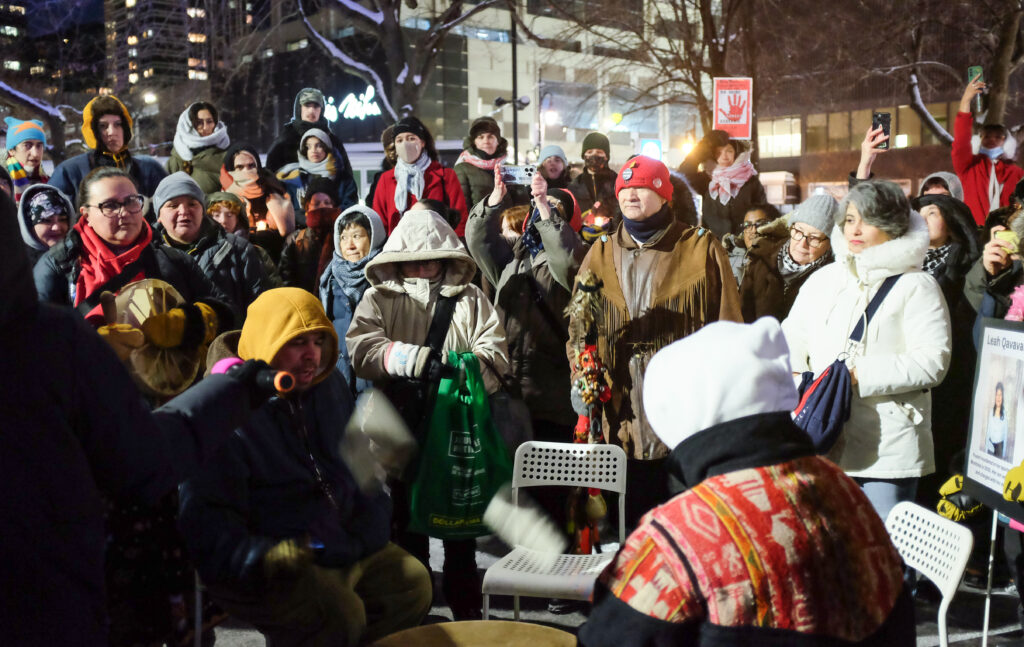
The Native Women’s Shelter of Montreal (NWSM) and Concordia’s Centre for Gender Advocacy (CGA) hosted the No More Lost Sisters march for the National Day of Awareness/Action for Missing and Murdered Indigenous Women, Girls, and Two Spirit People (MMIWG2S+) on Feb. 14. Protestors walked in -10° C weather to raise awareness about the disproportionately high rates of violence committed against Indigenous women, girls, and two-spirit people, and the low conviction rates for their murderers. 

The march began at Cabot Square at 6 p.m. and ended at Place du Canada at around 8 p.m.. According to speaker Kevin Deer, the goal of this event was to inform onlookers of the historic and ongoing violence MMIWG2S+ people face in Canada, where Indigenous women are 16 times more likely to go missing than white women.

Before the march, activist Ellen Gabriel addressed the crowd, discussing the central role protests and demonstrations play in creating systemic change within Canada’s policing system. 

“To all the people who have lost loved ones because of racism, because of sexism, we are here to show our support to anyone that has experienced this type of violence,” Gabriel said. “If we don’t stand up and rise up against imperial fascists, we will lose our rights.” 

Gabriel has been a prominent advocate for over 30 years, acting as the Haudenosaunee’s spokesperson during the 1990 Kanesatake Resistance: A 78-day stand-off between Mohawk communities and the town of Oka, who sought to build a golf course on Indigenous burial grounds. 

At this march, Gabriel asked that the media and the Canadian government stop blaming murder victims for their deaths, criticizing the press for labelling missing women as “partiers.”

“Let’s bring to light this issue of violence that we all are responsible to fight against,“ Gabriel said. “I hope that one day, men will see that violence against women is not a woman’s issue, it’s a man’s issue.” 

(Armen Erzingatzian / The Tribune)

McGill’s Indigenous Student Alliance (ISA) also emphasized the responsibility of the media in pursuing justice in a written statement to The Tribune

“Our women aren’t only the targets of this violence at higher rates than the national average, but are sought out by organized crime and institutionalized networks,” the ISA wrote. “The media’s reluctance in connecting these organized networks (sex-trafficking) to the violence of Indigenous women, girls, and two-spirit people capacitates the way in which this violence is not only perceived by the settler state and its citizens, but also the way [justice evades] the deeply ingrained injustices that allow and promote this violence.” 

The ISA encouraged non-Indigenous McGill students to show their solidarity with MMIWG2S+ by supporting the Red Dress Alert initiative, which the federal government agreed to develop in May 2024. The Red Dress Alert is akin to an AMBER Alert system, pointing the public to the last known location and appearance of MMIWG2S+. 

(Armen Erzingatzian / The Tribune)

Mike Turner was also present at the march. His daughter, 24-year-old Chelsea Poorman, went missing in 2020. Despite her mother reporting Poorman as missing to authorities the next day, Turner reported that the police did not start investigating her disappearance until 10 days later. Police discovered parts of her body in 2022, but today, neither her killer nor the entirety of her remains have been found. Turner told The Tribune that the press has a duty to report on cases like Poorman’s, which go under-investigated and neglected by police due to the victim’s race. 

“The media’s role has been insignificant when it can be extremely significant,” Turner said. “Why can’t they run ads for missing people? […] There’s no reason why this isn’t front-page every single day. If that were the case, a lot more could change.”

When the march concluded at Place du Canada, Gabriel thanked the crowd for their participation on Valentine’s Day, and spoke about the integral role public protests play in raising awareness for MMIWG2S+ who are neglected by the Canadian government. 

“On Love Day, although this cause is heartbreaking, I have to say I’ve never seen so many people pour love back into the hearts of women,” Gabriel said. 

Football, Sports

Propelled by their defence, Eagles soar to victory in Super Bowl LIX

It is said that you either die a hero, or live long enough to see yourself become a villain. This is the situation the Kansas City Chiefs found themselves in leading up to Super Bowl LIX in New Orleans. Once a group led by a young, relatively unknown quarterback named Patrick Mahomes going up against the decades-long dynasty of the New England Patriots, the Chiefs now find themselves on the other end of the spectrum. That young quarterback is now a two-time league MVP, leading a team that has won three out of the past five championships. The Chiefs were the National Football League (NFL)’s version of Star Wars’ Galactic Empire—a powerful regime on a quest to conquer the league yet again. This year, Kansas City was trying to do something unprecedented: Win three Super Bowls in a row.  

In an era where the players’ lives off the field can take the forefront (especially star tight end Travis Kelce’s relationship with musical superstar Taylor Swift), the Chiefs’ regular season trudged along without much fanfare. While they won an American Football Conference (AFC)-best 15 games across the regular season, questions arose about their offence, as they never managed to score 30 or more points in a game. This problem was exacerbated against the Eagles’ number-one-ranked defence, who had given opposing offensive lineups problems throughout the year.  

Philadelphia had generated 1.9 turnovers per game in the 2024 regular season—a league-best— and its defence had only given up 278 yards per game in the 2024 regular season—33 yards fewer than the second-place Tennessee Titans. To put this in perspective, the gap between first and second in this statistic was as large as the gap between second and 23rd ranked teams. The Eagles also had a little extra motivation as Kansas City had bested them in Super Bowl LVII two years prior. The unstoppable force of the Chiefs and their dynastic power would meet the immovable object of Philadelphia’s staunch defence on Feb. 9 in New Orleans.

Fans expecting a back-and-forth battle much like the first Super Bowl meeting between the two squads were quickly corrected. From the outset of the game, the Kansas City offence seemed completely outmatched by the Eagles’ defence. Mahomes was sacked six times throughout the game, the highest total of his career. Amazingly, Philadelphia did not blitz a single time in the game. They were able to generate pressure on the quarterback through simple three- or four-man pass rush schemes. Mahomes also threw two picks, including a first-half pick-six to rookie cornerback Cooper DeJean (on his birthday no less), which made the score 17-0 and swung the momentum of the game decisively in the Eagles’ favour. Mahomes finished the first half with a career-low 33 yards and a paltry 43 per cent completion rate.

When Eagles quarterback and eventual Super Bowl MVP Jalen Hurts threw a 46-yard laser to DeVonta Smith for a touchdown to make it 34-0, the game was all but over. Two consolation touchdown catches from Chiefs rookie wideout Xavier Worthy, who finished with 157 yards, did nothing to sway the end result. The Eagles were so confident that they gave Head Coach Nick Sirianni a celebratory “Gatorade bath” with three minutes left in the fourth quarter. The Chiefs’ offensive problems, which had popped up throughout the regular season, emerged at the worst time possible. Their inability to move the ball down the field and generate points, coupled with their relative ineffectiveness on the defensive side, spelled disaster and the end of their hunt for a historic three-peat.  

The Eagles now face some big decisions to make in the offseason, as multiple key defensive players will be hitting the free agency market looking for the big payday they deserve, including defensive end Josh Sweat and linebacker Zack Baun. As the green and white confetti fell in New Orleans, however, this was the last thing on anyone’s mind. For now, the Eagles and their fans can revel in the fact that they are Super Bowl champions.

Montreal, News

Quebec rental tribunal recommends record rent rate increase

On Jan. 21, Quebec’s Tribunal administratif du logement (TAL) announced that its recommended rent increase rate for 2025 was 5.9 per cent for units that do not include paid heating, and between 4.1 and 5.5 per cent for units that include heating in the rent. While this recommended increase rate is not binding, it is a signal for both landlords and tenants of what is considered a reasonable rent hike. 

This year’s recommendation is the highest since 1988. It also represents a significant jump from 2024’s rate of 4 per cent and 2023’s rate of 2.3 per cent, although when tenants contest rent increases, the TAL often approves increases in excess of their recommendations. In 2024, the average rent adjustment granted by the TAL was 5.8 per cent. Daphne Sainte-Onge, an organizer for the tenant union Syndicat des locataires autonomes de Montréal (SLAM), commented on the difficulties these hikes can pose for tenants.

“The majority of tenants are not receiving raises, (cost of living or otherwise), that match these increases, so every year rent is eating away a bigger chunk of our earnings and landlords are taking more from our pockets as tenants,” Sainte-Onge wrote in an email to The Tribune

Sainte-Onge also noted that students are particularly vulnerable to exploitation by landlords through high rent increases, due to their high turnover rates and lack of collective organization. She emphasized the importance of speaking with one’s neighbours about rent prices and contesting unreasonable hikes. 

“Landlords often ask for unjustifiably high increases because they do not expect tenants to push back, but you have the right to refuse and to stay in your apartment,” Sainte-Onge wrote. “Negotiating collectively multiplies the power tenants have to fight back.”

Elliott Kalt, U2 Science, and his roommates were paying $3,000 CAD a month for a three-bedroom apartment in the Plateau, where one of the bedrooms did not have a window. When Kalt and his roommates decided not to renew their lease, the landlord listed the apartment for $3,300 CAD, a 10 per cent increase in just one year. 

“I think that my old apartment was already a bit expensive for what it was, but increasing the rent by $300 almost feels criminal,” Kalt wrote in a statement to The Tribune

While upper-year students navigate the housing market in broader Montreal, first-year students living in McGill residences are also considered tenants, signing leases with McGill for the duration of the academic year. While the Quiet Residences at the Downtown Campus and Laird Hall at Macdonald Campus offer prices per room from $585 to $985 CAD for some students, prices in residences range from $1,055 CAD to $1,780 CAD, with a regular single room in Royal Victoria College costing $1,610 CAD per month, and a double room in La Citadelle costing $1,545 CAD per month. 

These rents do not take into account the mandatory meal plan in most residence halls, which is currently $5,800 CAD for the year. In the Plateau, the average rent for a one-bedroom apartment is $1,512 CAD; however, that price includes a bathroom and kitchen. 

As a landlord to thousands of students, McGill also makes decisions about rent increases year to year. The McGill Media Relations Office (MRO) commented on the factors the university takes into account when setting residence fees. 

“The Quebec Rental Tribunal’s rent increase rate provides a guideline for understanding the housing market, but it is not the main factor we consider when revising our fees,” the MRO wrote in an email to The Tribune. “More importantly, we take into account the overall cost of living in residence, the condition of each building, and if any recent upgrades and renovations have been done.”

The rent for McGill residences in the 2025-2026 academic year has not yet been finalized, but the MRO stated it would be announced in the next several weeks. 

With rent increases across Montreal, students are struggling to find suitable apartments for reasonable prices. 

“I’ve definitely seen pricing get worse over time, but the more annoying part of looking for a place is just finding a place that has windows in all rooms—something you would think is a normal standard,” Kalt wrote. “Overall, it feels like the quality of places has gone down while prices have increased.”

Student Life

TEDxMcGill makes waves by celebrating ripples

TEDxMcGill brought together seven speakers and two performances by McGill students at their annual conference on Feb 9. TEDx events are similar to TED Talks, except that they are independently organized all over the world by community groups who have obtained a free license from TED to use their name and format. In turn, all of the speeches are uploaded to a centralized TEDxTalks library

“I really love [TEDx’s] international community,” Katherine Squitieri, U3 Arts and Chair of TEDxMcGill said in an interview with The Tribune. “It’s a super strong network of people. You’re constantly in contact with other TEDx leaders, attendees, and members. I think it’s really inspiring to be able to see that so many people are working towards the same goal throughout the world.”

This year’s event featured lectures on a variety of topics, from equality in healthcare, to community-based AI literacy, to reflections on working with cancer patients in an oncology ward. The morning session ended with a performance by McGill’s Soulstice acappella group, and the afternoon kicked off with a dance number from United Groove

“I hope that people will be inspired to learn more and explore more opportunities to connect with topics that maybe they don’t hear about as much,” Squitieri told The Tribune. “I think that’s the beauty of TEDx: The variety in talks and being able to get snapshots of things that people are so passionate about.”

The organizers for this year’s TEDxMcGill event asked presenters to incorporate the idea of “ripples” into their talks as a guiding conceptual thread, although it was left to individual speakers to interpret the theme as they wanted. 

“Ripples are a reminder that even small actions matter, often in the largest ways,” Mikalah Martindale, U1 Arts and VP Communications of TEDxMcGill, said in her opening remarks. “Our speakers today have carefully curated both ideas and stories to share with all of you of ripple effects in their lives, from comedy to human connection.”

Charlotte Spruzen, a PhD candidate at McGill whose presentation focused on a geological response to climate change denialism, began her talk with a very literal reference to the conference theme. As it turns out, physical ripples appear in various materials and along different time scales in the geological record. 

“Modern ripples are everywhere [….] You can also find them in rivers, desert sands and lakes,” Spruzen said in her talk. “Ripples are fundamentally transient structures; ripples you see on the beach today will not be the same as the ripples you see the beach tomorrow, and that makes it, in my opinion, mind-blowing that the same structures of ripples can be preserved in rock for billions of years.”

Spruzen went on to describe how climate change deniers misconstrue evidence from the geological record—such as the fact that there have been large spikes in global temperature in the past—and she carefully demonstrated how those claims draw invalid conclusions from valid data. 

Coming from a different angle, Michael Zegarelli, Vice-President of Project Management at Colliers Project Leaders, spoke about the wide-reaching ripple effects that can result from seemingly small changes to city design, such as improving parks, infrastructure, and gathering places. Charlie Scholey, U3 Engineering, took yet another perspective, talking about the positive impacts that comedy can have on people. 

“If there’s one thing I’ve learned, it’s that everyone has the ability to be funny. Everyone has a sense of humour,” Scholey said in his discussion. “They just need the tools to use it, and then they have to want to use those tools.”

Read the latest issue

Read the latest issue