Latest News

Science & Technology

Reason and the art of neuroscience

One of the major attractions of academia is the ability to make a career out of learning, where one can pursue a life reminiscent of ancient Greek philosophers or Renaissance polymaths. Of course, following one’s research passions depends on funding. Grant applications and email correspondence shape the everyday life of academics, draining time and energy that would be more enjoyably spent pondering lofty ideas.

McGill professors David Ragsdale and Ian Gold took time off from such drudgery on Nov. 19 at the event ‘Synapses and Skepticism’ to discuss their favourite topics at the intersection of neuroscience and philosophy. The two started their academic careers on parallel paths that eventually converged. Ragsdale, a neuroscientist, studied psychology in his undergrad before happening upon the budding field of neuroscience. Today, he contributes to the field through his work on ion channels, proteins that control the movement of electrical signals in the brain. Gold, a philosopher, tackles the puzzle of delusions and the social determinants of psychosis, how human minds make educated guesses about reality, and how these guesses can go awry.

Research on brain function has yielded insight into philosophical questions. Ragsdale cited a famous neuroscience experiment from 1983 that many lauded as definitive evidence that free will does not exist. The researchers measured participants’ brain waves using electrodes on their scalps and asked them to press a button whenever they felt inclined to do so. Using a fast-spinning clock in the participant’s view, they could determine both when the participant felt the conscious intention to press the button, as well as when they actually pressed it.

As expected, the conscious experience of the will to act preceded the act itself. Unexpectedly, though, the brainwave measurements showed a boost in neural activity before the thought arose on a conscious level, indicating that the brain prepared for the action before the participant was even aware of it. 

“While the implications of this study are still heavily debated, its results suggest that our feeling of agency in making decisions is an illusion produced by the brain,” Ragsdale said.

Gold’s research on delusions sheds light on another basic philosophical conundrum informed by neuroscience: How to determine what is real and what is not. In response to a student’s question on the relationship between hallucinations and reality, Gold spoke of a now commonly accepted model of the brain’s role linking sensation to conscious perception. 

“Rather than simply projecting the raw sensory data coming in, our brains process these inputs and construct an altered picture of the world,” Gold said. “This model suggests that our brains make these educated guesses about incoming sensory information that enable us to act more efficiently.”

Optical illusions, such as the famous grey bar, are an example of this process. An objective eye seeing the bar will determine that the bar is the same shade throughout its length. But our brains, primed to detect contrast, produce an image that gets darker from left to right. This process stems from evolutionary pressures that have pushed our nervous systems to produce a useful, rather than accurate, perception of the world.

After two hours of discussion, the event concluded with many questions still circling. Left with a hefty dose of head-scratchers, everyone got back on with their lives, neurons firing all cylinders.


Optical illusions such as the famous grey bar illustrate how our brains construct an altered picture of the world.

Science & Technology

Alexa, tell me what you’re thinking

Amazon announced its vision for home assistant device Alexa to play a more active role as a personal assistant in November. In interviews with The McGill Tribune, Will Hamilton and Jackie Cheung, professors in McGill’s Department of Computer Science, outlined the basics of the technology behind voice-controlled home assistants like the Amazon Alexa and Google Home. 

Alexa’s algorithm first transcribes sound waves. Known as raw speech processing, this procedure employs supervised machine learning, whereby computers are trained to recognize and interpret speech through labelled input data. An artificial neural network with neurons takes in the speech waves and outputs the matching textual transcript. 

The transcript is then translated into a language that the computer can understand, so that the speech input becomes an instruction for the home assistant algorithm to follow. Compared to raw speech processing, the workload instead falls onto AI systems designers, who must provide the home assistant algorithm with a response for all possible voice commands given by the human user. 

“There is a lot of manually curated, manually specified knowledge [involved in this step],” Cheung said. 

As with other voice-controlled devices, the issue of reliability significantly influences design.

“[Tech companies] really don’t want the model to do weird things,” Hamilton said. 

To avoid giving responses that are unexpected or would make the user uncomfortable, Alexa is designed to provide clear answers for every command it is given. As a result, the programming behind Alexa’s responses is considerably less advanced than raw language processing. Alexa’s recent upgrade, which allows it to provide better predictions, operates on the same cautious principle. 

Training the computer to match verbal commands to specific responses is not fundamentally different from programming traditional dialogue. For example, if a user were to make a dinner reservation for two on a Friday night, Alexa’s algorithm would be prompted to ask if the user wants to make a movie reservation after the meal.   

Regarding the privacy implications of home assistants, both Hamilton and Cheung noted that while privacy is a valid concern, a great part of users’ fears concerning their data security may stem from common misconceptions about the home assistant industry. For companies like Amazon and Google, collecting data is not an outrageous deed. After all, they need these data to train algorithms and improve their model. 

Both Hamilton and Cheung agreed that concerns over user privacy also depend on the user’s own risk tolerance.

“Generally, people are aware that these companies are collecting data.” Cheung said. “If they accept this, they will buy and use these devices of their own volition.”

Once customers give access to their information by purchasing these devices, however, Canadian law stipulates very few restrictions on what type of data companies can collect. In an email to the Tribune, Ignacio Cofone, a professor in the McGill Faculty of Law, discussed the issue of giving consumers the responsibility of protecting their own privacy. 

“The idea that, if we rely on consumer consent, consumers will […] manage their privacy risks by consenting only to those things that are beneficial to them has proven, at minimum, ineffective, and at maximum, harmful [to consumer interests],” Cofone wrote.

Cofone’s comments echo statements made by other legal scholars on the role of personal consent in the use of data mining technology. Such scholars maintain that the concept of ‘privacy self-management’ is not enough to protect users from exploitation. 

Neither the technology behind Alexa’s upgrade nor its accompanying privacy issues are particularly revolutionary. Perhaps more groundbreaking are their implications. As these devices become more intimately involved in the private lives of users, the data they collect will construct an increasingly detailed picture of users’ identities and behaviours. While Amazon continues to profit off of user data, the long term consequences of this degree of data collection are not yet understood.

Commentary, Opinion

World War III memes need to stop

The political turmoil between Iran and the US has created fears for many members of the McGill community. These range from direct impacts on their families in the Middle East to smaller things, such as increased surveillance at airports or train stations. McGill meme pages have been posting jokes about the outbreak of a potential war between the two countries, deeming it ‘World War III’ and ignore the implications of such an event. Jokes making light of a potential war between the US and Iran belittle the real fears that come with war. Though not everybody is personally affected by the issues between the countries, everyone should be able to respect the situation and allow those impacted to fully cope.

The Middle East is not unfamiliar with what happens when the US sends troops. Historically, the US has been extremely brutal in the region—for example during the Iraq war—and chances are that the current conflict will be no exception. The US has a military budget of close to $1 trillion and does not face much of an actual military threat from Iran. In addition, it is important to note that Iran does not have nuclear weapons, has never invaded the United States, has a smaller military budget than Canada, and is surrounded by American military bases. The war would most likely never touch American soil, much less that of Canada, or the context of McGill meme pages. The people who will be affected in Canada are those who will suffer from the probable rise in Islamophobia and xenophobia that would come with a war, just like that after 9/11: This is a scary reality for many members of the McGill community. People everywhere feel the effects of this political tension. Those with Iranian heritage, no matter their citizenship, are being detained at US borders and being questioned for hours. Students who make jokes about “building up the courage to ask their crush out before a war breaks out” undermine these fears.

“People have been defending the insensitive posts by stating that humour is their way of coping, but this is not their trauma to cope with.”

Being so far removed from any actual danger is a privilege that allows people to make these jokes. The US President is threatening to bomb Iranian historical sites, places filled with civilians who rarely see a military presence. No such threat has been made toward American citizens, and if it had, most people would not make these jokes. Canadians are even more distanced from the situation, but again, if the threat was local then they would not find the possible danger humorous. In addition, the Ukrainian flight accidentally shot down by Iran had 82 Iranians and 57 Canadians on board, including a McGill student and two alumni, bringing the pain as close to Canada as it will likely ever get. Because the plane crash directly impacted Canadians and the McGill community, it is no longer seen as fodder for inappropriate jokes. It is a privilege to be able to look at the potential war between Iran and the US and be sure enough about the safety of the people in your life to make memes about it. There should be enough respect in the McGill community to know that making jokes at the expense of the safety and wellbeing of other students is unacceptable.

Living in Canada and not seeing the effects of war firsthand means that many do not understand the gravity of the situation. However, in an institution like McGill with a diverse student body and high academic standards, there should be a higher expectation for students. A school that boasts diversity should not allow students to make jokes about the terrifying experiences of their peers.

People have been defending the insensitive posts by stating that humour is their way of coping, but this is not their trauma to cope with: The fear being felt by Iranians is not the same felt by Canadians. McGill has yet to acknowledge how its community will be affected and their statement about the plane crash in Iran is not enough.  There should be a higher standard set for McGill students and McGill should provide an example of this standard by issuing an adequate statement acknowledging this political tension that has a serious impact.


Hockey, Sports

NHL midseason awards

The NHL has passed the halfway point of the 2019-20 season and is steadily moving toward the postseason. Although there are many months of hockey still left to play, the top skaters and goaltenders have already elevated their franchises and are separating themselves from the field for the annual NHL awards.


Hart Memorial Trophy (Most Valuable Player): David Pastrnak

Through the first half of the season, Boston Bruins forward David Pastrnak has narrowly etched out other Hart contenders such as Nathan MacKinnon and Connor McDavid. The Czech product has led the Bruins to the top of the Atlantic Division and tied for the most team points. Pastrnak currently leads the league with an astounding 35 goals and sits fourth in points with 65. Pastrnak is known for strong postseason performances, and if he continues on his tear throughout this campaign, he could bring home both the Hart and the Stanley Cup. 


Norris Memorial Trophy (Top Defencemen): John Carlson

The Washington Capitals sit atop the Metropolitan Division with a league-best 30 wins, led defensively by 11-year veteran John Carlson. Carlson currently leads all defencemen with 55 points, nine more than any other blue-liner. The Stanley Cup Champion will look to continue his dominant start and add to an already fantastic career, while helping the Capitals go on another deep playoff run and avoid yet another early postseason exit


Calder Trophy (Rookie of the Year): Cole Makar

Many first-year players have been instrumental parts of their teams throughout this year, but the most impressive rookie thus far has certainly been Colorado Avalanche defenceman Cole Makar. Makar, the fourth overall pick from 2017, has exhibited tremendous poise on the back end and excellent skating, creating an abundance of chances for Colorado. The 21-year-old Calagrian’s valuable contribution to the Avalanche is demonstrated further by his 33 points, only two behind the lead for all rookies, and 0.89 points per game. Makar appears to be the star defenceman Colorado needs, and with Hart candidate Nathan MacKinnon leading on offence, the future looks bright in Denver with these young playmakers.


Vezina Trophy (Top Goalie): Jordan Binnington

Amidst several contenders for the Vezina Trophy, one goalie has taken the league by storm: Jordan Binnington. The St. Louis netminder, who has yet to play a full season, has already led the Blues to their first Stanley Cup in franchise history, proving yet again that goaltending in postseason hockey is absolutely essential. This season, the Canadian has led St. Louis to first place in the Western Conference, while posting a league leading 22 goalie wins. Though his save percentage of 0.917 and his 2.47 goals against average are not numbers that immediately jump out, Binnington has simply done what it takes to win; it is undeniable that in the last year, Binnington has been the most valuable player on the league’s best team. A Vezina Trophy would etch Binnington’s name in hockey history.


Jack Adams Award (Coach of the Year) : Mike Sullivan

When first glancing at the standings, the Pittsburgh Penguins’ second position in the Metropolitan Division and third in the Eastern Conference is not particularly impressive. Yet, this is a huge accomplishment, as a majority of Pittsburgh’s best players have missed extended time on the ice this season. Future Hall of Famers Sidney Crosby and Evgeni Malkin have dealt with injuries, and many other important players like Kris Letang, Jake Guentzel, and Patric Hornqvist have also been sidelined this season. To make matters worse, their Stanley Cup winning goaltender Matt Murray has played poorly. Mike Sullivan’s decision to start Tristan Jarry was an excellent move and an example of his superb decision making in this difficult time. With all these difficult situations, the man who has led the Penguins to two Stanley Cup victories in the last half decade is proving to be effective yet again and looks good to lead his team another playoff run when his entire core returns.

Commentary, Opinion

Open Letter Against the Face to Face Trip

To the McGill community,

We are a group of Jewish student leaders who wish to address the allegations of antisemitism in regard to the ongoing debate over the all-expenses-paid “Face to Face” trip to Israel offered by Hillel Montreal. These concerns have been put forward in Students’ Society of McGill University (SSMU) Councillor Jordyn Wright’s Facebook post, an open letter by 11 SSMU councillors published in the Bull & Bear, and an email sent out by Deputy Provost Fabrice Labeau. While antisemitism is abhorrent and deeply disturbing, criticisms of the trip and consequences for participating councillors do not constitute antisemitism.

It is important for us to address this considering the circulation and breadth of misinformation that has spread beyond the McGill community regarding the nature of participation in the trip. The trip itself and actions of various McGill organizations have also been portrayed in ways that do not reflect the truth, making these discussions unproductive and difficult to navigate.

We are concerned with the Face to Face trip, specifically because it is being funded by an explicitly anti-Boycott, Divestment, Sanctions (BDS) political interest group, the Maccabee Task Force, and the ways in which ‘student leaders’ were targeted, as revealed in the trip invitation and explained by The McGill Daily. We do not question the abilities of the students partaking in this trip to critically analyze the information presented to them, but we do question the precedent that doing so sets. Accepting this trip sends the message that propoganistic and opaque attempts to influence our campus are tolerated at McGill.

The number of ‘student leaders’ who were offered this trip is also concerning. It is not just Councillor Wright, but also other SSMU councillors, members of the SSMU Board of Directors (BoD), Arts Undergraduate Society (AUS) councillors, and Science Undergraduate Society (SUS) councillors. While multiple students have stated that they are participating in the trip in their personal capacities, they were selected for their influence on campus and we believe that is a considerable conflict of interest, despite the SSMU BoD’s ruling on the matter.

Students must recognize Councillor Wright’s potential conflict of interest as a greater concern than that of other student leaders due to her positions on SSMU Legislative Council as a SUS Representative and on the BoD as a Council Representative. No other student attending the trip is a member of both bodies. However, we also believe that the Nov. 28 SSMU motion should have reprimanded other participating students, not just Councillor Wright. While we do not believe that singling out Councillor Wright was antisemitic, we do believe that it was irresponsible and exclusionary. 

We recognize that there are other Jewish students on campus who disagree with our perspectives on the situation, and that precisely is the point of our letter. The Face to Face trip and Israel more generally have been discussed as inherently in the interest of all Jewish individuals, which is not the case. Portraying Jewish people as a monolith with uniform political interests and goals is itself an antisemitic stereotype. The undersigned do not appreciate being spoken for or being used as rhetorical devices to silence concerned students, especially Palestinians. We believe that the allegations of antisemitism are disingenuous, damaging to productive discussion, and purposefully misconstrue the nature of the issue at hand. 

We would like to echo the sentiments of the SSMU and AUS statements on this matter reaffirming discontent with the trip itself. We hope that going forward, the debate is focused on the nature and funding of the trip, concerns regarding democratic integrity and transparency, and the precedent this sets for McGill in the future. 

Sincerely,

Mo Rajji Courtney, RSUS Vice-President (External Affairs)

Abigail Drach, member of Independent Jewish Voices McGill

Adam Gwiazda-Amsel, Vice-President (External Affairs) of SSMU

Maranda Raskin, HSA Vice-President (Internal Affairs)

Madeline Wilson Vice President (University Affairs) of SSMU


McGill, News

AUS votes to send out email condemning free trips to Israel

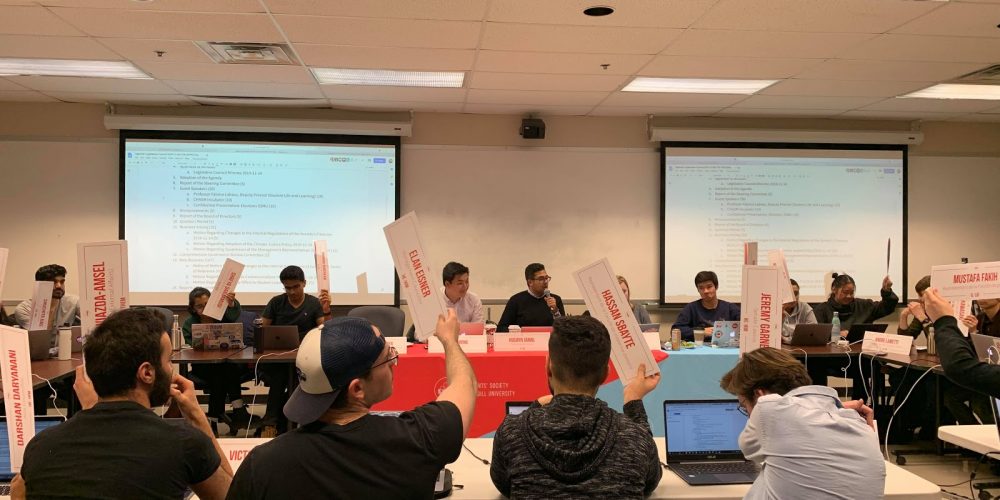
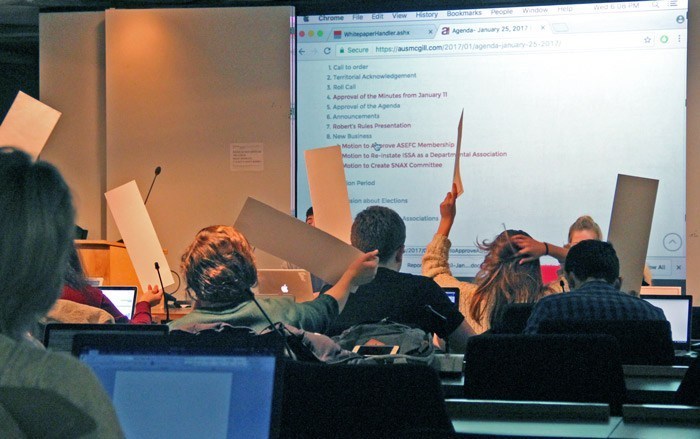
In its final Legislative Council meeting of the fall semester, the Arts Undergraduate Society (AUS) held a moderated discussion about an all-expenses paid trip to Israel offered to AUS members by Hillel McGill, a cultural organization for Jewish students on campus. 

The trips, which were explicitly targeted to McGill student leaders, are funded by the Maccabee Task Force, an organization that opposes the boycott, divestment and sanctions (BDS) movement against Israel. During the moderated discussion period, many councillors voiced their concern that accepting the trips as a gift would be inappropriate and would present a conflict of interest. Unlike the Students’ Society of McGill University (SSMU), AUS does not currently have a conflict of interest policy.

Two AUS executives, Vice-President (VP) Finance Stefan Suvajac and Arts Representative to SSMU Andrew Chase, have accepted the trips. Arts Representative Adin Chan, who originally accepted the offer, announced to the Legislative Council that he had withdrawn his acceptance of the trip.

During his opening statement, Sujavac explained that he did not see his actions as inappropriate.

“I don’t believe my acceptance of this trip represents an overreach or abuse of my position,” Suvajac said. “[Regarding] the harm that individuals suggest this trip causes to Palestinian students, I don’t think that I can provide a neat answer to that in any meaningful sense. Although I will say, I don’t believe that I represent all students in any meaningful capacity. I don’t think I have that right.”

Dalton Liggett, VP External of the History Students’ Association, argued against student leaders  accepting trips from any advocacy group.

“My personal political views on the Israeli-Palestinian conflict are irrelevant to the issue at hand,” Liggett said. “The objective facts of this issue are that elected officials, who are supposed to serve students, accepted a financial gift in the form of trip subsidization from an on-campus interest group [….] Our job is to hold the executive accountable.”

The council moved on to discuss other business, including the suspension of three departmental executives who had not attended mandatory equity training. However, in the last 10 minutes of the meeting, a motion was introduced proposing that AUS release a statement condemning the Hillel McGill trips.

Myriam Driss, VP External of the McGill Environment Students’ Society, explained that the statement would express disappointment with the executives who had accepted the trips.

“We would like to reemphasize to the Palestinian students […] that, even in spite of [the executives’] decision[s], we stand in solidarity with their concerns,” Driss said. “We do not believe that the rules of a policy, in this case, the SSMU Conflict of Interest policy, should [alone] serve as a moral compass [for executives].”

Despite multiple attempts to postpone the motion indefinitely, five minutes after the meeting was adjourned, the motion passed. The statement was sent out to Arts Students in a Listserv two weeks ago.

Flashback:

After debate about whether the AUS executives were selected for the trips based on their influence on campus, Andreas Koch, the VP External of the World Islamic & Middle Eastern Studies Student Association, read out the trip invitation sent out by Hillel McGill word for word. Koch noted that the phrase ‘student leader’ was repeated four times in its first paragraph.

Sound Bite:

“[Palestinians] themselves have a claim to the land. It’s their homeland. Yet they do not have a right to visit their own home. So how [should] random AUS executives not only have the right to go visit Israel or Palestine, but [be able to] go free of charge when people who have their homes there can’t even return there? […] Don’t you think that’s a bit offensive to Palestinian students on campus?” —anonymous gallery member.

McGill, News

Filipino journalist Patricia Evangelista discusses the nuances of reporting on conflict

Patricia Evangelista, a multimedia journalist for the online Philippines-based news organization Rappler, examined the responsibilities of journalists telling trauma survivors’ stories in a lecture hosted by the McGill International Review (MIR) and the McGill University Filipino Asian Students’ Association on Nov. 26. 

As a specialist in trauma journalism, Evangelista has reported on natural disasters, conflicts, and global development issues. Evangelista is the  2019 Marshall McLuhan Fellow, a role awarded by the Canadian embassy in the Philippines to promote responsible journalism and support democracy.

Focussing on current events in the Philippines, she explained that, in covering topics from hurricanes to sex trafficking, special precautions must be taken to ensure the safety and wellbeing of survivors.

“We are voyeurs at the worst parts of [traumatized people’s] lives,” Evangelista said. “It is a privilege to be there. And we can do so much to damage them in the aftermath.”

Journalists, Evangeslita addressed, must use various strategies to avoid causing further harm in forcing people to relive their trauma.

“We offer sympathy, not a claim of understanding,” Evangelista said. “We don’t say, ‘I know how you feel,’ because we can’t know, and to pretend is to patronize and insult them. We accept refusal with courtesy. [….] We offer them control and agency.”

Throughout her lecture, Evangelista referenced stories that she had written about survivors of the 2013 Super Typhoon Haiyan that devastated the Philippines, many of whom had to watch strangers or family members drown during the ensuing floods, as well as pieces on child sex trafficking and state-sanctioned killings. Within the context of these stories, Evangelista recognized the limits of journalism.

“We don’t promise justice or safety or the possibility of a change in policy, because we can’t [do] any of that,” said Evangelista. “We just promise to tell the story the best way [that] we can.”

Evangelista outlined certain rules that should be followed in order to interview trauma survivors effectively and respectfully. Although extracting information from survivors is a delicate task, she claims its necessary to accurately reflect and communicate the realities of conflict to the world. 

“For people to be able to help, to move, to care, they have to be able to see,” Evangelista said. “Trauma journalism is about making people imagine. The rule of thumb is this: If people drown, I need to know enough to drown with them, so I can tell you what I saw.” 

However, as Evangelista explained, survivors of a traumatic event should not be defined exclusively by their pain. 

“The story also involves resilience, courage, the height of the human spirit, the community spirit,” Evangelista said. “All of these are important to the narrative.”

Helena Martin, U3 Arts, shared how the lecture’s subject matter was deeply moving to her because she grew up in the Philippines. 

“A lot of the issues [Evangelista] was talking about were issues [that] I grew up seeing,” Martin said. “Stories about trauma, I could really relate to those more.”

Alec Regino, Editor-in-Chief of  MIR, explained how events such as Evangelista’s lecture can spread awareness of international issues within the McGill community.

“These events [are important] because they allow students to intimately connect with issues from all over the globe,” Regino wrote in an email to The McGill Tribune. “While it’s valuable to read an article online about the War on Drugs in the Philippines, to hear the lived experiences of people who are directly affected forces you to approach these issues more critically.”

Regino believes that student journalists can benefit from learning how to report empathetically.

“For me, Evangelista’s talk served as a reminder that it is imperative that student journalists provide agency to the people [they are] reporting about,” Regino wrote.

Creative

Tribune Tries: Fencing

Sports editors Kaja Surborg and Ender McDuff meet the McGill Fencing Team, have a brief training session with them, and face-off in a fight to the death (best of three).

Video by Staff Producer Alex Hinton

Features

Skin deep

In an airy Plateau studio space perched high above Saint Laurent, Instagram dreams come true. It’s clear from the neon sign, white walls, and minimalistic furniture that Black Rose Tattoo is a millennial haven. Laden with house plants, it bears a closer resemblance to a trendy open office space or an aspirational Pinterest apartment than a tattoo studio, albeit punctuated by the persistent hum of a tattoo machine.

Science & Technology

The haphazard world of scientific research funding

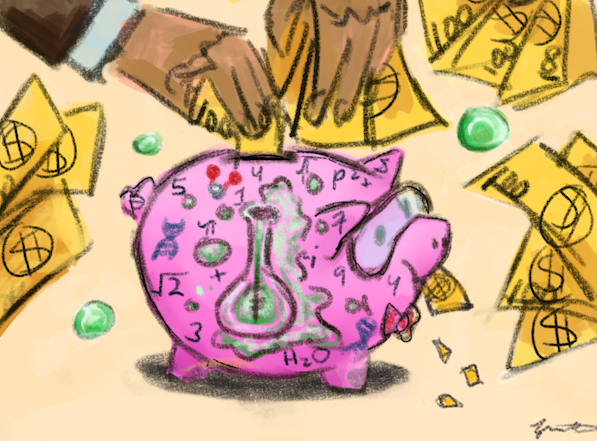
Human systems, from medicine and technology to industrial agriculture, are built upon the tools and findings brought forward by scientific achievement. Yet, to practice science in the 21st century, researchers depend upon another cornerstone of modern civilization: Money. 

The amount of funds required to conduct scientific research is almost incomprehensible. Last year, McGill received over $500 million to fund research. In the past, grant money has allowed McGill scientists to uncover the molecule behind synaptic plasticity, suggest innovative climate change solutions, and peer into life on other planets.

Although the benefits of research endowments are obvious, the source of McGill labs’ research money is a more complicated story—one that includes various stakeholders across the scientific community. 

In Canada, the vast majority of grants for scientific research come from the federal government. When scholars apply for federal funding, they submit a proposal to one of three governing bodies: The Canadian Institutes of Health Research (CIHR), the Natural Sciences and Engineering Research Council (NSERC), or the Social Sciences and Humanities Research Council (SSHRC). These bodies indirectly receive funding from the government, according to Katie Gibbs, executive director of Evidence for Democracy, a non-profit organization that advocates for evidence-based policymaking in Canadian politics.

“The federal government decides how much money to give those councils and has varying degrees of determination over how those funds are distributed,” Gibbs said in an interview with The McGill Tribune.

These three funding agencies, together referred to as the ‘Tri-Councils,’ are led by scientists who read and choose which applications to fund from university faculty and graduate-level researchers.

The competitive nature of this application system creates tension in academic environments. Among other aspects, a professor’s research output can be a deciding factor in a university’s decision of whether to grant them tenure. This reality puts additional pressure on academics to secure funding and churn out more papers; the alternative entails jeopardizing career growth. 

In a country where the government holds a tight grasp on the purse strings of science, researchers find themselves strapped to propose immediately useful projects. Studies with instant benefits to the public interest are more likely to receive funding and have been appearing with increasing frequency in the application process. These projects typically fall within the fields of medical science or engineering—disciplines that are known for producing direct and tangible results. 

Another issue associated with the current funding landscape is the inconsistency of available money from year to year. Left to the whims of changing federal governments, each prime minister can dictate the federal budget’s research allocations during their time in office. The Harper government increased Canadian expenditures to science and technology from 20052009 but decreased the same funds by 10 per cent leading up to 2015. 

“Certainly, over the years of the Harper government, funding for the Tri-Councils was pretty stagnant,” Gibbs said. “Even when there was new money made available, it was often criticized that a lot of the new programs put in place required things like an industry partnership.”

At McGill, industry-sponsored research represented the fourth-largest funding source in 2018. Approximately eight per cent of McGill’s research budget, which amounts to just over $44 million, was acquired through industry partnerships from businesses and corporations. 

Industry funds are not typically dispersed evenly between disciplines. Similar to successful governmental grants, research subjects that attract interest from corporations come from scientific fields with direct applications. This practice can ostracize scientists who require funds to complete what is known as basic science in the fields of chemistry, physics, and biology. These subjects provide foundational knowledge for researchers in the applied sciences to create the drugs, machines, and technology of the future. 

Rafael Reif, the president of the Massachusetts Institute of Technology (MIT) wrote to the Wall Street Journal in 2016 about the issue of the asymmetric support that industries provide to certain disciplines. 

“The qualities [that] make industry good at applied research, primarily their appetite for immediate commercialization, a laser focus on consumer demand, an obligation to maximize short-term returns, and a proprietary attitude about information—make industry a bad fit for supporting basic scientific research,” Reif wrote.

Gibbs is unsure that the government has lived up to its campaign promise to provide scientists with additional support that they requested five years ago.  

“Overall, the Trudeau government has done a pretty good job,” Gibbs said. “They didn’t really make any big promises around funding in the [2015] election. They expressed, more broadly, vague commitments around ‘restoring science to its rightful place,’ so it is kind of hard to measure if they have followed through or not.”

In 2017, the federal government commissioned a report on the state of scientific progress in Canada and recommended fairly large investments into fundamental research. Yet, federal government spending on science and technology is expected to decrease by 2.6 per cent from $12 billion to $11.7 billion in 2019. In fact, federally funded research in Canadian universities and institutes remains among the lowest per capita of any high-income economy, sinking to less than 25 per cent in 2017. Thus, Canadian institutions are left to supplement 50 per cent of these costs today, to the detriment of both research and education.

The repercussion of government funding decisions directly impacts researchers at all levels of academia. Decisions to cut the amount of funds available to McGill professors in the basic sciences has consequences for their students as well. 

Brendon McGuinness, a second-year PhD candidate in the Department of Biology, understands this experience first-hand. He expressed frustration with the NSERC application process specifically. 

“It is a lot of money,” McGuinness said. “[But] the applications are not fun to do because it really is quite intimidating. It’s very competitive and a lot of work for an award you are statistically not going to get.”

Graduate students are generally encouraged by their supervising professors to seek additional sources of funding aside from government grants that have become increasingly difficult for students to depend on. In an interview with the Tribune, Jessica Rose, Association of Graduate Students Employed at McGill (AGSEM) Chair of Teaching Assistant (TA) Bargaining, explained that supervisors are hesitant to offer students research contracts because they fear that the university will not be able to reliably supplement the student’s income. Graduate students are therefore left to accept graduate offers that are not adequately supported by federal funds and must take on the additional responsibilities as TAs or search for other sources of income.  

“In our conversations with the Faculty of Science, we found that most of the funding for doctoral students comes from their supervisors, but the supervisors were very reluctant to guarantee students a minimum [salary], because they were concerned that they could lose their grants,” Rose said. 

McGuinness also explained that students are not always motivated to apply for funding, since they rely on money from many other sources.  

“In my experience, you are not incentivized financially when applying for the [NSERC] awards because so much of the money that we make is coming from other sources,” McGuinness said. “Yes, it looks good on a CV and is very good for getting postdoc positions, but in terms of the money you are receiving, it most likely is coming from somewhere else. Regardless of the pressure, we are encouraged by our supervisors to apply for grants.”

Scientific progress is only as successful as the people involved. As of yet, the Canadian government has still not found a mutually amicable way to relieve the financial burden placed on individual professors, their students, and the institutions that support them. Ultimately, basic sciences should not be overlooked, and instead must receive funding that reflects the immense contribution of scientists to more applied fields.


Read the latest issue

Read the latest issue