

Latest News

Ask Ainsley, Student Life

Ask Ainsley: How do I recover my GPA?

Dear Ainsley,

I’m a third-year Arts student returning to McGill after a terrible Fall semester. In addition to struggling with the class material, I was coping with personal issues and my grades took a hit. I feel like the drop in my GPA erased all the hard work and progress I made in my first two years at McGill. I’m worried that potential employers will now write me off for internships and job offers. I don’t want one bad semester to impact my transcript so badly. How can I bring up my GPA? 

Sincerely, 

Gradually Perishing Academically (GPA) 


Dear GPA, 

Sorry to hear about your troubles last semester. Firstly, it is important to remember that life happens to us all, and one bad semester does not define you. Although it is significantly harder to boost your GPA than to lower it, it can be done, and McGill has several resources to help guide you on a path to success. Stop by the Arts Office of Advising and Student Information Services (OASIS) to set up an appointment with your advisor; this will reassure you that you are on track for graduation. Once there, a counselor can also direct you to your department’s office where you can talk to an advisor for your major and see how much flexibility you have in your schedule. Maybe you have room for electives, which would allow you to choose classes that cater more to your strengths and therefore help your GPA. Taking electives you enjoy will automatically make studying a simpler task. Additionally, seeing a counselor will help put you back on a steady, organized path and calm your worries in the process. When choosing electives, it is also a good idea to take the professor and structure of the course into consideration. If you liked a specific professor’s teaching style in the past, see what other courses they are teaching. If you struggle with final exams, look for courses with essay-based finals or vice versa. 

When it comes to courses required for a specified program, raising your overall average can be a little tougher. Luckily, McGill students are always creating online Facebook pages and arranging study groups so make sure to seek them out and see what works for you. Your peers at McGill can be your best assets for help; they’re going through the same struggles as you, and solidarity is key. 

In addition to strategies within classes, it is also important to organize your life outside of coursework. Get out your calendar and see where you can make cuts. Is there an extracurricular activity that you no longer find fulfilling? Is there a social engagement that is eating into your study time? Make this new year a time to focus on yourself. It also might be beneficial to make a study schedule as studies suggest that being organized can ease stress and anxiety. So plan ahead, because if your mind isn’t at ease, your grades will suffer. Write down what needs to be done and allocate specific times for each task so that your workload will be less daunting and ensure you stay on track for a better semester. 

Lastly, make time in your schedule for pleasure. Worrying about grades is a common part of university, but it should not be the only part. Future employers may look at your GPA, but they also look at other things like your resume, recommendations, and extracurriculars, so remember that grades are not the only thing you should be focusing on. Keep working toward success and don’t be too hard on yourself! 

Wishing you all the best,

Ainsley
Editorial, Opinion

This is not divestment

Climate change devastates human populations, animal species, and entire ecosystems: The fossil fuel industry remains the largest contributor to climate change. Given the circumstances, being complicit in environmental degradation is immoral and investing in fossil fuels is socially injurious. With the urgent threat posed by the climate crisis increasing every day, it is absolutely imperative that McGill divests. 

The new year marks the conclusion of the university’s Vision 2020 action plan. In the outline, McGill commits to carbon neutralization by 2040. It also aims to reduce greenhouse gas emissions by 58 per cent by 2025. Despite these lofty aspirations, the plan lacks information about how these goals will be achieved and its ambiguous language makes it unclear how it would achieve its goals and how they would benefit McGill’s commitment to sustainability. Half of the time-period specified for reducing emissions has already expired, yet McGill has not released reports on the plan’s progress since at least 2017. 

Moreover, the plan’s goals fail to address the urgency of climate change. The world does not have two decades to reach carbon neutralization. In fact, top climate scientists assert that 2020 is the last year to prevent irreversible climate damage: 2040 is an unacceptable deadline for carbon neutralization.

In the plan, McGill also cites its Sustainability Projects Fund (SPF) as a program that promotes climate awareness on campus. The SPF focuses on funding student initiatives that reduce waste and increase sustainability at McGill. While the fund makes excellent small-scale changes, it does not adequately respond to the urgency of the climate crisis. Top climate scientists have repeatedly stated that individual action cannot stop the climate crisis without the support of large scale, institutional change. McGill must recognize this fact by not only funding student projects but also by committing itself to serious institutional-level change, starting with divesting from fossil fuels.

On Dec. 5, McGill’s Committee to Advise on Matters of Social Responsibility (CAMSR) met to consider divestment for the third time since students founded Divest McGill in 2012. The initial Divest McGill petition called for McGill to divest from the 14 companies that extract tar sands and an additional 13 that lobbied for Plan Nord, a natural resource extraction plan that the university invested in. 

The CAMSR meeting marked an opportunity for McGill to hear student voices and to recognize the science backing climate change and the social devastation that it causes. Yet, CAMSR voted to not divest, instead opting for decarbonization in a weak attempt to placate students and mask its complacency in climate destruction. The refusal to divest comes after years of protests, and most recently a moratorium on auxiliary fee increases by McGill’s undergraduate and post-graduate students’ societies to put financial pressure on McGill. The committee also chose to meet just before the final exam period began, when students were less available to stay informed, protest the vote, or attend the meetings. McGill’s refusal to divest sends a clear message that McGill’s values are more focused on funding than adhering to the concerns of their students, the surrounding community, or the planet. 

McGill’s refusal to divest not only ignores clear student demands but also neglects the extensive scientific research that backs the need for divestment. McGill prides itself on being a leader in research and indeed, in 2019, McGill employed dozens of staff whose entire careers have been dedicated to climate research. However, McGill has chosen to ignore extremely relevant evidence and continue to work against exactly what its experts would advise. 

CAMSR’s report also recommends that McGill reduce its carbon emissions by a certain percentage but does not specify what that percentage is. The fact that McGill could not even specify a clear aim demonstrates just how inept decarbonization is as an institutional goal. It is pertinent that McGill be explicit with its goals and commitments surrounding decarbonization. McGill’s students, alumni, and supporters deserve to know how committed the university is to playing its role in preventing further climate devastation.

Adding to the iniquity of CAMSR’s decision is the fact that the former director of retail services for PetroCan currently serves as the chair of CAMSR. Cynthia Price Verreault, worked as the director of retail services for PetroCan for 18 years. Given that PetroCan is one of the country’s largest fossil fuel producers, this affiliation poses a blatant conflict of interest. Thus, The McGill Tribune calls for Cynthia Price Verreault’s resignation from CAMSR.

While students should continue to support organizations like Divest McGill, C-JAM, and Greenpeace McGill, persuading McGill to take issues of climate justice and sustainability seriously will require more than that. The Tribune asks members of the McGill community to commit to not donating to McGill until they divest from fossil fuels. The wellbeing of countless ecosystems, species, and communities can not be ensured without the reversal of climate damage, and this reversal is not possible without institutional support.

Science & Technology

The Internet bands together to save Earth’s forests

Many consider online influencers and the YouTube community to be a toxic cesspool of negativity. However, YouTubers Jimmy Donaldson, known by his online name MrBeast, and Mark Rober are challenging this view by bringing internet celebrities together to make the world a better place through their TeamTrees campaign

Donaldson and Rober created the campaign after fans challenged them to plant 20 million trees to celebrate the MrBeast Youtube channel hitting 20 million subscribers. The aim of the project was to plant 20 million trees globally by 2020. In order to make their dream a reality, the YouTubers partnered with the Arbor Day Foundation, a US-based tree-planting organization. For every dollar donated, the Arbor Day Foundation would plant one tree in a forest in need. The campaign garnered massive attention, with important players in the online and technology communities such as Elon Musk and celebrity YouTuber Jeffree Star donating thousands of dollars to the cause. 

The environmental benefits of planting 20 million trees could be enormous.

In urban areas, trees act like natural air conditioners while they photosynthesize,” Anna Hargreaves, assistant professor in the Department of Biology at McGill, wrote in an email to The McGill Tribune. “They mitigate heat waves, provide shade, increase property values, and make people happier. Reforesting […] can eventually provide more forest habitat and, depending on where you plant them, help connect patches of existing forest.” 

Planting trees is also a cheap and easy solution for reducing carbon dioxide levels.

“Trees sequester carbon out of the atmosphere, so [they] can counteract the carbon dioxide we emit from burning fossil fuels,” Hargreaves said. 

Trees have other restorative abilities. For instance, by removing pollutant gases, they aid in air purification. They also reduce evaporation from the ground and produce 200450 gallons of water each day through photosynthesis, thus contributing to water preservation. In terms of soil properties, trees help to reduce ground erosion, increase fertility, and help soil retain its moisture content. Planting 20 million trees could amplify such effects worldwide. 

Despite the potential benefits of the TeamTrees campaign, planting 20 million trees presents serious logistical issues and some unexpected consequences. 

Coordination and cost are obvious ones,” Hargreaves said. “Survival of those trees is another.”

The timing of tree planting could also have important consequences on the ecosystems that the TeamTrees campaign is attempting to protect. 

“Planting trees in grasslands is very controversial,” Hargreaves said. “When  you start reducing grassland habitat, it can change water balances [in the ground]. Recent evidence suggests natural grasslands can be more stable carbon sinks than forests.”

Planting trees in the wrong places can damage ecosystems, increase wildfire intensity, and actually worsen global warming. Some scientists believe that placing too much emphasis on tree planting can also distract people from cutting down on fossil fuels, the most important step in combating climate change. As such, the cultural emphasis on the TeamTrees initiative could have negative effects on the environment by diverting people’s attention from the many issues associated with the fossil fuel industry.

Still, by the end of 2019, MrBeast and his collaborators had achieved their goal. The trees will be planted between January of this year, continuing until December 2022

In a recent video, MrBeast urged his fans and fellow YouTubers to continue fighting climate change and join forces to raise awareness of climate-related issues, hoping to carry the spirit of the TeamTrees campaign into the new decade. Following this new medium of outreach, humanity may have a chance to reverse some of the damaging environmental abuses of the past two centuries.

Arts & Entertainment, Books, Film and TV, Gaming

Stuff we liked this break

Winter break is all about recovering from finals, spending time with your family, and updating your Goodreads and Letterboxd accounts. Here are the best from the A&E team’s period of rest and relaxation.

Book: Jia Tolentino, Trick Mirror

To those unacquainted with Jia Tolentino’s writing, it might seem like an exaggeration to call her the voice of a generation, but Trick Mirror proves that she has earned the often overused title. Tolentino sharply analyzes the mess that is modern life from the perspective of a self-aware millennial, covering topics from reality television to drugs and religion with ease and wit. A standout chapter, “The Story of a Generation in Seven Scams,” breaks down the American pastime of swindling suckers for money, starting with the infamous Fyre Fest and ending with the 2016 American election. One thing is for sure, folks: We Live In A Society, and Jia’s the gal that will make you take a long hard look at how and why it is the way it is today.

Video Game: Disco Elysium

If you have ever wanted to be a badass ace detective, solving crimes and taking names in the big city, Disco Elysium is not the game for you. The player character is a drunken lunatic detective whose years of hard partying have wiped his memory clean. It is up to the player to piece together his identity while trying to solve the murder of a universally despised mercenary. The player can choose to be a communist, a superstar cop, a cop of the apocalypse, an ultraliberal, or can maintain the detective’s cripplingly depressed state if you’re feeling mean. Disco Elysium is the funniest—and most depressingly existential—game of 2019.

Movie: Star Wars: The Rise of Skywalker

It is a little hard to be a Star Wars fan right now. With the current backlash surrounding Disney’s sequel trilogy at the back of my mind, loving The Rise of Skywalker, despite its glaring flaws, is an anomaly. But, the John Williams score, intergalactic dogfights, and lightsaber theatrics inspires the same awe and excitement as the originals. Maybe having to turn off one’s brain to enjoy the spectacle validates the film’s critical reception but expecting Star Wars to be a bastion of nuanced cinema isn’t the only way to enjoy the franchise’s spectacle. Sometimes enjoying the ride aboard the Millennium Falcon is more important than endlessly critiquing its shoddy construction.

Movie: Uncut Gems

Director duo Josh and Benny Safdie have followed up their 2017 cult hit Good Time with the equally exhilarating Uncut Gems. The film follows jeweller and pathological liar Howard Ratner, played to perfection by Adam Sandler, who constantly has to weasel his way out of trouble as he attempts to navigate a world of illegal debt collectors, high-profile clients, and secret girlfriends. The film’s relentless energy and frenetic sound mixing, along with Sandler’s anxiety-inducing performance, make for a searingly tense viewing experience. The film even features a scene where The Weeknd punches Sandler in the face—enough said.    

TV: Cheer on Netflix

If there’s one major take-away from Cheer, a six-part docuseries on Netflix, it’s that competitive cheerleading is very, very difficult. Following the 13-time national champion cheerleading squad at Navarro College in the tiny town of Corsicana, Texas, Cheer touts itself as an inspiring narrative about the uplifting power of sports, but soon turns that very notion on its head. Cheer is a bittersweet examination of the sacrifices that college athletes endure for the marginal successes and recognition they earn, all the while treating its subjects with genuine care.

McGill, News

Education Undergraduate Society misses quorum to strike

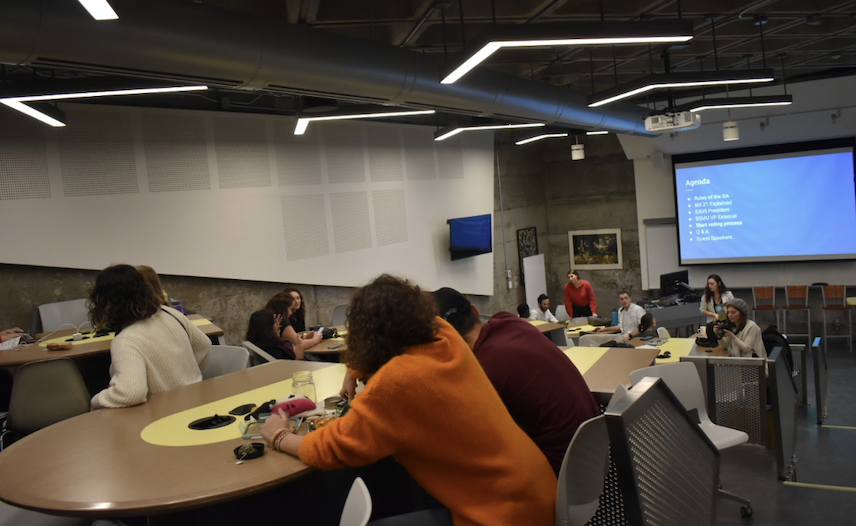
The Education Undergraduate Society of McGill (EdUS) and the Students’ Society of McGill University (SSMU) held a General Assembly (GA) on Jan. 10 where they condemned Bill 21. During the GA, students in the Faculty of Education voted on the possibility of striking for two days on Jan. 17 and Jan. 20. Although most of the 89 Education students in attendance voted to strike, a quorum of 118 people was required for the strike to pass. However, there will be another opportunity to vote for a strike during the week of Jan. 20.

Bill 21, which was introduced by the Coalition Avenir Québec (CAQ) government in 2019, bans certain public employees in teaching, healthcare, and other sectors from wearing visible religious symbols at work. The bill passed in June 2019, drawing concerns that it violates individuals’ religious freedoms and right to expression.

The bill includes a grandfather clause that allows current public workers who have worn religious symbols to keep their position. However, as GA organizer and Vice-President (VP) External of EdUS Tatum Arcon explained, these workers still face professional obstacles posed by the law.

“If you’re a teacher, you can never be promoted,” Arcon said. “You can’t get your master’s [degree] and get higher pay or anything like that. You’ll stay at the exact same point [….] If you ever want to become principal of your school, that won’t be possible.”

EdUS President Fanny Langin discussed the difficulties faced by Education students wearing religious symbols when applying for internships following the passage of Bill 21.

“There’s nothing about [student teachers] in the law, so you’re supposed to be able to get your field experience, even if you’re wearing a religious [symbol],” Langin said. “But some school boards said they wouldn’t accept student teachers wearing a religious [symbol].”

Although Bill 21 affects religious freedoms, the law invokes Section 33 of the Canadian Charter of Rights and Freedoms. This notwithstanding clause allows a government to temporarily protect a law against being struck down by the supreme court for violating certain Charter Rights. At the GA, community activist and Board of Governors member Ehab Lotayef argued that the usage of the notwithstanding clause in the case of Bill 21 sets a dangerous precedent.

“Who knows what other items of the Canadian Charter will be overwritten by a law, tomorrow or next year or [under] a future government?” Lotayef said. “That’s what makes this battle really important. It is not only about a kippah or a headscarf or a turban. We cannot accept or take it lying down that one individual is denied a job because [they] decide to abide by what they believe in.”

Guest speaker Jason Lister, an Education course lecturer, pointed out the unequal consequences shouldered by different groups due to Bill 21.

“Quite frankly, it’s white people being scared of brown people,” Lister said. “There’s this idea somehow that if someone is wearing a hijab while teaching, they will end up converting people to Islam […] which is of course an absolutely absurd notion [….] And I can’t speak for the other professions affected for this bill, but I do believe [that] for the teaching profession, this law targets Muslim women. It’s absolutely discriminatory.”

SSMU VP External Adam Gwiazda-Amsel, who was involved in organizing the event, expressed his frustrations with the CAQ’s poor leadership. 

“I think that what frustrates me the most is that the government knows better,” Gwiazda-Amsel said. “The people who are in these government positions, premiers, and members of parliament, take trips around the world. They’re well-educated people who don’t just live in small communities in rural Quebec that are afraid of immigration they don’t understand […] For them to be fearmongering and taking advantage of the sorts of insecurities that exist in rural Quebec shows a decided lack of leadership. They should be ashamed of themselves.”

Although the GA failed to reach quorum, the online vote will allow Education students another opportunity to consider striking. SSMU and EdUS will be holding a demonstration against Bill 21 on Jan. 17 at 12 p.m. on McTavish street.

Student Life

Courses of action for course materials

A new semester means new classes—and expensive textbooks. For many students, the first place that comes to mind for new textbooks is Le James at the corner of Sherbrooke and University, which gets jam-packed with students during the first few weeks of September and January. However, outside of the campus bookstore, there are other ways to get the necessary materials for any McGill course.

The Word

A staple bookstore in the Milton-Parc community is The Word. Owned by Adrian King-Edwards, this quaint shop on Milton between Aylmer and Durocher has been in the business of selling a wide assortment of second-hand books for 44 years. At the beginning of every term, they compile a list of course textbooks that students can sell to the store, with some worth $100 or more. They only accept course materials that are of high quality, which means that they do not sell textbooks that are highlighted or have a broken spine. The process of buying back books and selling them to other students is no simple feat, since The Word spends a considerable amount of time before the rush of every September and January curating them.

“We usually spend six weeks before January getting ready for [the new term],” King-Edwards said. “We check on what books are being used [in courses] and make sure we have them, so that when the students come at the beginning of January, we have all the McGill textbooks at the [store] […], and we know [down to] which editions are used.” 

The McGill Library 

The campus library is an often overlooked resource for all types of course materials. With a mandate of creating a vast collection of information from all disciplines that is both legal and freely accessible, the library organizes materials into various categories. One major system is the course reserves system, which is where materials dictated by professors or frequently requested books are placed. As this method is free for all students, it comes with the caveat of shorter due dates for return.

“We have one-day loans and three-hour loans.” Katherine Hanz, head of the Lending and Access Service of the McGill Library, said. “Three-hour loans [are more difficult to acquire so] the only things that are three-hour loans are items that are getting stolen [and] items that someone is asking for […] every hour. As much as possible, we try to keep reserves […] to [more convenient one-day loans], where you can ask for card access to the self-serve room [where they are].” 

Course reserves also add a huge cost burden on the library, meaning there is incentive for them to use other strategies such as buying electronic copies of textbooks when possible and advocating for the growing trend of open educational resources (OERs). OERs are free alternative teaching resources for students that are within the public domain rather than in the hands of private institutions. In the classroom, students can champion the trending move toward free resources such as non-reserve books and online resources rather than packaging them into expensive course packs.

“Philosophically, we plan to continue offering [course reserves],” Robin Canuel, Head of Liaison Services at the McGill Library, said. “We’re just hoping practices [such as] more OERs, [more] open textbooks, and [more] linking to our existing  [online] materials [… means] less stuff in course reserves that [the library] has to buy.”

File-sharing websites 

A seedier avenue are sites that have unauthorized files of many popular course materials. This underground network of links, sharing sites, and pirated copies is dependent on word-of-mouth and extensive google searching. Legally dubious due to its role in copyright infringement, many of these sites share a philosophy of decommercializing educational materials. A issue with getting textbooks through this method is that it yields mixed results since there is no centralized quality control. 

With all these options available in the community and on the web, looking for textbooks doesn’t have to be a stressful task. The resources are out there; it is just a matter of knowing where to look. 

News, SSMU

McGill students stand in solidarity with Wet’suwet’en Clans

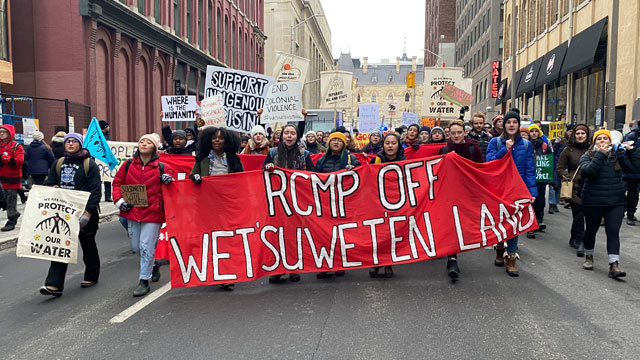
The Students’ Society of McGill University (SSMU) Indigenous Affairs Committee and the Indigenous Student Alliance of McGill hosted a response to the Wet’suwet’en call for solidarity against a pipeline project. On Jan. 9, students gathered at the Y-intersection to support hereditary chiefs and the Unis’tot’en and Gidimt’en camps protesting Coastal GasLink’s plans to build a pipeline through their territory in Northern British Columbia (BC). 

The Coastal GasLink pipeline project proposed by TC Energy (formerly TransCanada) will carry natural gas from Dawson Creek to an LNG Canada facility near Kitimat to be turned into liquified natural gas. While construction has already started on parts of the pipeline, protestors are continuing to block access to Wet’suwet’en territory. 

Hereditary chiefs have explicitly opposed all pipeline activity since Sept. 3, 2015. They have been in conflict with TC Energy, Chevron, and Enbridge about pipelines through Wet’suwet’en territory. The BC Supreme Court issued an injunction against protestors, preventing them from denying Coastal GasLink access to the lands. 

In response, the Wet’suwet’en have put out an international call for solidarity to respect Indigenous sovereignty and Indigenous peoples as the rightful title holders of the land. The international call began on Jan. 7, the one year anniversary of the Royal Canadian Mounted Police’s (RCMP) raid on protest camps, and lasted until Jan. 12.

As a large part of the pipeline’s route goes through Wet’suwet’en lands, Coastal GasLink has signed agreements with band councils to authorize construction. However, protestors deny that agreements made by band councils serve as free, prior, and informed consent on behalf of the Wet’suwet’en clans they represent. 

Marlene Hale, a member of the Wet’suwet’en Frog Clan, spoke about the differences between the authority of hereditary chiefs and band councils, insisting that hereditary chiefs should dictate access to the land. 

“[A hereditary chief] earns his title,” Marlene Hale said. “A band council chief is only there to do the administration […] they do not tell me what to do on the land”. 

BC is the first province to enshrine the United Nations Declaration on the Rights of Indigenous Peoples (UNDRIP), and the Supreme Court of Canada has acknowledged the Wet’suwet’en lands are unceded territory. However, the BC Supreme Court granted the injunction on the basis that Coastal GasLink had met the legal requirements to begin building on the land.The five hereditary chiefs blocking the pipeline rejected the injunction. Dini’ze Na’moks of the Tsayu clan urged the BC government to respect Indigenous autonomy and their land.

“In this time of reconciliation, with BC being the first province to legislate UNDRIP, this ruling by a court in BC against Indigenous rights and recognition truly proves that industry, not the people, can control the Province and its laws,”  Na’moks said. “Ultimately, we are our own government, and we decide who [is allowed] on our territory. We are the hereditary chiefs. British Columbia and Canada only have assumed and presumed authority on our lands.”

Tomas Jirousek, Indigenous Affairs Commissioner of McGill, explained the importance of Indigenous sovereignty within Canadian politics, noting that the events at Wet’suwet’en were emblematic to reconciliation. 

“The issue at hand is one of Indigenous sovereignty,” Jirousek said. “Regardless of whether you support pipelines and the resource extraction, or not, we all maintain an obligation to recognize and respect the laws and customs of the Indigenous peoples of those territories.”

Event leaders urged the McGill community to hold federal and provincial leaders and RCMP accountable and to respect Indigenous sovereignty. 

“Solidarity can take place through a few different forums, and will dictate and change the course of events in a few different ways,” Jirousek said. “Not everyone needs to become an activist, or donate money to show solidarity with the Wet’suwet’en. [Solidarity shows] that Canadians refuse to accept this incursion and disrespect shown towards the Wet’suwet’en.”

For students interested in the conflict between the Wet’suwet’en and the BC provincial government and Coastal GasLink, speakers and organizers have provided a supporter toolkit, designed to help allies in their own mobilisation efforts.

Arts & Entertainment, Gaming

McGame Jam highlights video game programming, art, and beavers

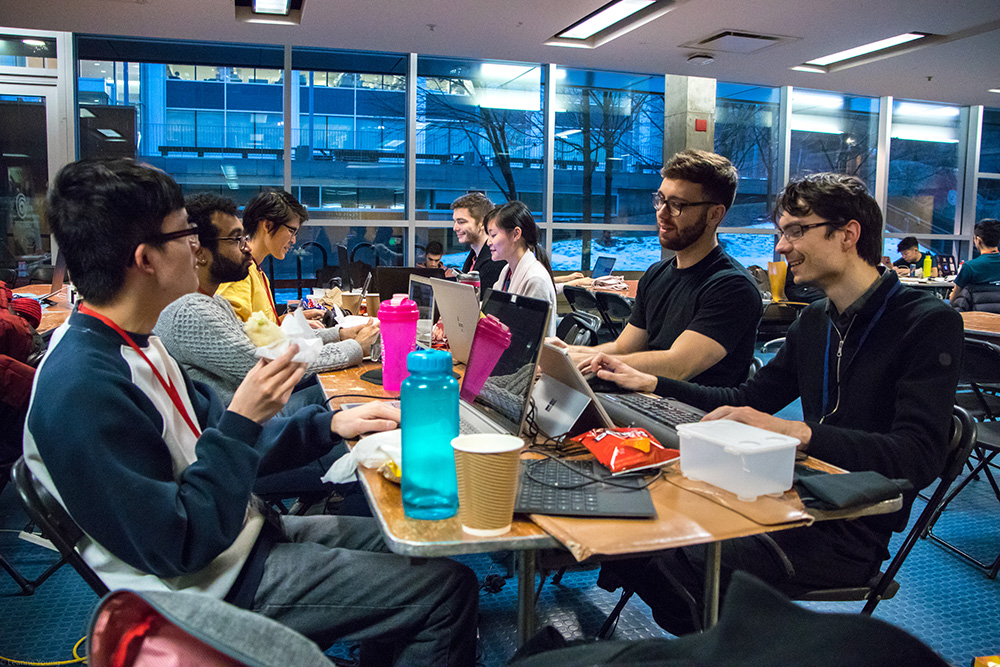
Designing an entire video game would be an impressive feat to accomplish within a matter of years. This past weekend, however, the McGame Jam, a development marathon organized by Game Dev McGill, condensed the video game making process into just 48 hours of straight development that took place Jan. 10-12. Teams made up primarily of McGill students gathered in the Trottier building to participate in a game jam, an event that hones the skills of artists, programmers, and designers as they endeavour to create an entire video game within the strict time limit. This year’s theme was “Can’t Go Back,” an abstract idea that teams must incorporate however they like into their game. 

Recent Concordia graduate Camilo Ignacio Vides Perez’s take on the theme culminated in an Indiana Jones-style puzzler in which the player must grab a treasure and get out. The catch: The floor falls away after walking on it, leading to some tricky and creative challenges. Perez led the programming and directing on his team, making sure each aspect of the game is both as functional and as fun as possible. One of the most underappreciated aspects of game design, Perez explained, is the core, fundamental design principles of architecture.

“It is so important for a game to have core mechanics and polish so the game can actually be fun,” Perez said. “If we lose sight of the game’s architecture, we don’t have a fun game.”

While working with a larger, more established team would allow someone like Perez access to more resources and staff, he insists that amateur projects like McGame have their own benefits:

“[In a major studio], you don’t have to think about finances. Budgeting isn’t a problem,” Perez said. “But in an independent studio, you have more freedom of creation. You don’t have to abide by what the game studio wants you to do.”

Michelle Samson and Leeza Girolami, 3D and 2D artists, respectively, operate on the opposite end of the game design process. Their team’s game began as a horror title, inspired by the ominous theme of the Jam, but eventually became a project they describe as being at once more sorrowful and funnier than their original idea. 

“We ditched the horror at some point and it became a meme [….] We joked around and deviated into a sad story,” Samson said. 

Their final product focused on a family of beavers forced to relocate due to their habitat being destroyed. When asked about the pros and cons of working at a large studio, Samson and Girolami cited the creative freedom as one of the more enjoyable aspects of independent game design. 

“From what we hear about big studios, you get a very specific type of task; maybe you’ll start to design rocks and for three years you’ll be doing rocks,” Samson said. “Rocks are great, but then you go somewhere else and they say ‘what’s your portfolio?’ and you say 100 rocks.” 

When the teams only have 48 hours, creating a game in such a short window of time means that certain design aspects are often overlooked, and Samson and Girolami see sound design as paramount in order to succeed in giving a game a distinct atmosphere. 

“[Sound] really completes the game,” Girolami says. “A lot of people forget to put in music and that’s always the missing link [….] You don’t want to be stuck in this vacuum.”  

Though it may seem like a tech-heavy event, Game Jams offer spaces for every kind of creative mind, from digital artists and sound designers to storytellers. While programming is essential, it barely scratches the surface of all the work that goes into creating the games we play and enjoy. 

McGill, News

Podcasting as a medium for all

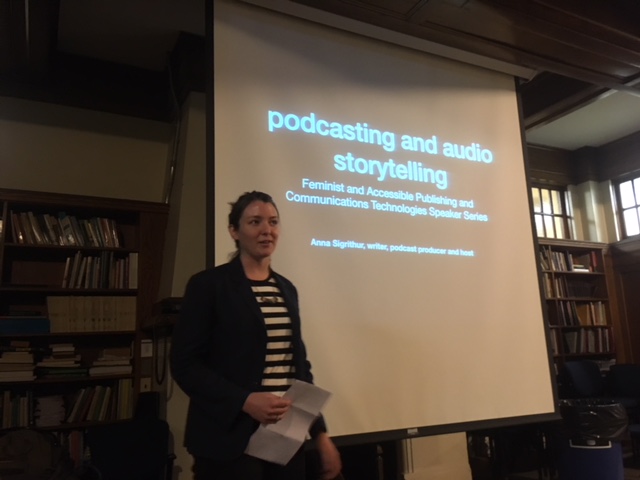
For the 20th event in the Feminist and Accessible Publishing and Communications Technologies Speaker Series, podcaster Anna Sigrithur led a Feminist Podcasting Workshop on Jan. 10 in Wilson Hall.

With about 20 participants, the workshop was an interactive and judgement-free space. Sigrithur began by describing the most common podcast formats, breaking down the elements of each. From there, participants worked in small groups to write a short script that could be edited over with sound effects and background music. Sigrithur demonstrated how to achieve desired effects by using the open-load audio-recording and editing application ‘Audacity’ which is available online. Finally, attendees were given time to discuss their ideas for podcasts and share them with the rest of the group. 

The speaker series, organized by Dr. Alex Ketchum, a faculty lecturer at the Institute for Gender, Sexuality and Feminist Studies, is composed of 25 workshops and discussions, seeking to bring together scholars, creators, and people within the communications industry, in order to look at the intersections of digital humanities, computer science, feminist studies, disability studies, 2SLGBTQIA+ history and critical race theory. 

“One of the reasons I decided to start this series was the thought about communities, scholars, traditional forms of academic publishing and even technologies as being sexist, classist, racially biased and inaccessible,” Ketchum said. “The kinds of solutions that [can often seem proper] actually don’t really change these problems, such as open access […] and oftentimes we end up [romanticizing and] fetishizing technological alternatives [without looking] at how that could be perpetuated.” 

Entirely self-taught in the art of podcasting, Sigrithur has no university degrees or formal training, but created the ‘Nordic Food Lab Radio Podcast’ in 2008, and also produced ‘OxTales,’ a series of podcasts from Oxford University’s Symposium on Food and Cookery. 

“I hope that is encouraging to you [and demonstrates how]  you can learn how to do some of these things and really [get] yourself [into podcasting],” Sigrithur said.

The speaker series focussed on two main approaches to accessible publishing and communications. The first involves providing a place for theoretical and activist applications of publishing and communications concepts. The second aims to create a space for workshops and teaching practical communications skills. 

Sigrithur’s workshop fell into this second category, with an overview of the main podcast formats, the tools needed to start your own, and a number of group activities to encourage comfortability with free podcasting technology, as well as brainstorming podcast ideas. 

Sigrithur believes that podcasting is more accessible that many believe it to be.  

“I don’t have any fancy technology [with me today], I [just] have my smartphone [.…] This is because I really do want to emphasize that podcasting, like many things, is not about technology,” Sigrithur said. “It’s about how well you understand the form, how clearly you come up with your ideas, and how well you are able to execute the content.” 

Sigrithur aimed to demystify the notion that podcasts are difficult to create. Many attendees came in with ideas for podcasts that they had for a number of years and discovered that starting a podcast can be done with readily available technology. Colin Maynard-Rier, U3 Arts, commented on the lack of hands-on training of the event, but he still learned a lot from attending. 

“[The workshop could have benefitted from] an opportunity to go through editing on [Audacity] itself,” Maynard-Rier said. “There is really such a low barrier to starting to podcast.” 

The workshop’s focus on the use of technology available online makes the daunting prospect of starting a radio show available to all members of society, no matter their gender, sexual orientation, class, or ethnicity.

quit
Commentary, Opinion

Point-counterpoint: New Year’s resolutions

The McGill Tribune contributors Favour Daka and James Li present their opinions on New Year’s resolutions.

Favour Daka, Against:

People often see the beginning of a new year as a time for reflection, when they can use the lessons of the past year as an incentive for positive change in the coming months. It is also the time where the excitement for New Year’s resolutions peaks. While people’s intentions for creating New Year’s resolutions may be positive, these resolutions can involve poor goal-setting.

Normally, people view New Year’s resolutions as only being valid for a year, which in turn causes people to unrealistically put every goal into a year-long time-frame. As a result, one may not consider ways to motivate and sustain themselves beyond the initial excitement of the New Year. This failure to conceptualize goals requiring more than a year may be why only two out of 10 Canadians manage to complete their New Year’s resolutions. Society’s obsession with instantaneous results obscures an understanding of progress and how it relates to time. New Year’s resolutions often involve the breaking of habits or creating new ones, a process that sometimes requires professional help, but more importantly, requires extensive time. 

New Year’s resolutions have become a standard practice in setting unrealistic goals. Life is spontaneous, and this serves as an important argument against the creation of New Year’s resolutions. Depending on the type of goal, most New Year’s resolutions are often abrupt decisions which aim towards a social standard, be it fitness, finance, or academics. If not fulfilled, resolutions can result in personal and financial costs that can be both damaging and demotivating. Therefore, with the overarching reality that a resolution may expire long before it is actualized, the idealistic characteristics of New Year’s resolutions can lead to negative results.


James Li, For:

As students hang up their brand-new 2020 calendars, many will also choose to draft a list of accompanying resolutions for the year ahead. However, there is increasing criticism of the effectiveness of these annual periods for reflection and goal-setting. While there are limitations to this millenia-old tradition and they are not overly comprehensive, the fact that New Year’s resolutions are so embedded in our culture makes them an accessible gateway into a more deliberate way of life. Burdened students may find it hard to get into the routine of reflection and planning, which is why they should start with the New Year.

Once a year may not be frequent, but New Year’s resolutions require work to be maintained on a regular basis and any amount of concerted effort adds up. It is easy to blow over or simply forget any other self-mandated regimen, but the ubiquity of New Year’s resolutions makes them difficult to ignore. Some will argue, though, that these resolutions are far too difficult to keep.

Because there are so many people beginning self-improvement endeavors at this time of the year, these goals offer a support system. From a friend with the same goal as you to the plentiful online resources available, any goal is more likely to be seen through. Yes, there is also abundant joking and criticism of New Year’s resolutions, but these also help normalize an essential aspect of goal-making: failure. The positive coverage provides support and the negative helps people realize it is okay to fail and that they should continue regardless.

For centuries, New Year’s resolutions were mostly religious or moral devotions. Today, they represent an opportunity to reflect and grow. Although the contents of our resolutions have greatly changed, their enduring place in society is their biggest strength. 


Read the latest issue

Read the latest issue