

Latest News

Sports

Inside Montreal’s ultimate scene

We’ve all spent a warm summer day lazily throwing a frisbee around with our friends. But if one were to go to Parc Jeanne-Mance on a sunny Sunday afternoon, they would find a group of adults throwing a disc in ways you would not think were possible. With full uniforms, cleats, and players barking directions at each other, this looks more like a game of football or basketball than the friendly, carefree context that usually accompanies the graceful toss of a frisbee. This is ultimate, and it’s been growing, quietly, since its founding in 1968. 

The first ultimate team was forged in a high school parking lot in the heart of suburban New Jersey by high schooler Joel Silver, later known for producing The Matrix. The teams were separated into student government versus school-newspaper kids and were first coached by a janitor who had some spare time. Silver had invented a new sport with soaring discs, endless possibilities for creative growth, and most importantly, ‘spirit of the game’: A loose concept that emphasizes the burden of sportsmanship and the responsibility of governance on the player. Thus, ultimate is the only sport that operates without referees at every level. The “win first” mentality that is so heavily encouraged in other sports is regarded with disdain in ultimate.

Ultimate has grown from a borderline joke in a parking lot into a professional sport with paid contracts and touring teams. Its development can be attributed to growth throughout the ‘70s and ‘80s, with the initial founders bringing ultimate to their colleges and laying the foundation for what would evolve into a competitive international sport. 

Today, ultimate has grown to the professional level, but those who play know that the real basis for the sport lies in the intense, tight-knit club and intramural scene that exists in almost every major urban area in North America. Every week, communities of eccentric and competitive players of all backgrounds, ages, and skill levels gather for a few hours of unadulterated, exhilarating fun.

Everybody has a different story for how they got involved in ultimate. Gwany Patenaude had been a lifelong athlete when she picked up ultimate as her primary sport in secondary school. Previously, she was a swimmer, but found herself without a sport, and so she decided to reestablish her CEGEP ultimate team. 

“I thought the combination of the team aspect of the sport [and] how much you could improve individually is what really drew me in,” Patenaude said in an interview with The McGill Tribune

Within three months, she joined Team Quebec and, later, Team Montreal as well. As a CEGEP student, she balances playing on two high-level teams, on top of coaching the McGill Men’s B ultimate team. 

For Kevin Quinlan, a professional player for the Montreal Royal, ultimate started as a more casual activity.  

“It started more […] like a social event than [as] a competitive thing for us,” Quinlan said in an interview with the Tribune. “We were just hanging out. Frisbee was just complementing the goofy people we were. It was when I got to college that I realized that this was more of a competitive sport, and […] people take it really seriously.”

For those who play it, ultimate is a lot more than a sport; everybody has their own reasons for loving the game.

“At first, it was really just a way to hang out with […] a really cool group of people,” Quinlan said. “But then it became the creativity you can use within the sport. There’s a lot of different ways to win. You’re always learning [and] adapting to different situations. That’s what I really love about the game.” 

For Patenaude, it is the sense of community that lies at the core of the game that she believes makes ultimate so appealing. 

“When you’re playing the game, it doesn’t matter [if you are] advanced or [a] beginner, you are all together,” Patenaud said. “I started out as a beginner, surrounded by people on national teams, and felt accepted.” 

The level of acceptance and fair style of play speaks to the sense of community that runs deep and is integral to the sport itself. The “spirit of the game” concept has been ingrained in ultimate since its founding in 1968 and is still taken very seriously. The American Ultimate Disc League (AUDL) maintains the player-officiated structure of the game, only recently implementing the use of “observers” who help mediate disagreements between teams. On the more local pick-up scene, the ‘spirit of the game’ translates to more than just sportsmanship and a self-officiated game: Players take pride in creating a competitive yet accepting and fun environment that prioritizes a sense of inclusivity and fun, which is lacking in most other competitive sports. 

“I’ve very rarely seen anyone intentionally try to abuse the rules or be unsportsmanlike,” second-year computer science student Adrien Philardeau-Planche of the McGill Men’s B team said. “There is always a high level of respect between opponents, and games essentially always remain fair, even though there are no referees in the sport. People play hard, but they don’t play dirty [….] The same can be said about Montreal’s Frisbee community. It’s very Québécois, very friendly, and quite competitive. It’s a lot of fun.”

In Montreal, ultimate flourishes every week through rain, sleet, and snow. Montrealers meet up in self- or club-organized groups to compete and have fun. Ultimate Grand Montreal, a volunteer based group, has been facilitating the growth of the community since 1993 with a mission of “encouraging the practice and development of recreational and competitive ultimate in the Montreal metropolitan area, by promoting and upholding the Spirit of the Game.” Today, UGM organizes dozens of leagues all throughout Montreal in addition to facilitating outreach programs to teach children, encourage development, and reinforce the values of hard work and the spirit of the game. 

Ultimate also exists in open pickup groups, a more casual and less organized form of the game. Every week, groups of university students, tourists, Mile-End tech professionals, and even middle-aged doctors talk on Facebook and schedule meeting times. People from across the city toss their bikes and work bags into a haphazard pile on the side of a field, and don light or dark shirt in accordance with a loosely adhered-to lights and darks policy. Then the frisbee takes flight and everything else is left behind.

“What’s unique about Montreal is that there [are] so many ways to get involved in ultimate, and to learn ultimate, and that’s really what’s unique about the city,” Quinlan said. “In smaller towns, it’s really hard to find that community. [Here,] you can start and work your way up from any level.”

Ultimate’s popularity is growing in Montreal, with kids, for the first time, picking it up at a young age. Pathenaude, who co-captains the McGill Men’s B Team, was especially surprised by her experience coaching youth outreach ultimate programs. 

“I had never met so many kids who were only playing ultimate […] as their primary sport,” Pathenaud said. “They were nailing throws I didn’t learn until I was 17.” 

Kids picking up the sport at younger and younger ages speaks wonders for the growth of ultimate in future years. The graceful, floating nature of the disc, the intricate strategic positioning and cuts, and the free flowing nature of the game, along with the endless possibilities for creativity, truly make for the ultimate sport.


Research Briefs, Science & Technology

Weathering the storm of aerosol emissions

There has long been concern surrounding the environmental impacts of extracting oil from Alberta’s Athabasca oil sands, the world’s third largest oil reserve. According to a McGill-led study published in Environmental Pollution, contamination from the Athabasca oil sands is impacting the weather patterns of nearby regions. The study was led by Parisa Ariya, a professor in the Departments of Chemistry and Atmospheric and Oceanic Sciences. Ariya worked with McGill PhD candidate Rodrigo Rangel-Alvarado, as well as other collaborators from the Université de Montréal, the University of Alberta, and Environment and Climate Change Canada. 

The  researchers found that snow from areas surrounding the oil sands had much higher concentrations of particulate matter than snow from downtown Montreal. The atmospheric pollutants near the oil sands were also more efficient at ice nucleation—a process involved in the formation of clouds—than dust particles normally found in the atmosphere. This is because snow-borne particles from the Athabasca oil sands region have a higher mean freezing temperature than mineral dust. 

Snow from areas surrounding the Athabasca oil sands also had a high concentration of particles greater than 100 nanometres in size, two orders of magnitude higher than snow from Montreal. Additionally, most concentrations of metals, including chromium, nickel, copper, arsenic, selenium, cadmium, and lead, were higher in snow samples taken near the oil sands.

Ariya mentioned that there are feedbacks between air pollution, weather, and climate, which affect how pollution-induced changes to weather patterns can interact with other climate change impacts. Aerosols affect cloud properties such as the initiation, frequency, intensity, and quantity of precipitation, and can alter natural processes, such as floods and droughts.

Climate change is known to affect urban pollution, which is the main source of climate change driving factors,” Ariya wrote in an email to The McGill Tribune. “Similarly, the weather conditions impact air pollution, and weather, as we show[ed] in this study, is also impacted by air pollution. In short, these three processes are linked.” 

Moreover, the ability of aerosols from the oil sands to be captured in clouds means that these pollutants can be spread to other areas through precipitation, causing damage to ecosystems, wildlife, and public health. Ariya cited reports by the Intergovernmental Panel on Climate Change (IPCC) and World Health Organization (WHO), although she noted that these intergovernmental organizations recognize the need for further research. She described how the impacts of air pollutants are not completely understood, as scientists still have to do further research into the physicochemical characteristics of aerosols, such as size and composition, to understand how they interact with clouds.

“The [IPCC and WHO] concurred that particulate air pollutants are their utmost knowledge gap,” Ariya wrote. “Air pollution is linked to eight million premature deaths worldwide every year.”

Despite the lack of knowledge on health impacts of particulate air pollutants, emissions from the Athabasca oil sands operations have been linked to health risks, such as increased likelihood of developing cancer and respiratory problems

“I think that we opened up a closed door to show that anthropogenic airborne nanoparticles can play [a] key role in weather processes, which [has] not [been] considered before,” Ariya wrote. “It builds […] on our leading contributions on air and snow nano-emerging compounds in urban centres or other polluted sites, such as oil sands covered in this study, and their importance in both health and climate research.” 

In the meantime, Ariya’s lab is conducting further research to explore the effects of other major industrial pollutants. The lab is also developing novel sustainable technology for air and water pollution remediation, as well as for the detection of gaseous and particulate matter, which will play an important role in tackling the mounting problems associated with anthropogenic pollution.

Arts & Entertainment, Film and TV, Pop Rhetoric

Pop Dialectic: ‘Cats’ divides theatre aficionados

Every generation has its signature so-bad-it’s-good movie: Before there was The Room, there was Showgirls, then Plan 9 From Outer Space. This week, The McGill Tribune decided to investigate Cats, the newest addition to this canon. 

A real cat-astrophe

Gabe Nisker 

One cat takes a couple of attempts to launch Bustopher Jones, performed by top-billed James Corden in one of two fat-shaming roles, the other from Rebel Wilson, into a garbage can so he can eat. It doesn’t work: Corden lands on the rim of the garbage can, and squarely on where his human genitals would be. It hurts, obviously, and it is played for laughs, because the film loves focussing the camera on crotches. Director Tom Hooper’s Cats movie is surprisingly and incredibly sexualized, usually to its detriment. The characters give longing looks, sidle up to, and nuzzle each other far too often.

Hooper’s bizarre directorial decision to use the same shaky camerawork he employed in his 2012 adaptation of Les Miserables often makes the work feel like a nature documentary, minus the David Attenborough narration. However, unlike the other 2019 musical nature documentary The Lion King, Cats does not depict anything resembling a feline on screen. The computer-generated fur in Hooper’s film is patchy and incomplete: Dame Judi Dench, whose lazy performance suggests that her check must have cleared prior to shooting the film, wears her wedding ring on her visible human hands. When antagonist cat Macavity (Idris Elba) removes his fur—yes, many cats have fur coats on top of, well, fur coats—to reveal a six-pack, the audience gasped. Sure, Elba is handsome—a key factor for those suggesting he play James Bond—but his furry body is more like Frankenstein’s Monster than a suave British spy.

Ultimately, Cats is an absolute trainwreck. The choosing of the Jellicle Choice—the winning cat of what appears to be a singing competition—is one of the major plot points of the film. The winning cat is floated up to the Heaviside Layer, which is the film world’s version of Heaven. Despite these references to paradise, the film presents something more hellish.


Cats is purr-fect

Kyle Dewsnap

Cats is a movie that, arguably, should never have existed. However, seeing that Universal and Andrew Lloyd Weber decided to curse Tom Hooper with turning the infamous Broadway show into a feature film, the director did absolutely everything in his power to make sure that his Cats was the best it could possibly be. In the end, he ended up creating one of the most fascinating movies that I have ever seen.

Even when performed onstage, Cats  is already a horribly awkward thing to watch: The show is comprised of two and a half hours of spandex-wearing actors introducing themselves to the audience as they all compete to be the next cat to die and be reborn. Hooper’s movie is strongest when it fully embraces this awkwardness. In the best scene of the movie, we see Skimbleshanks, played by Australian ballerino Steven McRae, lead a row of other cats as they tap dance on a railway line towards King’s Cross station, making for an absolutely delightful musical number. However, the movie also has startling moments of self-awareness where it acknowledges how embarrassing the subject matter is. This leads Hooper to make bold creative choices to distract the audience from the singing furries, such as making Jason Derulo waterboard James Cordon with CGI champagne. These scenes are incredibly disturbing, lending Cats the same horrifying energy reminiscent of a middle school’s theatre production.

As a result, Cats remains engaging throughout its entire 109 minute runtime, which cannot be said of many films. Watching Cats is like being unable to look away from a five-car pileup on the side of the highway. It’s degenerate, ugly to look at, and will haunt me for weeks to come.

Student Life, The Viewpoint

Fostering cats as an introspective exercise

The process of fostering a cat begins with reading a description: A female rescued from a kitten mill, vet work in process; a friendly grey female cat of two months—not yet vaccinated but treated for fleas.

When you make the decision to foster a cat, you go in with no expectations of commitment; the rescue organization may have already found a permanent home for it. The process of your local shelter is equally simple, requiring some paperwork and a meeting. Once a cat has been assigned to you, the only thing left to do next is to wait, and before long, a majestic creature will come swishing its tail through your door and into your heart.

I chose to foster rather than adopt due to career and financial instability. As my time as an undergraduate student at McGill comes to an end, I am still uncertain of whether I will return home to the West Coast, remain in Montreal, or move overseas in my next step of life. I would be devastated if I had to give up a cat because I could not take it with me. I also have limited financial resources as a student and would not be able to afford treatment if the cat became sick. Fostering takes the stress off of permanence, but, as with all temporary things, it also teaches the importance of letting go.

I once took in a green-eyed tortoiseshell cat named Sophia who would creep out of hiding on cautious paws then bolt back beneath the bed as soon as I turned my gaze in her direction. We tangoed in this manner for eight months—a slow, wary step forward followed by a fast, frantic scramble back, then a tense and dramatic pause before the dance repeated. My frustration mounted as the days inched by without any show of affection from her. It was like living with a roommate who actively avoided me and, worse, was also scared of me. I missed the affection of my previous foster cats who set about exploring and even snuggling in my lap within minutes of opening the carrier door. 

Sophia embodied all the qualities that anti-cat people find fault in. She was aloof, indifferent,  even impertinent. She recoiled from my attempts to befriend her and her only response to my gentle coos was a frightened stare with her cavernous black pupils. For god’s sake, I just want to love you, I wanted to shout. It took months of gentle cajoling before Sophia eventually warmed up to me. I cannot adequately describe the whirlwind of emotions that churned in my heart the first time she leapt into my lap, purring and butting her head into my hands. It was a mix of relief, joy, and validation.

Our period of unfettered friendship was short-lived. Sophia was adopted a year after she came to me, just weeks after she first opened up to the idea of snuggles. I was sad to let her go, but I like to think I played a part in showing her the better side of human nature. She entered her new home with more trust than she arrived with at mine.

The fostering process ends with letting go. It’s the last and essential step, and the one that I hate the most. It teaches you that it is impossible to force a good thing to last forever, momentous tides of change, such as moving away after graduation, means both the humans and furry friends in our life, may go in separate paths. It teaches you that it will be alright; the love and memories were worth it.

News, SSMU

SSMU plans for affordable student housing enters consultation phase

Since 2015, the partnership between the Students’ Society of McGill University (SSMU) and L’Unité de travail pour l’implantation de logement étudiant (UTILE) has worked to maintain affordable rent and educated students on real-estate practices and tenants’ rights. A 2018 report by the Canada Mortgage and Housing Corporation shows that Montreal’s vacancy rate has dropped by 1 percent between 2017 and 2018.

In 2019, SSMU continued its fight for affordable student housing by introducing a project in collaboration with UTILE to look into the potential for constructing affordable housing specifically for McGill students. In October 2019, SSMU created the Affordable Housing Committee dedicated to the issue making progress on this issue. SSMU Vice-President (VP) External Adam Gwiazda-Amsel is on the committee and is organizing a town hall meeting on Jan. 27 to gain insight on students’ priorities.

“We are trying to solicit feedback from students about what their priorities for a living space are,” Gwiazda-Amsel said. “What are the sort of qualities [SSMU] should look for in the building and its residents? Aside from the building project, the Affordable Housing Committee also felt the need to educate students about housing rights because this is also why rents go up.”

The committee will invite UTILE directors, McGill Legal Information Clinic members, and people from the Milton-Parc community to help educate students on rent-control, which will help control rent prices in the long term.

“Different communities have seen success with tenant strikes and information campaigns about exploitative rent practices,” Gwiazda-Amsel said. “For example, a landlord can only raise your rent two per cent a year in Montreal, but a lot of students do not know that.”

Along with teaching students, SSMU is working with UTILE to design housing for McGill students, created by McGill students. UTILE’s General Coordinator Laurent Levesque works in collaboration with SSMU.

“We are working towards the biggest possible project,” Levesque said. “Our working target at the moment is to build at least 300 beds [within five years]. In the short term, we are aiming to confirm this and other project parameters in a contract between UTILE and SSMU before the summer so we can get to work looking for land [and] designing the building.”

Even with SSMU and UTILE’s operating budget, space and resources are limited for making affordable student housing.

“We are also in talks with the City of Montreal to make sure they continue to fund affordable student housing,” Levesque said. “[Montreal] has [done so] for our Woodnote project in collaboration with the Concordia Student Union and our Angus project. That will be the key to taking affordable student housing to an even higher level.”

Levesque also stressed the importance of educating students on housing rights as a long-term tool to fight against rent increases.

“There is a lot of helpful advice on how to find a decent place in Montreal and how to fix problems you might have with your landlord, flatmates, et cetera,” Levesque said. “Montreal is facing a serious housing crisis and one way that affects students’ lives is that it can take much more time and effort than before to find an affordable flat. I recommend budgeting plenty of time when you start looking. If you’re planning on moving, consider looking into apartment swaps, that help keep rents low.”

Members of the Milton-Parc community will also attend the town hall to teach students based on the community’s experience with fighting rent increases. SSMU Community Affairs coordinator Claire Grenier works with the Milton-Parc community. 

“Milton-Parc [residents] have always been avid organizers,” Grenier said. “Right now, [we are] working on campaigns to combat one of the greatest causes of higher rents, AirBnb. Hopefully McGill students can take inspiration from the community’s work and start more co-op student housing, or educate themselves about the effects of AirBnb on neighborhoods like Milton Parc.”

Students can visit UTILE’s website, likehome.info, to gather more information about tenant’s rights.

Student Life

Winter on two wheels

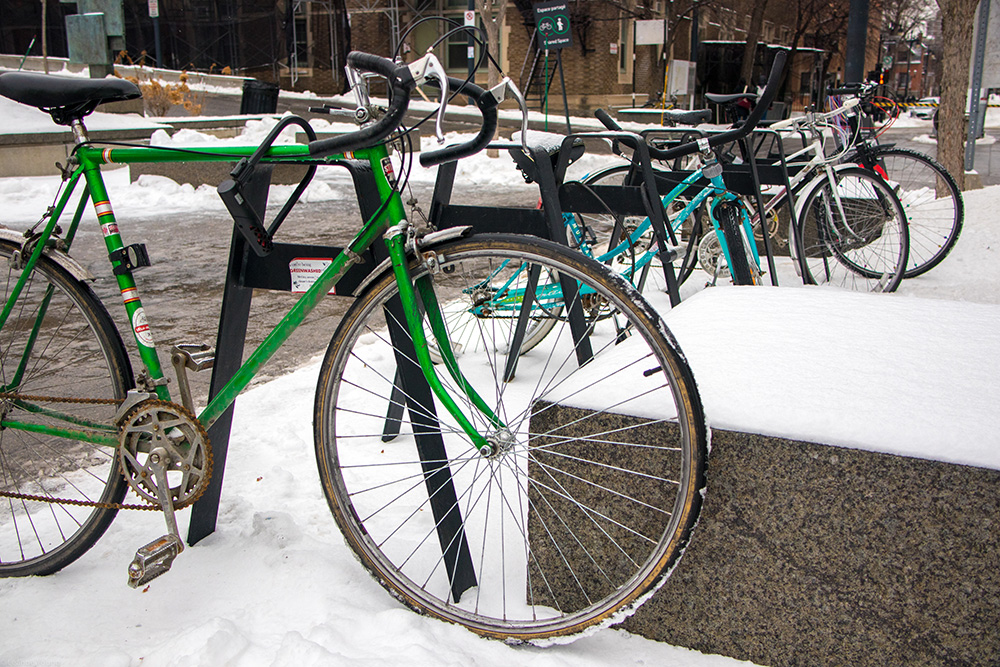
The removal of BIXI bikes every November can only mean one thing: Winter is coming. For some, this spells the end of biking season, but many Montrealers continue to bike even during the long, cold months. In fact, the number of winter cyclists in Montreal rose by 14 per cent in 2017, according to Vélo-Québec.

Among them is Tommy O’Neill Sanger, U3 Science and volunteer at The Flat Bike Collective. He is not deterred by the harsh conditions of the winter months. 

“I [bike to school] everyday,” O’Neill Sanger said. “It’s quite common, a lot of my friends do [it,  too]. There are definitely less people [biking] on the road in the winter, but every year, I’m seeing more and more people.”

In order to prepare their bikes for the winter, many cyclists switch to snow tires. Studded tires, a type of snow tire with metal studs embedded in the treads, provide good traction on icy roads, but are also heavier, which makes for a slower ride. According to Vélo Québec, a common tip for slippery roads is to let a bit of air out of the tires for better grip, but to not go below the minimum pressure recommended by the specific manufacturer. Moreover, salt on roads can cause  friction for bikes and can wear out the chains. But, as O’Neill Sanger assured, as long as bikes are cleaned frequently, once or twice a week, salt corrosion should not be too much of a problem. 

“In the winter, […] I put tires on that have more tread [than my normal tires…] [but they are not] specifically meant for snow,” O’Neill Sanger said. “Although some good winter tires have metal in them, [some, like mine, don’t]. [Bike parts], such as derailleurs or brakes, [can freeze] in the winter. One of the solutions is to have a single-speed or fix-gear bike so [there is no derailleur and] it’s a lot simpler and [requires] less maintenance.”

A common issue in the winter is that many of Montreal’s bike lanes lack a physical divider between bikes and vehicles, which, when combined with ice patches or thick snow, can create dangerous conditions for cyclists.

“The main thing is to be aware of the conditions [on the road],” O’Neill Sanger said. “You have to watch out for patches of ice or thick snow. Roads get thinner because snow doesn’t get cleared perfectly, and you bike more towards the middle of the road, which can be dangerous.”

O’Neill Sanger suggests planning your journey beforehand to stay safe on the roads. Some cyclists prefer to switch to smaller roads where there are fewer cars, but often these roads are not plowed as well. However, he believes that Montreal’s bike infrastructure has seen improvement in recent years, allowing for safer cycling in the winter.

“We’ve seen a lot of progress in recent years in the maintenance of biking routes,” O’Neill Sanger said. “Often, [some] bike paths are the first to get cleared. Sometimes you find a bunch of pedestrians on the bike paths just because the sidewalks aren’t cleared. [But] there is [definitely] still room for improvement, and it’s not perfect.”

Still, O’ Neill Sanger maintains that the fear behind winter biking is definitely unfounded.

“It’s definitely good to do some research to figure out how to [bike] safely, but I definitely recommend it to [all cyclers], even beginners,” O’Neill Sanger said, “Most days throughout the winter, the streets are clear and quite safe [.…] For the most part, you can often ride on the same bike [as you would] ride in the summer.”

Arts & Entertainment

Style and the city

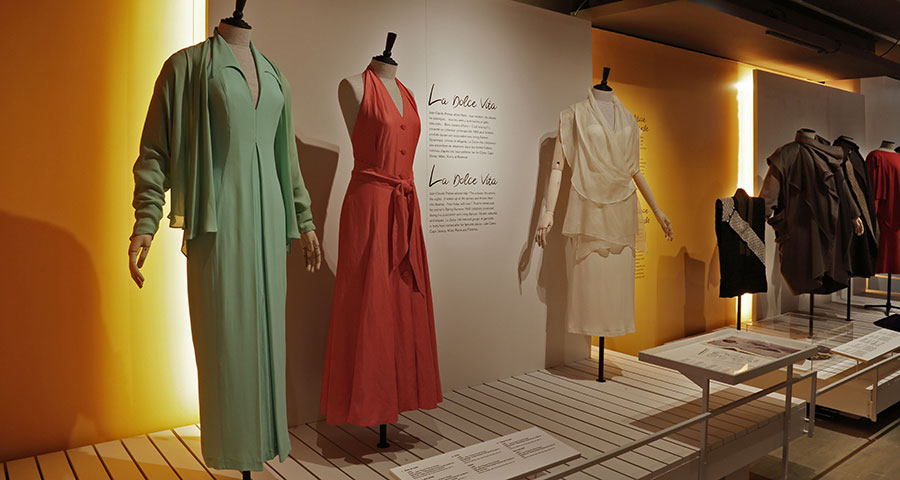
What defines Montreal style? The typical outfit around campus often features heavy parkas, rolled up beanies, and thrifted sweaters. Montreal’s climate requires practical outerwear while its social scene requires tasteful dress. While it’s impossible to pin down a single style for an entire city, Jean-Claude Poitras, one of Montreal’s best-known fashion designers, has distilled a part of the city’s character in almost all of his garments. Known for his outerwear and clean cut designs, a collection of Poitras’ ready-to-wear clothes are currently on exhibition at the McCord Museum until April 26. Jean-Claude Poitras: Fashion and Inspiration showcases the breadth of his life’s work and provides sources for his design inspiration.

Throughout the course of his career, which spans nearly three decades, Poitras has designed everything from simple pant suits to voluminous wedding dresses. The McCord Museum’s exhibit is arranged to show that Poitras’ surroundings greatly influence his stylistic vision, as each room shows how his life experiences affect his work. Starting with his early life, the rooms transition to explore his travels and his fascination with film stars. Presented in a straightforward fashion, the clothes draw inspiration from period clothing but feel timeless, drawing references from many cultures while still feeling quintessentially Montreal. Jean-Claude Poitras: Fashion and Inspiration demonstrates how inspiration can appear anywhere, impacting style and identity along the way, as it has for Poitras.

Born in 1949, Poitras grew up in the Cartierville neighbourhood of Montreal. From a young age he was influenced by the elegant dress of churchgoers and clergy at his local parish—a style he termed “monastic chic.” After he earned his diploma in fashion design from the École des métiers commerciaux, he went on to open his own store in Old Montreal in 1975. Since then, he’s created a number of labels, worked with many manufacturers, and won prestigious awards for his designs, including the Fil d’Or de Monte-Carlo. Specializing in ready-to-wear clothing, his garments are designed for everyday life. Don’t expect avante-garde, sculptural pieces here—Poitras’ clothes are wearable in any situation.

In this exhibition of his life’s work, many of the garments feel timeless. Most of the clothes on display are from the ‘80s and ‘90s, but they certainly aren’t the typical type of clothes from those periods.  A sleeveless, salmon-coloured sundress looks like it was from 1950s Italy, but it was made in 1993. A boxy, high-neck fur coat from 1992 looks like it could be worn anywhere from the 1930s or today. Poitras cites classic Hollywood as a source of inspiration for his work, and his style certainly assumes that classic quality. In contrast to contemporary fast fashion, Poitras’ designs aren’t dated by trends—his clothes last physically and stylistically for years to come. 

“For over 30 years, Jean-Claude Poitras has influenced Quebec fashion through his signature designs, exceptional know-how and intuitive, very sensitive, artistic approach,” Stephen La Roche, executive director of the Musée de la civilisation, a co-producer of the exhibit said. “For him, fashion is an art form that is part of our lives and reflects who we are.”

Jean-Claude Poitras: Fashion and Inspiration is an insightful look into a Montreal designer’s sense of style and spirit that is emblematic of Montreal as a whole. His designs make elegance seem effortless, whether the wearer is attending a red carpet event or drudging through a snowstorm. Poitras, still an active member of the fashion scene, will be at the McCord Museum on Jan 30. to present a free screening of the documentary, Jeanne Moreau, l’affranchie.

Jean-Claude Poitras: Fashion and Inspiration runs until April 26, 2020.

Basketball, Sports

NBA midseason awards

With the 2019-20 NBA season halfway done, The McGill Tribune presents its midseason awards, highlighting some of the most notable individual and team performances so far.


Unexpected Breakout Team: The Miami Heat

Since the end of the reign of the “Three Kings” in 2014, the Miami Heat have endured a run of mediocre seasons, never managing to scrape their way past the first round of the playoffs. Remarkably, it was the off-season $142 million acquisition of Jimmy Butler that’s turned the team around, clinching the second seed in the Eastern Conference. Many pundits doubted this move at the time, questioning Butler’s ability to lead a franchise after his flame-outs in Minnesota and Philadelphia. This has made the emergence and success of Miami’s positionless, unselfish style of play all the more surprising and exhilarating. We’re excited to see if the Heat can keep this up, and whether an offence without a point guard holds up under the strains of the playoffs.


Best Individual Player: Luka Dončić

Following an already historic rookie of the year campaign, Luka Dončić has put on a brain-melting masterstroke of a season. As a 20-year-old sophmore, he’s managed to put up an incredible average of 29.4 points, 9.7 rebounds, and 8.9 assists without sacrificing the team’s success. Dončić has led the Dallas Mavericks to a 23–15 record without a clear number two player or all-star on his team. If he manages to keep up this performance, he could be the youngest MVP of all time. His dominance from such a young age has other franchises worried about their own prospects, and Mark Cuban basking in the success of yet another European superstar.


Worst Franchise: The New York Knicks

Although the New York Knicks bungling the off-season once again is not surprising, how they did it this year was certainly creative. With the prospects of signing Kevin Durant and Kemba Walker and drafting Zion Williamson, the team somehow wound up with a starting lineup of no-names playing in what has become a veritable dumpster-fire of a season. At this rate, the Knicks will most likely finish as the worst team in the league.


Unexpected Breakout Player: Dwight Howard

In anticipation of Dwight Howard’s return to the Los Angeles Lakers, basketball media outlets had a field day poking fun at Howard’s reinvention of his game and body. Having spent the last decade as a basketball nomad on five different teams, Howard was all but written off as a relic from the 2000s: Outdated in today’s faster, spaced out game. Nobody expected Howard to turn his career around, but here he is, 40 pounds lighter, draining threes and actually contributing to a winning team for the first time in nearly a decade. Howard’s transformation is reflective of a changing NBA and has fans waiting to see if he can continue to contribute to a team that has the potential to be the NBA champion.


Best Team: The Los Angeles Lakers

Halfway through the season, the Lakers have resoundingly established themselves as the best team in the West, a full five games ahead of the number two seed Denver Nuggets. The re-emergence of the purple and gold can be attributed to the dominating performances of Anthony Davis and LeBron James, with a fantastic accompanying cast of Kyle Kuzma, Danny Green, Alex Caruso, and Dwight Howard. Even at 35, James has managed to extend his reign as King of the NBA. He leads the league in assists and has accompanied Davis’s dominant season with his own flurry of triple-doubles. After last season, many had written James off as a no-longer-dominant force in the NBA, but he’s proved them wrong and could even add a ring to his collection come June.

(Kathryn Leci / The McGill Tribune)
Off the Board, Opinion

The mental impacts of physical injury

When I was 16, my dream was to play soccer and run track at university, and perhaps even at the professional level. At the time, sports were my social life, my confidence booster, and my joyful escape from the stress of academics. But adolescent dreams die hard. In my third year of high school, I tore my anterior cruciate ligament (ACL), a knee injury that typically requires surgery and nine months of recovery.

Four months after my surgery, I tore the same ACL in physiotherapy. A year after that, I tore it for a third time, along with cartilage in my knee. In the span of two and a half years, I underwent four surgeries on the same knee, and my dream of becoming a collegiate athlete gradually faded away.

However, during all the time I spent feeling sorry for myself,  I failed to notice my injury’s influence on my mental health. Without sports, I felt lost and dispassionate. I tried to ignore sports and focus solely on academics. I became less confident and was plagued by the trauma of my injuries.

Although mental recuperation can be just as important as physical rehabilitation, my physiotherapists and doctors never mentioned the mental aspect of sports recovery. Following a traumatic orthopedic injury, between 20 and 50 per cent of patients suffer from post-traumatic stress disorder (PTSD), while others experience emotional responses such as sadness, anxiety, and depression. Injured athletes must deal with muscle atrophy, intense pain, and frustration. In my case, I became angry and bitter. I grew jealous of others and lamented the life that I used to have, one where I won races and scored goals. I felt like a nobody, destined to fetch water bottles for my teammates. 

It has been three years since my last surgery, yet my knee still gives out when I run to the bus, swells up after standing for a few hours, and grinds and clicks as cartilage wears against bone. My frustration now stems from my inability to participate in physical activity for fun, let alone for competition. I can not kick around a soccer ball with friends, ski with my family, or go on a hike. A seemingly temporary injury developed into a condition that is still pervading many areas of my life, and that, according to my doctor, I just have to live with. 

Society places a lot of pressure to bounce back from disappointment but rarely discusses disappointment itself, as well as the failure to recover from it. We hear about athletes who return from an injury better than ever, but we don’t often hear about the athletes who never return to play their sport. Excluding the stories of those who have not had a fairytale ending, but who have still battled and grown along the way, overlooks their experiences and creates the unrealistic expectation that everything always works out in the end.

A small part of me will remain bitter and resentful about letting my sport go, but the experience also opened up new opportunities to explore pastimes like yoga, rowing, writing, and science—things that I doubt I would have pursued if I were a collegiate soccer player.  My injuries were a harsh reminder that life does not revolve around me. I learned to be adaptable, accountable, and patient with myself when things did not go as planned. I learned to not take success or recovery for granted, and to try new things. And I learned to accept that it is okay if I do not live out all my dreams; eventually, I made new ones.


News, SSMU

DriveSafe extending services to Kahnawake Mohawk territory

As of the beginning of the Winter 2020 semester, Students’ Society of McGill University’s (SSMU) DriveSafe has extended its services to the Mohawk territory of Kahnawake, south of the island of Montreal. The initiative, set up in collaboration with SSMU Indigenous Affairs and in consultation with Mohawk students at McGill, allows students to call DriveSafe for a free drive home in the region.

DriveSafe is a student-run volunteer service that offers free rides and shuttles to McGill students between 11 p.m.— 3 a.m. from Thursday to Saturday. Currently, DriveSafe operates in Kahnawake, on the Island of Montreal, and offers shuttles in Longueuil. There are plans to extend services to Laval next year. 

DriveSafe President Charles Choi acknowledged that the decision to extend the territory of operation to Kahnawake stemmed in part due to the scant availability of public transport between Montreal and the region.

“Kahnawake [has little] public transport to Montreal, [and] it is very scarce and very difficult to access,” Choi said. “So for McGill students and faculty, we felt that this was the best we could do.”

He added that the extension helps DriveSafe in its mandate to offer a greater equality of service to all its students, irrespective of race or socio-economic status.

“From what I have heard […] from different leaders in our school community [and other] individuals, they have been overwhelmingly supportive and they have been commending SSMU for this extension to Kahnawake, knowing that it is a marginalized community,” Choi said. 

SSMU Indigenous Affairs Commissioner Tomas Jirousek believes that students living in Kahnawake will greatly benefit from this development. He noted that Indigenous students now have the possibility to partake in activities downtown later in the day, without the stress of having to plan a safe trip home. 

“There isn’t this insecurity wondering ‘Is the metro going to be running?’, ‘Is it too cold to get a taxi?’, [or] ‘Am I going to be able to get home?’” Jirousek said. “And that is something that we can finally offer to our Indigenous students living [in] Kahnawake.”

Jirousek added that although he does not think the extension to Kahnawake will significantly increase the use of DriveSafe, the availability of the service offers students reassurance. 

“There aren’t a ton of students who are going to be from Kahnawake in town during those times,” Jirousek said. “But the point is that we can offer this blanket security and […] the same services that non-Indigenous students [enjoy]. We can offer them that same peace of mind.”

Erin Patton (BSc ‘19), a resident of Kahnawake, is pleased with the change, as it will simplify Indigenous students’ itinerary home and will provide a free alternative to an otherwise expensive trip by taxi or Uber. 

“It’s a really good initiative,” Patton said. “[Drivesafe] only [covered] the island of Montreal before and it was hard to get home if you were studying late or going out that night. But now that they have [extended it] it is much easier to get home.”

Patton believes that she would have appreciated the extension to Kahnawake if DriveSafe had expanded earlier. 

“I was always involved in student life and going out with friends, and doing activities at school, [and] I always found that I had to leave early from things and plan my public transit out or how I was getting home that night,” Patton said. “I would have had more time participating in these things than worrying about getting home.”

Read the latest issue

Read the latest issue