

Latest News

Commentary, Opinion

Legal weed is safe weed

On Oct. 29, Quebec’s National Assembly passed Bill 2, which will raise the legal age for Cannabis consumption to 21 on Jan. 1, 2020. This change comes as a result of a major campaign promise made by the Coalition Avenir Québec (CAQ) ahead of last October’s provincial elections, despite Quebec already having some of the strictest cannabis laws in the country. The CAQ and other proponents of the bill argue that the changes will curb the potentially harmful effects of cannabis on adolescents, while critics say such measures are ineffective. Overall, Bill 2 is both dangerous and contradictory, and in response institutions like McGill should pursue programs and policies in favour of harm reduction.

After about a year and a half of debate in the federal House of Commons, the government passed the Cannabis Act on Oct. 17 2018. Supporters claimed that legalization would reduce organized crime, bring in tax revenue, and keep the substance out of the hands of underage people. The federal legislation allows provincial governments to set their own regulations for the use of the drug, and Quebec already had some of the most rigid regulations in the country prior to the introduction of Bill 2. For example, while Canada recently legalized the sale of edible and topical cannabis products, the CAQ has decided that products that may be attractive to minors, like pastries and candies, will remain illegal. Quebec is also in the middle of a legal battle regarding whether their ban on home-grown cannabis is constitutional. 

“Overall, Bill 2 is both dangerous and contradictory, and in response institutions like McGill should pursue programs and policies in favour of harm reduction.”

The problem with Quebec’s restrictive laws, particularly Bill 2, is that they fail to prevent young people from using cannabis, despite this being their purported goal. The CAQ claims that the new age restrictions are meant to set a precedent and will come with education programs intended to dissuade youth from using the drug. However, this is wishful and unrealistic thinking. According to Quebec Liberal Party health critic Andre Fortin, 31 per cent of 18-to 24-year-olds consume cannabis. There is little evidence that the new legislation will do anything to bring these numbers down. 

Instead of allowing young adults to visit Société québécoise du cannabis (SQDC) stores to get information from specialists regarding THC concentration as well as safe consumption, it seems that the Quebec government would rather pass legislation that is likely to cause young people to return to their dealers. Unregulated products often have higher levels of THC and, in rare cases, can be laced with dangerous substances. While provincial governments should be looking for ways to promote the purchase of regulated cannabis as opposed to unregulated products (such as with lower prices and a higher concentration of dispensary locations), Quebec has taken a step in the opposite direction.

Quebec’s decision is part of a broader debate surrounding measures that should be taken to promote harm reduction, and whether current legalization efforts are sufficient. Advocacy groups like Canadian Students for Sensible Drug Policy (CSSDP) are taking a different stance than the government on drug use. The group advocates for progressive drug legislation and policies, including the legalization and regulation of all drugs, as well as a designated space for medical cannabis use on campuses and education programs to encourage responsible cannabis use for youth. The McGill chapter of CSSDP is currently looking into providing free drug testing kits for students in order to reduce harm, a resource which is less specifically relevant for the use of cannabis but extremely pertinent for safe drug use more generally. 

The CAQ is clearly not ready to put the legitimate needs of young people first and would prefer to pander to its socially-conservative base. Where the government fails to act responsibly, institutions like McGill should follow the lead of groups like CDSSP and provide financial and institutional support for harm reduction programs.

Arts & Entertainment, Film and TV

Where do I begin?: ‘Ancient Aliens’

Ancient Aliens first aired on The History Channel in 2010, and for one month this year, I let it take over my life. The documentary-style series, produced by the Emmy Award-winning Kevin Burns, follows a group of conspiracy theorists as they attempt to convince the audience that life and culture on Earth began with aliens. Many of the “experts” featured in the show have no credentials other than having authored non-academic books on the subject. In fact, most of their claims have been blatantly rejected by actual scholars with training in archeology, and even Carl Sagan did not believe in UFOs

The Experience

The first time I watched this show, I was in disbelief. This piece of media called Ancient Aliens is out there, and the people that the show cites as specialists in alien activity are apparently real. But, from the get-go, before any so-called ‘experts’ have even been introduced, the show already had me in a daze of wonder and confusion. 

One of the immediately startling aspects of the show is its terrible production quality. The show uses bad artist renditions to help the audience visualize the encounters of ancient humans with extraterrestrial life, and I cannot imagine a worse use of money. Within seconds, I was hearing blatantly false statements, including that scientists do not understand the Bermuda Triangle. In reality, the phenomenon of airplanes and ships disappearing in the area between Southern Florida, Bermuda, and Puerto Rico has been explained by scientists as nothing abnormal. The narrator, Robert Clotworthy, had already thrown a series of bold claims at the audience with absolutely no supporting evidence even before someone that the producers cite as an expert makes an appearance on screen. Words like “decades” and “millions” are used arbitrarily, seemingly at random, without citing any actual research. 

The Highlights

The first ‘expert’ that appears on screen in season two is none other than the disheveled-looking conspiracy theorist of meme fame Giorgio A. Tsoukalos. While I am delighted that most people do not take him seriously, it is still beyond me that anyone would pay him to appear on a show where all he does is throw meaningless sentences at the camera. What sets the cast of “experts” in this show apart is that they had the gumption to go out there and make these claims to the public. 

The title sequence is a remarkable piece of television. Ominously vague questions such as “Who were they?” and “Why did they come?” flash across the screen. These words, which rattle my core to this day, float mysteriously across stock images of the pyramids, Stonehenge, and other famous landmarks that drift around the words. 

The Power

Ancient Aliens went so far as to actually make me believe in aliens less. I have always accepted that the universe is infinite, so it makes sense that there would be life out there somewhere. But, the cast of this show and their alleged “evidence” of aliens have made me reconsider where I stand. Everything they say seems to discredit them more and more, yet the show stays true to its path. I can only compare the producers of Ancient Aliens to a horse with blinders on, except they put the blinders on themselves to actively ignore the scientific evidence that overwhelmingly counters all of their claims. In a weird way, I respect their stubbornness, and maybe it was the sheer audacity of everyone involved in its production that convinced me to keep watching the show a decade later.

LICM
McGill, News, SSMU

Fall 2019 referendum endorsements

The McGill Tribune’s editorial board provides its endorsements for the Fall 2019 Students’ Society of McGill University (SSMU) referendum period.

Creation of Indigenous Equity Fund and Fee: Yes

The proposed creation of this non-opt-outable $1.00 fee would serve three purposes: Funding the activities of the SSMU Indigenous Affairs Committee, financing projects led by Indigenous or equity-seeking student groups, and providing a source of financial support for Indigenous undergraduates at McGill. The Tribune endorses the creation of this long-overdue fund and fee. The fund would support Indigenous students and grant them the fiscal autonomy needed to address their needs and concerns. Given the lack of substantial institutional support that exists for Indigenous students on campus, and the relative bureaucratic silence from McGill after the 2017 Provost’s Task Force on Indigenous studies and Indigenous Education, this fund is a step in the right direction. 

Creation of SSMU Student Academic Support Services and Fee Levy: Yes

The proposed $0.93 opt-outable fee will go toward an office that integrates and expands Open Educational Resources, SSMU Tutoring, and MiniCourses. The fee will also go toward the creation of paid note-taker positions and affordable preparatory courses. The Tribune endorses the fee, as access to open education is necessary. However, it is imperative that students consider the need for the university administration to fund the compensation of note-takers, in the way the Office for Students with Disabilities no longer does, as it is not sustainable for students to fill gaps in student resources.

Increase and Nature of SSMU Equity Fee: Yes

The proposed $0.50 increase to the SSMU Equity Fee is reasonable and financially necessary given the Equity Fund’s $5,000 deficit. One of the Equity Fund’s main purposes is to fund the salaries of SSMU’s Equity Commissioners, who oversee discrimination complaints within SSMU. Because students who choose to opt-out of the Equity Fee cannot be denied access to this process for ethical and practical reasons, making the fee mandatory is a sensible decision.

Club Fund Fee Increase: No 

Vice-President (VP) Student Life Billy Kawasaki leads the campaign to increase the SSMU Club Fund Fee from $2.75 to $7.75, which he says will enable the creation of an online platform for SSMU club communication and go toward funding an improved insurance plan for events. While it is admirable that SSMU executives are working toward improving their relationship with clubs and services, Kawasaki’s campaign has not clearly demonstrated how spending $20,000 per year on an online portal and updated insurance will provide club executives with the support they need. As such, the Tribune believes that the 280-per cent fee increase is not justified.

Discretionary Funding for DriveSafe: Yes

SSMU’s free DriveSafe service drives students home safely anywhere on the Island of Montreal on Thursday–Saturday nights. It is funded by a non–opt–outable Safety Service Fee of $3.97, of which $0.60 goes toward DriveSafe. Currently, all of the 280 vehicles rented each school year by the service use gasoline. The motion regarding discretionary funding suggests that, by 2030, DriveSafe will only use electric vehicles. The Tribune endorses voting ‘yes’ to support the first steps towards offsetting the 9.8 tonnes of greenhouse gases released by this service each year. 

Sports

How to be a sports fan

So, you want to be a sports fan. If you were not born wearing the jersey of the team that your family has followed for decades, beginning to follow sports can be intimidating, but it’s not as daunting a task as you may think. To help you on the journey, here are five easy steps to become a sports fan.

Step one: Choosing a sport

If you are just starting out, it’s best to stick with one sport. While one of the North American “Big Four”—baseball, basketball, football, or hockey—will probably be easier to follow from Montreal, don’t be afraid to follow a sport that is more popular internationally, like soccer or cricket. You can also try something more niche, such as fencing or Quidditch. If it calls to you, watch it.

Now you have your sport—let’s say you picked hockey. You are eager to get started, but the NHL has five games tonight, and you have no idea which to watch. This brings us to step two. 

Step two: Picking a team

The NHL, to continue with our example, has 31 teams. You might have an idea of which one you want to follow, maybe your home city’s team. It’s also fine if you have no idea. You can pick the team with the best logo or name, or the team that you heard mentioned on an episode of Bones years ago. You could pick the team that won the Stanley Cup last year, or the one that’s the favourite to win this year, because, despite what you might have heard, there is nothing wrong with being a “bandwagon fan.” If a team is popular, they’re probably fun to watch, so go for it.  

Since this is Montreal, let’s say you pick the Habs. Now it’s time to move on to step three.

Step three: Watching a game

If you are worried about learning the rules next, don’t worry: You will learn more from watching a game than you ever will from staring at a rulebook. Having a friend you can pester with questions at every whistle is also very helpful. If you like history, some research can be fun, but you are not a “fake fan” if you can’t list every time the Yankees won the World Series.

Going to games is a great experience. Major league games can get prohibitively expensive so consider going to a minor league or university game—The McGill Tribune is particularly fond of the McGill teams. The feeling of being surrounded by an arena full of fans cheering for your team is unparalleled.

Whether your team won or lost, you probably learned a lot from that first game. If they did lose, you might be questioning whether you made the right choice. This brings us to step four.

Step four: Learn to love losing

Teams lose. It happens. Not even the best teams win all of their games. But losing can have its benefits: Commiserating with fellow fans about a loss is almost as enjoyable as celebrating a win. Complaining about your team is a time-honoured tradition in most sports. You can also find bright spots in losses. Maybe a player you like snapped a goalless streak, or your team took fewer fouls than they did last game. 

Through losses and wins, you’ll experience a rollercoaster of emotions. It’s now time for the fifth, final, and most important part of this process: Step five. 

Step five: Have fun!

Despite the billions of dollars invested into sports, their ultimate purpose is to provide entertainment. At the end of the day, watching a game should be fun. Remember that, and you’ll do fine.


Congratulations, you’re a Certified Sports Fan! Welcome to the club. We’re happy to have you.

McGill, News

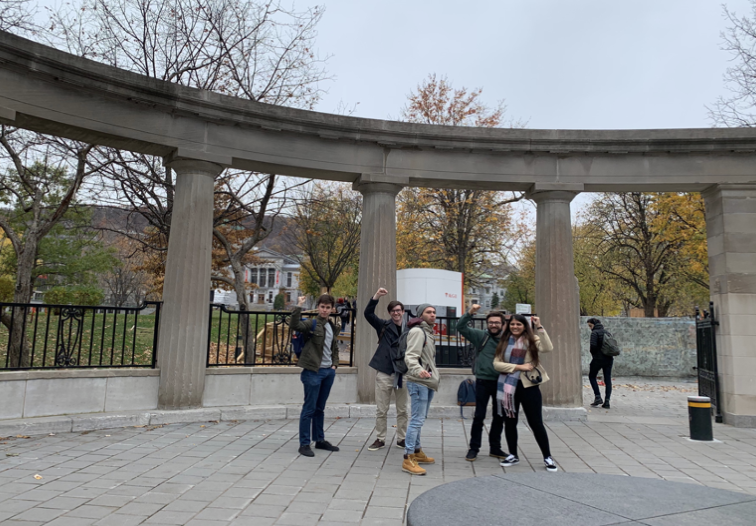
“Save Our Samosas” protest draws crowd of six

Six students gathered to protest McGill’s samosa ban in front of Roddick Gates on Nov. 4. The Facebook group ‘Save Our Samosas’ organized the protest and received over 1,200 likes on their page as of press time, with 600 students expressing interest in attending the event. While most of those who showed interest did not show up, those who did were not deterred by the poor attendance. One student chanted  “No samosas, no rights!” while performing a protest dance. Another student tried to get passers-by to join the rally, with mixed results. 

City of Montreal inspectors shut down a samosa sale fundraiser on Oct. 22 due to sanitation violations, prompting the Students’ Society of McGill University (SSMU) to ban all samosa sales on campus until a proper protocol regarding food sales can be developed. The decision was met with discontent by students who view samosas as a source of inexpensive food and a fundraising opportunity for student groups.

Michael Dickinson, U1 Arts, however, felt that the ban was unnecessary.

“We do not have to tolerate the tyrannical health department of this city telling our students at what temperature we can and cannot eat our samosas,” Dickinson said. “This is […] a massive example of government overreach. I came to Montreal thinking it was a liberal city in which I could live my life the way I wanted to.”

Avni Aghi, U0 Arts, expressed her disappointment with the new rules regarding samosa sales, saying that they demonstrate a lack of consideration for student life.

“Samosas are a source of cheap, nutritious, [and] fulfilling food for students on campus, and they’re taking that away from us,” Aghi said. “Student groups […] are doing a service [for] students on campus [.…] You get three samosas for [two] dollar[s]. And that’s a full meal […] which the university doesn’t seem to understand.”

SSMU Music Senator Sebastian Duckett also decried the ban. 

“We see this as what might be the greatest threat to student wellbeing on campus all year and definitely in my time here at McGill,” Duckett said. “Samosas are a staple of our culture and this should be taken as a direct attack on that.”

During the protest, attendees also discussed their concerns about student life in light of the samosa ban. One student worried the university could ban the farmers’ market next. 

By 1:12 p.m., a third of the crowd had to leave for a POLI 244 midterm. The rest of the protestors had disbanded by 1:27 p.m.

News, The Tribune Explains

Tribune Explains: McGill’s updated drug policy

McGill’s updated Policy Concerning Alcohol, Cannabis, and Other Drugs went into effect on Nov. 1. The McGill Tribune spoke with Gabriel Aboutboul and Matthew McLaughlin, representatives for Canadian Students for Sensible Drug Policy McGill (CSSDP), about how this policy will affect drug use at McGill. 

Which drugs are allowed under this policy?

The policy forbids the use of alcohol on McGill property unless it is done at residence or at an event that has acquired an alcohol permit. The use of non-medical cannabis and other illegal drugs is strictly forbidden, however, the consumption of marijuana for medicinal purposes is allowed. As in the rest of Canada, personal cannabis cultivation and the sale or distribution of cannabis or any other drug is prohibited without an official license. It is also in violation of the policy to promote marijuana products on school property or in university communications. Violations of the new policy will be considered non-academic offenses and may result in disciplinary measures, ranging from removal from university property to criminal charges.

Why is an updated policy necessary? 

The updated policy on drugs and alcohol replaces the interim rules enacted in Aug. 2018 following the federal government’s legalization of cannabis. The past guidelines prohibited the use and sale of cannabis on campus, excepting cases of use in academic research. Cynthia Lee, associate director for media relations at McGill, explained the reason for updating this interim policy. 

There was no specific incident that caused the development of this policy,” Lee said. “When the university announced its interim cannabis rules shortly before the legalization of cannabis in Oct. 2018, Vice-Principal (Administration and Finance) Yves Beauchamp and Provost Christopher Manfredi informed the community that […] McGill will develop an [updated] policy addressing the possession and use of cannabis, alcohol and other drugs.” 

According to the policy statement, the purpose of the recent update is to promote a healthy, safe, and respectful environment for all members of the McGill community. However, McLaughlin, U2 Economics and Urban Systems, explained that this policy was not created solely at the discretion of the McGill administration. 

“The government of Quebec has a policy that says cannabis can’t be [smoked or vapourized] on campus. McGill goes a step further and says you can’t consume it in any form.” McLaughlin said. “If we were in let’s say [British Columbia (BC)], it might be a different story because in BC there’s no provincial law that says that you can’t consume cannabis on campus. In fact, [The University of British Columbia] has made it so that you can smoke or consume cannabis in certain sites.” 

To whom does the policy apply?

All members of the McGill community, including students, faculty, staff, and visitors to any of the school’s campuses must abide by the rules of this policy while on university property and while representing McGill at conferences or events. Certain members of the McGill community will be subject to specific clauses within the policy, such as employees, who are all prohibited from working under the influence of drugs or alcohol.

McLaughlin said that students who live in residences are also impacted by the campus-wide ban on recreational cannabis.

 “Students in residence, who literally live on campus […] have to essentially leave their homes. There’s no place for them to [consume cannabis] except for in the public street.” 

How will this policy impact people with substanceuse disorders? 

For members of the McGill community with substanceuse issues, accommodations will be made up to the point of unacceptable harm and inconvenience towards the university. Students and staff suffering from substance abuse are encouraged within the policy to seek support from the Employee & Family Assistance Program or Student Services.

Emerging Trends, Student Life

‘OK Boomer’ is a call to action

‘OK Boomer,’ the digital world’s latest viral meme, has gained seemingly overnight attention from mainstream media outlets and spurred heated controversy between the young and old. Last week on Nov. 7, New Zealand Member of Parliament (MP) Chlöe Swarbrick dropped the phrase in response to heckling by an older MP. The catchphrase, initially popularized on the app TikTok, has become a more-or-less universal retort to shut down or make fun of older people whose views are considered out-of-touch among the younger generation.

The phrase was originally meant to target baby boomers, those born during an era of rapid population growth in Western Europe and North America between the mid-1940s and 1960s. While many baby boomers joined counterculture movements during their youth, younger people have since blamed them for many societal woes, from the high cost of college tuition to the failure to address climate change. Many Millenials and Gen Z-ers feel as though they were brought into the world by baby boomers and are now expected to clean up their mess, so to speak.

‘OK Boomer’ has become nothing short of a sensation, with a flood of tweets, TikToks, and Instagram posts to prove it. The catchphrase has interestingly even become a commodity, now appearing on t-shirts, phone cases, stickers, and reusable grocery bags. The trend is emblematic of Millenials’ and Gen Z-er’s rather unique ability to transform serious matters into both memes and marketing devices.

Despite its name, ‘OK Boomer’ has transcended its literal meaning and can now be used to address people of any age, as long as they exude boomer qualities. It is most frequently used as a retort to adults who seem dismissive of the younger generation’s concerns or who hold outdated views on gender roles, the job market, or immigration. On the other hand, younger people have notoriously been criticized by the older generation for being lazy, entitled, oversensitive, and obsessed with technology and avocado toast.

Skeptics of ‘OK Boomer’ seem rather puzzled about the potential implications of the term, as it is somewhat unclear as to whether ‘OK Boomer’ is just a meme or a call to action. Rather than shutting boomers down altogether, young people may be better suited to encourage them to hear us out on the problems we face today.

The growth of ‘OK Boomer’ in the public consciousness is indicative of both the new power of social media platforms to spread collective grievances and the enduring nature of generational divides in ideology.  Social media has become an extremely powerful tool, to the point that memes like ‘OK Boomer’ have set the media agenda and the narrative. In fact, many older people likely learned of ‘OK Boomer’ from the news. The emergence of the phrase through TikTok might be new and specific to today’s younger generation, but the generation gap has always existed. Boomers and Gen Z-ers have grown up in different eras and faced different obstacles throughout their lives, so they are bound to disagree and approach things from different perspectives. Rather than perpetuate this divide, it is important to learn how to breach the generation gap and collaborate on finding solutions to the issues we face today. As such, ‘OK Boomer’ should be taken as a call to action for both the young and old to address these problems together by drawing on their diverse perspectives. 

Young people seeking economic security while struggling to pay off their student loans are probably not looking to be lectured by those who shaped the policies that contributed to putting them into that situation. That said, it is important to not stereotype all ‘boomers’ as out-of-touch. ‘OK Boomer’ may have started out as a joke, but it now serves as an important reminder of the generation gap, as well as a call to action which implicates both young and old people.

Arts & Entertainment, Books

‘Find Me’ is stirring and lush

Andre Aciman’s new novel, Find Me, seems conscious of the burden of being a sequel to two works: It follows Aciman’s wildly popular Call Me by Your Name published in 2007, as well as Luca Guadagnino’s 2017 film adaptation. With the exception of choice passages and lines, Aciman resists allaying fans’ desire for a third immersion into the familiar dreamscape of the languorous, unhurried longing of two men during a summer without consequence.

The two protagonists remain the same. Elio, a melancholic and precocious adolescent has become, in the past decade, a classical pianist living in Paris. Oliver, the elegantly rugged philosophy student whom Elio fell in love with in the first novel is now a professor of the pre-Socratics in Manhattan. 

The sequel does not get to either of them until the halfway mark. Elio’s father, Samuel, a secondary but warm and insightful character in the original, directs Aciman’s streaming prose for the first hundred pages. We enter his thoughts as he engages in a dance of seduction by wits with a younger woman. These two lovers are sometimes frustratingly, unbelievably articulate in their introspective powers.

In Samuel’s courtship, there is little of the hesitant tension of the first novel. Reading Aciman, the everyday becomes a feast of sensual motionthe handling of a fresh fish, a momentary graze of the arm, even kisses which clumsily miss their marks. Tenderness is an inevitability in spontaneous, everyday interactions. The fog of rapturous adolescent lust in Call Me by Your Name has aged into a meditation on love, language, and time. Find Me sacrifices such youthful romance for a slower, more controlled passion.

Elio and Oliver each get their own parts of the novel. Elio, meets an older lawyer, Michel, at a concert. They tumble into an awkward romance which oscillates between a country estate and a darkened bistro in a loop of careful conversation and extravagant passion. Oliver, hosting a party in his apartment on the Upper West Side, dreams of being in bed with two of his guests. He hardly knows either of them but both feel more passionate and perceptive than his wife. In reality, he is drawn to the shimmering suggestion of Elio in each of them. 

Call Me by Your Name is a memory, recalled in the past tense by Elio. Find Me has the rushing immediacy of the present unfolding, yet Aciman’s prose retains this hazy quality. Perhaps, because his style here is more spare and abstract, demonstrating a departure from the film’s and first novel’s textured richness, where the environments were as enchanting as the seduction itself. 

“We all have many lives, one tucked beneath or right alongside the other,” one character remarks. For Aciman’s speakers, these interior lives are those remembered and imagined, coexisting in the imagination to render the present a prism which creates meaning only because it reflects the past, or what could have been. In his conclusion, Aciman presents an escape from this retrospection, yet it comes about only through a contradictory reclamation of what is in the pastor, rather, who. 

“A paradox is never an answer, it’s just a fractured truth, a wisp of meaning without legs,” muses a character. Find Me is, with its speakers who seek novel love and find only the shadows of old romance, exactly this sort of delightfully incomplete paradox. 

Album Reviews, Arts & Entertainment

Doja Cat’s ‘Hot Pink’ will keep you warm all winter

Only a year after her debut album Amala and viral Twitter sensation “MOOO!”, Doja Cat proves to audiences that she is no one hit-wonder with the release of Hot Pink, a sophomore album proving her audacity as an artist. While Amala signaled an effortless and playful entrance to the rap world, Hot Pink demonstrates that the 24-year-old rapper can consistently deliver deliberate and lush production. 

The album opens with steamy “Cyber Sex,” a bouncy beat that is reminsicent of the light and fruity energy of her Amala track “Game.” The track is accompanied by a gorgeous high-tech and futuristic video, showing off Doja Cat’s same lovable charm from “Go To Town,” but with creative high-production experimentation. The video is a sexy Black Mirror episode, featuring innovative metallic outfits and purposefully tacky visuals. 

Hot Pink matches the charismatic energy seen from Doja Cat in her previous hits, but the album overall feels far from repurposed. Doja Cat flexes a new range of creativity with a versatile set of tracks. She shows off her multifaceted talent with powerful and sexy “Bite,” “Say So,” and “Like That,” — all electric summery-hits that are more than welcome in these cold winter days. The second half of the album slows down, with “Addiction” and “Streets” offering Doja’s more sultry and hazy bedroom vocals. Where the album lacks a stylistic cohesion, Hot Pink satiates a range of moods that make for an all-round memorable set of tracks. 

Hot Pink ends with a remix of her iconic “Juicy,” a near-perfect track, spoiled only by the unfortunate Tyga feature. While Gucci Mane and Tyga are welcome additions to the album, Doja Cat’s solo tracks establish that her songwriting has more than enough substance on its own—a mix of genres, gorgeous vocals, and a captivating charisma that we first fell in love with last year. 

Science & Technology

44th SQEBC covers cognitive ecology and animal behaviour

The 44th Société Québécoise pour l’Étude Biologique du Comportement (SQEBC) took place in the McIntyre Medical Building from Nov. 1–3, drawing speakers and attendees from around the world. This year, the theme of the conference was cognitive ecology, the study of cognitive phenomena in social and natural contexts. 

Organizers Simon Reader and Mélanie Guigueno, both professors in McGill’s Department of Biology, attended prior conferences, but this was their first time organizing SQEBC. 

“There were many rewarding aspects to the conference, namely the connections I built with the [four] invited speakers, who gave phenomenal plenaries on the theme of cognitive ecology,” Guigeno said in an interview with The McGill Tribune.

Researchers from around the province presented over 60 talks, as well as workshops on spatial analysis and careers within the field.

Sarah Benson Amram, an assistant professor in the Department of Zoology & Physiology at the University of Wyoming, presented her research on behavioural flexibility in carnivores, specifically raccoons. Known for their intelligence, raccoons have the same ratio of neurons-to-brain size found in primates. Benson Amram and her team set up problem-solving trials to test patterns of intelligence in raccoons and concluded that the individuals that attempted more solutions to the problems were more successful, a pattern that may also ring true for other carnivores. 

“The same cognitive abilities that are enabling [raccoon populations’] success in urban areas are actually bringing the most adaptive individuals into greater conflict with people,” Benson Amram said.

Adaptive raccoons can thrive in city environments because of their problem-solving capacity. However, their ability to do so makes them a pest to humans. As urbanization and city sprawl increases in North America, people are encountering wild animals more often, making research on species like raccoons essential for urban planning and conflict resolution. 

Studies on animalian social patterns are not limited to mammals. David White, a professor in the Department of Psychology at Wilfrid Laurier University, discussed his research on the cognition and social patterns of the cowbird, a parasitic species that lays its eggs in other birds’ nests. Through a set of logical trials, White and his team observed that female cowbirds prefer nests with more host eggs. By tracking nest and resource visits of Passive Integrated Transponder (PIT) tagged cowbirds, White described that, in most contexts, the smartest cowbirds rely on personal information, rather than social.

“In each circumstance, a female goes in, figures out the value of personal and public information in that moment, and makes a decision on which one is more valuable,” White said.

Another plenary speaker at the conference was Lauren Brent, a faculty member at the University of Exeter and McGill graduate. Brent presented her research on the affiliations within a group of rhesus macaques, a species of Old World monkey that she studies on Cayo Santiago, an island off of Puerto Rico. Macaques spend 20 per cent of their time grooming each other, making them ideal social network study subjects.

“Individuals that have received more grooming have greater reproductive output,” Brent said. “Stress [caused by lack of social support] at the molecular level recapitulates many of the hallmarks of aging.” 

Macaques with fewer social connections thus showed a higher biological age—the age at which the body functions—relative to chronological age, which describes how old the calendar says an individual is. Evidently, it pays to be socially connected, a conclusion that many human studies have also reached. In this way, by delicately designing research methods, cognitive ecologists can uncover innate animal behaviour, which contributes to a greater understanding of both the environment and humans.

Overall, the conference provided an opportunity for researchers and students from different backgrounds to learn about diverse, yet interconnected, research. 

“The breadth of the work is what struck me: From conservation biology to behavioural neuroscience, from across Quebec and also international researchers,” Reader said.

Read the latest issue

Read the latest issue