

Latest News

Student Life

Five most anxiety-inducing places on campus

Although being a student at McGill is already horrifying enough, there are a few places on campus that really exacerbate the feeling of impending doom. For students seeking a thrill after university life has left them emotionally numb, here are some of the scariest spots on campus.

The doorway to the stairs from Redpath to Première Moisson

Not only is this stairwell perpetually grimy, but it is also leads to Première Moisson. There is no way to know who is lurking behind this door or if they are carrying a full cup of hot coffee sans lid. The architect who designed this trap probably did so on purpose.

The stairs between Trottier and Rutherford at Prince Arthur and University

They seem like the proper way to ascend to campus from afar, but, up close, these stairs are a death trap. Not only are they deceivingly short and uneven, as if they came straight from a 2003 video game, but students don’t even get the dignity of falling down these stairs—they fall during their ascent, and that may be the scariest part.

The door to the women’s locker room in the McGill gym  

Swinging doors might be cute in kitchens, but less so when they cause two sweaty people to collide and someone’s nose starts bleeding. Props to McGill for putting a small window in the doors, though, so students at least know when they are about to get whacked.

The basement of the Arts building

First, there’s a Subway—terrifying. Second, there are occasionally amateur improv comedians performing down there—petrifying. Beyond those chilling sights, there are tunnels that go entirely unoccupied and unseen. That screams of a horror movie in the making.  Finally, the ceilings are so inexplicably low that McGill must have constructed them as part of some sort of social experiment determined to uncover what it takes for students to cave into claustrophobia.

The doors in between the Arts building and Dawson Hall  

There is no rational reason to construct such a big, thick piece of wood with absolutely no way of knowing who’s behind it. Political science majors burst through these doors and out of Arts advising appointments like the ‘school is out’ scene in every high school movie.


Hockey, Sports

How the NHL playoff system fails its top teams

Temperatures are rising, and the snow is finally melting, which means two things: Spring is coming, and it is time for the NHL playoffs. Starting in mid-April, the hockey world will direct its attention to North American ice for the next month and a half as 16 teams vie for the Stanley Cup. As always, and perhaps this year more than ever, much of the NHL fan base will complain about how the champion earns its crown.

The NHL playoff structure has been a point of contention for years. The league introduced the current format in 2014 following an over-complicated divisional realignment. Under the current system, the top three teams in each of the NHL’s four divisions make the playoffs along with two wild card teams per division, which are awarded to the two next-best teams in the conference. The top team in each division plays one of its conference’s wildcards while each division’s second and third-seeded teams face each other in the opening round. Barring an upset by one of the wildcards, the top team in each division plays the winner of the two-versus-three series in the second round.

As it stands, the flaw with this system is that it does not account for the strength of the teams within each conference in any given season. As a result, matchups between top teams can take place earlier than they reasonably should, sending strong contenders home before less-deserving teams. The object of a championship should be for the two best teams in a league to meet in the final battle of the season and prove that the winner, alone, constitutes the best team. If one of the top teams is eliminated before the final round because of the current playoff format, the championship series does not truly feature the NHL’s best teams.

The flaw in the playoff format was evident as recently as last year, when the top two teams in the NHL, the Nashville Predators and the Winnipeg Jets, met in the second round. After the Jets won a lopsided two-versus-three matchup against the Minnesota Wild, Winnipeg defeated division rival Nashville in a highly entertaining seven-game series. However, they lost to the expansion franchise Vegas Golden Knights in the Conference Finals due, in part, to exhaustion from the second round. Both the Predators and the Jets were knocked out before the Stanley Cup Final even took place. As of Mar. 15, three of the league’s top six teams are in a position to be eliminated by the end of the second round due to their divisional placement.

Out of fear of history repeating itself, fans, journalists, and players alike have called louder than ever this year to change the format. The most sensible option would be to return to the previous one-versus-eight system. In this scenario, the top team from each conference plays the eighth seed, the second-best plays the seventh, and so on. After each round, the teams matched up anew in their conference based on the same top-versus-bottom principle. Gradually, teams were eliminated until only the best in each conference remained. The NHL used this system with great success from 1993 until 2014, and they would be wise to bring it back.

Unfortunately, the league remains unfazed by widespread calls for change. The NHL introduced the current system to force divisional rivals to face each other early on, year after year. This setup increases the tension among teams and among their fan bases as well, supposedly translating into more profits from ticket sales and television ratings. Deputy Commissioner Bill Daly echoed this vision when asked about the absence of the playoff structure from the General Managers’ Meeting agenda.

“The current system has done what it was intended to do,” Daly told TSN’s Frank Seravalli. “[It has] emphasized and featured rivalries in early round matchups, and that has generated interest and better ratings.”

There is no sign that anything will change in the short term. However, if the NHL decides otherwise, a better system that has already received widespread support is available.

grade inflation
Editorial, Opinion

Unfair admissions practices go beyond Hollywood scandals

Every spring, prospective McGill students begin to receive their offers of admission. These students will have among the highest grades of their graduating class: The mean grade 12 academic average for an accepted non-Quebec Canadian student was 93.7 per cent in fall 2017. However, McGill’s extremely competitive admissions cutoffs make the university susceptible to certain problems: For example, grade inflation is pervasive, particularly in private schools accessible only to the upper class. McGill must ensure that its admissions process does not give the children of affluent families an unfair advantage.

Grade inflation, by its nature, worsens over time: Schools that market their students’ sky-high post-secondary acceptance rates have to boost their students’ grades each year to keep up with competitors. Some students even go outside of their regular high-schools in search of a better GPA, opting to ‘buy grades’ by taking more difficult classes at ‘credit mills’ outside of their schools. In 2011, a Toronto Star investigation found that the Toronto Collegiate Institute, one such credit mill, was giving its students final grades that were mathematically impossible given their test results. These courses provide an unfair advantage to students who can afford to access these outside classes: A representative from TCI told the Tribune a in phone call that they charge $450 for a grade 12 biology course.

The admissions process for the University of Waterloo’s (UoW) Faculty of Engineering provides a template for how McGill and other universities can address this problem. Beginning in the 1990s, the UoW faculty began to measure grade inflation across Ontario high schools and adjust for it in their admissions process. After determining the difference between students’ grade 12 and first-year university marks, UoW determined the overall average for each school: If students from a particular high school have significantly lower grades when they arrive at university, Waterloo infers that their high school was padding their grades. Future applicants’ marks are adjusted accordingly during the admissions process. McGill should follow UoW’s lead and launch their own internal investigation on grade inflation statistics.

Still, Canadian admissions processes are fairer than their American counterparts: For example, admissions essays and extracurricular activities, common considerations in the US, are typically reserved for the most competitive programs in Canada. Including these non-academic factors stacks the deck in favour of students whose families have the means to support these often expensive pursuits. Legacy admissions, a concept relatively unseen in Canada, still gives US students an advantage if their family are alumni. Furthermore, the consideration of non-merit-based factors in university admissions has historically been used to bar entry to students from particular ethnic backgrounds: McGill maintained an unofficial cap on the number of Jewish students it would admit until after World War II, and Harvard University is currently being sued for allegedly discriminating against Asian-Americans in its admissions practices.

McGill’s grades-only approach offers a more level playing field. For most undergraduate students, the only non-academic factor included in applications is an optional letter in which applicants can explain why their transcripts may not accurately reflect their potential. Exceptions at McGill are the Faculty of Education, whose prospective students are required to submit a letter of intent, and the Faculty of Music, which also requires an audition and music reference letter. However, this relatively equitable system is also more vulnerable to the effects of grade inflation: McGill’s mean acceptance average has climbed by approximately 0.45 per cent every year since 2006 with the exception of 2013. 

Wealth will always provide advantages within a university and beyond. However, universities have a responsibility to minimize any unfair advantages. An equitable environment for students is not just an intrinsic good; fostering a meritocratic system, where any student’s talent can flourish, enhances McGill’s academic climate. McGill must take steps to address the threat that grade inflation poses to equity—for its applicants’ benefit and its own.

McGill, Montreal, News

Students worldwide march for climate justice

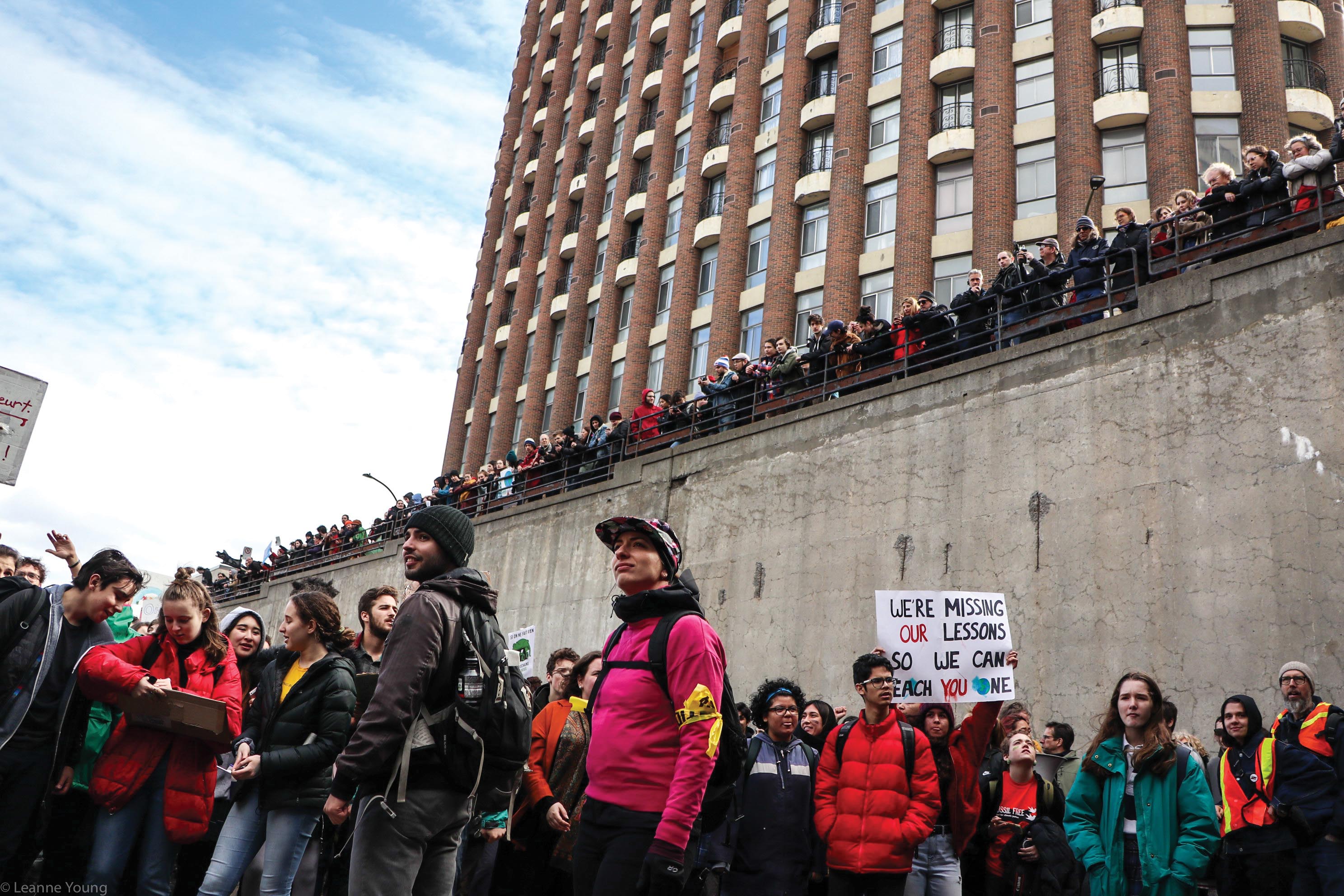
Over 150,000 protesters, including university, CEGEP, and primary school students, joined the Montreal march for climate justice on March 15. The march, organized by the student movement La planète s’invite à l’Université, was one of more than 2,000 of its kind in 125 countries. Around 1,500 McGill students attended the McGill Walkout for Climate Justice demonstration held in front of the Arts Building, later joining a coalition of delegations from other universities and CEGEPs for the main demonstration at Jeanne-Mance Park.

The McGill Walkout’s organizers made three demands of McGill University: That it publicly acknowledge that fossil fuel companies cause grave injurious impacts on humans and the natural environment, that it immediately divest from fossil fuel companies, and that it urge the federal and provincial governments to implement the United Nations Declaration on the Rights of Indigenous Peoples (UNDRIP), which states that Indigenous peoples have the right to conserve and protect the environment. Further, the organizers called on the provincial and federal governments to implement an emergency climate action plan.

Jacqueline Lee-Tam, U1 Environment and Economics and one of the organizers of the McGill walkout, sees no excuse for McGill to postpone divestment.

“[Divestment] is a first step, and it is not radical,” Lee-Tam said. “Entire cities, states, and countries have divested. It is more than possible, and higher returns are being seen in fossil-free investments.”

Lee-Tam believes that declaring a climate emergency is the only way to prevent further irreversible climate destruction and that youth voices are essential to bringing about policy change at the international level.

“What would be radical would be to be complacent on this issue, to not act,” Lee-Tam said. “It’s our future, that’s the whole point of the youth [movement]. We’re taking the power back to have a say in what our future will look like.”

Alex Allard-Gray, member of the Listuguj Mi’gmaq First Nation and outreach administrator for the Indigenous Health Professional Program at McGill, explained that students need to collectively mobilize to amplify their voices.

“Students are very future-minded,” Allard-Gray said. “They’re not only learning about [climate change], but they’re experiencing a lot of these changes first-hand. A lot of us are not in decision-making roles, and it feels out of our hands. That can feel like a very hopeless environment, but, by coming together in these large groups and showing solidarity for [wanting] to change how we are [treating] the environment, it makes our voices heard.”

Allard-Gray pointed out that Indigenous communities often shoulder the most serious consequences of climate destruction.

“There have been constant promises of things to come, and it feels like lip service,” Allard-Gray said. “When [Trudeau’s government is] working with Indigenous peoples, we want to feel included. We want to feel as if we have a say when it comes to what is being done in our territories [….] Governments are going to have to start respecting Indigenous access to land. Consultation should not be a chore.”

Mostafa Henaway, a community worker at the Immigrant Workers’ Centre, explained that climate change disproportionately harms the global south, driving mass displacement and migration.

“This is the natural outcome of a system where profit exceeds everything else,” Henaway said. “[Of a system where] where profit exceeds our democracy, our humanity, Indigenous peoples’ rights […] to self-determine, the right for people to have decent and living jobs, […and] for people to not be displaced on their lands. It’s a crisis for all of us, but we’re going to make it a crisis for them.”

Many elementary and high school students were present at the Montreal March. Zoe Desharbes, a student at Villa-Maria elementary school, explained that it is important for children to make their voices heard because climate change will impact their futures the most.

“We’re here today because [the] climate is changing [and] the planet is dying,” Desharbes said. “It was really nice to see how many people came today. It’s a shame that they didn’t cancel school so that we could all come out.”

Montreal, News

Protesters riot during annual anti-police brutality demonstration

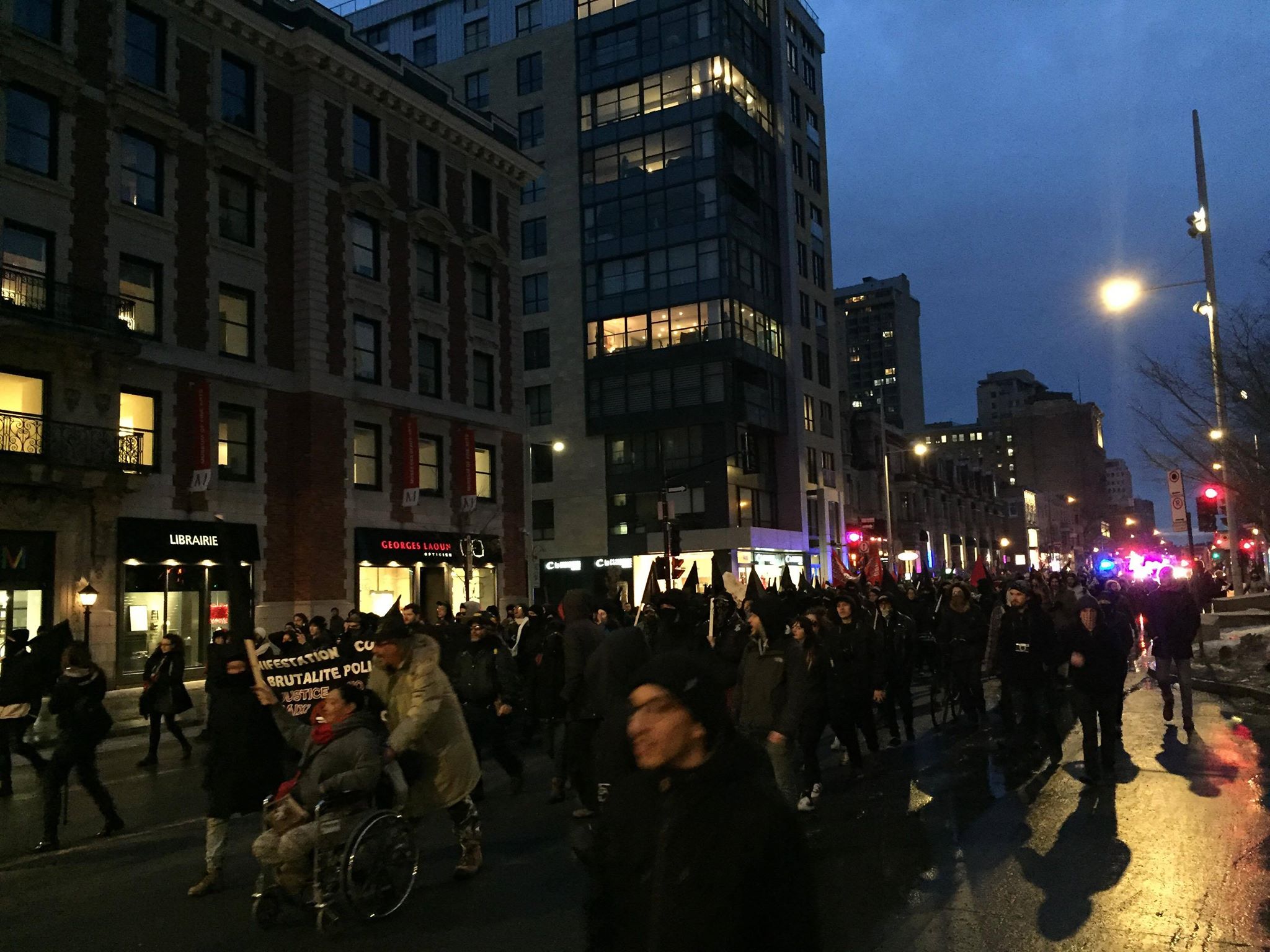
Protestors took to the streets in downtown Montreal on March 15 for the 23rd annual anti-police brutality demonstration. The event was initially peaceful, beginning in the evening with a gathering at Norman Bethune Square. Food Against Fascists provided meals to the crowd and community members took turns delivering speeches highlighting the history of police brutality continuing in Montreal.

Jeremy Thomas, Welding and Fitting student at Laurier Macdonald Vocational Centre, described how intense police surveillance has affected his career. Although he does not believe his situation will change, he came out in support of his fellow residents.

“The police have actually completely destroyed my life,” Thomas said. “I started in Calgary. I was involved with gangs and crime, [and] when that was going on, I had lots of run-ins with the police and justice system. The police became very emotionally attached to me due to the fact that they can’t get me through the justice system. They got me fired from my jobs and constantly bombarded my house with drones, airplanes [and] helicopters.”

From May 2016 to April 2017, the Service de Police de la Ville de Montréal (SPVM) launched a pilot project to evaluate the feasibility of deploying body cameras. 78 patrol members wore the cameras during the project, but the decision to deploy them was rejected by Montreal’s public security committee due to their cost and ineffectiveness. Member of Mouvement Action Justice Robin Edgar claimed that the police’s abusive power extends beyond physical brutality and includes misconduct like false arrests and repression of speech. Edgar believes that body cameras promote better behaviour by police and suggested that officers of the SPVM begin to employ them.

“I think the SPVM has too much influence over politics,” Edgar said. “They have too much power making excuses like, ‘it’s too expensive.’ I do a lot of videoing of police myself and they behave better when they know they are being filmed.”

Event organizer and member of the Industrial Workers of the World Tessa Mascia denounced the SPVM for the shooting of Nicholas Gibbs, an unarmed 23-year-old father from Montreal’s Notre-Dame-de-Grâce neighbourhood, in August 2018. Mascia went on to provide more vivid accusations of how he believes the SPVM have abused their power.

“We have the displeasure today of being surrounded by Montreal’s supposed finest, the SPVM,” Masica said. “Whereas as firefighters have a specific mandate to save people, the state agents of the SPVM do nothing but further tax the already burdened working class with more state fines. They’re the goons of the condo developers when they push out homeless people, and their hands are dirty with the neocolonial genocide of natives in precarious social conditions here on the island [of Montreal] itself.”

Mascia believes that police brutality is a serious problem in Montreal, rife with both physical violence and discriminatory behaviours. She claims that the SPVM targets marginalized groups to reach their ticket quota and she does not believe that policing has any place in today’s society.  

“We need to make policing obsolete, not just by talking about this [issue], but by gathering together and building those better communities [and] those better services,” Mascia said. “There’s absolutely nothing [the police] can do to better train or protect its citizens. The only [solution] is if we as a people dismantle the institution of policing.”

Immediately after the speeches, the group of a few hundred protestors stormed north. They marched down Sherbrooke, setting off fireworks, throwing flares, and chanting ‘No justice, no peace, f*ck the police.” Some individuals began to smash the windows of stores and parked cars, uttering threats and breaking out into fights. The demonstration quickly began to resemble a riot and police were on standby in riot gear.

As a smoke bomb was set off, the SPVM ordered the protestors to disperse due to illegal behaviour that was ‘endangering safety and public order.’ The SPVM has reported on Twitter that two arrests were made for mischief and uttering threats.


A previous version of this article originally stated that the demonstration was hosted by the organization It’s Going Down. In fact, It’s Going Down only publicized the event. The Tribune regrets this error.

Creative

An interview with Leslie Copeland

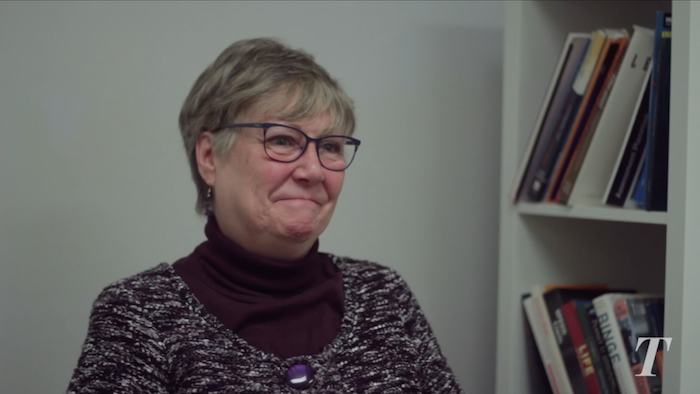
Leslie Copeland has been First-Year Coordinator at Campus Life and Engagement for more than 20 years. She has seen her role, the school, and the world change around her – but the one thing that has kept her inspired all of these years: the generosity and kindness of McGill’s students.

Video by Beatrice Dimaculangan, Elli Slavitch, and Tristan Surman

Creative

Word on the Y | Where is McGill in the rankings?

The McGill Tribune went to the Y to ask students where they thought McGill fell on the 2018 QS university rankings. Has McGill gone up or down in the rankings? Stick around to find out!

Video by Sofia Mikton, Aidan Martin, Thyaga Dahanayake.

Features

Beyond #ChangetheName

The Government of Canada established Canada’s Truth and Reconciliation Commission (TRC) in 2007 to investigate the history of residential schools. The investigation’s goal was to inform Canadians about the brutal treatment of Indigenous people under the residential school system and to start the process of reconciliation with Indigenous communities. Reconciliation, however, goes beyond the residential school system: indigenous language rightsdisparities and discrimination in the child welfare system, and the coerced sterilization of Indigenous women are just a few examples of persistent injustices that Canadian indigenous people face today.

Off the Board, Opinion

Enough with the unwarranted LinkedIn views

A helicopter pilot once viewed my LinkedIn profile five times in one day before sliding into my DMs. As bizarre as this sounds, I know that I am not alone in experiencing harassment on the platform. Numerous women have come forward about harassment on LinkedIn, and unpleasant experiences sparked the creation of the website CreepedIn, which documents users’ encounters with inappropriate messages. On a forum where professionals want to be recognized for their accomplishments, some individuals are objectified for their appearance instead. Inappropriate LinkedIn profile views affect many users, but they place students in a particularly vulnerable position. Online spaces should not be exempt from zero-tolerance standards for sexist behaviour.

As students prepare to enter the workforce, creating a LinkedIn profile is often the first step in seeking—it generally serves as a first introduction to the opportunities which exist outside of McGill. Although useful, LinkedIn is undeniably strange. It is invariably cluttered with sponsored spam in users’ inbox, and odd lingo such as ‘gurus’, ‘ninjas’, and ‘jedis’. While harassment pervades all social media platforms, LinkedIn differs in that the website sends users a notification when another user views their profile. LinkedIn’s primary efforts to stay engaging and relevant neglects important components of the workplace, like the importance of workplace conduct and resources to help victims of harassment, online and offline.

Profile views are LinkedIn’s currency of clout, boosting users’ egos and keeping them addicted to the site. Often times, the feature is useful, and I find it exciting to see that employers that I look up to are viewing my profile. Most of the time, however, my notifications are populated by user profiles from individuals who work in fields unrelated to my own and whose only unifying trait is that they are middle-aged men. Initially, I had no idea how or why this was happening. However, I realized that I am a young, inexperienced student soon to enter the workforce and that being ‘viewed’ is inherent to LinkedIn and the professional world at large. As students, the early stages of employment are often precarious—especially as we land in ‘probationary’ paid and unpaid internships and entry-level positions. Many of us will face exploitative labor, workplace discrimination and harassment, but still don’t know how to deal with it. This is something we’re introduced to through LinkedIn views and will repeatedly endure in the workforce—universities should prepare us for this as its internship networks and career portals connect us to future employers.

The traditional solution to unwanted social media attention is going into ‘private’ mode: Hiding your profile picture, connections, bio, and everything else related to your profile. But LinkedIn is different because, on this platform, you need to be seen. Obscuring your profile is potentially harmful to your professional future and does nothing to address the root issues of harassment in work-adjacent environments. No one, especially femme-identifying workers and others vulnerable to harassment, should feel the need to hide from professional spaces.

The public nature of LinkedIn gives students an unfortunate, yet realistic introduction to the professional world. Harassment happens in offices, just as it does online. Too many of us have unpleasant and traumatic introductions to a world in which we are being ‘viewed’ inappropriately and it’s essential spaces we interact in foster respect and do not tolerate predatory behaviour. Just as McGill offers Career Development WorkshopsCareer Advising and even LinkedIn Advising, it should also warn of potential dangers in all workplace environments, including cyber spaces. Too many of us have unpleasant and traumatic introductions to a world in which we are inappropriately and unwarrantedly being ‘viewed,’ online and offline. It’s time that we’re viewed for the right reasons.

Read the latest issue

Read the latest issue