

Latest News

Commentary, Opinion

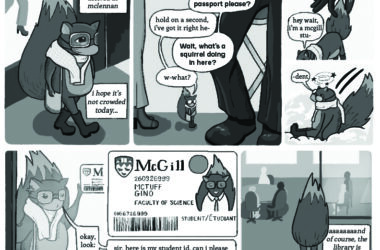
You Reddit here first: The best social media platform at McGill

McGill students have a strong presence on every imaginable social media platform. For example, the Facebook community includes everything from a Samosa Sale tracker to a group dedicated specifically to clothing swaps for petite people. On Instagram, the McGill University geotag is frequently used by a wide range of accounts. However, the best social media platform for McGill students to connect with each other and get introduced to campus life is definitively Reddit.

The McGill Reddit community has 6,158 subscribers, a number that seems measly compared to the approximately around 58,700 members of McGill Facebook groups. However, Reddit is one of the most engaging and interesting McGill online platforms, providing answers to individual questions, and introducing current and prospective students to various cultures and subcultures on campus.

Unlike Facebook or Twitter, where one is often followed by family and friends, Reddit usernames, such as “pikachu_at_mcgill,” let users anonymously post comments and questions that they wouldn’t feel comfortable asking anywhere else. One of the highlights of the Reddit community is a weekly thread called “Real Talk Friday.” Users can post rants about anything from problems in classes, to roommate troubles, to the effects of popcorn on their weight. As McGillians love to complain, this forum is essential for everyone to get their grievances off their chest. The best part? IT HAS TO BE TYPED IN ALL CAPS. It’s the digital version of the trope of a movie character standing on the edge of a cliff and screaming their problems away. The responses to comments vary from sympathy, to actual advice, to people mocking the original commenter. Regardless, the ALL CAPS mandate allows participants to convey excitement at a small victory, or make imperative statements, mixing advice with commands.

Although anonymity can, unfortunately, lead to harassment and bullying, moderators try to delete any offensive comments. Some inevitably fly under the radar, but taking away this anonymity would be taking away the edge that Reddit has over the other social media—no student would willingly ask about “the best places to poop on campus” on Facebook using their own account. The community does have some rules; one can’t discuss obtaining substances illegally, can’t start unapproved election campaigns or publish private information about an individual. The moderators can be easily reached if trouble arises, and generally do a good job at flagging or deleting comments. The easiest and best solution, however, is just don’t be an asshole online. This will allow the McGill Reddit community to achieve its highest potential.

Filters on the sidebar further add to the sense of community-building, as students can join in on the McGill-related conversations that they are most interested in. Anyone who’s interested in the recent SSMU drama can now filter their experience only read SSMU-related posts, making it easier to find people with similar or opposing views. Alternatively, those who are sick of the SSMU-related drama don’t have to wade through it to get to posts that they’re actually interested in. Instead, they can find advice about the athletic centre, for example.

Most importantly, Reddit provides a quicker and more accessible information channel than the eternity-long wait at Service Point. The FAQ linked on the sidebar is the most comprehensive one related to the McGill community, with questions ranging in topics from course registration to housing, making it an invaluable resource for potential and current students. If a student has further questions, they can then post about it and wait for responses. There are also links to a range of resources, including campus media, mental health, and legal resources.

Finally, Reddit is uniquely representative of various elements of the McGill experience. The most iconic post on this subreddit and the McGill Reddit community’s crown jewel, “Gertrude’s Theorem,” uses a meticulously-detailed spreadsheet to explain to every broke student exactly how much alcohol they’re getting for each dollar they spend at the Gerts student bar, in terms of (Gz)(Hz), or “Gertz 'til it Hertz.” This post perfectly represents a demographic of the McGill community—intelligent and creative people who like their alcohol—letting potential applicants and current students get acquainted with one facet of campus culture.

While sometimes a Reddit search results in outdated or extremely biased posts (not all Management students are suit-wearing snakes!) and the anonymity can lead to some harsh words and borderline bullying, if used respectfully, the McGill Reddit community is an invaluable resource for every McGillian, and provides unique insight into a highly diverse campus culture. Still not sold? Go forth and rant about it in the next Real Talk Friday.


 

Sanchi Bhalla is a first-year business student with an unmatched love of novelty phone cases.


Hockey, Martlets, Sports

McGill Martlet hockey overwhelms Carleton Ravens in rematch


McGill
5


Carleton
1


The McGill Martlets (3-4) handily took their Nov. 18 rematch against the Carleton University Ravens (3-4) 5-1 after applying steady offensive pressure in the second and third periods. McGill’s victory puts the Martlets on an upward trajectory, rebounding from an 0-4 start to the season to three consecutive wins.

“We scored five goals, that’s a good thing,” Martlet Head Coach Peter Smith said. “We’ve had a hard time scoring goals, so to score five in one game against a very good goaltender on the other side, it certainly is a positive.”

The game started with a quick tempo, but the Martlet offence couldn’t generate any scoring opportunities early on. Carleton’s momentum on the turnover was consistently quashed by McGill’s strong blueliners and penalty killers, but the constant pressure from penalties eventually wore down the Martlet defence later on.

Throughout the first period and the start of the second, Carleton proved they could block any offensive push coming down the center. McGill was quick to exploit Carleton’s weak defensive flanks, however, by breaking in from the sides and ripping shots from outside lanes. This revised strategy worked, as the Martlets shut out the Ravens 3-0 in the second period and took the third 2-1.

“Our best period was the second period,” third-year forward Shana Walker said. “We just had a shot mentality and kept shooting in the second period, and we weren’t exactly in the perfect zone to shoot but we shot anyways, and we got opportunities and goals.”

Despite the convincing victory, the players admitted that they didn’t play a perfect game.

“Just in the third period, our defence was kind of lacking,” second-year defender Cassidy Bell said.

McGill’s next game is on Nov. 24 against a strong opponent in the University of Ottawa Gee-Gees at McConnell Arena. Heading into this next match, the Martlets are confident that they can maintain their momentum, even though first and second years compose a majority of their bench.

“We practice really hard, we practice a lot,” third-year defender Emilia Cotter said. “I can see the improvements in the practice [….] It’s been going well, so I see a bright future.”


Moment of the game

The fifth and final McGill goal came about when the Carleton goalie tried to tried to jump on the puck and missed, leaving it to crawl into the slot where Martlet forward Olivia Atkinson shot on a virtually empty net.


Quotable

“Even with so many first-years, everyone tries to talk to everyone and have more of a team dynamic, [….] It just ends up building our team chemistry even more.” – Martlet defender Cassidy Bell on team-building with a young bench


Stat Corner

Stephanie Desjardins, a first-year, scored two goals in the second period to give McGill a commanding lead.

Arts & Entertainment, Film and TV

‘Stranger Things 2’ is as imaginative and heart-wrenching as its predecessor

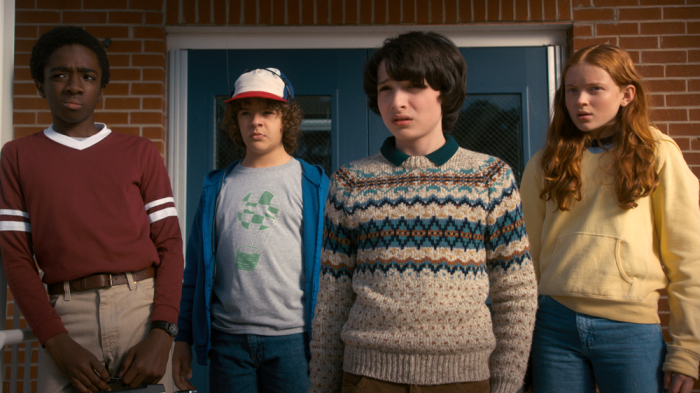
Stranger Things (2016), one of the most critically- and commercially-successful Netflix Original shows, has returned for its second season. Considering the incredibly high bar set by the first season, it is nothing short of remarkable that Stranger Things 2 is able to match it.

Stranger Things 2 takes place in 1984, one year after the events of the first season. Eleven (Millie Bobby Brown) is still missing. Joyce Byers (Winona Ryder) is in a successful relationship with Bob Newby (Sean Astin), but is struggling to care for her son Will (Noah Schnapp), who is experiencing horrific visions of the nightmarish world of the Upside-Down where he was held captive. Meanwhile, Jonathan Byers (Charlie Heaton) and Steve Harrington (Joe Keery) are caught in a love triangle over Nancy Wheeler (Natalia Dyer), while Season One’s lead gang–Mike (Finn Wolfhard), Dustin (Galen Matarazzo), and Lucas (Caleb McLaughlin)–are faced with the arrival of feisty new classmate Max (Sadie Sink) and the discovery of a mysterious reptilian creature.

The original Stranger Things gained a cult following for good reason: It combines ‘80s nostalgia with memorable characters, an emotionally-driven plot, and creative sci-fi thrills. Stranger Things 2 continues on in this same tradition, following quite a similar plot structure, while expanding the story beyond Hawkins, Indiana, and devoting more time to the subplots of individual characters, most notably Eleven’s quest for her origins and identity.

As expected with this series, the cinematography, lighting, and sound design are flawless, creating a suburban world at once comfortingly familiar and terrifyingly unpredictable. Stranger Things 2 looks and feels like the ‘80s Spielberg movies to which it pays homage, down to the most minute details, including decor, costume design, and an absolutely stellar soundtrack (if Oingo Boingo, Duran Duran, and Devo aren’t already on your November playlist, they will be soon).

The standouts of Stranger Things 2 are three of its cast members. Sean Astin is every bit as sincere and heroic as he was as Sam in The Lord of the Rings, and Natalia Dyer steals all of her scenes with a nuanced and heart-wrenching performance. However, the unlikely hero of Stranger Things 2 is Joe Keery as Steve Harrington, who went from Season One’s insufferable jock to Season Two’s witty, courageous, and upstanding hero, complete with a killer new uniform of sunglasses and a barbed baseball bat.

Perhaps the only major disappointment about Stranger Things 2 is the lack of significant character development among its leads. Nearly all of its characters, apart from Steve, are effectively the same as when we met them in the very first episode, and do not have any meaningful arcs. Moreover, viewers who complained that the monsters’ designs and “evil scientist” plotlines of Season One were derivative will not be appeased by the generic Lovecraftian creations on offer in Stranger Things 2.

The new additions to the cast slide seamlessly into the established universe, but have not yet received enough development to cement them amongst the returning cast. Max in particular is an enigma, and it will be interesting to see where the writers take her in the future. However, as it stands, it is a shame that the most prominent female addition to the cast is never really allowed to show anything other than varying degrees of a snarky “tough girl” stereotype.

Stranger Things is unlikely to make any new converts in its second season, but loyal fans will undoubtedly be charmed by the return of its snappy dialogue, thrilling action, heart-wrenching drama, and genuinely loveable characters. The bar has once again been set very high. Here’s hoping that Netflix will be able to match their own masterpiece when Season 3 premieres next year.

Student Life

Midnight Kitchen celebrates 15th anniversary with vegan tacos and birthday cake

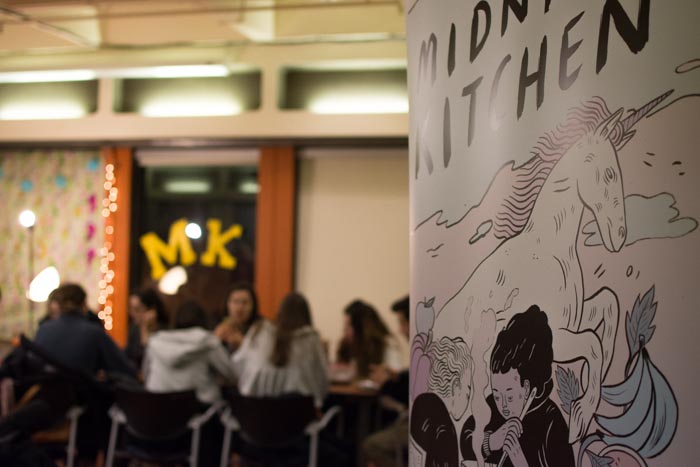
On Nov. 10, Midnight Kitchen (MK) celebrated 15 years of serving free, vegan lunches to the McGill community. The second floor of the SSMU building was swarmed with dinner guests: A line ran from the Madeleine Parent Room to the cafeteria as students eagerly awaiting their meals. A sense of camaraderie filled the air as mingling voices and uplifting music spilled out of the room.

Walking away with vegan tacos and birthday cake on their plates, groups of friends found places to sit and dive into their food. According to the MK regulars in attendance, this sense of community is one of the lunch provider’s defining traits. Sam Hull, U3 Arts, was one of the birthday party attendees. For him, the memories surrounding MK have kept him coming back for years.

“In second year, my friends started telling me about it […] and they just told me that it was a great opportunity to get free food, but also just that the social situations which it allowed were really great,” Hull said. “You just got to meet a lot of people who you would not have […] interacted with otherwise, and that it was just a really good community building thing on campus [….] I’ve been coming ever since.”

MK was founded in 2002 by McGill students who wanted to model an anti-capitalist market in which healthy food is affordable and accessible to everyone. It provides free meals from 12:30 p.m. to 1:30 p.m. Monday through Thursday, and is accessible to anyone. It was designed to empower the community at McGill and to help students take control over their experiences with food as consumers.

According to Nat Alexander, a coordinator of the event, the cooperative has grown in many ways from what it was upon opening.

“To see the very genuine response and appreciation from people is awesome,” Alexander said.

Another aspect that seems to factor into MK’s longevity and success is its unique approach to food: It de-commodifies food by making it free and accessible to everyone, while providing a social context for people to meet over food.

“I really loved the mandate of anti-capitalism, and really anti-oppression,” Alexander said. “Building a sense of a community and a space where people can learn together and just grow over food.”

The enthusiasm was evident in the overwhelming turnout for the event. At the height of the night, the wait time reached 30 minutes just to reach the room in which the food was served. The crowd was insistent, though, and continued to pour in despite the long line.

“We didn’t expect this big of a turnout,” Alexander said. “We planned for about 80 people, but we definitely served over 250 at least.”

MK continues to grow and expand, both in their outreach and in popularity. They host a number of events throughout the year that keep them busy and broadening their customer base.

“I hope [MK is] here for 15 more [years],” Ryan Shah, U3 Arts, said.

McGill, News

Introducing Building 21, a building with no structure

(more…)

Student Life

Beyond protests and picket signs: How student activists make a difference

Student activism can take many forms, from petitions and hashtag campaigns to marches and guerilla theatre. But such avenues for dissent have one thing in common: A passion for challenging the status quo. Young student organizers are committed to bettering the world they will graduate into by advocating for equality and challenging public opinion.

The most recent showing of McGill’s student activist energy took place on Nov. 12, when close  to 100 McGill students gathered at the Roddick Gates and stopped traffic to march down St. Catherine street, eventually joining activist groups from across the city as part of the Manifestation Against Racism and Hate.

Student demonstrations are loud, disruptive, and attention-grabbing. These mass displays of public discontent can influence social and political attitudes toward policy, acting as a check on the government.

A study from the Pew Research Center indicated that 74 per cent of Americans strongly believe that protests are vital to maintaining a healthy democracy. On campuses and beyond, university activism often takes the form of visible protest. In Canada, McGill’s campus in particular boasts of a diverse history of grassroots mobilization against oppression. For example, the Quebec Public Interest Research Group (QPIRG) McGill organizes annual discussions on social issues at their workshop series Culture Shock, Divest McGill staged a 72 hour sit-in outside the James Administration building in 2016 to show their disapproval of McGill’s fossil fuel investments, and Demilitarize McGill led a tour of military research facilities on campus at the 2015 open house. Regardless of the tactics chosen, a common thread in all these activist movements is a commitment to a more equal and just society.

“Activism, for me, is the will to change things,” Connor Spencer, Vice-President (VP) External of the Students’ Society of McGill University said. “The will to point out when things are wrong [….] To believe in something so much that you can put yourself out for it, to engage, to stay engaged, to care about the folks around you and what is happening to the folks around you, to see yourself as part of a larger system, a larger kind of ecosystem of humans and thoughts and feelings and institutions. [To see yourself] as not only a member but also a contributor to the capitalist, patriarchal society that we live in.”

Beyond McGill’s campus, youth have historically served as a main source of energy for a variety of activist movements, from the Greensboro sit-ins in North Carolina during the American Civil Rights movement, to the 1968 student protests in Paris.

Today, in the shadows of the alt-right movement and growing inequality, campus activism is more important to university students than ever. Despite relatively low voter turnout rates for Canadian youth aged 20-24, this age grouping is the most likely to engage in some form of political activism, suggesting that they deem it to be the primary way to initiate political change.

“I think there is this idea of energy,” Spencer said. “[At this age], we are going through a phase in our lives, and especially on university campuses, when a lot of us are having blinders removed, or a shifting of lenses. I think that what comes with that is a realization of what’s going on, and I think that it is very natural for people that are inquisitive to end up at universities and end up studying. [It’s] not that all inquisitive people end up here, there is a certain amount of privilege that goes with it.”

The rich history of activism in Quebec has given university students an opportunity that many McGill students do not know how to take full advantage of. Since the 1960s, Quebec university students have protested a number of issues, including austerity, Islamophobia, and government corruption.

Notably, in 2012, in what was later dubbed the ‘Maple Spring,’ Quebec university students—with the exception of McGill—clashed with the government over a proposed 75 per cent increase in tuition fees, and they were ultimately successful in preventing such hikes. For nearly seven months, student protesters were met with violent backlash from the police, who were armed with pepper spray, batons, and riot gear. In Montreal, the protests reached a peak in May 2012, when students barricaded the streets and lit bonfires, which the police responded to with excessive force. In September of the same year, the newly-elected Parti Québecois came into power, and the proposed tuition increases were scrapped. Since then, when Montreal students have taken action, the government takes notice.

“We have a legacy […] that we directly benefit from, which is that because of the work of our predecessors we’ve been given a huge megaphone,” Spencer said. “I think we don’t really realize that because so much work has been done in the past that the government is kind of afraid of the students and how much they can mobilize.”

Paige Hunter, U3 Arts, understands the power McGill students wield in influencing future  politics. In 2016, she joined Generation Screwed at McGill, a non-partisan campus activism group, after learning about Canada’s growing national debt. Today, Hunter is the organization’s campus coordinator.

“Activism stimulates change,” Hunter wrote in an email to The McGill Tribune. “If young people don’t make their voices heard on serious issues that will certainly have an effect in their future, those in charge will not get the message [….]  I would like to live in a prosperous, economically-sound country, but we can’t have that if we’re drowning in debt. I think many Canadians want the same.”

For Hunter, campus activism serves a dual purpose: To affect change and to educate the student population on political injustices. Throughout the year, Hunter and her team at Generation Screwed hold events on campus aimed at encouraging students and politicians to take action. Among them, the group organizes documentary screenings and petitions urging candidates running for political office to commit to tackling the Canadian debt crisis.

“I hope young people will have their consciousnesses raised about the Canadian federal debt in terms of understanding how this issue will directly affect their future,” Hunter said. “All the taxpayer dollars that go to servicing the debt could have been used to pay for social services that all Canadians need and want. Better yet, Canadians could have been given a tax break. With this knowledge, perhaps young people will begin to favour political candidates that prioritize a balanced budget.”

Students continue to be on the front-lines of change within society, and their relentless commitment to greater equality impacts both local and national politics. Like Hunter, Spencer emphasized the need for students to take the future into their own hands. She explained that when students are apathetic to injustice, the consequences run deep.

“I think we are living [the cost of being passive],” Spencer said. “When you are passive, you get exploited, and it might not be you specifically right away, or you may not be able to see that you are exploited, but you are being exploited.”


Small steps to get started in activism

If you have 5 minutes… Have a conversation with a friend about an inequality you recognize in society. This is a quick and easy way to express you concerns about what is happening , and brainstorm potential solutions.

If you have 30 minutes… Write a letter to your elected officials or sign a petition. Though it’s not often headline-making, it is possible to do activist work within the existing systems. Many elected officials are accessible via email or phone, and can be swayed by pressure from their constituents. Additionally, these techniques have proven to be valuable mobilization strategies and help to create a list of people who care about the same issues.

If you have an afternoon… Attend a meeting for a group you are passionate about. McGill has a number of student activist organizations which exist within and outside of SSMU. In the past, on-campus groups have been responsible for organizing movements advocating for indigenous rights, environmental protection, and anti-austerity.

Student Life

How to make the most of office hours in the last few weeks of the semester

As the Fall semester comes to an end, students are frantically turning in term papers, taking their last round of midterms, and reluctantly beginning to think about their upcoming finals. While there is no magic solution for securing a high GPA, there is one resource from which all students can benefit: Office hours.

For many students, the idea of chatting with a professor one-on-one is more anxiety-inducing than any exam, but it’s essential; office hours are arguably the best way to get to know the person who is grading your work.

What should I talk about at office hours?

Although meeting with a professor or teaching assistant (TA) outside of class might seem intimidating, there is no faster way to establish rapport with a teacher than to stop by their office. In all four years that Kieran Jimenez, PhD candidate in the Department of Political Science, has been a TA, he has always found this to be true.

“Office hours can be a moment to add […] that personal aspect [of learning], where the TA can see that there's a person behind the paper that he or she is marking,” Jimenez said. “The student can have the same opportunity to talk to the person behind the marks that appear on his or her essays.”

Office hours are meant for more than just the academic. For Rachel Zellars, a course lecturer in Gender, Sexuality, and Feminist Studies, meeting with professors and TAs outside of class is crucial for addressing personal issues that may impede a student’s learning. Although it may not always feel like it, most professors and TAs only want to help their students.

“For me, it is essential to have a large chunk of time for office hours,” Zellars said. “Whether it’s taking the opportunity to listen to personal stuff [to] support [the student] in some way, or listening to and working through ideas that would become an assignment, just having a conversation about needing an extension for an assignment [matters].”

Office hours also provide students the chance to have a private tutorial with the professor; it’s the perfect opportunity to clarify confusing concepts or remedy miscellaneous issues that might feel awkward to ask in a 500-person lecture.

How do I get over my nerves about going to office hours?

Admitting that you don’t understand a concept can be daunting at first. This was the case for Abigail Leblanc, U0 Arts, who recently met with one of her political science professors for the first time to discuss a grade she was unhappy about.

“Honestly, I was terrified because he’s the professor of 600 people and he’s never seen me before, obviously, but you just have to do it,” Leblanc said.  

Afterward, Leblanc realized how important and unexpectedly rewarding office hours are.

“Usually your teacher will surprise you and be pretty nice,” Leblanc said. “Not many people go, so you’ll probably get good one-on-one help as well, like I was the only one there when I went.”

Coming prepared with questions and talking points can help students feel prepared to attend office hours.

“I’ll usually have a list of questions and some follow-up questions,” Sebastian Pazdan, U3 Arts said.

Getting into the habit of making lists beforehand can help calm nerves, organize thoughts, and clear the mind. Additionally, lists help to specify the scope of questions and allow students to get the most out of their office hours.

What can I do to boost my GPA beyond going to office hours?

Attending one professor’s office hours is not the only way for students to get a leg up; familiarizing oneself with other resources available within their specific department can help in this realm.

Contacting other TAs and professors, joining student-led Facebook groups, booking appointments with the McGill Writing Center, or setting up study sessions with students and tutors can boost students’ GPAs. BookUp Study Groups, an app, allows students to plan and organize study groups on an online public or private forum, ending the hassle of scheduling study sessions and facilitating the process of finding people to study with on the McGill campus.  

While it might be nerve-wracking to be vocal in office hours or class participation, taking that leap of faith and communicating with professors is worth it.

“It never hurts to go to office hours,” Jimenez said. “Once you get over the hurdle of [going for the] first time it’s always easier to do it again.”

Artistic Swimming, Sports

McGill synchronized swimming makes a splash at season-opening Invitational

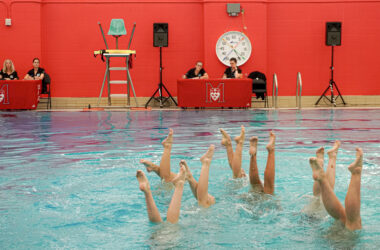
On Nov. 18, the McGill Martlets synchronized swimming team hosted the McGill Invitational, bringing together eight universities in competition. The meet served as the season opener for the Canadian University Synchro Swim League (CUSSL), where novice and expert-level swimmers challenged each other in solo, duet, and team performances.

Although the results don’t count toward the national title—which McGill has won 14 times in the past 16 years—the meet serves as the perfect opportunity for veterans and novices alike to practice their boosts, verticals, and “ballet legs.”

“Early in the season, we’re really focused on getting [the team] up to the technical level that we want,” Head Coach Lindsay Duncan said. “Later on in the year, it’s about polish [….We’re] still in the midst of choreographing the routines […] but, I mean, everyone came out, and I think [we] had a nice performance, so we’re feeling really optimistic about the rest of the season.”

Each team was assessed by a panel of four judges, who evaluated the swimmers’ artistic impressions and technical manoeuvres. Overall, McGill fared well, with the novice team scoring an impressive 51.833 in comparison to McGill’s two expert-level teams—Red and White—who had respective scores of 58.667 and 64.999.

Despite McGill’s boastful lung capacity and pop-ups, the University of Ottawa Gee-Gees established themselves as McGill’s chief rivals, as both teams blew all other competition out of the water. The Martlets came out on top in the expert solo competition, with third-year swimmer Flordespina Dodds placing first. McGill’s novice team also secured a win over Ottawa, triumphing by a close 1.2-point margin.

The McGill Invitational provides an opportunity for newer swimmers to experience a structured competition environment. For Katharine Callahan, a second-year swimmer with the novice team, the Invitational was only her second-ever competition. Ultimately, the meet was nerve-wracking, but it allowed Callahan and her teammates—many of whom are new to the sport—to get in sync and find their rhythm.

“We were all a bit nervous, I think,” Callahan said. “For some of us, it was only our first competition [….] We took all our nervous energy and just put out a good performance. I think we were just able to be really sharp and precise and we travelled really well.”

It’s still early in the season for the Martlets, and they’ve got three months to practice and perfect their routines before heading to the CUSSL National Championships in mid-February. For second-year swimmer Jessica Henry, the competition was the foundation for success to come. 

“I think we had a really great swim, it was sharp,” Henry said. “Obviously, there [are] a few things we can work on, but it’s a good platform to build the rest of the year off of [….] I think we all have a very good work ethic and work well together. Everyone comes to practice happy and they leave happy, and it’s a really cohesive group.”


Moment of the meet:

McGill’s White team executed two boosts perfectly, one of which entailed a full backward flip.


Quotable:

“It’s one thing to start the choreography, and it’s another thing to work together as a team and figure out who needs to be where, and when, and how to swim [with] all eight people as one person.” — Second-year Martlet swimmer Jessica Henry


Stat corner:

Three minutes is the amount of time an average synchro swimmer can hold their breath underwater.

Read the latest issue

Read the latest issue