

Latest News

McGill, News

#ConsentMcGill annual campaign teaches students about consent, sexual violence, and healthy relationships

The #ConsentMcGill campaign kicked off its third year with a week of speaking panels, workshops, and other activities designed to educate members of the McGill community about consent, sexual violence, and how to build healthy relationships. Events were scheduled from Sept. 26 to 30 and covered a variety of topics related to consent on the university campus. Included in the week’s programming was a workshop on how to intervene in cases of sexual assault and a symposium that covered the topic of caring for survivors of sexual violence. Other events included a pottery class that promoted therapeutic self-care and a speaking panel on the power dynamics that contribute to sexual violence at the university.

Coordinated by the Office of the Dean of Students, #ConsentMcGill has been hosting the annual week-long campaign since 2014. The initiative works with students, staff, and faculty, and seeks to promote the three key principles of consent: Ask, listen, and respect. Organized largely by Liaison Officer (Harm Reduction), Bianca Tétrault, #ConsentMcGill is run by volunteers year round.

Consent McGill Panel

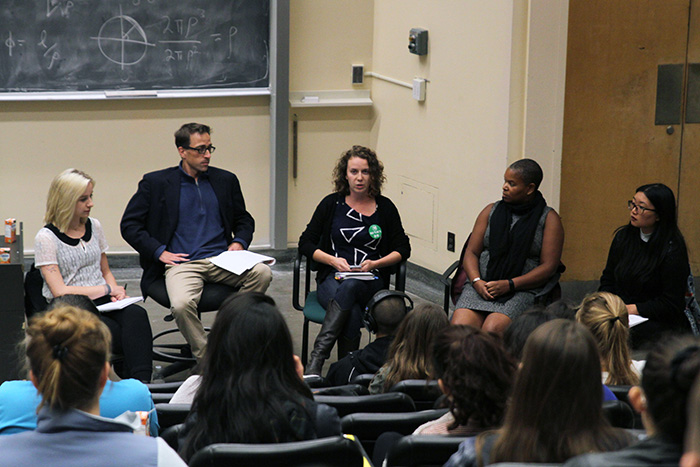
The Consent McGill Panel consisted of four speakers, each with different experiences with sexual violence and power dynamics. The speakers included Adrienne Piggott, one of McGill’s harassment assessors; Jason Opal, an assistant professor from the Department of History; Nina Hermes, a floor fellow at RVC and sexual violence survivor; and Claire Michela, the president of the Association of McGill University Support Employees (AMUSE).

The panel’s topics ranged from the responsibility of faculty to create a safe space for students to the efficacy of the university’s sexual harassment policy, as well as the role of witnesses of sexual violence.

“From a professor standpoint, it should be said particularly of professors that whether they like it or not […] they are in a position of privilege,” Opal said. “That privilege therefore means that you have to generate healthy boundaries, and guard healthy boundaries and be there as a form of respect and service to your students.”

Students were invited to ask the panel questions and participate in discussions. Aside from the speakers’ prepared introductions, the conversation was spontaneous with new questions being posed by both the host, the Equity and Diversity Commissioner of PGSS, Angela Yu, and audience members. Students participated in discussions about the role of McGill’s drinking culture, the role of parents in teaching their children about healthy relationships, and the effectiveness of McGill’s policies.

One of the central topics of the night was about the ability of McGill to pursue allegations of sexual harassment. Piggott is directly involved with the investigation of harassment complaints and with redrafting the university’s sexual harassment and discrimination policy.

“[The harassment policy] was written by people, so we adjust as we go,” Piggott said. “We don’t necessarily get it right the first time we draft.”

In response to one of the final questions of the night, however, Michela pointed out that this is not a hopeless message.

“Work together,” Michela said. “Speak up. It took that straw that broke the camel’s back for people to finally get together and be like ‘alright, we’re going to work on [the policy….]’ Make enough noise and you can maybe get that.”

How to Respond to and Support Disclosures Workshops

On Sept. 28 and 29, two workshops, titled “How to Respond to and Support Disclosures,” were hosted by Tétrault.

Tétrault, who has been running this campaign for three years, said it is essential to hold workshops like these because it is important to be prepared to support a survivor of sexual violence.

“Students look to certain members of the community,” Tétrault said. “It’s important to be prepared to support a student.”

In Tétrault’s presentation, she emphasized the importance of supporting survivors, whether as an active listener or as a source to help them to find the right resources. Tétrault also highlighted information on rape kits and important legal details, such as McGill’s current process for dealing with sexual violence.

Susanne Baumann-Moroy, human resources advisor in the Department of Engineering, said that the information shared in the “How to Respond to and Support Disclosures” presentation should be more widely known among the McGill community.

“Information for people who are sexually assaulted, like [the fact that you] only [have] 72 hours to get a [rape kit], is very important and should be common knowledge,” Baumann-Moroy said.

During the workshops, Tétrault noted that she was disappointed with the gender disparity of the attendees. Around 15 people attended the Sept. 29 workshop, but only two were male.

“It really speaks to who the advocates [for] those who are assaulted are [at McGill],” Tétrault said.

Baumann-Moroy believes that presentations like “How to Respond to and Support Disclosures” should be mandatory for the McGill community.


“What we learned today was not only about sexual assault, but also about respecting each other,” Baumann-Moroy said.


Ask a Scientist, Science & Technology

Ask a Scientist: How is spider silk so strong?

How is spider silk so strong? It’s so thin and light!

The properties of spider silk—also known as gossamer—can seem mysterious if we try to think of it as a kind of string; however, the strength of spider silk comes primarily from its complex structure on the microscopic scale.

Gossamer is actually so materially and structurally complex that humans have only very recently been able to—imperfectlysynthesize spider silk in the lab or engineer it inside of a goat. But spiders have been doing this without difficulty for millions of years. What’s their secret?

First of all, people don’t always mean the same thing when they say strong. For example, something that’s strong seems like it should be hard. However, eggshells are a much harder material than rope, and are simultaneously also much weaker. For the purposes of this article, we’ll take strong to refer to tensile strength, which indicates how well something can withstand being pulled apart by outside forces.

It’s no scientific distortion or misrepresentation to say that spider silk has a tensile strength about equal to that of steel—a strand of steel the same width as a thread of spider silk would break under the same pressure.

Gossamer has two main structural components that make it so impressive: Crystalline blocks of protein in a rigid molecular structure, which are connected by and suspended in a stretchy matrix of the same proteins in a looser structure. In addition to the crystalline blocks and stretchy matrix, a variety of trace substances have their own effects: Saltpetre acts as a chemical preservative, phosphoric acid keeps the pH low enough to ward off bacteria, and tetrahydropyrrole keeps the thread from drying out and snapping.

What happens inside a spider to create a substance so much better than human efforts could produce for millennia? The answer, like so many flies, lies in a spider’s gut. Spiders don’t extrude silk the way mammals extrude hair; their abdominal organs––known as spinnerets––manipulate and craft the silk from an already-prepared liquid solution created in the spider’s silk glands.

The starting ingredient of silk is a protein soup known as silk dope, a liquid crystal composed of the same biochemicals that will ultimately be spun into the super-strong thread, but not yet in the peculiar structure that will give it its remarkable properties on a larger scale.

The molecules of silk dope are in what is called a nematic arrangement, which means they naturally align themselves into a roughly parallel formation because of their electric charges. It’s because they do this that the twists in the spider’s spinnerets will be able to further order the silk dope into tougher, stronger silk.

Spiders don’t just make one kind of silk, either. By altering the rate at which they spin or intertwine silk strands in different ways, spiders can customize the strength and elasticity of their web. For example, a spider might spin a thinner silk for day-to-day web repairs, then a more rugged and bulky silk when constructing the protective shielding for their eggs. Spiderwebs are both versatile and still one of the strongest biomaterials in existence.

McGill, News

Dr. Cindy Blackstock joins McGill’s School of Social Work

Dr. Cindy Blackstock will be joining McGill’s School of Social Work starting in Sept. 2017. Dr. Blackstock is famous for her work as an advocate for indigenous children, namely during a case brought before the Canadian Human Rights Tribunal regarding equal access to child and family services for indigenous children.

Dr. Nico Trocmé, director of the School of Social Work and Philip Fisher Chair in Social Work, are pleased that Dr. Blackstock is joining the department.

“This builds on a longstanding collaboration between [Dr. Blackstock and I], from the work we have done on the overrepresentation [of] indigenous children in [the] child welfare [system, and] documented by the Canadian Incidence Study of reported Child Abuse,” Dr. Trocmé said.

As Executive Director of the First Nations Child and Family Caring Society of Canada (FNCFCS), Dr. Blackstock worked to end the Canadian government’s discrimination against First Nations children in the child care system.

“Going back decades, the federal government has provided less public funding for services like education, health care, and child welfare [for First Nations children] than all other Canadians receive […],” Dr. Blackstock said. “Depending on the program, 50 […] to 70 cents on the dollar for First Nations kids.”

In Jan. 2016, the Canadian Human Rights Tribunal recognized the FNCFCS’s claim. The Tribunal ordered the Canadian government to end the discrimination against indigenous children in the provision of government services.

“We said that failures to act on the available solutions and the perpetuation of these inequalities for children is racial discrimination, and in January 2016 the Tribunal agreed with us and ordered Canada to stop,” Dr. Blackstock said.

Since then, the Tribunal has issued two orders concerning the lack of action to end the underfunding of child and family services for indigenous children.

“We [sent] a compliance order [in April] to Canada that [notified them that] they failed to comply with the January order […] and then we have another compliance order that was issued on [Sept. 16] again because Canada failed to comply,” Dr. Blackstock said.

If the government does not respect the order, Dr. Blackstock and the FNCFCS plan on taking the issue a step further.

“We are always hoping that Canada […] complies with these orders, but if it fails to do so, then we are within our rights to file an application for contempt in federal court […] because we simply cannot allow 163,000 children to suffer,” Dr. Blackstock said.  

“It’s been shown and sold out to audiences all over Eastern Canada, and this week is going to Calgary,” Dr. Blackstock said.

Dr. Blackstock is currently completing speaking engagements and will begin to teach at McGill next September. She will teach a course about advocacy and changing public policy in change-resistant environments.

“I don’t think very many people in academia actually have those skills because they’ve never learned how to actually create systemic change [….],” Dr. Blackstock said. “Without those skills, we can’t really expect people to be able to make those changes. So I want to be able to pass along what I do in 20, 30 years to another group of folks on how you change things in peaceful, respectful ways.”

According to Dr. Trocmé, in addition to the advocacy course, Dr. Blackstock will contribute to the development of an indigenous social work course–the first of its kind in the province of Quebec.

“We also are the first school in Quebec and one of the first in Canada to add a required Indigenous Social Work course to our [Bachelors of Social Work] program; [Dr. Blackstock] will play a major role in developing this course,” said Dr. Trocmé.

Moreover, Dr. Blackstock intends to seize every opportunity she has to pass on her knowledge in order to raise awareness and engage Canadians in the fight for the protection of indigenous children’s rights.

“I’m also blessed with the frequent opportunity of being in the media, both in written media and in broadcasting, and so I take whatever opportunities I have there to spread the word,”  Blackstock said.

Dr. Blackstock also starred in the movie We Can’t Make the Same Mistake Twice, following the story of the tribunal case. Produced by Alanis Obomsawin, the film premiered at the Toronto International Film Festival in Sept. 2016.

Despite being one of only a few indigenous-Canadians to be hired at McGill, Dr. Blackstock remains focused on her advocacy. In her new role as a professor, she is motivated to bring the unfair treatment of indigenous children to public consciousness.

“I really do believe that our students at McGill and people in the Canadian public more generally would be appalled if they actually knew that there’s racial discrimination that is going on and would stand up against it,” Dr. Blackstock said. “But it’s been so normalized in our society that people make excuses for it or they minimize it.”

Private, Science & Technology

Quebec promises to abolish health care accessory fees by early 2017

On Sept. 14, Quebec Minister of Health Dr. Gaetan Barrette announced that as of January 2017, Quebec doctors will no longer be allowed to charge accessory fees—additional fees on services already provided by the Quebec health insurance.

Accessory fees have generally been charged for services such as eye drops, injections, and stitches. According to Barrette, these fees sum up to approximately $83 million dollars in charges per year, guaranteeing a large profit margin for physicians who pay less than one-seventh of that cost to provide these services.

Many argue that this violates the principle of “accessibility” outlined by the 1984 Canada Health Act (CHA), which states that all medically-necessary services shall remain free-of-charge for Canadian citizens. The Canadian government provides this funding in the form of Federal Health Transfers to the provinces on the condition that they respect the principles of the CHA.

Dr. Amélie Quesnel-Vallée, Canada Research Chair in Policies and Health Inequities and associate professor in the Departments of Sociology, Epidemiology, Biostatistics and Occupational Health, explained that since the end of the 1980s, the federal government has done little to monitor the provinces’ compliance. However, this no longer appears to be the case: Canada’s Minister of Health Dr. Jane Philpott recently stated that Quebec would be penalized for violating the CHA through deductions in transfer payments.

“The strong stance adopted by Minister Philpott [regarding] the Quebec user fees and the threat of clawbacks is thus a break from the past and signaling that the federal government really means business,” Dr. Quesnel-Vallée explained. “This could be a strategic move in anticipation of the Health Accords meetings that are to take place between the federal government and the provincial or territorial counterparts […] indicating to other provinces that the laissez-faire attitude of the past […] will no longer hold.”

The issue of excessive fees is not new to Canadian health care discourse. Extra billing—which occurs when physicians billing both patients and the government for the same services—was banned across Canada in 1987 as a violation of the CHA. Dr. David Wright, chair of the McGill Department of History who specializes in medical history, explained that unlike extra billing, accessory fees fall into a /”grey area” of Medicare regulation.

“Patients […] do not want to pay “user fees” for what are supposed to be “free” medical services covered by provincial insurance plans,” Dr. Wright said. “And governments expect that the fees that they reimburse for insurable services include the cost of related activities and medical items.”

Historically, this grey area has created opportunity for questionable additional billing practices, proving factious amongst the Quebec public.

“Sometimes, doctors have billed for specific non-insurable services, like writing a medical note for students,” Dr. Wright added. “In other instances, some doctors, or groups of doctors, have tried charging ‘registration’ or ‘annual membership’ fees for patients. The latter practice has proved to be particularly controversial in Quebec.”

This matter became increasingly more contentious with the 2015 enactment of Bill 20 in Quebec, which was proposed to regulate accessory fees that would minimize social and health inequities.

“[Bill 20] brought attention to the fact that the province was aware of user fees, and was implicitly legitimizing them by wanting to regulate them rather than abolish them,” Dr. Quesnel-Vallée said.

The distribution of power and funds between the federal and provincial governments in Canadian health care thus continues to prove an excessively complicated issue. More information on the specifics of this regulation will be made public in the coming weeks. In the meantime, policymakers in other provinces will continue to walk the tightrope between health care accessibility and affordability.

“There are always going to be differences in policy and practice between provinces,” Dr. Wright concluded. “I would expect that other provincial ministers of health will be watching closely to judge how this policy change is received, both by doctors and by the general public.”

Private, Science & Technology

Advances in veterinary practice: Doggy acupuncture and the technological future

Anyone who has ever taken an introductory biology class probably recalls the effort that goes into learning a few evolutionarily basic phyla characteristics. Those who remember will likely appreciate a profession that builds exponentially upon that introductory class in order to diagnose and treat species across the animal kingdom.

“Veterinarians are an essential part of civilization,” Morgan Rauscher, the principal consultant in Technology and Business for the Young Women’s Veterinarian Association (YWVA), said. “They’re connected to food production, sustainability research, wildlife conservation—it’s not just your cat or dog at home, although that’s part of it, too.”

Veterinary medicine has evolved into a dynamic field, encompassing much more than check-ups for pets.

“Before, maybe 50 years ago, once you graduated you either started your own clinic or partnered up with [a colleague], ” Véronique Thivierge, Director of Operations for the YWVA and a fourth-year veterinary student at the Université de Montréal, said. “But today, […] you have to collaborate with biologists, people in agriculture, [and] business people. It’s crazy the number of options [available].”

Veterinary science, as a study of the natural world and health science, has inextricable links to sustainability and a duty to keep up with technology. Rauscher explained that while environmental sustainability and advancing technology often compete within their industries, in veterinary medicine, the two advancing spheres help push each other to progress even further.

Veterinary treatments to cure the diseases of pets, farm and wild animals are constantly subject to innovation.

“There are so many different alternatives,” Thivierge said. “If [the client] is not so interested in the classical way of treating an animal, [they] can try acupuncture, hydrotherapy, massage, alternative food, organic food, [and] plant-based food [….] The possibilities are expanding as veterinarians […] with what type of practice you want to have, and as clients, with what kind of service you want for your animal.”

Even with the constantly evolving field of veterinary medicine, Rauscher and Thivierge agree that intuition is still a key component when diagnosing and treating an animal.

“I’ve personally seen Ms. Thivierge next to a horse, and it’s a bit shocking,” Rauscher said. “When she approaches the horse, the whole animal just relaxes. There’s this connection that veterinarians have, and I think that’s what motivates them into the veterinary sciences.”

For students interested in pursuing studies in the veterinary sciences, Thivierge stressed the obvious importance of having a passion for animals. Furthermore, there are other skills required to sustain a veterinary practice in the modern era.

“It’s very important to also think about how you’re not only going to be a health care professional––you’re going to be a business person, a manager, a PR person, [and] you’ll have to deal with families,” Thivierge said.

Thivierge further suggested that those interested should spend some time volunteering at a veterinary clinic, wildlife center, or farm.

“If you’re ready to do it, it’s a great profession [and it’s] so diverse,” Thivierge said. “You can really build what you wish to build and have the impact you want around you.”


The International Conference on Sustainable Veterinary Practice, featuring keynote speaker Dr. Jane Goodall, is taking place on Oct. 6th from 9a.m.-7p.m.in Marché Bonsecours.

Arts & Entertainment

Pop Dialectic: Snapchat Spectacles and the rise of wearable social media

Snap to it

When Snapchat first arrived on the social media scene, it was hard to see its purpose beyond sending nudes. The app started as a project created by a group of Stanford students. On Snapchat, the user snaps a picture and sends it to a friend who can view the picture for up to ten seconds before it disappears—of course, someone can always take a screenshot. Now worth over $3 billion USD, Snapchat has added a host of other features, like chat, geotags, and filters that make for a spontaneous and fun social media platform. It’s no surprise that Snapchat’s latest invention, Spectacles, further integrates social media with real life in a positive way.


The concept of Spectacles is simple: They are a pair of sunglasses with a video camera embedded in the frame. They allow the user to take videos from their perspective, which can then be uploaded to the app via Bluetooth or Wi-fi. Once uploaded, the videos go to the ‘Memories’ section of the app, meaning they are saved and users can choose to send it to friends. Spectacles sell for $130, whereas other wearable tech are significantly pricier: Go-Pros are in the $200 to $400 range and the Google Glass, an Android device resembling a pair of eyeglasses, which went for $1,500 USD. Snapchat also announced that they are changing their name to Snap Inc., suggesting that Spectacles are just the first innovation of many. The home page of their website describes Snap Inc. as a camera company. Snap Inc. could veer further into the wearable tech industry by focusing on creating more cameras and camera accessories that are equally affordable and easy to use.


The comparison to Google Glass­­—which stopped selling to the public last year—has already been made; however, Spectacles are much closer to a Go-Pro. Google Glass allowed users to access all of their phone’s features, including internet, apps, and camera, on a glass screen right in-front of their eyes. They were meant to be worn all the time. Google Glass distracted and alienated people from the world around them, whereas Spectacles allow one to capture videos without the distraction of pulling out one’s phone.


The video announcement of Spectacles features a group using the device to capture footage while skateboarding. The handsfree video camera is a great way to capture video in situations where pulling out a phone could be dangerous—biking or skateboarding. Yet, the low profile of the glasses allows Spectacles to be used while casually walking around.


The major objection to Spectacles is the issue of personal privacy. With Spectacles, people can discreetly take pictures of anyone anywhere. Yet, taking pictures of strangers has been easy for years. Spectacles will do little, if anything, to escalate this problem. Think of all the people in photos, videos, and memes that have gone viral. How many of those people were aware they were being photographed? The issue of privacy and social media is far more complex than a pair of sunglasses.  


For a company that has managed to bring out the best in social media and communication, Spectacles are a step in the right direction. Sometimes it’s just nice not to stare at a screen.

 
—Anna St. Clair

Contributor

Snap back to reality

Unsatisfied with its status as a ‘messaging app,’ Snapchat is venturing into the world of wearable tech. ‘Spectacles’ are sunglasses with an integrated video camera allowing users to transfer their memories onto the app via Bluetooth or Wi-Fi. Snapchat, in changing its name to Snap Inc., is trying to broaden their brand; one that has been  working just fine already. With over 100 million daily users and approximately 8,796 photos shared every second, it’s easy to see where Snapchat gets the confidence to expand. Transitioning from software to hardware, however, is a high-risk move—one that Snapchat hasn’t proved that it’s ready for.


The idea behind sunglasses that film your vision is an exciting premise. With the steady advancements of technology in our society, something as futuristic as a wearable social media device seems only appropriate. What Snapchat doesn’t want its users to remember is that a very similar product was released only a few years ago. Compare the Snap Spectacles to the lack of success of Google Glass. Released in 2012, many people raised their concerns over Google Glass; public places, such as movie theatres and bars, went as far as banning the product due to privacy issues. In fact, Google Glass had significantly more powerful filming capabilities and built-in Wi-Fi when initially released; however, it was still unable to maintain market share. By Jan. 2015, Google officially announced that they would be taking Google Glass off the market in a humble retreat, and the product is now little more than a memory.


The other issue concerning Spectacles is their very limiting style. While sunglasses seem ideal for the function of inconspicuous filming during the daytime, it limits the events a user can wear them to without looking ridiculous. Not to suggest that Google Glass was any more stylish, but at least the clear glass was less of an eyesore.


Much of the concern for Spectacles comes from the fear of unknowingly being filmed. Today the ethics of recording unaware people is a grey area. While it is legal to film someone in a public space, the idea of someone’s sunglasses recording video would make anyone uncomfortable. This isn’t the first time Snap Inc. has found itself questioned for privacy. Recent complaints arose when the company released their new privacy policy stating they have the right to reproduce users’ snaps. With the expansion to include Spectacles, Snap Inc. opens itself up to potential legal implications.


At $130 dollars USD, the sunglasses are being marketed as affordable and accessible. When considering alternatives such as the Go-Pro, which does cost about $300 but films for over two hours and gives you a very high quality image, spending $130 on Spectacles appears fiscally irresponsible. Additionally, it’s inconvenient that Spectacles can only transfer the footage to the app when connected to Wi-Fi or Bluetooth. Ultimately, Snap Inc. Spectacles would be a misguided venture and an exhaustion of the company’s resources. Snapchat should focus on what it knows in order to remain one of the number one social media apps.


Morgan Davis
Staff Writer

Off the Board, Opinion

Montreal pit bulls victims of impulsive decision-making

Last week, the Montreal City council passed a bylaw that will prevent the city’s residents from adopting any new pit bulls and introduce a set of rules governing existing pit bull owners. This decision has garnered much attention, mainly in the form of outrage and criticism: Montreal residents have set up petitions imploring the city council to reverse its decision, and various publications have presented facts and expert opinions that challenge the effectiveness of the ban.

Simply observing the messy aftermath of the decision would lead one to believe that the majority of the public is fundamentally opposed to the bylaw. However, it is uncharacteristic of Montreal Mayor Denis Coderre—who is notorious for his populist politics—to push a decision that would go against the general public’s opinion. According to an online poll conducted in June 2016 for La Presse, two-thirds of Quebecers were in favour of a ban on pit bulls. While the bylaw may seem justified in this context, its inception and development was marred by a signature characteristic of Coderre’s decision-making—impulsiveness. In essence, the bylaw is a rushed and limited band-aid solution that is meant to assuage the general public’s fear of dangerous dogs without adequately addressing the issue in the long run.

Leadership entails making difficult choices in a decisive manner, and Coderre has made great efforts in this area; however, leaders must remain critical and think about the long-term implications and practicality of their decisions. They should not make the mistake of bending to the fickle wishes of segments of the population they represent. The Coderre administration’s failure to meet this criteria is clear when it comes to the bylaw.


In essence, the bylaw is a rushed and limited band-aid solution that is meant to assuage the general public’s fear of dangerous dogs without adequately addressing the issue in the long run.

Critics and colleagues of Coderre are quick to point out the impulsiveness that pervades many of his administration’s political pursuits. In particular, there are glaring similarities between the story of the recent bylaw and Coderre’s proposal back in May for a one-year ban of horse carriages, which came in response to a carriage accident. Ultimately, the moratorium had to be cancelled due to a ruling by the Quebec Superior Court, which judged that the City did not have the authority to put carriage drivers out of work under such short notice. This mirrors what is happening today with the bylaw: The Quebec Superior Court Justice Louis Gouin has temporarily suspended the ban until he can make an official ruling on Oct. 5, citing the potential difficulty pit bull owners would have in complying with some of the restrictions in the bylaw.

Both initiatives were well-intentioned, and sought to ensure the safety of Montreal residents. Yet, both exhibited a lack of refinement and neglect towards the people that the laws would ultimately affect the most—carriage drivers and pit bull owners. Much like the carriage ban, hastiness was another definite factor in the creation of the recent bylaw: The controversy around ownership of dangerous dogs only came into discussion this June, after Christiane Vadnais, a citizen of Montreal, died after being mauled by a dog that was initially reported to be a pit bull—later revealed to be possibly of a different breed. It only took around four months for a concern to manifest itself into a law.

The mechanism of the bylaw also suggests that insufficient effort was made to ensure its effectiveness and feasibility. Even those who support the general sentiments behind the bylaw question the enforceability and validity of a system based on banning specific breeds of dogs—primarily because breeds are often difficult to identify. A government-appointed advisory panel, which made recommendations on how to curb the dilemma of dangerous dogs in Quebec, suggested a case-by-case approach, making no mention of a universal ban on pit bulls.

While the bylaw was developed with the safety of the general population in mind, the insufficient planning behind it has produced a policy which is an unproductive knee-jerk response at best. The municipal government often introduces reactionary, large scale changes in response to relatively insignificant issues, such as its decision to spend $950,000 on an anti-littering campaign in an effort to “unequivocally target bad behaviour.” Ultimately, the pit bull ban is a byproduct of this kind of impetuous overzealousness of the Coderre administration.


Albert Park is the Features Editor at The McGill Tribune and a U3 student in Immunology and Microbiology. He is a writer, guitarist and above all an enthusiastic patron of Gerts.


Commentary, Opinion

In defence of laptops: Students must not be forced to take handwritten notes

When entering their first classes of the semester, students are often apprehensive as they wait to hear the professor’s policy on laptops in class. While insisting on handwritten notes is not the norm at McGill, some professors nonetheless present students with articles and studies that explain how writing notes by hand improves memory, helps with the absorption of information, and is generally the best way to become a successful student.

The campus culture that classifies handwritten notes as ‘best’ or simply ‘better than’ typed notes homogenizes education and labels a student’s learning process as either right or wrong. While taking notes by hand benefits some—possibly even most—students, insisting upon it can create stressful and even inhospitable learning environments.

Despite its alleged positive impact on memory, handwriting notes lacks the accessibility of computers. While professors make exceptions for students with learning and physical disabilities, simply having messy or slow handwriting can disadvantage a student in the classroom. For those accustomed to typing their notes, taking notes by hand can be a grueling process that actually inhibits the absorption of information. Given that today’s students type much faster than they can write, handwritten notes often devolve into a game of catch-up with the professor: If students have to put most of their focus towards maintaining the professor’s speed, simply writing the words down takes priority over what the professor is actually saying.

These frantic notes may be messy, disorganized, and barely-legible, whereas computer programs such as Onenote or Evernote can be extremely useful in organizing important subjects and trains-of-thought. A student struggling to keep up with the professor likely doesn’t have the time to even write legibly, let alone highlight information. This chaotic transcription of a lecture can ultimately leave a student feeling stressed or disoriented, neither of which are optimal mental states for retaining course material. In an attempt to limit distractions and help students succeed, a professor may not realize the alternatively detrimental learning environment that insistence on handwritten notes creates.


For those accustomed to typing their notes, taking notes by hand can be a grueling process that actually inhibits the absorption of information.

Typing notes on a computer is admittedly not without its faults. Considering students’ constant exposure to the internet, allowing laptops in class inevitably opens those students up to an infinite number of distractions. These tend to have a snowball effect, in that someone surfing Facebook can distract the person behind them, and so on and so forth.

However, this possibility of distraction does not necessarily warrant a laptop ban, especially when one considers how teaching methods have evolved to incorporate, and even benefit from, digital media. Learning is not confined to spoken lectures; instead, professors employ a variety of digital aids such as powerpoints, music, videos, and images to augment their lessons. This shift towards a digital classroom recognizes that students learn in a variety of ways. For example, a visual learner retains information better with images or other visual cues. Likewise, an aural learner benefits from the presence and assistance of music or other sounds. These different learning methods intersect and overlap, making it impossible to suggest one student learns better than another.

Learning is a highly individual process. Just as the mode of presentation affects how a student absorbs information, so does the way a student takes notes. If it is agreed upon that the diversification of teaching styles should be encouraged, then it is equally important to allow for diversity in note-taking. Just because a student takes notes on a computer does not make him or her a poor or ineffectual learner. Students should be encouraged and allowed the freedom to discover which learning methods work best for them, rather than adhering to someone else’s definition of ‘proper learning.’


Diana Little is a U2 student in the Department of English Literature whose hobbies include petting dogs around Montreal and going to all-you-can-eat sushi.


Opinion

MTL Blog’s repurposing of Instagram content highlights grey area of control on social media

MTL Blog is a normally benign clickbait website known for publishing articles such as “The Whole Foods Market Close to Montreal You Have To Road Trip To ASAP.” Recently, however, the blog moved away from think pieces on snow and poutine, and engaged in truly tasteless journalism. Two of the pieces in question, which have been retracted, were titled “12 of the Hottest Concordia University Guys on Instagram” and “18 of the Hottest Mcgill Girls on Instagram.” The articles featured photos linked from the Instagram accounts of 30 students without their consent. The existence of these articles—though brief—was exploitative because it violated the control that Instagram users have over their own content. MTL Blog neglecting to ask users for consent is a failure in ethical journalism.

Instagram images belong to the users who put them up, but the public nature of the website allows these images to exist somewhere between the public and private domains. Because anyone can view a public account, an image can be a simultaneous expression of a user’s private life and a part of the public domain. On the internet, theft is not easy to define and even harder to punish. Social media users might find that they do not have the grounds to take legal action against those who would repurpose their images.

Even highly public cases of image theft fall into this grey zone. In 2015, artist Richard Prince’s “New Portraits” exhibition at the Gagosian Gallery in New York City repurposed images from personal Instagram accounts—primarily, sexually suggestive photos of young women. By removing the captions written by the account users and replacing them with his own, he also removed the user’s ability to dictate the portrayal of his or her image. Just like MTL Blog, Prince placed the images in a new context, robbing the users of their control.


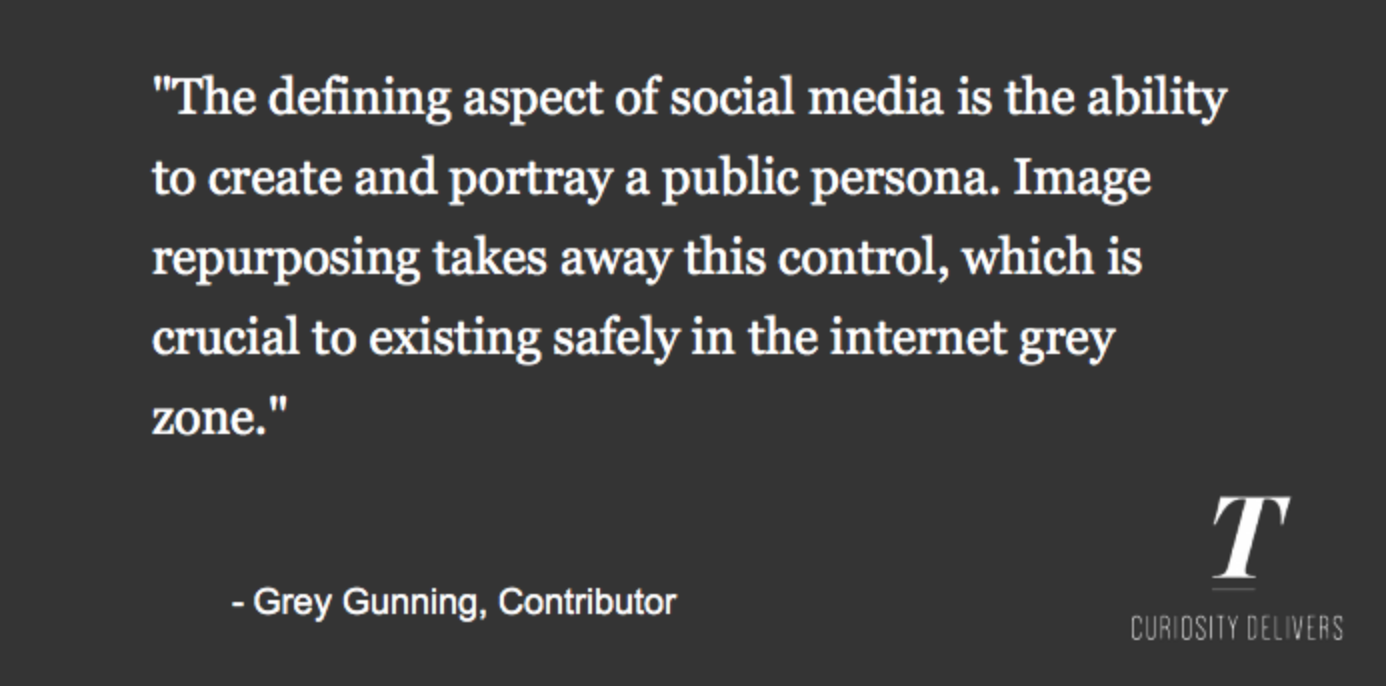
The defining aspect of social media is the ability to create and portray a public persona. Image repurposing takes away this control, which is crucial to existing safely in the internet grey zone.

Applications like Instagram enable people to put their lives on display, but this does not mean that the users featured in the MTL Blog articles or Prince’s exhibition invited their own exploitation. Such an interpretation would ignore the fact that social media is as bound by ethics as anything else. Social media is used to engage with a peer group: When university students put images of themselves online, it is for themselves and their ‘public’—a wider network of people they may not know personally. It is not an invitation for MTL Blog to swoop in and repurpose the image without permission. Although today’s youth are seemingly comfortable existing in public spheres such as Instagram—posting photos that anyone can see—the issue here is not publicity, but control.

The appropriation of internet content—especially personal images of a user—can have frightening repercussions for the original poster. Ruby Mae Landry, one of the girls featured in “The 18 Hottest McGill Girls on Instagram,” said in an interview with the CBC that she received unsolicited Facebook messages from men saying they “saw [her] on the blog” after the article’s publication. On Instagram, a user can control their content output and block other users. Once an image is taken out of the Instagram context, the user loses these safeguards. The most worrying implication of the added visibility created by artists like Prince and media platforms like MTL Blog is that it has the potential to make young people, especially women, susceptible to unwanted and even dangerous advances. Decisions like these are callous. An individual’s safety is more important than an artist’s career or the number of pageviews on a website.

Social media has changed the way people express their identities: The defining aspect of social media is the ability to create and portray a public persona. Image repurposing takes away this control, which is crucial to existing safely in the internet grey zone. All MTL Blog had to do was ask. It is a disservice to the online community it relies on that it did not.


Grey Gunning is a U2 History major and occasional artist. She enjoys climbing, gardening, and cheesy 80's sci-fi.


@ |


Science & Technology

Saskatchewan doctors seek state of emergency over HIV rates

In response to high rates of HIV and AIDS within the province, a group of Saskatchewan physicians is urging the provincial government to declare a public health emergency.

According to an open letter signed by a group of 30 physicians on Sept. 19, the 2015 provincial rate of HIV was 13.8 cases per 100,000 people; this is more than double the national rate of 5.8. For decades, the province has reported the highest rates of the infectious disease in Canada. Rates are especially high in indigenous communities, which account for 70 per cent of all cases in Saskatchewan despite comprising only 20 per cent of the population.

“We perceive this to be an emergency,” said Dr. Stephen Sanche, one of the physicians who discussed Saskatchewan’s HIV crisis at a press conference on Sept. 19th. "It calls for immediate action, and that’s really what we're asking for here.”

Between 2010 and 2014, the Saskatchewan provincial government implemented a strategy targeting HIV/AIDS, which successfully saw rates of HIV testing increase. However, since its expiry, there has been a sharp increase in the number of new HIV cases in the province, with 158 cases in 2015 compared to just 114 in 2014.

“[HIV] is a problem of discrimination, marginalization, […] punitive legal laws [and] notification services,” said Dr. Nitika Pant Pai, an associate professor in McGill's Department of Medicine and leader of the team that created the HIVSmart! mobile-based self-testing app. "[We must fight against] a culture where people are scared to get tested.”

To change the trend of HIV in Saskatchewan, it is also important to address the factors directly influencing the social stigma of the disease.

“Part of reducing stigma is to normalize testing, being diagnosed and being treated,” said Dr. Joseph Cox, an associate professor in the Department of Epidemiology at McGill. “Informed leadership is needed in educating the general population, and risk groups, about HIV and what it means today. The Saskatchewan example […] highlights how quickly infectious diseases like HIV can spread among networks of people when prevention programs are not sufficiently developed or deployed.”

In their letter, the doctors call on the government to adopt and achieve the UNAIDS recommended 90-90-90 goal by 2020. The UNAIDS goal urges governments to make changes to see that 90 per cent of those with HIV get tested and are aware of their diagnosis, 90 per cent of those diagnosed are put on antiretroviral treatments, and 90 per cent of those on treatment reduce the number of viruses in their bodies to prevent further transmission.

“[90-90-90] is a goal for every country in the world,” explained Dr. Catherine Hankins, a former McGill professor in the Department of Epidemiology and Biostatistics who recently retired as the chief scientific officer for UNAIDS. “[There are] countries in Africa that are close to reaching those targets, while Canada as a whole is not.”

Saskatchewan has pushed back. According to the Canadian Medical Association Journal, the province has not endorsed the 90-90-90 goal. Dr. Denise Werker, Saskatchewan’s Deputy Chief Provincial Medical Health Officer, has thus far declined to declare a state of public health emergency as she says it’s impossible to do so when the term, “state of public health emergency,” doesn’t technically exist under the provincial health act.

According to Hankins, the HIV/AIDS crisis in Saskatchewan is propagating rapidly, and will continue to do so regardless of political agendas.

“What they [need to] do immediately, is make anti-retroviral [treatment] free of charge and offer it […] as soon as HIV is diagnosed,” said Hankins.

In the open letter, the physicians calculate that each new HIV case costs the provincial government nearly $500,000 on medication alone, in comparison with the $1.4 million it costs the province to support an HIV-positive patient throughout their lifetime. To lessen the financial burden, it is in Saskatchewan’s best interest to decrease the number of new HIV cases.

In addition to high costs, access to medication can also be a roadblock for some patients, particularly in indigenous communities. HIV has historically been associated with homosexual men, but increasingly the epidemic has moved to indigenous populations. As indigenous populations make up the majority of new HIV cases in Saskatchewan, it is critical to focus efforts on the populations most affected by the modern HIV crisis.

Read the latest issue

Read the latest issue