

Latest News

Arts & Entertainment, Books

The multifaceted stories of ‘Personal Attention Roleplay’

Montreal-based writer and fiction editor Helen Chau Bradley is set to release their debut story collection Personal Attention Roleplay on Nov. 23 under Metonymy Press. The McGill Tribune reviews the stories ahead of this upcoming release.

“Only The Lonely,” Ian Clements

“Only The Lonely” follows the relationships of an unemployed Meals on Wheels volunteer living in Montreal. The story begins with the unnamed protagonist’s romantic relationship with V, a polarizing figure in their community. The protagonist also develops a friendship with Joe, a Meals on Wheels client, for whom they sing and play songs on the guitar for. The story skillfully explores themes of queer loneliness and power dynamics within different relationships. The story’s characterization of emotional investment and intimacy is stripped down and raw, yet descriptive and wryly humourous.

“The End of Gods and Heroes,” Suzanna Graham

“The End of Gods and Heroes” is a wholesome story that discusses the complexities of friendship and growing up. Childhood friends Tommy and Shirin bond over a fantastical game of gods and heroes, where they imagine themselves as characters in their favourite Greek myths. Although their childhood innocence protects them, the girls use these morals as a guide while they question family identity, loyalty, and betrayal. In the end, they must decide what it means to be a hero, and if they themselves are truly worthy of this title. 

“Personal Attention Roleplay,” Dana Prather

This titular story finds an unnamed 20-something-year-old “listicle” writer navigating a situationship with her roommate Jasmine. Written from a second-person perspective, the reader is enveloped in every sensation the protagonist experiences, from intense pain caused by Jasmine’s increasingly distant behaviour to the serenity felt when watching ASMR videos. As her connection with Jasmine crumbles, she becomes entranced by YukiASMR, a YouTuber espousing the virtues of a minimalist life. Seamlessly blending themes of queer identity and obsession, “Personal Attention Roleplay” will leave you satisfied, but deeply unsettled. 

“Sheila” Ella Gomes

“Sheila” follows strong-willed May and her energetic daughter Mimi as they pass a harsh winter day in a cozy record store in Toronto. While tracing the lifetime of a Rachmaninoff record from purchase to destruction, readers learn of May’s rocky history with Mrs. Timoransky, an outwardly chilly piano teacher, and Sheila, a haunting figure from her past. With references to the uncontrollable “animal instinct” and transitions into adulthood, “Sheila” reads like an ode to unexpected change and the natural cycles of adaptation that guide our lives.

“The Queue,” Sylvie Bourque

Drawing inspiration from Vladimir Sorokin’s novel “The Queue,” which tells the story of people waiting in line solely through their dialogue, Bradley modernizes the tale to fit the 21st century. Weaving in relevant discussions and dialogue, the queue represents shared feelings of community, and isolation, that many experienced over the pandemic. While some try to find humour in discussing COVID-19, Bradley explores deep and divisive topics such as public health measures, politics, and police brutality—themes that reveal how the pandemic infiltrates the most fundamental aspects of peoples’ livelihoods. Bradley’s story reveals how the pandemic has uncovered a universal desire for reconnection.

“Surface Dive,” Avryl Bender

In “Surface Dive,” Bradley tells the story of an experienced swimmer finally returning to her local pool after a harrowing experience in the waters by her family cottage. Bradley uses beautifully descriptive words, flowing seamlessly back and forth between the main character’s past and present experiences. Weaving alliteration into a story of ambiguity and suspense, Bradley’s writing embodies the smooth waters of the lake this intriguing mystery takes place in.


McGill, Montreal, News

McGill partners with Centraide to host walk/run fundraiser in annual campaign

McGill announced on Oct. 12 that it is partnering with Centraide of Greater Montreal for its 2021 Centraide Campaign. The campaign, managed by the McGill Centraide Committee, will raise funds to help alleviate  financial burdens of Montrealers in need, providing support for rent, food, education, and other necessities. 

The main event of the Centraide campaign is the virtual “Let’s Move for Centraide” walk/run. Participants choose a day between Oct. 15 and Nov. 19 to complete a five- or 10-kilometre run or walk that can be completed indoors on a treadmill or outdoors. To certify that they have completed the walk/run, participants must track their activity using an app like Strava Run or Nike Run Club and then submit the activity record to McGill.

Participation in “Let’s Move for Centraide” costs 20 dollars, withall proceeds donated to Centraide. Four major donors—Stephen Bronfman, Mitch Garber, Andrew Lutfy, and Lino A. Saputo—will match every donation of 10,000 dollars that McGill makes to Centraide. Darshan Daryanani, the Students’ Society of McGill University president and member of the McGill Centraide Committee, believes the campaign will have a positive impact on local communities.

“This year, McGill’s target is to raise $425,000,” Daryanani wrote in an email to the McGill Tribune. “Each agency [supported by Centraide] has a different culturally appropriate and community-based approach, which will help to create inclusive and resilient communities and break the cycle of poverty and social exclusion locally.”

Another event that will be occurring toward the end of the McGill 2021 Centraide Campaign is a zumba class, hosted by Ender Nava. The fee to participate in the class is $10, and all proceeds from the class will be donated to Centraide.

The COVID-19 pandemic affected Montrealers in different ways, but the marginalized and diverse communities supported by organizations like Centraide were hit harder than most. McGill reported that in Quebec, 24,000 women dropped out of the labour market and 12.9 per cent of the lowest-paid workers in the area lost their jobs since the onset of the pandemic.

As a result of this trend, Centraide established four emergency funds: Centraide COVID-19 Emergency Fund, Youth Fund, Emergency Community Support Fund, and the New Horizons for Seniors Program. The McGill administration acknowledged these funds are an important step in helping Montrealers overcome the consequences of the pandemic.

“As a COVID-19 response, Centraide established different funds, projects and programs to help vulnerable people and those weakened by the health crisis,” wrote Frédérique Mazerolle, a McGill media relations officer. “McGill is committed more than ever to our partnership with Centraide and the need to extend our support, kindness, and compassion to vulnerable Montrealers.”

Some students, however, such as Doris Tian, U2 Arts, were unaware of the campaign. Ultimately, Tian was happy to learn of McGill’s efforts.

“I had not heard of the Centraide campaign before, either from McGill or outside the McGill bubble,” Tian wrote. “It seems like a very timely philanthropic campaign to launch in the aftermath of COVID, and I am glad McGill is promoting social initiatives such as this one.”

Sophie Hart, U3 Arts and lead organizer at Mobilizing for Milton-Parc, discussed the influence that a campaign such as this can have on the relationship between students and the larger Montreal community. 

“I think it is great [that] McGill is inviting students to think about their role as citizens in Montreal and the importance of student involvement, whether it be volunteering or donating, to community organizations,” Hart wrote in an email to the Tribune. “COVID-19 helped many people see the importance of community and care for one another, so I hope this campaign will be successful and will encourage student learning about community organizations.”

Arts & Entertainment, Books

‘Orcs in Space’ is bloody cute

Fantastical bloodthirsty main characters? Check. High-speed space-chases? Check. Modesty? Not quite. Orcs in Space, Justin Roiland’s new graphic novel published by Oni Press, features 100 pages of amusing, carefree adventures in an uncanny outer space backdrop, all illustrated by Montreal-based artist François Vigneault

Slated to be the first volume of many, Orcs in Space follows three goblin ruffians who, by a stroke of luck, obtain access to the galaxy’s most technologically advanced spaceship and its A.I. operator—who eventually becomes their close companion and confidant. Gor, Kravis, and Mongtar are not afraid to spill blood—and other fluids—on the run in this brash but comedic space odyssey. Alongside these non-traditional heroines stands an array of enemies and allies as diverse as the stars in the sky. Cyborgs, pirates, and tentacled seductresses beware. 

Vigneault’s illustrations leap from the page. Loaded with vibrant hues, his cartoony style soaks the novel’s characters and settings in gaudy, unmoderated detail. Such creativity reigns without restraint throughout Orcs in Space: Every scene, whether it be a bar fight at “the hippest club in the galaxy,” or a laser-blaster shootout with “Space Rats,” presents a smörgåsbord of details that keep the reader engaged and amused. 

Orcs in Space secures the reader’s laughter as if holding a knife to their throats. Each protagonist—one little, one big, and one extremely bloodthirsty—fills a different conversational niche, keeping the plot animated and humorous. Ironic and self-referential Gen-Z comedy bleeds into the realm of the uncanny and bizarre; zany and avant-garde plot twists remind the reader that the story is, literally, out of this world. Jokes leave the reader constantly gasping for breath.

Just as the story takes place in many weightless environments, Orcs in Space makes no claims of having gravitas. Its tight plot and eccentric graphics provide a purely fun and brazen read that will have the reader turning pages at light speed to see the next dismemberment. However, the narrative’s easygoing atmosphere does not override artistic integrity; on the contrary, it bolsters it. The novel presents aesthetics, characterization, and plot development with expertise. Readers may be just going for a joyride, but they should still buckle their seatbelts. 

Volume two of Orcs in Space is currently slated for a February 2022 release. Vigneault’s other works include Titan (2020) and 13e Avenue (2018).

McGill, News

McGill to discuss reports on anti-Black racism and equity plans at upcoming Senate meeting

In the spring and fall of 2020 respectively, McGill released updated versions of their Equity, Diversity & Inclusion (EDI) Strategic Plan (2020-2025) and their Action Plan to Address Anti-Black Racism (ABR) (2020-2025). Reports assessing the plans’ first years in action were presented to McGill’s Board of Governors on Sept. 7 by Angela Campbell, professor in the Faculty of Law and associate provost (Equity and Academic Policies), and Terri Givens, professor in the department of Political Science and provost’s academic lead and advisor (Action Plan to Address Anti-Black Racism). The Senate will be discussing the reports at their next meeting on Oct. 20. 

The Action Plan to Address Anti-Black Racism aims to confront systemic racism at McGill by tracking five main pillars: Student experiences, community outreach, design of physical space, research, and workforce makeup. The plan also seeks to acknowledge and act upon the university’s connection to the transatlantic slave trade. The EDI Strategic Plan examines inequities according to the same five aforementioned elements

Campbell stated The McGill Tribune in a student media round table that these plans signal McGill’s commitment to implementing change.

“The Student Services team led and facilitated [the creation] of spaces last year called ‘Being Black at McGill’ and that has been really helpful to developing a specific plan within Student Services to serve the needs of Black students at the university,” Campbell said. “[The creation of these spaces] really focussed on not just having a plan, but serious commitment to implementation.”

Campbell also highlighted the role of student organizations in the rollout of the Anti-Black Racism and EDI plans.

“Throughout the last year and going on this year, we have been meeting every month with the [McGill African Students Society (MASS)] and the [Black Students’ Network (BSN)] to make sure that we get their feedback,” Campbell said. “It is one thing to have a plan, but it is another thing to hear on the ground how [the plan] is impacting, or not, the lives and the lived experiences of our students.”

The Post-Graduate Students’ Society BIPOC Grad Network coordinator, Vivian Miyata, acknowledged the importance of communicating with campus organizations, but pointed out that not all BIPOC students are represented in these organizations.

“It is important to create consistent outreach to members of the Black community at McGill who aren’t in BSN or other associations, to make sure that any Black student who wants their voice heard has the opportunity to do so,” Miyala wrote in an email to the Tribune

A central part of both the EDI Strategic Plan and the Anti-Black Racism Plan is the implementation of an online module—based on the same structure as the It Takes All of Us—that will focus on educating the McGill community about systemic racism. The module is still in development, but once complete, will be mandatory for students, staff, and faculty. Campbell and Givens mentioned that the module will be important, but that it is only a small part of the work needed to address systemic racism.

“This is such difficult, deep work, and it takes time,” Givens said. “We are trying to change culture in terms of developing a culture that is welcoming to Black students, to Black faculty,  and so you have to take a broad approach to make sure that you are approaching [systemic racism] from different levels and different perspectives.”

Miyata believes that online modular learning is a step in the right direction, but that the university must also commit to holding those who engage in racist and discriminatory behaviour accountable.
“I believe that the sexual violence learning program and anti-racism modules that will be similar to [It Takes All of Us] are important, but ineffective unless there are real consequences for students who exhibit behaviour that opposes the teachings in them,” Miyata wrote.

Student Life

Friendsgiving takes many forms among students

Friendsgiving, a Thanksgiving celebration among friends, holds a beloved place in the hearts of students, sometimes even more than its familial alternative. For those who find themselves away from home or simply wish to gather with loved ones, Friendsgiving celebrations foster unique forms of bonding and expressions of gratitude among students. 

Especially due to the fraught history of Thanksgiving, many students choose to focus on expressing gratitude through alternative celebrations. Though it borrows its name from Thanksgiving, Friendsgiving is popular precisely for its casual structure. Since it’s not beholden to any set of familial traditions, it can take different forms for each group of friends. 

For Cathleen Ma, U2 Arts and a second-generation Chinese immigrant, Thanksgiving has never been a part of her family tradition or culture. In university, she used the reading break to see friends kept apart by busy schedules. 

This year, Ma took part in a Friendsgiving potluck celebration. Some brought store-bought items for a stress-free evening, while others made cultural foods. The dinner table was transformed into a mosaic of diverse offerings, including Tandoori rice, a vibrant veggie stir-fry, rotisserie chicken, and even Madeleines. 

“It wasn’t traditional at all,” Ma said. “There was a huge variety of dishes that people made that I could never make at home.”

An occasion often used to gather with one’s chosen family, Friendsgiving conjures images of exclusive, tightly knit groups. But platonic bonds, unlike blood relations, can be more easily formed between strangers. With people bringing their siblings and acquaintances from different social circles, Ma’s friendsgiving brought new and old friends together. 

“It definitely differed from our usual get-togethers because there was [others’] family there […] and it wasn’t just a singular friend group,” Ma said. “It was an opportunity to get to know all these different people.” 

Faith Ruetas, U2 Arts, celebrated the holiday on a smaller scale with her roommate. They made lentil and mushroom Wellington, a dish the two had never tried before, and then went the lazier route for dessert, indulging in a premade blueberry pie. 

When away from loved ones, perhaps one of the best reassurances one can provide is the snapshot of a good meal. Before eating, Ruetas and her roommate arranged and decorated their dinner table before sending pictures to their families. 

“I was really proud of our spread,” Ruetas said. “My popo responded with one word: ‘Wow.’ Even though we’re in different provinces, I’m happy I was still able to share something with her.” 

Arantza Fernandez and Christal OuYang, both U3 Arts, also celebrated the holiday together this year. Though Fernandez is from Mexico, where Thanksgiving isn’t typically celebrated, her time in Montreal led her to observe the holiday with her family.

“It’s not a thing in Mexico,” Fernandez explained. “Last year when I [was] back home in Mexico, I forced my family to have Thanksgiving with me.”

OuYang has always stayed in Montreal for the holiday.

“I’m from Vancouver, and I usually do not go home for Thanksgiving just because Thanksgiving is not really like a big celebration for us,” OuYang explained.

This year, Fernandez and OuYang organized a dinner among friends where each person brought something to the table.

“I think Friendsgiving is having all of the people you care about come together and everybody contributes something in a collaborative effort,” OuYang said.

The meal consisted of chicken, cranberry walnut salad, vegan shepherd’s pie, cranberry sauce, a green bean casserole, carrot cake, banana bread, and wine. They turned all the lights off and listened to a playlist combining jazz and classical music. 

“We played a little game where we were not allowed to talk until we finished all the food and drinks,” OuYang explained. “[We got] to really appreciate each other’s company without words.”

McGill, News, The Tribune Explains

Tribune Explains: McGill’s new COVID-19 initiatives

In a university-wide email sent out Oct. 7, McGill announced four new COVID-19 initiatives to help track and curtail the spread of COVID-19 on campus. The protocols, which are being implemented throughout October, include measuring CO2 levels to assess the efficiency of ventilation systems; testing wastewater in student residence buildings; distributing thermometers to those in residence; and establishing a new COVID-19 dashboard to distribute weekly updated data. 

Why is McGill measuring CO2 levels in some of its buildings?

CO2 builds up when ventilation is poor, so measuring CO2 levels is a way to track whether ventilation systems are operating properly. Some of McGill’s classrooms and exam rooms already have CO2 monitors, but others do not—a fact that prompted the university to conduct a systematic review of CO2 levels in spaces that previously went unassessed. Testing began on Oct. 4 and continues to be carried out by internal and external Subject Matter Experts (SME). The analysis is set to wrap up on Oct. 26. McGill has yet to announce next steps after the SMEs data is collected. Currently, the “Ventilation in your building” page details the ventilation statuses in specific rooms on campus.

What is wastewater sampling and how would it help prevent COVID-19?

Wastewater sampling is currently underway at La Citadelle, Carrefour Sherbrooke, Royal Victoria College, and Solin Hall. McGill says it will expand the sampling to other residences soon. By sampling the wastewater from these buildings for evidence of the COVID-19 virus, McGill hopes to be able to detect potential COVID-19 outbreaks early. The university has devised three alert levels—vigilance, precursor, and outbreak—that can be activated at residences depending on the results of wastewater sampling. 

To support self-monitoring for potential symptoms of COVID-19, the university has decided to dispense 80 forehead thermometers to floor fellows and reception desks—which will be available to students upon request—and 750 personal stick thermometers, which are being given to students directly.

What is the new COVID-19 Situation Dashboard?

Another initiative McGill has rolled out is the implementation of a COVID-19 Situation Dashboard, which is updated every Tuesday and provides COVID-19 information from the past week. The dashboard provides information about campus and library traffic data, the number of new cases on campus, the number of cases linked to McGill classrooms, the number of calls to the Case Management Group (CMG), and the amount of contact tracing the CMG has conducted. This is more data than was previously available to the McGill community through the COVID-19 case tracker, which only stated the number of confirmed cases in a given week and whether there was evidence of community transmission.

What prompted McGill to implement these extra protocols?

Frédérique Mazerolle, a McGill media relations officer, says these new measures were devised in conjunction with public health officials and demonstrate McGill’s ongoing vigilance toward protecting the community.

“McGill University is working closely with public health officials to adopt policies and put into practice measures to protect students, staff and faculty. The University will continue to take a prudent planning approach that allows us to adapt as the health and well-being of our community remains a top priority,” Mazerolle wrote in an email to the //Tribune//. “The initiatives […] will provide new means of monitoring, keep the community informed with the latest data from around the McGill community and encourage and facilitate vaccination, which remains the best way to keep individuals, and the community at-large, safe.”

What is the McGill community’s reaction to these new measures?

David Juncker, chair of the Department of Biomedical Engineering, believes these new initiatives are useful, but wished they were implemented sooner. Juncker feels that there is still more that McGill could do to keep the community safe, such as requiring vaccination and implementing rapid testing. 

“I wish they had started [CO2 measurements] at the beginning of the semester, and I would encourage [McGill] to proceed faster and to make the results available publicly as soon as possible,” Juncker wrote in an email to the //Tribune//. “[T]he university should develop a strategy for using rapid tests under different modalities based on epidemiological modeling and cost-benefit analysis. Depending on the situation, twice a week screening for everyone could help catch many cases. Alternatively, rapid tests could be used as tests-to-stay or tests-to-enter for people who […] have mild symptoms.”

McGill, News

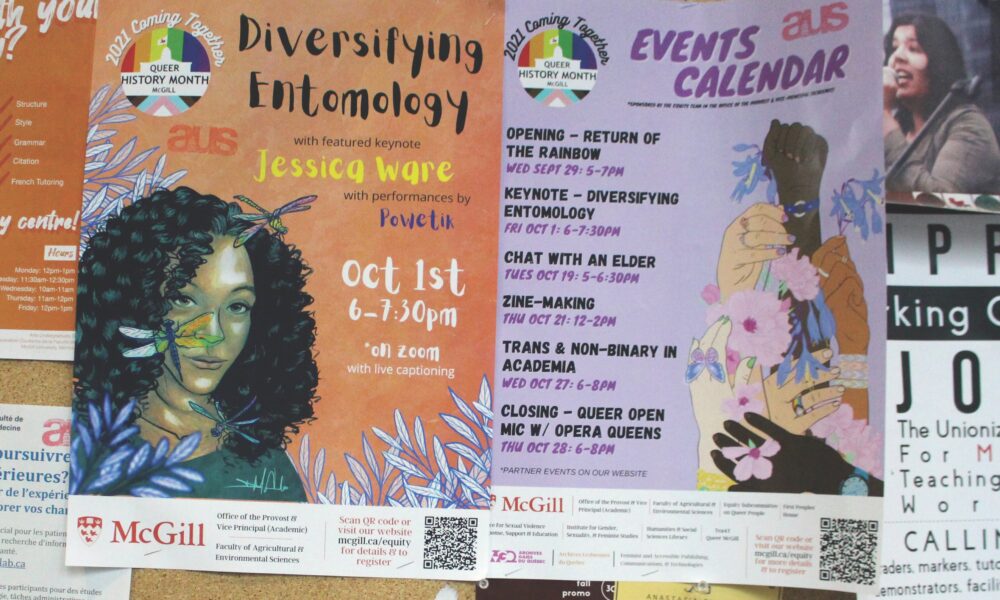
McGill holds annual Queer History Month themed “Coming Together”

Throughout October, McGill is holding a series of events in honour of Queer History Month, ranging from public talks to workshops, centred around the theme, “Coming Together.” The month opened with a homecoming event called “Return of the Rainbow,” which featured Kanien’kehá:ka Elder Kawennotas Sedalia. The event brought together former and current McGill queer community members, including staff, students, and faculty, to foster connections through relationship-building activities and to provide a safe space to share personal stories.

McGill’s Equity Education Advisor (Gender Equity and 2SLGBTQIA+ Education), Andrea Clegg, shared the meaning behind this year’s theme in an interview with The McGill Tribune.

“The theme ‘Coming Together’ is connected to the opening up of communities, including the McGill campus, in relation to the pandemic,” Clegg said. “[It is about] having a renewed opportunity to come together and celebrate and affirm our identities, something […] that varied communities have been impacted by in terms of the COVID pandemic.”

Honouring Queer History Month at McGill is important, explained Clegg, in that it provides space for celebrating members of the 2SLGBTQIA+ community and also includes a commitment to work toward further equality at the university.

“[Queer History Month at McGill] is an opportunity to come together, connect, celebrate our achievements, and identify ways we still need to continue to move forward on issues,” Clegg said.

While the month is primarily organized by the Office of the Provost and vice-principal (Academic) (OPVPA), they partner with many other groups to organize a wide range of events. One such group is McGill’s Subcommittee on Queer People (SQP), which submitted a formal motion to the McGill Senate in May 2021 for Queer History Month to be held and hosted the Return of the Rainbow event. Hiba Zafran, chair of the SQP, underscored the importance of adopting an intersectional approach in an email to The McGill Tribune.

“Equity and accountability are only possible when we both resist white supremacy and coloniality, and queer-ify, amplify and rebuild our ways of doing—together,” Zafran wrote. “It is our collective responsibility to promote the wisdom of, and leadership by, those of us with experiential knowledge. Queer History Month is one of the spaces where we can come together to envision such a politics and ethics for belonging.”

A handful of student-run groups helped organize Queer History Month as well. Queer McGill, a SSMU support service and the oldest queer organization on campus, hosted a documentary screening on Oct. 13 as part of the month’s programming. Jordan Elbualy, U4 Arts and an event coordinator for Queer McGill, spoke to the Tribune ahead of the screening and expressed his appreciation for the month’s events.

“I think [Queer History Month] shows that the administration cares about us a little bit,” Elbualy said. “I like it. It kind of takes the pressure off of Queer McGill’s shoulders not being the only Queer advocacy agency at McGill [and the Queer History Month organizers] do some really good work.”

For more information on Queer History Month and the events being held, visit the official page.

Queer students looking for support can visit Queer McGill’s Facebook.

Commentary, Opinion

McGill should reduce harm, not safety

University is a time of experimentation, exploration, and self-discovery. For some students, this includes experimenting with drugs. However, users rarely have access to comprehensive education regarding safe drug use—a necessary component of a harm reduction approach. For many first-year students, their only “harm reduction” measure is an informal tradition: Floor fellows instruct students to write down the name of the drugs they are doing and tuck it into their left shoe. In the event of an overdose, floor fellows can refer to the note to help identify the drugs and respond appropriately. However, beyond this, there are very few harm reduction initiatives implemented across campus on behalf of McGill, especially in residences—a move that does more harm than good.

McGill has a responsibility to make sure that students’ experimentation with drugs is as safe as possible. Instead of prioritizing their students’ well-being, however, McGill recently adopted a zero-tolerance policy on drug consumption, further stigmatizing drug use on campus. Consequently, students themselves have taken on the responsibility of making harm reduction resources available on campus. McGill’s lack of care for their students’ health and safety places an unfair burden upon students to make campus safer. 

Drug use happens across all university campuses, and McGill is no exception. Students are not naive to this reality, and many are committed to addressing the gaps in knowledge that exist. One student-led group, Making Drugs More Accurate (MDMA), has made it their mission to address the lack of harm reduction education on campus. By providing accessible drug testing, education, and safe spaces, MDMA makes it safer for McGill students to experiment with drugs

What is perhaps most telling about the state of harm reduction at McGill is the overwhelmingly positive student response to their initiative. According to the founder of MDMA, the group handled over 40 orders containing 160 different substance samples that were tested and deemed safe to use over the course of a mere 48-hour period. The group’s online following only continues to grow because of their willingness to do what the administration refuses to. 

This is not the first time students have taken matters into their own hands to protect their peers. A petition on change.org demanding a commitment to harm reduction began circulating in May and has since gained traction, with 400 signatures as of Oct. 18. The petition is demonstrative that McGill students will continue to protect each other even if their university fails to. In the petition, students call on McGill to adopt a compassionate, educational, and non-punitive approach to drug use in residences and across campus as a whole. This approach might include adopting harm reduction techniques set forth by the National Harm Reduction Coalition and making resources such as naloxone available in all residence buildings and campus partners. Additionally, the petition calls upon McGill to embrace the recent postponed motion brought before the Students’ Society of McGill University Legislative Council in March 2020. The motion serves as an exposé against McGill for actively rolling back harm reduction policies by removing floor fellow training and online resources. 

The lack of institutionalized harm reduction resources on campus renders countless students without support when it comes to the safe consumption of drugs. If not for the student mobilization Making Drugs More Accurate sparked, the state of harm reduction at McGill would be virtually non-existent. If McGill refuses to implement life-saving harm reduction measures itself, it must at the very least provide support to student-led harm reduction initiatives and invest in a safer McGill community for all students. The administration’s blatant ignorance and avoidance of the topic of harm reduction can no longer be overlooked. Even if students are willing to take on this burden, it is ultimately McGill’s responsibility to alleviate the pressure by providing adequate resources.

Science & Technology

Where mother-of-pearl becomes glass

Many would agree that one of the foremost attributes of glass is its fragility. However, a team of McGill researchers have found a surprising model after which to fashion a more durable glass. The team has enlisted nacre, more commonly known as “mother-of-pearl,” to improve glass’ fracture toughness, impact resistance, and light refraction, and created a glass that is as resilient to fragmentation as plastic. 

“The methods for improvement [of glass composites] offer infinite variation and opportunities for novelty,”  Allen Ehrlicher, an associate professor in McGill’s Department of Bioengineering and a member of the research team, wrote in an email to The McGill Tribune

Ehrlicher and his team foresee such a durable glass composite as having the potential to vastly improve common applications, such as cell-phone screens. 

Using small fragments of glass and acrylic material, the researchers were able to adjust flexibility and collision resistance by varying how long the composite was spun in a centrifuge. This allowed them to align microscopic glass tablets into layers of parallel planes, leading to an overall denser structure with greater resiliency. 

To increase the transmittance of light and the overall transparency of the composite, the researchers made the opaque glass and acrylic solid take on the refractive index of glass through the selection of both hard and soft materials. According to Ehrlicher, hard substances provide a necessary backbone for the composite, while more pliable ones increase transparency by preventing the reflection of light, also known as refraction. This allows the clarity of the composite to be identical to that of more common glass forms, including those which are laminated and tempered with heat, but are comparatively weaker. 

“Mollusk shell in bioinspired materials is broadly recognized as an archetype of tough composite materials, and offers a design template in its brick and mortar architecture as well as [a] combination of rigid tablets and ductile connective material,” Ehrlicher wrote. “For the material to not shatter, the material must flex and the energy of deformation must be absorbed more gradually than catastrophically.” 

It is mainly due to the mollusk shell’s structure, rather than the material itself, that such deformative properties can be achieved. 

“[Deformation] occurs through toughening mechanisms in the plastic connective phase between the glass flakes,” Ehrlicher wrote. “By allowing the plastic phase to gradually break, develop cavities, and let the glass tablets slide, this prevents the overall material from breaking, similar to a myriad of mechanical ‘fuses.’ Toughening mechanisms are the processes which allow the material to not be fragile or brittle like conventional glass.” 

Nacre has both hard and soft phases that allow for a high level of rigidity while still being able to absorb and resist impact. Thus, the researchers fashioned their composite out of both stiff and deformable material, resulting in a high level of interface strength due to strong bonding between the different phases. 

The researchers have calculated that their composite is three times stronger than normal glass and over five times more fracture resistant, a sign that this design could have significant real-world applications. 

Even more compelling is that Ehrlicher believes this glass composite is comparatively easier to manufacture than traditional glass. The team is currently in talks with companies regarding its wide-scale production. 

It is hard to believe that nacre, most commonly a protective lining for many mollusk species, could be behind such an exciting scientific development. Yet, Ehrlicher thinks the sky is the limit for nacre and its other biological counterparts. 

“Bioinspired materials has become a field in its own right,” Ehrlicher wrote. While Ehrlicher and his colleagues specialize in cell mechanics, the realm of bio-inspired materials remains an open canvas for experimentation and development. It seems that as scientists discover more about the minutiae of nature, the potential for innovation will only grow.

Science & Technology

Deep learning algorithm predicts early warning signals of climate tipping points

Tipping points are all around us, but it’s hard to see them coming. When a person falls off a bike, a patient has a heart attack, or a campfire escalates to a wildfire, it is nearly impossible to identify the exact moment at which disaster became inevitable.

 But it might not be impossible for much longer.

On Sept. 28, Thomas Bury, a researcher in McGill’s Department of Physiology, and Chris Bauch, a professor at the University of Waterloo, published a paper detailing the development of a new deep learning (DL) algorithm, that identifies early warning signals (EWS) of tipping points in dynamical systems. 

Dynamical systems are all around us and are defined as systems in which many variables interact and evolve over time. From the Earth’s climate to the human body, the organizations and organisms that dictate our quality of life are complex and unpredictable.

DL algorithms can improve their output automatically through experience and the use of data. But even with the help of DL systems, there remains the problem of not having enough data. Artificial intelligence algorithms need to be trained on data sets in order to learn how to recognize and predict patterns. Many of the areas researchers hope to explore, such as climatic dynamics or heartbeats, do not yet have enough data to properly train an algorithm.

However, data does not need to be taken from field experiments for it to be an accurate reflection of real events. Previous research into dynamical systems revealed key patterns about how data changes close to tipping points. By simplifying these patterns and building computer models to represent them, it is possible to generate vast amounts of simulated data that reflect real systems without actually collecting observations in the field.

Using simulated data representing dynamical systems with and without tipping points, Bury and Bauch trained their DL algorithm to recognize which features corresponded to systems with tipping points. Once trained, the algorithm was able to examine new situations, real and simulated, and successfully make predictions about the likelihood of future tipping points. 

Bury, who has been studying tipping points since 2015, is interested in early warning signals in both ecological and medical contexts.

“I am inspired to study tipping points because they arise in such diverse areas of science and society,” Bury said in an interview with The McGill Tribune. “This algorithm, for the first time, combines deep learning and dynamical systems theory to predict tipping points, and does so with better accuracy than previous approaches.”  

Although their algorithm is still undergoing testing to avoid unexplained inaccuracies, the possible applications of such an algorithm are endless. The ability to predict regional tipping points in climate systems could enable governments to prepare for natural disasters, such as floods or droughts, and better adapt to the effects of climate change. 

The algorithm can also be applied to unpredictable events at the individual level. For patients with cardiac arrhythmia, a condition that heightens the risk of sudden death by heart attack, data taken from heart monitors could be used to predict if and when a patient might experience a heart attack.

“Our approach may provide individuals [and] societies with greater forewarning to these events, and therefore allow mitigative [and] preventative strategies to be implemented in advance of the tipping point,” Bury said.

In the world of mathematics, Bury and Bauch are some of the first to study deep learning and dynamical systems simultaneously. 

“I find this research particularly exciting as it has shown that the combination of two seemingly disparate areas of mathematics, deep learning and dynamical systems, provides better prediction of tipping points than either area […] has managed on its own,” Bury said.

Though researchers cannot yet predict the next drought or medical emergency with absolute accuracy, it seems that it’s now only a matter of time before it can. 

Read the latest issue

Read the latest issue