
Latest News

Science & Technology

Science Rewind: Innovators from the last 67 years of Beatty Lectures

As McGill prepares for the 2021 edition of the annual Beatty Lecture with Dr. Anthony Fauci, the chief medical advisor to U.S. President Joe Biden, The McGill Tribune takes a look back at the most memorable scientists and innovators who have been invited to speak since the lecture’s inception 67 years ago. 

The lecture series was created in honour of Sir Edward Beatty after his brother, Dr. Henry Beatty, left a $100,000 gift in his name in 1952. Beatty studied political science at the University of Toronto, pursued a law degree, and rose in the ranks of the Canadian Pacific Railway (CPR), eventually assuming the top role of president in 1918. Beatty got involved at McGill around the same time, serving as its chancellor from 1920 to 1943. 

Since their establishment, the Beatty lectures have welcomed researchers, humanitarians, artists, and other remarkable individuals from around the world, to inspire the next generation of academics.

Peter Ritchie-Calder 

Born in 1906 and hailing from Glasgow, Peter Ritchie-Calder got his start as a court journalist, but made a lasting impact through his work documenting the daily lives of Londoners living through the Blitz—the bombing of London by German forces. After the war, Ritchie-Calder became more involved in science reporting and was the first to break the story about Watson, Crick, and Franklin’s discovery of the structure of DNA in 1953. 

Ritchie-Calder devoted much of his career to campaigning for nuclear disarmament, and delivered his 1971 Beatty lecture, “Science and Social Change,” on that very topic. Wary of the dangers rampant nuclear advancement might bring, he warned that scientific ambition should never take precedence over moral and social consequence.

 Jane Goodall 

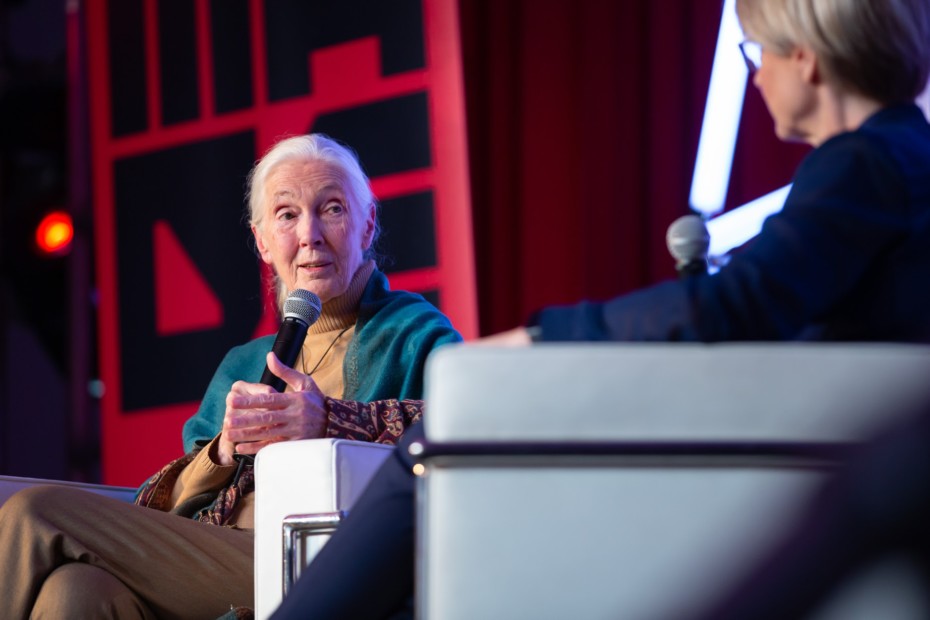
Jane Goodall, one of the best-known scientists on this list, delivered a Beatty lecture not once, but twice: First in 1979, to present her research from 20 years’ worth of observing primates, and again in 2019, where she shared a lifetime’s worth of environmental knowledge. After travelling to Gombe, Tanzania and discovering that chimpanzees are capable of using tools, Goodall was allowed to pursue a PhD at Cambridge University without earning any previous degrees. In addition to being the world’s foremost expert on chimpanzee society, Goodall has dedicated her life to promoting conservation efforts and animal well-being.

“I have seen so much suffering and destruction,” Goodall said in her 2019 lecture. “But my reasons for hope, the main one, is the young people. As you know, they can, and are, changing the world.” 

Richard Feynman 

Richard Feynman was a Nobel Prize-winning theoretical physicist who made astonishing advances in the field, including pioneering a space-time approach to quantum electrodynamics and introducing the idea of a quantum computer. After completing a PhD at Princeton, Feynman assisted with the Manhattan Project—the development of nuclear weapons during the Second World War—a part of his career he would later regret. He was known for his great ability to distill complex scientific concepts into simpler terms, and was referred to as “The Great Explainer” by colleagues and students. A collection of his talks, titled The Feynman Lectures on Physics, later became a bestseller within the scientific community. 

In his Beatty lecture, Feynman spoke about the quantum behaviour of light and matter with his characteristic engaging humour. 

“I’m supposed to be known as an expert in this field,” Feynman joked. “I think it’s true that if I don’t understand it, nobody understands it.” 

Sandra Steingraber 

Sandra Steingraber is an ecologist and writer who turned a personal tragedy into a lifelong career in activism. After going into remission from a cancer diagnosis in her twenties, Steingraber earned graduate degrees in biology and English and started studying the relationship between environmental pollution and growing rates of cancer. Her first book situates cancer within the realm of human rights, citing toxic releases and environmental pollution as direct causes, and her second book examines the impact of contaminants on infant health. 

Steingraber delivered a Beatty lecture in 2002 titled “Protecting the First Environment: The Ecology of Pregnancy and Childbirth,” to commemorate the 40th anniversary of Rachel Carson’s landmark book about environmental pollution, Silent Spring

Richard Dawkins 

Born in Kenya in 1941, Richard Dawkins obtained his master’s and PhD degrees in zoology at Oxford University. Dawkins is best known for his book The Selfish Gene, published in 1976. The book has been likened to a modern-day version of Charles Darwin’s On the Origin of Species, both in terms of reaching a large audience and being a game-changer in scientific advancement. Dawkins popularized the view that genes act as the principal unit of selection in evolution. 

In October 2006, Dawkins delivered a Beatty Lecture titled “Queerer Than We Suppose: The Strangeness of Science,” which focussed on humans’ inability to grasp reality beyond their immediate perceptions. 

“All science is a form of violence against common sense,” Dawkins said in his lecture. “Although the scientific method is grounded in a trained and informed common sense, greater scientists deploy a wildness of imagination, which, in the case of an Einstein or Heisenberg, outclasses the best science fiction.”

Yang Chen-Ning 

Yang Chen-Ning, a Chinese-born American theoretical physicist, made significant contributions to the field of mathematics and physics, particularly statistical mechanics, gauge theory and particle physics. Yang’s doctoral thesis on angular distribution in nucleon reactions landed him a research position at Princeton University, where he later became a professor in 1955. 

In 1957, Yang was awarded the Nobel Prize in Physics for his discovery that when certain chemicals decay, parity—the symmetry between physical phenomena occurring in right-handed and left-handed coordinate systems—is violated. Yang spent his 1991 Beatty Lecture, titled “Symmetry and Physics,” explaining this complex discovery.

Carl Djerassi 

Carl Djerassi, an Austrian-born Bulgarian-American chemist, novelist, and playwright is best known for advancing hormone synthesis methods—specifically ones that led to the development of an oral contraceptive pill known as the birth-control pill

In January 1999, Djerassi delivered a Beatty lecture titled “Science-in-fiction is not science fiction.” Djerassi purchased 500 copies of his own novels with his honorarium, and handed them out free of charge to the audience. 

“Everything in my books dealing with science is accurate, obsessively so,” Dejrassi said in his lecture. “It’s a way to smuggle something into reluctant minds. When people read my books, they will have learned something.”

Steven Pinker 

Steven Pinker, a McGill alumnus, received his bachelor’s degree in psychology in 1976. While he has conducted groundbreaking research in the field of visual cognition and psychology, Pinker’s books have also been wildly popular, earning him two Pulitzer Prize nominations. 

Pinker’s 2020 Beatty lecture, titled “Progress and Enlightenment in the 21st Century,” discussed concepts from his latest book published in 2018, where he argues that human society is improving, rather than worsening, as a direct result of 17th century Enlightenment ideals. This idea has been met with criticism and has sparked a great deal of controversy, especially among those who believe that a serious restructuring of the economic system is needed to solve the current climate crisis.


Hockey, Sports

Quebec University All-Stars face off against Habs rookies, losing 5-3

Closing out the 2021 Montreal Canadiens rookie camp, the top Habs prospects played an exhibition game against the Quebec University All-Stars (QUAS)—a team made up of players from McGill, Concordia, and Université du Québec à Trois-Rivières (UQTR). Despite a strong showing from the all-stars, eight of whom play for the McGill Redbirds, the game finished off with a 5-3 win for the Habs rookies. 

The QUAS squad struck first late in the first period, with a goal by Alexandre Katerinakis, a Concordia Stingers forward. The momentum quickly swung toward the Habs and remained that way until well into the second period, as the rookies managed four consecutive goals—one on Université du Québec à Trois-Rivières (UQTR) goaltender Tristan Cole-Cazenave and the three others on McGill first-year Alexis Shank. The current Redbirds captain, Samuel Tremblay, broke the team’s streak off a backhand pass from fifth-year forward Keanu Yamamoto, burying the puck left as goaltender Joe Vrbetic went right. 

“I got a beautiful pass from Yamamoto and I went on a breakaway and put it in,” Tremblay wrote in a message to The McGill Tribune. “[It] felt awesome to be a difference maker in that game and be a step closer to win it, but we ended up coming short.”

The QUAS stepped it up in the third period, with Concordia Stinger Tyler Hylland cutting the deficit to 4-3. Unfortunately, there just was not enough time on the clock to recover; Shank was pulled and Habs rookie Kaiden Guhle sealed the deal with an empty-netter.

The exhibition game took place on Sept. 21 at the Bell Sports Complex—the Canadiens’ practice arena—but was closed to the public due to COVID-19 restrictions. The match was not streamed but the game stats were updated live, to be viewed by McGill students, die-hard Habs fans, and those intrigued by a matchup between hockey’s most promising athletes. 

Eight of the McGill Redbirds players were selected for the QUAS, including Scott Walford, second-year defenceman and 2017 Montreal Canadiens third-round draft pick. For Walford, getting the chance to compete with such talented players made the experience worthwhile.

“It is always great getting the chance to challenge yourself against great players. I was happy to get that opportunity to not only challenge myself, but also have the opportunity to represent McGill,” Walford said in an interview with the Tribune. “I think the whole experience was special and what made it so special was being able to share it with my teammates.”

Among the others representing the Redbirds were Will Warm, Caiden Daley, Eric Uba, and Jacob Golden. The players will confront their QUAS teammates this season as rivals when McGill plays Concordia on Oct. 22, and UQTR on Oct. 29. 

Walford is looking forward to returning back to the rink for the season after COVID-19 cancellations. 

“I am really looking forward to just being able to play again,” Walford said. “After a year and a half off, you forget all the little things about everyday life at the rink, which is what makes playing on a team so enjoyable. It will be fun getting to play hockey again with my teammates and to compete for a championship.”

The Redbirds hockey season officially kicks off Oct. 13 with the home opener against the Queens Golden Gaels at McConnell Arena.

On the other side of the ice, the Montreal Canadiens have already started their NHL pre-season exhibition games with a 4-1 loss, then a 5-2 win against their archrivals, the Toronto Maple Leafs. 

STAT CORNER

First-year goaltender Alexis Shank saved 29 out of 32 shots against over 40 minutes of play. 

QUOTABLE

“I thought the game went well for us, especially for me personally. The first period was pretty chaotic, but we got better as the game went on. The second period we were all over them and in the third I thought they were pretty tired.” —Captain Samuel Tremblay on his team’s performance against the Habs rookies. 

MOMENT OF THE GAME

Samuel Tremblay’s second period snipe snuck past Canadiens rookie goaltender, Joe Vrebtic, raising the score to 4-2 and attempting to spur on a comeback.

Editorial, Opinion

Quebec must answer for non-consensual sterilizations

Content warning: This article discusses forced sterilization, racism

Radio-Canada recently aired an interview with a 44-year-old Haitian woman, Maria*, who claimed she was sterilized without consent at a Montreal hospital in 2018. She was asked if she wanted to undergo tubal ligation to prevent further pregnancies during her emergency C-section. Maria said that she refused the procedure, and there is no trace of written consent in her medical file. Non-consensual sterilizations are not bioethical dilemmas; they are the result of longstanding colonial practices that inflict disproportionate, irreparable harm on Black and Indigenous women. In a province whose leadership denies systemic racism, the onus is on the Quebec healthcare system to eliminate racial, gender, or other biases—as well as to guarantee that medical consent is given affirmatively and unequivocally.

Some patients might want their tubes tied, and some may opt to undergo the procedure after a C-section. But professionals must ensure that consent is unambiguous, especially when it is solicited from those whose first language is not French or English. Such a decision should never be allowed without the patient’s full and informed consent. 

Despite no written consent, the Quebec College of Physicians is taking the doctor’s word for obtaining “verbal consent.” Although this type of consent may be acceptable in extreme circumstances, even then, it only holds if the doctor makes certain that the patient comprehends the full extent of the procedure. The government should require translators fluent not only in French and English but also in Indigenous languages to be on-site at all times. Even if this is infeasible in the short-term, there are potential translation technologies that could be harnessed if they can be medically verified. 

It goes without saying that patients should not be asked to make such a life-altering decision under the already stressful, and at times traumatic, circumstances of childbirth. Nicole Awashish, an Atikamekw woman who is one of many Indigenous women who have experienced non-consensual sterilization, felt that the pain and stress of her contractions made it impossible for her to fully grasp the details of the procedure. To mitigate the risk of medical practitioners taking advantage of such stressors, patients must be given the time to think about whether the procedure is right for them far in advance and without any external pressure. 

Human rights groups have every reason to be skeptical of physicians, and of medical racism more broadly. Canada has a long history of forcibly sterilizing racialized “Others,” including Indigenous women, Black women, immigrants, and other minorities––and these atrocities are not a thing of the past. In this context—a callous cacophony amplified by a premier who denounces “wokes” for protesting structural prejudices—the government would be abdicating justice if it did not investigate Maria’s case, along with all others like it. 

Premier Legault’s opposition to “woke” activists is a form of rhetorical terrorism against people who criticize his politics, positioning them as enemies of the Quebec nation. Moreover, by fomenting bigotry, his words and labels compound the racism already embedded in the health care system, reinforcing well-founded distrust between racialized women and medical professionals, and discouraging vulnerable populations from seeking care. The government must take accountability for the women whose lives their health care system has irreparably damaged and must also address their underlying causes, lest Quebec hospitals remain structures of indifference and factories of injustice.

Quebec’s health care system has robbed victims of their agency, and their trauma must not be forgotten. Women’s health continues to be taken for granted, their pain minimized and their concerns about racial inequities labeled as “woke” paranoia. In this way, healthcare has become a crossroads of intersecting daggers of discrimination. A radical shift in Quebec’s approach to health care is the only way to bridge the cavernous legacies of oppression that serve to dehumanize and ignore racialized women.

*Maria’s name has been changed to preserve her anonymity.

Features

The art of companionship

As the ending of the 1994 award-winning novel //Snow Falling on Cedars// says, “accident ruled every corner of the universe except the chambers of the human heart.” While I have come to accept that life is unpredictable, I realized that at the very least, we can choose how we face the accidents. I’ve found that enduring hardship becomes easier with companionship—both human and animal. What I have also learned, however, is that pets themselves can have their own complexities, just like the complexities of human life. 

Before the pandemic started, I never considered myself someone who needed a lot of company. But after half a year of staying at home every day, I got to know loneliness in a way I had never before. After the emptiness brought on by the long-term isolation, I decided to officially move in with my girlfriend of a year. 

I’ve never had the desire to own pets, because I dislike taking care of things. Having pets seemed akin to raising a baby—and taking care of myself was already a hard enough task during the pandemic. At the very least, living with my girlfriend definitely helped us deal with a stagnant quarantine. 

I began to change my mind about pets over time, however, after adjusting to her living habits. Before I met my girlfriend, I had no interest in “cute” things––I never liked Barbie dolls or plush toys, even when I was little. My girlfriend is exactly the opposite of me, however: Her apartment is full of plush toys, and she has always wanted to have both a dog and a cat.

After sending me countless Instagram videos of cats and dogs during quarantine, I was convinced, little by little, that a life with pets wouldn’t be as exhausting as I had initially thought. We started casually browsing through the pets on Kijiji and SPCA, though we had not made any official decisions yet. It was the summer of 2020 when we finally decided to adopt a cat, something unfortunate happened to my girlfriend.

Life changed overnight. Without any warning, my girlfriend was suddenly struck by an unknown disease. After rushing to the emergency room, she was hospitalized for two months. During that period, she was sent to the ICU once and almost lost her life. In July 2020 she finally returned home, but still had to go to the hospital every other day for medical treatment. Although her day-to-day health improved, the shadow of sickness constantly hung above us. I was consumed by anxiety, as was she. 

A few months later, her situation stabilized, and she only needed to visit the hospital every month. After her health crisis, both of us gained a deeper understanding of the uncertainty of life. We decided that there would be no more hesitation in our lives: If we wanted to do something, we would go for it. In November 2020 we got our first pet on Kijiji, a male Scottish Straight kitten named Burger. We also joined the waiting list of a breeder to get a Shiba Inu puppy.

Burger’s health hadn’t been in perfect condition from the first day he came to our home—and nobody knew why because of his mysterious origins. He came from an unknown cattery in Kyiv, Ukraine, after which he was purchased by a girl in Montreal and flown to the city by airplane

Burger didn’t have testicles, so we assumed that he was already neutered. During this summer, however, he started behaving like a very horny cat. It turned out that he had cryptorchidism, a condition where testicles do not descend from the abdomen as they should have. After his diagnosis, we had to wait a month for the castration surgery. During that time, having a cat was as miserable as I had originally feared: Burger peed everywhere in the home and ruined at least five carpets with his smelly urine, and we barely slept because Burger screamed every night. But surprisingly, I never felt any hatred toward Burger through this difficult time. Instead, I felt genuinely sad for him, for all the suffering he was enduring. Luckily, after the surgery, he returned to being our sweet cat of before.

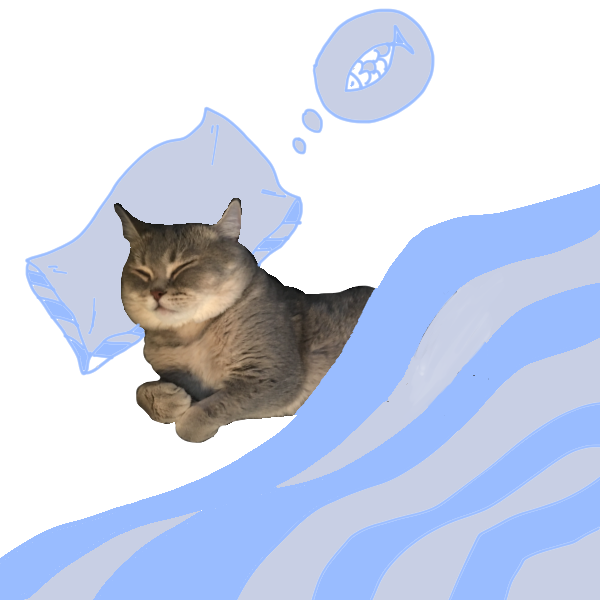
Despite its ups and downs, I began to enjoy living with a cat. Regardless of the painful moments he had brought to us, Burger is affectionate and very friendly. Every night when we go to bed, he will also come upstairs and quietly sleep on the end of our bed, or on the nightstand. Sometimes, he climbs on us and asks to be pet. We call him “little princess” because he is so spoiled.

After adjusting to living with Burger, we took the plunge and purchased a dog, a female Shiba Inu. We named her Kirby after obsessively playing Kirby Star Allies during summer vacation. I quickly discovered that raising a dog requires far more effort than a cat, since we had to train her from zero, and walk her every day. Kirby is naturally dominant, and she doesn’t like to be trained. Her breed is known for being independent and self-willed. She never follows me when I walk her, and she refuses to listen to my instructions. Sometimes she drives me crazy. After dealing with a cat that peed everywhere in the house, a stubborn dog is nothing to me. As I noticed my loneliness fading away living with Kirby, I began to appreciate many dogs’ happiness and joy. Especially during the pandemic, her happiness became a kind of sunshine that punctured my life, and reassured my girlfriend and I that maybe everything would be okay.

Over these last two years, I have become more calm when dealing with the troubles my pets bring me, and I have learned an important quality that I didn’t have before: Patience. Living with pets, of course, has its negative aspects—it requires a lifetime’s worth of responsibility and caring, and involves a lot of frustration and exhaustion. However, I also learned how to love and be patient when dealing with those struggles. In a time of global and personal hardship, my two animals brought colour to my life. After having Burger and Kirby, I feel like my life has two more witnesses. 

Off the Board, Opinion

Finding new words for my identity

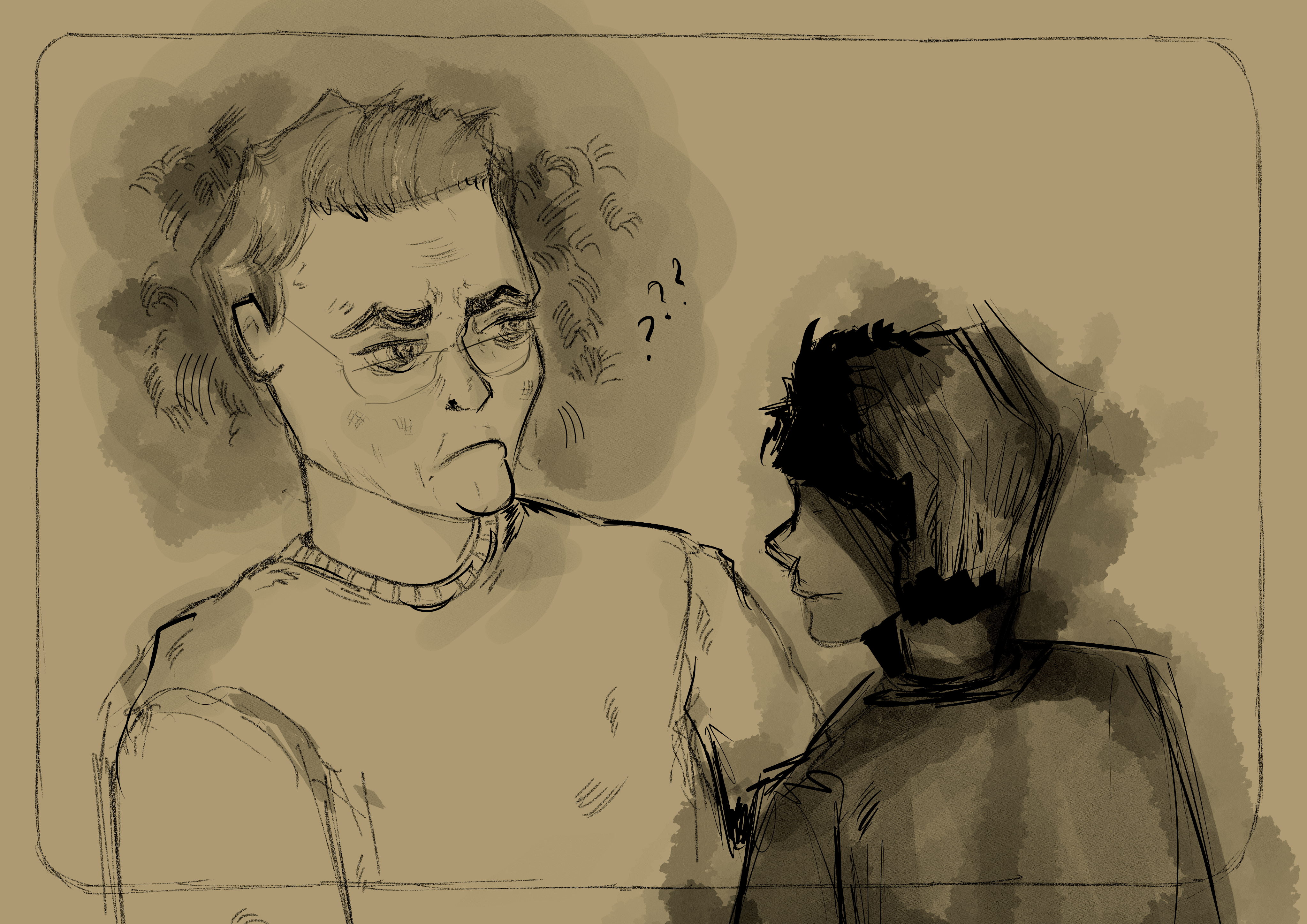
It took me until I was 12 to realize that my father’s English was accented. Before that, it was just my father’s voice: Familiar and melodic, a vestige of his first, tonal language. Like many mixed kids, I was hyper-aware of the racial categories I fit into from a young age. While I often wondered if I looked more white or Chinese, language did not play a part in my identity struggles. At home, we spoke English, and my highly educated father was always able to express himself in his second tongue.

Things changed when my parents decided to move to Taichung for my mother’s sabbatical. While she researched Taiwan’s forests with my father as an ad hoc translator, my world turned upside down. At school, I fought through tears as teachers and classmates attempted to engage me in a language I had never learned. My only allies at school were two Taiwanese girls who knew some English. When I tried to speak Mandarin one time, my friends laughed at my accent. I realized that while I felt somewhat Chinese at home, in Taiwan, I was completely foreign—seen as white as it gets.

We returned to Canada less than half a year later, but my feelings of linguistic inadequacy stuck with me. In the eight years afterwards, I took Chinese lessons with my mother. My accent sounded more natural by high school, enough to be taken for a native speaker—as long as I managed to spit out a few confident sentences. When I was 16, I went to Shanghai with my dad, spending my days in his air-conditioned office wrestling through articles on Baidu, the Chinese equivalent of Wikipedia. 

Although I was half-literate by the end of summer, I was still unable to fully grasp the language. I had learned Pinyin, the standard romanization of Chinese; I had encountered a few thousand characters; I even occasionally dreamed in Mandarin. But nothing ever translated to spoken fluency—probably because I never had anyone to speak to. My father has refused to speak Chinese with me throughout my life, citing his own discomfort using the language, even though he uses it with others. I began to wonder if I’d ever be good enough.

The fall after I returned home from Shanghai, I gave up learning Chinese. I spent my Fridays watching movies with my friends instead of studying grammar particles. There are times when my decaying comprehension of Chinese feels like a wound. But in truth, ending my studies was a huge relief. I stopped feeling that I had to prove my Chinese identity to myself, or make up for a childhood of linguistic immersion I never had. I also began to question the exclusionary paradigm that I implicitly accepted—that identity hinged on a certain grasp of language or a kind of invisible flexibility across cultural spheres. It wasn’t just me who was excluded by this linguistic absolutism, but others as well, like transracial adoptees raised by white families, or native speakers who experienced first language attrition. 

In truth, cultural identities are transitive and expansive, shifting across geographical context. Some diasporic individuals who return home even experience “reverse culture shock,” where familiar elements of their native country seem alien. My father often confesses to me that he has issues understanding modern Mandarin, with its English loan words, Tiktok slang, and novel technological terms that did not exist in 1960s Taiwan. As for myself, to accept that I’m the product of my circumstances, to integrate poorly into one of my cultures—this is a tough thing to face. But it’s also what most new immigrants confront when they try to integrate into a new country.  

My father once explained to me that he learned English by slowly reading books with the help of a Chinese-English dictionary, and I told him I couldn’t imagine learning another language without the internet. Only years later did I understand his response: “There was no other option. I had to survive.”

Sports

The future of sports broadcasting is at our fingertips

It’s a Friday night, and all you want to do is order pizza and watch an NFL game live with some close friends. As a student on a tight budget, however, finding access to the games you want to watch can prove difficult—and sometimes even impossible—without a cable plan. Some students have access to their families’ cable information, but many more find themselves out of luck on game night, likely spending the rest of the evening trying to access a low-resolution, stuttery, illegal stream.

Live sports are as popular as ever, but as our media consumption gradually migrates from the family TV to our own personal devices, watching sports through cable television is becoming more and more antiquated.

In the United States this year, only 56 per cent of households have a cable plan, down from 76 per cent in 2015. This dramatic cable-cutting wave is even more pronounced among young adults, with only 34 per cent of people aged 18-29 shelling out cash on a monthly plan. As this younger generation ages into their prime spending years, cable television will likely die out, and with it the large media companies that broadcast our favourite sports. 

The decline of younger viewership is already apparent in nearly every major North American sport; the average NHL viewer’s age is 49, up from 42 in 2006, and the average baseball viewer is 57, up from 52. This trend reflects the generational lag in sports viewership: Younger viewers are just as engaged in sports, but have instead turned to digital sports media commentary to satisfy their craving. Platforms such as Youtube, TikTok, and podcasts, have seen tremendous growth in the past decade. 

The mode of delivery won’t be the only thing that changes. Because live sports have such high viewership, broadcasts are meant to appeal to as many people as possible. But content creators on online platforms are gaining followers thanks to their unique approaches to sports analysis, challenging the generalized commentary inherent to larger networks. While this broad strokes approach is engaging for those who are already invested, it fails to draw in new viewership. Now that most people own a device, the potential for more niche, individualized live sports broadcasting is virtually untapped. Exclusive broadcasting contracts still held by companies like ESPN, TNT, and Fox Sports are the only barriers preventing this new wave of sportscasting from dominating the industry. 

Nearly every major sports-casting contract is ending in the next decade. While it is possible that companies like ESPN will retain some of their contracts, it is just as possible that huge tech corporations like Google or Amazon, who have already dipped their toes in the streaming pool, will spend a small fortune to acquire exclusive rights to stream games how they please. 

If one of these tech giants manages to secure streaming rights, the way we consume live sports will undoubtedly change forever. Streaming services like Youtube Live and Twitch have the capability to individualize content for millions of people. Audience segmentation is something that Spanish Football league La Liga has experimented with, bringing various influencers to commentate on soccer games—to great success. Allowing already established streamers, such as xQcOW or HasanAbi, to cast sporting events could draw in an entirely different demographic to the sports ecosystem and could make viewing games—many that would be otherwise uninteresting, such as blowouts or regular-season games—engaging in an entirely new way. 

As we all gradually move further into the digital world, it is only natural that things will change. Watching sports games on our laptops is just the beginning—segmented monetization and new commentating styles will foster unique, small communities in these digital spaces.

Research Briefs, Science & Technology

Neuroinflammation found to drive Alzheimer’s disease progression

Over a century ago, Alois Alzheimer, a German psychiatrist, spotted strange plaques and tangles in the brain slides of a patient with dementia. Ever since, scientists have been trying to better understand the mechanisms behind what is now known as Alzheimer’s disease.

Alzheimer’s disease (AD) is a brain disorder that progressively deteriorates cognitive and memory skills, eventually taking away the ability to perform even the most basic tasks, such as walking and eating. It is the most common cause of dementia among older adults and affects an estimated one in 10 people aged 65 or older.

From a biological standpoint, the disease is characterized by the accumulation of misfolded proteins, called amyloid beta, in the brain. They aggregate and form plaques that eventually trigger an inflammatory response. Microglia, the brain’s resident immune cells, activate and release molecules that cause further damage to the neurons. Another class of proteins, known as tau proteins, also get modified and clump together, forming tau tangles. The misfolded proteins then propagate according to hierarchical stages known as Braak stages. They originate from lower brain areas and make their way up to higher areas that control thinking and memory. The combination of amyloid plaques and tau tangles, along with the inflammatory response in the brain, is what scientists believe to be the physical basis of AD.

The role of brain tissue inflammation in Alzheimer’s, however, is still disputed among scientists.

“Some scientists believe that neuroinflammation can protect the brain because it would attack the amyloid plaques,” Dr. Pedro Rosa-Neto, director of the McGill Research Centre for Studies in Aging and professor of neurology and neurosurgery, said in an interview with The McGill Tribune.

Nevertheless, a recent McGill study has proven the alternative theory to be true: Neuroinflammation was found to drive the progression of the disease. The research team, led by Rosa-Neto, used an imaging technique called positron-emission tomography to quantify microglial activation, amyloid beta deposits, and tau propagation across the brain.

Their findings suggest that neuroinflammation is a precursor that allows tau proteins to spread to higher brain areas. 

“Microglial activation paves the way for tau to invade the brain,” Rosa-Neto said. 

The researchers also found that amyloid beta enhances the effect of microglial activation on tau proteins spreading through the brain. Their model shows that the combination of amyloid beta and microglial activation is what determines tau pathology.

This study clearly has considerable clinical applications; for instance, treating patients with anti-inflammatory drugs could prevent further progression of the disease. However, the clinical trials have been unsuccessful so far. There are many reasons for this failure, but an important one is that patients receiving the drugs are already in the late stages of the disease.

“The results that we found suggest that there is a right timing to give this medication, which is right at the beginning of the disease,” Rosa-Neto said. 

Indeed, neuroinflammation creates a path for the progression of misfolded tau proteins from lower to higher brain areas. Turning off neuroinflammation when misfolded tau are still confined within lower structures could prevent them from spreading further. Stopping neuroinflammation only when tau has already reached higher structures would likely be futile. 

As is the case for most complex diseases like Alzheimer’s, a lot of work needs to be done before scientists can reach a complete and accurate understanding of the disease mechanism. A clearer picture of how AD progresses is a promising start in ensuring better outcomes for patients. 

Last Tuesday, on World Alzheimer’s Day, Alzheimer’s Disease International released the World Alzheimer’s Report 2021—a comprehensive report of recent advances in the field. The 2021 report was entirely written by four McGill researchers, including Rosa-Neto, underscoring their standing as global leaders in Alzheimer’s research. 

Art, Arts & Entertainment

PHI’s newest exhibit imagines post-pandemic human connection

Five artists, each with their own unique artistic methods, mediums, and backgrounds unite in the exhibition …And Room in the Bag of Stars currently on display at the PHI Foundation for Contemporary Art. Curated by Daniel Fiset and inspired by science-fiction author Ursula K. Le Guin’s 1986 short essay The Carrier Bag Theory of Fiction, the art builds upon Le Guin’s ideas about prioritizing human community and unity over secession and violence. 

Le Guin’s essay proposes that humanity’s first tool was a receptacle rather than a spear, suggesting that humans were collectors and artists before they were hunters. …And Room in the Bag of Stars is a simulacrum of Le Guin’s ideas, imagining a world where people connect and share with each other, rather than engage in violence. kimura byol-nathalie lemoine, Salima Punjani, Dominique Sirois, Santiago Tamayo Soler, and Karen Trask all contributed their individually distinctive artworks to this cohesive exhibition. Exploring themes of social isolation, sexism, cultural diversity, and technological advancements, …And Room in a Bag of Stars brings to light Le Guin’s ideas and leaves behind the narrative of glorified—typically male—heroic archetypes. 

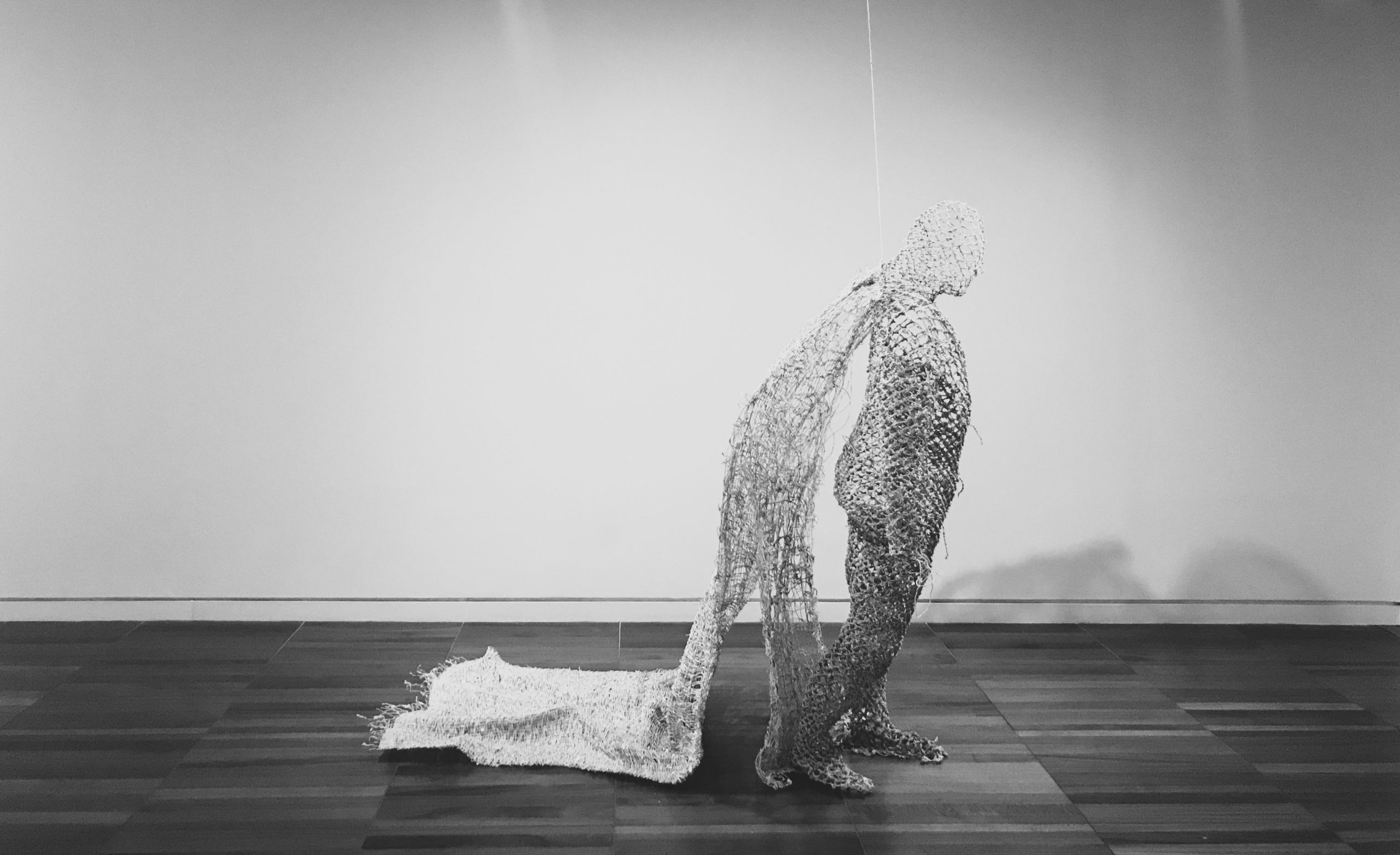
Applying the same technique used to tie knots in fishing nets, Trask’s sculpture Hanging by a Thread intricately weaves together pages torn from encyclopedias and dictionaries. In the room’s centre stands a masculine humanoid effigy, his cape trailing behind him and a single thread connecting him to the ceiling. This phantom figure’s fragility is dissimilar to the unstoppable hero to which myth and story are so accustomed; instead, its ghostly form symbolizes the fading of patriarchal ideals and the flaws in society’s consistent search for epic heroes. 

Will you pass the salt by Salima Punjani draws viewers into a multi-sensory experience. The project invites the spectator to sit at a dining room table set with dishes and cutlery, immersing them in the familiar sounds of friendly chatter, laughter, and clattering dishware. The audio’s noises come from 10 different Montreal households, recreating a snapshot of life before the COVID-19 pandemic. 

In Saekdong색동Diaspora, kimura byol-nathalie lemoine incorporates Le Guin’s theme of humans-as-collectors by using natural materials, such as bamboo, iris, and lotus, amassed from places the artist has lived. From here, the artist creates an assortment of multifaceted representations of containers, ranging from mason jars to pouches. The title refers to saekdongot, a type of vibrantly striped traditional Korean cloth that lemoine incorporates into the piece. lemoine’s precise placement and symbolic use of materials present create a strong sense of zer communal identity, mediated through art.

Along with Dominique Sirois’ Alliance #14 and Santiago Tamayo Soler’s Retornar, these five artists gather a meticulous and intriguing understanding of the human condition. …And Room in the Bag of Stars reimagines a world where humans can reconnect through art, drawing one’s attention away from the individual and toward a collective experience of healing. 

‘…And Room in the Bag of Stars’ exhibition continues until January 9, 2022, at the PHI Foundation for Contemporary Art (451 & 465 Saint-Jean Street, Montréal). Book in advance. Free admission. 

Montreal, News

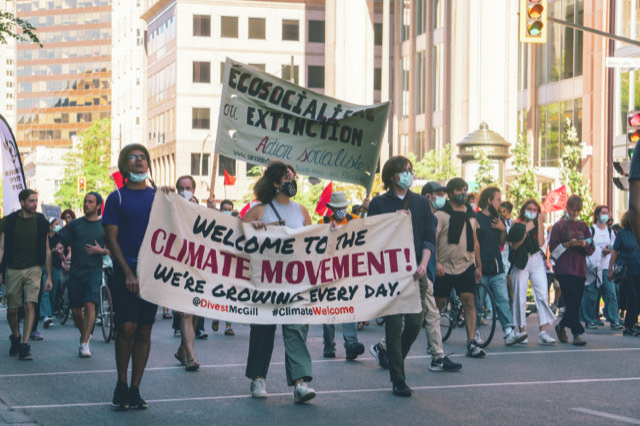
Students march for climate justice and urge McGill to divest

Divest McGill hosted a teach-in on Sept. 24 to encourage McGill students to participate in the annual climate march that occurred downtown later that afternoon. Students gathered at the Y-intersection on campus to listen to several speakers, and then walked to Jeanne-Mance Park with posters and signs in hand. 

The march was part of the larger Fridays for Future movement, and members of Divest McGill used the occasion as an opportunity to educate people about McGill’s investment in fossil fuel companies. Following the news of Harvard University’s divestment from fossil fuel companies on Sept. 9, many students, including Lily Cason, U1 Arts student and Divest McGill member, took to the streets to urge McGill to do the same.

“Our institution is invested in many of the main fossil fuel companies that […] are worsening the environment and the impending crisis that we are all going to have to face,” Cason said. “We think it’s irresponsible for McGill to stay invested in these companies knowing that it’s not the way of the future.”

In their speech, Lane McCrory, U2 Arts student and Divest McGill member, explained the depth of McGill’s fossil fuel investment portfolio. 

“Above all, who is contributing the most to greenhouse emissions? Who is burning fossil fuels and pumping 70 per cent of greenhouse gasses into the air?” McCrory started. “It is the top 100 fossil fuel companies that are producing 70 per cent of our total greenhouse gasses, [many] of which McGill University actively supports. McGill has tens of millions of dollars in the energy sector. This means that the institution is actively supporting fossil fuels, oil, and the coal industry.”

After listening to activists’ speeches at Jeanne-Mance Park, students joined thousands of other climate activists and organizations in marching down Parc Avenue and along Sherbrooke Street West. While official numbers have yet to be released, multiple sources estimate the number of participants to be in the tens of thousands. The Montreal climate strike was one of approximately 1,500 occurring on Sept. 24 across the globe.

Many people, like El Bush, U1 Arts, joined the march after hearing about it by word-of-mouth.

“My friend is a part of Divest McGill, and she has always prompted me to be aware of the political climate I am in,” Bush said. “I think it is very important, especially as a McGill student who comes from a place of privilege, to actively engage in activities and with communities that are helping to decolonize and create a sustainable campus.”

Prior to the march, Divest McGill held a meeting in Three Bares Park to discuss ideas and logistics.

“[Divest] is non-hierarchical. It is all incredibly collaborative, which is a really nice space to be in,” Cason said. “Everyone who has an idea is welcome to share their ideas. You get so much knowledge in one space when you have that kind of open-forum discussion.”

Divest members counted the meeting a success.

“Divest was thrilled by the number of McGill students who came out to strike for climate justice and to learn about how fighting the university’s steadfast refusal to take money out of the fossil fuel industry fits into a larger Just Transition Framework devised by Climate Justice Alliance.” said members of the club in a joint statement to the Tribune.

Arts & Entertainment, Film and TV

Festival Stop-Motion Montréal explores the cultural significance of Indigenous filmmaking

Festival Stop Motion Montréal, which took place from Sept. 10 to 19, is dedicated to highlighting the beauty and uniqueness of stop-motion film. For its 13th edition, the festival showcased both local and international talent and focussed on amplifying the work of Indigenous stop-motion artists.

As part of the festival, Wapikoni, a non-profit organization dedicated to supporting First Nations cinema, hosted a round table on Indigenous stop-motion productions, featuring Métis/Anishinaabeg producer and filmmaker Melanie Jackson, Métis filmmaker and multidisciplinary artist Terril Calder, producer Neil Christopher, Inuit filmmaker and producer Zacharias Kunuk, and moderator and Innu filmmaker Jani Bellefleur-Kaltush. The five artists—some having met at the panel, some having been long-time friends and colleagues—discussed their personal experiences as filmmakers and producers. 

“I’m fascinated by my culture, [and] fascinated by the knowledge and land,” Kunuk said. “[In the North], there are no trees, so no paper to write on. I am fascinated by [everything] thought orally.”

Kunuk’s stop-motion film Angakusajaujuq: The Shaman’s Apprentice won the festival’s award for Best Independent Film at the festival this year.

The panellists agreed that stop-motion as an art form is an interesting way to tell the stories they grew up hearing from their elders. Director Melanie Jackson used hoop dancing to underline the importance of movement in Indigenous cultures, as shown in her 2009 short stop-motion film Vistas: Dancers of the Grass.

“When it comes to stop-motion, it’s the artistry of the movements [that are important],” Jackson said. “It’s a different way to share those stories that we have been told.”

Another unique aspect of the stop-motion format is its ability to use textures as a narrative tool. Kunuk used the texture of fur, snow, and leathered garments to highlight distinct aspects of Inuit culture. Christopher explained that the authenticity of these textures would have been impossible to recreate in classical or 3D animation.

“When Zacharias Kunuk approached us with a traditional story, stop-motion just felt like the right decision,” Christopher said. “We wanted to see the texture of the fur. It didn’t feel like we should bring it to the computer, and stop-motion would allow us to do animation in a very tactile way.”

Despite the patience required to shoot a stop-motion film, there is an accessibility to the medium that is otherwise rare in cinema. Without a crew to feed and actors to pay on set, the cost of shooting a stop-motion film is often drastically lower than shooting live action. There are opportunities to explore creative liberties that would otherwise be impossible, like shooting a movie in one’s native language.

“With stop-motion, all that is unimaginable becomes imaginable,” Kunuk said.

The round table closed on a discussion on the importance of uplifting Indigenous creators, something Festival Stop Motion Montréal aimed to do during this year’s edition. 

“The next challenge for Indigenous creators is to break channels other than APTN,” Jackson said. “Teletoon or Cartoon Network, for example.” 

Jackson explained that Canada, in comparison to New Zealand, lags behind when it comes to giving Indigenous creators the opportunity to share their work on country-wide television. 

“In New Zealand, TV broadcasters take pride in showing animated shows by Indigenous people,” Jackson said. “By seeing brown skin on screen, it encourages our youth [to see that] there is another way for them to get their stories out there.” 

Read the latest issue

Read the latest issue