


Latest News

Basketball, Sports

A sibling pick and roll: Matt and Alec Phaneuf’s rival routes

In the heart of Montreal’s university sports scene, a unique sibling rivalry is unfolding on the basketball court. Matt Phaneuf, playing for the McGill Redbirds, and his brother Alec Phaneuf, representing the Concordia Stingers, share more than just DNA. Their love for each other and their competitive spirit has been fostered through countless hours of backyard games and has shaped them into the athletes they are today. The brothers sat down with The Tribune to discuss their sibling bond.

“Anything we did growing up was always competitive,” Alec reflected. 

“Playing football one-on-one, whatever it was—after 15 minutes of doing nothing, we just had to compete against each other,” Matt added. 

Growing up in a family where sports were not just played but lived, the Phaneufs were destined for athletic success. Their mother, Marie Drapeau, was a competitive swimmer at Université Laval (ULaval) who nearly made the Olympics. Their uncle, Simon Noël, won the National Championships with ULaval Volleyball in 1993-94. Their cousin, François Gauthier-Drapeau, recently competed in the 2024 Olympics in Judo, and cousin Isaac Noël played football for the Carleton Ravens

The brothers’ shared profound love for basketball began in their family’s driveway. Their father Chrystian Phaneuf has been their biggest supporter, going as far as to serve as the two boys’ coach. In fact, Matt and Alec attributed their mastery of the mid-range shot—a favourite for both players on the court—to their father. 

“He was never really into one sport—he was [a] multi-sport [athlete] when he played, but now that we play basketball for rival universities, he’s not shy to say, ‘I’m living my dream through you guys,’ which is kind of inspiring,” Matt said. “It’s always nice to know that you have people in your corner.”

Today, they find themselves on opposite sides of one of Quebec’s most intense university rivalries. In their most recent matchups on Jan. 16 and 18, Concordia emerged victorious with 76-54 and 94-47 wins over McGill. However, the score tells only part of the story.

With around 30 family members attending each of their matchups, these games are more than just regular season contests; they become family-wide affairs.

“I think I’d be lying if I said there wasn’t a little more importance when I play against [McGill],” Alec said.

The uniqueness of their situation is not lost on Matt, either. 

“It still feels unreal. On the court, it’s just a regular basketball game. But as soon as [Alec] steps on I feel like I’m back home,” he added.

Living together on Montreal’s South Shore adds another dimension to their relationship. After games, regardless of the outcome, they drive home together. When describing the aftermath of their games, the boys highlighted how they maintain perspective. After all, basketball is just one part of their relationship.

Matt’s view on living with a rival—and sibling—is refreshing. 

“When I’m at home, post-practice, or a game, or a long day of school, I just want to be ‘Matt who cooks,’ or ‘Matt who likes to watch Sunday Night Football,’ so we do that together on our one day off (Sunday) during the season,” he noted. “It’s nice, you know, to wind down and relax together without talking about basketball all the time.”

When asked about their advice for younger players entering collegiate sport, both brothers emphasized the importance of growth and balance. 

“Keep progressing, keep working on new stuff, keep improving,” Alec said. 

“Take it day by day,” Matt also added. “Don’t put all your eggs in the same basket. Don’t focus on just basketball, when it feels like there is no light at the end of the tunnel, you have to remind yourself that it is one day at a time, so enjoy it while you can.”

As their careers progress, both brothers may wonder what it would be like to play together rather than against each other. But for now, they will continue their rivalry, pushing each other to greater heights while maintaining a bond that only brothers can share. Currently, in the Réseau du sport étudiant du Québec, Concordia sits just under the Bishop’s University Gaiters in second place, while McGill is last in the standings. Both teams are aiming for playoff positions—potentially setting up another chapter in the Phaneuf brothers’ story. 
Science & Technology

Who are these guys, anyway?

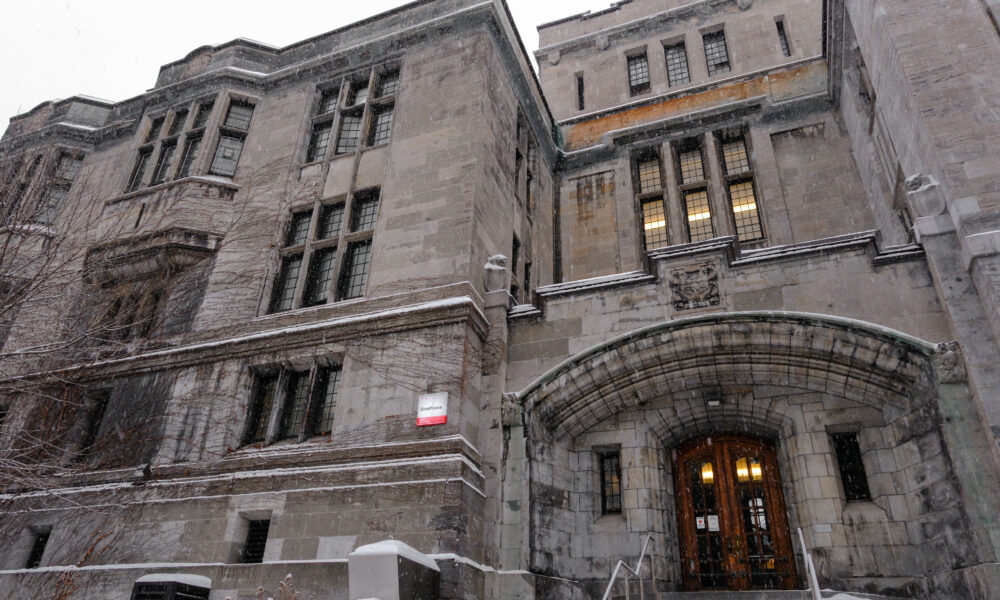
Have you ever taken the tunnel from Otto Maass to Burnside to MacDonald Engineering and wondered which dead, old, white men these buildings were named after? Have you picked up a bag of Redpath sugar and wondered if there was any connection with the library? Read on for a deep dive into the colonial and violent histories of some of McGill’s most prominent benefactors. 

MacDonald

William Christopher MacDonald, who gave his name to the MacDonald Engineering Building, amassed his wealth in the tobacco industry in the late 19th century. He established a tobacco factory on what is now Rue de la Commune in the 1860s, primarily employing women and adolescents. When the American Civil War broke out in 1863, he exploited the opportunity by purchasing tobacco leaf from the Southern United States, manufacturing tobacco products in Montreal, and reselling them to the Northern states, which were in the midst of a tobacco shortage due to the war. 

Redpath

You may recognize the name Redpath from the supermarket aisle, in addition to the McGill Museum and Library buildings. The Redpath family, who financed the latter McGill buildings, also started the Redpath Sugar Company—originally named the Canada Sugar Refining Company—in 1858, which imported sugar cane from the Caribbean and refined it on the banks of the Lachine Canal. Although the Slavery Abolition Act of 1833 had made slavery illegal in British colonies, brutal and exploitative working conditions persisted in the sugar cane industry. Redpath Sugar continues to be a major Canadian company, with its primary refinery based in Toronto. 

Burnside

Although technically not someone’s name, Burnside is a building name that cannot be overlooked in the history of McGill as an institution. The present-day building, which houses Mathematics, Geography, and Atmospheric and Oceanic Sciences at the university, draws its name from Burnside Hall, James McGill’s Montreal estate. McGill, who enslaved at least five Black and Indigenous people during his lifetime, left the original bequest of  £10,000 that founded the university that now bears his name. After demands from students and vandalism, a statue that depicted McGill was taken down by the administration in 2021. The Tribune has also called for McGill to change its name in light of its founder’s involvement in colonial and racist violence.

Strathcona

The Strathcona Anatomy and Dentistry Building and the Strathcona Music Building both derive their name from Donald Alexander Smith, a Scottish-born businessman who bore the title “First Baron Strathcona and Mount Royal.” Strathcona supplied the funding and land for the anatomy and dentistry building after a fire destroyed the old Faculty of Medicine building in 1907. His laundry list of colonial engagements includes a term as chairman of Burmah Oil Co., which discovered large oil fields in Iran and eventually spawned the famous British Petroleum (BP) company, as well as personally raising and equipping an entire regiment to fight in the Second Boer War in South Africa. 

Otto Maass

While Maass, who died in 1961, is more recent than some of the other names on this list, he made his mark as the director of two very different institutions: The Pulp and Paper Research Institute of Canada on the one hand, and the Directorate of Chemical Warfare and Smoke on the other.  In his role as Director of the latter organization, he was involved in Canadian biological weapons research in a variety of ways, including the distribution of grant funding for chemical weapons, and serving as a go-between for British and American scientists during World War II. During his career, he worked on multiple other weapons-related projects, including the development of chemicals used for rocket fuel.

McGill, News

Students report getting trapped in elevators of Sherbrooke 680/688 Building

On Oct. 3, Ella Bachrach, U1 Arts, walked into the elevator of Sherbrooke 680/688 on the ground floor, intending to travel up to the 13th floor. However, after Bachrach entered the elevator, the doors did not fully close behind her, leaving an inch-wide gap. While ascending, the elevator suddenly stopped moving and all the lights turned off. Bachrach remembers trying to find an emergency call button within the elevator but was unable to do so in the darkness. Fearing the elevator would fall 13 stories, she forced the doors open and managed to squeeze out.

“I was so scared that the elevator had lost power and would suddenly drop [.…] The adrenaline helped me,” Bachrach wrote to The Tribune.  

Sherbrooke 680/688 is home to a variety of programs, including the McGill Community for Lifelong Learning (MCLL) and its Language and Intercultural Communication unit, which are part of the School of Continuing Studies. The building also hosts a popular study area on its ninth floor. Because of this, the 21-storey building sees a high number of students entering, exiting, and travelling between floors daily. 

After she was trapped in the elevator, Bachrach reported the incident to the building staff. She alleged that staff replied by saying such elevator-related incidents were extremely common.

Bachrach is not the only student to report technical difficulties with elevators. Sarah Alfaro, a  Bachelor of Science in Nursing (BScN) undergraduate, also reported being trapped in a 680/688 Sherbrooke elevator. 

In Fall 2024, Alfaro took the elevator to the 19th or 20th floor of the building to go to class. Alfaro claimed that when the elevator reached her floor, the doors would not open to let her out. She repeatedly pressed the button to open the elevator door for minutes before they finally opened.

Alfaro recalls being unsure what to do in such a situation, especially since she did not know any classmates to contact to alert them of the problem. She also remembers wanting to call for help, but was unsure of who to contact. 

“[The elevators] could be better, especially because it would really suck to be late in class because the elevator [got] stuck,” Alfaro said. 

Bachrach told The Tribune that the building staff told her there is an electrical issue in the building that frequently causes these elevator problems. 

In a written statement to The Tribune, the McGill Media Relations Office (MRO) denied these claims. The MRO explained that it is aware of a minimal number of elevator stoppages in the past year, citing nine, and that all were resolved within a minute before a response team could reach the elevators in question.

“The number of stoppages in the recent years does not point [to] any type of regular malfunctioning […] though we regret the inconvenience that even a single breakdown causes, elevators can malfunction for various reasons,” the MRO wrote.

The MRO noted that elevator stoppages are unrelated to any power or electrical issues in the building, and claimed that elevators are inspected on a regular basis to ensure the safety of staff and students. 

“Elevator breakdowns are a regrettable inconvenience, but they should not be confused with safety issues,” the MRO wrote. “Furthermore, we have a rapid response protocol in place, including if someone is inside and anxious.” 

Despite this, Bachrach expressed anxiety about taking the elevators in Sherbrooke 680/688 following her experience. 

“I always take the stairs in [Sherbrooke 680/688] now because I’m scared that it’ll happen again and I don’t know what I would do if the door wasn’t open a crack,” Bachrach wrote. “[I’m] not sure why it hasn’t been fixed yet but it definitely should be because getting stuck in the elevator is a big deterrent to students attending class.”

Student Life

Take The Trib’s Black History Month quiz

In what year did William Wright, the first person of colour to earn a medical degree in Canada, receive his degree from McGill’s Faculty of Medicine?

a) 1824
b) 1848
c) 1863
d) 1907

What is the Canadian government’s theme for this year’s Black History Month?

a) Black Liberation
b) Black Excellence
c) Black Legacy and Leadership
d) Ours To Tell 

What was the name of the first Black students’ group at McGill, founded in 1940?

a) The Black Student Network
b) The British West Indian Society
c) The African Students’ Society
d) McGill Black Community Association

When was Black History Month created?

a) 1926
b) 1891
c) 2015
d) 1900

What was the first version of Black History Month, initiated by Carter G. Woodson in the US?

a) It has always been Black History Month 
b) Negro History Week 
c) Carter G. Woodson did not create Black History Month
d) African American History Month

The son of which prominent civil rights activist attended McGill?

a) W.E.B. DuBois
b) Rosa Parks
c) Marcus Garvey
d) Bayard Rustin

Why was February chosen as Black History Month?

a) It was a random choice
b) To commemorate the birth month of two influential figures in Black American history: Frederick Douglass and Abraham Lincoln
c) The first person of African heritage known to have come to what is now Canada arrived in February
d) Carter G. Woodson was born in February

As of the most recent Student Census Report (2023), what percentage of McGill students identified as Black?

a) 3.2 per cent
b) 4.4 per cent
c) 6.8 per cent
d) 9.2 per cent

When did the House of Commons officially recognize February as Black History Month in Canada?

a) 1976
b) 1926
c) It is still not officially recognized 
d) 1995

Answers:

b) 1848
c) Black Legacy and Leadership
b) The British West Indian Society
a) 1926
b) Negro History Week
c) Marcus Garvey
b) To commemorate the birth month of two influential figures in Black American history: Frederick Douglass and Abraham Lincoln
b) 4.4 per cent
d) 1995

Sports

Black women athletes who changed the game

Despite significant contributions to the sporting world, Black athletes have often been held back by discriminatory regulations that kept them from participating in the world’s prestigious sports competitions. Today, there are many Black women athletes recognized as the best in the world—Serena Williams, Simone Biles, and Sydney McLaughlin-Levrone, to name a few. These American women have made astounding strides in both racial and gender equity, but their triumphs may not have been possible without the Black women athletes that preceded them.

Alice Coachman, Wilma Rudolph, Sheryl Swoopes, and Althea Gibson are just four of the many Black women athletes who paved the way for athletic excellence, but who history has neglected. 

Alice Coachman, born in Georgia, USA, in 1923, made sports history despite navigating both sexism and racism in her youth. As a woman, she was discouraged from playing sports because of societal notions that it was unladylike. As a Black woman, she was banned from training in white facilities. Instead, she ran barefoot on roads and created makeshift bars to practice the high jump. 

Her tireless work paid off, and as a collegiate athlete, she won the American national title for high jump for nine consecutive years (1939-1948). However, her most impressive feat was at Wembley Stadium in 1948, where she flew 5 feet 6 ⅛ inches, breaking the Olympic high jump record. When the medal was placed around her neck, Alice Coachman became the first Black woman to win an Olympic gold medal. 

Wilma Rudolph, “the fastest woman in the world,” was born in Tennessee in 1940. Childhood bouts of pneumonia, polio, and scarlet fever left her with a leg brace and a diagnosis that she would never walk. However, with her family’s support, she proved this wrong and became an elite sprinter. 

At the age of 16, Rudolph attended the 1956 Olympics, where she won bronze in the 4×100 relay. At the 1960 Olympics, she made history by becoming the first American woman to win three gold medals in a single Olympic Games. She returned from this victory to a racially-segregated banquet planned in her honour. When she refused to attend, her activism forced organizers to adjust, and her banquet became the first integrated public event in Clarksville, Tennessee.

Sheryl Swoopes, born in 1971 in Texas, was the first-ever player to sign with the Women’s National Basketball Association (WNBA). Swoopes led the Houston Comets to four consecutive WNBA Championships (1997-2000). She is recognized for her offensive and defensive prowess and was the first player, NBA or WNBA, to win three Most Valuable Player awards and three Defensive Player of the Year awards. Additionally, Swoopes played for the USA Women’s National Team, with whom she won three Olympic Gold Medals. On Oct. 26, 2005, Sheryl Swoopes came out as gay, becoming the first high-profile African American basketball player to publicly do so. She was a trailblazer not only for women in sports but for the Black and 2SLGBTQIA+ communities. 

Althea Gibson, born in South Carolina in 1927, was a pioneer for Black women in not one, but two sports. She started with paddle tennis, winning New York City’s Women’s Paddle Tennis Championship at just 12 years old. She then dominated the American Tennis Association (ATA)—the oldest African American sports organization in the world—winning 10 consecutive national titles (1947-1957). 

Despite her talent, racism kept her out of mainstream tennis until 1950, when players Alice Marble and Sarah Palfrey lobbied for her inclusion. That year, she became the first Black athlete to compete in the US National Championship and later at Wimbledon. 1957 was the year of Althea Gibson, as she won both the singles and doubles Wimbledon trophies, and secured gold at the U.S. Nationals. She went on to repeat these titles in 1958. She retired from amateur tennis and quickly made history again as the first Black woman to play in the Ladies Professional Golf Association (LPGA). 

It is crucial to recognize Black women athletes for their groundbreaking achievements, as racism has long silenced their contributions to sports history. Bringing the stories of American athletes Alice Coachman, Wilma Rudolph, Sheryl Swoopes, and Althea Gibson to light celebrates their triumphs, secures their rightful place in the narrative of athletic excellence, and ensures that their legacies inspire future generations of athletes. 

Hockey, Sports

Golden glory for McGill stars as Canada triumphs at FISU Games

From Jan. 13 to 23, Torino, Italy, hosted the 2025 Fédération Internationale du Sport Universitaire (FISU) World University Games: A once-in-a-lifetime opportunity for exceptional collegiate student-athletes to compete in a ‘mini-Olympics’ of winter sports.

Three of McGill’s own were called up to the big stage. Mathieu Gagnon, U3 Management, William Rouleau, U3 Management, and Redbirds Hockey Head Coach David Urquhart travelled overseas and secured Canada’s second consecutive Men’s Hockey FISU gold. 

“Playing for Team Canada is something that was kind of unexpected for both of us [Gagnon and Rouleau], at this point in our hockey careers,” Gagnon told The Tribune in an interview. 

“We just cherished every second of it,” Rouleau added. “It was amazing to wear that jersey. And the way we were treated too, we quickly realized how important it is to play for Team Canada.” 

Playing hockey for Canada goes beyond representing the country—it is about carrying on the legacy of a sport that is deeply woven into the nation’s identity. For Rouleau and Gagnon, wearing the national jersey was a chance to be part of a proud history, to understand the responsibility that comes with it, and to experience the passion that makes hockey such an integral part of Canada’s identity. Despite being consistent powerhouses in the hockey world, Gagnon assured that the team “definitely had to earn [their] wins.”

Coach Urquhart, one of four Assistant Coaches for FISU Team Canada, is well acquainted with the Italian hockey scene, having played for Valpellice (2011-12), Pontebba (2012-13), and Ritten-Renon (2013-14) in Italy. A proud McGill Hockey alum, Urquhart’s coaching expertise and track record of success at McGill made him a valuable addition to the team.

Set to compete in seven gruelling games over 14 days, Team Canada quickly came together, featuring top talent from across U SPORTS. Despite having to adjust to Olympic-sized ice and new teammates, the group remained composed, powering through the preliminary round while building chemistry along the way. 

“Our coaching staff did an amazing job proposing team-building exercises,” Rouleau said. “A great one forced us to share personal things that you wouldn’t necessarily share with ‘strangers’ and it made us want to win for each other.” 

“Everyone accepted to be vulnerable with each member of the team, and we gained a lot of trust from everybody,” Gagnon added.

In hockey, where split-second decisions can determine the outcome of a game, chemistry and trust are what separate good teams from great ones. 

“Personally, I’ve always been a huge advocate of combining sports and studies,” Gagnon shared. “I just think it’s a great way to learn about life, [understand how] to manage a busy schedule, and build a good work ethic.” 

Gagnon and Rouleau felt they were chosen not only for their skill, but for their integrity as individuals and students. The trust delivered results, as Team Canada came away with a commanding 10-2 win over the United States in the semi-finals and a 3-1 victory over Slovakia in the finals. 

Both Rouleau and Gagnon admitted they knew little about the FISU Games before joining U SPORTS, but now hope to see the Games’ popularity soar. As Gagnon put it, the tournament provided them with “the best hockey experience of [their] lives.”

Off the ice, the athletes had the chance to explore Torino and take part in an opening ceremony that brought many young Olympic dreams to life. While bringing home gold was the ultimate goal, the two athletes found themselves cherishing the small moments along the way. For Gagnon, the highlight of the games was walking out behind the flag and connecting with fellow athletes at the opening ceremony. Rouleau, on the other hand, treasures the simple joys of hanging out with the team, sharing stories, and playing cards—experiences that left a lasting memory.

Now back in Montreal, Rouleau and Gagnon hope to build on this momentum with McGill as they hit the ice again on Feb. 7 to face off against the University of Guelph Gryphons. With a 14–10 record this season, the gold medalists are powering McGill Men’s Hockey.

Science & Technology

How debiasing techniques could help combat discrimination

When making key decisions like who to hire for a job or who to trust in a crisis, we all like to imagine that we are rational actors, making reliable, objective decisions. However, we are known for being quite the opposite, and bias can creep into every aspect of our decision-making, even—or especially—when we aren’t aware of it.

In a recent publication in the journal Personality and Social Psychology Review, Jordan Axt, an assistant professor in McGill’s Department of Psychology, explored how debiasing techniques designed to address judgement and decision-making errors might also be effective in addressing the bias behind intergroup discrimination.  

For researchers exploring judgement and decision-making errors, bias typically refers to how irrelevant pieces of information can inappropriately influence an individual’s beliefs and behaviours. Research in this field often concentrates on debiasing techniques, with the goal of limiting the impact of this irrelevant information on decision-making.

When researching intergroup relations, however, bias takes on a different form. In this case, it refers to our tendency to prefer a certain social group, namely our own. This is often based on personal characteristics like race, gender, or age. Researchers in this area aim to reduce intergroup discrimination—the unequal treatment of individuals based on their group membership—rather than address the bias that informs discriminatory behaviour. 

Axt reviewed four broad classes of debiasing techniques that are typically applied in judgement and decision-making research, exploring their potential to address the bias behind intergroup discrimination and ultimately reduce such discriminatory behaviour. 

The first class of debiasing techniques involves changing an individual’s ability to assess the relevance of different information through practice and training, in hopes of increasing their capacity to avoid bias. However, this kind of training can be quite difficult to implement effectively. 

“There’s some reason to believe that training could be effective in intergroup discrimination, but oftentimes I find that there’s a limited transfer effect: You can do a good job training on one thing, but it doesn’t necessarily carry over well into other contexts where you might want it to,” Axt said in an interview with The Tribune.

The second class of debiasing techniques addresses an individual’s motivation to avoid bias, rather than their ability to do so. The goal of these techniques is to get the individual to put more effort into considering decisions. For example, although financial incentives have been shown to be effective in weight loss and exercise settings, they are less effective for cognitively demanding tasks like noticing and combatting one’s own biases.  

The third class of debiasing techniques gives specific interventions and ideas to help avoid common errors in judgement and decision-making tasks, and looks at how decisions are processed. Though not yet applied in intergroup discrimination literature, this class of techniques is promising in its ability to address intergroup bias and ultimately reduce discrimination. 

“The goal of a lot of intervention research is to change the way you approach the task,” Axt said. “There’s good research showing that if you have to think not first about why you’re right, but why you might be wrong, then you include a wider range of information when you’re making your decision, and you become more accurate more of the time.”

The final class of debiasing techniques changes the context in which a decision is made. This could mean adjusting how relevant information is presented, or how the decision itself is structured.

“In cases where you change the context to give people enough time to really think through these decisions, that could be one manipulation of context that gets people to be more accurate and less likely to discriminate towards others,” Axt said.

Axt’s lab tends to focus on intergroup relations, rather than debiasing techniques. He explained that, while both areas of research are concerned with bias, there is very little overlap between the fields’ respective corpora. 

“At a very global level, both [areas of research] are embracing this idea of getting people to avoid irrelevant information in their beliefs and behaviours. I’m hoping that this [review] can paint a nice small bridge between these two literatures,” Axt said.

Off the Board, Opinion

Skipping class can be a studious choice

Growing up, I had near-perfect attendance. In Grade 1, my school pre-emptively excused us all due to a blizzard forecasted for the next day. But my dad and I still crunched stubbornly through the snowfall the following morning, where he deposited me with the only teacher who had managed to trek in. I spent the whole day in the Grade 6 classroom, reverently listening to the teacher read Hatchet by Gary Paulson aloud.

When I got concussed during recess in Grade 5, my dad took me to the emergency clinic, made sure I didn’t need to be hospitalized, and then dropped me back at school right in time for last period. My Senior Skip Day filled me with immense anxiety: I had dropped the family mantle by playing hooky. 

But at university, I have absolutely none of these qualms (sorry, Dad!). The agency that cutting class can give you, the productivity it can foster, and the mental hygiene it can support are truly magical. Last semester, when I was juggling six classes, ditching certain ones not only allowed me to effectively manage my academic and personal commitments; it kept me sane.

Skipping can’t just be done willy-nilly, though. It’s “strategic”: There are certain courses that you simply can and can’t be skipping while still aiming for academic achievement. Last semester’s 8:30 a.m. in Stewart Bio, recorded, with no participation grade? Perfect for a later catch-up. Conversely, any conference or small 400-level should never be missed; racking up all possible attendance points in such a class is crucial. Overall, the better you can gaslight yourself into believing it was necessary or appropriate to sleep through your Monday morning lecture or ignore your Tuesday afternoon class, the less guilt you’ll feel skipping.

All jokes aside, I’m a big fan of the strategic skip. Skipping class can immensely increase your capacity as both a student and a person. It’s important to rest and refocus your mind in the face of McGill’s rigorous academic environment. Occasionally skipping a class whose content you’re sure you can learn on your own when you’re feeling mentally overwhelmed can actually help you do your best. You won’t retain any information in class when you’re too stressed, anyway. Whether ditching to lock in at the library or to enjoy a hot dog on the Redpath Museum steps, this form of skip allows you to clear your brain and be more present moving forward. 

And now we get to my favourite part of skipping class: It reminds me of how much I actually want to be there. The greatest privilege of my life is to get to learn. To be at university, taught by incredible faculty among really bright people, is something I feel lucky for every single day. The relationships you can build with profs, TAs, and peers by going to class are often more worthwhile than even the greatest skip. At a school as large as McGill, feeling like people know you and are personally there to support your learning is a huge win—one that can’t be realized without showing up for them, too.

I am a firm believer in committing as best as you can to all you’ve signed up for, and in seizing all the opportunities you are privileged enough to have in reach. This means that skipping—while more necessary than profs and admin might believe—must be done with the greatest discretion. Which is why I really don’t do it all that much. It’s an ace in the hole for reevaluating academic priorities from time to time, but shouldn’t stand in for the fulfillment a good class provokes.
Ultimately, the chance to learn something transformative and be suspended in wonder is what inspires me to show up and stay in class. I will never forget the enthrallment six-year-old me felt getting to sit beside older kids on that snow day, all of us hanging onto every word of Hatchet. At its best, a university class inspires that very same feeling: An overwhelming gratitude for being in the exact right room, at the exact right moment, with the exact right students, out of all the places and times and people in this world. I hope you feel that too.

Arts & Entertainment, Comedy

Wait, Timothée Chalamet can sing now?

When NBC posted their January Saturday Night Live (SNL) lineups to social media, the casting for the Jan. 25 show generated a lot of buzz. SNL announced that Oscar-nominated actor Timothée Chalamet would serve as both host and musical guest for the second live show of the year. While it excited fans, the announcement received a confused reaction from the public. Though it is not uncommon for SNL to enlist musicians as both hosts and musical guests, Timothée Chalamet constitutes a rare case in which a non-professional singer takes on both roles; the last example of this occurred 30 years ago with Lily Tomlin in 1975. Last week, Chalamet joined a coveted and sparse group of just four other non-professional musical guests in the show’s history. 

Chalamet’s lack of experience as a professional musician raised the question: What will he sing? The actor has no original music on streaming platforms and thus no discography from which to pull. The only songs attached to Chalamet’s artist profile on streaming sites come from his filmography; the actor is a credited artist for the soundtracks to Wonka and A Complete Unknown. Considering this barren discography, some joked (and even hoped) that Chalamet might perform “Statistics,” a viral meme starring the actor’s high school rap persona, Lil’ Timmy Tim. Others assumed, more rationally, that Chalamet would perform songs from his Bob Dylan biopic, A Complete Unknown, to promote the film now in theatres. Because the public knows so little of Chalamet’s singing ability, his SNL debut as a musical guest intrigued fans as it invited many possibilities for his performance. 

Ultimately, Chalamet laid Lil’ Timmy Tim to rest and covered three Bob Dylan songs. The actor opened his musical set with a high-energy performance of “Outlaw Blues.” He commanded the stage, removing his hood partway through the song to highlight his “dark sunglasses,” of which the song speaks. Chalamet’s charismatic performance propelled the momentum initiated by the hilarious monologue and sketches already presented that evening.

After “Outlaw Blues,” Chalamet removed his jacket and sat near the front of the SNL stage to give an intimate performance of “Three Angels.” As with all songs performed, Chalamet used a different arrangement from the original version of Dylan’s track. Here, he provided the audience with a break from SNL’s energetic tone by selecting a spoken-word song. This performance not only allowed repose from the enthusiasm and angst expressed in “Outlaw Blues,” but demonstrated Chalamet’s range as a performer and his ability to captivate an audience without a tune—just words and instrumentals.

In his final musical performance of the night, Chalamet sits with his guitar to sing a meditative rendition of “Tomorrow Is a Long Time.” The song’s slow pace showcases Chalamet’s vocal ability and, like “Three Angels,” contrasts the show’s otherwise unserious tone.So, how did audiences receive Timothée Chalamet’s musical debut? While skeptics may view the actor’s choice to perform Bob Dylan songs as an obvious publicity stunt to draw attention to A Complete Unknown, Chalamet’s talent is nonetheless undeniable. The Oscar nominee took advantage of the fact that most viewers have never heard his voice and performed impressively. He selected deep cuts from Dylan’s discography and made the songs his own, pulling inspiration from Dylan’s inflections while changing the instrumental arrangements to stand out. By leaning into the edge of “Outlaw Blues” and emphasizing the melancholic tone of the other tracks, Chalamet maintained his individuality while impersonating Dylan. Notably, none of the songs Chalamet sang are on the soundtrack for A Complete Unknown; this was an exclusive performance. Chalamet thus left more to the imagination, giving the audience a taste of what to expect from the film without spoiling his performances. Chalamet’s performance undoubtedly made Miss Lawton proud.

Arts & Entertainment, Music, Theatre

‘The Light in the Piazza:’ A call for hope

Love and acceptance—our primal desires—are laid bare in Opera McGill and McGill Symphony Orchestra’s opening night production of Adam Guettel’s The Light in the Piazza. The story explores love and hope through the intercultural romance between Clara, an American, and Fabrizio, an Italian. The plot is layered and complex, yet remains comedic and focused, thanks to the excellent cast and soaring melodies. 

Kate Fogg, M2 Music, delivered a gripping and beautiful rendition of Clara, a young woman who suffered a brain injury as a child, limiting her emotional and mental development. Fogg’s gentle yet brilliant voice encapsulated the dichotomy between Clara’s youthful demeanour and the fierce emotions that burgeon as she embarks on a life for herself without her mother. 

Though the romance between Clara and Fabrizio (Kyle Briscoe, M2 Music) was playful, and the blending of their voices was mesmerizing, I found the relationship between Clara and her mother Margaret (MacKenzie Sechi, M2 Music) to be the most compelling. The deep love between Clara and Margaret remained at the heart of their struggles with independence and identity. Fogg and Sechi were able to display these intricacies through their nuanced performances, revealing that their close bond was forever at odds with their respective individuality.

Despite being partially in Italian, the show overcame the language barrier through the cast’s expressiveness. The operatic Italian songs suited the classically trained cast and showed an impressive grasp of not only Italian but Italian-accented English. The cast of the Naccarellis—Fabrizio’s family—did an exceptional job. Their Italian was precise and convincing, yet I understood each scene through their gesturing and expression. Giuseppe (Christopher Pitre-McBride, M1 Music), had an electric stage presence and comedic timing, making his scenes especially memorable. 

Though the show contained serious subject matter—struggles with mental disabilities and marital disappointment—it remained funny and captivating. The staging, costuming, and lighting, under the direction of David Gately, worked together to bring out the melange of cultures in the narrative. Many scenes were staged like a tableau vivant in the style of the Florentine Renaissance artwork that surrounds the characters. The costuming was remarkable, transforming the stage into a parade of 1950s fashion that subtly highlighted the cultural differences between the Americans’ casual vacation wear and the Italians’ sophisticated dresswear. 

The use of spotlights was particularly effective at bringing out the relationships between characters. While other characters’ soft spotlights placed them within the amber lighting of the stage, Clara’s father was under harsh white lighting that alienated him from the setting. On his final phone call to his wife, he paced desperately between the confines of his spotlight as he learned he would not be able to stop his daughter’s wedding. 

Even though musicals are outside the usual repertoire of McGill Opera students, their execution was true to the style of the piece. 

“Opera has changed. There’s been a big shift in the repertoire that opera companies are doing,” Patrick Hansen, the Artistic Director of Opera McGill, said in an interview with The Tribune. 

The Light in the Piazza acts as a way to prepare students for the opera world’s changing landscape. While this piece is a musical, operatic elements come through in the orchestration, wide singing range, and Italian traditions that make it uniquely powerful. These elements were able to bring out the larger-than-life emotions of Clara’s newfound freedom, breathing new life into familiar themes of traditional musicals. The orchestra, conducted by Jonathan Monro, played beautifully, balancing the difficult act of expressively playing the phrases without overpowering the singers or the dialogue. The striking orchestration and use of coloratura register evoked the dramaticism of young love and emphasized Clara’s deep desire for acceptance. 

In the final moments of the show, Margaret faced the audience and finally embraced the promise of Clara’s future, closing with a beautifully haunting plea for the light of her love to never dim in a moving declaration of hope.

Read the latest issue

Read the latest issue