


Latest News

Basketball, Martlets, Sports

Martlets fall short against Citadins at Senior Night

The Martlets (7–9) faced off against the UQÀM Citadins (7–8) on Feb. 20, with the hopes of securing a third place finish in the RSEQ. The game ended in a loss for McGill, with a final score of 58–55. 

At the end of the first quarter, UQÀM led, 17–14. There was a scary moment when, with four minutes left in the quarter, a Citadins player pushed McGill’s Sirah Diarra into teammate Kamsi Ogbudibe. Both players remained on the ground for a few minutes before they were escorted to the locker room. Fortunately, both returned in the second half. McGill bounced back to gain a nine-point lead in the second quarter, but UQÀM responded, and by halftime, the Citadins once again had the advantage with a 30–28 lead. 

Despite six free throws off of UQÀM’s eight fouls in the third quarter and a three-pointer from fifth-year guard Geraldine Cabillo-Abante, the Martlets never regained the lead. They entered the final quarter trailing 49–43.

The battle remained close throughout the game. McGill remained behind by one with six minutes left in the final quarter. With one minute left, the home side was down 58–52, but a three-point shot from Cabillo-Abante gave the Martlets some momentum. UQÀM remained strong, however, and although McGill outscored them 12–9 in the final quarter, UQÀM held on, defeating the Martlets 58–55. 

Both Head Coach Ryan Thorne and second-year guard Delphine Robitaille agreed that there was not much to say after the loss. 

“When you [lose] a game, you just don’t want to talk about it,” Robitaille said. 

Thorne emphasized that the team needed to improve their focus moving into the playoffs. The Martlets had 20 turnovers and 12 fouls, which cost them valuable points throughout the game. 

“We [were not] disciplined, and the little mistakes that we made cost us,” Thorne said. “Today’s game came down to fight, came down to effort, came down to discipline, and we didn’t have those. I think tonight’s game was an important one, because we could have either ended up in third or finished in fourth, so it’s not like we were playing for nothing [….] Given that we were playing for something and that was the effort we came out with, that’s kind of disappointing.”

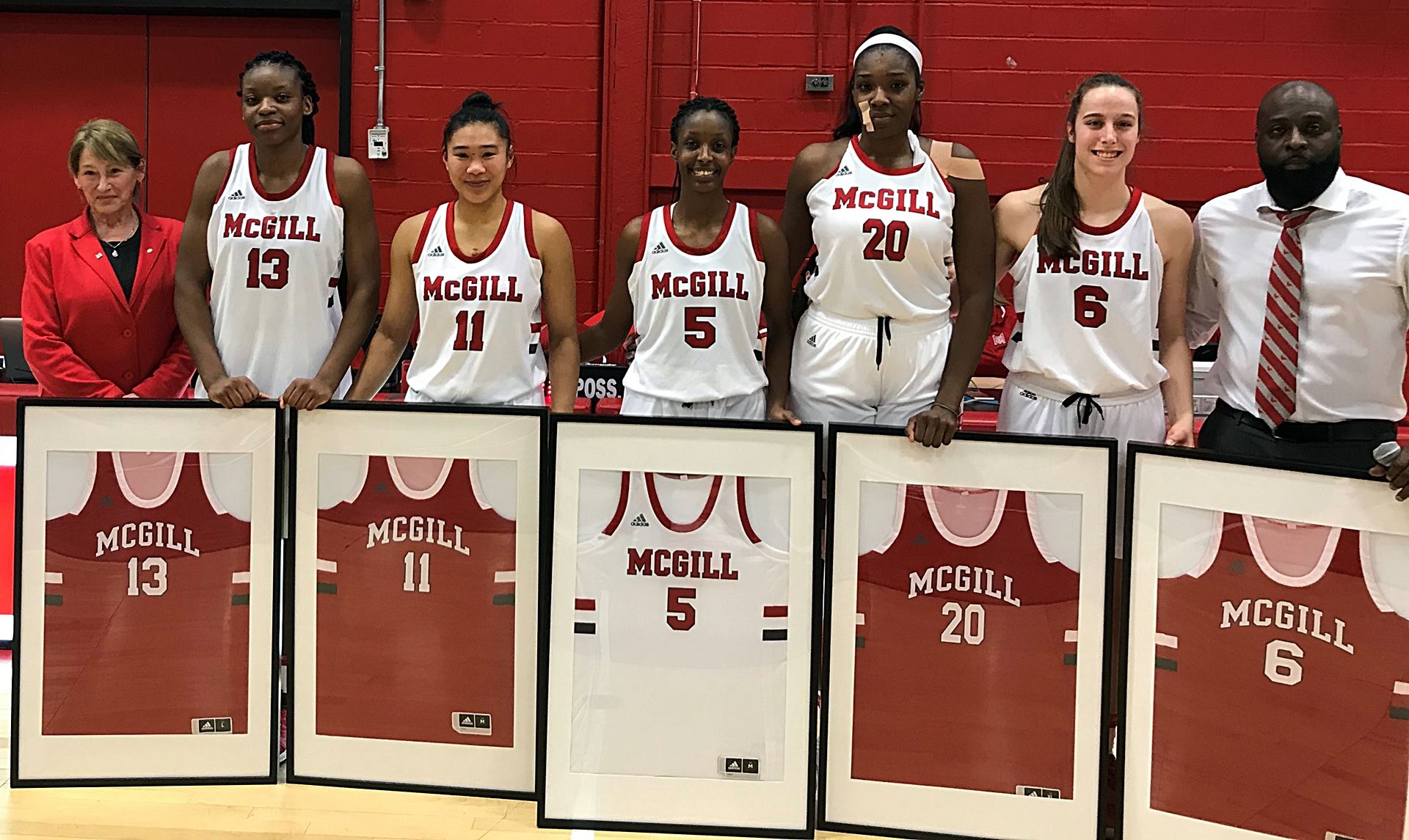
The Senior Night ceremony took place immediately after the game. McGill honoured Diarra, Cabillo-Abante, guard Gladys Hakizimana, forward Ruth Tshikudi-Tshila, and guard Stephanie Mondou. Each graduating player was presented with their framed jersey and flowers. 

During the ceremony, Thorne discussed the impact that the seniors had on the program and the numerous obstacles each had overcome. For example, fifth-year guard Hakizimana endured two hip surgeries.

“Being a senior means that I have a leadership role on the team,” Hakizimana said. “I have to lead by example and [with] communication. It’s my last year to give everything I have to the program.”  

When speaking about the impact the seniors had, Robitaille teared up. 

“The seniors really mean a lot,” Robitaille said. “This is only my second year with them, but I feel bad. I know it’s only a game, but it’s Senior Night, and I think we didn’t play as well as we [could have].”

The Martlets face the first-place Laval in the RSEQ semifinal on Feb. 26 in Laval. Robitaille is excited for the challenge. 

“We have four days to [prepare] for Laval,” Robitaille said. “They are number one, and it is going to be a really good game. We have to follow the game plan and [know] what we are going to do defensively and offensively, and just be ready.”

A semifinal win will move the Martlets on to the RSEQ Final on Feb. 29.


Moment of the Game

With less than four minutes left in the game, fifth-year transfer centre Sirah Diarra made a crucial block on UQÀM’s Inga Aleksaite to keep the game close, down 52–50. 

Quotable

“It’s my last year to give everything I have to the program and the team that I love, in order to not regret anything” – Gladys Hakizimana, on what being a senior on the Martlets means to her.

Stat Corner

Fifth-year guard Geraldine Cabillo-Abante led the Martlets with 11 points. She made three three-pointers, had three rebounds, and three steals in her 32 minutes on the court.

McGill, News

The Africa Speaks conference looks to the future of “Africa in the ‘Z’ Age”

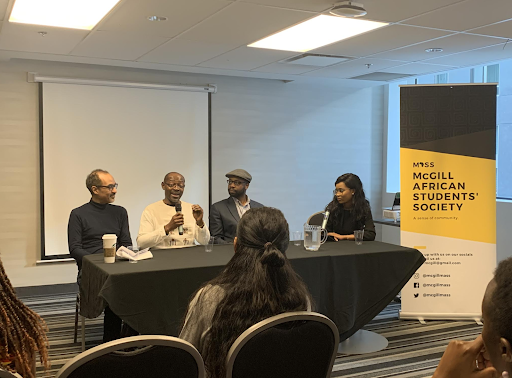
On Feb. 21, the McGill African Students’ Society (MASS), in collaboration with the African Studies Students’ Association of McGill (ASSA), opened their annual two-day Africa Speaks conference with a panel called “Wathint’Abafazi, Wathint’Imbokodo,” focusing on the feminist movement across the African continent. 

Sukoluhle Bhebhe, ASSA co-president, introduced the panel by explaining the meaning behind its name. 

“Wathint’Abafazi, Wathint’Imbokodo is a Zulu phrase that means, ‘When you strike a woman, you strike a rock,’” Bhebhe explained. “It symbolizes the power and agency that South African women [resisting apartheid] had [….] The involvement of women within [anti-apartheid] struggle is often overlooked, so I felt that it was necessary to title this panel with this phrase.” 

The panel featured speakers Chloe Kemeni, U4 Arts, Ommu-Kulsoom J. Abdul-Rahman, BA’19 and President of My Voice Matters, and Djamilla Toure, founder of SAYASPORA

The panel began with all three panelists defining what feminism meant to them. In Kemeni’s view, feminism is still a very white movement. 

“Feminism, as a whole, is very white, and there are caveats, like Black feminism, where we inject other people’s experiences but, […] as a whole, it has harmed more people than it benefited,” Kemeni said. “Feminism still centres itself [on] white experiences [….] The way to combat [white feminism] is to embody teachings that are more [inclusive] to my experiences and those of the women I’m surrounded by.” 

Each panelist brought up the ways in which African feminism differed from white feminism. Toure cited white feminism’s main failure as the attempt to funnel feminism through a one-dimensional lens. 

“I don’t think that we will ever all be on the same page,” Toure said. “We’re all different as women, we all have different versions of what success, wellbeing, and wellness means to us, as well as what we want to stand for and against. We will not always be on the same page.” 

Abdul-Rahman referenced her Muslim identity to highlight how one’s experiences can influence their focuses as activists. 

“The issue that comes with feminism is when we all try to be on the same page,” Abdul-Rahman said. “Your lived experiences and the things that inform your feminism differ based on who you are. Difference should make us stronger.”

MASS and ASSA continued the conference with a panel on the next day to discuss present political and economic shifts in Africa. 

The panelists encouraged Generation Z, those born between 1995 and 2010, to embrace the history of the continent while striving for a more united future. 

Dr. Khalid Medani, Chair of the African Studies Program at McGill, began the conversation contextualizing the recent challenges faced by the continent. Medani urged Generation Z to seek further unity between African states.

“It is crucial to defend against a new form of imperialism and limiting economic sovereignty,” Medani said. “[This] requires unity. [This] requires cooperation.” 

In 2013, the African Union adopted Agenda 2063, which outlined a set of specific goals to help grow Africa’s influence and solidarity. Panelists were asked for their thoughts on how Agenda 2063 can be most effectively implemented. Dr. Nii Addy, Assistant Professor at the Institute for the Study of International Development (ISID), responded by referring to the crucial relationship between youth and elders. 

“The elders have experiences, and there are certain things they have gone through,” Addy said. “If [Generation Z] does not know [these experiences], they will make the same mistakes again.” 

For Dr. Wendell Nii Laryea Adjetey, Assistant Professor of Post-Reconstruction US History, Africa’s aspirations for global recognition and equality have remained the same for over a century. Adjetey cautions against blind optimism, but places hope in Generation Z moving forward. 

“Agenda 2063 won’t mean anything if the most important thing doesn’t happen, which is an incredible, revolutionary paradigm shift,” Adjetey said. “And the great thing about [Generation Z] is that [they are] amenable to change. [They are] optimistic and hopeful.” 

Adjetey finished his thoughts by reflecting on the urgency of mass societal change. 

“[There are] little boys or little girls on the streets of Nairobi […] who are [selling] bubble gum when they should be in school learning,” Adjetey said. “Do you know how much talent we have on this continent that is never realized?”

Arts & Entertainment

Soviet life on Mars

For as long as humans have looked to the stars, we have wondered what lies beyond the scope of our stratosphere. This wonder particularly piqued the imagination of artists and writers in Soviet Russia. On Feb. 20, a crowd gathered in the Canadian Centre for Architecture (CCA) to hear Asif Siddiqi discuss this cosmic enthusiasm in Bolshevik Russia. Siddiqi, a history professor at Fordham University, painted a picture of a 1920s Soviet Union (USSR) enraptured by the concept of galactic travel. 

The talk was a part of the CCA’s lecture series, Search for a New World. The series explores Russian sci-fi throughout the 20th century, focussing particularly on how the genre was influenced by existing technology and inspired many to think about utopianism and new societal organization. The series is a counterpart to the CCA’s exhibition Building a new New World: Amerikanizm in Russian Architecture, which considers Russia’s relationship to modernity and the United States though its architecture.

From literature, to modern art, and films, the endless possibilities of the cosmos inspired creatives and captivated the general public. Space travel offered a chance for the USSR to carve out its place in space and history, symbolizing the seemingly endless limits of human invention and exploration in the age of modernity.

North American audiences are most likely familiar with the USSR’s major role in the 1960s space race,  though the countries advancements in space travel were the result of more than just a simple competition. Siddiqi explained that, starting in 1917, Russian popular culture drastically shifted its attention towards the heavens, inspired by Soviet utopianism and the Marxist fascination with technology. The ‘space fad’ of the 1920s was a massive phenomenon that pervaded all aspects of culture, and Siddiqi’s research traced the theme of the cosmic throughout fiction, film and art, along with the public’s reception.

To show the pervasiveness of the sci-fi genre, Siddiqi noted that one-fifth of all books published at the time were science-related. Siddiqi pointed to Alexei Tolstoy’s Aelita as an example of Bolshevik-era science fiction. The successful novel follows a young man who travels to Mars and starts a proletariat uprising against the planet’s elite. Its adaptation was the first Russian sci-fi movie, a silent film, sold out theatres on opening night in 1924—extremely rare for the time. In the world of contemporary art, Kazimir Malevich and Boris Ender experimented with abstract and geometric styles to represent imaginary space stations and theoretical concepts like infinity. 

“[These artists believed that] art should mirror technological advancements, mechanically and abstractly,” Siddiqi said. “They were crafting a universe without a reference point.”

Not only were creatives producing copious amounts of space content, but the public loved every minute of it. Lectures on space travel were so popular that police were frequently called to quell the massive mobs attempting to push their way into the auditoriums.  Before there were “Trekkies” and “Whovians,” there were Russian space enthusiasts making up their own intergalactic languages and space names. Space clubs hosted exhibitions that featured rocket models and hypothetical maps of Mars. One exhibition showcased a blueprint for a rocket that would melt its own wings to provide fuel for the engine, to which Siqqidi commented that we certainly haven’t reached that level of technological advancement yet. Later on in the 1930s, the popular preoccupation with space travel died down and shifted towards the more realistic aspiration of aviation, but the Soviet Union continued to produce sci-fi works beyond the initial craze. 

Search for a new New world continues on March 5 with Sergei Kapterev on Soviet Sci-Fi Cinema of the 1950s–1960s. The exhibition Building a new New World runs until April 5 at the Canadian Centre for Architecture.

Student Life

From spinning to swimming

Between studying for midterms, participating in extracurriculars, and maintaining a social life, it can be difficult for students to squeeze exercise into their schedules despite the many health benefits it provides. For some, just climbing up to the McGill fitness centre is enough of a workout. These alternative workout spaces are close by and affordable, making them a great option for any student looking to get their sweat on. 

Éconofitness (625 Ste-Catherine Street West)

Located five minutes away from McGill, Éconofitness is the perfect place for exercise without all the frivolous features of fitness clubs. The chain also hosts 25 other establishments throughout the island of Montreal, so many students can find an Éconofitness near their home. The company also runs gyms that are only open to women, providing a safe space for students who feel more comfortable exercising around their own gender. For $4.99 bi-weekly, members have access to the gym, group fitness classes, and training programs. 

Spin Energie (3483 Parc Avenue)

While all spin classes are within a higher pricing range, Spin Energie, located on Parc Avenue offers the most affordable spin classes near McGill. For $45, students can buy an unlimited week of introductory spinning or for those who would like to less commitment, Spin Energie offers an affordable trial class for $10. Students also get a 15 per cent discount on all regular series of classes if they present their student card at the studio. 

Association Recreative Milton-Parc (3555 Rue St-Urbain)

Another way to get your heart pumping is within the heart of the Milton-Parc neighbourhood at the Centre multiethnique Saint-Louis. With a starting membership fee of $10, the not-for-profit organization Association Recreative Milton-Parc offers a variety of activities from badminton to Zumba, for a small price. The collective allows for people of various commitment levels in any sport, with prices ranging from $6 for drop-ins to $70 for a season pass.

Innocere Yoga (160 Prince Arthur Street East)

A new addition to the yoga scene in Montreal, Innocere Yoga offers great intro prices for new members. With a variety of classes, from beginner Yin and Restorative classes to higher level Flow classes, Innocere Yoga has something for those fascinated with the art of yoga. For $30, members can get one unlimited month of yoga. Innocere also offers discounts for students, so long as they bring their student ID when purchasing classes.  

McGill Memorial Pool (475 Pine Ave West)

For those who aren’t fans of weight benches and yoga mats but are still looking for a way to get in shape, consider the McGill Memorial Pool. Recreational swimming hours—known as Lap Swimming times—are offered every day. As students pay for Athletics fees as part of their tuition, they have access to all the other sports complexes—including the gymnasium, indoor and outdoor track, tennis courts, squash courts, and swimming pool—for free. Day passes ranging from $8.70 to $13.04 are also available for non-McGill students. 

L’École de Danse Swing Cat’s Corner (3451 St Laurent Blvd)

If moving to the beat is your type of groove, Cat’s Corner is the fitness studio for you. Offering swing dances, blues dances, and tap dance, this studio is sure to sweep you off your feet. To get the most affordable prices, make sure to attend their drop-in classes on Monday to Thursday from 6 to 7 p.m. for only $10 per class. For those looking for a deal, a drop-in card for $50 gets six classes for the price of five. 

Regardless of the kind of exercise you like to do, Montreal offers something that caters to everyone’s interests and budget. Now get up, put on your sneakers, and get moving!

Creative, Podcasts

In Conversation with: Lilah Fear

In October 2019 Sports Editors Kaja Surborg and Ender McDuff sat down with British ice dance champion Lilah Fear to talk life in Montreal, studying psychology at McGill, and training with the best figure skaters in the world.

LICM
Editorial, Opinion

PGSS Winter 2020 Referendum Endorsements

The McGill Tribune presents its endorsements for the Post-Graduate Students’ Society (PGSS) Winter 2020 Referendum period.

1) PGSS Keep.meSafe Fee: Yes

The Keep.meSafe Fee proposes to establish a nonopt-outable $2.75 semesterly fee from Fall 2020 to Winter 2024. This fee will provide all PGSS students, at no additional cost, with access to Keep.meSafe, a mental health service that includes access to in-person counselling, secure clinical mobile communication, and  telephone and video chat. Keep.meSafe’s highlights include minimal wait times, a diverse assortment of counsellors who can be matched with students’ unique lived experiences, and services in over 60 languages. With extensive concerns over long wait times and breaches of personal privacy at the Wellness Hub, Keep.meSafe promises to meet the needs of graduate students by providing 24/7 access to mental healthcare. Given this need, and the fact that a vote against the fee would result in the program’s termination, The Tribune endorses a ‘Yes’ vote to the Keep.meSafe Fee. 

2) PGSS Health and Dental Insurance Plan: Yes

The PGSS Health and Dental Insurance referendum question proposes the creation of a two-tiered model with basic and enhanced plans. Members will automatically be enrolled in the new enhanced plans for both health and dental. The health plan will increase vaccination coverage to $300, health practitioner coverage to $40/visit, and mental health coverage to 50 per cent per visit up to $1000. The dental plan will increase overall coverage to a maximum of $800. Members can also opt out of the enhanced plans and into the basic plans.

The Tribune endorses a ‘Yes’ vote, yo the comprehensive nature of the plan and the ability for PGSS members to choose their desired options at two levels. 

3) PGSS Daycare Fee: Yes

The SSMU Daycare was created in 1999 to support students, staff, faculty and other members of the McGill community who are parents/guardians. A nursery was opened in 2009 for children aged 4 – 18 months. Partially funded by the government, the SSMU Daycare costs $7 per child per day for parents and has an accessible location in the Brown building. The PGSS hopes to establish a nonopt-outable PGSS Daycare Fee of $3 per student per semester to guarantee 8 of the 32 daycare spots and 2 of the 8 Nursery spots for PGSS students. The fee will start in the Fall 2020 semester and end after the Winter 2025 semester. The Tribune endorses a ‘Yes’ vote to provide the daycare with more support, as it is an indispensable resource on campus. 

4) PGSS Library Improvement Fund Fee: Yes

Prior to Winter 2017, PGSS collected a $3 Library Improvement Fund (LIF) fee, with McGill matching PGSS’s contribution each semester. However, this led to an excess of available funds, which proved problematic for PGSS’s non-profit status. Now that PGSS’s LIF funds have been depleted, the organization is proposing to renew the fee, which has not been collected in recent years, at a lower rate of $2 per semester. Maintaining high quality study spaces on campus is an essential undertaking for any student organization, and the Tribune endorses a ‘Yes’ vote on reinstating the LIF fee.

McGill, News

Holocaust survivor condemns McGill’s handling of anti-Semitism allegations

During her visit to promote her memoir, Holocaust to Resistance: My Journey, Suzanne Berliner Weiss led a rally on Feb. 17 condemning Deputy Provost of Student Life and Learning Fabrice Labeau’s handling of anti-Semitism allegations regarding last semester’s controversial Face to Face trip. Weiss, a lifelong activist and Holocaust survivor, heard about these allegations from media coverage last December. Co-organized by Independent Jewish Voices (IJV) and Solidarity for Palestinian Human Rights (SPHR) McGill, the rally outside of the James Administration Building featured Weiss delivering a letter to Deputy Provost Labeau detailing her perspective on the issue. Weiss read the letter aloud before delivering it to Labeau’s office.

“I am a Jewish Holocaust survivor and I have engaged throughout my life in combatting hatred of Jewish people,” Weiss read. “For me, such reports [of anti-Semitism] are very alarming [….] I have reviewed relevant reports on controversies at McGill this school year [and] I find no evidence of anti-Semitism here. What I see is a passionate debate on the politics of [Israel and Palestine].”

During World War II, French resistance networks hid Weiss in the countryside. As her family was killed by Nazis, Weiss spent her childhood years after the war in orphanages and eventually was adopted by a family in New York City. During her adult life, Weiss became involved in student activism, the Cuban Revolution, the Black Power movement, Indigenous rights, anti-Vietnam War activism, women’s liberation, and Palestinian freedom movements. Weiss, now 79 years old, hopes that the lessons she has learned throughout her life can help advocate for social justice around the world today.

“These irresponsible charges serve to put Jewish people at risk by weakening our ability to focus on genuine acts of anti-Semitism, that is, ‘hatred of Jews because they are Jews.’” Weiss said. “As for the Palestinians, their very attempt to voice grievances is now branded anti-Semitic. The Palestinians, who have suffered so much from Israeli rule, now face an implacable attempt to silence them entirely.”

IJV and SPHR organizers also stated that, especially given the current presence of Royal Canadian Mounted Police forces on unceded Wet’suwet’en territory, advocacy for Palestinian rights should be linked to movements for Indigenous sovereignty. 

“We recognize that Palestine and Canada are both occupied territories and that, in order to resist [colonialism] abroad, we must first address how we are complicit in the continual colonial process in Montreal, specifically at McGill University,” Mo Rajji, U2 Arts, said. 

Rajji urged rally attendees to help hold space in solidarity with Wet’suwet’en land defenders held later on the same day. Abigail Drach, U3 Arts, echoed the need for people to recognize the links between Indigenous and Palestinian struggles.

“[It] is not a coinicidence that, [on Feb. 13], the Palestinian Boycott, Divest, Sanction National Committee released a statement in solidarity with the Wet’suwet’en land protectors,” Drach said. “These struggles do not exist in isolation, but are rather part of the vibrant fights against settler-colonialism that have been going on since the European conquest.”

The demonstration concluded with organizers giving Weiss a black and white keffiyeh, a cotton garment and symbol of Palestinian solidarity. While the rally planned for Weiss to deliver her letter to Labeau in person, staff informed rally attendees upon entering the James Administration building that they had been instructed only to collect the letter in order to forward it to the Deputy Provost. After commanding protestors to vacate the building, arrangements were made for Labeau’s communication director to come down and receive the letter from Weiss.

“What we need at McGill and elsewhere is a firm defense of the right of political advocacy, even if directed against Israel’s policies,” Weiss said. “This is a precondition for effective resistance [against] genuine anti-Semitism.”

Editorial, Opinion

PGSS 2020–2021 Executive Endorsements

The McGill Tribune presents its endorsements for the Post-Graduate Students’ Society (PGSS) 2020/2021 executive team. 

Internal Affairs Officer:  Yes 

Gustina Giordano is a masters student in Educational Psychology running for the position of Internal Affairs Officer. During her undergraduate years, also completed at McGill, she worked with several campus organizations, including Jam for Justice and the McGill Undergraduate Fine Arts Council. As Internal Affairs Officer, Giordano hopes to provide a variety of events that cater to PGSS’ diverse membership, including the introduction of Wellness-centric activities, such as mindfulness workshops. Giordano intends to prioritize sustainability and accessibility for all PGSS events. Giordano’s priorities reflect the values of the graduate community and The Tribune believes that she is qualified for the position of Internal Affairs Officer.

Academic Affairs Officer: Yes

Eric Wilkinson is the incumbent for the position of Academic Affairs Officer, his term beginning on Jan. 23. Before coming to McGill, Wilkinson worked with student advocacy at the University of Ottawa, the University of Toronto, and York University; he hopes to import this experience in order to fill all vacant PGSS appointments and by promoting institutional memory. Wilkinson also hopes to expand the PGSS’ ability to communicate in French, as well as ensuring that graduate students on Macdonald Campus are equally represented on McGill’s governing bodies. The Tribune holds that Wilkinson is fully capable of continuing this role for the 202021 year.

Financial Affairs Officer: Yes

Connie Shen is rerunning for the position of Financial Affairs Officer and looks forward to seeing the full implementation of the initiatives that the PGSS executives have taken on this year. As most graduate students are international, one of her main projects is to identify ways to improve the accessibility, affordability and cost of the International Health Insurance plan. Additionally, Shen hopes to raise funds for the PGSS’s needs-based bursary, the only bursary available to graduate students on the basis of financial need. Further, Shen would like to continue the travel awards grant program, a fund covering the travel fees for students attending conferences and competitions out of town. 

Member Services Officer: Yes

Current PGSS Secretary-General Dakota Rogers is running for the Member Services Officer position with the hopes of engaging members with the services that PGSS offers such as healthcare, leisure classes, and family care. Rogers wants to establish a good communication framework for students by having accessible, in-person consultations. In addition to improving avenues for feedback, Rogers will be responsible for integrating the new referendum questions into the McGill community by educating members of PGSS and the university administration about their existence. With experience as Secretary-General, along with the McGill Board of Governors and Senate, Rogers is qualified to advocate for members’ student services and fulfill the position’s mandate.

Process:

In order to present the most informed endorsement decisions possible, our editors conducted in-person interviews with all of the candidates, and examined each platform in detail. The endorsements are the product of an Editorial Board meeting in which we addressed every position, debated, and voted. In order to earn the Tribune’s endorsement, a candidate had to receive a majority vote. Reservations could also be appended to any “Yes” endorsement with the approval of a majority of editors. Questions or concerns should be directed to the Editor-in-Chief at [email protected].

McGill, News

Dean of Arts office announces the proposed cancellation of Graduate Options

McGill’s Office of the Dean of Arts announced the planned suspension of the Graduate Option in Gender and Women’s Studies (GWS) and Development Studies on Feb. 10. The cancellation of the options would eliminate feminist studies graduate programs, as of the Fall 2021 semester. 

However, on Feb. 19, Associate Dean, Professor Michael Fronda, clarified to chairs and directors that the Faculty of Arts has not instituted an official suspension or cancellation. 

“The Faculty of Arts is in the preliminary stages of a consultation about the options, following the usual practices relating to any proposed changes to university programs and curricula,” Fronda wrote. 

In response to the proposed suspensions, the Gender, Sexuality, Feminist and Social Justice Student Association (GSFSSA) posted an open letter to be signed by graduate and undergraduate students. The letter voiced disapproval of the proposed cancellation and the request of its retraction. 

“By suspending the Graduate Option, the course of our education is being significantly altered without our prior knowledge or the vital input of those faculty who are entrusted with its implementation,” the letter states. 

The GWS is offered in 15 Master degree programs and 11 PhD programs, while the Development Studies Option is available in six Masters programs. 

The letter also emphasized that the cancellation of the programs would threaten inclusivity.

“Not only does the university’s actions significantly narrow the pool of exceptional students that would benefit from a graduate program concentration, but it also suspends what has long been considered an asset for the University’s attempt at inclusivity.”  

Kiersten van Vliet, third-year PhD student in Musicology with the option in Gender and Women’s Studies, emphasized that the proposed suspension would eliminate a program that is both viable and valued within the McGill community. 

“I was gutted to hear that the Graduate Option in Gender and Women’s Studies was being suspended,” Van Vliet said. “The GWS Option fosters the type of scholarly community-building that, at least in my experience, has been rarely found elsewhere at McGill. It has provided me with an interdisciplinary cohort of scholars.” 

In an official statement, Dr. Alexandra Ketchum, Faculty Lecturer of the Institute for Gender, Sexuality, and Feminist Studies, echoed similar sentiments. 

“The university should be expanding its support and providing more financial resources towards the program at this time, rather than trying to end it,” Ketchum said. “I want to underline that the community created by the Graduate Option is not tangential. By creating a research environment in which graduate students feel supported, they are able to do better research and be better scholars.” 

Van Vliet, who also serves as President of the Association of Graduate Students Employed at McGill (AGSEM), speculated that the inclusion of a wider range of stakeholders in the discussions leading up to the decision would have changed the outcome. 

“The decision appears to have been made by administrators currently or previously affiliated with Arts, without consulting with administrators within the Faculty of Education or the Schulich School of Music, which challenges the autonomy of other Faculties at McGill,” Van Vliet said. “By bypassing any consultation, the decision was also made without following McGill’s own policies for modifying existing graduate teaching programs.” 

The lack of communication with graduate students concerned  Van Vliet. 

“The silence throughout this process is deafening, and speaks to larger issues concerning how McGill does not act in the interest of its graduate students, its graduate student employees, and its faculty lecturers, who are the institution’s most precarious faculty members,” Van Vliet said. 

Maha Cherid, a masters student in Education and Society who is pursuing the GWS option, expressed her disappointment about the university’s priorities.  

“In my opinion, the fact that the administration even considered taking away this option, without consultation and without already having a different program in place for MA students, shows a lack of foresight and a serious lack of understanding of the role that gender and women studies play in university,” Cherid wrote in an email to the Tribune.

As of press time, the decision to cancel the GSW option has been suspended. There will be a faculty meeting to discuss the new criteria for graduate options on Feb. 25. 

Emerging Trends, Student Life

Finding meaning in found object Instagram accounts

In the past year, through countless hours of diligent procrastination, I’ve begun to observe a curious trend overtaking my Instagram Explore page. It began with the occasional random picture of an old sofa or a shot of a peculiar pink porcelain toilet on the side of the road, but has now become an avalanche of snapshots bearing similarity to National Geographic or Planet Earth except the subjects aren’t animals: They are random street crap. 

‘Found object’ Instagram pages are a genre of curatorial street photography dedicated to the documentation of certain inanimate, and sometimes even animate, objects. While not a brand-new phenomenon, with many accounts being over two years old, their growing popularity has resulted in the birth of accounts archiving increasingly obscure subjects from campus-dwelling squirrels to security cameras.

Since it is not bound by rigid criteria, found object Instagrams can serve a variety of functions for those who run the pages as well as those who follow them. Emma Harris, U1 Arts, is the owner of @leschairs, an account dedicated to “the appreciation of the unexpected chaise. She explained how this form of photo curation can take on many purposes. 

“I think of [found object Instagram accounts] as a sort of curation of different things you found on the street,” Harris said. “It should be spontaneous. I find that there are a ton of different genres and approaches to [these accounts], but design is definitely one of the main approaches that I’ve seen.” 

In the case of many accounts, such as @subwayhands and @someone_dropped, running an account of this nature is an opportunity for collaborative creative expression centred on a common interest with a certain object. Similar to contemporary ready-made artworks such as My Bed by Tracey Emin, a member of the Young British Artists group and Fountain by conceptual artist Marcel Duchamp, found object accounts allow for the creation of art simply through a shift in the way we view the objects around us. 

For Harris, Instagram serves as an accessible method for fostering a deeper connection with one’s surroundings and encouraging greater appreciation for aspects of life that may otherwise go unnoticed. 

“I think that people are trying to find ways of connecting with others in public spaces, and animating objects is one way of feeling an attachment to [an] urban landscape,” Harris said. “It’s nice to attach more than a [utilitarian] value to an object and [create] more of an emotional [form] of connection to your objects as a way of preserving them.” 

Yet another function of the found object Instagram account is the sense of community they are able to cultivate by catering to particular interests and social groups. In the McGill context, an account like @tinyhatsmcgill, a page with over 600 followers, is dedicated to capturing the headwear trend of wearing an impossibly small toque. 

The account run by two McGill students, who wish to remain anonymous to maintain the mystique, employs its small army of followers for the majority of submissions. As a result, the content is comprised largely by its audience who are motivated to participate by both a mutual fascination of tiny hats and of getting their Plateau friends featured on the page.

“In the beginning, I was always looking around trying to get pictures of people but now people send stuff in and I can kind of look and see what I think is funny,” one of the account operators said. “Honestly, I don’t really get […] why it’s so popular because it’s a pretty simple idea [and] not really anything special. I think it’s just funny.” 

Whether as a means of creative output or cultivating community, the rise of found object Instagram accounts is an accessible way of expanding how one sees the world. The simple act of forming a collection on one unifying topic, allows people to stop and appreciate the little things in life that they would otherwise miss. 


Read the latest issue

Read the latest issue