

Latest News

McGill, Montreal, News

Mohawk Mothers appear in court, discuss archives and records related to New Vic site

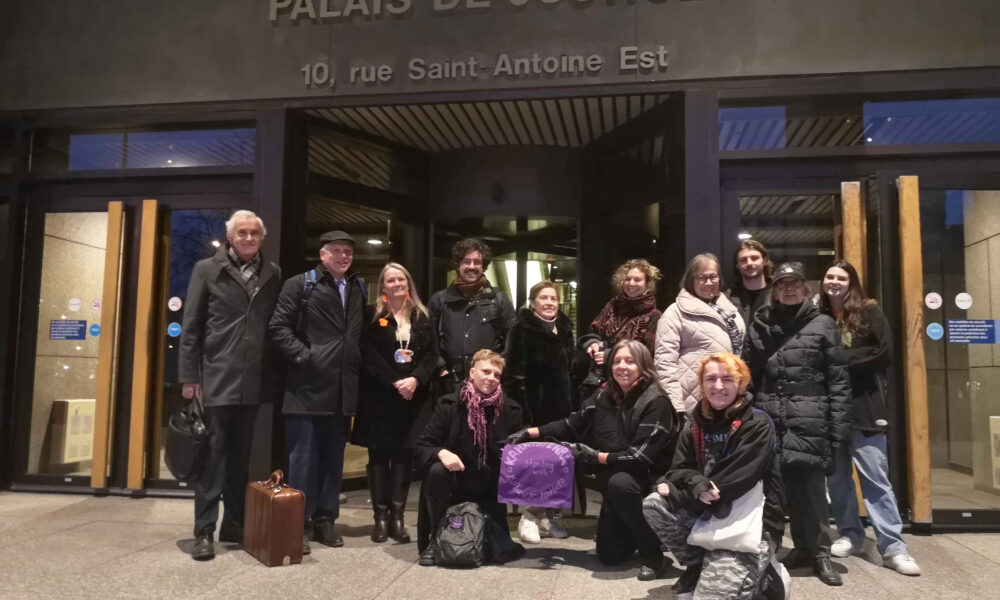
The Kanien’kehá:ka Kahnistensera (Mohawk Mothers) appeared at the Montreal Courthouse for a five-hour case management hearing on Dec. 1. The hearing came as part of the Mother’s ongoing investigation into McGill’s New Vic Project site, where they fear that there may be unmarked Indigenous graves. The Mothers argued that the defendants—including McGill, the McGill University Health Centre (MUHC), the Société québécoise des infrastructures (SQI), the Royal Victoria Hospital (RVH), the Integrated University Health and Social Services Centres (CIUSSS), the City of Montreal, and the Attorney General of Canada—were refusing to abide by the settlement agreement’s mandate to provide the Mothers with all archives and medical records related to the former RVH. 

Mohawk Mother Kahentinetha was the first to speak before Justice Gregory Moore. She reminded the court that under articles two, three, and four of the settlement agreement, McGill, MUHC, and the Attorney General of Canada are bound to provide expedited access to their archives and records. She alleged that MUHC refused to share their archival records on medical experiments on Indigenous children, which she believed to be direct evidence of denialism. 

“[The archives] is where all the information is of what they did to our children, to our people. It’s all there, it’s all in the archives,” Kahentinetha said in an interview with The Tribune after the hearing. 

The lawyer representing MUHC and RVH argued that MUHC has a right to patient confidentiality and that while MUHC wanted to assist in the investigation, they could not as confidentiality laws prohibited them from providing all patients’ records. The lawyers also explained that the medical records are only searchable by patient number, not by age or ethnicity, meaning that researchers could not search for Indigenous patients on the database. 

Julian Falconer—the lawyer for the Office of the Independent Special Interlocutor, Kimberly Murray—asserted that the settlement agreement allows the defendants to override “confidentiality concerns” without consent from the patients. He further expressed that he felt the notion of collaboration and reconciliation between the two parties had “utterly disappeared,” with credible historians working on the case being at a standstill due to limited or no access to archives. 

Falconer ended by stating that the refusal to provide full access to archives is the second breach of the settlement agreement by the defendants, the first being the defendant’s disbandment of the court-mandated expert archaeological panel, which Justice Moore ruled to reinstate on Nov. 20 after a case hearing on Oct. 27

In an interview with The Tribune after the hearing, Falconer revealed that the Mothers were made aware that the defendants were considering appealing the court’s decision to reinstate the archaeological panel during the hearing. 

“[McGill] was told that they made an agreement to be guided by a panel led by Indigenous-led best practices, and their response was to fire that panel,” Falconer said. “When a judge brought to their attention the error of their ways, their response is to appeal to that Judge. Does that sound like reconciliation to you?”

Philippe Blouin, anthropologist and associate of the Mothers, pointed out that appealing the court decision will take more financial resources from McGill and will lead the investigation away from protecting Indigenous graves. 

“The money that they are going to spend on the appeal is money from the Canadian [and] Quebec public and from McGill students, that they’re going to use against using the best practices to find unmarked graves on those lands,” Blouin said in an interview with The Tribune. “It’s going to cost them way more than abiding by the recommendation of said panel.”

McGill explained in a written statement to The Tribune, that they have chosen to appeal to obtain further clarity on how to proceed with the investigation, and that some of the legal fees will be drawn from students’ tuition. 

“McGill is seeking leave to appeal the decision that Justice Moore rendered on Nov 20. to obtain some clarity on the decision and ensure there is a clear path forward with respect to the archaeological work taking place on the site,” McGill wrote. “The University’s expenditures related to legal matters draw on the University’s operating funds. That budget is built from a range of revenue sources, including tuition and government grants.”

Kahentinetha revealed that to her knowledge, since Justice Moore’s ruling to reinstate the panel, the defendants have not taken any action to contact the members of the panel to reassemble them, all while work continues on the New Vic site. McGill confirmed in a written statement to The Tribune that they have not reached out to the members of the panel since Nov. 20. 

Justice Moore adjourned court without a decision, stating the date of the next hearing will be decided via email between him and the parties involved. 

Student Life

A comprehensive guide to finding the perfect winter coat

As the fall semester comes to an end, the infamous Montreal winter begins, and your attire may feel incapable of warding off the December chill. If so, you are primed for a new winter coat. 

The search for a good jacket can feel daunting, especially for first-year students who may have never experienced a winter quite like Montreal’s. Any good coat encompasses more than just functionality—the style matters too, and getting it right can elevate your winter look to the next level while keeping you warm. Here are a few tips on what to look for—and what to avoid. 

How to get started

The key factor in determining a coat’s quality is its ability to keep you warm. This depends mainly on the material of the coat. So, which material is the best for ensuring cozy comfort?

In an interview with The Tribune, GQ Style Editor Noah Johnson gave some advice on what to look for. 

“For a jacket, always go for down. It’s got the best warmth for its weight, by far,” Johnson said. 

The more insulation, the better, so look for anything thick enough to withstand cold and wind and trap heat. It’s always a good idea to make sure the down is ethically sourced. Some good options are The North Face and Patagonia, which are certified to the Responsible Down Standard.

If you’re not a fan of down, Johnson offered some good alternatives. 

“Go for wool, or better yet, cashmere if you can swing it,” he explained. 

Aside from down, these fabrics are the next best option in terms of warmth and are always stylish

If you enjoy the snow, look into brands like Burton, Arc’teryx, and Helly Hansen that carry more water-resistant jackets meant for winter sports and extreme weather. 

Avoid slimmer puffers and vests, which still have insulation but aren’t enough to withstand Montreal’s far-below-freezing temperatures. If you like to accessorize, choosing a jacket with extra pockets is useful for added storage, but if hats and scarves aren’t your preference, a parka-style jacket will provide added head warmth. 

For those who want more than just upper-body warmth, you may be in the market for a longer style that helps keep your legs warm, in addition to your torso. 

“I always like a winter coat to fit a bit oversized—I just think it looks cooler and it makes sense to give yourself maximum layering options,” Johnson explained. 

If you’re looking for something classic and reputable, the iconic North Face Nuptse and Uniqlo’s Seamless Down Parka are great options. If your price range is a little more flexible, go for even higher-quality brands like Woolrich, Canada Goose, and Ten c. Bear in mind that the average-priced winter jacket is still in the $100 to $200 range. A quality coat is never going to be cheap, but a hefty price tag isn’t necessarily something to be afraid of. 

“I think a winter coat should be an investment,” Johnson explained. “Buy the absolute best one you can afford, and expect to wear it for as long as it fits you.” 

A good coat maintains its quality for years, so it’s better to spend more on a long-lasting coat than to buy a cheap one that has to be frequently replaced. 

“If you’re really strapped for cash or unsure about finding the right style,” Johnson added, “Just go to an army [or] navy store and find some vintage military field jacket or peacoat. You can’t go wrong with either of those.” 

Where to look 

Montreal has plenty of amazing options for coat shopping. A ten-minute walk from McGill’s downtown campus will take you to St. Catherine Street, where you’ll find stores like Simons, Sports Experts, Uniqlo, Arc’teryx, and The North Face

If your budget is tight, walk over to St. Laurent Boulevard, where you’ll find great options at thrift stores and vintage shops like Eva B, Empire Exchange, and le Chaînon.

If you’d rather order a winter jacket online, look for brands that can ship within Canada to avoid hefty import fees. 

It’s safe to say that nobody looks forward to the cold of a Montreal winter, but with a well-chosen jacket, even an unpleasant trek to your 8:30 a.m. class will feel more like a cozy holiday stroll.

Martlets, Men's Varsity, Sports

Redbirds and Martlets fear consequences of tuition hike on varsity sports

On Oct. 13, the Quebec government revealed its plan to raise tuition for out-of-province and international students. In the immediate aftermath, students flooded the streets of Montreal, protesting the proposed hike and fearing its consequences on their university experience. Shortly thereafter on Nov. 2, McGill University Principal and Vice-Chancellor Deep Saini outlined the major impacts, including a drop in annual enrollment revenue that could be disastrous to smaller faculties, job reductions, and the elimination of some varsity teams.

Following several meetings with Saini and Bishop’s and Concordia University presidents, the provincial government announced that the increased out-of-province tuition cost would decrease from $17,000 to $12,000, while the cost for international students remains the same. However, McGill still expects to lose 60 per cent of its out-of-province students. 

This loss will drastically affect collegiate sports teams. With McGill’s student body made up of 20 per cent out-of-province students and 30 per cent international students, many varsity teams are composed largely of students from outside of Quebec. As such, teams rely on recruiting students from out of province to not only fill their rosters, but fund their teams. With only level one varsity teams funded largely by the university, many level two, competitive club and recreational club teams rely on fundraising and player fees to function. Therefore, losing players from out-of-province will threaten many teams’ existence. Some teams will fall in jeopardy as their rosters largely rely on out of province athletes including fan-favourites such as the Redbirds lacrosse team,McGill artistic swimming, Martlets field hockey, and McGill rowing.  

Ontario-born lacrosse midfielder Luke Dawick raised major concerns about the future of McGill’s team. To him, McGill offers a great education, the opportunity to meet lifelong friends, and a chance to play a high level sport. However, without lacrosse, Dawick likely would not have attended McGill.

Dawick explained his shock when he heard the news of the tuition increases, and that the most serious impacts will come through the amount of players they will be able to recruit in the next few years. 

 “Coach Soubry is going to have a harder time recruiting players outside of Quebec, and that will definitely limit the talent that we have been able to bring in the past,” Dawick told The Tribune

This year, the team only had four Quebecers, with the rest of the 30 players coming from other Canadian provinces and the United States.

Field hockey midfielder and Vermonter Madeline Cohen,shared another perspective as her team faces a higher risk of being cut, despite being largely self-funded. 

“Knowing our status as a tier-two team and knowing how easy it was for us to be cut during COVID, that’s kind of when the realization set in,” Cohen told The Tribune.

Cohen expressed how the financial constraints would lead to a different demographic of people at McGill and how that could lead to an entirely different student experience in Montreal altogether. Considering the appeal of McGill from a prospective student, she said the choice would not be easy anymore.  

“I definitely would have had to think twice and weigh the pros and cons,” Cohen explained. “It would not have been this incredible opportunity for me, it would have definitely diminished the likelihood of coming here.”

While Media Relations Officer Frédérique Mazerolle emphasized to The Tribune that no definitive decisions have been made regarding varsity sports, it is clear that if the Quebec government implements the proposed tuition hikes, McGills’ teams will be affected. The Quebec government remains hostile towards eliminating the tuition hike entirely, leaving many varsity programs in a state of perpetual uncertainty. With anglophone universities comprising the majority of teams within several RSEQ divisions, some sports may be forced to look out of province for competition, forcing the future viability of Quebec university sports into question. 

Sports Editor and Martlets field hockey goalkeeper Anoushka Oke did not contribute to this article.

Science & Technology

Neuroscience myths and facts: Alcohol and the spectrum of human senses

If you are as curious as the rest of this Tribune special issue, then this article will hopefully answer some of your burning questions about two topics that merge neuroscience and student life seamlessly: Alcohol and human senses. In this second round of myth debunking in our Neuroscience myths and facts series, you will learn whether alcohol kills any of those brilliant neurons in your brain and whether humans only have five sensory faculties. So grab a beverage of your choice and read on about how all those 5 à 7 drinks at Gerts Bar & Café, Bar des Arts, or Blues Pub may be affecting your brain.

Does alcohol really kill the brain’s neurons?

Nuance is key when it comes to understanding the relationship between neuroscience and alcohol consumption. For starters, having a pint or two at Gerts after an exhausting exam or stressful altercation will not destroy any neurons. In fact, taking a break accompanied by any type of drink may have a positive effect on your brain and overall well-being. While some studies have shown that moderate drinking can negatively affect cognitive health, certain research suggests that responsible drinking might also have some cognitive benefits. This cohort study of 19,887 participants from the Health and Retirement Study (HRS) found that low to moderate drinking may contribute to higher cognitive abilities and lower rates of cognitive decline in middle to older aged adults. So contrary to the widespread myth that alcohol is a ‘neuron murderer,’ responsible drinking rarely leads to serious neurological damage as long as basic safety precautions are in place.

However, this myth requires extra nuance because excessive drinking can prove neurotoxic, meaning it has the potential to damage nerve cells in the brain. For example, excessive alcohol consumption—defined as five or more drinks on any day for men and four or more for women by the National Institute on Alcohol Abuse and Alcoholism (NIAAA)–may lead to neuronal cell death in specific brain regions, such as the hippocampus and the cerebral cortex. Chronic abuse can also pave the way for cognitive impairments affecting brain health over a longer period.

Do we only have five senses or are there more sensory faculties to uncover? 

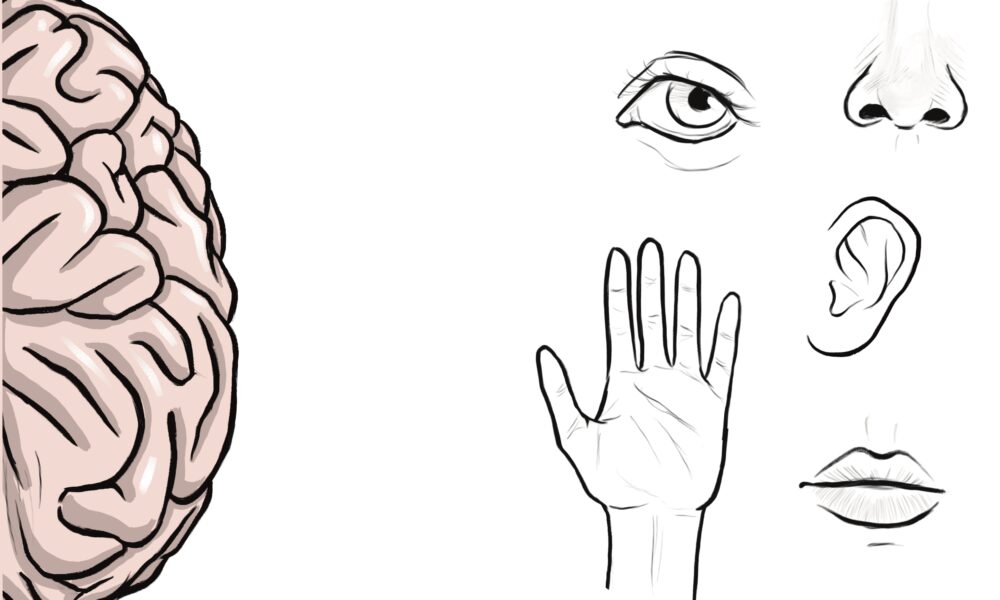
Without any particular nuance needed, one of alcohol’s well-known effects is its influence on the senses. Although the “five senses” model underlies the widespread belief that we have five senses—which is partly true—it is limiting and slightly biased against the rest of the human body’s sensory systems such as the vestibular system. This restrictive model includes only the familiar basics: Touch, sight, hearing, smell, and taste. But, humans can experience far richer sensory experiences and function in complex situations that engage other sensory systems. For instance, without our vestibular system and its sensory receptors called “hair cells,” we would have a much harder time maintaining our balance and not sliding down the icy McTavish street during the winter months. 

Proprioception is another sense that often goes unnoticed when discussing human sensory faculties, despite its crucial role in providing us with body awareness. Without the proprioceptive system’s mechanoreceptors—sensory receptors located in joints, tendons, and muscles, students would find it extremely challenging to navigate the busy Schulich library flooded with other stressed-out McGillians and errant spinny chairs. By acknowledging and understanding these additional senses, we gain a deeper appreciation for the marvels of human perception.

Your weekly 5 à 7 are not killing your neurons, and you have more than five senses

Now that you know only excessive alcohol consumption can cause serious neurological damage, you can enjoy your next drink at peace without worrying about any of your neurons dying as long as you put safety and responsible drinking first. The SciTech team hopes that you can also further appreciate your body’s incredible sensory systems and their expansive functions, from balance to proprioception. Stay tuned for the next installment of this series next semester with myth-busting in the areas of memory, intelligence, and love through the neuroscience lens.

Science & Technology, Student Research

Human Cognition: Moving away from the brain

Long before Francis Schmitt coined the term “neuroscience” in 1962, scientists have been interested in demystifying the secrets of the human brain. Although neuroscience primarily focuses on the functions of the cortex—the outer layer of the brain— researchers have begun to highlight the importance of more primitive brain anatomy: Namely, the brainstem. In her recent paper, Justine Hansen, PhD candidate from The Neuro, used a novel approach to pair brainstem functions with those of the cortex.

“The brainstem isn’t really looked at in vivo [in living human participants],” said Hansen in an interview with The Tribune. “Because of that, we’re somewhat biased against thinking of the brainstem as being involved in these human-specific cognitive functions.” 

Most contemporary knowledge about the brainstem comes from animal studies, anatomy studies looking at connectivity, or lesion studies—lesions in the brain induce various deficits from which we can extract functions. However, many more methodological aspects make this research interesting.

Many studies examining brain functions exclusively look at the cortex. This is the wrinkly part most people imagine when thinking about the brain. The cortex reportedly hosts most of the mind’s cognitive functions, including memory, perception, and decision-making.

“We wanted to extend our perspective of cortical function to the brainstem. The reason we want to do that is that the brainstem is very often overlooked in a lot of these human neuroimaging studies,” Hansen said.

The current cortico-centric view of the brain poses many constraints when looking at the purpose of certain brain circuits. This perspective disregards the potential role of the brainstem’s intricate anatomy. 

“A big thing is that it’s comprehensive across the brainstem. So a lot of studies, or those already doing brain imaging studies, typically just focus on a region in the brainstem that they are interested in,” Hansen stated.

As an attempt to address some of these issues, this research also groups different anatomical brainstem areas according to their associated cortical functions. Multiple neurotransmitters are produced in the brainstem, each implicated in different functions such as arousal and awareness. These groups represent clusters of neurons producing these molecules.

Interestingly, they found that norepinephrine, a neurotransmitter downstream of adrenaline, is present across all functional groups. Norepinephrine is implicated in various functions, including arousal regulation. This omnipresence paves the way for many hypotheses about the role and importance of norepinephrine in the general integration of cognition.

“[Norepinephrine] is involved in getting the brain to work together or work in a more segregated fashion,” Hansen said. 

Hansen’s team also found a gradient in how the functions of the brainstems are correlated to those of the cortex. They discovered that the brainstem has more associations with the anterior part of the brain, including the frontal lobe and the anterior temporal lobe, implicated in higher cognitive functions like language, rather than the occipital lobe. The presence of this gradient implies that the brainstem might serve an important role that is usually attributed to the cortex in higher cognitive functions.

Although this paper is correlational and therefore does not prove causality, this type of research opens questions into the different functions of interaction between the brainstem and the cortex, especially surrounding the issue of consciousness. A coma is an altered state of consciousness and can provide valuable information on its nature.  

“Now I don’t know if I want to go that direction, but it would be another angle to look at the brainstem in a [comatose] population instead of just in a healthy population,” Hansen said.

Hansen’s research paper emphasizes the importance of researching the more primitive parts of brain anatomy to gain a deeper understanding of the beautiful intricacies of the human brain.

“I think we can stop thinking of the brainstem as just being a lizard brain implicated in breathing and keeping you alive,” Hansen noted. “Maybe it’s also involved in more higher-order functions that we usually attribute to the cortex.” 

Student Life

A day in the life of a 4.0 student

Most of my mornings start within the healthy range of 9 a.m. and 5 p.m. Today I woke up peacefully around 11 a.m., primed for another day of academic indifference.

I listen to my body and give it all the beauty sleep it needs. After all, how you present yourself at a school such as McGill is by far the most relevant indicator of success. 

In that vein, I take the next 45 minutes getting ready. McGill is a runway; it’s imperative that I look classy (without looking like a finance bro), accessorize uniquely (without going all out Plateau-y), and try hard, but look effortless. 

Around 11:45, I’m finally set, and if I do say so myself, I’m pretty proud of this outfit. Blue Adidas Spezials to match my blue, asymmetrical sweater, and thrifted grey dress slacks. Plus, I even curled my bangs today.

My first class is at 11:35, so I grab my tote bag and head out the door. 

WHAM! 

Striding down my steps onto the sidewalk of Milton, I immediately slip on a monstrous ice patch hidden underneath a pile of nice, brown Montreal slush. Before I know it, I’m face-up on the sidewalk, my hands, behind, and ego badly bruised. 

My tote bag has taken off, skidding full-speed down the street. I consider getting up and chasing it but quickly consider the consequences—Slush Girl, they’ll call me. The incident will go viral on YouTube, and I’ll be the subject of Spotted: McGill posts and Tribune articles for decades to come. No, thank you. No recovering from that. I call off my 11:30 class and scramble right back up to my apartment. 

It’s not as if class would’ve served me much anyway. After all, my usual seat during chem class in Leacock 132 is the table. You know. The table. 

Plush chairs, no one behind you to judge your 90-minute Pinterest scroll, and excellent proximity to the lecture hall doors for easy last-in, first-out access.

If you don’t know Leacock 132 has a table, chances are you are in fact not a 4.0 student. 

For the next few hours, I heal from the horror of this morning’s slip-up by practicing some much-needed self-care: Some online shopping, a facial with my aloe mask and Jade Gua-Sha, and a midday snooze seem to do the trick.

Around 3:30 p.m, I head over to campus with one goal—start my history paper. I skip on over to Schulich, first grabbing my obligatory ‘little treat’ from Dispatch, fifteen dollars worth of toast and coffee.

An hour later, I head back home. I feel drained but proud of the work I did. Not only did I finish The Washington Post crossword, but I mapped out every single possible schedule option for my next three years on Visual Schedule Builder, I perfectly curated my LinkedIn profile, and I created the Google Doc for my essay.

Later that evening, I head to Bar des Arts with some friends. The theme is Snug as a Bug, so naturally, I dress up as a sexy cockroach. A few Sleemans deep, I ditch my friends to go on a side-quest and investigate the large crowd outside Leacock 132. 

I spot my blissfully-unaware-of-the-Leacock-132-table friend in the crowd.

After listening to her spatter off her usual “I’m so nervous,” and “I’ve barely studied,” and “I only got a 52/55 on the practice exam,” I come to the sobering conclusion that the big event of the evening is, in fact, my forgotten Chem midterm. 

I actually learned a lot from my adventures in academic indifference:

  1. Benzene rings are very hard to draw under the influence
  2. A 25 per cent midterm is practically nothing (I’ll easily make it up with the final)
  3. Snug as a Bug actually meant dress in PJ’s, but damn, do I make a super cute cockroach
Science & Technology

Making scientific data accessible to all

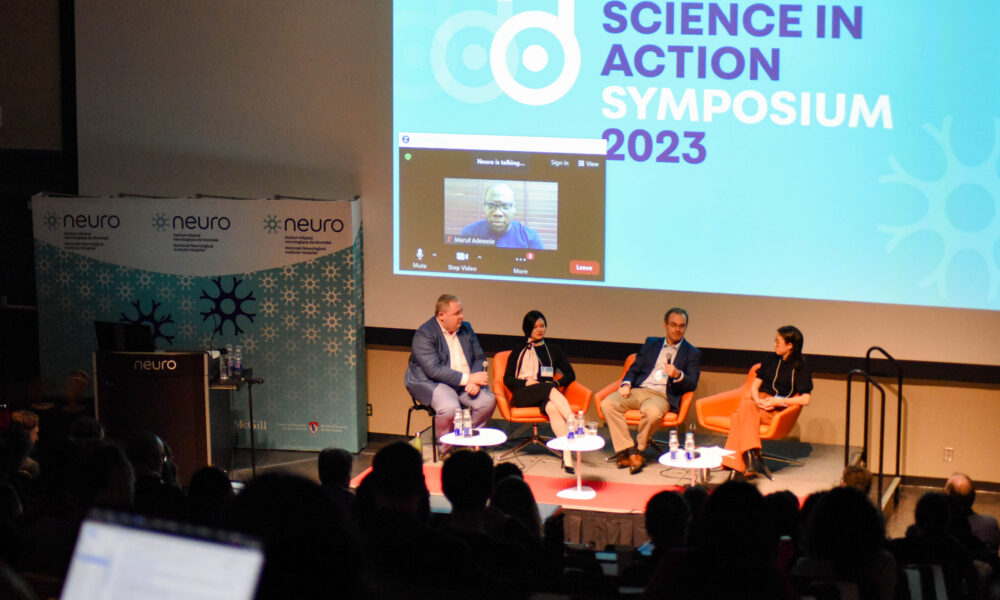
On Nov. 30, neuroscience and data-sharing experts came together for a day of insightful talks at The Neuro’s fifth annual Open Science in Action Symposium. Kicking off the event, Annabel Seyller, CEO of the Tanenbaum Open Science Institute (TOSI), emphasized the growing prevalence of open science across scientific institutions in Canada. 

“Open science is everywhere,” Seyller said. “I remind you that 2023 is the year of open science.”

She gave an overview of the day’s events before handing the microphone to Christopher Buddle, Associate Provost of Teaching and Academic Planning at McGill, who spoke about open science on the McGill campus—both among students and at institutions like The Neuro. Guy Rouleau, Director of The Neuro and co-founder of TOSI, expanded on these points and discussed the history of open science at McGill. 

“When TOSI was created in 2016, the idea was to crystallize open science practice at The Neuro, but also as a living lab for how to, at the institutional level, adopt open science practices,” Rouleau explained.

After these opening remarks, Vincent Larivière, inaugural UNESCO Chair in Open Science and professor of Information Science at Université de Montréal, delivered the keynote address. He spoke on a variety of issues surrounding scholarly publishing, including the difficulties of publishing open-access papers, changes brought about by the COVID-19 pandemic, and the pressures that predatory publishers place on scientists. There was also a panel discussion, moderated by Viviane Poupon, President of Brain Canada, covering the potential of open science to accelerate drug discovery. 

The afternoon spotlighted a number of different initiatives—many of which that The Neuro has sponsored—that aim to engage in and promote open science, spanning various areas, such as data sharing, open-source software, and science communication. 

Gabriel Pelletier, Open Science Data Manager at TOSI and the moderator of the data-sharing session, highlighted that while these initiatives are of critical importance, implementing them is not always straightforward. 

“Data sharing and knowledge sharing is key to accelerate the pace of discovery in neurological diseases and in any domain really, but also has considerable challenges,” Pelletier said in his introduction. “It’s not easy. It takes time, knowledge, and expertise.”

Nikhil Bhagwat, a computational neuroscientist at McGill, addressed these difficulties in his presentation on ParkCore, a tool for sharing data on Parkinson’s disease. “In thinking about open science in Parkinson’s disease, we have to first accept the fact [that] it’s very hard,” Bhagwat said. “We all need more data. But the key word here is we need more open and harmonized data.”

Bhagwat explained that it was not always as simple as just sharing collected data with another scientist: Researchers need to make sure they’re both using the same protocols and software, even the same variable names. 

“What we really want is to be able to get the data and be able to use it without having to play this game of twenty questions with whoever is sharing data,” Bhagwat said. 

ParkCore helps to ease this process by centralizing and standardizing data on Parkinson’s disease in one easily accessible repository. 

Open science practices also include open-source software, referring to software with publicly available source code. This means that anyone can freely download it, and even build their own additions. At the next panel, researchers shared different open-source softwares with a focus on neuroscience, including a Python library called Pynapple, which collects a set of tools for neurological analysis. 

The day closed with several projects for science communication, highlighting that open science means sharing knowledge not just with other researchers, but with patients and the public as well. Panelists included Cindy Hovington, host of the Curious Neuron podcast, and Stuart Trenholm, associate professor in McGill’s Department of Neurology, who is involved in an ongoing project to create an interactive neuroscience textbook called The Open Brain

From patients to students to researchers, all of these projects are committed to sharing data, knowledge, and methods to improve the scientific process for everyone. 

McGill, News, Private, SSMU

Students take to the streets to oppose Quebec government’s proposed tuition hikes

Red felt squares dappled McGill’s Y-intersection on Nov. 30, as students gathered to once again protest the Quebec government’s proposed tuition hikes for English-speaking universities. The hikes, announced on Oct. 13, would nearly double fees for out-of-province students at schools like McGill and Concordia from around $9,000 to $17,000 annually. The proposal would also increase international students’ tuition fees to a minimum of $20,000 per year. 

According to the Quebec government, the increased fees would go toward funding French-language universities, and the Coalition Avenir Québec (CAQ) has stated that the change is a response to the threatened state of the French language in the province.

McGill has claimed that these hikes would severely jeopardize the university, and has announced an immediate hiring freeze in an attempt to combat the financial impacts. In university-wide messages, Principal and Vice-Chancellor Deep Saini has decried the hikes, stating that they would have far-ranging impacts “from a drop in the number of students and important revenue losses, to devastating consequences for some Faculties and a suspension or re-evaluation of some major infrastructure projects.”

McGill did not reply to The Tribune’s request for comment before the publication deadline. 

According to La Presse, the CAQ is now considering implementing a 33 per cent increase for out-of-province students rather than the original near-doubling of fees. The minimum of $20,000 per year for international students would be maintained.

The Students’ Society of McGill University (SSMU), the Quebec Public Interest Research Group at McGill (QPIRG McGill), QPIRG Concordia, and the Concordia Student Union (CSU) collaborated to put on a week of activities and events related to the tuition hikes leading up to Thursday’s protest. On Nov. 27, a petition signed by over 33,000 people was sent to the National Assembly, demanding that the Quebec government rescind the proposed tuition hike.

At the Y-intersection, McGill students gathered around a banner that read “Squarely in the red, Carrément dans le rouge”—a phrase that protesters popularized during mobilizations in 2005 against proposed changes to loans and bursaries for students. The red squares have made multiple comebacks since 2005, including during 2012 student strikes that successfully dissolved proposed tuition hikes. At Thursday’s protest, organizers again handed out red felt squares along with informational flyers to encourage passersby to join the rally.

Protestor Hannah Marder-MacPherson, U2 Science spoke to The Tribune about why she feels that the CAQ’s measures are problematic and threaten the accessibility of education in the province. 

“There’s so many students who are working really hard, have got great marks, who have the potential to go off and do great things, who just won’t be able to afford going here [….] I think that’s problematic in a lot of ways, because we already have a huge disparity in terms of wealth and class, especially with access to education,” Marder-MacPherson said. 

Many of the individuals protesting were from programs that are disproportionately at risk if the government’s proposed hikes go into effect, including the Schulich School of Music and varsity teams, as both have a large number of out-of-province students. 

Joseph Liang, U1 Music and Music Undergraduate Students’ Association VP Internal, voiced his fears for the future of the Music program if the proposed tuition hikes were to go through. 

“The faculty council meeting […] projected that we’d lose a ton of funding, we wouldn’t be able to hire new staff, the proportion of graduate students would increase and undergrads would decrease,” Liang said. “I’d like to be able to keep the music school alive because it’s a really vibrant program and we like the way that it contributes to the scene of Montreal cultural life.”

The Tribune spoke with SSMU Vice President (VP) External Liam Gaither at the Y-intersection. Gaither voiced frustration over the lack of student consent in the government’s proposal and explained why the students’ union seeks to mobilize students around accessible education.

“We’re really mobilized on this because we have mandates that continue from the last time that tuition came under threat in 2012 and 2015, and even 2005 and before that,” Gaither said. “Mandates at the SSMU are basically twofold: One is we oppose [non]consensual tuition hikes in any form, and we believe in the work towards free education—that is the eventual goal.”

Gaither expressed that a 33 per cent tuition increase, while smaller, is still unacceptable. 

“This is how the CAQ rolls, this is very classic: they put out a massive number, and then they’re like, ‘Okay, maybe we’ll just do it a little bit,’” Gaither said. “They’re hoping that we back off, they’re hoping that we don’t take further action, they’re hoping that we drop our arms now, but we’re not ready to do that, we’re going to continue pushing, because the mandate is not to only let education increase by 30 per cent, the mandate is to fight for free education.”

Shortly after speeches came to a close, the crowd moved toward Sherbrooke to meet with Concordia students that organizers had coordinated with. 

As the crowds representing each university merged at the Roddick Gates, The Tribune spoke to Robin Moore, BSc’ 23, who is from Montreal and expressed what he saw as the futility of the CAQ’s proposed tuition changes. 

“I don’t think [the tuition hikes] are an effective measure, because the students will just go to schools elsewhere in Canada, and it takes away the opportunity to bring in more people to actually learn French and get engaged in the Quebec culture,” Moore argued. “So if anything, it just takes away the opportunity for [the Quebec government] to expand the French population base in Canada.”

In the merged crowd of about 150, students and professors alike from both universities held signs and banged on pots and pans with spoons as music played. “Solidarité avec les étudiants” was a common chant as the group proceeded down Sherbrooke. “I am Quebecoise and even I am affected,” read one sign. 

The Tribune spoke to Concordia students in the crowd; among them was Hannah Jackson, External Affairs and Mobilization Coordinator for the CSU. She reaffirmed the importance of mobilizing against the proposed tuition hikes, and pointed to the ripple effects that the proposal would cause within universities and throughout Montreal.

“A lot of grassroots activist groups—like Solidarity Across Borders, that fight for the rights of undocumented immigrants—they get funding from the universities, they get funding from QPIRGs, they get funding from student grant applications, and so actually, what we reduce [in] the budget of the university will also reduce the budget of the student unions. We will reduce the budget of these fee levies, and then also all of the grassroots community groups that rely on that funding to exist will also be affected,” Jackson said.

Jackson also spoke about the roughly 1,000 Concordia students who are currently on strike over the proposed tuition hikes. Ryan Assaker, a student in Concordia’s School of Community and Public Affairs, is one of them. His department voted to strike from classes on the day of the protest, and has planned for an additional three-day strike from Jan. 31 to Feb. 2. 

“I’m a Quebec resident, French is my first language, but […] these measures are austerity hidden behind language rights [….] It’s not actually about language rights.” Assaker said.

The protest ended at the Université du Québec à Montréal (UQÀM), where UQÀM students greeted the Concordia and McGill protesters and welcomed them inside the auditorium for more speeches and warm drinks.

“[The proposed tuition hikes are] going to affect […] the entire fabric of Montreal as a city,” Jackson said. “Because a lot of the vibrancy comes from the multicultural nature of the city, and also the people who come from other places and work and study and contribute to this beautiful city and this province.”

Montreal, News, The Tribune Explains

The Tribune Explains: Quebec’s public sector strikes and what they mean for students

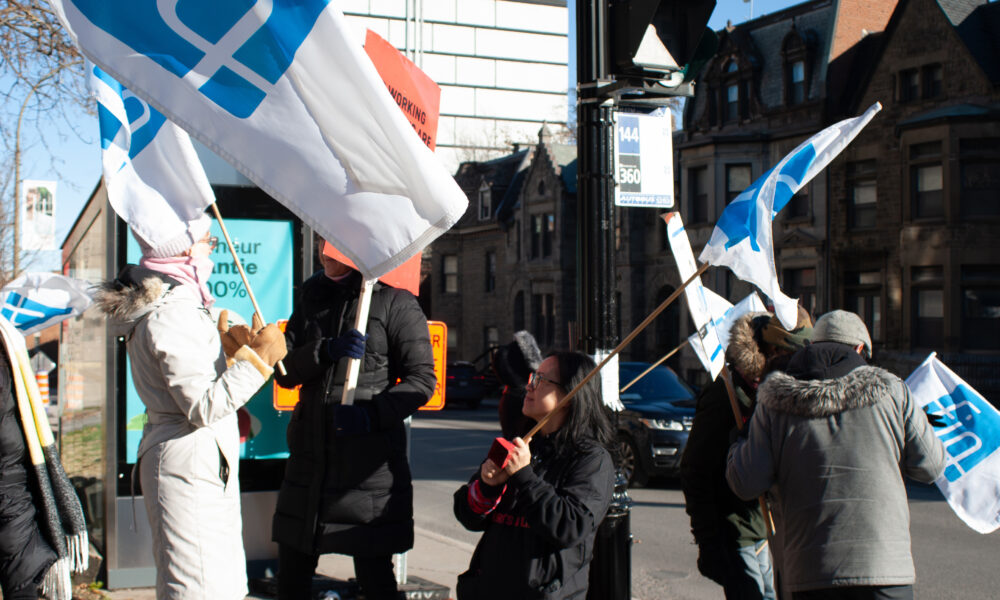
With 800 schools closed indefinitely, CÉGEPs shut down, almost a thousand surgical procedures postponed, and operating rooms limited to 70 per cent capacity, Quebec’s public sector strikes are clearly causing disruption. But what are the origins of this strike? And how does it impact students?

Why are public sector workers striking?

Nearly 570,000 Quebec public sector workers have joined forces to demand higher wages and better working conditions. Four unions spearheaded the mobilization—the Confédération des syndicats nationaux (CSN), the Centrale des syndicats du Québec (CSQ), the Fédération des travailleurs et travailleuses du Québec (FTQ), and the Alliance du personnel professionnel et technique de la santé et des services sociaux (APTS)—who have come together to form the Front commun, representing nearly 420,000 workers. 

The Fédération interprofessionnelle de la santé du Québec (FIQ) and the Fédération autonome de l’enseignement (FAE), represent an additional 80,000 and 65,000 public sector employees respectively; both of which have decided to negotiate separately from the Front commun, but are also on strike. 

The Front commun demands higher wages and stronger benefits, as employees’ living conditions have been severely affected by the rising inflation. To achieve this, they are proposing a three-year contract with annual salary increases linked to the rate of inflation. These increases would raise salaries by two per cent in the first year, or $100 a week, followed by an increase of one per cent a year until the third year. 

What are the recent developments of the strike?

On Nov. 29, after a “constructive” meeting with Sonia LeBel—the minister responsible for Government Administration and President of the Conseil du trésor—failed to make any major headway, the Front commun announced seven new strike days, from Dec. 8 to 14, and affirmed that the next step would be an unlimited general strike. The FIQ will follow, with strikes from Dec. 11 to 14. The FAE commenced an unlimited strike on Nov. 23 and seems determined not to give up. The stated aim is to sign a principal agreement before the holidays, hence the growing pressure on the government.

How has the public responded to the strikes?

Even as Quebec residents are experiencing impacts directly from these strikes, locals overwhelmingly support this mobilization. According to a SOM poll conducted between Nov. 17 and 20, 78 per cent of Quebec residents support the public sector strikes, compared to only 12 per cent supporting the government’s approach. 

In an interview with The Tribune, François Enault, first vice-president of the CSN, explained that the public sector can continue to rely on public support for strikes and expressed confidence over the current dynamics of the negotiations between the unions and Quebec government.

“The public will continue to support us. Right now, if I were in government, I’d be more nervous about public support for the government than for the workers,” Enault said.  “The balance of power [between the union forces and the Quebec government] is very good. It hasn’t been this good for years.”

How do the strikes affect McGill and its community?

In a written statement to The Tribune, McGill media relations officer Frédérique Mazerolle explained that while Quebec public sector strikes do not directly affect McGill employees, the strikes may affect staff’s private lives. 

“It is conceivable that [the public sector strikes] could have consequences for the professional performance of McGill employees, particularly in terms of managing family obligations,” Mazerolle wrote. “In these circumstances, the University encourages employees to communicate their needs and challenges with their immediate supervisor.”

Antonina Nikolaev, U2 Arts, VP Finance of the History Students’ Association (HSA), and President of the McGill Polish Students’ Association (MPSA), believes that these strikes are affecting all students at McGill, as the entire Montreal community is feeling more strain in its public service sectors. 

“The Quebec public sector strikes affect McGillians and their access to services such as healthcare, which already had long wait lists and waiting periods,” Nikolaev wrote. “This can seriously affect McGillian’s health, mental wellbeing and time management, and having all this happen right around finals season is all the more stressful.”
All Front Commun unions will convene their governing bodies on Dec. 18 and 19 to take stock of the situation.

Editorial, Opinion

2023 PGSS executive midterm reviews

The Tribune’s editorial board presents its midterm reviews of the Post-Graduate Students’ Society (PGSS) executives. Tribune editors researched and communicated with each executive before leading an editorial board discussion on the executives’ work and accomplishments. Editors with conflicts of interest abstained from discussing, writing, and editing relevant reviews.

Secretary-General: Satish Kumar Tumulu

Tumulu has been the PGSS Secretary-General since June 24 and is in charge of representing PGSS to other university bodies, including the McGill Senate and Board of Governors, overseeing the PGSS governance documents, and chairing the executive committee. He entered the position concerned that students were not able to get in touch with their PGSS representatives when they needed to and believes that PGSS has successfully improved communication with constituents during his tenure. Tumulu sees funding as one of the most pressing issues facing post-graduate students—PGSS’ recently-published 2022-2023 McGill Graduate Student Funding Report states that 88 per cent of McGill graduate students make “less than a sustainable income”—and advocates for better funding and grant opportunities for post-graduate students. He also meets with the Association of Graduate Students Employed at McGill—which is currently bargaining with McGill over a new collective agreement for teaching assistants—to stay up to date on their work. Next semester, Tumulu has important goals to tackle: He hopes to increase attendance at the Feb. 7 General Meeting (GM), as this semester’s GM did not reach quorum, to tackle structural issues within the Society, and to potentially simplify the insurance process for students. Tumulu’s goal of increasing funding and grant opportunities for post-graduate students is crucial; The Tribune urges further coalition-building and the wielding of Tumulu’s spots on McGill’s highest governing bodies to better students’ working and living conditions, and to hold the university administration accountable. 

External Affairs Officer: Ansley Gnanapragasam

As External Affairs Officer, Gnanapragasam aims to enhance the organization’s involvement in provincial and federal political affairs. His noteworthy accomplishments include fostering ties with other student unions, like the Concordia Student Union, and exploring PGSS re-joining the Quebec Student Union. Gnanapragasam has initiated discussions on student and research funding, with a potential town hall with a Member of Parliament in the works. His main priorities for the upcoming semester are continuing ongoing projects and establishing “interdisciplinary inter-university sessions,” such as a case competition across various Quebec universities. Gnanapragasam explained that PGSS avoids taking firm stances on global political issues, such as the ongoing conflict in Gaza, to avoid stoking tensions among a diverse student population. Ongoing and future initiatives include addressing French translation costs and exploring collaborations with other universities while balancing both francophone and anglophone student needs. Looking forward to the next half of his term, Gnanapragasam emphasized careful planning as he is diligently working on completing the projects that he has undertaken to ensure that all McGill graduate students feel adequately represented. Overall, Gnanapragasam’s work to build connections and improve funding is important, but The Tribune calls for PGSS to reconsider its position on political statements and take a stand for human rights when geopolitical crises arise.

Internal Affairs Officer: Cindy García

The Internal Affairs Officer is in charge of organizing and marketing PGSS events in response to constituent feedback, overseeing the PGSS orientation, communicating with Post-Graduate Students’ Associations, and recruiting to PGSS committees. García recently assumed the role on Nov. 6 and has been focused on going through student feedback and brainstorming events in her first weeks on the job. Next semester, García hopes to run events with a focus on environmental, financial, and social sustainability and is particularly focused on finding ways to better immerse post-graduate students in the university community. While she is still in her first weeks on the job and knows she still has a lot to learn—for example, about student unions’ advocacy around tuition hikes—García’s commitment to catering to students’ needs, listening to feedback, and sustainability are admirable.

Financial Affairs Officer: Faezeh Pazoki

As Financial Affairs Officer, Pazoki has undertaken responsibilities pivotal to the organization’s financial health. Pazoki’s overarching goals have focused on optimizing the PGSS budget for equity and inclusion, notably implementing transparency measures such as including monthly budget actuals in her council reports. Her accomplishments this semester include successful crowdfunding for travel awards and need-based bursaries, demonstrating effective budget management without resorting to fee increases. Challenges, such as navigating the effects of inflation as well as Memorandum of Agreement negotiations with Macdonald Campus Graduate Student Society, were met with careful planning and collaborative approaches. As her term concludes in December 2023, Pazoki is prioritizing a seamless transition for the incoming Financial Affairs Officer. It is imperative that the transparency Pazoki has created through tangible action continues under the next Financial Affairs Officer. 

Member Services Officer: Sabrina Yusuf

The PGSS Member Services Officer manages services offered to PGSS members and issues related sustainability. They are responsible for the Grants Program, the Member Legal Defence Fund, the Health and Dental Insurance Plan, and the PGSS annual handbook. At the start of her term, Yusuf hoped to bring back services that had been cut during the pandemic and strengthen the PGSS’s health and dental insurance coverage. However, she came into her role not knowing the full extent of how nuanced insurance is, and found it challenging to find an option that balanced the need for more complete coverage with the need for affordability. Even without any changes, the insurance plan has become more expensive annually for the past few years because of the sheer volume of claims that have been put in, especially those related to mental health. Yusuf has been looking into ways to prevent students from needing to put in so many claims, including the possibility of offering different providers to provide telehealth psychotherapy—making it not only less costly but more accessible to students in general. Yusuf has also been involved in PGSS’s transition from Desjardins to a new insurer, GreenShield, which she noted was not as smooth as the team would have liked. In this process, she noticed the need for transparency with PGSS members, and has been working to keep members informed on the switch, why they made it, problems that arose and their solutions, and any other updates. As a part of this initiative, she helps run a town hall focusing on the insurer transition, which PGSS publicized through their listserv, flyers, their website, and presidents of different Post-Graduate Students’ Associations. Yusuf wants to focus on improved transparency within the Society for the rest of her term. She also works directly with the BIPOC Coordinator, the International Student Caucus, and the Mental Health Coordinator in supporting students affected by ongoing geopolitical crises.

University Affairs Officer: Racchana Ramamurthy

As University Affairs Officer, Ramamurthy takes on a host of responsibilities to ensure that graduate students’ voices are heard at all levels of the university. Coming into the semester, Ramamurthy’s main priorities included improving graduate student funding and rectifying issues with supervisors—both of which she has made significant progress on. Her biggest accomplishment to date is her success in garnering the McGill administration’s acceptance of the recommendations detailed in the 2022-2023 McGill Graduate Student Funding Report, developed by the Funding Working Group. The accepted recommendations include providing students who receive external awards with a 10 per cent increase in funding, encouraging supervisors to provide cash advances for conference fees and speeding up reimbursements, and working towards ensuring that all students receive the provincial minimum wage rate. Ramamurthy strives to educate constituents on the avenues available to them to address issues with supervisors, including using the required progress tracking system to report bad conduct by supervisors. Ramamurthy has also done an impressive job advancing the interests of graduate students within the university administration and moving forward, she hopes to address communication issues that have led to a lack of recruitment for university committees. Given her success on the funding front, recruitment should be a priority in the upcoming semester to ensure that all student voices are represented.

Read the latest issue

Read the latest issue