
Latest News

Features

Assimilation in  21st-century Quebec

On the first Monday of October, all those eligible to vote in the province of Quebec will head to the polls to elect members of the National Assembly of Quebec. The party that wins the most seats in the National Assembly will form the government, and their leader will become our new Premier. In 2018, that party was the centre-right Coalition Avenir Québec (CAQ), and the controversial François Legault became our Premier.

If someone were to ask Legault what he thought was the crown jewel of his last four years in office, I bet he would say Bill 96. Legault has made it clear that he is proud of the so-called protection that Bill 96 will provide for the French language in Quebec. While the legislation will forcibly increase the use of French across the province, the Bill primarily sends a message to all non-francophones that they are not welcome. Legault’s government is using the Bill to legally implement its racist ideology—cultivating the systemic racism that the Premier claims does not exist in Quebec.

Bill 96 will not affect everyone equally. Francophones are virtually unaffected—except for limited access to English CEGEPs—and some anglophone residents, specifically those whose parents attended English high schools in Quebec, are expected to be able to receive services in English by claiming the status of a “historic anglophone.”

The future of living in Quebec for Indigenous peoples, however, remains disturbingly unclear. Currently, there are no exceptions or provisions written into Bill 96 for Indigenous peoples, for many of whom French is their third language. 

As it stands, the Bill will erect a slew of barriers to quality education, fair legal dealings, and proper patient-centred healthcare for Indigenous peoples. For example, Indigenous students will have to compete for a spot in an English CEGEP, as the total number of students enrolled will be capped at 17.5 per cent of the province’s total student population. Once accepted, they will have to complete three 45-hour core curriculum courses delivered in French. 

When it comes to the justice system, the Bill requires all provincial court documents to be in French and no longer requires judges to be bilingual. This violates the legal principle that an accused person has the right to be understood by a judge and to understand legal proceedings.  

Crucially, Indigenous communities’ access to healthcare will further deteriorate in an already racist system. Joyce Echaquan’s death in September 2020 and a recent report revealing racism, sexism, and other forms of oppression rampant at the McGill University Health Centre (MUHC) serve as reminders of the fatal consequences of the government’s refusal to recognize our discriminatory health care system. In November 2020, the Conseil des Atikamekw de Manawan and the Conseil de la Nation Atikamekw proposed Joyce’s Principle in response to Echaquan’s death. The Principle, based in part on the United Nations Declaration on the Rights of Indigenous Peoples (UNDRIP), calls on the Quebec government and health care system to recognize traditional Indigenous medical practices and beliefs in an institutional setting so that culturally safe medical care can be provided. On Nov. 25, 2020, the CAQ government rejected the motion to adopt Joyce’s Principle.

Under Bill 96, the inequities of access will worsen. Doctors and other health care providers will be required to provide medical care to Indigenous peoples in French—compelling patients to learn and translate medical terms in, what is often, their third or fourth spoken language. This means they will receive substandard care and will be more at risk of exposure to undesirable medical burdens, such as unintentional injuries, unnecessary complications, and inappropriate prescriptions. This is something Richard Budgell, an assistant professor and current history PhD student at McGill who focuses on Inuit health care, is acutely aware of.

“Not surprisingly, people see good care as happening in their first or at least their second language,” Budgell said in an interview with The McGill Tribune. “The second language for most Inuit people in Quebec is English, not French. So people are going into a health care system […] seeking care in a minority language [….] We do not often remind ourselves that we are speaking a language of colonialism. We are not speaking Inuktitut.”

While not a physician himself, Budgell comes from a line of health care workers—both his father and grandfather worked in health care in their Inuit community in Labrador. Budgell was hired by McGill in 2020 and began teaching a one-credit graduate course called “Inuit health in the Canadian context” in Winter 2022. Before working at the university, Budgell worked as the executive director of the First Nations and Inuit health branch of the federal government, which provides funding for some medical services and programs to First Nation and Inuit communities across Canada. Budgell stresses that the provincial government’s infringements on Indigenous peoples’ right to self-determination have resulted in the racist system we know today. 

“As a fundamental starting point, the system was not designed by us,” Budgell said. “In the case of Inuit who live in Nunavik, the Nunavik Regional Board of Health and Social Services is largely managed by Inuit, but it is nevertheless part of the provincial system. So obviously, it has to obey provincial laws, and Bill 96 is now law.”

Though different Indigenous communities operate their own hospitals, such as the Kateri Memorial Hospital Centre that serves the Kanienʼkehá:ka community of Kahnawake, rural and Northern communities struggle with critical shortages of medical personnel. The lack of professionals forces people to migrate to urban centres, where more robust services are offered in exchange for mistreatment and marginalization.

“The MUHC is a big […] centre for the treatment of Inuit coming from Nunavik,” Budgell explained. “All of the hospitals of the MUHC are referral centres for people coming from Nunavik [….] There are, unfortunately, very very few health care practitioners, nurses, and doctors who speak Inuktitut [….] I have to say that when I started hearing about [the racism at the MUHC], it was like, unfortunately, this is not surprising.”

Budgell believes that recognizing the differences between First Nations, Métis, and Inuit people is crucial to being able to provide culturally safe health care. With Bill 96, however, the province is isolating Indigenous peoples in the health care system and further ingraining the systemic racism that already exists.

“I think it’s vitally important that when we’re talking about cultural safety, in relation to Indigenous people, that we be more specific,” Budgell said. He believes that using an umbrella term like Indigenous “sometimes allows us to be a little bit lazy. Because then, you know, people can say, ‘Oh, we’ve covered the Indigenous training.’ Well, for any person from any Indigenous background, they immediately think, okay, ‘What does that mean? Who are you talking about?’”

The relative lack of Indigenous health professionals and, therefore, culturally safe health care can be traced to barriers in the medical education field created by Quebec’s language laws. As a member of the Kanienʼkehá:ka Nation and a second-year medical student at Université de Montréal, Frédérique Gauthier-Bisaillon has witnessed the inequities that language laws enforce firsthand. 

Since starting medical school, Gauthier-Bisaillon has travelled throughout Quebec, visiting different First Nations communities and working in their medical centres. While discussing Bill 96, which she called “outright racist,” Gauthier-Bisaillon told me a story about an Indigenous woman she met who was barred from her career in nursing after years of schooling. 

“She did all her exams, everything to be a nurse [and passed],” Gauthier-Bisaillon explained. “She wanted to go back to her community to work, and because she didn’t pass her French test, she could not practice in her community. French was her third language. I think that you can see in this case that there is such a big injustice that Bill 96 will just reinforce.”

Gauthier-Bisaillon was one of many who attended a candidate debate on Sept. 20 hosted by the Assembly of First Nations Quebec and Labrador (AFNQL). The discussion aimed to raise awareness of Indigenous issues ahead of the provincial election on Oct. 3. Candidates from several major parties in Quebec, including CAQ candidate and current Minister Responsible for Indigenous Affairs Ian Lafrenière, Québec solidaire candidate Manon Massé, Parti Québécois candidate Alexis Gagné-Lebrun, and Quebec Liberal Party candidate Gregory Kelley attended—the Conservative Party of Quebec did not send a candidate to participate. The debate focused mostly on governance and self-determination, territories, resources, and economy, health and education, and the protection of language and culture. Some of the more oddly contentious topics addressed were the existence of systemic racism in Quebec, Bill 96, and the general need for consultation with First Nations and Inuit communities on any laws that impact them.

Many of the answers given throughout the night were exactly what one would expect from politicians: Lots of talk about creating change but no concrete plans on how to actually do it. 

Marie-Ève Bordeleau—the first Cree woman to ever become a lawyer in Quebec—in her role as moderator of the event, asked candidates whether their parties would acknowledge the existence of systemic racism in Quebec. Gagné-Lebrun, Massé, and Kelley all readily did, but Lafrenière ignored that part of the question. Instead, he chose to focus on the CAQ government’s creation of a three-hour training program titled “Formation sur la sensibilisation aux réalités autochtones” or “Indigenous Awareness Training”. The program is supposed to teach health care workers about the importance of understanding Indigenous culture when treating an Indigenous patient—fittingly, it does not have an official English translation name and cannot be accessed by the general public. 

Lafrenière’s responses did not gain popularity throughout the remainder of the debate. When Bordeleau asked whether the CAQ would be willing to grant Indigenous people exceptions from Bill 96, Lafrenière answered that the CAQ would not change Bill 96 but is open to creating new laws that would protect Indigenous languages and cultures. Many First Nations chiefs have proposed amendments to the Bill but have been ignored by the government

“My colleague [Manon] Massé mentioned the importance of diplomacy earlier and she is completely right,” Lafrenière said.* “We know that there are problems with certain sections of Bill 96 […] so we said ‘let’s take the time to sit down with the Premier and with First Nations chiefs to find a solution that will respond to the concerns raised by the First Nations’ [….] Diplomacy is important and we do not want to strain those relationships so we will keep working towards a solution.”

Indigenous communities are not hopeful. In an interview with the Tribune after the debate, Chief of the AFNQL Ghislain Picard said he did not believe in Lafrenière’s stated intentions to find alternative ways of protecting Indigenous culture. He feels that the supposed plan to revise Bill 96 in accordance with Indigenous voices will resemble the trajectory of another problematic piece of legislation—Bill 15. 

Bill 15 was unanimously adopted by the National Assembly of Quebec on April 12 in response to the killing of a seven-year-old girl by her father back in 2019. While the goal of the Bill was to facilitate the process of removing children from abusive homes and placing them in foster care, it imposed colonial ways of parenting on Indigenous families and disregarded the rights of Indigenous governments to oversee their communities.

 “We went through the same exercise, we agreed to sit down, we agreed to do the work, to provide propositions and amendments to Bill 15,” Picard said. “And at the end of the day [the government] decided to proceed without any consideration for amendments to the act.”

Picard would much rather see Indigenous communities make legislative decisions for themselves rather than be forced to obey and adapt the ways they live to laws they had no meaningful part in creating.

“I know Mr. Lafrenière also suggested that if [our] concern is Indigenous languages and culture, [the government] will present a Bill for that. We don’t want that. We can do it ourselves. We can adopt our own laws. What we need for you to do is to respect the right that we have and that is where we don’t hear anything from government,” Picard said. “On Bill 15, the argument we had with [the Social Services Minister] was that he said ‘we are waiting for you to have more autonomy.’” 

“We don’t want more autonomy; we want full autonomy. There is a world of difference between the two and that is really where [the Quebec government] is not wanting to go.”

Gauthier-Bisaillon echoed Picard’s sentiments, adding that it is exhausting and discouraging to always find herself in a position where she wonders what rights of hers she may not have for much longer.

“What we have heard tonight was a lot of ‘oh yeah, we are going to change [Bill 96],’ but why didn’t [the government] think of that first?” Gauthier-Bisaillon said. “The same thing happens over and over again. We are thought of last, after the fact.”

On Oct. 3, as all of us who can legally vote head to the polls, we need to remember that it is our responsibility to uphold principles of justice, equality, and freedom to self-determination—for all communities, not just our own. As Picard argued, the conversation about Indigenous rights should not be treated as tangential to the rest of Quebec politics. We must remember that the land we live on is unceded and that First Nations, Métis, and Inuit people are the ancestral owners of this land we call Quebec and Canada. We are only visitors on this land, yet we impose our beliefs and values, and we strip the traditional custodians of their rights to self-determination. 

We allow our medical systems to abuse Indigenous people seeking help and design our judicial system in a way that actively works against them. Then, when we are shown exactly what our policies do, we take to social media and proclaim solidarity with Indigenous people. What we should do is make space for Indigenous voices in our governments and on our medical boards. Let them be the ones to determine how they will be governed and how their societies will be organized. We must overhaul our colonial mindset and totally abandon this 21st-century assimilation project.

*Debate conducted in French and translated by the author.  
Montreal, News

Students march in protest at annual climate strike, renew calls for McGill to divest

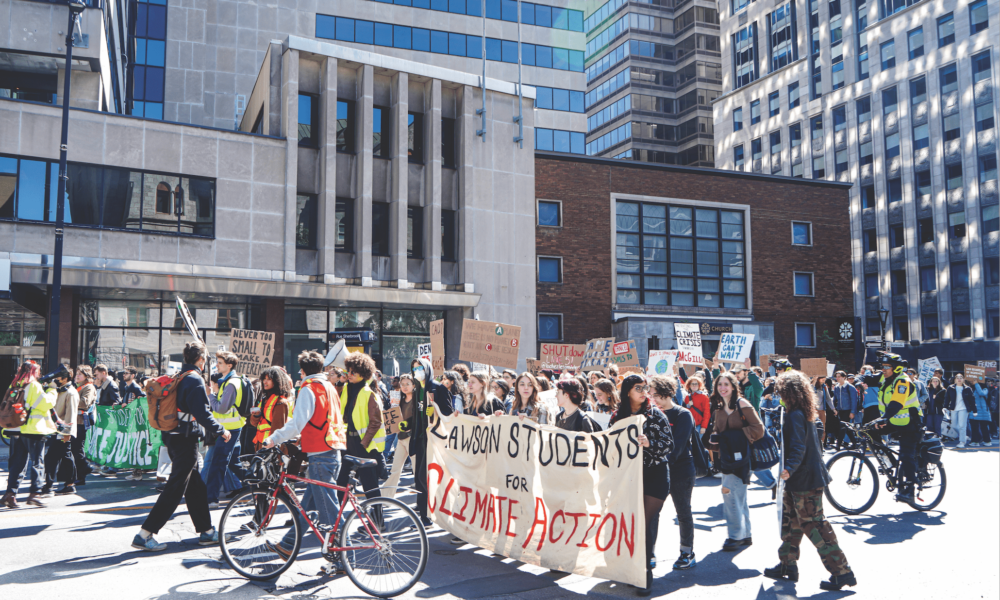
Divest McGill, a student activist group on campus, held a rally and march for the climate on the afternoon of Sept. 23. They started at the bottom of McTavish Street before leading sign-wielding and chanting students up to the George-Étienne Cartier Monument at Parc Jeanne-Mance. There, the McGill group joined the tide of Montrealers attending the annual global climate strike, organized by Fridays for Future

At the rally, Divest called on McGill to retract its investments in fossil fuels and to recognize the harm that their investments are causing to the environment and to Indigenous communities. Spokespeople for Divestalso stressed the importance of standing against the construction on the Royal Victoria Hospital site, where McGill plans to excavate grounds suspected of containing the unmarked graves of Indigenous children.

Divest was joined by the Association of Graduate Students Employed at McGill (AGSEM), which passed a mandate on Sept. 20 to go on strike for the climate on Sept. 23, even though their affiliate union, the Confédération des Syndicats Nationaux, had advised against it.

But according to Kiersten van Vliet, PhD candidate in Musicology and AGSEM Mobilization Officer, striking was imperative due to the urgency of the climate crisis.

“Climate actions like these have not been a part of the labour movement because our employers do not see the connection between climate justice and labour rights,” van Vliet said, addressing the crowd at the rally. “But climate justice is labour justice [.…] There is no economy on a dead planet.”

Before leaving campus for the city-wide protest, McGill protestors were joined by contingents from Concordia University and Dawson College. Laura Doyle Péan, 4L and Divest member, told The McGill Tribune that they believe inter-university solidarity is a powerful tool for the climate justice cause. 

Doyle Péan explained that after Divest’s occupation of the Arts building last year, similar protests were held at Concordia and Université de Montreal (UdeM). After the UdeM occupation, students were able to get a commitment from the university to divest from fossil fuels. Doyle Péan emphasized that the multi-school network that activists have built was a key driver of this step forward.

“It brought me a lot of joy today to see AGSEM on strike and to see Concordia and Dawson students coming up to McGill so that we could march together, because the links we are building are essential to the work that we are doing,” Doyle Péan said.

Lola Milder, U2 Arts and member of Divest, said that after Divest’s occupation, the group’s focus has shifted more towards democratizing the university and community building.

“I think climate strike days are a unique moment for people to feel connected to a community of people that have the same frustrations, or motivations,” Milder said in an interview with the Tribune. “I hope that people will be inspired to action, feel a sense of community, and be confident in returning to it, whether that is through coming to a Divest meeting or joining another community organization.” 

Aglaé Lambert, U2 Environment, was among the thousands who took to the streets. She explained in an interview with the Tribune that her motivations for attending reflect her hopes for the future.

“I want a more just world for every person,” Lambert said. “I want the world that we have to be possible for the next generation. I feel anxious and stressed about the future. But I know at the bottom of it there is something we can do.” According to Doyle Péan, Divest’s next rally will be held on Oct. 26 in collaboration with the McGill Radical Law Students’ Association (Radlaw) to stand in solidarity with the Kanien’kehá:ka kahnistensera, who are currently taking legal action against the New Vic project.

McGill, Montreal, News

Government officials brought onto Kanien’kehà:ka Kahnistensera court case against McGill

CW: Mentions of colonial violence, abuse

On Sept. 20, the Kanien’kehà:ka Kahnistensera (Mohawk Mothers) attended a case management hearing at the Quebec Superior Court as part of their ongoing lawsuit against McGill over the New Vic project

Exceptionally, federal and provincial representatives were brought onto the case as third parties. Independent Special Interlocutor Kimberly Murray was established as a “friend of the court”—someone brought on to offer outside expertise or information—during the proceedings. A member of the Kanesatake Mohawk Nation herself, Murray is a federal representative for cases involving Indigenous unmarked graves and burial sites. 

Daniel Benghozi, representing the Attorney General of Quebec (AGQ), was also added to the case as a third (impleaded) party because of its importance and potential to alter standing pieces of Quebec legislation, such as the Cultural Heritage Act

Philippe Blouin, an anthropologist and associate of the Mohawk Mothers, thinks that the AGQ ended up playing an outsized role in the case.

“The Quebec attorneys […] decided to join [the hearings] as a third party, but they ended up leading the whole defence […] and litigating very aggressively,” Blouin said in an interview with The McGill Tribune

According to Blouin, Murray’s inclusion as a third party in court seemed to worry McGill and the AGQ. 

“[The opposition] fears that [Murray] will give evidence that there are bodies [on the land in question],” Blouin said. “It is quite an issue that Quebec is pushing back against the person in Canada who’s supposed to facilitate the investigation of unmarked graves.” 

On Sept. 20, the AGQ filed a cross-examination in which they asked Mohawk Mother Kahentinetha 57 questions. The Mothers officially filed their answers on Sept. 21, though they found the questions to be problematic. Kahentinetha elaborated in an interview with the Tribune, saying she believes the questions served no purpose but to diminish her status as an Indigenous person in front of the court.

“Questions like, ‘how many nations are there in the Iroquois confederacy?’ First of all, there is no Iroquois confederacy,” Kahentinetha said.

Kwetiio, another Mother, echoed Kahentinetha’s sentiments and agreed that the Mothers found AGQ’s cross-examination questions to be irrelevant and uninformed.

“They gave her a set of questions […] that were almost comical in our eyes,” Kwetiio said in an interview with the Tribune. “[These questions] are [striking] even to her being because they are all uneducated questions, so when she does answer them, all of them have nothing to do with the case.” 

McGill media relations officer Frédérique Mazerolle stated that the university is devoted to resolving the dispute alongside Indigenous groups and governing bodies. 

“We are committed to collaborating with governments, the Société Québécoise des infrastructures (SQI), […] and Indigenous community leadership to undertake the work necessary to investigate this concern,” Mazerolle wrote in a statement to the Tribune.

The Mohawk Mothers are not satisfied with McGill’s promises of collaboration. McGill announced in court its intent to strike down Blouin’s affidavit, a collection of 100 exhibits of analysis and explanations of archival evidence by Blouin himself, which the Mothers filed on Aug. 25. According to Blouin, the Mohawk Mothers are also frustrated with the SQI’s exclusion of the Mothers from the archaeological process. 

“We have been [making requests] to meet with Arkéos for over a month [….] to make sure that they are not destroying forensic evidence of the bodies that are there [….] The SQI cancelled that meeting, and […] they forbid [Arkéos] to meet with us,” Blouin said. (Arkéos is the firm hired by McGill to survey the Royal Vic site.)

The SQI is postponing archeological work until they organize an information session with Arkéos. The Mohawk Mothers are apprehensive about attending such a meeting, however, as they fear the SQI may consider their presence as consent to begin work.

The next hearing will take place on Oct. 26, and the Mohawk Mothers have invited McGill students to attend and show their support.

Off the Board, Opinion

Greek life, behind closed doors

“Welcome to the club. You’re, like, one of the few pretty girls at McGill. Use it wisely.” No, that’s not a quote from a Mean Girls production at McGill. That’s a genuine thought expressed to me by a sorority girl at my first—and only—frat party. Following that linguistic beauty and feminist wonder of a statement, she asked me who I found cute so she could introduce me to them. No less than 15 minutes later, the guy I had pointed out had his tongue down her throat. That’s when I was forced to confront a notion that I always knew but somehow allowed myself to be blinded from in the pursuit of free beer and a party: I fucking hate Greek life.

I can’t say that my experience got much better throughout the evening. We’ve all seen the movies. We all know the stereotypes. I definitely wasn’t walking into this party expecting McGill’s best and brightest, but I thought “hey, it’s Canada. It can’t be that bad.” I was wrong. This party was riddled with flags so red, even the most colour-blind of bulls would have gone ballistic.

I was invited to the party by a friend who was rushing the frat. The theme: CEOs and office hoes —a classic. As an outsider, I can only describe the rush party as a souped-up peacocking of upper frat and sorority members trying to show off for their rushees. It was like a networking event for drunken first graders trying to seem like the coolest kids on the playground—the people they knew, the connections they had, the people who wanted them or wanted to be them. I beat a guy in beer pong twice, and, let me tell you, it was clear that I had committed sacrilege.

After that guy “let me win” (yes, he said that), I went looking for the free beer I was promised. Brothers kept steering me towards the jungle juice which, in all honesty, felt a little weird. I’m not implying there were roofies in there, I just know how easy it is to make a velvet hammer of a jungle juice: 90 per cent alcohol that tastes like 100 per cent juice but produces 150 times the bad decisions. No thanks, I’ll opt for drinking warm PBRs in the basement packed with sweaty, jumping 20-year-olds.

If those prior impressions of Greek life hadn’t already turned me off from frat houses, this next one definitely did. For whatever reason, my friends were going upstairs, so I went with them. That’s where I saw it—bedroom doors that could be padlocked from the outside. Although it wasn’t clear exactly what purpose they served, I knew it wasn’t for anything above board. 

So, I never went to another frat party again. I didn’t really think too much about it until the Delta Kappa Epsilon (DKE) Roofie story began to spread by word of mouth and surfaced on the McGill subreddit. For those unfamiliar, three girls were allegedly slipped the date-rape drug Rohypnol at a DKE frat house party last October. No statements were made, but other frats like Sigma Chi closed off their own Halloween parties to outsiders, making it clear they only wanted people in attendance who would protect their own. Say what you will about frats and sororities, but their ability to bury skeletons and pawn off accountability is unmatched. 

A week after the story was posted, I witnessed their cult-like attempts at vindication firsthand. I asked a sorority girl about the incident, and she immediately went on the defensive for DKE. Later, to probe a little further, I asked her about a frat guy I saw for a short period of time. She told me she had “heard things” about him, but it wasn’t her information to share. The secrecy and insular nature had struck again.

Like I said, I fucking hate Greek life.

Montreal, News

Students claim negligence at newly constructed housing complex

On the first day of her lease at the new Le Mildoré apartment complex, McGill student Setareh Setayesh was dismayed to find most of the building still under construction. The unit she and her roommates had signed for was not ready yet, and they were placed in a temporary unit without some of the promised amenities. Setayesh told The McGill Tribune that there was also dust, debris, and construction equipment throughout the building. 

Owned by University Apartments Canada and located on Peel, the building was supposed to be completed in May 2022, but construction was delayed and was unfinished come Sept. 1, when many residents’ leases started. 

Setayesh, U2 Science, explained that despite anticipating a delay in the completion of the building, the management team had reassured her that her unit would be ready on time.

“Three days before our allotted move-in date, my roommates and I received an email stating that our unit was, in fact, not ready, and that we would be placed in a temporary unit until Sept. 18 at the latest,” Setayesh wrote in an email to the Tribune. “The morning of [Sept.] 18, my roommate obtained a number from some construction workers to contact the building management, and he informed us that the room had not yet been inspected or cleaned and so our move-in would be delayed to [Sept.] 23.”

During construction, Le Mildoré was heavily advertised to McGill and Concordia students, with Concordia renting 22 apartments to use as student residences. Madelyne Mackintosh, U2 Science and a Mildoré resident, feels the owners took advantage of the relative lack of resources and knowledge students have of their housing rights.

“Lease terms began on Sept. 1 and the building is [still] wrought with issues, from the minor to the dangerously severe,” Mackintosh wrote in an email to the Tribune. “Yet, the corporation is now failing to meet their legal obligations, leaving those students in unethical and sometimes dangerous living situations, because they know we lack the time, money, and resources to ensure that they are penalized for their behaviour.”

Andrew Barker, leasing manager at the complex, expressed that the company was upset at the inconvenience that the construction delays had posed to the tenants. Yet, as they did not want students to be left without a home at the start of the semester, they decided to have students move into the completed units but to restrict floors and areas that remained unfinished. 

“The building has been certified safe by the architects and engineers who have signed and stamped the occupancy permit,” Barker wrote in an email to the Tribune. “It is very important for us that our tenants live in a building that lives up to their expectations, and we’re getting there. The contractor, for example, has a full-time team of four people triaging and assigning issues to the right tradespeople.”

Mackintosh and Setayesh, however, do not believe the building was safe when tenants began moving in. Mackintosh pointed to an instance where an electrical outlet allegedly shocked a resident, and despite immediately reporting the incident to management, they did not hear back until a week later.Both are part of a group of students living in the building who went to the Régie du logement to learn how to file notices; they hope that taking formal action will pressure the building management to take residents’ concerns more seriously and to address issues swiftly.

Commentary, Opinion

Ushering in a new future for McGill’s museums

Museums: A quintessential aspect of family vacations, school trips, and artsy dates. For centuries, they have offered visitors the chance to explore conceptual, social, scientific and artistic heritages. But museums hold more weight than most realize; they are inherently political and consistently perpetuate racism. Non-Western cultures are frequently misrepresented in exhibitions, and artifacts that were looted through colonial practices remain proudly on display. To create a space where non-Western cultures are respected, museums must be openly accessible, and institutions like McGill must embrace their role in sharing underserved historical narratives..   

Although museums often showcase foreign cultures and underrepresented aspects of history in an attempt to make them more widely available, the institutions themselves are all too inaccessible. Due to class and educational disparities, many people, particularly people of colour, lack access to the cultural and historical resources that museums can provide. This inaccessibility perpetuates the mythicization of various cultures and transforms museums into white spaces where people of colour no longer feel welcome, internalizing the concept of othering.  

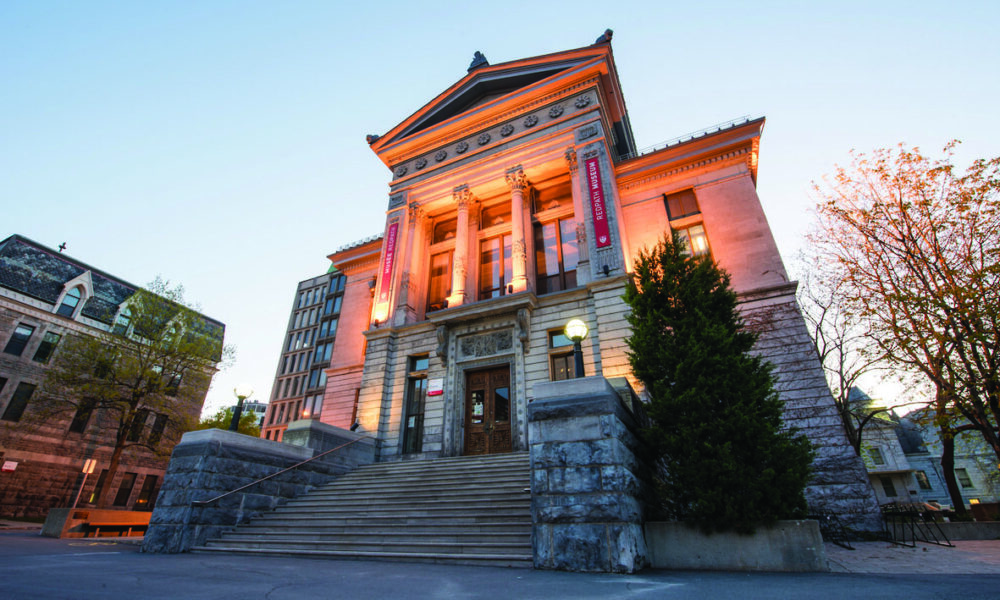
McGill’s Redpath Museum holds 17,000 archaeological and ethnological artifacts. Approximately 2,500 of these objects are from the African continent and are said to have been collected since the beginning of the 20th century, when British imperialism was in full swing. One cannot help but wonder about the origins of their acquisition, and what practices of colonial violence may have taken place in order for them to be present on McGill campus today. Considering the recent debate over whether the display of Egyptian mummies in Western museums is culturally insensitive or not, it is time for McGill to reconsider the presence of these artifacts in the Redpath Museum. 

Historically, many countries outside the Western world have had their histories stolen from them. Since formal colonialism came to an end, a widespread practice of concealing its atrocities from the public consciousness has developed, and museums have contributed to this cultural erasure. Further, following the death of Queen Elizabeth II, many aspects of the Crown’s colonial history are being revisited. Calls are growing in South Africa for Britain’s royal family to return the world’s largest known clear-cut diamond, mined by the South African colonial authorities and handed over to the British monarchy in 1905. Many diamonds and other precious gems and artifacts that the French and British Empires looted are displayed in museums as a proud representation of a dark colonial past. 

Neocolonialism can be combatted by making history more accessible. Western museums that hold stolen artifacts should be returning them to their countries of origin. Not only will this empower cultures that have suffered and continue to suffer at the hands of colonialism, but it would offer those most affected by colonial erasure to expand on their own personal histories. Further, McGill should be using the spaces dedicated to preserving history to educate students about Canada’s shameful colonial past that is currently being upheld in museums across the country. 

Many remain unaware that the majority of the McCord Museum’s collections are owned by McGill and that the museum has a contractual agreement to manage McGill’s Canadian History Collections. It would be a great step forward for McGill to have this museum expand on the aspects of history that students may not be informed about. The institution should be providing students and Montrealers—particularly those who have been impacted by colonialism, such as racialized people—with better access.
It is important that spaces dedicated to preserving history are transparent about all parts of the story, even those that may not be the most comfortable. There are many parts of history that have been concealed, like the fact that James McGill was a slaveholder, and it is high time that this type of historical information be made widely accessible. Universities play a central role in discovering and teaching history, and McGill must take its role more seriously while also disseminating non-white-washed history to all those looking to learn. 

Laughing Matters, Opinion

On becoming the Plateau man

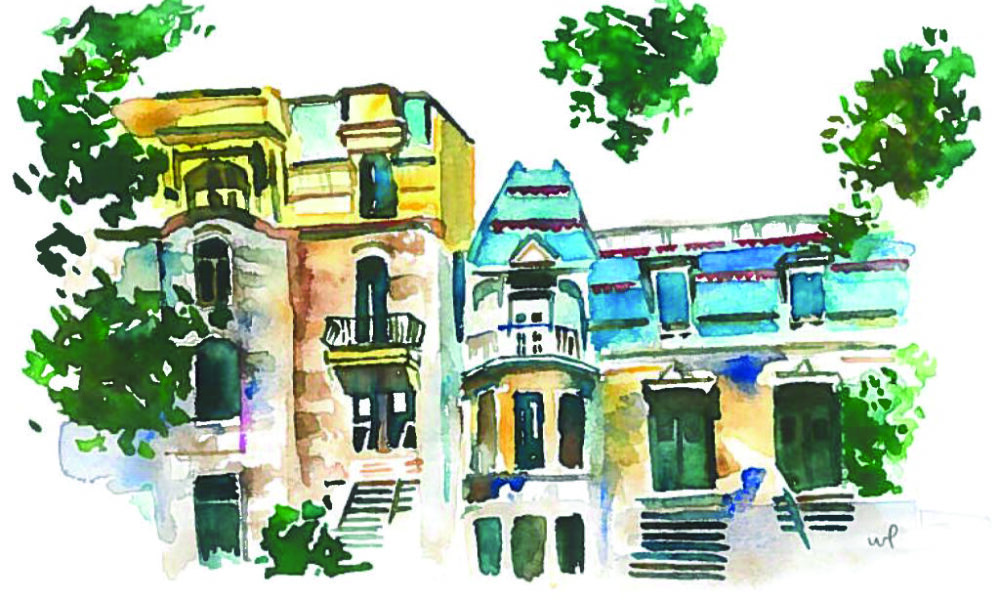
Yeah, I’m a Plateau man. No no, I don’t live on the McGill side of St. Laurent, not near Jeanne-Mance; I’m on the other side, the real Plateau. There are, like, no McGill students here, not like if you’re on Aylmer or something. I crave authenticity and you just don’t have that in the bubble. But in the Plateau…that’s the real Montreal.  

I live so far from campus that it literally takes me like 30 minutes to walk there. But obviously, I have a bike; it’s a fixie. You don’t have a bike?! I got mine on Facebook Marketplace, you wouldn’t believe the deal I got. 350 dollars! You’ll probably see me riding home from campus on it. I’ll often stop by Mamie Clafoutis to pick up a baguette. The Plateau is literally exactly like France. Have you been to France before?… Me neither. 

And I love how francophone the Plateau is. At the grocery stores they always speak French to me. When the cashier says “est-ce que blah blah blah un sac, I reply “Nôn” (because I brought my Cinema L’Amour tote bag), and when they ask how I will pay, I say credit, but don’t pronounce the “t”. It’s so refreshing to finally put my bilingualism to use. 

My style has gotten so much better in the Plateau. Everyone’s so well dressed. These thrift stores on St. Laurent have everything, and I’m basically best friends with the clerks at Chainon. I look so much like a poli sci student now. Don’t you think I look like I’m in poli sci? My closets are so packed with Dickies and Dime hoodies that I don’t know how I’ll bring them all back to Toronto. I’ve also started painting my nails now, aren’t they super cool? But if anyone asks, I’m straight….if you’re wondering….

But anyway, the area is so great if you’re living on a budget. Have you heard of Segal’s? It’s so cheap! Provigo and Metro will make you go broke these days; I never set foot in there. It really helps me to keep to my parents’ $1,000-a-month budget. How am I even supposed to go to Datcha on that?? Do you also hate your parents? I do. I only call them once at the end of the month, if you know what I mean.

The Plateau is also so diverse—it really gives you a flavour of what Montreal is really like outside the bubble. There’s such a unique blend of cultures here, like there’s this little Portuguese community, so many people from France, and … um yeah… isn’t diversity so cool?

The apartments here are also the epitome of Montreal charm. Mom said my place looks like a shithole, but I don’t care; I have exposed brick. But sometimes, it’s a bit of a struggle. There’s this strange smell emanating from the basement cellar the landlord locked off, and it takes me five minutes to figure out how to unlock the 100-year-old door every morning. I also really need a bed frame because the floor is freezing in the winter. But I like it; I feel like such a bohemian living there.

I’ve also started smoking cigarettes- hand-rolled, of course. It’s the culture of the Plateau. I love having a cigarette on my porch overlooking the street. I honestly think I like cigarettes more than weed. But I also really like weed; I smoke it so much. My favourite strain is Yellow Kush. Do you like weed?

I also really love the local deps and…

…Oh. You need to go back to your friends? That’s cool. I should probably go back to my group as well, haha. But, hey, you think I could maybe get your Snap or something??

Rugby, Sports

Redbirds rugby power to victory over Gee-Gees in front of whiteout home crowd

On Sept. 17, the Redbirds (2–0) took the field to face off against the University of Ottawa Gee-Gees (1–1) for their second RSEQ game of the season. After a win over the Carleton Ravens last week, the Redbirds dazzled a rambunctious whiteout crowd with a 31-19 victory on home turf. 

The Gee-Gees opened the scoring with an early try, but failed to convert the kick to earn the extra two points. Despite conceding first, the Redbirds fought back. Leading scorer and captain Monty Weatherall stepped up and calmly converted a penalty kick shortly afterward. Then, fourth-year flanker Zachary Auger pierced the Gee-Gees’ defence to score the Redbirds’ first try. Weatherall’s subsequent conversion allowed the Redbirds to take a 10-5 lead into the break.  

The second half worked much more in the Redbirds’ favour. A quick try by winger Ferreol Amigues invigorated fans. Weatherall delivered another poised kick to secure the additional two points. The Gee-Gees, however, did not go quietly and fought back to cut the lead to 24-19—only a try away.

With their opponents within striking distance and cheered on by their boisterous fans, the Redbirds began firing on all cylinders. The game’s climax, Alex Pantis’ try in the last minute of play, electrified the stands. One final Weatherall conversion capped off the night as the referee blew the final whistle. On cue, the crowd erupted into cheers as the team saluted them.

Over the 80 minutes of play, Weatherall added 11 points to his tally. The fourth-year fly-half from Amersham, U.K. was on the mark for all four conversions, as well as for the lone penalty. Wingers Ferreol Amigues and Alexandre Laurendeau also chipped in their first tries of the season, contributing to a balanced offensive effort. Finally, senior tight-end prop Alex Pantis broke through the defence to earn his third try of the season and cap off the win.

“We dominated the first half in terms of possession and territory, but didn’t come home with the points, a couple of errors, [the] scrum was very strong, [the] lineout was a bit of mess—we got to work on that,” said head coach Ian Baillie, assessing the team’s performance to The McGill Tribune. “Our goal this year is to host a playoff game and give ourselves an opportunity to win the final.”

Gaspard Poire, a second-year team fullback, echoed that there were some things to improve on, but also expressed gratitude for the immense crowd turnout.

“We conceded a try at the beginning and it’s a very difficult way to start a game when you are losing, as it affects the confidence, but we built and built and we won,” explained Poire. “But we are lucky to have the chance at McGill to have energy from the crowd.”

“The crowd was fantastic, [the] best crowd in the world, everyone was cheering us on, it really really makes a difference. I can’t express how grateful we are for people to spend their Saturdays [here], come out and cheer us on,” added captain Weatherall. “The team is full of so many leaders, it’s a great group of guys. We’re just really happy to just get a win in our first home game.” 

Catch your Redbirds back at home against the Sherbrooke Vert et Or on Oct. 8 at 3 p.m. for more rugby mania. 

Quotable: “Look me in the eyes, hustle, hustle, all hustle!” —Alex Pantis overheard during a mid-game huddle

Moment of the Game: TRY TIME by Alex Pantis in the final minute of play—the veteran punctured the Gee-Gees’ defence, sending both the crowd and the players into a frenzy. 

Stat Corner: The McGill Redbirds have won their past five games against the Ottawa Gee-Gees.

Arts & Entertainment, Film and TV, Pop Rhetoric

Mo representation, Mo problems

Mo, a Netflix comedy-drama show released in late August, centres around the life of Palestinian-American Mo Amer in a story based on his lived experiences—navigating legal illegitimacy by selling bootleg merch, working at a strip club and a Texan olive farm—as an asylum seeker in the U.S. The show has received critical acclaim, with a rating of 100 per cent on Rotten Tomatoes.

I was first introduced to Mo Amer’s work at a stand-up show in Amman in 2019, where my good friend Zayd Lahham opened for him. I, like many of my peers, were proud when we heard he was working on a show, and were excited to see what he could do with a Netflix budget. I was disappointed to get a show that is politically insensitive, orients itself towards a white, outsider audience, and depicts half-baked and one-dimensional Palestinian identities.

The show is so politically misinformed that even a Zionist publication wants you to watch it. In the first episode, Mo tries to dismissively wrap up an argument by saying that, if he had it his way, Palestine and Israel would go back to the 1967 borders. No Palestinian wants to go back to ‘67 borders, especially not if their family is from Haifa, like Amer’s. The context of this comment frames it as some kind of age-old religious conflict—a common Western misrepresentation of the occupation. But more importantly, the quip neglects that the ‘67 borders are in violation of international law under the UN Resolution 242

Mo contributes to a longstanding practice of watching TV shows as a means of learning about another culture and its sensitivities, particularly on Netflix. Reviews of the show by white critics, despite their acclaim, carry an air of condescension, if not pity. Such critics describe Mo as a “big teddy bear” who “buoyantly bounces” between cultures, and claim that Mo’s story brings us closer to understanding each other. The show acts like it was made to humanize Arabs for the white viewer. And if Arabs like it, it’s partially because they like that they’ll be more “understood.” One Arab IMDB user was excited that Mo portrays Arabs as “normal humans”, part of families that have normal “dysfunctions and contradictions.” This racist sentiment celebrates a pathetically low bar.

The erasure of Palestinian identity is a significant tenet of the Zionist project. For us, there is power in just hearing the word Palestine. Yet, I was really disappointed that the kind of representation Palestinians are getting has to appease the ignorant politics of inclusion and stay within the comfort zone of white America. Granted, the writers’ room (initially Mo Amer and Ramy Youssef) was hyper-aware that they needed to represent their ethnic identities. But, unfortunately, the conversation seems to have gone as follows: I’m Palestinian, therefore, I need to write about hummus and carry around a bottle of olive oil everywhere I go. I’m Palestinian, therefore, I need to make an exaggerated caricature of Palestinians as a reference for Americans. Television shows don’t need calls to action or trauma porn to make the Palestinian plight feel like more than an afterthought, but any worthwhile piece of art should have nuance beyond the tired stereotypes employed in the show.

Among my least favourite arguments in support of Mo is that which says it’s headed in the right direction. There are over 20 Palestinian short films and movies made by Palestinians on Netflix and thousands more elsewhere that display real resistance and confront the apartheid regime and Zionism head-on, such as the works of Elia Suleiman. Even if realistic depictions of Palestinian Americans didn’t exist (they do), we shouldn’t just settle unquestioningly for whatever Netflix decides to fund. Accurate minority representation isn’t the be-all and end-all of curing racism—and it’s not enough to overlook the problematic elements of the media we consume. We’re allowed to expect more than hummus Habibi content from our Arab comedians, and we deserve films and TV that are produced on our own terms.

Mo is currently streaming on Netflix.

Soccer, Sports

Martlets and Redbirds soccer defeat UQTR in home double-header

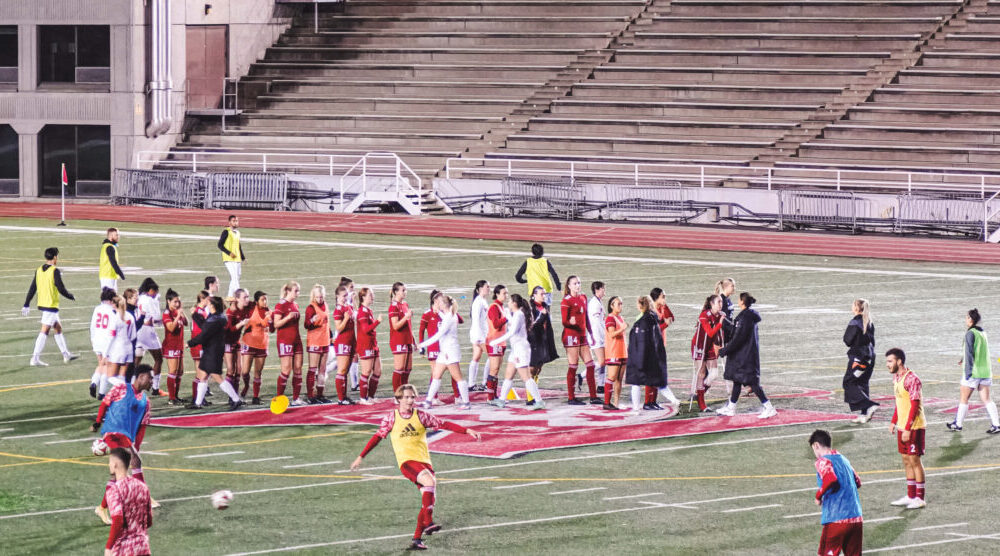
Sept. 16 was a particularly good night for McGill soccer teams as both the Martlets (2–3) and Redbirds (1–1–2) recorded shutouts on home turf. The evening began with the Martlets winning 2-0 against the Université de Québec à Trois-Rivières (UQTR)’s Patriotes and ended with the Redbirds taking a 1-0 win over the men’s team, marking their first victories of the season.

Emotions ran high during the Martlets’ game as the team witnessed several injuries, with two Martlets exiting the field during the first half: First-year midfielder Hana Yazdani injured herself after trying to retain the ball, then defender Ariel Carignan had to be carried off the field after a defensive play took a toll on her left leg, forcing the team to adapt quickly. 

The Martlets struck first with fourth-year forward Thalia Krauth-Ibarz scoring early on in the first quarter, assisted by second-year Zoe Gardiner. The quick goal set the tone for the rest of the game. While there were several scoring opportunities for UQTR, they were swiftly denied by the Martlets’ defensive core and goaltender Sophie Guilmette.

The second half of the game saw a change in dynamics, with opportunities arising on both sides. 

First-year winger Aaliyah Kamdar, however, sealed the deal for the Martlets with a second goal late in the game, triggering intense pressure from the Patriotes who remained unsuccessful. 

Martlets’ head coach, Jose-Luis Valdes, emphasized the importance of continually improving as the season continues. 

“[We need to work on] being consistent with what we want to do and establishing our game plan defensively, having a little bit more cohesion,” said Valdes in an interview with the The McGill Tribune.

Netminder Guilmette emphasized the importance of the team’s unity to this shutout victory at the Percival Molson Stadium.

“A big thing for us is just getting back together as a group, and that all of us stay focused on the game […] especially with injuries,” said Guilmette in an interview with the Tribune.

The second game of the night was marked by energy and tension for the Redbirds, starting right from the opening face-off. The beginning of the match seemed particularly defensive, with several opportunities for the Patriotes forcing McGill back on their heels. Right before half-time, the crossbar came to the rescue, preventing an opposing midfielder from opening the score. UQTR’s offensive play continued in the second half of the game, although their momentum waned. The Redbirds took advantage of this when first-year forward Pedro Gulli revived the game at 69 minutes with the lone goal off an assist from second-year Reese Carlow.  

For Redbirds’ head coach Marc Mounicot, this match is part of a larger picture.

“Right now we are in the process. It’s not about winning, it’s about improving, and  they do that quite well,”  Mounicot told the Tribune.

Despite their efforts, the Patriotes left empty-handed and the Redbirds picked up their first win of the season. 

The Redbirds then headed to Laval to face the Rouge et Or on Sept. 18, where they drew 1-1.

“We have to produce the same kind of performance,” Mounicot said. “We have done a lot of work over the last few weeks to absorb the pressure and the quality of the opposing teams.” 

Moment of the Game:  Ciociola kept calm during frantic final minutes of play and preserved victory for the Redbirds with a brilliant diving save.

Stat Corner: Redbirds’ goalkeeper Ludovyck Ciociola made five saves, while Martlets goalkeeper Sophie Guilmette made 10 saves, earning them each a shutout.


Quotable: “It’s our first game at goal, it definitely felt good! Especially coming into the game, we knew this was a team to beat because they play the way we want to play.” —Goaltender Sophie Guilmette

Read the latest issue

Read the latest issue