


Latest News

McGill, News

Alice Wong calls attention to the importance of disability visibility

As part of a speaker series organized by McGill Gender, Sexuality, and Feminist Studies Faculty Lecturer Dr. Alex Ketchum, author and disability rights activist Alice Wong and Faculty of Education professor Elizabeth Patitsas gathered virtually on Oct. 28 to discuss the diverse  experiences of people with disabilities.

Wong, the keynote speaker, is the editor of the anthology Disability Visibility: First-Person Stories from the Twenty-first Century. Wong explained the book is intended for all audiences, noting that there is power in accessible language and in digging deeper than the mainstream representations of individuals with disabilities. 

In her introductory remarks, Wong described her book as a celebration of people with disabilities, highlighting universal aspects of humanity.

“There’s a lot [of content in my book] of people just living their lives, and I think that’s really important,” Wong said. “Not all of them talked about disability. They talked about their careers or their passions or their work [….] I think that today is really important, more than the basic ‘this is what it’s like’ […] because I think we’ve seen that already.”

Wong did not use much, if any, scholarly writing in her book, because she found it difficult to access in many ways. She argued that the language in scholarly writings is out of reach from her own understanding, and she pointed to this as being problematic for the greater community of people with disabilities. 

“There’s so much important knowledge being created by scholars that is so out of reach to the communities they’re writing about,” Wong said. “I do think that scholars should practice plain-language writing because what is the point of creating all this work if people aren’t going to be able to access it? [….] I think people should care about that.”

On the subject of learning and academia, Patitsas highlighted the value of incorporating discussions about disability in classroom curricula. Both Wong and Patitsas agreed that more disability representation is something that benefits everyone.

“One thing […] I would add on for teachers in the audience is thinking about how you can talk about disability and make that part of your curriculum, because disability touches on everything,” Patitsas said. “Right now, the standard in our culture is to not talk about disability, to hide it, make it invisible, and […] for disabled students, it’s hard for them to know about disabled history.”

Wong shared her experiences growing up with a disability in an educational system designed for non-disabled people. Her greatest childhood frustration was the persistent feeling of being a burden on her teachers. Wong agreed with Patitsas that there must be a shift away from merely tolerating students with disabilities in classrooms, and towards creating an environment that allows them to flourish.

“There are so many things that I wasn’t included in or just put on the sideline as a kind of afterthought,” Wong said. “I think there are so many creative ways to think about how [to] bring everybody in without making that student feel so […] under the spotlight. I think this is a call for teachers to really be creative.” 

During the question and answer period, Anna Ma, B.A. ‘18 and Professor Patitsas’ research assistant, asked if Wong had any advice on how to have productive family conversations about disability in the context of Chinese-American homes. Wong admitted that for her, sometimes letting go is more productive than trying to educate. 

“I think I have been traumatized, to be honest, by comments, stereotypes, and […] assumptions,” Wong said. “For me what’s been really helpful is knowing that I’m not alone in this.” 

Wong assured Ma that it is possible to find support in a chosen family. 

“For a while I thought maybe I was missing something in my communication with my parents and relatives,” Ma said. “It’s just really nice to have these feelings validated and to know that you’re not alone.”

Student Life

A walking tour of Montreal’s murals

After a recent announcement that Montreal will remain in the red zone in November, many students are at a loss as to how to spend their free time. Students have exhausted the many movies to watch with roommates and, due to the drop in temperatures, can no longer spend time lounging in the park with friends. Inspired by the summer’s MURAL Festival, taking advantage of Montreal’s incredible mural art scene is a great way to make walks with friends more interesting. The McGill Tribune has put together a walking tour of four incredible murals, starting on Sherbrooke Street and heading up Saint Laurent Boulevard, during which students will pass by many more public artworks to reach the pinpointed destinations.

“Burnt Toast,” Scott MartinSherbrooke Street and Parc Avenue

Created by Canadian-born artist Scott Martin, this piece is hard to miss. Considerably recognized for his digital work, Martin has recently expanded into the world of murals. Located at the back of Provigo, “Burnt Toast” is a massive mural depicting three pastel characters, two standing and one in a wheelchair. With a soothing purple background, the three subjects all have twisty-turny limbs and are gazing in different directions. The piece is meant to touch on the topics of diversity and inclusion, and is sponsored by the yogurt brand Light and Free. The upcoming line of yogurts all have Martin’s cheeky designs present on the top of the labels.

“Untitled,” IntiPrince Arthur and Milton on Clark

The next stop of the tour is located on the brick wall facing Parc Ethel-Stark. While today the mural is partially covered by graffiti, its gravity is still coherent. The muralist Inti was born in Valparaíso, Chile and began his career at a young age painting murals on the walls of his home town. Since then, Inti has participated in mural festivals across the world, including in Montreal. This particular mural is untitled and depicts the famous folkloric character, kusillo, who recalls traditional Incan symbols. The enormous piece of art is not just beautiful—it will invite viewers to stay and take a closer look at the detailed patterns, intricate features, and entrancing composition. 

“DENIAL,” Daniel Joseph Bombardier – Saint Laurent and Clark 

Next, take only a few steps onto Saint Laurent Boulevard to find Daniel Joseph Bombardier’s pop art masterpiece. The title of his piece, “DENIAL,” was adopted in 1999 and has been intended to ridicule society’s denial of reality when it comes to media, advertising, and the world of politics. Bombardier is Canadian born; however, he has created many similar murals around the world satirizing contemporary politics. This particular mural is meant to challenge the viewer in understanding the North American political climate, and with the recent attention on social justice activism such as the Black Lives Matter movement, it remains salient. “DENIAL” calls out the viewer in their complacency. This piece is powerful, daring, and accurately portrays the language of sociopolitical upheaval at the top of the mural with the words, “Sorry is not enough.” 

FVCKRENDER” by Frédéric Duquette – Saint Laurent Boulevard and Saint Dominique Street

Our final stop on the tour is “FVCKRENDER” by Frédéric Duquette. This recently finished masterpiece showcases an array of delicate flowers against a black-painted brick wall. The striking juxtaposition has become part of Duquette’s signature style and has brought him wide recognition in both the mural scene and the pop culture world. Duquette has previously collaborated with Dior, Lil Nas X, and Supreme. His work is innovative and is often mixed with cutting edge fashion, photography, and graphic work. This is a must-see on the tour.

To expand the tour and get more information on the hundreds of incredible murals across Montreal, check out this dynamic map of murals on the Mural Festival website. 

Chill Thrills, Student Life

The highs and lows of plant parenthood

With Halloween now behind us and orange leaves beginning to choke up gutters around Montreal, students may be looking for ways to keep seasonal mood swings at bay. Houseplants are one affordable, easy-to-maintain, and fulfilling avenue to brighten any living space.

Described by her friends as a “plant mom,” Shrabani Debroy, the Local Wellness Advisor (LWA) for McGill’s Law department, explained the benefits of plants in one’s personal space. 

“I think that just the idea of growing something and taking care of [it], [tends] to a lot of our nurturing needs,” Debroy said. “Just watching the plants grow, that’s really rewarding. Whenever my plant has a new leaf, it’s super […] exciting!”

Debroy highlighted Peperomia, a succulent-like houseplant that is easy to care for, among her personal favourite plants.

“They’re so much fun, and they come in so many varieties,” Debroy said. “They tend to grow [well]. I also like ‘ZZ’ plants [Zamioculcas zamiifolia]. They’re super easy to take care of. They’re so beautiful that they look plastic, [so they] literally look fake.” 

The scientific names of plants can be confusing to students at first but thankfully, there are some amazing online resources for those hoping to get started from ground zero. The Quebec government has a helpful and informative website that breaks down everything one needs to know about home gardening.

For students without a green thumb to speak of, or who even have a trail of murdered houseplants in their past, fear not: There are plenty of plants that thrive off of negligence and are easy for beginners to take care of. 

Aptly named for its spindly leaves, the “spider plant” deserves the hype as it is easy to care for and propagate. Similar to the spider plant, the “pothos” is often cultivated in hanging baskets as it is a vine-growing plant. With durable and waxy heart-shaped leaves, this household classic is a great option that also saves space. Any variety of cacti would also be a good choice, as they are notoriously hard to kill and very resistant to neglect. That being said, not all cacti are created equal, so it is best to do cursory research on any specific varieties. Finally, the “flamingo lily” is a simple yet beautiful tropical flowering plant, and known to endure neglect well.

Tasmin Chu, U1 Arts, shared her perspective as a novice plant-caretaker in the hopes that it would encourage other students to make the leap and adopt a few plants of their own. However, Chu does not identify herself as a plant parent. 

“Absolutely not, because I kill a lot of plants,” Chu said. “But at the same time, I’m a regretful serial killer [….] The passage of plants [through] my life may be transitory, but I still experience a lot of joy [as a result].” 

While her own collection is rather modest, Chu still had helpful pointers for novice plant parents who may be restricted by a lack of natural light and surface space in their living spaces.

“I have a flamingo plant, [and] his name is John Donne, after the English poet who wrote some very sexy verses,” Chu said. “Flamingo plants are very easy to take care of because they don’t require a lot of sun or water. Start out with something low maintenance that you’re not afraid to kill.”

Speaking to the studies that have been done on the alleged benefits—both physical and psychological—of owning houseplants, Chu was slightly skeptical. 

“I appreciate that in a hyper-productive modern world, people feel the need to justify owning plants to themselves by touting the so-called benefits of owning plants,” Chu said. “But honestly, it’s [just] a plant and it’s beautiful.”

McGill, News

New COVID-19 vaccine tracker developed by McGill scientists shows status of vaccines

McGill Professor of Epidemiology, Biostatistics and Occupational Health Dr. Nicole Basta and her team released a COVID-19 vaccine tracker on Oct. 26. The website is now available for the public to see real-time updates on vaccines that are being developed. The tracker displays information about at least 50 vaccines currently in human trials. In addition to being a tracker, the website also provides general information about vaccines and why they are important. 

As of Nov. 2, the tracker reveals that there are 116 trials in progress across 33 countries. For each trial, users can see the name of the company, the trial’s current phase, and the type of vaccine that the company is working on.

Basta’s team, who has compiled data and structured the tracker, includes other McGill professors, graduate students, and recent alumni. Dr. Erica Moodie, a McGill professor in the Department of Epidemiology, Biostatistics, and Occupational Health, is a member of the team. In an interview with The McGill Tribune, Moodie explained why a COVID-19 vaccine tracker is important.

“[Our team] created the tracker because we saw a need for comprehensive information with a global overview on the progress towards a vaccine,” Moodie said. “The public health measures that we have in place now, [such as] masking, physical distancing, and hand-washing, are important elements of controlling the pandemic, and will continue to be needed even once a vaccine has been approved, but a vaccine remains one of the most powerful tools we hope to have to manage the pandemic.” 

Basta’s team is excited to see that their resource is useful for everyone, not necessarily just scientists or academics.

“We are seeing thousands of visits daily, with the website being accessed around the globe, so it is exciting to see that we really are provided a much-needed informational resource,” Moodie said.

One Canadian vaccine followed by Basta’s tracker is being developed by Medicago, a Canadian biotechnology company which recently signed an agreement with the Canadian government to supply up to 76 million doses of its plant-derived vaccine upon approval. Currently, Medicago’s vaccine is in phase one, and still has a ways to go until it is approved for distribution, but McGill Professor of medicine Dr. Brain Ward, who is currently working on this trial as Medigo’s medical officer, told The McGill Tribune that this vaccine is likely to progress to the next phases soon.

“We’re producing a virus-like particle vaccine that delivers the ‘S’ protein using plants as the bioreactor,” Ward said in an interview with the Tribune. “We’ve completed our phase one and will be entering phase two/three in the next two to three weeks.”

While the COVID-19 tracker does not have a direct impact on the work that researchers like Ward are doing, Manuela Tomic, B.Sc ‘19 and a member of Basta’s team believes that their project provides the public with an understanding of the international effort to combat COVID-19. 

“It’s important to highlight the global-collaborative aspect of our tracker page,” Tomic said. “Researchers around the world are working around the clock in order to develop a safe and effective COVID-19 vaccine. [With] multiple vaccines on the horizon chances are we’ll end up with multiple vaccines for the novel coronavirus.” 

Katie Gravagna, a member of Basta’s team and master’s student in the Faculty of Sciences, also thinks that the tracker is a crucial part of making information about the pandemic accessible to those not in the medical community. 

“This tracker plays an important role in providing the information that people want to know about these vaccine candidates and their development in a way that everyone can engage with,” Gravagna said.

News, SSMU

Tribune Explains: SSMU’s endorsement of the Sexual Violence Petition

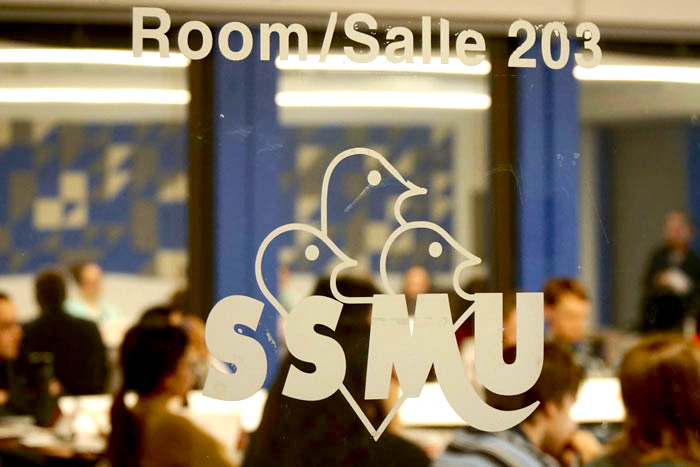
The  Students’ Society of McGill University (SSMU) endorsed a petition on Oct. 29 demanding that the Quebec National Assembly amend its current privacy laws. The change would allow universities to disclose to survivors of sexual assault the sanctions institutions apply to their aggressors. Since its release, the petition has garnered nearly 2,000 signatures. The McGill Tribune looked into what this proposed amendment could mean for Quebec’s university and CEGEP students. 

What are the petition’s demands? 

Started by Alexandra Dupuy, Sarah Bérubé Thibault, Laurianne Ladouceur, and Stéphanie Thibodeau, four students and staff members from University of Quebec in Montreal (UQAM), the petition calls for an amendment to the Act respecting Access to documents held by public bodies and the protection of personal information (CQLR c. A-2.1). The act currently does not  allow CEGEP and university administrations to disclose information about disciplinary measures taken against alleged perpetrators of sexual violence. 

Prior regulations governing privacy were passed in 1994. The National Assembly is currently in the process of modernizing several regulations relating to privacy documents under Bill 64: Act to Modernize Legislative Provisions Respecting the Protection of Personal Information. Introduced to the National Assembly on June 12, the Bill currently limits universities’ ability to disclose penalties imposed on people found to have committed acts of sexual violence. 

If passed, Bill 64 will establish a default system of privacy known as “privacy by design.” This system ensures that public or private institutions that collect personal information must guarantee high levels of confidentiality for those whose information is collected. Additionally, Bill 64 will increase fines for both public and private institutions who fail to follow the province’s new proposed privacy legislation. 

The petition therefore calls on the Government of Quebec to amend Bill 64 to mandate universities to disclose to survivors of sexual violence the disciplinary procedures placed on their aggressors. Petitioners argue that this would increase transparency within institutions that have historically covered up incidents of sexual violence. This is in accordance with Bill 151: An Act to prevent and fight sexual violence in higher education institutions, which was passed in 2017 and intended to protect survivors of sexual violence.

How could Bill 64 impact the McGill community? 

As stated in SSMU’s endorsement of the petition, Bill 64 would help break the current culture of silence surrounding sexual violence at Quebec’s post-secondary institutions. As with all other universities in Quebec, when a report of gendered or sexual violence is made at McGill, the complainant is not informed of the outcome. 

This means that McGill students and staff who report sexual or gendered violence will not be informed about any sanctions applied to their perpetrators. This is currently codified in McGill’s Policy Against Sexual Violence, which sets out provisions outlining the procedure for dealing with allegations of sexual violence. Under the policy, complaints are delegated to a Special Investigator who is able to undertake an investigation. The results of the investigation are then submitted to the Provost for further review. 

What is survivor-centric justice?  

The petition represents a move towards survivor-centric justice, which is an approach to justice that prioritizes the needs and safety of survivors of violence above all else. This approach can include treating survivors with dignity and respect, allowing survivors to access a private and non-judgmental environment, providing relevant information to allow survivors to make informed decisions, and ensuring that the survivor’s confidentiality is maintained. 

The aim of survivor-centric justice is to prevent re-traumatization through legal proceedings. It is proven that this approach, in which the survivors’ lived experience is taken into account, encourages survivors to come forward about the violence they have experienced.

Science & Technology

At the convergence of art and science, ecology becomes an experience

On Oct. 29, The Convergence Initiative hosted their popular Sci-Art/Art-Sci event, a webinar about the work of scientists, artists, and researchers at the intersection of science, art, and communication. Matthew Halpenny, an interdisciplinary artist and member of the Montreal collective Somme, led the event with his talk titled “Ecologies of Experience: Systems in Art.”

When people think of the word “art,” media like painting, photography, or videography come to mind. According to Halpenny, however, these forms are static, unchanging. His work, by contrast, rests on the introduction of moving and changing components as part of his artmaking.

General systems theory, proposed by twentieth-century Austrian biologist Ludwig von Bertalanffy, states that a system is made up of interdependent and interrelated parts. Changing one part will affect other parts and the system as a whole.

“[When looking at systems in art], the meaning of the artwork is expressed by the relations between the elements, rather than representing the elements themselves,” Halpenny said. “With systematic art, a lot of the time you can’t predict the outcome.” 

Halpenny also mentioned how observers themselves play a role in how the artwork is perceived.

Halpenny’s projects all follow a similar process. He starts with an idea, interest, or curiosity, then picks a medium through which to display it. His ideas often centre around the ways in which social systems influence biological systems, as well as their relationship to technology and humanity. 

“We can think of technology as evil, but it’s humans creating these technologies,” Halpenny said. 

Mycocene, one of Halpenny’s projects, uses slime mould to address the impact of our information technologies on natural systems. Using electronic waste as a metaphor for the technosphere—all the structures that humans have made to help keep them alive—the project illuminates just how much waste technology produces, with the slime mould acting as a metaphor for the biosphere.

Mycelial systems, or whole conglomerations of slime moulds, act like a network that Halpenny referred to as the “mycelial internet.” These systems, composed of eukaryotic organisms of the kingdom Protista, are aware of and responsive to change. Their ability to sense and respond to their surrounding environment using complex processing of sensory information classifies them as sentient.

With the live slime mould in the centre of a small room and the recycled electronic waste sculptures surrounding it, their components are only visible from the faint green glow of the mould. As the slime mould moves and grows, it gives off an electric signal which is used to repower the e-waste, creating a living atmosphere permeated by the sounds of motors spinning and cameras zooming.

Sensenet, another one of Halpenny’s works, is a conceptual piece that requires volunteers. Each participant wears gear that mutes their own senses, but is equipped with a suit that collects and displays the sensory information of every other participant, effectively swapping sensory information amongst participants.

“[With this piece] we tried to move to a more perceptual ground,” Halpenny said. “Since we were working with neuroscientists, we wanted to make this about perception and cognition and consciousness.” 

He based his ideas around the umwelt, a cognitive theory which states that consciousness is related to the environment. 

“[We] wanted to see what would happen if we removed the environment from somebody,” Halpenny said.

By creating an environment of unknown variables and stimuli, Sensenet allows participants to explore a novel and disrupted state of perception, with the aim of synchronizing the group members’ individual senses into a unified perception.

Along with his colleagues, Halpenny combines biology, coding, and new technologies into each of his projects. With dynamic installations that illustrate the different interconnections of biology and technology, his work successfully bridges the gap between science and art.

Arts & Entertainment, Music, Pop Rhetoric

Pop Dialectic: When should the most wonderful time of the year begin?

With Thanksgiving and Halloween behind us, the holiday season in Canada has officially begun. For some international students, though, American Thanksgiving will delay the onslaught of holiday music that has already found its way into grocery stores and Spotify playlists. This week, The McGill Tribune weighs in on one of our most contentious differences from our neighbours to the south—our holiday music timelines.

Anti-Canadian Christmas Hegemony — Michelle Siegel

As an international student coming to McGill from the United States, one of the first cultural differences I became aware of was the earlier Thanksgiving date: While Americans celebrate their nation’s colonial roots by tucking into turkey, potatoes, and stuffing on the last Thursday in November, Canadians celebrate the traditional harvest on the second Monday in October. As Thanksgiving and Halloween pass, October draws to a close and Canada rolls into the final two months of the year: “The Christmas season.” 

Despite Christmas being another eight weeks away, for some reason, November 1 is seen by many as the socially acceptable date to start decorating and playing Christmas music. And frankly, I hate it. Obviously, Canadian residents can’t change the date of a statutory holiday, but no one is forcing them to flood their Spotify playlists with Christmas music two months ahead of schedule.

Logistically, it does make sense that Christmas music takes up as much cultural space as it does, since there is a high volume of classic Christmas songs as well as a steady influx of new releases each year. There are almost no specifically recognizable Thanksgiving tunes, and while there are some classic Halloween jams, like “Monster Mash” and “Thriller,” they simply cannot hold a candle to the countless Christmas tunes that play for months on end.

Admittedly, I am not the biggest fan of Christmas music, but as I tell friends, family, and random strangers in grocery stores when they admonish me for it: I’m not a Grinch, just a Jew. Most Christmas music sounds homogenous, with a constant track of sleigh bells, repetitive melodies, and nearly identical lyrical content. Growing up in a predominantly Christian town, I always felt that Chanukah classics like “Dreidel, Dreidel, Dreidel” and The Chanukah Song deserved more recognition from my peers. We should not, as a society, be subjected to an infinite onslaught of sleigh bells when the musical stylings of Chanukah range from Adam Sandler’s acoustic guitar to the wide world of a cappella.

Pro-Canadian Holiday Discourse — Alaana Kumar, Student Life Editor 

From excluding the letter “u” to deciding that the metric system is beneath them, the United States tends to set its own rules. For a nation that refers to the holiday season as “the most wonderful time of the year,” they sure do jam-pack it into one stressful month. I adore the Canadian holiday schedule, as we give thanks in early October and are swiftly reminded to start Christmas shopping as soon as possible. With an earlier start to the festivities, the transition from fall to winter is much less jarring.

This year in particular, the juxtaposition from the dreariness of Halloween to the bright and colourful holiday festivities has been rather poetic. The album swap from Kim Petras’ Turn Off the Light to Mariah Carey’s Merry Christmas has been a quintessential reminder that we’ve made it over the hump and 2020 will soon be over. Personally, I think it would be taxing to go into winter without Richard B. Smith reminding us that snow is glistening, and that it’s actually a beautiful, not foreboding, sight. 

In recent years, Christmas music has expanded far past the traditional carols and hymns, with numerous celebrities dabbling in the world of holiday albums and EPs. Last winter, Rolling Stone put out a list of 40 essential Christmas albums—and that’s not even scratching the surface of festive tunes available for listeners. It’s near impossible to bask in the full glory of all these holiday bops in only 25 days.

The Canadian holiday schedule leaves more room for stores and radios to play a variety of songs—including the Chanukah classics that deserve more recognition. Holiday music isn’t for everyone, but there is merit in diving beyond the classics and exploring the hidden gems of festively-themed albums.


Soccer, Sports

Point-counterpoint: Messi versus Ronaldo

Soccer is inherently a team sport, but it is important to take into account individual statistics when assessing the success of individual players. Each player has a unique impact on their team, but there are some statistical metrics that lend themselves to comparison. In recent decades, two players have risen above the rest in the GOAT conversation: Lionel Messi and Cristiano Ronaldo.

Lionel Messi

In looking at both Ronaldo and Messi’s careers, it makes sense to compare both players’ records for the team they play for the most: Their clubs. Attackers’ main statistical measurements are goals and assists, which together are known as goal contributions. In 731 club appearances, Lionel Messi has 634 goals and 256 assists, an average of 1.22 goal contributions per appearance. In 850 club appearances, Cristiano Ronaldo has 638 goals and 195 assists, an average of 0.98 goal contributions per appearance. Although Ronaldo spent time in the English Premier League, which is considered the hardest league in the world, he also played in Portugal, Spain, and Italy. Both the Italian and Portuguese leagues are considered to be easier than the Spanish league, where Messi has been his entire career. 

Although both players have spent significantly more time with their club teams, their international careers must also be considered. In 138 international appearances, Messi has 70 goals and 42 assists, with an average of 0.81 goal contributions per appearance. In 164 international appearances, Ronaldo has 99 goals and 28 assists with an average of 0.77 goal contributions per appearance. 

Typically, Ronaldo is credited with more international success based on Portugal’s win at the 2016 European Championship against France. This, however, is a misattribution. Ronaldo, due to an injury, was subbed out early in the game when the score was 0–0. Messi, who is considered the weaker international player, was awarded the Golden Ball for best player at the 2014 World Cup. Messi had previously won the Golden Ball, as well as the Golden Boot for most goals scored, in the 2005 U-20 World Cup, which Argentina won. Messi is also a frequent recipient of the highest individual award a soccer player can receive, the Ballon D’or. Messi has won it six times, most recently in 2019, while Ronaldo has won it five times.

Cristiano Ronaldo

Cristiano Ronaldo is widely considered to be the greatest soccer player of all time for his unparalleled success individually, at the club level and at the international level.

Since his professional debut in 2002, Ronaldo has scored 641 goals in 854 club games, scoring 0.76 goals per game. He is the all-time leading scorer in European club soccer’s highest level of competition, the UEFA Champions League, and has won nearly every individual accolade in soccer, including the prestigious Ballon D’Or on five occasions.

The best players must be successful in different European Soccer Leagues as each has its own style of play. The English Premier League has a fast and aggressive game compared to the slower but more technical Spanish La Liga and Italian Serie A. While Ronaldo has succeeded at the club level in all three of these major European leagues, Messi has only found success in the La Liga, and thus cannot be considered as adaptable as Ronaldo. Ronaldo also has five Champions League titles, two La Liga titles, three Premier League titles, and two Serie A titles to his name.

Apart from individual and club success, Ronaldo has led the Portuguese team to win the UEFA European Championship in 2016—the first major tournament title for the Portuguese National Team. Although the FIFA World Cup trophy has eluded both Messi and Ronaldo, the European Championship is what many consider to separate Ronaldo from Messi as the greatest of all time.

Editor’s Pick

Although Ronaldo has been dominant at many levels of soccer, especially the UEFA Champions League, Messi has the more impressive resumé. With significantly more goal contributions per game, a Golden Ball, Golden Boot, and six Ballon D’or awards, Messi is the stronger all-around player.

McGill, News

McGill law workshop highlights feminist issues in law

Namibian Minister of Justice Yvonne Dausab led a workshop on Oct. 23 exploring the relationship between feminism, social justice, and the practice of law. Dausab’s talk was part of the Annie MacDonald Langstaff workshop series, which is held annually in commemoration of the first woman and single mother to obtain a law degree in Quebec, and aims to celebrate the increasing numbers of women in the legal field.McGill’s Centre for Human Rights and Legal Pluralism has been hosting this annual event since 1988.  

Event coordinator Shauna Van Praagh spoke to The McGill Tribune about the importance of this annual workshop series.

“The point is to talk about the impact of feminist perspectives on law in different arenas through different roles and responsibilities that feminist jurists take on, whether they’re in government or an NGO, or as a lawyer or a dean of law school,” Van Praagh said.

Dausab expressed her desire for lawyers to use their position and expertise to work for citizens, stressing the importance of using legal systems to foster a culture of change in society. Dausab described a bottom-up approach to practicing law which focusses on constantly striving to obtain more and do better for neglected communities. She emphasized the need to continually advocate for those in need and to not stop at “enough” for those who are marginalized. 

“Social justice is not a once-off project, Dausab said. “t’s transformative. If we don’t see a transformation of our society, it may be difficult to say that we have done enough as lawyers in our country to enhance that trajectory.”

According to Dausab, in order to have a legal system that truly works for its community, the benefits of the system must be accessible to marginalized groups and address certain core criteria. 

“The first thing that you’re talking about is courts,” Dausab said. “Do we have court infrastructure available? The second one is your availability of human resource capacity [and] the availability of legal representation. The other important one […] is what kind of jurisprudence are we developing? What kind of cases are being heard?”

Minister Dausab spoke at length about her experience as a prominent woman in law, a position she achieved despite the challenges of growing up in Namibia during apartheid rule. Though the representation of women is increasing in the legal arena, gender disparities in the number of women in law still persist. Minister Dausab explained that, as a woman in a position of power, she feels she has an especially strong obligation to represent all women. She believes that all women face the same pressures to conform to gender based stereotypes, regardless of their personal accomplishments in the professional world.

“One of the biggest challenges [women] are facing is that whereas they are competing with [men] who have support in the form of a wife, or girlfriend, she is the support [for her family],” Dausab said. “Those dynamics don’t all of a sudden change because I’m the Minister of Justice.”

During the workshop, attendees were encouraged to think more deeply about the intersection of feminism and the Canadian legal system. For Vishakha Wijenakaye, a third-year doctoral candidate studying international human rights law, Minister Dausab’s statements about the relationship between her identity as a woman and as a legal academic were particularly salient. 

“Her vision that doctoral students should try to create positive change through their work resonated with me,” Wijenakaye said. “Learning about her personal experiences also highlighted the fact that my work, whether as a doctoral student or as a practicing lawyer, cannot be entirely separated from my identity [as a woman] and background.” 

Read the latest issue

Read the latest issue