


Latest News

Hockey, Know Your Athlete, Men's Varsity, Sports

Redmen help Canada take bronze at FISU Winter University Games

When one thinks of the ideal venue for the International University Sports Federation (FISU) 2017 Winter University Games, Kazakhstan probably isn’t the hockey mecca that comes to mind. However, for McGill Redmen Hockey centre Mathieu Pompei and defenceman Nathan Chiarlitti, the opportunity to head to the Kazakh city of Almaty to represent Canadian universities was a once-in-a-lifetime experience.

“I was honestly just super excited,” Chiarlitti said. “It was not only a great opportunity to play with other great university players, but also represent Canada.”

Both seniors are coming to the end of their varsity hockey careers and are looking to soak in as much of these last few games as they can.

“As a fifth-year player, this is probably one of the last times I will have such a special opportunity,” Pompei said.

The two agreed the time spent at the rink with their team was a highlight of the trip. Just missing the finals after a 4-1 semi-finals loss to Russia, the team faced off against the Czech Republic in the bronze medal game on Feb. 8.

“[…There] was no way we were leaving that game without a medal after we lost to Russia,” Chiarlitti said. “Unfortunately, I had to miss the game due to injury, but it was still super fun cheering from the sidelines.”

In the bronze medal game, Team Canada jumped ahead early against the Czechs, clinching third place with a 4-3 victory.

“The feeling was pretty surreal getting the medal,” Pompei said. “We truly put our everything into this tournament […] to make sure we accomplished our goal.”

The team had just one practice, hours before heading out to Kazakhstan, the team had to bond on the fly. Chemistry formed through years of practice and games needed to be emulated in only hours. The team’s only practice was at York University before the tournament and was a crucial time for the players to mingle and become comfortable with each other.

Because the team had little-to-no time to develop relationships before leaving, they became friends by exploring the area in and around the athletic village in Almaty. Through these interactions, the team grew together and players even made friends on other teams.

“Being around a bunch of great athletes from around the world was an amazing experience,” Pompei said.

However, both Redmen were amongst the five players chosen to briefly head into the town to interact with locals.

“We actually got to go play with some of the local kids of the community at the closest ice rink,” Chiarlitti said.

Travelling through the city, both were surprised by the mayhem on the Kazakh streets.

“The driving was kinda weird,” Chiarlitti said. “There would be lines […] on the road, but people would just be driving on the lines, ignoring lanes, and making new lanes.”

Outside of the city centre, the team had lunch in the scenic Trans-Ili Alatau mountains.

“One day we did go up to the ski hills,” Chiralitti said. “It was super picturesque up in the middle of the mountains.”

Reflecting on Pompei and Chiarlitti’s two and a half weeks abroad, the gratitude for their family and friends back home was as strong as ever.

“You know, honestly I was just so excited to get home and share my medal with everyone,” said Pompei. “Being able to share this accomplishment with everyone that helped me to get where I am today is truly a special feeling.”

With the Redmen in the midst of a playoff push, the two have had to adjust quickly to the 11-hour time difference since returning back to Canada.

“I know I am going to feel it once the season is over, but physically, I feel totally ready to chase a championship,” Pompei said. “Mentally, I am as focused as ever.”

McGill takes on UQTR at home in the first game of a best two out of three OUA East Semifinals on Feb 22.

Arts & Entertainment, Theatre

Players’ Theatre’s ‘Art’ is fiercely sarcastic, cynical, and hilarious

Your friend buys a painting. Not just any painting, but an Antrios painting. In fact, it may be the best Antrios painting around, better than the three at the gallery. It’s a staggering work—about five feet by four—and it cost—well, I won’t say how much, but it’s more than you earn in a year. And did I mention? Oh, goodness, did I forget to mention? The painting is completely white. Genius? Or madness? 

So begins Art, Players’ Theatre’s latest production. When Serge (Steven Finley), a precocious aspiring collector buys the infamous white painting, his longtime friends Marc (Sara Harvey) and Yvan (Douglas Clark) have mixed reactions. Marc is confused and dismayed at such an ostentatious purchase. After all, the three are young, (somewhat) single, and broke, so where did Serge get that kind of money? Yvan, the trustworthy and neurotic optimist, tries to see the painting from Serge’s view, including what Serge is convinced are shades of yellow, blue, even a touch of grey underneath the bright white. What begins as lighthearted disagreement about the painting quickly deteriorates in a whirlwind of bickering and escalating betrayals that cause the audience and the characters to question the foundation and nature of friendship. 

With a small cast of three, each actor shines in their distinct—yet co-dependent—roles. Sara Harvey delivers a fierce performance as Marc, whose need for validation and affirmation almost destroys her friendship with Serge and Yvan. Yet, Marc is not the villain—Harvey captures the simultaneous insecurities and indignation of a friend who suddenly feels overshadowed by the offensive arbitrariness of what we conceive as art. 

Are these artistic distinctions arbitrary? Finley’s convincing portrayal of Serge persuades the audience that they are not. While the egregious painting looms—on stage and psychologically—in every scene, his conviction in his monstrous purchase and its personal value to him is admirable, yet somewhat repellant as his stubbornness causes his friendships to fray. 

In fact, Marc and Serge are not likeable at all. Yvan is the most sympathetic character because he deflects Serge’s arrogance and pretension and Marc’s biting cynicism, which, despite Clark’s fabulous height, are dominating. In spite of his bullying costars, Clark’s excellent performance doesn’t characterize Yvan as an “amoeba,” like Marc repeatedly says, but a bastion of good-natured—albeit sometimes naive—friendship. 

Art achieves a nice balance between funny and irritating. The constant bickering and displays of various neuroses is almost exhausting, but not quite. For all their flippant intellectualisms and art-speak, by the end of the play Harvey, Clark, and Finley reveal the vulnerability of their characters and the fragility of relationships in the face of extreme ego. 


Art is playing Feb. 22-24 at 8 pm in Players’ Theatre, 3rd floor of SSMU, 3600 Rue McTavish.

Basketball, Sports

Redmen basketball celebrate seniors with victory over Gaiters


McGill Redmen
89


Bishop's Gaiters
71


McGill Redmen basketball (12-3) took a swift 89-71 victory over the Bishop’s Gaiters (2-12) on Saturday Feb. 18, just days after clinching the top seed in the RSEQ playoffs. Prior to the game, the Redmen honoured their four graduating members–Jenning Leung, Michael Peterkin, Daniel Pieper, and Regis Ivaniukas–as part of Senior Day festivities.

As per usual, the Redmen jumped out with an early lead and never looked back. With an 18-point advantage at halftime, McGill continued to pile it on before Head Coach David DeAveiro went deep into his bench up 27 at the start of the fourth quarter.

With forward Francois Bourque recovering from a calf injury, graduating senior forward Pieper got the start in the final regular season home game of his career.

“It was special to share the starting lineup with my teammates for the first time,” Pieper said. “I appreciated every minute of the evening playing with the guys at home one last time.”

While Pieper did not play many minutes early in his career with the Redmen, he saw his role expand late this season as he grew into a contributor off the bench.

“Before coming to McGill, I thought I knew basketball,” Pieper said. “Once I joined the team, I realized I barely knew anything. The three years have taught me more about the game [than] I knew was possible.”

Forward Peterkin led the way for the Redmen, scoring 15 points with 7 rebounds and 5 assists. Since beginning his career as a starter for the Redmen, Peterkin has become the key to McGill’s depth, accepting his new role as the team’s sixth-man.

“As long as we are winning games and improving as a team, I’m happy with whatever role allows me to be a part of that,” Peterkin said.

Coming off the bench has allowed Peterkin to grow with the Redmen. He’s currently fourth on the team in minutes per game and has become a key asset on both offence and defence.

“[Peterkin] just has a chance to take over a game [and] impose his will on people,” DeAveiro said. “He just knows he can make a difference in every game now and he plans to do that.”

Never one to hog the spotlight, the veteran forward took the opportunity to credit his teammates after his stellar performance.

“The great thing about our team is that night-in and night-out there are different scorers,”  Peterkin said.

Point guard Leung finished his home career with 14 points and 7 assists against the Gaiters. Unlike Peterkin–who was thrown into the fire in his first season–Leung worked his way up from a walk-on freshmen who got almost no playing time to a second team all-star last season. He has now become one of McGill’s key players.

“I just got more comfortable on the team,” Leung said. “I learned a lot during my first and second year from the coaches and the players, just how to play under control, get to my spots, and understand what the coaches were looking for.”

Unable to play due to injury, the team also said goodbye to Ivaniukas. The senior guard took last season off and struggled with a shoulder injury this season limiting his playing time.

"When I came to McGill in my first season it was always me first and team second,” Ivaniukas said. “After taking my third year off and dealing with the injuries I've had to face it, makes you put things into perspective […. I’ve] found a different way to contribute to the team now that I'm unable to play, and even though my role has changed I appreciate every minute I spend with the guys.”

With one final game against Laval before their first round rematch against  in the RSEQ Final Four, the team is just trying to stay healthy and enter the playoffs in full stride. If the Redmen manage to knock off Laval in the first round, this senior class will move on to their fourth consecutive RSEQ finals appearance.

“[Laval has] been struggling in the latter part of the season, but the playoffs is a different game,” Peterkin said. “They play very well against us.”

Despite an injury to starting Redmen point guard Kendrick Jolin, who will be out for the foreseeable future, this senior class looks poised to capture their third RSEQ championship in three years. If all goes according to plan, the team will head to the CIS national tournament on  March 9 where these seniors have previously failed to advance past the first round.

“I think we’re right up there with some of the best teams in the country,” Leung said. “Especially with how we’re playing right now. Our team has really been clicking in the past few games and if we were to make it to nationals I’d say we have a good chance of making it over the hump.”

The Redmen finish up their regular season on Feb. 23 before they head to the RSEQ Final Four on March 3 and 4. If they’re able to capture another title, they’ll head out to Halifax for the CIS tournament.

While the team might be looking towards the CIS playoffs, Head Coach DeAveiro doesn’t want to jump ahead.

“We just try to win every game,” DeAveiro said. “One game at a time.”

Editorial, Opinion

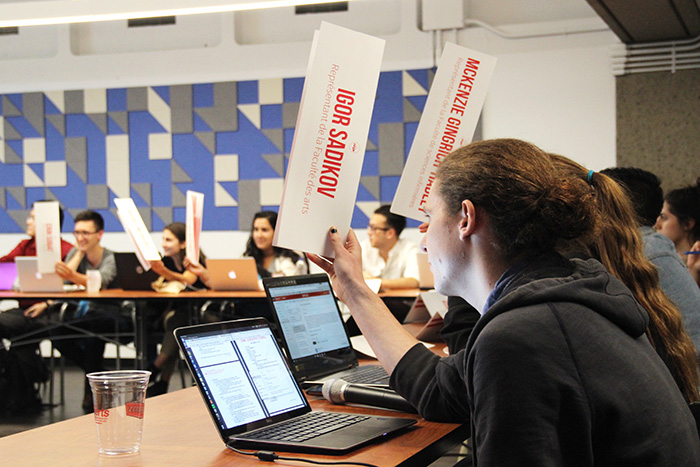
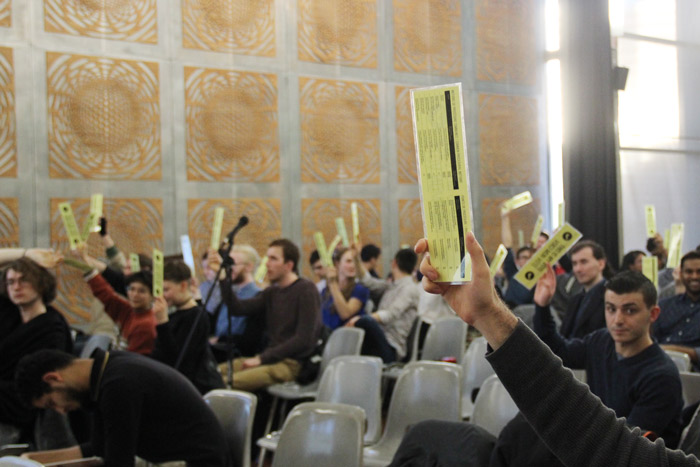
Winter 2017 SSMU General Assembly Endorsements

Motion Regarding Policy Against Ancillary Fee Increases: “Yes”

Ancillary fees are non-opt-outable fees that are charged to students to fund various student service units, including Student Services, Athletics and Recreation, the World University Services Canada (WUSC) Student Refugee Program, Access McGill, and Athletics Facilities Improvement. Current estimates from the university state that undergraduates students pay between $1,668 and $2,968—depending on what program they are in and what their student status is—in ancillary fees each year.

This motion regarding ancillary fee increases would enable the SSMU to call on the university administration for more transparency and student collaboration in matters of budgeting that affect students’ finances. Currently, the creation or modification of ancillary fees requires approval from students through referendum; once approved, students support essential services directly. That said, the process for creating the ancillary fees and determining why the financial burden must be placed on students is currently opaque. The Tribune therefore endorses this motion as it will establish a new framework for holding the administration to account for how its budget impacts students.

According to the motion, ancillary fees charged by Quebec institutions should not replace what is already accounted for in the university’s operational budget or displace the financial burden for providing essential services onto students. The motion states that the university charges student fee-funded units, such as Student Housing, Athletics and Recreation, and Student Housing and Hospitality Services, for resources that are provided through the operating budget. Such additional “overhead charges” indirectly increase the ancillary fees charged to students while also burdening essential student services.

This motion would ensure that SSMU would not approve referenda questions on new, or changes to existing, ancillary fees until McGill University meets certain criteria regarding its own charges on student service units. The editorial board believes this is an essential step to ensure that the university is transparent and held accountable for budgetary decisions that affect students directly—both in terms of fees and the provision of services that benefit students. In order to achieve this, the motion calls for the university to provide SSMU executives with a yearly budget detailing the distribution of student fees, provide a formula for how overhead charges on these services are calculated, require that the yearly budget of these units be approved by a committee that includes parity student representation, and to immediately cease increasing overhead charges to these units. Such criteria are not only reasonable, but also ensure that the university will meet its obligations with student interests at the forefront. The SSMU must be able to hold the university accountable to the budgeting behind charges on student fee-funded units.

Motion Regarding the Formal Ratification of the UN Sustainable Development Goals: “Yes with reservations”

The United Nations Sustainable Development Goals (SDGs) were adopted by all 193 Member States of the UN in 2015. This motion for the Winter 2017 General Assembly (GA) contends that the Students’ Society of McGill University (SSMU) should formally ratify the SDGs; however, the language of the motion is vague and misleading. Thus, while the Tribune editorial board supports the sentiment behind this motion, it endorses the motion with reservations as its language does not appropriately represent what SSMU is capable of doing.   

The motion argues that ratifying the United Nations Sustainable Development Goals (SDGs) would bolster SSMU’s symbolic leadership in sustainable development practices. However, as it is currently worded, the motion conflates SSMU and McGill as institutions, making it unclear where the proposed symbolic leadership would come from. While SSMU is bound to GA decisions and may lobby McGill University if called to do so, the SSMU cannot create McGill policy. Moreover, the motion does not currently include any actionable items that would expand on the Society’s existing sustainability policy. The policy already mandates SSMU to demonstrate leadership in sustainability through advocacy and its own practices. The motion should therefore be amended to make clear what it will add to SSMU’s sustainable mandate beyond simple symbolism. The SDGs themselves are considered too broad and vague for UN Member States to adequately work towards.

Arts & Entertainment, Music

Trib Mix: Dad Rock

You’ve seen the hordes of white middle-aged men longing for the days when music was loud, men were men, guitar solos were long, and the word “rock” was a verb. You’ve seen the YouTube comment sections packed to the brim with 12-year-olds claiming to be born in the “wrong generation.” Now listen to the music. Hidden behind the big hair and cheese-drenched machismo are some of the catchiest songs of the 1970s. A playlist featuring Bruce Springsteen’s teenage mythology and Heart’s pagan fantasies might require a suspension of disbelief, but give these songs an inch and they’ll give you a mile. Like the best Dads, these songs may be deeply uncool but they will always be silly, fun, and gleefully benign. Besides, deep down, you know you love that guitar line in “The Boys are Back in Town.” Sometimes, father knows best.


McGill, Montreal, News

HANY Refugee Summit hosts experts to discuss new approaches to global refugee crisis

On Feb. 5, the HANY Refugee Summit brought together four experts of various professional backgrounds to discuss the modern refugee crisis. McGill professor Arash Abizadeh, Co-director of the National Observatory on Language Rights Frédéric Bérard, Executive Director of Action Réfugiés Montréal Paul Clarke, and Managing Partner at XPND Capital Alexandre Taillefer delivered a series of presentations on the current climate surrounding refugees. Topics of discussion ranged from theoretical analyses to local economic and social aspects of the crisis.

HANY President Florence Chaussé said that the summit was intended to raise awareness about humanitarian crises and the social integration of refugees, in addition to discussing different approaches to immigration policies.

“Having such a diversity of speakers enhanced enlightened discussions with the audience and helped [address] the situation by providing concrete solutions,” Chaussé said.

In the first presentation, Abizadeh and Clarke conducted a joint question and answer session moderated by Chaussé.

Chaussé first asked Abizadeh if a state is obligated to keep its borders open. Abizadeh said that he believes that the fundamentals of unilateral state sovereignty amounts to no such obligation.

“[The] view that is held by most people who are subscribed to the dominant ideology of our era, which is the ideology of state sovereignty, [is that] there is no obligation that the state has […] to open or close [its borders] because it has a unilateral right to make decisions because it is sovereign,” Abizadeh said.

Abizadeh brought up two doctrines that have risen to challenge state sovereignty: The doctrine of human rights and the doctrine of justice. Under these doctrines, Abizadeh stipulated that political power comes with accountability to the people as a matter of inalienable human rights, as well as a duty to serve them.

“[One] way that the ideology of state sovereignty has been challenged […] is that it is not the case that the state is unaccountable, it is accountable to the people over whom it exercises its political power,” Abizadeh said. “[…What] we should notice is, one of the most significant ways that the state exercises political power over people is through the inter-state coercive regime of border control.”

Abizadeh concluded by saying that the notion of border control regimes was democratically illegitimate as such regimes were not accountable to the foreign individuals, in this case refugees, they governed. This prompted the audience to ask Abizadeh to speak on the nature of the recent U.S. executive order on immigration which temporarily banned citizens of several countries from entering the U.S. entirely.

“What is distinctive about the new regime in the United States is that it is explicitly motivated by an ideology that is held by some people that is a far-right, neo-Nazi ideology,” Abizadeh said. “[…It] is important to see that it is a white supremacist, racist ideology.”

Citing a poll conducted online in September 2016 by CBC, Clarke said that a large majority of Canadians believe that refugees should be prioritized only if it contributes to the Canadian economy.

Clarke concluded the first panel with a quote from the previous United Nations High Commissioner for Refugees, Antonio Guterres, the current United Nations Secretary-General.

“[We] can't deter people from fleeing for their lives,” Guterres wrote in TIME in April 2015. “They will come. The choice we have is how well we can manage their arrival and how humanely."

Ask Ainsley, Private, Student Life

Ask Ainsley: I’m developing feelings for my casual hookup. What do I do?

Dear Ainsley,

I recently started hooking up with someone new. Everything has been going well so far and they’re super fun, but I can’t help but worry that I’m going to get attached, and from what I’ve heard, they’re not looking for anything serious at the moment. To be honest, I’m not sure what I want yet, either, but at the same time I find myself starting to actually like them. So, what do I do? Should I keep hooking up with them and see what happens, regardless of whether or not I get hurt in the end?


Sincerely,


Conflicted About Casual Coitus (CACC)


Dear CACC, 

Before you make a definitive decision about whether to end or continue the relationship, I think it’s important for you to take some time to really consider why you’re afraid to get attached. If you get the sense that your feelings for them are not reciprocated, this could be the result of the social cues they are giving you. Does this person make you feel unwanted in any way? The fact that you are concerned about developing feelings for them is worth analyzing.
 
When you first start hooking up with someone, it’s easy to feel a strong connection. Do you find yourself actually enjoying this person’s company and having meaningful conversations? Or does your enjoyment merely come from mutual physical attraction? If the latter is true, you should avoid post-coital cuddling as the release of oxytocin that comes along with it may make your bond stronger and therefore harder to break. Sharing a bed with another person can sometimes be more intimate than sex and the closeness felt after spending a night together may heighten romantic feelings. If you’re really hesitant about developing feelings for this person, maybe you should reduce the amount of time you spend together. Hooking up every once in awhile isn’t a big deal, but if you find yourself going to their room every weekend night, you may want to reconsider your actions.

If you do realize that you have romantic feelings for them, this is completely understandable and natural. If you’re open to the possibility of a new relationship, tell them how you feel. The worst that can happen is that they tell you they don’t feel the same way. The best that can happen is that they feel similarly and are willing to develop the relationship into a deeper commitment. When moving your relationship into this new territory, it’s important to remember that, though the bond created by physical intimacy is unique and powerful, a basis of shared values and interests is essential in sustaining a serious relationship. 

If  you’re not in a place to enter into a relationship currently, you may want to break things off—if you do, it might be best to break them off completely. Explain to your partner that you feel the relationship has crossed a boundary and that you need space and separation, at least for a while. It’s hard to remove someone from your life when you have deep feelings for them, but you need to think about what’s best for you in the long-term. There’s nothing wrong with taking time to be alone and focus on yourself, because keeping contact may only prolong your pain. A lack of closure could lead you to relapse into hooking up with them again after a party. 

On paper, the whole “friends with benefits” thing sounds easy: You get to hook up with someone you’re physically attracted to without any strings attached. But, in practice, this only works through strong communication of your intentions with the other person. If both parties are clear about their boundaries at the outset and check in with each other frequently, then sustaining a ‘no-strings-attached’ relationship can work out. 

If you like the person enough to sleep with them and spend extended amounts of time with them, it’s likely that at least one of you is going to start caring for the other as more than just a friend. It can work out fine between the two of you in the end, as long as you keep a close watch on your feelings and communicate with the other person, but if you don’t feel like you’re both on the same page, or are not being treated well by the other person, it’s probably time to let them go. Self-care goes far beyond eating well and working out, it also means keeping people in your life who make you feel loved and valued. So if this person ever makes you feel “less than,” or isn’t clear with you about their intentions, I would suggest saying goodbye, and turning your focus back to caring for yourself. 


Sincerely,

Ainsley

Sports

Ten things: comebacks

In the wake of the New England Patriots incredible 25-point comeback victory over the Atlanta Falcons in Super Bowl LI, here are 10 other incredible sports comebacks.

  1. Feeding off the stellar play of goaltender Jonathan Quick, the Los Angeles Kings rallied back from a 3-0 series deficit in the first round of the 2014 Stanley Cup Playoffs to upset the San Jose Sharks in game seven of the series. The Kings became just the fourth team in NHL history to pull off such a comeback and carried their momentum to a Stanley Cup victory.

  2. When soccer superpowers Liverpool and Milan met in the 2005 Champions League Final, Milan came out strong, taking a commanding 3-0 lead. But Liverpool came storming back, tying the game in the second half. The Reds took the game in a 3-2 shootout after a spectacular save in the final round by Polish keeper Jerzy Dudek.

  3. Leading 4-1 in the third set of the 1993 Wimbledon Women’s Final, Jana Novotna was beating Steffi Graf 40-30 in the set’s sixth game. Despite Novotna needing just five points to win the championship, Graf thundered back, eventually winning the game, the set, and her fifth grand slam.

  4. During the 1993 playoffs, the Buffalo Bills orchestrated the largest comeback in NFL history. Down by 32, the Bills rallied back to force overtime against the Houston Oilers and won the game 41-38. The comeback came off the back of a 50-yard scoring drive by Buffalo, a 38-yard touchdown, and an additional four touchdown passes. Most Bills fans reverently refer to the game simply as “The Comeback.”

  5. In the first game of the 1995 NBA Eastern Conference semi-finals, Reggie Miller’s Indiana Pacers were down 105-99 against the New York Knicks with 18.7 seconds left in the game. Miller scored eight points in nine seconds, hitting two three-pointers, two free throws, and snagging a rebound. The Pacers won the game 107-105 and eventually the series 4-3.

  6. After squandering a 3-1 series lead in the 2013 Stanley Cup Playoffs, the Boston Bruins found themselves down 4-1 in game 7 with just over 10 minutes remaining. Nathan Horton found the back of the net to narrow the lead and the Bruins netted a pair in the final two minutes to force overtime. Patrice Bergeron then clinched the series with an overtime winner.

  7. The rivalry between the Boston Red Sox and New York Yankees reached a pinnacle during the 2004 American League Championship Series. In a 3-0 series hole, David Ortiz led the Sox all the way back, forcing game seven and eventually clinching the series with a 10-3 victory. Boston would go on to win the World Series that year.

  8. At the 2016 Rio Olympics in women’s 4x200m freestyle swim, the American relay team fell behind the Australian team by almost a second. On their final swimmer, Katie Ledecky made up the difference by the end of the first leg and stormed ahead to win gold for the U.S.

  9. Halfway into the Canadian Grand Prix in 2011, Jenson Button crashed twice. Though Button re-entered the race after patching up, his mangled car, all seemed lost as he remained almost two minutes behind first place. Remarkably, Button raced past his opposition into second place with five laps left, then squeaked into first place to win the race.

  10. All seemed lost for the Canadian Women’s Hockey team in the 2014 Olympic gold medal game against Team USA. The Canadians were down 2-0 with three minutes left in the game before Brianne Jenner scored to launch the comeback. The momentum turned after the Americans hit the post on an empty Canadian net and Marie-Philip Poulin scored the game-tying goal, and again in overtime, to capture gold for Canada.
Features

Dead ends and dead links: Navigating the shortcomings of McGill websites

“I found the whole process to be inaccessible and daunting,” said Rachel Siu, U2 Marketing, reflecting on her frustration at using the McGill websites when applying to McGill. “It was really overwhelming. I remember putting off the application process numerous times because I couldn't figure out how to navigate the dang site and I didn’t know where to find the specific admission qualifications for […] students.”


For most McGill students, their first interaction with the university is through its websites. Applying to universities is a challenging and stressful process, and it is made even more taxing by the labyrinthine system of websites that students are forced to navigate. Upon arriving at McGill, many students realize that the problem with the website isn’t limited to the application process. From dead links, to conflicting information, to disorganized layouts, at times it seems like McGill’s websites are actively trying to confuse users. This is an issue that plagues the McGill experience for many, adding undue frustration and extra time to simple tasks, such as looking up course requirements for their program.


“[As a student,] I constantly [stumble] across e-calendars from previous years where my degree requirements have changed since then, so it is unclear what my actual requirements are,” said Siu.


Josh Liu, U2 Computer Science, echoed Siu’s frustrations. Beyond the difficulty in looking up course requirements, he believes that McGill sites are inherently disorganized.


“When I am looking for information on course requirements, I search and search for the right page,” Liu said. “Using the site in general, there is an overall sense of lack of organization. I am aware of how the system works currently, in terms of how information is posted to the site, but there needs to be a better way of managing information that is important to students in a responsible way. It makes you wonder how many people have been unable to fulfill graduation requirements due to mistakes on the website.”


Understanding how McGill websites are managed is key to identifying the system’s weaknesses. Through a lack of oversight of what gets posted, funding woes, and an ever-increasing workload for the website staff, McGill websites have gained a reputation for failing to meet students’ needs. According to Chief Information Officer of McGill Ghilaine Roquet, the websites are managed by a small team of 10 developers.  Despite the increasing importance of a strong and cohesive online presence, the Web Development team has only seen slight growth in its number of staff. There are roughly 800 associated websites run by McGill, including different pages for all of the various labs, faculties, departments, and projects, but only 10 people to maintain it all.


“[The McGill Web Development team supports] the service for public-facing McGill websites including the homepage and almost 800 associated websites,” Roquet wrote in an email to ////The McGill Tribune/////. “The numbers and composition of the team have fluctuated over a 16-year period, but the current configuration represents a modest increase in members.”


Managing hundreds of websites with only ten people is an extremely daunting task. The sheer volume of sites that exist under the McGill Web Development team purview necessitates the Web Management System, a tool developed by the McGill Web Service Group to better manage the McGill websites. The system allows faculty and administration to edit website information, provided they complete a course on how to make the changes in a safe manner. Upon the completion of the two-and-a-half hour course offered by McGill IT, these members  of the faculty and administration are given editing privileges that allow them to update and delete content from their given domain. Since 2009, when this program was put in place, the McGill Web Management System has trained over 4,000 McGill administrators and faculty to use its tools, lightening the burden on the McGill Web Service Group.


As Roquet explains, each team of trained members is responsible for their website. Guidelines are put in place by the McGill Web Service Group, but it is up to individual site managers to follow them.


“The McGill Web Service Group team provides a web platform and guidelines to McGill units requiring a website, but each unit is responsible for creating and managing the content of their respective websites,” he said.


The system wherein faculty and administrators update content on their own section of the site leads to multiple drawbacks. The breadth of possible problems that can occur with a site of McGill is large, as Gary Francoeur, associate director of Communications Services explains.


“There are more pages on the McGill website than there are students who attend the university,” he said. “Ensuring that as much of this information as possible is readily accessible and up to date on the McGill website is a difficult feat.”


One such challenge is that of design; although website layout templates are provided by the Web Services Group guidelines, they are not always used as specified, and may cause students to rely on the wrong information. Misusing templates leads to incohesive design on the site; for example, the page for McGill Admissions has a different layout than the page for McGill Libraries. Straying from a cohesive look for a site is not just a matter of aesthetics; creating a common practice for navigation and formatting allows users to effectively find and consume information. Learning how to navigate McGill websites that dramatically differ in layout adds unnecessary time for students trying to find vital information.


Perhaps most detrimentally, sites often contain conflicting information. This is the direct effect of having a system where people with little content-management knowledge are able to make unilateral changes to a website.


Imagine a change of course requirements for a given department. Upon completing the website management class, the dean of the department posts the updated requirements on a new page; however, all of the references to the old course requirements still exist on the site. Therefore, unless the dean visits every page on the site and removes references to the old requirements—a time-consuming task—the contradictory information remains on the page. One example of this can be found on the the page for B.A. & Sc. Freshman Program Requirements where all of the Freshman requirements for the Faculty of Arts and Science are listed. Elsewhere on the site, a page called “Course Requirements” offers contradictory information about required courses.


In a 2016 presentation hosted by the McGill Web Service Group, Jason DelMarr, a senior web developer analyst, explained common issues that can easily occur with the McGill websites. He referred specifically to dead links, or 404 pages—a common and frustrating occurrence on some McGill sites. There are an estimated 21,000 dead links across all McGill websites, a figure shared in the same presentation.


“Often we have many site managers working on one site, someone creates a page, someone links to a page, and then some other person deletes that page,” said DelMarr. “What happens to that link?”


It should be noted that McGill Web Service Group offers a tool to find and remove dead links, but it is up to the 1,200 site managers to adopt this best practice. A lack of centralized control over websites’ content lends itself to problems of this nature, which are very challenging to combat.


The shortcomings of McGill websites cannot be blamed on the development team—a small team with a large responsibility should not be the scapegoat for this issue. Furthermore, one cannot condemn the administrators and faculty who are unable to properly manage a website after only a few hours of training. In essence, this issue is the direct product of a lack of funding and accountability.


According to the McGill University Budget Book FY2017 published in April 2016, the total salary spending on Information Technology Services at McGill dropped by roughly seven per cent from FY2013 to FY2014 and fell by another five per cent from FY2014 to FY2015. In comparison, the University of Toronto and the University of British Columbia both saw increases in spending over the same period. The Internet is more important than ever, both as source and a method of gathering and organizing information, so it is concerning that IT does not receive adequate funds.


Upon learning about the spending cut in the IT department, Siu seemed unsurprised. She believes that the poor organization of the site leads to users spending more time than necessary for many tasks.


“It's par for the course at McGill, the whole thing is just frustrating,” she said. “Time and careful consideration of [the sites’] layout should be used in making the navigation experience as easy and useful as possible for both members and non-members of the McGill community. I shouldn't have to spend 10 minutes looking for what courses I need to graduate!”


The shortcomings of McGill’s websites have created an opportunity for students, sparking a cottage industry of students building applications with the purpose of enhancing the usability and functionality of McGill websites. One such student is Demertrios Koziris, a U3 Software Engineering student who has developed a Chrome browser extension, McGill Enhanced which integrates features from various McGill websites into a easy-to-use platform.


“The biggest thing that frustrated me was searching Google for a course and ending up on a course overview page, but from a previous year,” Koziris said.“The McGill site would have a message that showed I was on a previous year and the options it provided were either to click a link that brings you to the home page of the current year or edit the year in the URL yourself to get to the current year's version of the course page. I realized that instead of editing the URL myself every time, I could write a script that does that for you.”


Koziris’ extension, a result of hundreds of hours of development, is an ongoing project which has grown in functionality and user base over the past two years. In its current iteration McGill Enhanced creates a more coherent experience across McGill’s websites.


“For me, the issue seems to be how it affects students,” Koziris said. “When you want to register for courses, you shouldn't have to look up course info on the overview page, then navigate through Minerva to search for Mercury Evaluations, and then go to Visual Schedule Builder (VSB for schedules, and then go back to Minerva and navigate to the registration menu to submit course codes. Being able to jump straight from a course overview page to the registration page or Mercury Evaluations for that course, or being able to register straight from VSB without copying and pasting CRN codes, makes the process a lot smoother and that's what I tried to accomplish with [McGill Enhanced].”


An overall lack of cohesive design and structural flaws in McGill’s organizational network has created a system of websites where important information can slip through the cracks and students can be easily confused or even misled. At its core, this is an issue of funding, but with McGill cutting IT spending in recent years, it is difficult to imagine that these problems will be solved by the administration any time soon.


Instead, students are being forced to pick up the slack by creating applications, like McGill Enhanced, Minerva Bot, and Get A Seat. But these applications can only do some much. McGill websites remain the main means by which students interact with the university; unless the administration starts to adequately value this communication, students—prospective and current—will continue to be misinformed and frustrated.

Private, Student Life

Valentine’s Day Affirmations

(Alissa Zilber / The McGill Tribune)


(Alissa Zilber / The McGill Tribune)


(Alissa Zilber / The McGill Tribune)


Read the latest issue

Read the latest issue