Latest News

McGill, News, SSMU

Anti-Zionist tweet prompts lengthy question period at SSMU Council

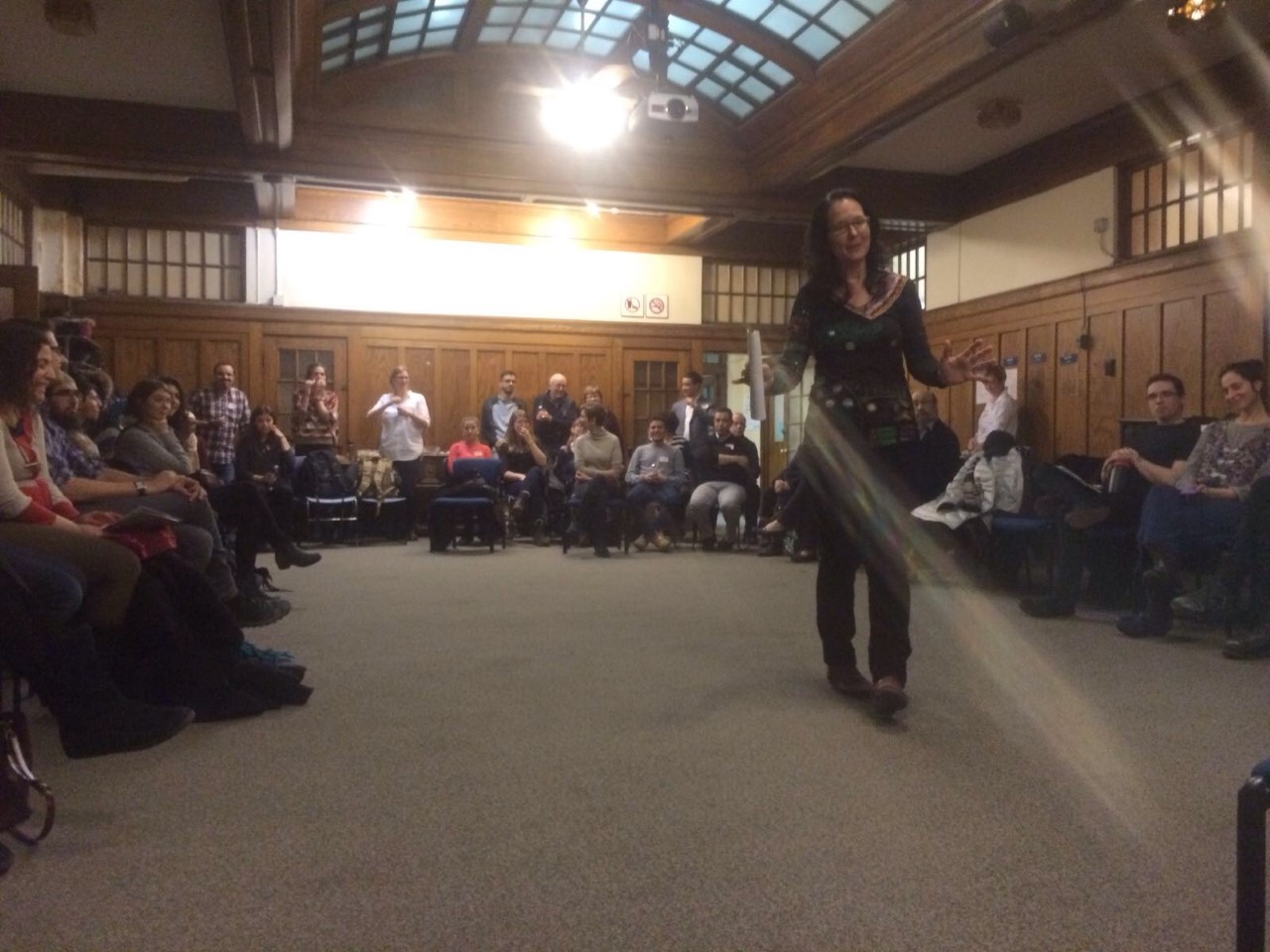
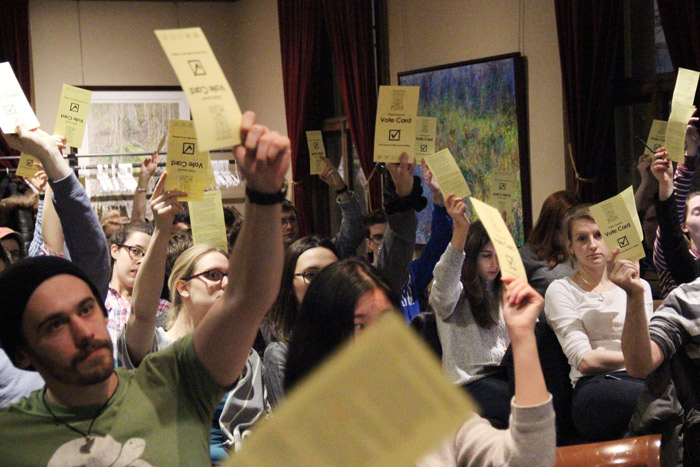
This past Thursday, Feb. 9, the Students’ Society of McGill University (SSMU) Legislative Council hosted speakers from McGill Athletics and Recreation and the Association for the Voice of Education in Quebec (AVEQ). In addition, two out of four motions were passed: the Motion for SSMU to Advocate for an Immediate Suspension of the Canada-U.S. Safe Third Country Agreement, as well as a motion to extend the executive electoral time. There were six notices of motion, including the motion regarding the Amendment of the Internal Regulations of Governance, which will be discussed at the Feb. 23 meeting, due to a lengthy question period at the beginning of the meeting. Questions pertained to a controversial tweet by Arts Representative Igor Sadikov.

On Feb. 6, Sadikov posted “punch a zionist [sic] today,” on his personal Twitter account. The tweet has since been shared on Facebook by several McGill students who expressed their concern over the message.

During an extended question period that lasted over 50 minutes, several students in the audience approached the microphone to condemn or defend Sadikov for his tweet. Questions addressed topics such as Sadikov’s definition of Zionism, the potential for his impeachment or resignation, and concerns over both his safety and that of Zionists on campus.

In response to a question from the audience, Sadikov expressed regret over the tweet.

“When I talk about Zionism I’m not referring to a group identity,” Sadikov said. “I’m referring to a political ideology. I understand that many members of the McGill community identify with the label Zionist and that for some of them, this label is connected to Jewish identity. As someone with Jewish heritage myself, I find it important to draw a clear distinction [between] Jewish identity, culture, and religion on the one hand, and Zionist politics and ideology on the other hand [….] I regret that the way I phrased my opposition to Zionism was harmful to some of my constituents and fellow students.”

Several hours before the Council meeting, the Arts Undergraduate Society (AUS), which Sadikov represents at SSMU Council, formally requested his resignation in a Facebook statement. On Feb. 13 the SSMU Board of Directors voted against removing Sadikov from his post.

During the question period, Science Senator Sean Taylor asked why Sadikov had ignored the AUS’ request for his resignation.

“I have not yet reached a decision on this issue,” Sadikov said. “I will follow the institutional procedures that exist in the governance documents.”

AUS President Becky Goldberg was also present. In a statement to the Council,  she discussed the backlash directed at Sadikov for the tweet.

“These are my words and not on behalf of the [AUS],” Goldberg said, “But [the exposure of the tweet] seems to be a little bit of a witch hunt, a political witch hunt, and I have tried to ensure Igor’s safety just in providing support in my capacity as a friend.”

Sadikov echoed Goldberg’s concerns for his safety.

“Over the past 24 hours, I have received hundreds of insults and threats on social media, my personal information has been posted online,” Sadikov said. “I cannot say that I feel safe [….] I am grateful for the solidarity that’s been shown to me, but I would prefer to see further institutional support.”

Social Work Representative Jasmine Segal–the only Councillor to openly identify as a Zionist during the meeting–replied to Sadikov’s safety concerns after the backlash his tweet received.

“I agree that you also need support and safety because I’ve seen some of the emails you’ve received,” Segal said. “However, I do think at the same time it’s important to note that you did make other people feel unsafe.”

A silence ensued after an Laura Khoury, U3 Engineering, asked why any Zionist councillors were allowed to sit on SSMU Council.

“I’m just wondering, since SSMU has a social justice mandate, why does it allow Zionist councillors on council when Zionist ideology is inherently [linked with] ethnically cleansing Palestinians and I, as a Palestinian, do not feel safe with councillors like that representing me on a daily basis,” Khoury said.

Ben Ger, SSMU president, was later asked to respond to the comment.

“I just want to point out that there are mechanisms put in place if people would like to see [their representatives] removed, but anyone who is elected is allowed to sit around this table and we try to focus on that key pillar of democracy,” Ger said.

Molly Harris, U2 Arts, attended the Council session as an audience member.

“The [Feb. 9] meeting was more unsafe than any [General Assembly meetings discussing Boycott, Divestment, Sanctions] that I’ve experienced in my three years at McGill,” Harris wrote in a message to The McGill Tribune. “When I asked how the SSMU and the AUS would protect me from being punched by anti-Zionists, the room fell totally silent.”

Khoury later commented on the Council meeting in a message to The McGill Tribune.

“I [felt] betrayed by the silence of almost all of my elected representatives at Council, where I had to listen to Zionists speak about protecting their dangerous, colonial belief,” Khoury wrote. “[The uproar] is clearly an exaggerated response to a tweet on a personal account, which makes it clear that [it] is an orchestrated campaign to instill intimidation and fear in anyone [who] expresses pro-Palestinian views.”

In addition to the response from SSMU, AUS, and the student body, members of the McGill administration issued two statements condemning the tweet on Feb. 9 and 13. The statements were issued on behalf of Provost and Vice-Principal (Academic) Christopher Manfredi and Principal and Vice Chancellor Suzanne Fortier.

“I was shocked to read that Twitter post and want to make it clear that the University condemns all expressions of hatred and attempts to incite violence, including any that have been made in reaction to the post,” Fortier wrote.

SSMU issued a formal statement on the tweet and the discussion at the Legislative Council via an email to members on Feb. 11.

“[…We] condemn physical, emotional, and institutional violence, and do not condone racism, discrimination, or prejudice in any form,” SSMU wrote. “We regret that some members of our community, including those present at the Legislative Council meeting on [Feb. 9], have felt personally attacked or unsafe due to the nature of the discussion or the original tweet.”

A previous version of this article incorrectly stated that there were 10 motions on the agenda, when in fact six of these were notices of motions and only four were motions to be voted on in the Feb. 9 Council session. 

Martlets, Sports

In conversation with Martlet Rugby alumna Gillian Florence

Canadian Rugby Hall of Famer and McGill alumna Gillian Florence spent 17 years playing internationally and retired as one of the most decorated athletes in her sport. She now lives rural Nova Scotia, where every morning she wakes up to the sounds of her chickens squawking. Despite her humble surroundings, Florence is one of the most celebrated players in Canadian rugby history, with a career spanning nearly two decades and five World Cups. As a reward for such an illustrious career, Rugby Canada will be honouring her as one of the seven inductees to the inaugural class of the Canadian Rugby Hall of Fame.

Florence began her rugby career playing for the Ste-Anne-De-Bellevue Rugby Football Club in the early 1990s. It was there that she became involved with the Canadian National Team.

“I had been playing with Ste-Anne Rugby Club, which was a top level club […] in the country,” Florence said. “McGill was [in] sort of a competitive league. It was fun and just another opportunity to play rugby in the fall.”

Florence played one season for the Martlets in 1995-96. As a freshman that year, she led the team with a pair of tries in a 50-0 beatdown of the Bishop’s Gaiters for the championship. Despite the team’s success, she was not able to continue playing for McGill.

“Back then, this was pre-CIS, […] there wasn’t much emphasis on the pathway to the national team,” Florence said. “The next season, I tried [to play for McGill], but it was conflicting with my national team responsibilities and commitments. It was too hard to do both.”

Starting in 1994, she played in five different rugby World Cups with the Canadian National Rugby team. Between 1994 and 2010, she played a fundamental role in Canada’s achievements on the field.  Before 1994, Canada was generally considered a second-tier nation in the sport. The nation was newcomer to international competition and had not fared well in prior appearances. During Florence’s tenure, the team never finished below sixth, reached the semifinals on two separate occasions, and was consistently ranked one of the top-five teams in the world. 

“Just the fact that Canada was in a semifinals, I think turned a lot of heads in the [international] rugby community,” Florence said. “We were what they called a ‘second tier nation’ in terms of the sport [….] Being able to compete on the world stage at that level, despite losing those games, we took pride in [playing] and were able to walk away from that still accomplishing something.”

Since retiring from national and club play in 2011, Florence has been focusing her career outside of rugby. She currently works for Ultra Electronics in Nova Scotia. 

“Obviously rugby and sports took up a big chunk of my 20’s and 30’s, so here I am,” Florence said. “I worked in Montreal for Caterpillar and we moved [to Nova Scotia] when I was eight months pregnant, I had my first [child] here.”

Despite the distance from rugby in her new home, she’s excited about the prospect of returning to the sport for the HoF ceremony.

“It’s sort of surreal right now,” Florence said. “I moved to rural Nova Scotia […] totally feeling out of the loop of the game and not relevant. As close as it was, it seems like a lifetime ago, [and]  I’m excited to get back into the Canadian rugby family.”

The HoF ceremony takes place on March 9 in Vancouver. It will precede the Canada Sevens men’s tournament that weekend. Florence and the other inductees will be in attendance for the matches, where they hope Canada will build on their 13th place finish in the Sydney Sevens on Feb. 5.

Montreal, News

Mayor Coderre holds consultations to open Montreal Urban Aboriginal Health Centre

The Montreal Urban Aboriginal Health Committee (MUAHC), an organization mandated to empowering the health of Montreal’s Aboriginal communities, has successfully brought the city’s mayor, Denis Coderre, and his cabinet into public consultations to open an Aboriginal health centre in Montreal. The health centre would provide free services to those of Aboriginal descent, including primary care, infectious disease treatment, chronic disease treatment, addiction treatment, traditional medicine, pediatric services, family services, homelessness and housing services, and cultural safety services.

On Jan. 19, MUAHC released a petition on its website seeking 15,000 signatories in order to be granted public consultation with the municipal government to discuss securing a building for the health centre. Members collected signatures in person on Jan. 20 at the Students’ Society of McGill University and on Jan. 21 at the Montreal Women’s March demonstration. However, Coderre agreed to hold public consultations even without the collection of the 15,000 signatories.

The centre would be the first of its kind in Montreal. In a press release, NETWORK—an organization that improves the quality of life for Montreal’s Aboriginal communities— stressed the importance of the new facility.

“While more than 12 Canadian cities have an Aboriginal health centre, Montreal, Canada’s second largest city, does not,” NETWORK wrote in a press release on Jan. 19, 2017. “In 2011, the Directeur de santé publique de Montréal highlighted the ongoing health and social inequalities for urban Aboriginal people in Montreal. The Directeur noted that the Aboriginal people of Montreal do not have easy access to health and social services, and emphasized that without appropriate support, these inequities can deepen.”

The press release cited a number of statistics from the National Collaborating Centre for Aboriginal Health indicating that members of Canada’s Aboriginal communities are at a higher than average risk of suffering from numerous medical ailments.

“While Aboriginal peoples comprise 3.8 per cent of Canada’s population, they account for 8 per cent of people living with HIV and 12.5 per cent of new infections,” NETWORK wrote. “Aboriginal peoples are also 26.4 times more likely to develop tuberculosis and are among the highest risk populations for diabetes and related complications. The rate of infant and child morbidity, adult and youth suicide, and infectious diseases is also much higher among Aboriginal populations.”

MUAHC has previously held a number of consultations with the provincial and federal government, including with the Ministère de la Santé et des Services sociaux, the Public Health Agency of Canada, and Aboriginal Affairs Canada, among others. Sean Yaphe, the co-coordinator at the Montreal Urban Aboriginal Health Committee, recognizes that there is more work to be done.

“Despite [the consultations], no substantive progress has been made in developing a holistic Aboriginal health centre,” Yaphe wrote in an email to The McGill Tribune. “Although multiple levels of government have shown interest, the response so far has been slow and fragmented.”

Currently, the organization is considering moving into the former Centre for Tuberculosis located on Rue Lucien-L’Allier. In addition to finding a location, MUAHC is also seeking funding and staff for the centre.

“Many doctors, nurses, elders, and healers working in the Aboriginal community have expressed interest in working in the health centre,” Yaphe wrote. “Fundraising and applications for funding sources will also be extremely important in the coming months in order to sustain the development of continued services of this project. We also require a mandate from the Ministère de Santé et des Services sociaux.”

The McGill Student Health Service does not offer any specific services for Aboriginal peoples. In an email to The McGill Tribune, Hashana Perera, the director of the McGill Student Health Service, said that demand for such services has not been expressed.

“We haven’t had any concerns expressed or […] seen a need to specifically direct resources toward our Aboriginal students,” Perera wrote. “If we did learn of any concerns, we would be happy to come up with a solution.”

Private, Student Life

Galentine’s Day: A celebration of femme friendship

Every year since the holiday’s inception in 2014, BFFs (best female friends) around the world have gathered together to celebrate Galentine’s Day on Feb. 13. This pre-Valentine’s holiday originates from the NBC hit-show Parks and Recreation, in which two lead characters, Leslie Knope (Amy Poehler) and Ann Perkins (Rashida Jones), celebrate their formidable friendship amid waffles, syrup, and the presence of beloved femme friends. The duo sparked a renaissance of appreciation and love among viewers for the women in their lives, leading fans to pick up the holiday practice themselves.

Celebrating friendships with fellow femmes is powerful. Because of the way women are socialized, it’s common for them to internalize misogyny without knowing it. This leads women to use the sexist ideals society promotes against each other, resulting in a malign and competitive mindset. Additionally, this mentality is most often unconscious, meaning women don’t realize they are complicit in sexism when they shame other women for their sexual history, claim that they get along better with men, or simply state that they are ‘not like other girls.’  The competition women subconciously feel toward other women is commonly pointed out in feminist literature, including in Roxane Gay’s essay, “How To Be Friends With Another Woman,” in which she explicitly lists her personal rules for maintain healthy friendship with other women. As such, showing gratitude for and giving support to fellow femmes is a radical, albeit sometimes difficult, thing to do. The power within femme friendships is often unrealized or underrepresented in the media, but it fills gaps that romantic relationships do not.

[metaslider id=50699]

In the McGill community, there are many who cherish their closest gals and who choose to celebrate them come Galentine’s Day. Sam Gibson and Marlee Nisenboim, both U1 Arts, are among the many students who break out the romantic comedies and sweet treats annually.

“Everyone has different types of friends, […] but you’re always gonna have one friend who’s your everything friend,” Gibson said, referring to her best friend, Nisenboim.

(Photo courtesy of Sam Gibson and Marlee Nisenboim)


The duo have known each other since their first year of university, having met on the seventh floor of McConnell Hall. Gibson and Nisenboim grew close as chance landed them in the same sociology class, and they bonded through shared academic stress. Over the course of their first semester, they bonded and studied, realizing how like-minded they were after many late-night talks. They began to write music together, and even performed together; their personalities blended as harmoniously as their voices.

Though Gibson and Nisenboim have shared a smattering of tough times, the best friends’ relationship has grown to its strongest point, free of jealousy and judgment. When Nisenboim decided to take the semester off in Fall 2016, Gibson fully supported her decision. And when Gibson missed her best friend at school, Nisenboim made it clear that physical distance didn’t change anything in their relationship.

“Even though we weren’t together, nothing really changed in terms of being there for each other,” Nisenboim said, reflecting on their daily text messages and weekly phone calls over the course of the semester.  

Gibson and Nisenboim exemplify the uniquely empowering nature of femme friendships in which women love and encourage each other. Friendship is a source of inspiration, a sentiment to which Sarah Binney and Melissa Langley, both U2 Arts, can relate. As best friends and fans of Parks and Recreation, they share a strikingly similar dynamic to the one between Leslie and Ann.

(Photo courtesy of Sarah Binney and Melissa Langley)


“I’m much more tightly wound than [Binney], and she’s really good at reminding me to have fun [….] Sarah is definitely Leslie. I’m definitely a Ben-Ann combo,” Langley said, making reference to the show’s main female characters and Leslie’s love interest, Ben Wyatt.

Binney and Langley grew up a block away from each other in Sharon, Massachusetts, but the two didn’t talk to one another until they found themselves carpooling to a McGill information session in Grade 12. Since arriving at McGill, the pair have grown close, having both lived in Douglas Hall their first year. Now well into their second year, they frequently find themselves discovering cafes on the weekends or cooking adventurous meals for dinner together. To them, their friendship is one of balance and support.

“There’s a lot of difficult things about being a woman, but the thing that’s most rewarding about it is that you get to support other women,” Binney said.

When it comes to women supporting other women, these best friends are on the same page: Always aiming to uplift each other, their friendship growing stronger as they do.

For Galentine’s Day, Binney and Langley made homemade brunch plans with their wider group of friends. Like Leslie and Ann, the goal was to eat the best breakfast food with the best of friends. For Binney and Langley, Leslie and Ann set a strong example of not only how to throw a successful Galentine’s Day bash, but of how to maintain a healthy friendship in their day-to-day life—an image that’s rarely portrayed in film and television.

“The strong female friendship is so underrepresented [in the media],” Binney said. “Leslie [Knope] is always expressing how much she loves her friends, and I really, really feel that way about my friends.”

Mutual love is present throughout these unique and radical femme friendships; love and be loved, support and be supported. Galentine’s Day is a breath of fresh air from the competitive social atmosphere between women, and serves as a reminder of the power of love between femme friends.

Arts & Entertainment, Music

Trib Mix: Songs for lovers at McGill

Being distracted in class while thinking about your significant other

Song: A Dreamy Day of Daydreaming of You (2001)

Artist: Of Montreal

As it’s title suggests, this soft, piano-driven song encapsulates the mood of a blissful daydream. The dragging chords and the band frontman Kevin Barnes’ hypnotic, honey-like vocals invite the listener to indulge in their imagination. This all comes together to elicit a euphoric feeling similar to what someone might experience when their attention is being lulled out of the lecture by the thoughts of a crush or a lover. The lyrics capture the feeling of being so completely lost in another person that everything else in life feels like a bore.

Best lyric: “I can dream of you without snoring and I'm lucky that that's true / Because everyone would know that I found them boring simply because they're not you.”

When you are too broke to go on a date

Song: Can’t Buy Me Love (1964)

Artist: The Beatles

This classic serves as a playful reminder that love is not about material possessions. Backed by a messily upbeat rhythm section, and Harrison’s iconic clangy lead guitar, McCartney proudly sings, “Say you don’t need no diamond rings, and I’ll be satisfied / Tell me that you want the kind of things that money just can’t buy / I don’t care too much for money, cause money can’t buy me love.” This is a message that many university students can take comfort in; in the midst of mounting student debts, it’s difficult for some of us to afford a dinner date, let alone a diamond ring.

Crushing on your lab partner

Song: Love Potion no. 9 (1973)

Artist: The Clovers

There is perhaps no better soundtrack for a budding romance between two lab partners than this classic song about a love potion. The concept of a magical potion that can make someone fall in love is an age-old trope; while surrounded by countless chemical solutions and compounds, an aspiring scientist’s mind might be fascinated by this idea. The lyrics tell the story of a lonely man who drinks a concoction which makes him fall wildly in love with anyone he sees. While drinking strange mixtures is the last thing anyone should do, this song gets the message across that at the end of the day, love is all about chemistry.

Avoiding your ex on campus

Song: Campus (2008)

Artist: Vampire Weekend

This song expresses the bitter anxiety of bumping into an ex-lover on campus. Accented by a fast, driving, muted guitar riff, the song builds a palpable feeling of nervousness, akin to the uneasy excitement associated with the narrative. Into the chorus, after the singer describes the moment of seeing his ex—the instrumentation blooms into a tender rhythm, as the lyrics express the sincerely poignant sentiments of the singer: ‘How am I supposed to pretend/I never want to see you again?

Love at first sight/night

Song: Strangers in the Night (1966)

Artist: Frank Sinatra

This is a classic love song that has captured the hearts of many for decades. Amidst the romantic orchestral accompaniment and Sinatra’s recognizable cheesy crooning, millennials can find a very relatable story about two people who impulsively fall in love in the dead of night. This vintage tune offers a classy commentary on modern hook-up culture, reminding listeners that it is completely possible for strangers to experience romance—even fleetingly.

Best lyrics: “Wondering in the night / What were the chances / We'd be sharing love/Before the night was through?”

For those moving away from their significant other

Song: Another Town (2006)

Artist: Regina Spektor

While the song is not explicitly about long-distance relationships, Spektor elegantly expresses the geographical boundlessness of love in this sweetly optimistic piece. In the verses, Spektor describes how she could be in different places doing different things: ‘In another town / They've given me the key / I'm drinking for free.’’ However, the chorus earnestly assures the listener that despite these variables, the one unchanging factor is that the singer would love the subject of her affections: ‘In another town / But I know I know I know / I love you.” Supported by Spektor’s lively and imaginative piano-work, this song serves as an affirmation of love’s mystical ability to bypass physical separation.

When everyone, including yourself, doubts your relationship  

Song: Bound 2 (2013)

Artist: Kanye West

In this song Kanye eloquently lays out the challenges of sustaining a new and rocky relationship. In university, enveloped in a dating culture based on hook-ups and short flings, we often make tenuous connections. Many student relationships begin in a place of insecurity, and friends-with-benefits wonder if what they have is worth committing to. Kanye’s lyrics succinctly and cleverly express the doubt, but also the underlying hopefulness unlikely lovers often feel: “And hey, ayo, we made it to Thanksgiving / So hey, maybe we can make it to Christmas.”

Learning to love everyone

Song: Seasons of Love (1996)

Artist : Jonathan Larson

In university, thousands of students with different backgrounds, cultures, and beliefs come together to learn. Because of this, it is the best place to gain first-hard experience of the universality of love. While there are many songs that explore this idea, none of them gets the message across with as much astute simplicity as this broadway classic from /Rent/. Wrapped in a medley of ethereal harmonies, the song contains the message that the best way to measure one’s life is through love: “In five hundred twenty-five thousand six hundred minutes / How do you measure a year in the life / How about love?” Delivered by a diverse chorus, the song can serve as a reminder to students that, while there is a wide array of people at university, no matter who you are, and what you go through, the love you experience is ultimately the most important thing.

Private, Student Life

Dating in the fast lane: McGill student groups offer speed-dating Valentine’s day dating events

McGill students value efficiency. With the pressures of midterms, internship applications, and extracurricular commitments, many students lack time to date regularly. For many, the answer to time constraints is the quick swipeability of Tinder. For others, an approach that combines the ease of apps and the importance of social interaction is speed-dating and matchmaking. For Valentine’s Day, several student groups at McGill have strived to show students how more traditional forms of blind-dating are done.


The McGill Chinese Students’ Society (MCSS) had its own take on matchmaking this year with a blind speed-dating event on Feb. 11, Be There or Be Square: Valentine’s Party. Participants ranked their top five choices of partners after several rounds of quick chatting, and a computer algorithm identified matches from the choices selected.

To shake things up, participants were given mysterious Venetian-esque masks and a number at the door. With that digit as a sole identifier for each participant, the hopeful hearts in attendance were free to express themselves however they liked. In the same way that dating app users can control their appearance online, this anonymity enabled attendees to converse with their partners without feeling self-conscious about their looks.

“We wanted to provide a mysterious atmosphere to this event so people could blind date without judging others’ appearances right off the bat,” Tony Ye, U2 Engineering and project manager of MCSS, said. “One of the perks of blind speed-dating is the release of dopamine and endorphins from anticipation and excitement from talking to someone with a mask on.”

For participants, the climax of the event was the removal of the masks at the end. The anticipation was akin to what online daters might feel before meeting a date in person, although their nerves were somewhat alleviated by the participants having already met in disguise.

“There [was] a grand reveal in which everyone [took] their masks off,” Ye said. “That moment [was] full of joy and laughter, or perhaps a little disappointment.”

This event delves deeper than superficial first attraction based on looks. A primary attraction of speed-dating is found within the light-hearted freedom of mingling with many equally hopeful participants.

“This type of event [attracted a] large crowd because it is interesting, and [speed-dating with masks has] never been done before at McGill,” Ye said. “It takes in the philosophical art of blind speed-dating fused with the mysterious science of a computer algorithm.”

Gamifying the pursuit of soulmates, the McGill Students for Think Pink’s matchmaking event on Feb. 10, My Funny Valentine, had participants trying to find who Think Pink had matched them with based on their answers to an online quiz. Among other fun tasks, the quiz asked participants about their ideal study methods, their favourite Pokémon, and to write a haiku addressed to “the one.” After being handed the quiz answers of another event attendee, deemed their “ideal partner” based on response compatibility, participants were tasked with locating their ideal partner themselves. Couples who successfully found each other received prizes, which were mainly gift cards to finance their first real date.

“Everyone got along so well that we all wouldn’t stop talking long enough to get directions out for some of the activities,” Sam Wunderlich, U1 Arts and Science and vice-president of Think Pink’s Financial Implementation and Sponsorship Committee, said. “Two couples hit it off and walked out hand-in-hand with each other, even before the event was halfway done, so hopefully that was a good sign! There was [also] one match that just sat and talked in the middle of everyone, absorbed in their own little world.”

Speed-dating creates a positive, energetic environment for participants. Even if they lack romantic chemistry off the bat, people tend to enjoy the opportunity to meet each other, and engage in opportunities that can’t be found online.

“There is never a lull in conversation because you have limited time with that person before you move on to the next,” Wunderlich said. “It’s a really relaxing way of meeting people […and you’re] surrounded by tons of others in the same situation as you, it’s almost comforting.”

Speed-dating is a great way to interact with someone new in a candid way that is not present on dating apps. The Valentine’s Day events while kept the search of love light, emphasizing what it really should be about in the end: Fun.

Baseball, Sports

Changing the game: NBA rules

Stop sending bad free-throw shooters to the line: Stephen Gill, Contributor

Current “Hack-a-Shaq” rules give teams an alternative to actually playing defence when the other team has possession. Rather than creating a real defensive scheme, opposing coaches can just send poor free-throw shooters to the charity stripe whenever they please.

The strategy slows games to a crawl and turns basketball into a free-throw shooting contest. The only counter to this trick is to remove the poor shooter from the game, meaning far too much emphasis is placed on a player’s ability to make uncontested 15-footers. This game plan plagues basketball from both an aesthetic and strategic standpoint.

The league needs to prevent these senseless gimmicks with a simple solution: When an off-ball foul occurs, the offensive team should be given the choice to restart the possession or head to the free-throw line for a pair of shots. This would finally put an end to the Hack-a-Shaq strategy, giving NBA fans defence to cheer for rather than watching some knucklehead miss shots from the charity stripe. Defenders would have to keep DeAndre Jordan from dunking on them instead of laughing as he helplessly bricks shot after shot from the line.


24 seconds is too long after offensive rebounds: Wasif Husain, Contributor

With the rise of guards like Steph Curry and Kyrie Irving  boasting both incredible ball-handling and deep-shooting abilities, teams are able to waste game time as these players dance around behind the three point arc without risk of a turnover. The NBA needs to do away with these painful experiences by implementing a 14-second shot clock after a team grabs an offensive rebound. A reduced shot clock would give teams more time to attempt a comeback, adding excitement to boring blowouts 

As it stands now, the clock resets to the standard 24-second mark when the offence recovers the ball. The result is slow possessions with little time for losing teams to attempt a comeback. The league has already started experimenting with a 14-second clock in the D-League, which has has received rave reviews. These matches are faster-paced and more entertaining to watch, despite having a lower level of talent across the board. If implemented in the NBA, the 14-second timer would accelerate gameplay and make games far more exciting. In a league dominated by just a few really good teams, pushing the pace of the game may allow new strategies to knock off the continuing Golden State Warriors-Cleveland Cavaliers supremacy.


No more cheap threes: Jonas Cohen, Contributor

Initially just a risky proposition with the potential to yield high rewards, the three-point shot has become one of the most abused tools in the NBA. An undeniable crowd-pleaser in games, especially when Steph Curry effortlessly sinks threes from beyond halfcourt, the three-point shot has diminished the the value of big men for too long. Without cheap threes, the NBA would have a big-man renaissance, harkening back to the days when Charles Oakley and Bill Laimbeer ruled the court from the paint.

The NBA must foster a more a mentality that values versatile players. Avid basketball fans yearn for the days when no backboard was safe from destructive “Shaq Attacks.” Fans definitely don’t buy overpriced tickets to watch Kyle Korver relentlessly jack up corner threes while the rest of the team hustles on both ends of the court. At the very least, it’s time to move the three-point line back three feet. In an even more radical move, the NBA should get rid of corner threes by drawing the arc from wing to wing. It wouldn’t take away from the most talented players; it would just prevent three-point specialists from camping out in the corners. 

Science & Technology

Unlocking the benefits of exercise for mental health

It’s a no-brainer that the physical benefits of exercise can take time to manifest, but the emotional and mental benefits can be almost instantaneous.

“When we exercise, more of the hormone serotonin is released,” Louise Lockhart, a nurse at Macdonald campus’ Student Health Services, explained.

These hormonal releases work as an immediate mood booster.

“When we exercise, blood flow increases steadily to the brain and other hormones are also released, such as thyroxine and androgen, which lead to a much calmer demeanour,” Lockhart said.

In addition to improving mood, exercise can lead to greater confidence.

“Overall, even after exercising a moderate amount, we can feel an immediate boost of energy, self esteem, and increased cognitive function,” Lockhart said.

In university, regular exercise becomes increasingly important in managing anxiety and mild depression, since these conditions usually develop during late adolescence and early adulthood. However, with severe depression, it is necessary to contact a professional.

“[There is] a lot of data [that] suggests that college students [who] exercise report [fewer] mental health problems,” Jill Barker, director of Macdonald Athletics and Recreation and a fitness columnist for the Montreal Gazette, said.

Mathilde Guglielmi, U1 Environment, has felt the benefits from exercise first hand. Guglielmi explained that she started experiencing symptoms of depression during the summer after her freshman year at McGill. Running became her way to improve her mood and fight depression.

“I kept running and it [became] a kind of a drive,” Guglielmi said. “The anxiety is worst when I don’t run, so my body gives me a push to go.”

For Gugliemi, running is also a study aid. Studies have shown regular exercise has positive impacts on productivity in the workplace, and for that matter, the classroom.

“It motivates me!” Gugliemi said. “After a run, I become more productive and get more stuff done. When I don’t run, I am more jittery and distracted.”

It can be difficult to know how to form a new habit. Yet, it is important to focus on self-care to experience the positive effects of exercise on one’s mental state.

“‘No pain, no gain’ is counter-productive if you want the emotional and mental benefits of exercise,” Lockhart said.

Gugliemi suggested finding people to run with so it keeps you accountable to a plan.

“It helps because you have motivation as you can talk to them while you run and you can challenge each other,” Gugliemi said. “Exercise was always a social thing.”

Exercise also presents an opportunity for social interaction. As Gugliemi explains, there’s no shame in starting slow.

“You can start running in intervals where you [switch between] running and walking,” Gugliemi said.

Overall, exercise should be enjoyable and leave you feeling relaxed. Though it can be difficult, Barker offered some helpful tips to get started on a regular fitness routine.

“[Use] an app to track your goals and progress, [find] something that you really want to do, [and] start slowly and spread out your workout,” Barker said.

Ultimately, self-encouragement and visualization are helpful tools when trying to find motivation and will help develop positive feelings towards working out.

Next time you’re struggling to get out and run, remember that the rewards are not just physical, but mental, and will literally pay off in the long run.

McGill, News

OSD continues to be plagued with long wait times and lack of staff

Recently, the McGill Office for Students with Disabilities (OSD) has faced a lack of capacity and resources due to a heavy demand from students. The OSD’s mission is to provide students who experience permanent and temporary disability, illness, and injury with a wide range of services, including workshops, note-taking services, awareness campaigns, and alternative examination accommodations. The OSD was established at McGill in the 1980s in accordance with the Quebec Charter of Rights and Freedoms.

Over the past decade, the number of students registered with the OSD rose from 500 to over 1,800. Despite the large number of affected students, the office currently has only 11 staff members, a number that has remained stable since 2010. 

“McGill is not upholding its legal duty to accommodate students because it is not adequately resourcing this office, and we know that many students fall through the cracks as a result,” the Students’ Society of McGill University Vice-President University Affairs Erin Sobat said.

In Fall 2015, changes were made to the provincial grant funding structure that affected the OSD. The allocation of $1.2 million from the Quebec Education Ministry was not given directly to the OSD, but was rather incorporated into McGill’s annual budget. The McGill administration stated that the funds would be used to support a wider range of students not limited to those registered at the OSD.

“[There is] concern that government funding is not going directly towards the OSD and that it is simply being funded by students [as a part of the student services fee],” Sobat said.

For students trying to access the resources provided by the OSD, wait time when initially registering with the office can be a significant issue. Andries Feder, U3 Arts, is registered with the OSD. He said that because same-day appointments are not available, long wait times become a concern.

“Once I got an appointment, [the OSD was] pretty helpful, [it just] takes such a long time to get that initial appointment,” Feder said. “[If they need exam accommodations], some people [try] to schedule an appointment at the beginning of the semester, and they can’t schedule one until […] after some of their midterms start. It's a little disconcerting because there isn't an active availability.”

OSD Director Teri Phillips acknowledged the problem of under-capacity in an email to The McGill Tribune. Phillips wrote that excessive wait times are a problem for the OSD.

“At peak times, particularly during the Fall semester, advising wait times stand at the two- to three-week mark, which is not uncommon across similar [McGill student] services,” Phillips wrote.

Sobat said that the limited budget is a source of problems for the OSD, stemming from a general lack of funding and resources allocated to McGill student services in recent years.

“It is the general lack of capacity of the disability and access services at McGill,” Sobat said. “One of the biggest issues is that McGill is not only not adding more resources to the OSD, but taking resources away from student services in general [….]”

According to Phillips, financial restrictions imposed on the OSD in recent years have hampered some of the services it provides, but that changes to the provincial grant funding model did not affect the OSD’s overall provision of services.

“The intent of this change, which was initiated at a provincial level, not within McGill specifically, was to decrease the administrative burden on the individual student, such as having to hire and pay their own attendant and do follow-up reconciliation,” Phillips wrote. “As many are aware, student access to disability-related funding changed as of Fall 2015.”

This change has not removed the availability of funding for students, it has simply shifted responsibility for administration to the institution and shifted the avenue by which a student gains access.”

Phillips explained that, for the time being, the OSD is aware thatthe lack of resources and  problems with implementation of accommodation policies across McGill cause problems for affected students..

“We are cognizant of the sensitivity of needs of those students experiencing barriers to engage fully in the McGill learning environment, and the impact that this can have on their studies,” Phillips wrote.

Laughing Matters, Off the Board, Opinion

Laughing Matters: Squirrel slander put to rest

McGill has been the target of some vile chattering. As good McGillians, we must stand up for our grey friends—mostly because they can’t speak for themselves. Ladies and gentlemen, I am addressing the University of British Columbia’s (UBC) student newspaper, The Ubyssey, and one article’s boast that UBC’s squirrels are more popular than McGill’s. Fortunately, their swaggering is rife with alternative facts, and McGill can rest easy knowing that its squirrels still reign supreme. The McGill Tribune tried reaching out for comments from our fuzzy friends, but since even our best endeavours failed, our perspective will mainly be that of Homo sapiens.

Ever since there have been students, there have been squirrel enthusiasts. Several universities have Facebook groups dedicated to posting pictures of the local critters, including “Squirrels of UBC,” “Squirrels of McGill,” and “Raccoons of SFU,” with The Ubyssey reporting them to have 4,000, 3,800, and 101 Facebook likes respectively. So while it’s true that UBC squirrels have the highest absolute number of likes, it’s a mistake to draw the conclusion that they are “narrowly beating” the other top Canadian universities. In reality, what really matters is the ‘likes per squirrel fanatic,’ or LPSF. By its 2015 numbers, UBC has 61,113 students, and McGill reports 40,493 as of 2016. Assuming all UBC students are squirrel fanatics, as we are, you’ll notice that McGill’s LPSF ratio is higher at 0.094 versus 0.065.

What’s more, one must factor in the geographic differences between campuses. Thanks to its comparatively smaller size, McGill is a close-knit, community-based campus, which provides a more authentic and personal squirrel spotting experience. McGill isn’t just a place to scurry for scraps—it’s a home. Meanwhile, it’s impossible to tell where UBC ends and the surrounding forest begins; the UBC label may be imposed upon squirrels that more accurately identify with the neighbouring Pacific Spirit Park.


Thanks to its comparatively smaller size, McGill is a close-knit, community-based campus, which provides a more authentic and personal squirrel spotting experience.

Our environment is simply more suitable for squirrels. As any McGillian can tell you, our squirrels’ carefree attitude is only matched by their hefty weight. They are free to frolic across our campus. Thanks to the never-ending construction on the Sherbrooke and MacTavish streets, the constant police presence keeps dangerous carnivores at bay. Meanwhile, at UBC, coyotes prey freely on squirrels to the apparent disregard of onlookers. Indifferent Reddit users commented on the UBC subreddit, “I think I saw that [coyote] eat like three squirrels on three different occasions,” and “my bio prof saw it and called it natural selection in action.”

Additionally, McGill students’ relationships with the resident squirrels are superior. On campus, students and squirrels live in harmony. McGill squirrel fans should not be alarmed that the “Squirrels of UBC” page has more activity. This is easily explained by Montreal temperatures being so low that Arcade Fire wrote a song about it, so opportunities to take off our gloves to snap a pic are few and far between.

At the same time, our squirrels are too busy surviving and being conscientious citizens to pose for pictures. In a development exemplary of the close relationship between McGill’s squirrels and scholars, 2010 research by McGill Professor Murray Humphries revealed several cases of squirrels adopting the orphaned pups of their neighbours. UBC does not show any signs of embracing the research opportunities provided by their local critters, likely because their underachieving squirrels are too busy scavenging at a Lululemon to contribute to advancing scientific inquiry.

Thus, as with many things in life, the less calculable factors must be taken into consideration as well. Blanket statements based on minor details are not a proper foundation for which school’s squirrels are better. Besides, when it all comes down to it, squirrels of all furs, all across Canada, need to hunker down together for the next four years as we weather the storm of the big orange nut to our South.


Calvin Trottier-Chi is a News Editor at the McGill Tribune.


Read the latest issue

Read the latest issue