Latest News

Album Reviews, Arts & Entertainment, Music

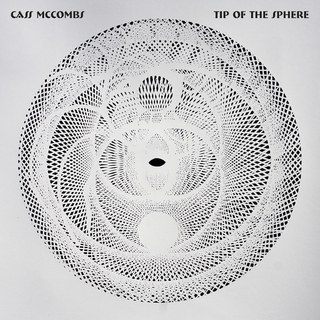
‘Tip of the Sphere’ is a little bit magical

Singer-songwriter Cass McCombs has always been a compelling storyteller and Tip of the Sphere, his latest work, might just be his magnum opus. The album, released on Feb. 8, is a whirlwind of fantastical world-building, deft lyricism, and cathartic melodies.

The songs are a subtle departure from the spare, folksy aesthetic of McCombs’ past few albums. While 2016’s Mangy Love was delicate and earthy, Tip of the Sphere introduces a fuller, more robust sound which better accompanies the depth of the themes of loss and regret that his work explores.

“The Great Pixley Train Robbery,” the second track on the album, tells the story of a riotous railroad heist involving a fugitive, an insurance salesman, and an otherwise-nondescript passenger from Modesto, California. The details of the fictionalized robbery unfold against a backdrop of thundering percussions and galloping acoustic guitar to produce an atmosphere that perfectly accommodates the wildly-specific dystopian stick-up that McCombs describes.

Few songwriters can boast the kind of lyrical dexterity that McCombs has deployed over the years. In 2015, the artist penned “Bradley Manning,” a somber folk song that mournfully chronicles the tale of a real-life army private who was sentenced to 35 years in military prison for divulging classified documents to WikiLeaks. Four years later, McCombs has seamlessly transitioned from writing political protest ballads to churning out surrealist, dream-like melodramas.

The scope of his stories ranges from transcendental to mundane: “Tying Up Loose Ends,” the album’s melancholic centrepiece, finds its narrator picking through a box of old family photographs, unable to remember the name of the man pictured next to his Aunt Dorothy. McComb’s breadth of skill is equally as poignant on “Sleeping Volcanoes,” an existential and foreboding song about impending natural disaster.

Tip of the Sphere invites the world to see through the keen eyes of an overactive imagination. With his croaky vocals and warm melodies, McCombs beckons his listener into a weird and wonderful world they will never want to leave.

4.5 stars


Arts & Entertainment, Theatre

McGill Drama Festival continues to impress

Every year, Player’s Theatre’s Drama Festival highlights the abundance of student talent that McGill’s theatre scene has to offer. Showing until Feb. 23, the festival offers six original short plays written, directed, produced, and performed by students. Stories that depicted everything from a first date between high-schoolers to an existential drama set in 1930s Harlem graced the stage at the Mainline Theatre.

Young Love

Leo Stillinger, Staff Writer

This brilliant and concise comedy tells the story of a  high school first date in the style of a Discovery Channel documentary. Narrated by Steven Finley, the audience peers into to a cringeworthy natural spectacle of medium-sized proportion: The teenage movie date. Viewers watch in suspense as Ari (Liana Brooks, U3 Science) and Bea (Isobel Macleod) struggle through conversational miscues, spilled popcorn, and their own mutual attraction. Finley steals the show as the eccentric narrator, but Brooks and Macleod are equally captivating in their portrayal of the sweet and self-conscious lovebirds. Victoria Stevens’ (U1, Education) script and Hope Kelly’s direction were both perfect, and this tour de force left the audience howling with laughter.

A Man in Hue

Leo Stillinger, Staff Writer

Written by Steve Greenwood, A Man in Hue was a charming amalgam of Shakespearean theatre: An adaptation of Twelfth Night featuring characters from The Tempest. According to Greenwood’s introduction, both plays are “rich with queerness,” and the adaptation brought Shakespeare’s complex network of homoerotic tensions to the fore. Featuring unrequited lovers, power-grabbing queens, and twin siblings who swap suitors, A Man in Hue was an entertaining dive into a hybrid world. Caroline Portante’s (U4 Arts) direction brought the script, which mixes Shakespearean diction with modern swear words, to its full comic potential. A Man in Hue represents queer relationships with a clever twist on Shakespearean scholarship, and it pulls off this performance with aplomb.

Mike and Jo (Jo & Mike)

Nicholas Raffoul, Staff Writer

In an Eternal Sunshine of the Spotless Mind-esque production that takes place in the near-future dystopia, exes Jo (Ana Krutchinsky, U2 Arts) and Mike (James Pallato, U2 Arts) have to reconcile their differences and find themselves on good terms. If they fail to meet this seemingly simple objective, they face expulsion from their city. To promote maximum efficiency, the city’s government requires that all citizens fully cooperate with each other. Thus, the two characters are forced into ‘Relationship Recovery,’ an absurd machine invented by a Nurse (Maeve Williams, U1 Arts) with the help of her intern (Ethan Mendell, U1 Arts & Sciences), in which Mike and Jo unpack their relationship, and learn how to move on. The process forces the couple to sit in a room and watch holograms of their bittersweet memories, including the first time they met, their first date, and their breakup. Light and sound effects create the illusion of the latest cutting-edge advancement in relationship technology. Written by Kate Hammer, in her third year at Concordia studying Creative Writing and French, and directed by Tess Capern (U1 Arts), Mike and Jo provides an interesting perspective on breakups and communicating with an ex.

The Bottomless Pit in the Back Room of Nick’s Speakeasy

Nicholas Raffoul, Staff Writer

After selling his soul to the devil, con-man and aspiring musician Tom (Harry Skinner, U3 Music) tries to cheat his soul back from Pinch (Sydney Gemin, U3, Management), Satan is disguise. He tries to win it back in a preposterous card game with Pinch and Zoras (Jen Ower), a graceful and witty angel, losing terribly. In an attempt to settle his bet and replace his soul, Tom scrambles around 1930s Harlem hoping to find and con a gullible stranger out of their soul before the devil comes to collect his. He meets, among others, Cleopatra (Gretel Kahn, U3, Arts), a sharp and melodramatic hospital patient whose illness has forced her into solitude. The trio of Kahn, Ower, and Gemin, play two hilarious roles each, allowing for a diverse range of likable characters in a small cast. With hilarious performances by Kahn and Ower, and a ridiculous card game, The Bottomless Pit in the Back Room of Nick’s Speakeasy offers silly and lovable characters, witty comebacks, and insight into the consequences of betting against the devil herself.

Yellow Room

Diana Viola, Contributor

Yellow Room, written by Paige Lawson (U1 Arts) and directed by Summer Mahmud (U2, Arts), reconstructs friends Flynn and Sloane’s blurry memories of a summer night spent in the bedroom of an old friend whose identity remains a mystery for the majority of the play.  

Sloane, played by Victoria Stevens, is intent on ensuring that  Flynn’s (Laine Berry, U1, Science) attempts to downplay the story do not obscure the truth. Gretel Kahn (U3 Arts), who portrays Flynn and Sloane’s mysterious friend, and Sofie Farkas (U2 Arts), as Lisa, her significant other, slowly unveil the truth about the teenagers’ tumultuous relationships and the misremembered events of the fateful summer night. The play’s ending relieves the tension that builds between the characters over the course of the story but leaves the audience questioning the reliability of the story’s narrators.  

8 ½ Collisions

Diana Viola, Contributor

Written by Danielle Eyer, 8 ½ Collisions is an unflinching portrayal of mental illness following Ferris Powell  (Nathan Mendel) and June Hayes (Ines Vieux Francoeur, U1 Arts), during their stays in a psychiatric hospital. Both are trapped by the loneliness of their illnesses and are at the mercy of  Mania (Leya Gervais), an omnipresent puppeteer who controls their actions. Mania commands that Ferris and June meet just eight times over the course of their stays, allowing the character’s to explore the intersections of their illnesses. “Who was the last person you met? Will you keep in touch? Did you catch their name?” These are some questions, written in the program, that director Charles Atkinson (U0 Arts) poses to his audience, encouraging viewers to reflect on how a single encounter could change their lives. 8 ½ Collisions further questions how much control individuals truly have over their own lives.

 

Hockey, Sports

Bold trades that could happen at the deadline

Recent National Hockey League trade deadlines have proved massive disappointments, with few trades despite weeks of speculation and hours of television coverage. However, with several big-name players on the trade block, this year’s deadline promises to be more eventful. As the deadline approaches, both buyers and sellers could find value in less obvious options.

Columbus Blue Jackets trade F Artemi Panarin to the Colorado Avalanche for F Alex Kerfoot and a 2019 first-round draft pick

All indications suggest that Panarin is on his way out of Ohio and wants to play in a larger market like Denver. The Avalanche have the most offensively potent line in hockey in Nathan MacKinnon, Mikko Rantanen, and Gabriel Landeskog. However, they lack firepower beyond those three players, and Panarin would fit well on their second line to boost scoring. In the future, the Avalanche will need to manoeuvre around the salary cap due to Rantanen’s impending contract extension, but for now, this trade would secure them a 2019 playoff spot. Moreover, they already have the lowly Ottawa Senators’ first-round pick, so sacrificing their own pick is a minor loss.

For Columbus, the trade would be ideal. For one, Panarin would be out of their conference. Furthermore, Kerfoot, a talented, young centre, would fill a hole in the Jackets’ lineup, and the pick could fetch another promising young player in the draft—or if they are bold, an immediate replacement for Panarin.

Blue Jackets acquire F Matt Duchene from the Ottawa Senators for Colorado’s 2019 first-round pick and a 2019 third-round pick

The best way for Columbus to replace Panarin would be to flip the aforementioned first-round pick from Colorado over to the Senators. The Blue Jackets would walk away with a strong haul: Duchene, a proven first-line forward, and Kerfoot, a young, up-and-coming centre. As for Ottawa, their roster is in desperate need of a shake-up. The struggling Senators’ trade for Duchene last season proved a mistake when their team ultimately put together a disappointing campaign. So far, Duchene’s performance has been inconsistent; however, his reputation will demand an impressive contract this summer and trading him would serve Ottawa well. Drafting well is critical to rebuilding a club, and Senators General Manager Pierre Dorion needs to rebuild quickly if he wants to salvage his job. Colorado’s first-round pick would go a long way toward building his team’s future, and the third-rounder only sweetens the deal.

New York Rangers trade F Mats Zuccarello to Winnipeg Jets for Winnipeg’s 2019 first-round pick

For the first season in a long time, the Jets have a legitimate chance at the Stanley Cup. As such, they should focus on building a championship team. Their one offensive weakness is on the right wing, and Zuccarello, a top-six forward for the rebuilding Rangers, can help to counter this flaw. He is on an expiring contract with a manageable $4.5 million cap hit, which means that he would be an affordable option for the Jets for the remainder of the season. Since Patrik Laine, Kyle Connor, and Jacob Trouba will all need new contracts this offseason, the Jets likely won’t commit to Zuccarello long-term, but he could have a significant impact in a Cup campaign. Jets GM Kevin Cheveldayoff has made it known that his team’s first-round pick is available, and the Rangers have committed to a rebuild in which any pick is important. The Rangers and Jets are thus a perfect match.

These trades may seem odd at first glance but could prove valuable as the postseason approaches. As teams look to solidify their postseason position, those who want to hoist the Stanley Cup come June should seriously consider making moves that fundamentally change the NHL landscape.

McGill, News

McGill receives $200 million to fund graduate scholarships

On Feb. 14, the McGill University Board of Governors (BoG) announced the new McCall MacBain Scholarship and discussed the Strategic Research Plan, sexual violence policy revisions, and the annual report of the Committee on Student Discipline. The BoG also approved motions that were previously approved by Senate, such as the creation of an Institute of Health Sciences Education within the Faculty of Medicine and the renaming of the Département de langues et littératures françaises to the Département des littératures de langue française, de traduction et de création.

McCall MacBain Scholarship

In honour of McGill’s upcoming bicentennial celebration, John McCall MacBain and Marcy McCall MacBain, both McGill alumni, donated $200 million to McGill to establish a new scholarship to support graduate students. This is the single largest gift to any university in Canadian history.

“We are investing a lot of money […] in selection,” J. McCall MacBain said. “Going around and trying to find those hidden jewels around Canada […] and around the world to come to McGill.”

Applications for the new McCall MacBain Scholarship will open in Winter 2020, with the inaugural scholars set to arrive in Fall 2021. The scholarship aims to support a network of up to 75 students per year.

Sexual violence policy revisions

Although McGill has had a sexual violence policy since Dec. 2016, the university missed the provincial government’s Jan. 1 deadline to update its policy. This deadline was set as part of Quebec’s Bill 151, an act to prevent and fight sexual violence at higher education institutions, which required institutions to create or update their policies with new regulations.

“Since we established our own policy in 2016, […] the provincial government […] introduced legislation so that each institution [should] have a policy on sexual violence, and they had some elements that they were putting in their legislation that we would have to add in our own policy,” Principal and Vice-Chancellor Suzanne Fortier said. “[The revised McGill Policy] is actually going to be presented at Senate in our next meeting next week.”

Senate will vote on the revised sexual violence policy at their next meeting on Feb. 20.

Strategic Research Plan

Martha Crago, Vice-Principal (Research and Innovation), presented McGill’s latest revised Strategic Research Plan (SRP). The SRP outlines McGill’s strategy and vision for increasing research over the next five years and was last ratified in 2013. It underwent a multi-level consultation period from Mar. to Nov. 2018 and was endorsed at Senate.

“Every university in Canada needs an SRP. We’ve had one for quite a while, [and] this is the latest version,” Crago said.

The SRP contains five core commitments to research, including a new one dedicated to promoting equity, diversity, and inclusion. Additionally, the SRP highlights seven Research Excellence Themes, with two new ones focusing on technology in the digital age and sustainability innovations. Lastly, the SRP presents four strategic objectives for materializing the university’s vision which relate to strengthening innovation, collaboration, and diversity.

Report of the Committee on Student Discipline

Dean of Students Christopher Buddle presented the annual report of the Committee on Student Discipline, which dictates university policy relating to the Code of Student Conduct and Disciplinary Procedures. According to Buddle, the university needs more staff trained to handle academic offence accusations.

“We had a similar number of cases as we’ve had other years, [and] we have more academic offences reported than non-academic offences,” Buddle said. “Of the academic offences, typically about a third or so of those end up being exonerations [….] This is actually an important point because it means that professors aren’t actually always the right people to be making [accusations of an academic offence]. In fact, we need trained disciplinary officers to oversee that process.”

According to the report, plagiarism is the most prevalent academic offence, comprising 72 per cent of cases, followed by cheating. For non-academic offences, the most common ones fall under article 10 of the code, ‘Physical Abuses, Harassment, and Dangerous Activity.’

The BoG will meet again on Apr. 25.

Football, Hockey, Sports

Changing concussion policy in youth sports

With growing amounts of research on the occurrence of concussions in contact sports, conversations about how to keep young athletes safe in organized sporting environments have expanded. At his Feb. 14 talk, “The Games We Play: What Should Law and Policy do About Playing Collision Sports?,” Jason Chung, an attorney and senior research scholar at New York University’s Sports and Society Program, discussed his efforts to find policies balancing the benefits of sports with safety standards backed by scientific research.

“No medical professional will ever say that getting hit in the head repeatedly is a good thing,” Chung said.

However, concussion research has not yet definitively established a cause-and-effect relationship between traumatic brain injuries sustained from collision sports and long-term neurodegenerative effects. Currently, researchers’ focus is on professional sports, such as the NFL and NHL, where there is a greater risk for chronic traumatic encephalopathy (CTE), a condition that results from repeated impacts to the head. Applying these findings to youth sports is not scientifically sound: The pace of play is not nearly as intense, and athletes’ brains are at different stages of development.

“The recurrent research that’s been performed regarding CTE is on elite athletes with far greater exposure [to CTE] than you and I,” Chung said. “When we talk about risk to the general population, we have to be careful not to take extreme cases or edge cases and extrapolate their experiences to the general public.”

However, both Canada and the U.S. have seen a rise in legislative attempts to restrict or ban collision sports at the youth level based on a belief that action is necessary even without conclusive research. Chung argued that there are more productive ways to address the issue like having open discussions about the pros and cons of a total ban, along with conducting longitudinal studies.

“When I’m speaking to American audiences, this is very black or white,” Chung said. “Either you ban it or you don’t. I am actually advocating for more of a Canadian approach. Let’s look at the evidence. Let’s actually perform the steps. Even if we disagree, let’s have a public forum on it.”

In 2013, after a lengthy review with medical professionals, Hockey Canada banned body checking at the peewee level and below. Chung views this example as concurrent with the more nuanced approach for which he advocates. He noted that the quick rush to add regulations founded on imperfect science is unproductive.

“When there’s still debate on the facts and consensus around an issue, changes on that issue will have a basis that’s […] like quicksand,” Chung said. “It’s vulnerable to any shift in […] public opinion.”

Chung cited the social barriers that come with a complete ban, particularly for low-income and racialized communities, as talent in football and other contact sports can provide an opportunity to receive a university education. He also referenced both the physical and emotional benefits of youth sports to those who partake, including preventing obesity and learning teamwork, as reasons to avoid a total ban on participation.

Ultimately, Chung concluded that the most appropriate direction for policy to take is to force youth sports’ governing bodies to take legal responsibility in keeping their rules consistent with the the most recent research. He also argued that federal and provincial governments should require leagues to keep their participants up to date with the available information. Federal and provincial governments across Canada have already begun to establish more comprehensive guidelines for treating traumatic brain injuries and returning to play after concussions.

“This is happening more consistently across Canada, and the federal government is currently spearheading a deeper look into national standards,” Chung said. “Provincial legislatures are adopting laws like Rowan’s Law or at least discussing it in legislature.”

Student Life

What it takes for McGill to cancel class

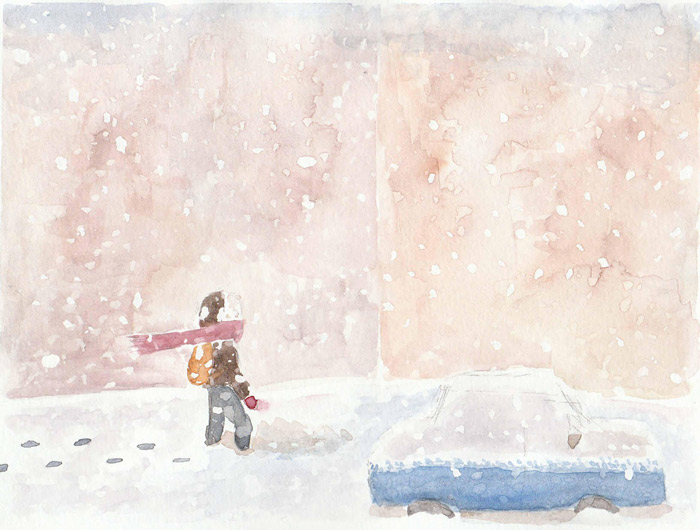
On Feb. 13, McGill students awoke to the best kind of news imaginable: Classes were cancelled due to inclement weather. Although the university has now had two snow days in the past two years, before March 2017, McGill had not cancelled class in 19 years prior. Though in recent winters the McGill administration has been more willing to declare a snow day, it takes an extreme storm for the university to close its doors for the day.

In the past 20 years of class cancellations at McGill, the 1998 Ice Storm was perhaps the most dangerous event. This natural disaster consisted of three severe storms over the course of six days. It cost the governments of Quebec, New Brunswick, and Ontario a combined total of 1.49 billion dollars in insured damage cost and resulted in at least 25 deaths. Following the storm, McGill was closed for a week, due to power outages, and the campus was covered in ice. Berkeley Kaite, an associate professor in the Department of English, remembers arriving at campus only to be told that the university would be closed.

“It was the first or second day of classes when the storm started,” Kaite said. “Not only did McGill close, but the whole city was shut down. It was eerie like a ghost town.”

While Kaite was fortunate to have power at her home, she noted that many people had to check into hotels that had generators to get access to electrical heating. Roads were closed off to traffic, and cars were stuck in the ice.

Some McGill students responded to this natural disaster through acts of charity—a group of law students coordinated donations and deliveries of essential supplies to areas of Quebec that were hit hardest during the storm. The event also resulted in new research projects at McGill: Project Ice Storm studied the long-term effects of prenatal stress caused by the environmental disaster, and is led by Dr. Suzanne King. McGill has not seen such an intense storm since.

Following the events of 1997, snow storms came and went, but McGill’s doors stayed open. It was not until recently that McGill cancelled classes twice due to blizzards: the first time in 2017 and the other in 2019. While neither of these instances were as extreme as the 1998 storm, the blizzards nonetheless posed a challenge to both commuters and those who walked to class, as roads and sidewalks were impracticable. Owen Quinn, U1 Engineering, observed that while students love to complain about bad weather, city employees worked hard to clear the paths for vehicles and students.

“McGill’s campus isn’t that big compared to other schools,” Quinn said. “But I imagine it takes a lot of work to clear that much snow in a short amount of time.”

The frequency of class cancellations in recent years may indicate that McGill is more seriously considering students who do not live within walking distance of campus. Paul Orasanu, U2 Engineering, commutes to campus and was relieved that he did not have to take the bus that day.

“Living in the West Island, it takes me almost an hour and a half to get to campus on a good day. That time can double with poor weather or traffic,” Orasanu said. “It’s nice to know that McGill doesn’t only think about its near-campus students when making these decisions.”

The snow day not only spared students from commuting in poor weather conditions, it also provided them with a small break during midterm season. Whether they spent the day studying or binge-watching Netflix, students had the opportunity to relax at a stressful time in the school year.

“I had midterm on Thursday [Feb. 14], so that extra day for studying definitely saved my grade,” said Quinn. “And, I felt much less guilty sleeping through my alarm for my morning class.”

Students at McGill who have experienced both of the past two snow days can consider themselves lucky. The 19-year gap between the 1998 Ice Storm and the blizzard of 2017 means that thousands of McGill students graduated without enjoying a single snow day.

“Snow days are so rare at McGill that [professors] are quite surprised when school is cancelled,” Kaite said. “[This snow day] felt special, like I was in fifth grade again.”

Commentary, Opinion

Let Muslim women wear whatever they want

Newly-elected Premier and leader of the Coalition Avenir Quebec (CAQ) François Legault recently shuffled his cabinet, naming Isabelle Charest the new Minister responsible for the Status of Women. Charest sparked controversy in early February for insisting that the “hijab is a symbol of female oppression.” When criticized for her comments, she refused to apologize or rescind her statement, citing her belief that women should be free to dress as they choose. Her comments fall in line with other sentiments expressed by Legault and his party, who plans to ban the hijab for ‘authority figures’ like judges and teachers. The policing of women’s clothing, especially when disguised as ‘feminist’ or as a form of liberation, exemplifies a disregard for the rights of those from different backgrounds. White women and feminists, like myself, should demonstrate proper allyship and aid in dismantling systems that we benefit from—and that starts with calling it out.

Facing criticism for her initial comments, Charest still stood behind her discriminatory statements.

“I think women should be free to wear what they want,” Charest said in a press conference on Feb. 5.

Herein lies her hypocrisy: Defending women’s freedom to dress while simultaneously calling for a hijab ban promotes conditional freedom of choice for women, whereby only those who conform to certain ‘Québécois values’ are seen as deserving of fair treatment. If Charest is genuinely concerned with women’s autonomy, perhaps she should listen to the experiences of women who choose to wear the hijab.

Clothing is integral to self-expression, and you can learn a lot about a person from the way they dress. When a Muslim woman chooses to wear a hijab, she freely expresses her culture, values, religion, and identity—something that feminists should celebrate. No woman should have to choose between accurately representing her identity and being able to live comfortably in Quebec. Feminists should not support a ban on any kind of clothing, especially gendered clothing like the hijab.

Of course, it is naive and ignorant to assume that this debate restricts itself to one form of oppression. Charest’s comments exist at the intersection between sexism, Islamophobia, and xenophobia. Quebec has a problem with hate crimes, especially regarding Islamophobia, and, thus, Muslim women experience a much different province than non-Muslim women. Charest and her followers aren’t expressing concern for freedom and equality for women so much as they want to codify their distaste for those who are different from them.  Solving this issue means tackling many forms of systemic oppression.

Feminism has taken many forms throughout the movement’s history. Though the changes sparked by the movement should be celebrated, it is even more important to highlight how feminism could have been and can continue to be more inclusive of women with diverse life experiences. Intersectional feminism calls for a movement which represents the interests of all women, not just those who are white, wealthy, straight, able-bodied, and cisgender. The time has come to abandon the white feminism behind actions like Charest’s and start listening to what Muslim women want and for white women like myself to start listening.

Student Life

Winter and warmth go hand in hand

As the frigid weather relentlessly persists, McGill students can have trouble dressing for the cold temperatures. It can be particularly hard to strike a balance between looking stylish and keeping warm. To help, The McGill Tribune has detailed some ways in which students can keep warm while looking presentable.

Colourful tights underneath boyfriend jeans

To manage during the cold winter months, try layering a pair of tights or long underwear underneath loose-fitting jeans. An additional layer keeps students’ ankles covered from the cold wind and can act as an additional protective barrier from the harsh weather. Mathilde Hourticq, U2 Arts, wears colourful tights underneath her pants every day for additional warmth and style.

“Wearing tights under your jeans really makes that crucial difference between being warm or cold all day,” Hourticq said. “Not only are they warm, […but you can also] find really cool ways to style your tights under jeans and really make a statement out of it.”

By wearing slightly cropped jeans that show the bottom of a colourful pair of tights, students are able to experiment with clothing while staying warm.

Mittens instead of gloves

Mittens are a much warmer option than gloves to keep students’ hands snug. Mittens are more insulating, because fingers generate greater body heat when they are not separated by fabric. Chloe Lacombe, U1 Arts, never leaves her house without her mittens.

“I would have to say that my favourite thing to wear in the winter is my mittens,” Lacombe said. “Whether I need to take a phone call and hold my phone, or my hands won’t fit in my pockets, having my mittens on me at all times has helped me avoid frostbite many times.”  

While many consider mittens to be juvenile, they can appear more sophisticated in darker colours.  

Blanket scarves

A large blanket scarf can protect students’ necks and faces from the stinging wind. Zach Billick, U0 Arts, has found that scarves are an easy way to stay warm in the winter.

“I think wearing a scarf in the winter is important because it covers your face, your nose and your neck,” Billick said. “You can get pretty [bad] frostbite if you don’t wear a scarf, and, its fashionable.”

Not only do they serve as a great wind protector, but once inside, blanket scarves can double as shawls inside McGill’s chilly buildings.

Waterproof boots

Having waterproof boots is one of the most effective ways to stay warm and safe during the negative weather in Montreal. Though layering socks and wearing warm boots can help students stay warm and dry on snowy days, it is also important for students to invest in a pair of waterproof boots to keep their feet dry. Makenzie Akeson, U2 Nursing, wears roomy, waterproof boots that allow her to layer her socks underneath.

“I like to wear the waterproof UGGs because they are lined with fur but still do not get wet inside,” Akeson said. “On top of that, even though my boots are waterproof, I think it is essential to wear two pairs of socks for that extra layer of warmth.”  

Many students have difficulty finding warm boots that are affordable. To that end, a pair of rain boots with good traction are worth the investment, since students can wear them almost year-round. While galoshes are not often insulated, several companies make inserts that are designed for winter weather and come in wide ranges of colours and designs.

Laughing Matters, Opinion

Subject: Guide to #ChangeTheName

Re: Next steps regarding the name / Étapes à venir dans le dossier relatif au nom

Dear McGill,

I hope this email finds you well, and thanks for the snow day!

I got your email, but it left me a little confused. It’s about time you noticed that no one likes the men’s varsity team name! But, what is taking you so long to finalize your decision?

Don’t worry too much about appeasing the donors regarding the name change —I know some people who opted out of their SSMU Library Fund fees that might be able to lend you a couple of bucks. Don’t be embarrassed, McGill. It is not like we haven’t come to expect this kind of thing from you. Here are some guidelines for how you can ensure that the name change plays out in everyone’s best interest:

Feelings matter

Now, this one might seem a little rudimentary, but you haven’t quite mastered it yet. When choosing the new name, do your best not to oppress marginalized people. Otherwise, students will rightfully fight back voraciously by putting up even more stickers in bathroom stalls expressing their discontent. Try something inclusive and compassionate, like the ‘Lovebirds’ or the ‘Warm-hearted Winners.’

Choose an animal that exhibits McGill pride

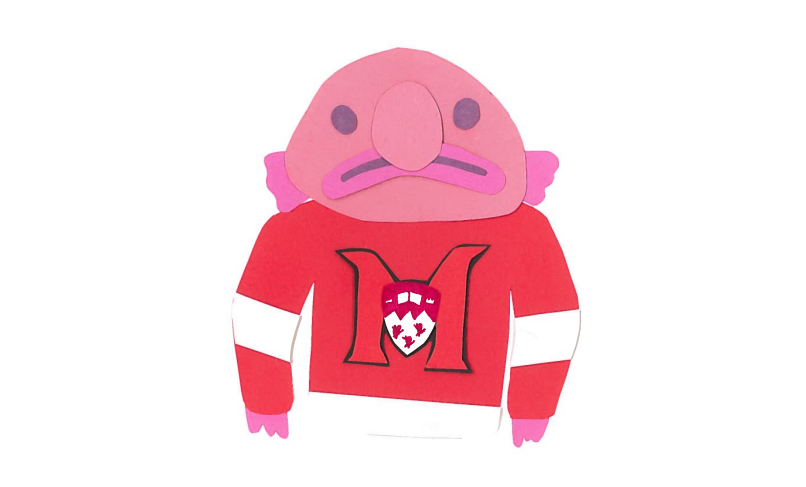
Martlets are cool birds and everything, but blobfish don’t get enough attention. With a name like the ‘Blob Men,’ competitors will definitely know we mean business. Ever heard of someone fighting a blobfish? That’s because no one would dare to.

Don’t threaten fragile masculinity

Martlets are female birds! You can’t expect the men’s varsity teams to adopt the name of an animal that is inherently feminine. The men’s teams need an animal that will show their competitors how strong they are! Names like ‘Hippopota-men,’ ‘Sala-men-ders,’ or even ‘Burly Boys’ will remind our athletes that they are super strong and manly.

No longer than two syllables and one vowel

Don’t forget to consider the most important actors in this equation: Fans (and their wallets). After a couple of beers at Molson Stadium, drunk spectators won’t be able to pronounce, let alone cheer, for a team with a complicated name. A new name will be hard enough to remember as it is. Don’t ruin the men’s varsity teams’ reputation with a convoluted name; choose something simple like the ‘Birds’ or the ‘Men.’

It’s not too late to undo the damage of the men’s varsity team name. Good luck with the brainstorming; I can’t wait to see what you come up with! If you have any questions or need more advice, feel free to ask literally anyone born after 1997.

Cheers,

Makena Anderson

McGill, News

Candidates discuss accessibility, mental health, and equity at AUS elections debate

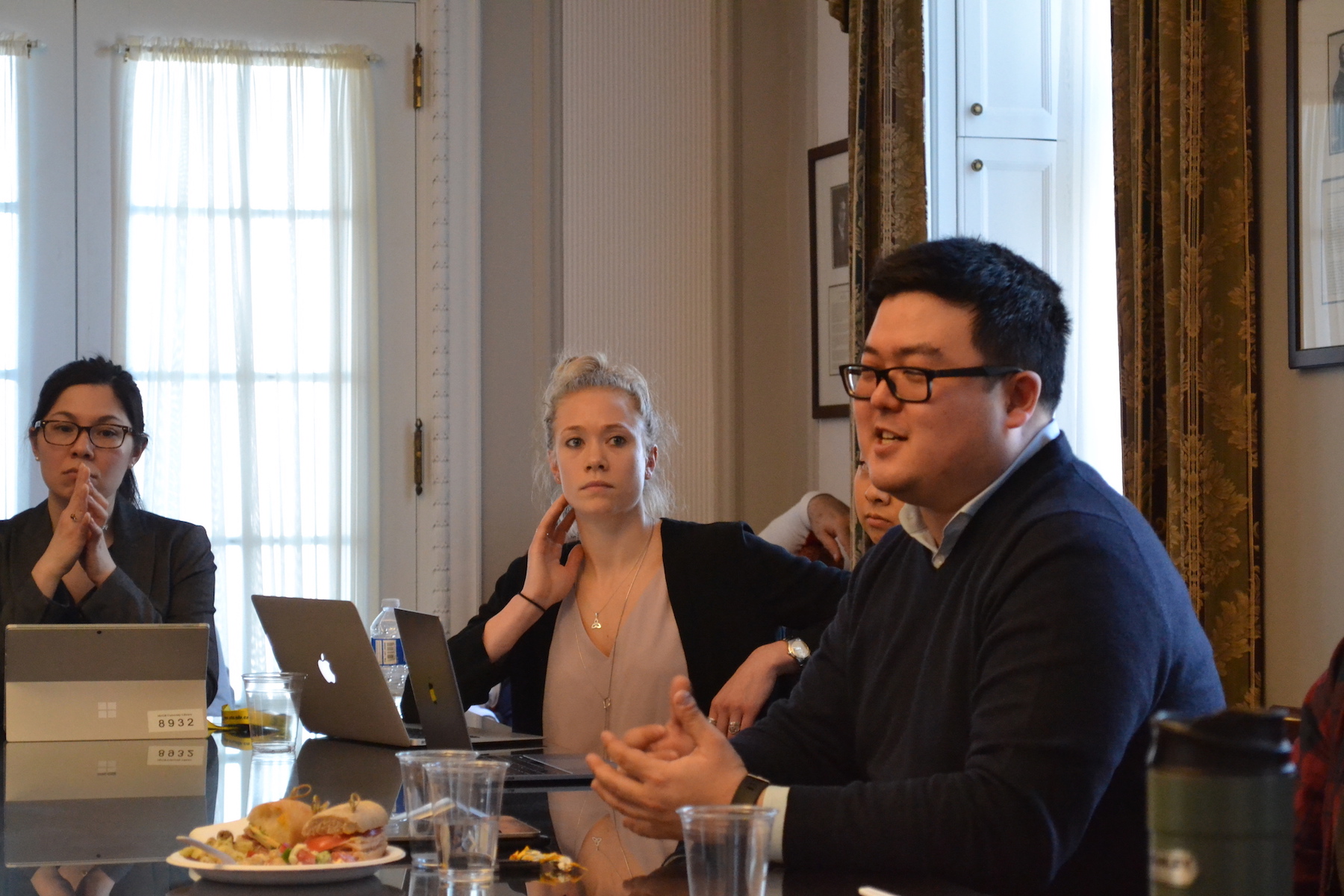
With the voting period for Arts Undergraduate Society (AUS) executives now underway, AUS Elections hosted a debate on Feb. 12 for candidates to discuss their platforms and respond to questions. All executive positions except for Vice-President (VP) Academic are uncontested. Meanwhile, there are six candidates up for the position of Arts Representative to the Students’ Society of McGill University (SSMU) and five candidates for the position of Arts Senator, competing for three and two positions, respectively.

Mental health was a main topic in the debate, and many candidates proposed ways to facilitate access to resources. Ananya Nair, one of the candidates for VP Academic, hopes to work with professors to reduce the burden of final exams.

“I want the curriculum to be more oriented around [the] well-being of the students,” Nair said. “If three exams in 24 hours is a conflict, I think [that] three exams in 28 hours should be a conflict too. It’s a loophole that I think the AUS should take a [stance] on and work with the enrollment services to accommodate.”

Nair’s opponent, Wing Wong, also proposed working with professors to address overly heavy course loads and opposed exams worth 70 per cent of the students’ final grade. Wong proposed implementing a minimum number of assessments per course, to prevent professors from placing too much weight on final exams.

In addition to campaign promises specific to their platforms, each of the candidates running for Arts Representative to SSMU addressed the subjects of accountability, mental health resources, and equity. Andrew Chase, Ruofan Wang, Ariana Kaye, Gabriel Ahmad, Shreya Dandamudi, and Adin Chan all cited accessibility and diversity as important issues in their campaigns. Chase and Wang promised to increase accessibility for Francophone students while Kaye discussed partnering with Rez Project to advocate for marginalized groups. Ahmad suggested hosting a conference for women in politics to bring awareness to the barriers that women face and endorsed a provincial-wide day against Islamophobia.

Another key issue for many of the candidates was improving SSMU’s image of accountability. Chase believes that this image fell after the bank switch left many of SSMU’s clubs unable to access their funds and when its chartered bus company cancelled their service at the Children of the Corn event, leaving over one hundred students stranded at MacDonald Campus. Kaye promoted accessible meeting minutes, Chase proposed working with the accountability committee, and Chan discussed improving the SSMU website to facilitate accessibility.

Jamal Tarrabain, current VP Communications for the AUS and the only candidate for President, discussed AUS’s commitment to transparency.

“I always want to increase the transparency of the AUS, and one thing I want to do is put the bylaws in the AUS handbook for incoming students,” Tarrabain said. “[I also want to] invite campus media to attend Legislative Council meetings and submit monthly reports to the campus media so that they can publish what they see fit about what the AUS has been doing.”

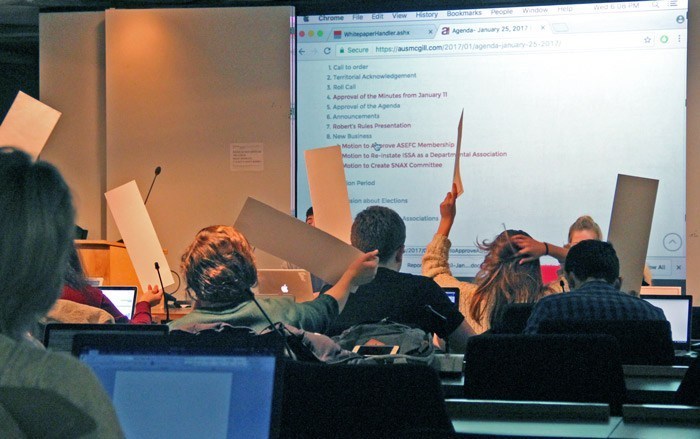
Two days after the debate, the Legislative Council passed a motion prohibiting recording and taping unless councillors voted to allow it by a two-thirds majority at the beginning of each meeting.

Regarding sustainability, Tarrabain advocated giving the AUS Environment Council (AUSEC) an increased ability to hold executive members accountable for the sustainability of their practices.

“I also want to work with the VP Internal to empower AUSEC to do audits of the different executive portfolios and issue sustainability recommendations,” Tarrabain said.

Members of the AUS will be able to cast their votes Feb. 18-21.

Read the latest issue

Read the latest issue