

Latest News

McGill, News

Candidates discuss accessibility, mental health, and equity at AUS elections debate

With the voting period for Arts Undergraduate Society (AUS) executives now underway, AUS Elections hosted a debate on Feb. 12 for candidates to discuss their platforms and respond to questions. All executive positions except for Vice-President (VP) Academic are uncontested. Meanwhile, there are six candidates up for the position of Arts Representative to the Students’ Society of McGill University (SSMU) and five candidates for the position of Arts Senator, competing for three and two positions, respectively.

Mental health was a main topic in the debate, and many candidates proposed ways to facilitate access to resources. Ananya Nair, one of the candidates for VP Academic, hopes to work with professors to reduce the burden of final exams.

“I want the curriculum to be more oriented around [the] well-being of the students,” Nair said. “If three exams in 24 hours is a conflict, I think [that] three exams in 28 hours should be a conflict too. It’s a loophole that I think the AUS should take a [stance] on and work with the enrollment services to accommodate.”

Nair’s opponent, Wing Wong, also proposed working with professors to address overly heavy course loads and opposed exams worth 70 per cent of the students’ final grade. Wong proposed implementing a minimum number of assessments per course, to prevent professors from placing too much weight on final exams.

In addition to campaign promises specific to their platforms, each of the candidates running for Arts Representative to SSMU addressed the subjects of accountability, mental health resources, and equity. Andrew Chase, Ruofan Wang, Ariana Kaye, Gabriel Ahmad, Shreya Dandamudi, and Adin Chan all cited accessibility and diversity as important issues in their campaigns. Chase and Wang promised to increase accessibility for Francophone students while Kaye discussed partnering with Rez Project to advocate for marginalized groups. Ahmad suggested hosting a conference for women in politics to bring awareness to the barriers that women face and endorsed a provincial-wide day against Islamophobia.

Another key issue for many of the candidates was improving SSMU’s image of accountability. Chase believes that this image fell after the bank switch left many of SSMU’s clubs unable to access their funds and when its chartered bus company cancelled their service at the Children of the Corn event, leaving over one hundred students stranded at MacDonald Campus. Kaye promoted accessible meeting minutes, Chase proposed working with the accountability committee, and Chan discussed improving the SSMU website to facilitate accessibility.

Jamal Tarrabain, current VP Communications for the AUS and the only candidate for President, discussed AUS’s commitment to transparency.

“I always want to increase the transparency of the AUS, and one thing I want to do is put the bylaws in the AUS handbook for incoming students,” Tarrabain said. “[I also want to] invite campus media to attend Legislative Council meetings and submit monthly reports to the campus media so that they can publish what they see fit about what the AUS has been doing.”

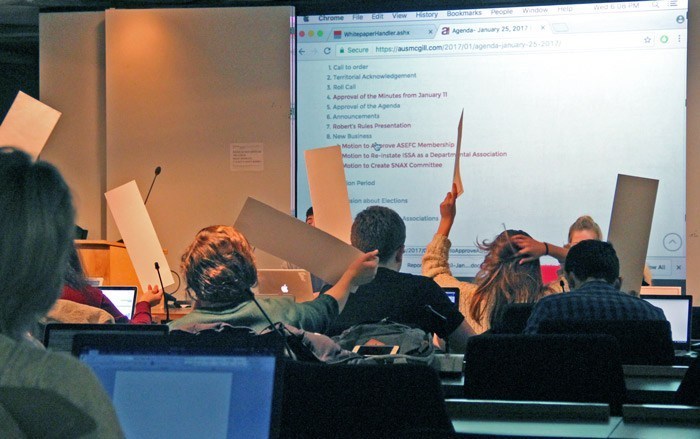
Two days after the debate, the Legislative Council passed a motion prohibiting recording and taping unless councillors voted to allow it by a two-thirds majority at the beginning of each meeting.

Regarding sustainability, Tarrabain advocated giving the AUS Environment Council (AUSEC) an increased ability to hold executive members accountable for the sustainability of their practices.

“I also want to work with the VP Internal to empower AUSEC to do audits of the different executive portfolios and issue sustainability recommendations,” Tarrabain said.

Members of the AUS will be able to cast their votes Feb. 18-21.

Editorial, Opinion

Don’t overturn a democratic vote for undemocratic reasons

In an ambiguous and poorly-worded email sent on Feb. 12, Arts Undergraduate Society (AUS) executives released a statement announcing that they had overturned the AUS Legislative Council’s decision to withhold approval of the course fee for POLI 339. POLI 339 Comparative Developed: Topics 1 is a two-week summer exchange course at the Hebrew University of Jerusalem, and at the Jan. 30 AUS Legislative Council meeting, members raised that the course was inaccessible for Palestinian students. Councillors ultimately voted not to approve the course fee, however, Executive Council quashed this decision using an emergency bylaw. Overturning the Legislative Council decision exceeded the executive’s mandate, and AUS executives should respect the democratic process and rescind their vote.

AUS executives and Arts Representatives to the Students’ Society of McGill University (SSMU) overturned a democratic vote with insufficient reason. While they claimed that the second vote was justified because a course syllabus and itinerary were missing, opposition to the class was  rooted in the Palestinian-Israeli conflict—other specifics are irrelevant and would not have changed the vote’s outcome. It appears that the executives used an emergency provision to overturn a democratic vote for political reasons, which, in a group of elected representatives, demonstrates a lack of transparency in their governance.

Under Quebec law, all courses that charge ancillary fees must have these fees approved by the university’s student society, and SSMU delegates the approval of Faculty of Arts course fees to the AUS. In response to the AUS Legislative Council voting not to pass the fee, two days later, the Executive Council held a meeting over Facebook Messenger on Feb. 8 to decide the course fee’s fate themselves. After three rounds of voting—with varying results—the first vote, which overturned the Legislative Council decision, was ultimately made official. They then waited four days to announce their decision to AUS members.

In a statement posted to the AUS Facebook page on Feb. 14, AUS Secretary General Sophie Zhao and Deputy Secretary-General Nathan Mendel announced that they had suspended the Executive Council’s decision to approve the course fee in order to conduct an investigation of the decision and its constitutionality.

The Secretary General’s statement adds another layer to the pandemonium. In addition to poor governance, AUS is becoming an increasingly hostile environment: Arts Representative Andrew Figueiredo and AUS President Maria Thomas admitted to ‘pressuring’ other executives into voting a certain way, and AUS members have called on Figueiredo to resign. Vice-President (VP) Internal Billy Kawasaki has announced his resignation because of the controversy.

Councillors have expressed concerns about harassment based on political beliefs and identities. As a proposed solution to harassment and to create a safe space, councillors moved to ban the recording of AUS Legislative Council meetings: Campus media can be granted exemptions on a per-meeting basis, subject to a two-thirds majority vote by Council. Although this motion may have good intentions, it will only result in a loss of transparency in AUS. Instead, AUS should be developing ways to fully address their representatives’ poor behaviour. If they truly want to protect councillors and gallery members at meetings, AUS must properly condemn and prevent harassment instead of blaming a scapegoat, like recording. Executives, representatives, and even constituents have to receive adequate disciplinary action.

According to the AUS constitution, all Executive Committee decisions must be ratified at the next Legislative Council meeting. However, their decision on POLI 339 was not submitted to Legislative Council for ratification, but instead forwarded directly to SSMU’s executives. Despite this undemocratic and opaque process, SSMU ratified the executive’s decision and sent it to the Deputy Provost Student Life and Learning (DPSLL) office. SSMU should have withheld their approval instead of blindly green-lighting an unrepresentative decision.

The issue extends far beyond the course’s funding, and reflect mismanagement and secrecy on the part of AUS. Conducting emergency meetings over Facebook Messenger is unacceptable. Students representatives and executives should reconsider their right to the position if their ability to fulfill their mandate and serve their constituents is compromised. Instead of blaming harassment on recording, AUS must develop better ways to protect members of Council and their constituents. SSMU has an opportunity to overturn the AUS Executive’s decision, as the DPSLL office has offered to rescind their approval should SSMU do so as well. SSMU and the AUS executives should respect the initial Legislative Council vote against the course fee.

Errata: A previous version of this article incorrectly stated that AUS president Maria Thomas was asked to resign. The Tribune regrets this error.

Creative

SSMU Who | Episode 2: What do they do?

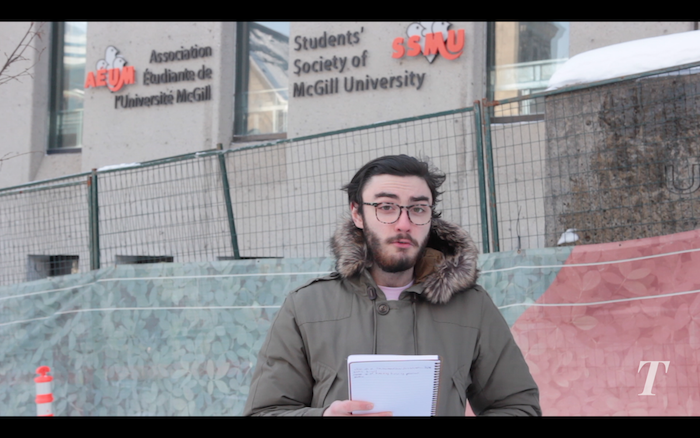
SSMU Who…? Wait…WHAT do they do? The Multimedia team sets up camp in the SSMU offices to ask the various executives about their portfolios, and their current initiatives. It’s time to find out exactly SSMU do.

By Bilal Virji, Tony Wang, and Sofia Mikton

Artistic Swimming, Creative

In Competition With: Artistic swimming

Sports Editors Miya Keilin and Gabe Nisker join the artistic swimming team to see what it takes! Will they sink…or swim?

Video by Bilal Virji

Creative

The Road in 2019


Benjie Higgins and Isabella Greenwood explore what it means to be on The Road in 2019. How do we connect to people, and what spaces exist for us to do that?

By Benjie Higgins and Isabella Greenwood

Creative

Tribune Presents: Cool + Fun!

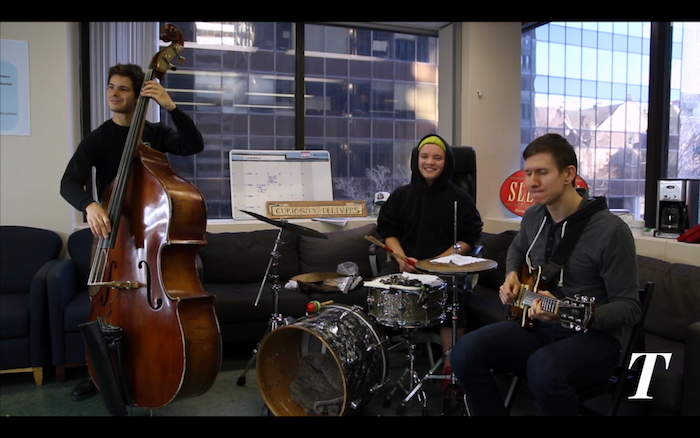
The Tribune Presents “Cool + Fun”. This McGill-based band found their name in someone’s Tinder bio! Listen to them play “Look at that Train” and “Roland, My Love.”

Filmed by Aidan Martin, Beatrice Dimaculangan, Patrick Beacham, James Collier

Edited by Aidan Martin and Beatrice Dimaculangan

Arts & Entertainment, Theatre

‘Cyclops’: McGill Classics Play entertains and educates

From Feb. 6 to 9, audiences at the Théâtre Sainte-Catherine Café-Bar were treated to an intrepid rendition of Cyclops, an ancient Greek play by Euripides. This run of Cyclops was the latest edition of a time-honoured theatrical spectacle: The McGill Classics Play.

Every year since the 2011 staging of Aeschylus’ Agamemnon, McGill students in the Classical Studies department have put their theoretical training into practice by staging an ancient Greek or Roman play. The experience gives students experience with amateur theatre, and an opportunity to engage more directly with their material of study.

This year’s iteration, Cyclops, was directed by Neha Rahman, (U2, Arts), and Daniel Whittle (MA1, Classical Studies). Rahman and Whittle were tasked with more than just directing—they also translated the play from ancient Greek into modern English.

Cyclops is unique in the history of Greek theatre: It is the only “satyr play” with fully intact scripts still available to a modern audience. As Rahman and Whittle explained before the performance, satyr plays were traditionally performed immediately after the conclusion of a Greek tragedy. Narrated by a humorous chorus of satyrs, sexually-frustrated half-horse, half-human figures of Greek mythology, the plays provided a comedic remedy to the weight of the preceding tragedy.

Opening with a lengthy rendition of a Greek folk dance, Cyclops is the humorous retelling of an episode from Homer’s Odyssey, in which Odysseus and his companions are trapped in a cyclops’ cave. In this version, Odysseus, joined by a blundering gang of satyrs sporting exquisite embroidered penises at their waists and played with comic bravado by Anthony Pavoni (BA ‘18). Rahman and Whittle’s lively translation featured hilarious exclamations and exchanges between the characters. One has to wonder how much creative liberty the translators took when, in mortal danger, Odysseus exclaims, “By Hades’ asshole!” The ridiculous nature of the script and story was perfect for the enthusiasm of the amateur cast, who created a truly entertaining spectacle.

Edith Hall, a professor at King’s College London’s visit to McGill enriched the Classics Play further. In her Feb. 8 lecture entitled“Was Cyclops a typical satyr play?”, Hall expanded upon the linguistic debates surrounding the work. She pointed out that, according to ancient sources, a typical satyr play would feature women in primary roles, often escaping capture by the satyrs, whereas Cyclops does not feature any female characters, although in this production many women actors shouldered traditionally male roles.

In an interview with The McGill Tribune, Michaela Drouillard, U2 Arts, the production’s set designer, opened up about the behind-the-scenes drama of Cyclops. In true satyr fashion, the production was dogged by tragicomic events of its own. Three weeks before opening, the actor playing the Cyclops dropped out, and Delaney Dunne (U3 Science), joined the cast just one week to go before the premiere. Meanwhile, another one of the satyrs was not let back into Canada for two weeks due to complications with their student permit. Just like Odysseus himself, the actor made it back eventually, and in the end, the Classics Play was a triumph of entertainment and education.


Features

Breaking Bread

Time slows down when I enter a Montreal diner. It slows down because the menu is so long, and it takes forever to read through and decide, for certain, what to order. It slows down because the plates are so big that it takes forever to eat a meal. And it slows down because conversations with friends, family, or simply the same waiters as last time are so enjoyable, and the jukebox soundtrack even more so.

Mister Steer is one such diner. It opened in 1958, with nine seats on the corner of Ste Catherine and Bleury. Working-class and immigrant populations flocked to it for the popular Steerburger, a kosher hockey-puck patty with lettuce, tomato, and onion.

The war on Valentine's Day
Off the Board, Opinion

St. Valentine’s Capitalist Manifesto

It seems that, every year, the public outcry against Valentine’s Day threatens to overwhelm the holiday itself. Browsing through the opinion sections of online publications, it is impossible to escape the feeling that a war is unfolding against the holiday. According to recent trends, the percentage of the population celebrating Valentine’s Day has been declining in recent years, with only 54 per cent of Canadians observing the holiday in 2018. This trend should be deeply concerning as Valentine’s Day is a boost to economic growth.

Valentine’s Day can, admittedly, be a source of significant stress. Expectations that the day be spent in the company of a romantic partner can be equally suffocating for those with a valentine as for those without. More than anything else, however, consumers bemoan the significant financial stress that holidays can impose; the average Canadian spends $164 on Valentine’s Day per year.

However, it is for this very reason that the benefits of commercialized holidays like Valentine’s Day, when viewed from an economic point of view, are important for encouraging consumer spending. According to the United States National Retail Federation, Valentine’s Day spending contributed $19.6 billion to the U.S. economy in 2018. Valentine’s Day encourages consumer spending and provides an important portion of the baseline of the retail sector. A population that has become disillusioned with Valentine’s Day will be less willing to spend money on the holiday, with potentially-grave economic consequences.

Saving an entire holiday is not an easy task, and economists will have to employ unconventional methods. We must use our platforms as intellectuals to convince the consumers of the importance of Valentine’s Day by appealing to emotion. Where politicians, journalists, authors, poets, philosophers, and teachers have let us down, we must not fail. We have to make people believe in love again.

But we cannot stop there. The compulsion to spend money on commercial holidays should be viewed as an unparalleled opportunity to induce economic growth. Until now, the commercial world’s primary concern with respect to holidays has been to boost consumer spending on existing holidays. However, once we’ve saved Valentine’s Day, we should shift our focus to the invention of new ones. As consumers, romantic partners, and family members, we ask ourselves: “Why do we have a holiday during which we celebrate our loved ones through seemingly-arbitrary acts of consumption?” But as economists, we should ask: “Why do we have so few?” Why not Cousins’ Day, a statutory-holiday to celebrate distant relatives over a box of chocolates? 

There is only one way to address this chronic under provision of empty, commercialized holidays: Governmental intervention. The private sector is unlikely to be of much use to us, since holidays are, for the most part, a public good, and their invention is unlikely to lead to enough direct profit for firms to research and develop them. As economists, then, we must encourage their provision through various government policies.

These policies need not see use only in times of prosperity. If packaged properly, the development of new, consumption-driven holidays could serve as an effective fiscal stimulus in times of economic stagnation. Indeed, one wonders if the aftermath of the 2008 financial crisis could have been at least partially alleviated had governments worldwide imposed hosts of state-mandated observances. 

As for Valentine’s Day, perhaps we must reach some compromise to save spending. Perhaps, the focus on romantic love has proved excessive, in which case, alternatives like Galentine’s and Palentine’s day show potential. Love, as a phenomenon, may have other economic implications and should be the subject of further research. 

Read the latest issue

Read the latest issue