

Latest News

Inkless, employable personas
Commentary, Opinion

Employable, inkless personas

Whether by feigning confidence in an interview or embellishing responsibilities on a resumé, people often present an enhanced version of themselves to prospective employers. Many industries, like law and finance, maintain conservative hiring practices that pressure prospective employees to craft an inauthentic personal presentation by covering tattoos or piercings and keeping hair dyed a traditional colour. Conservative hiring practices not only discriminate on irrelevant grounds, but they also compel people with non-conforming styles into obscuring aspects of their identity, alienating them from their genuine selves.

Companies hire candidates who they believe will be most capable of executing a job, and this includes assessing someone’s character for traits like respect and a sense of responsibility. Being impolite or reckless, for example, can show that someone lacks the moral character of a good employee. However, choices like enjoying expressive fashion or body art do not relate to moral character or employability. Nevertheless, a 2018 survey of hiring managers shows that applicants with tattoos were offered lower starting salaries than those without body art, and applicants with obvious and eye-catching tattoos were less likely to be hired at all. A 2017 study published in the journal Human Resources Management found that respondents rated images of tattooed people as eight per cent less employable than those without.

The bias against tattoos stems from antiquated stereotypes about people with body art. When tattoos first popped up in contemporary North American culture in the late 19th century, they were common among criminals and sailors, and, therefore, became associated with ostracized people. While tattoos have entered the mainstream in recent decades, some employers still view applicants with body art as uneducated, unintelligent or promiscuous, and setting a bad example. These same antiquated stereotypes extend to other forms of expression like non-traditionally coloured hair and piercings.

Moreover, even if employers themselves are unfazed by these forms of expression, they may argue that they need to hire employees with a clean-cut style to appeal to clients. If employers continue to let a prejudiced clientele shape their standards, hiring practices will remain in a rut. When the workforce tells people that their piercings or sleeve of tattoos makes them unworthy of a pay cheque, it enforces the idea that only people who fit into a traditional mould are respectable members of society, thus advancing the authority of outdated ethical standards.

In addition to holding no moral ground, conservative hiring practices separate people from their authentic selves. The more someone conceals their persona in the workplace, the harder it is for them to feel in touch with their identity during the day. Having to hide forms of personal expression urges an unnecessary suppression of individuality and can lead people to feel ashamed of who they are. This shame can easily trickle into one’s personal life, making them resent or discredit the forms of expression they would otherwise appreciate.

In recent decades, industries have made steps toward creating spaces for authentic self-expression in the workplace. For example, many workplaces have begun relaxing their dress codes and letting employees wear jeans instead of suits and pencil skirts, while more progressive fields like media and tech have also begun accepting tattoos and piercings. These changes allow people more freedom in expressing themselves. However, the work force still needs to improve its acceptance of all identities. Denying someone a job based on anachronistic conceptions of morality is unacceptable. Employers have the influence to redefine which identities are worthy of income; industries must move away from only hiring candidates that fit into a traditional framework  and start accepting more lifestyles and forms of expression as employable.

frosh
Commentary, Opinion

The lasting hangover of McGill’s drinking events

With midterms right around the corner and classes proceeding at full pace, events like Carnival, E-week, and Science Games seem distant. While your onesie might be neatly stored away and the lingering smell of beer washed off of your clothes, the impacts of these events on participants’ health can linger. Following periods of intense drinking, young adults have been known to experience anxiety, have trouble performing academically, and face an increased risk of developing a dependency on alcohol. McGill drinking events may feel like a rite of passage to many; however, their existence fosters an environment that pushes students into depending on alcohol for enjoyment.

The organizers of competitions among faculties and departments often promote these events by supporting charitable causes: For example, the Management Undergraduate Society hosts Carnival to raise money for cancer research. While many students participate in races, auctions, and keggers under the premise of funding cancer research, hundreds of them inadvertently harm their own bodies through binge-drinking and substance abuse. In the hope of sharing an unforgettable week with their peers, students reinforce each others’ inclinations to drink, resulting in a conditioned association between social acceptance and over-consumption. Although drinking feels like a routine part of McGill’s student culture, participants should familiarize themselves with the long-term effects of alcohol abuse, including liver and heart damage, malnutrition, and, ironically, given Carnival’s charitable cause of choice, an increased risk of developing cancer.

The coughs and sniffles heard in libraries and lecture halls serve as ominous reminders of how McGill’s work-hard-play-hard mentality continues to plague students. Despite the first couple of weeks of the semester bearing witness to some of the McGill clinic’s longest lines, students continue to sign up for events that often end in their contracting the flu, STIs, and lasting health impacts. With illness being a corequisite for these events, it’s curious that their popularity does not falter.

While drinking events are more prevalent in the first weeks of the semester, they are not limited to January. There is seldom a Thursday night in Montreal when students aren’t lined up on St. Laurent—drunk, cold, and dreading the next morning’s hangover. Beyond the façade of good times, the pressure to drink in university can fuel a dependence on alcohol that can endure well after graduation and take a toll on their mental and physical health.

By now, students are aware of the short and long-term consequences of binge-drinking. Yet, in an intense academic environment, they still choose to forget their stress for a few hours and feel the confidence and ease that is only found at the bottom of a bottle. With an endless stream of Snapchats and Instagram stories documenting the night, the fear of missing out encourages students to say yes to the next drink. Although it’s easy to blame the lasting hangovers on youth, it is time to realize that being a university student doesn’t preclude alcoholism. Students shouldn’t feel embarrassed or ashamed in seeking help to curb their drinking habits. The university offers services through the McGill Counselling Services to students struggling with substance abuse. 

As Fac-O approaches, students should consider whether binge-drinking for five days is something that they want to do or whether it’s something they feel that they can’t say no to. Alcohol isn’t what makes you fun, and no one will remember the time you skipped a Thursday night— or even whole week—of drinking.


Basketball, Know Your Athlete, Martlets

Know Your Athlete: Sirah Diarra

Basketball wasn’t always in the cards for Martlet basketball centre Sirah Diarra. The 6’1” fourth-year transfer tried her hand at a variety of sports, including soccer, tennis, and figure skating, before joining her high school basketball team. She was not solely focused on sports: Diarra also devoted her time to music.

“I used to play the saxophone,” Diarra said in an interview with The McGill Tribune. “I played for five years, up until I was 17.”

Ultimately, Diarra put the saxophone aside when she started investing more time in basketball. Despite her late entrance to the sport, Diarra found that she had a natural talent for it and developed a love for the game.

“I remember thinking, ‘I’m tall, and I’m good at it,’” Diarra said. “I would just sit in the paint, turn around and score, and I loved it.”

After high school, Diarra went on to play basketball at College Champlain St. Lambert. In the summer after her first year of CEGEP, she first thought about playing university basketball; by the following summer, she had set her sights on playing basketball at the next level.   

“When I entered CEGEP, I never thought, ‘I’m going to play [basketball] in the [United States]’ or ‘I’m going to play university basketball,’” Diarra said. “It was never a dream. Over time, it became something that I wanted.”

Diarra was recruited by several schools in the US and Canada, but, ultimately, she headed to South Carolina to play Division I basketball for the Clemson Tigers after she graduated from CEGEP. Basketball in the United States is extremely competitive, but the challenge was highly influential in Diarra’s decision to play in the NCAA.

“I wanted a new experience and to get out of my comfort zone,” Diarra said. “More than anything, it was the challenge.”

Diarra graduated after three years at Clemson University with a BA in psychology. She returned home to Quebec to play basketball for McGill while continuing her education.

Playing Division I basketball in the NCAA, she faced some of the top collegiate players in the world, but the RSEQ boasts its own share of fierce competitors and presents new challenges to Diarra.

“There are some aspects here [in the RSEQ] that are harder,” Diarra said. “In the States, you play a team once, and you’re done, see you next year. Here, you see a team multiple times a month. Now, everyone knows your flaws and strengths, and you have to find a way to adjust to that.”

Diarra entered her first season as a Martlet after undergoing surgery on both of her knees: She had a lateral tear in her left and medial and lateral tears in her right. Diarra faced the challenge head-on and is adjusting to the RSEQ’s fast-paced playing style, averaging 10.9 points and 10.5 rebounds per game. Given the Martlets seven consecutive RSEQ championship wins, the pressure is on for Diarra to continue to perform well.

“Knowing [that] the team has been successful the past seven years is something that’s always in the back of my head,” Diarra said. “No one wants to be on the team that ends the streak. We’re either going to make it happen, or we’re not. It takes everyone on the team to make it happen, but knowing I have a major role to play is pressure added because of the impact I know I can have on this team.”

The Martlets are currently ranked third in their conference behind Laval and Concordia. With the regular season winding down, Diarra will be put to the test as she leads the Martlets in their journey for an eighth straight RSEQ championship.


Point-Counterpoint, Sports

Point-Counterpoint: The G.O.A.T in men’s tennis

With 52 major titles between the three of them, Roger Federer, Novak Djokovic, and Rafael Nadal have cemented their places in tennis history while creating one of the most exciting sets of rivalries in sports. But, only one can be the greatest of all time.

Rafael Nadal: More than just the ‘King of Clay’

Adam Burton

When debating the tennis greatest-of-all-time, many overlook Rafael Nadal. His dominance spans back to 2005, when he won his first Grand Slam at the French Open. Since then, Nadal has added 16 additional major titles to his trophy cabinet. It’s obvious why Nadal is so distinguished: His speed, power, and athleticism pair perfectly with his impeccable technique, perhaps most evident in his deadly backhand.

In the G.O.A.T. discussion, many will be quick to point out that Nadal is second to Roger Federer in number of Grand Slam titles. However, using Grand Slams as the sole measure for greatness is a shortsighted argument because it does not consider other important factors. Nadal trails in the Grand Slam race due to the way that the tournaments are set up: Both the Australian and US Opens are played on hard court, Wimbledon is played on grass, and only the French Open is on clay. Nadal plays best on clay, going 11-0 in French Open championship matches. Federer and Djokovic, on the other hand, dominate the hard court. Eleven of Federer’s 20 Grand Slams are hard court victories, as are 10 of Djokovic’s 15 Grand Slams. Because Federer and Djokovic get to play twice as many tournaments on their best surface as Nadal, they have an undeniable advantage in the Grand Slam race.

Given the unfair advantage granted to Federer and Djokovic, tennis fans merely bestow Nadal with the title of ‘King of Clay.’ To adequately measure dominance, one must consider their head-to-head matches: In the 38 times Federer and Nadal have faced each other, the Spaniard has won 23 matches, while Federer has won only 15. In the big picture, it becomes clearer: Nadal is the greatest tennis player of all time.

Roger Federer: 21 years of incredible influence

Théo Farineau

Roger Federer may only be sixth in the Association of Tennis Professionals (ATP) rankings right now, while Djokovic and Nadal are first and second, respectively; however, the Swiss player’s case for being the greatest tennis player is simple. Federer is a beacon of longevity: In 1998, at just 16 years old, he became a professional tennis player, and now—21 years later—RF has won 99 titles and counting.

Federer holds nearly every possible record in the sport. His 310 total weeks spent at the top of the ATP rankings, 237 of which were consecutive, supersede any other player’s accomplishments. He is also one of just eight men’s tennis players that can boast a Career Grand Slam in his trophy case. He broke Pete Sampras’ record of 14 major titles with his 2009 Wimbledon win, which many fans thought of as unbreakable. With 20 major titles, three more than Nadal and five more than Djokovic, Federer is the most-decorated player in men’s tennis.

Finally, the biggest contrast between Federer and his competition is their playing style. Federer, Djokovic, and Nadal are incredible athletes, and their rivalry has marked men’s tennis forever. Federer, however, rises above his adversaries. His playing style is stunning to watch: His signature one-handed backhand, one of the most difficult moves to master in tennis, causes as much strife in his opponents as it does admiration from fans. He is a model of class on the court, and his incredibly refined technique inspires young tennis players all around the world.

The rivalry between Federer, Nadal, and Djokovic is one of the greatest in the history of tennis, and the winner will emerge as the greatest player of all time: In terms of both palmares and playing style, it is the Swiss star who edges out the others to claim this honour.

Novak Djokovic: A virtuoso performer

Gabe Nisker

On the first night of the 2016 US Open, Phil Collins performed the opening concert just before Novak Djokovic’s four-set victory over Jerzy Janowicz.

“It was hard to put up a show after Phil Collins, but he’s a legend,” Novak Djokovic said in a post-game interview.

Djokovic smiled and broke into Collins’ song ‘I Can’t Dance.’ With pure confidence, and, in spite of the name of the song, he added a dance move, too. Two-and-a-half years later, Djokovic is a legend, now, too.

As the current world number one, he took just over two hours to defeat Rafael Nadal in straight sets. With this victory, Djokovic extended his head-to-head lead over Nadal to three and claimed a record seventh Australian Open. Now totalling 15 Grand Slam Championships, Djokovic trails Nadal by two, and Federer by five. He also leads in the head-to-head matchup with Federer and is the first tennis player to win all nine ATP 1000 tournaments. He owns the record for most points accrued in a single ATP season and holds the longest winning streak of the trio at 43 consecutive matches. And as the youngest of the three tennis superstars, with a dogged mentality and clean mechanics, Djokovic is nowhere near finished.

‘The Joker’ may not have one signature skill but he also shows no clear weaknesses. Although it was once easy to overlook his all-around talent, it is now time to include him in the greatest-of-all-time conversation.

Tennis fans reopen the greatest-of-all-time debate each time a major championship finishes, boosting the profile of the latest winner. Novak Djokovic may not be able to dance, but his tennis ability more than makes up for it. The Serbian sensation is the artist behind some of tennis’ best matches and has the records to back it up, and it looks like he’s not going to stop anytime soon.

Editor’s Pick

Roger Federer has dominated the tennis circuit for years. Nadal and Djokovic have been worthy competitors, but, in his lengthy career, the Swiss superstar has proved he is the best of the three players. He has earned more trophies than any other player, broken impressive records, and rightfully earned the respect of tennis players and fans around the world for his incredible play and class.


A previous version of this article stated that Rafael Nadal won his first Grand Slam at the Australia Open. In fact, it was at the French Open. The Tribune regrets this error. 


Album Reviews, Arts & Entertainment, Music

The hollow girl bossery of ‘thank u, next’

My interest in Ariana Grande was piqued by 2018’s Sweetener, a critically-acclaimed jazz-infused love letter to then-beau, comedian Pete Davidson. thank u, next is the antidote to Sweetener, a cryptic dissection of the infamous broken engagement that has been met with similar praise. And yet, it is at this juncture that I must admit my brief love affair with Grande has also come to an end.

On Nov. 30, Grande released her music video for the titular “thank u, next,” a short that features Grande as various female protagonists in early 2000s rom-coms, lazily pandering for nostalgia’s sake. The video was good in the way that a perfunctory Saturday Night Live impression is good: Director Hannah Lux proficiently recreates Mean GirlsLegally Blonde, Bring It On, and 13 Going on 30 but offers no artistic intervention. Aside from an empty female-power mantra in which Grande chooses herself, and an overdone reference to Pete Davidson’s penis size for salivating fans, “thank u, next” does little in the way of expression.

With the release of “7 Rings,” Grande set the record for most streams in a single week, but the song faced intense criticism. The video appropriates kanji characters, and Grande has since touted an unfortunately-misspelled tattoo—the design, which is supposed to read ‘7 rings’ in kanji, in fact, says ‘barbecue grill.’ Accusations of cultural appropriation have plagued Grande throughout her career, but her empty use of Japanese language and culture is especially vexing when matched with an equally hollow song about being a rich white woman shopping. It’s not just Grande’s kanji that reads as inauthentic, but the entire production; she writhes forcedly, chants unconvincingly of buying diamonds for her bitches, and apes the worst of trap music for an exceptionally-long 30 seconds. The video’s pink fur, diamond-crusted, girl boss aesthetic feels manufactured, and six months too late—Grande has missed the boat on millennial pink.

Despite their uninspired videos, “7 Rings” and “thank u, next,” are perhaps the album’s best tracks—or at least its most distinct. The rest of thank u, next features vaguely-catchy, nearly-indistinguishable songs: I know I enjoyed listening to “imagine,” “bloodline,” and “makeup” but I can’t recall any specifics. “NASA” is another pandering reference to a belated Urban Outfitters trend. On “break up with your girlfriend, i’m bored,” Grande croons that “you make me feel some type of way,” a sentiment that wasn’t particularly profound when Rich Homie Quan said it in 2013 and hasn’t appreciated in potency in countless Drake songs since. “needy” is one of the album’s strongest, and her refrain “I can be needy, tell me how good it feels to be needed” is a refreshing break from the album’s vacant girl power-isms a la “God is a Woman.”

References to ex-lovers meant to rouse public interest ultimately hamper the album. “thank u, next” isn’t an ode to empowerment so much as a list of celebrity names; likewise, pithy and transparent nods to famous breakups populate the entire album.

While thank u, next feels like it was produced by a focus group, Grande is not without talent. She just won her first Grammy, and without even attending the awards ceremony where she was set to perform, citing the show’s alleged constraints on her creative freedom. Still, listening to “one small step for woman…. one giant leap for womankind” on the intro to “NASA,” it’s tough to imagine any particularly subversive spirit that The Recording Academy should need to censor.

McGill, News

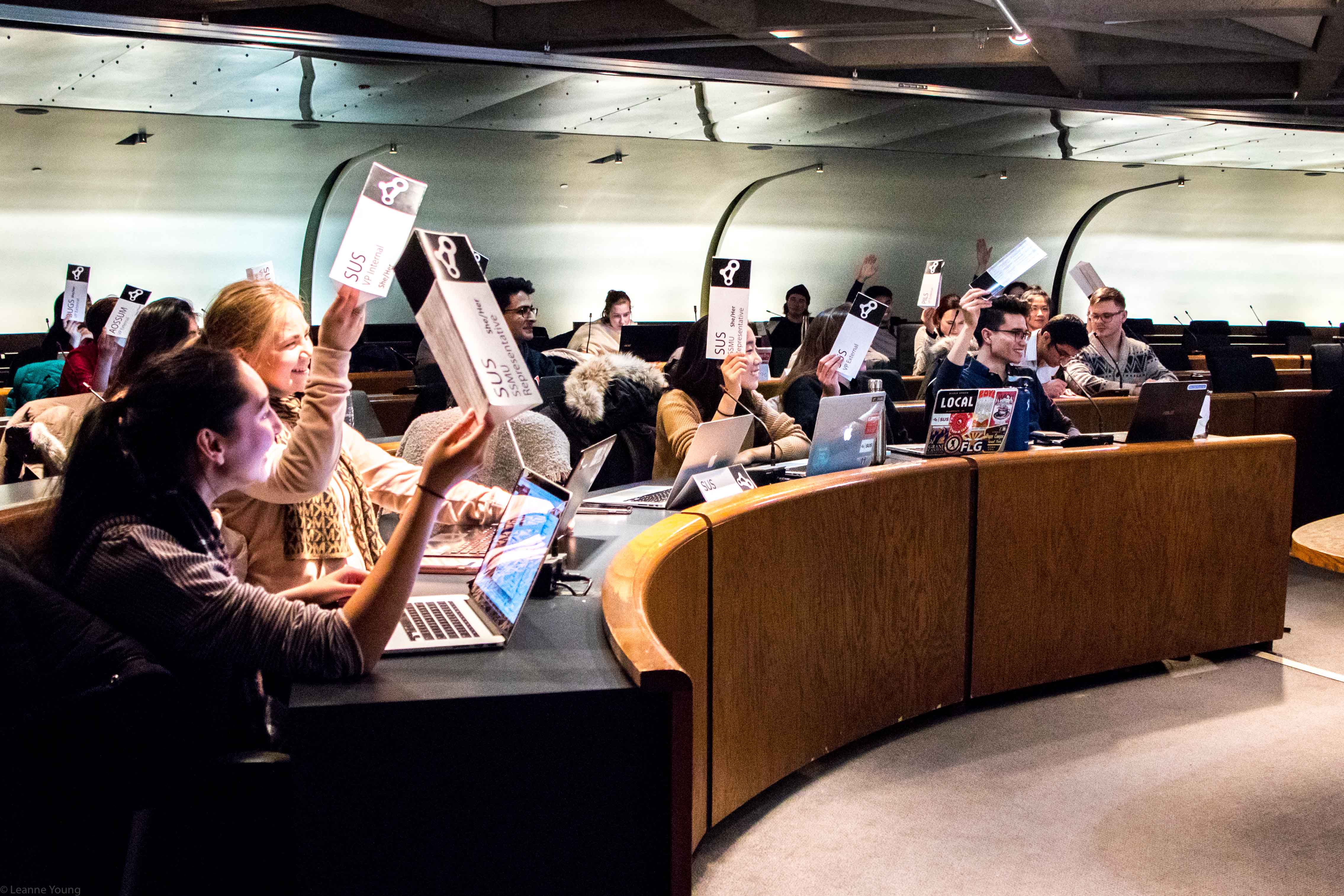
SUS General Council debates raising fees

The Science Undergraduate Society (SUS) met on Feb. 6 to add two questions to the ballot for the upcoming SUS referendum. The Council also discussed changing how departments receive funding, an increase in the SUS membership fee, and the renewal of the Lab Improvement Fund.

Increase in SUS membership fees

Vice-President (VP) Finance Dylan Wong moved to include a question about increasing SUS membership fees on the upcoming ballot, which was previously discussed at General Council on Jan. 23. Currently, the SUS membership fee is $12.50 per semester for full-time students, whereas the proposed increase would boost it to $15.50. SUS last raised its membership fees in 2015, and, even with the proposed increase, they would remain well below several other faculties’ membership fees: The Engineering Undergraduate Society (EUS) charges $27 while the Arts Undergraduate Society (AUS) charges $16.50. Wong predicts that the fee increase will ideally be sufficient for the next four to five years.

SUS President Reem Mandil emphasized the importance of the fee increase, particularly its use to pay the accountant SUS is planning to hire.

“This is really important for SUS because it allows us to remain a credible organization,” Mandil said. “In the past, we had to shuffle the budget around a lot to adjust increasing prices. This fee increase will help to make sure we stay accountable.”  

The motion passed with 21 votes in favour and one abstaining.

Renewal of the Lab Improvement Fund

Another motion, put forth by Mandil, proposed that the renewal of the Undergraduate Society Lab Improvement Fund be featured in the upcoming SUS referendum. At $25 per semester, it is one of the largest fees that science students pay and yet has never been voted on for its 30 years of existence. The money is distributed based on need and goes toward maintaining McGill’s labs. The Faculty of Science matches the fund, dollar for dollar. The referendum question will ask students to approve the fee’s continued existence.

Departmental representatives emphasized the importance of the fee and worried about the potential consequences of terminating it.

“It would actually be quite a large hit on our labs,” Mandil said. “It is a large sum of money, but the labs get a lot more funding to be able to run.”

Despite the concerns, the motion passed with 23 votes in favour, and the question will appear on the referendum for students to vote on.

Changes to the Equalization Fund

Wong also introduced the final motion, which addressed changes to the equalization fund in the finance by-laws. The equalization fund determines how much funding each department in the Faculty of Science gets per semester based on a projected budget that each department submits to the faculty. However, Wong argued that this system is ineffective, as projected budgets are rarely accurate and tend to change significantly.

The proposed system will divide funding according to department size, with the smallest departments receiving the most funding. Some departments may gain funding while others may lose some, but the changes would not amount to more than a hundred dollars for any department.

“It’s not really going to change how much money departments get,” Wong said. “It really just makes it a more dependable system for distribution of money.”

The motion was postponed to give departmental representatives time to examine the exact changes in allocated funds before voting.

SUS Council will meet next on Feb. 20 at 7pm in Leacock 232.

Science & Technology

A future vision of STEM education

Nanotechnology is revolutionizing healthcare systems. Self-driving cars are changing how we navigate our roads. The world has entered an unprecedented era of technological innovation, and scientists are making novel discoveries that will extend and improve the quality of our everyday lives.

Ainissa Ramirez, a world-renowned materials scientist and science evangelist, drew in her audience with these scientific anecdotes during her keynote presentation on Feb. 1, the culmination of SUS Academia Week 2019: To Science and Beyond.

A Google search will yield an extensive list of Ramirez’s accomplishments: She has directed the award-winning children’s lecture series Science Saturdays, hosted two popular-science video series entitled Material Marvels and Science Xplained, and was an assistant and associate professor of Mechanical Engineering & Materials Science at Yale University. She has also been profiled in many publications ranging from the New York Times to Scientific American, was named one of the world’s 100 Top Innovators by MIT’s Technology Review, and holds six patents.

Her many accolades have not made Ramirez inaccessible: She provided a candid picture of her nonlinear journey to becoming a scientist. She also highlighted the importance of finding a community in university and beyond, and the influential role that mentors can play in students’ lives. Although she primarily focused on the value of STEM education, Ramirez also mentioned the benefits of a holistic education that incorporates the arts as well. Furthermore, she stressed how policy makers need to take systemic barriers, of class, gender, and race, for instance, into account to make high-quality education accessible for everyone.

When asked how to make science interesting to the general public, Ramirez referred to the value of communicating facts and stories that people will be curious about.

“A couple of years ago, I wrote a book about the science behind football [and concussions],” Ramirez said. “Now, I could say, ‘I’m going to talk about biology and neuroscience.’ But, I don’t do that. I talk about why woodpeckers don’t get concussions. That’s the hook, and people get excited by that, and then you can draw them in.”

She also explained that inspiring people to become creative problem-solvers is key to enabling novel scientific solutions. This teaching method implies an increased focus on learning, rather than just test scores.

“We’re so focused on testing that we’ve forgotten about the learning,” Ramirez said. “People are afraid to make mistakes. They want to get a right answer, and they’re always looking for reassurance. That’s the antithesis of what you need for creativity. I talk about making friends with failure [.…] It’s not really about hitting milestones. It’s really about […] developing into the person you want to be.”

As her presentation drew to a close, audience members were left inspired to find ways to use science as a tool for positive change.

“There was definitely this sense of ‘we can change the world’ at the end,” Nadia Bichri, U2 Science and co-director of Academia Week, said. “People were asking very big questions and very specific questions, and she was still like, ‘Yeah! Get on social media, or go to this page, or go to this.’ She was very knowledgeable on where to start all of these changes.”

Janani Ramamurthy, U2 Science and co-director of Academia Week, was delighted at the impact that Ramirez had on attendants.

“It’s really beautiful when you see people who are just there to learn, and they’re taking notes, and it’s not even for a class,” Ramamurthy said. “I think that’s related to the message I want people to take away from the keynote. Just keep pushing yourself and putting yourself out there and don’t be afraid of the possibilities.”

Out on the Town, Student Life

The best dishes at the seventh annual La Poutine Week

In the same New York Times article that suggested that french fries should come in blasphemously-small six-fry servings alongside salads, corporate dietician Elaine Magee added further caution about poutine, which she ranked the least healthy of the many French fry variations.

“This is an example of taking something with fat and salt (french fries), topping it with something that adds more fat and saturated fat (cheese curds), and topping that with something that contributes potentially more fat, saturated fat, and salt (gravy),” Magee said.

With that in mind, I promptly threw caution to the wind, diving head-first into the seventh annual La Poutine Week, held Feb. 1-7. The festival is a celebration of poutine and invites restaurants from across the city to introduce special variations of the dish to their menus. Customers could visit the event website to vote on their favourites, and the team behind the festival also enlisted a group of professional chefs to help identify the best poutine in Montreal.

When I informed friends of my plans to celebrate the week, they told me that I’d be taking years off of my life, and, although I may have actually done so, I still don’t want to hear it. I had to try the latest in gastronomic overkill.

To make my own ‘best poutine’ choice, I settled on a four-point system. The perfect Montreal french fry is brown and crispy on the outside with some fluff on the inside. It must act as a sturdy base for the poutine’s other ingredients. I’m not particularly picky about gravy as long as it’s hot and has a sharp flavour, but the real key to the poutine—the part that holds it all together—is the cheese curd. There should be no other cheese on a poutine: I’ve seen shredded cheese on various poutines, which should be avoided at all costs. The squeakier the cheese curds, the better. Lastly, the unique additions should not take away from the core ingredients; they should complement them.

I started at Dirty Dogs. This St. Laurent restaurant has already mastered gluttony, and their Waffle MacChicken poutine only raised the bar. A ‘small’ is no ordinary small: It is their classic poutine, topped with a waffle, macaroni and cheese, a fried chicken strip, onions, and a drizzle of maple syrup. While the macaroni and cheese is excellent, there was too much salt in the whole dish, and, surprisingly, the sweetness of the maple syrup did not come through enough.

Two days later, on Super Bowl Sunday, I ordered a poutine in a mistake that I can’t decide whether I regret or not. The Burger Bar buffalo chicken poutine had strong potential, but a delivery delay ensured that it wouldn’t meet the mark. Unfortunately, whether it was thirty minutes or sixty, however long it spent in the delivery car was too long. Furthermore, the buffalo chicken was perfectly spicy, but the other core ingredients paled in comparison to offerings elsewhere.

Then came the El Cabron poutine at Taboo Cuisine Rebelle. This dish was a two-for-one special, serving up nachos on top of a poutine base. It delivered on both fronts. The french fry was perfect, the gravy flavourful, and the nacho toppings—once there were no chips left—made for a fun variation on the chili cheese fry. The cheese curds left a little to be desired, however: They were not quite fresh enough for my liking.  

Fried chicken made another appearance at Mon Petit Poulet, which is no surprise given the restaurant’s name. Delivered quickly, thanks to a lack of Super Bowl business, their classic poutine topped with crispy popcorn chicken bites was delicious. The fries were firm and well-done, the cheese curds perfectly squeaky, and there was even spice to the gravy, which I would have liked to see more of throughout the week.

On Feb. 7, the final day of the festival, I concluded that though there were many strong contenders, the poutine from Taboo was the clear winner. It brought the calorie count up to a number that I just don’t want to compute. I need to work out more.

McGill, News

SSMU hosts its first annual National Eating Disorder Awareness Week

The McGill community observed National Eating Disorder Awareness Week, which runs Feb. 1-7, for the first time with the Students’ Society of McGill University (SSMU) programming. Each day saw a different session related to eating disorders, including a workshop titled “Unboxing Fatphobia,” a discussion panel, and a mental wellness poetry reading put on in collaboration with McSWAY’s Poetry Collective.

Howard Steiger, the Eating Disorders program head at the Douglas Mental Health University Institute and a professor in the McGill Department of Psychiatry, believes that the week-long event is important for bringing awareness to a pervasive yet often misunderstood issue.

“In general, eating disorders are not very well understood by people but affect everyone either indirectly or directly,” Steiger said. “I think it’s a very admirable idea to have a specific moment to sensitize people to the suffering that eating disorders can cause. People have a lot of misunderstandings about what eating disorders represent, and the people that suffer them are sometimes misunderstood and stigmatized.”

SSMU Vice-President (VP) Student Life Cody Esterle echoed Steiger’s sentiments about raising awareness. Their personal experiences motivated her to take a direct interest in the week of programming.

“Raising awareness is also incredibly important to me because, in my personal experience suffering from an eating disorder, I know how incredibly isolating and alienating this mental illness can be,” Esterle wrote in an email to The McGill Tribune. “The lack of awareness made it both personally hard to understand what I was going through and how to recover from it, but also how my peers reacted isolated me even more. Comments, behaviours, and attempted support showed [a clear] misunderstanding of what I was going through.”

Esterle is an advocate for eating disorder awareness and is responsible for creating the SSMU webpage on eating disorders, which lists various institutes, support groups, and other resources for those who are struggling. Esterle believes there is both a severe lack of resources at McGill and information about off-campus services, which she feels was exacerbated when McGill cancelled its eating disorder program in 2017. McGill justified its decision as one of financial necessity and argued that the program’s components had been reintegrated with other mental health services.

“Through the existence of this program, McGill did not only act as a resource, but also showed that this university and campus cared for its students, and specifically students going through eating disorders,” Esterle wrote. “Through this, [McGill] created more spaces and conversations around eating disorders. When it shut down, it seems that it did not only defund the program, but it shut down the conversation.”

Esterle hopes that SSMU’s recognition of National Eating Disorder Awareness Week will help spark further conversations about the condition.

“My general goal for this week is creating spaces for folks to talk about their experiences, spreading the resources that are available, addressing and highlighting the social [and] or cultural issues around body image, gym culture, attitude and portrayals of mental illnesses, [and] misunderstanding of what an eating disorder is, and showing people that they aren’t alone, that there is recovery, that there are others who have gone through it,” Esterle wrote.

Claire Schnurr, U1 psychology, attended some of SSMU’s programming, including Tuesday’s Discussion Panel on Eating Disorders/Disordered Eating. She expressed a similar conviction that McGill needs to do more to support eating disorder awareness year-round.

“I believe that McGill needs to improve [on] eating disorder awareness, but also upon mental health awareness in general,” Schnurr wrote in an email to the Tribune. “Instead of just one week per year that raises awareness, it needs to be a constant conversation.”

McGill, News

Black History Month highlights racism in Canada

As part of McGill’s Black History Month 2019, the Black Students’ Network of McGill (BSN) and Black Law Students’ Association of McGill (BLSAM) hosted a panel titled “Racism and Systemic Discrimination: The Canadian Context” on Feb. 4 to shed light on the realities of black lives in Canada. Moderated by McGill law students Balarama Holness and Alida Kamaliza, the panellists included Philip S. S. Howard, assistant professor McGill’s Department of Integrated Studies in Education; Julius Haag, PhD candidate at the University of Toronto’s Centre for Criminology and Sociolegal Studies; Fabrice Vil, former lawyer at Langlois Kronström Desjardins; and Shanice Yarde, equity educational advisor at the McGill Social Equity and Diversity Education Office.

The panellists began by addressing Canada’s neglected history of oppression against its black population. Although slavery was legal in Canada until 1834, Howard claims that this shameful past is often excluded from mainstream historical accounts.

“In Canada, we don’t get to find out that there actually was slavery,” Howard said. “There’s an active process by which the historical record was twisted and sponged in order to create that story. What is allowed is the story that we hear more commonly, which is that enslaved people in the U.S.A. escaped here.”

Howard referenced the concept of ‘anti-blackness,’ a different and starker form of discrimination that places black people below the considerations afforded to non-black people. He gave examples of how anti-black attitudes are still prevalent in Canada today.

“Whenever we get situations where we see types of behaviour perpetrated toward black people that you just can’t imagine happening to someone who is non-black, we are talking about anti-blackness,” Howard said. “One example is Robin Maynard, who writes in her book [‘Policing Black Lives: State Violence in Canada from Slavery to the Present’] about the incident in which a 6-year-old girl in her school in Toronto gets bound by hands and feet by police because she’s dangerous. What does it remind us of?”

Hagg drew attention to the police system to illustrate that systemic racism is still present in many primary social institutions of Canada today.

“When we talk about systemic racism, we talk about racism that is really fully embedded in systems,” Hagg said. “The police institution itself is an institution that is founded on the basis of racist principles. It was meant to maintain the difference between white people and other racialized people in society. We have moved from a system of formal discrimination to discrimination that is embedded in seemingly-neutral laws that don’t specifically mention race by word, but negatively impact people from racialized backgrounds.”

Holness asked panellists to consider how the McGill Faculty of Law could construct a more representative student and staff body. Yarde suggested that the answer does not lie in simply opening the doors to non-white candidates.

“There’s this emphasis on getting these people who are not white, not straight, not cis, not men in so we can increase our numbers, diversify, and be inclusive and equitable,” Yarde said. “But, then we don’t actually do any work or invest any resources to ensure that those people who are coming into these incredibly white, colonial institutions are going to be supported.”

The discussion ended with a question period, during which Howard expressed exasperation over the struggle for the recognition of black lives in Canada.

“I have come to the position in my life where that’s no longer where I want to put my energy,” Howard said. “If there are white folks who want to come along and recognize my value, recognize me as a human being, and want to engage, then let’s go. But I am not spending my energy trying to convince you that I am human. That’s ridiculous.”

Read the latest issue

Read the latest issue