


Latest News

Arts & Entertainment, Music

‘BRAT’ and it’s the same but it’s in Montreal with Troye Sivan so it’s not

Even though I’ve finally had to accept that summer is over, getting to watch the Sweat tour with Charli XCX and Troye Sivan at Place Bell transported me back, one final time, to the joys of “BRAT summer.” Prior to the show’s commencement, I made sure to get my “SWEAT tour” T-shirt to commemorate what I knew would be a concert experience unlike any other. As  soon as Troye Sivan came on stage, he cemented my predictions. 

The concert lasted just under two hours, with Sivan making his grand entrance at exactly 8:30 p.m. to perform an energetic rendition of his hit “Got Me Started.” The pair proceeded to trade time in the spotlight, with one of them performing two to three songs, thanking the audience, and then ceding the stage to the other to repeat the cycle. I found it a little strange that the first time they performed together was over an hour into the concert during “1999,” but after that, they shared the stage for multiple songs. 

Remarkably, the night felt like two separate concerts in one. When Sivan came on stage, everyone was jumping and dancing along to his more dance-pop-esque music. Alternatively, when Charli performed, I felt transported to a DJ set where everyone was bumping their heads up-and-down to her style of synth-pop—with the one exception being during the viral “Apple” dance when the whole crowd immediately started doing the TikTok choreography, with famous Montreal TikToker and McGill student Nadia doing the dance on the big screen.

There were minimal set pieces, though a caged performance area running under the mainstage brought the performers within arms-reach of those in the pit. Both artists employed a variety of strobe lights and projections to captivate concertgoers—including an unforgettable clip of Sivan answering the phone in drag before launching into a performance of “One of Your Girls.” While these set pieces were great, I strongly believe that the show would’ve been just as spectacular without them due to the strong stage presence of both artists. 

While the whole concert was outstanding, there were a few moments that stood out to me. The highlights from Charli’s act were her performances of “Von dutch,” “Club classics,” “Vroom Vroom,” and “Girl, so confusing.” This, however, could be coming from personal bias, as those are some of my favourites from her discography due to their lively, danceable nature. Notably missing from her setlist, though, was her song “B2b,” whose absence saddened me. From Sivan’s performance, “What’s The Time Where You Are?,” “One of Your Girls” (obviously), and “My My My!” were all phenomenal. Yet my favourite part of Sivan’s performance was him shouting “Montreal!” more than 20 times throughout the evening, particularly because the autotune on his microphone made it sound hilarious. 
My only wish is that Charli would have brought out a special guest during the show. Whether it be Lorde for “Girl, so confusing,” Billie Eilish for “Guess,” or even Addison Rae for “Von dutch,” I think it would’ve added to the show. Though I can’t say I’m all that shocked given that she didn’t bring anyone out at her first show—and my hope was fairly far-fetched—it would’ve been an incredible way to make an amazing concert even better. Nevertheless, the concert was truly one of the most incredible live music experiences of my life. I hope everyone, whether a fan or not, gets to see Troye Sivan or Charli XCX at least once in their lives.


Behind the Bench, Sports

Canadian Sail Grand Prix team sees growing popularity and prowess

Every year, 10 teams from different nations compete on F50 foiling catamaran sailboats at some of the most incredible sailing venues around the world in the Sail Grand Prix (SailGP). Fans of all ages come out to watch the world’s best sailors race the fastest sailboats ever made against beautiful backdrops. At each event, all ten teams complete six fleet races building up to a winner-takes-all final which determines the event champion. The season concludes with a Grand Final, where the top three teams of the season compete for a prize of $7 million USD.

In recent years, the SailGP franchise has seen a significant increase in its fanbase—a boom in viewers across social media platforms and an in-person attendance of more than 200,000 spectators, as well as a 48 per cent increase in broadcast viewership over the past year. As the sport’s popularity grows, so does its appeal to sponsors. Therefore, knowing what attracts more spectators is key. Is it the speed, the spectacular boats with 28-metre-tall sails, or the full-speed crashes that get fans hooked? It’s probably a mix of them all. 

However, as Sail World managing editor Mark Jardine stated in an article, fans crave access to the sailors’ personalities and rivalries. Jardine compares the SailGP competition to Formula One (F1) motor racing, and notes how very few F1 fans know the speed record of any competition. Instead, a large part of its success lies in the great rivalries between drivers—like between Lewis Hamilton and Max Verstappen—showcased to fans with on-board cameras during the racing and at press conferences. The popularity of a documentary by the Canadian SailGP team, “Against All Odds,” indicates that perhaps the same principle is true for fans of sailing.

“Against All Odds” follows the Canadian SailGP team through the 2023-2024 season. The team, led by Phil Robertson, started off the season strong, finishing in third and second respectively at their first two events. The rookies on the team seemed to have gotten the hang of the very technically challenging F50 boat in record time. However, things took an unfortunate turn in Saint-Tropez, France, when the team’s lucky streak was cut short by extremely harsh wind conditions, and spectators began to believe the Canadians beginners’ luck had run out. 

In Sydney, Australia, the team faced an even bigger obstacle when their wing was smashed during haul-out by a flash storm, almost certainly putting an end to their season. Canadian SailGP fans celebrated when it was announced that the league and sponsors had decided to fund and produce a brand new wing in time for the next event in Christchurch, New Zealand—Robertson’s hometown. The team was thrilled that they would be able to compete. 

The rookies and veterans pulled through to surprise everyone and win the Christchurch event. The team was making history. Not too long after, Team Canada set a new SailGP speed record of 101.98 km/h while testing the new T-Foils in San Francisco. Also breaking records were the Canadian fans at home; the first ever Canadian SailGP event was held in the Halifax Harbour in June 2024, and was attended by record-setting shoreside crowds of 50,000 people. Tickets for the event sold out within 12 minutes of going on sale, and every merchandise-selling record in the history of the competition was broken.

The Canadian SailGP team’s high, however, has been short-lived. In the recently-announced 2024-2025 schedule, the Canadian event has been replaced by an event in the United Arab Emirates.
SailGP also recently announced that two new teams will be joining the competition this November, meaning that one of the current teams will be benched to leave room for the newcomers. It has not been officially announced which team will be cut, but historically there are few teams without home regattas. Canadian fans are therefore wondering if the scrapping of the Halifax event is a preview of more disappointing news to come. Regardless of what the future holds for the Canadian team, SailGP will continue to be an exhilarating display of top athletes using a force of nature to produce some fascinating racing.

McGill Recommendations, Out on the Town, Student Life

Activities in Montréal you can’t miss

Despite this week’s high temperatures and blue skies, McGill students know that the warm weather will not last forever. Still, students are enjoying every last bit of summer: Campus is buzzing with people walking around, getting hot dogs, studying outside, or simply laying down for a nap on the Lower Field. While Montréal’s outdoor events calendar is winding down for the winter, a few events are still happening here and there while we all pretend the cold isn’t coming. The Tribune offers a few recommendations for those who refuse to accept that fall is right around the corner. 

Village au Pied-du-Courant 

2380 Notre Dame Street East

Since June 13, Pied-du-Courant has welcomed the people of Montréal for a fun outdoorsy festival every Thursday, Friday, and Saturday. The entrance is free until 7:00 p.m., and then it costs $5 CAD—only card payment is accepted on-site—which makes it one of the cheapest festivals in town. Every day, new musicians and/or DJs are introduced—check out their Instagram for more information. Located in the Old Port, the Village au Pied-du-Courant has a breathtaking view of the Saint-Laurent River and one of the beautiful bridges that cross it. You’ll also find plenty of drinks and food on the site. You have until Sept. 21 to jump on this opportunity. Furry friends are also welcome!

Aire Commune

Esplanade Louvain, Avenue de l’Esplanade/De Louvain Ouest

If you’re looking for something to do on the remaining Thursday nights of September, Aire Commune should be on your radar. From 5:00 p.m. to 10:00 p.m., the Esplanade Louvain throws outdoor parties featuring performances from a variety of artists. Each week, the style of music being played varies based on the theme of the party. While the entrance used to be free, the festival has become the victim of its own success. The price to attend now ranges between $7.42 CAD until 6:30 PM and $11.12 CAD if you arrive later. Nonetheless, Aire Commune ensures an awesome time, which makes it a great place to decompress and have a drink with friends after class. Try their amazing poutine if you get a chance!

Piknic Electronik

Parc Jean-Drapeau

A longtime student favourite for summer festivals, the famous Piknic festival takes place in Parc Jean-Drapeau. It opened its doors on May 19 and will last until Oct. 6, welcoming thousands of people partying on weekends. Piknic offers two types of events: Off Piknic—a concert event with popular artists coming to perform—and Piknic Electronik on Sundays, where DJs play one after the other from 4:00 p.m. onwards. While the former usually exceeds $80 CAD, the latter is much cheaper with tickets starting at $24 CAD. Piknic also offers student-friendly passes for the season, such as the Student Back-To-School Pass for $60 CAD. Overall, Piknic never disappoints and is a great place to party with Montrealers from distant horizons. 

The Gardens of Light

Montréal Botanical Garden

If you are a fan of immersive experiences and breathtaking light displays, the Gardens of Light in the Botanical Garden is a must-see. This year, running from Aug. 30 until Oct. 31, the Japanese, Chinese, and First Nations gardens will come alive with spectacular illuminations. This edition will feature projections inspired by elements of Japanese culture such as the seven autumn plants, the two most famous butterflies in Chinese culture—Liang Shanbo and Zhu Yingtai—as well as fundamental principles of Indigenous culture through Innu poet Joséphine Bacon’s words and Métis artist Moe Clark’s songs. Take advantage of their 25 per cent discount from Sept. 2 to Oct. 8 when purchasing tickets for visits on Mondays and Tuesdays. Show your student ID to pay $12.25 CAD instead of the regular adult price $15.75 CAD. Montréalers also get a discount, so make sure to bring all your loved ones.

Art, Arts & Entertainment

‘Two by Two, Together’ bridges the gap between art and viewer

Two by Two, Together, the latest exhibition at the Montreal Museum of Fine Arts (MMFA), displays works that have been acquired by the museum over the past five years. Open as of Sept. 11, the exhibition groups together a multitude of works by both local and international artists from 440 BCE to the present day.

The pieces are arranged based on time period, theme, subject, material, and function. As the curator, Iris Amizlev was thinking about how to group these diverse and, in some cases, seemingly unrelated pieces. In an interview with The Tribune, she explained that her process began by asking herself: “How could I make these pieces sing?” The resulting groupings—a pair of self-portraits by Rembrandt, a print of multicoloured vases next to ancient Roman glasswork, and a wall dedicated to various depictions of the female form—speak to the ways in which art can create dialogue across time, place, and medium. 

Amizlev elaborated that her objective for the exhibit was to contribute to the works’ storytelling and inspire creative thought processes among viewers. Rather than displaying each piece independently in a traditional manner, she sought to create a more interconnected experience. 

This intention is visible through the exhibit’s layout. While many art exhibits are organized linearly, funnelling viewers towards pieces via separate rooms and hallways, the works in Two by Two, Together are all displayed within one airy room. This openness allows viewers to jump between pieces freely. Although the paintings, photographs, relics, and displays are certainly the focal point of the exhibit’s message, the thoughtful curation further emphasizes its focus on discourse through time and space.

In one corner, Still Life with Tomatoes (1720-1806) by Italian artist Carlo Magini is displayed next to the abstract Pears and Avocados (1944) by Madeleine Laliberte. While these pieces are strongly connected through their respective depictions of produce, there is also a juxtaposition between their art styles and time periods. By pairing hyperrealism and pure abstraction side-by-side, while maintaining the same theme, these works invite the audience to consider how similar subjects can act as a link between the otherwise contrasted pieces. 

In addition, the exhibition demonstrates the MMFA’s commitment to displaying works by artists from groups who have historically been underrepresented in the art world. Nunatta Sapujjijingit [Protectors of Our Land] (2021), a monumental whalebone carving by Inuk artist Manasie Akpaliapik, combines traditional Inuit legends with symbols of colonialism to bring attention to the effects of climate change. A sculpted face by Māori artist Riki Henare Manuel highlights Indigenous artists reclaiming control over their cultures amidst ongoing colonialism. 

Some may assume that a museum curator’s take on art is more valid than someone who looks at art simply for fun, but Two by Two, Together challenges this notion. In our interview, Amizlev expressed her hope that viewers to participate in the discourse prompted by the exhibit, noting that she prioritized playfulness and creativity when curating the exhibit. Visitors should think about how they would group these pieces together, embrace connections between diverse works, and in so doing discover their own subjective viewpoints. In a field where such dialogue is often reserved for those with a formal education in art, it feels especially powerful that the MMFA has put together an exhibition where the viewer, be they an art history major or someone just looking for something to do on a Sunday, has the opportunity to play an active role.


Two by Two Together runs until Oct. 5, 2025. Tickets are available online or in person at the MMFA.

Arts & Entertainment, Pop Rhetoric

‘The Bachelorette’ has lost the plot

Jesse Palmer’s piercing gaze finds me through my computer screen as he tells me, “Tonight we’re going to watch something that we have never seen before in Bachelor Nation history.” I groan. I’ve spent more hours of my life than I would like to admit watching ABC’s The Bachelor, The Bachelorette, and Bachelor in Paradise. Over the years, I’ve found that the “never seen before” controversy is always a variation of the same thing: The men behave reproachfully, the women are labelled as “strong,” and the show remains entirely performative in achieving its stated goal of finding love.

The Bachelor franchise has long been criticized for its deeply patriarchal, gendered, and racist norms. Under the guise of progress, the network began assembling more diverse casts and putting women of colour in the spotlight, starting with the first-ever Black Bachelorette—Rachel Lindsay—in 2017. However, the show’s creators and fans consistently fail the women of colour leads—showing that while representation in the media is essential, it only goes so far when these women are sabotaged from the start. 

Of the 23 leads over the course of the show’s history, all but five have been white—and don’t get me started on The Bachelor which has had one non-white lead in the nearly 30 years it has been running. Jenn Tran, the latest Bachelorette, was the franchise’s first Asian-American lead, and perhaps one of the best leads that the show has seen: Charismatic, confident, strong-willed, and funny. However, the producers undermined her from the start.

The leads are generally picked from the previous season’s runners-up and are chosen prior to the “After the Final Rose” (AFR) episode of each season. Tran was in the final six of Joey Graziadei’s season, marking a departure from the show’s usual tempo. Because of this, fans predicted that the Bachelorette would either be Daisy Kent or Maria Georgas, two of the final four from the season. At the AFR for Graziadei’s season, host Jesse Palmer sat down with Kent and asked if she wanted to be the Bachelorette. Kent declined and minutes later, Tran was announced as the lead. Simultaneously, rumours swirled online that Georgas had been considered for the role and declined. From the start, the producers made it clear that they thought Tran to be the third pick after two white women.

This is far from the first time a woman of colour has been the second choice. Clare Crawley (season 16) left after the first three weeks with her frontrunner, Dale Moss. With only seven weeks left, the producers replaced Crawley with Tayshia Adams, the series’s second lead woman of colour. Even though the men were cast with Crawley in mind, the producers did not restart the season or introduce a different cast. Adams was left to try to find love and a particularly expedited engagement with the  21 men who were initially there for Crawley.

The creators of the show are not the only ones who place unrealistic expectations on women of colour leads; the fans have an equal part to play. Many fans of the show expect BIPOC leads to perfectly represent every aspect of their identity and lash out when this is inevitably not achieved. Tran, a Vietnamese-American woman, received online hate ranging from criticism over her showing moments of insecurity on camera to insults about her proficiency in Vietnamese. 

In a TikTok Tran posted on Aug. 26, she stated, “The thing that I have come to learn about […] the entertainment industry is that people want to put you into a box at all times. Whether it’s the box of ‘You’re Asian’ or its the box of ‘You’re American.’” 

In the pursuit of novel drama and higher ratings, the Bachelor franchise is purposefully putting women in harm’s way. Tran and other women of colour on the show are simply not afforded the same grace as their white counterparts. The show must reckon with its unacceptable treatment of women of colour and find a way to genuinely allow them to take the wheel in their “journey” for love and connection. That would truly be something that we have “never seen before.”

McGill Recommendations, Student Life

Why you should join a club in your first year

Whether it’s your first year or your last, clubs are an integral part of student life at McGill. A cursory glance at someone’s laptop in the library can reveal their extracurricular alliances from publication clubs to environmental groups. With the buzz of Activities Night fading away into the rearview and hundreds of club listservs pestering you with general meeting details, you may start to wonder: “Should I join a club this semester?” Going straight to the biggest source of club recruitment on campus can reveal exactly why joining a club can make or break your first year of university. First, a basic rundown:

What is a club and what kinds of clubs are out there?

The Students’ Society of McGill University (SSMU) has over 250 official student-run clubs registered. Clubs are generally interest groups and can be sorted into ten categories: Athletic and recreational sports; charity and environment; community outreach and volunteering; fine art, dance, and performance; health and wellness; language and publications; leisure activity and hobby; networking and leadership development; political and social activism; and religion and culture. There are also 17 student-run services and 11 independent student groups.

How do I join a club?

The best way to find out is to reach out to a club directly! Getting in touch with a club through their website, social media, or by email can make you aware of whether there is a membership fee, an online channel to join, a tryout, or other parameters to start your club journey. 

What will clubs expect from me?

There are usually two levels of membership in a club: General members and executives. General members are typically expected to attend club meetings and events. Executive members have more specific roles such as President, Finance, or Design, and manage the club’s day-to-day activities. However, this structure varies—for example, services are composed of executive members and the people they provide for are the McGill community. As such, you don’t need to sign up for anything to use services like WALKSAFE

The tasks associated with each role vary between clubs, so it’s best to review each club constitution on the SSMU website to know more.

Why should I join a club?

In deciding whether or not to join a club, the choice comes down to your available time and personal goals.

Brianna Luo, U3 Science, stresses how athletic clubs can offer a low-pressure alternative to sports that require tryouts and competition. 

“[A] lot of sports have tryouts but the McGill Climbing Club doesn’t, and I think that McGill clubs are so welcoming and it’s fun to be around people who have similar passions and even to learn a new passion,” she said in an interview with The Tribune.

Clubs can also help when you want to explore something that the university may not offer, as Lachi Ezeokafor, U3 Arts, mentioned in an interview with The Tribune

“You should join a club in your first year to expand your horizons, and get away from studying, because life is about doing what you enjoy. Arts clubs like Dsign Lab give students a creative outlet especially because there’s no fine arts faculty at McGill.”

Culture clubs are also known for bringing together people who want to connect over their shared experiences. 

Dominique-Louise Magleo, U3 Arts, shared her thoughts with The Tribune

“[Clubs] will give you a sense of community,” she said. However, Magleo cautions first years against pledging your time to too many associations. 

“Some people sign up for everything but don’t go to any of the meetings. You have to truly put effort into a club,” she added.

Learning new skills, sharing your passion, and meeting new people are the main highlights of joining clubs. Balancing the time commitment with other responsibilities may be a challenge for incoming students, but it’s a challenge that many club-goers recommend. The world of extracurriculars cannot wait for you to dive in!

McGill Recommendations, Student Life

Comparing prices at go-to student grocery stores

With rising prices and an increasing cost of living, many students are keeping a close eye on grocery prices, but comparing deals across stores can be time-consuming and tedious. Luckily, we’ve done some of the work for you! The Tribune visited Metro, Provigo, and Segal’s to compare prices for 12 staple grocery items—ranging across produce, dairy, meat, and dry goods. All of the prices listed are sticker prices, not taking into account sales or two-for-one deals. 

ProvigoMetroSegal’s
Pasta (900 g)3.793.792.29
Bread (sliced white bread)3.995.394.99
Cheerios family size7.999.295.99
Butter (250 g)6.495.885.79
Eggs (dozen large eggs)4.234.154.10
Chicken Breast (per kg)8.0816.5122.95
Oranges (individual)0.641.980.69
Grapes (per lb)4.993.992.99
Apples (per lb)2.792.791.79
Potatoes (per lb)2.491.991.00
Canned Tuna (140 g can)3.291.991.99
Soy Sauce (591 ml bottle)8.2912.499.98
Total57.7870.2464.55
Sticker prices as of Sept. 13, 2024

Metro

Total price: $70.24 CAD ($63.21 CAD with the student discount)

3575 Avenue du Parc Suite 5100

The Avenue du Parc Metro, tucked away in the basement of Les Galeries du Parc, is conveniently located for many students living in the McGill Ghetto—especially for first-year students living in New Residence Hall, which is connected via an elevator. Overall, Metro’s prices for the items we looked at were higher than those at Segal’s and about even with those at Provigo. For example, both Provigo and Metro had 900g of pasta for $3.79 CAD and apples for $2.79 CAD/lb. However, Metro has a 10 per cent student discount on Mondays, Tuesdays, and Wednesdays for purchases of over $50.00 CAD, which helps make its prices more competitive with those of the other stores. 

Provigo

Total price: $57.78 CAD ($52.00 CAD with student discount)

3421 Avenue du Parc

Like Metro, the Provigo on Avenue du Parc has a student points reward system; however, it’s slightly more complicated to use. At Provigo, you need to have a PC Optimum card that was registered using your student ID. If you check out using that card on Mondays, you can get 10 per cent of your purchase in PC Optimum points, which you can then spend on future purchases. 

While Provigo’s prices across the board are higher than Segal’s, the total price for the goods we surveyed is significantly lower due to the lower price of chicken. While Segal’s is known for its cheap produce and dry goods, their meat selection is smaller and more expensive than Provigo’s. The latter had the cheapest prices for chicken of any of the stores, coming in at just $8.80 CAD/kg for boneless chicken breasts. Provigo also had the cheapest and widest selection of sliced breads, and competitive prices for eggs and oranges compared with Segal’s. 

Segal’s

Total price: $64.55 CAD

4001 Boulevard Saint-Laurent

Segal’s is slightly further away from campus and is closed on Sundays, but its low prices keep students coming back. If possible, try to avoid shopping there at peak times, as the aisles can get pretty crowded. Segal’s easily beats the other two stores for produce prices—with $0.69 CAD for an orange, $2.99 CAD/lb for grapes, and just $1.00 CAD/lb for potatoes. Segal’s also had the cheapest prices for staples like butter, eggs, and cereal, although the prices for butter and eggs were relatively similar across all three stores.

Behind the Bench, Sports

American sports go global

American sports have leapt beyond borders, turning the world into their playground. At the forefront of this transition is the National Football League (NFL). In 2005, the NFL organized its first overseas game when the Arizona Cardinals faced off against the San Francisco 49ers at Estadio Azteca in Mexico City. The game brought over 103,000 fans in attendance—one of the largest crowds to watch a regular-season game in NFL history. 

In 2007, NFL Commissioner Roger Goodell announced the inauguration of the NFL International Series, which entailed regular season games played overseas every year. The goal was to increase the popularity of the sport outside of the U.S. by hosting games throughout Europe, particularly in the United Kingdom. Increased social media usage has led the NFL to continue to grow in popularity, with searches for “NFL shop Europe” increasing 240 per cent outside of the U.S. over the past year.

The National Basketball Association (NBA) has been playing seasonal games overseas for decades before the NFL. The first international game featuring an NBA team occurred in 1979 when the Washington Wizards, formerly the Washington Bullets, faced off against Maccabi Tel Aviv in Tel Aviv. While the NBA continued to host games abroad, their popularity did not surge until 1992 when Team USA won gold at the Barcelona Olympics. Michael Jordan, Larry Bird and Magic Johnson—three of the greatest players in NBA history—teamed up for the first time to make up what is now known as the “dream team” of basketball. This team represented the skill of the NBA and introduced the league in Europe, increasing NBA viewership abroad.

Games played outside of the U.S. and Canada have the potential to earn sports associations tremendous amounts of money. Both leagues already rake in incredible sums each year, with the NBA making roughly $10.6 billion USD in revenue in the 2022-2023 season and the NFL making about $13 billion USD in 2023. Despite these high numbers, these leagues still hope for more. While the NFL’s International Series has yet to bring in substantial revenues, the league plans that it will pay off in the long run. Countries hosting these games may also reap long-term economic benefits, as some reports estimate each host city will have a turnover of around $40 million USD and has the potential to increase tourism.

Having American teams play regular season games overseas is not without its impacts. There are clear environmental drawbacks to hosting games abroad. For example, hosting international games contributes to more amounts of carbon dioxide emissions due to increased travel distances from teams, coaches, and spectators. During regular season games, the NFL contributes an average of 20.8 metric tonnes of carbon dioxide per game, making it the sport with the largest carbon footprint in major U.S. sports leagues. In comparison, the NBA emits the third largest carbon footprint:  13.7 metric tonnes per game. The NFL’s greater emissions are attributed to the larger distances between NFL venues in the U.S., compared to other major U.S. sports leagues with closer venues.  

Although both the NFL and the NBA have taken some steps to address these issues such as the NBA and NFL Green Initiatives. In addition to this, the NBA is focusing on reducing flight miles to games within the U.S., reducing travel miles by 11 per cent, and reducing greenhouse gas emissions by 39 per cent from the 2022-2023 season. These initiatives to reducing domestic mileage do not make up for the steep environmental impact that overseas games result in.

The globalization of American sports, particularly the NFL and the NBA, has brought significant financial benefits and increased international popularity, but these gains come at an environmental cost. As these leagues continue to expand their global reach, they must balance their economic ambitions with a greater commitment to environmental sustainability.

McGill, News

Protestors and Concordia University security clash at SPHR rally

A student rally in support of Palestine resulted in tense interactions between protestors and Concordia University security on Sept. 12. The rally was organized in conjunction between chapters of Students for Palestine’s Honour and Resistance (SPHR) at McGill and Concordia—formerly known as Solidarity for Palestinian Human Rights—and Palestinian Youth Movement (PYM) Montreal. It began in front of the Arts Building at McGill and proceeded to various buildings at Concordia where it was met by tens of security officers.

At 1 p.m., nearly 100 protestors met and engaged in call-and-response chants to condemn Israel’s siege on Gaza and McGill’s response to student mobilization in recent months. Some slogans explicitly called out McGill President Deep Saini with protestors chanting, “Deep Saini, pick a side: justice or genocide.”

In a speech made to attendees, Alex*, a representative of SPHR at McGill, said the rally was a response to a call to action from National Students for Justice in Palestine which included picketing classes on campus. 

“We are here to remind Saini, [McGill Deputy Provost Fabrice] Labeau, and [McGill Interim Deputy Provost Angela] Campbell that there will be no business or classes as usual during a genocide,” Alex told the crowd. “The student movement has emerged out of this summer, stronger, more united, and more resilient. So to our administration, we tell you, remember, the power is with us […] and until we achieve full liberation and victory, long live the student intifada.”

Around 1:40 p.m., the group began making their way to Concordia’s Engineering, Computer Science and Visual Arts Integrated Complex. There, tensions between protestors and Concordia University security guards bubbled as protestors continued chanting against the blockaded doors. 

After about 15 minutes, as the group moved to the Henry F. Hall Building, a group of security guards ran past to intercept them. Protestors began to run to get ahead of the security officers. Inside the building, chants of “cops off campus” echoed through the lobby as protestors tried to get past the security officer who blocked the escalators. Some protestors climbed over the escalator railing, forcing the guard to give in and ushering a wave of protestors to the second floor.

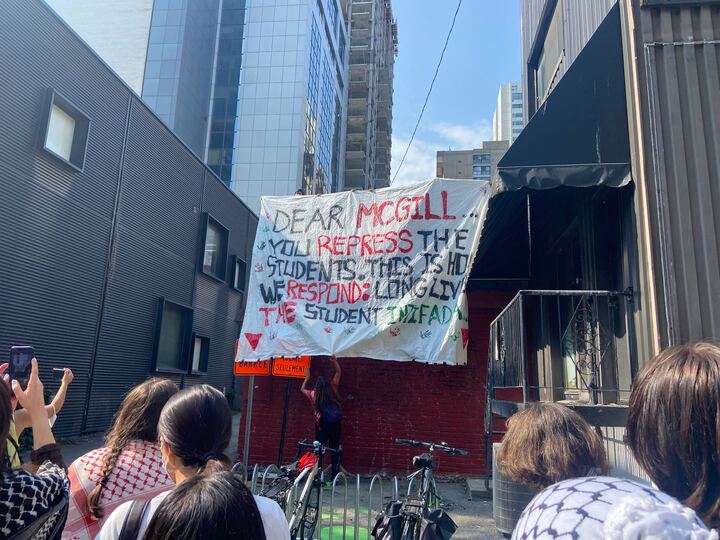
Protestors remained in the building for about 10 minutes, before going back outside to unveil a large banner which read “Dear McGill, you repress the students. This is how we respond: long live the student intifada.” Around 2:45 p.m., organizers dispersed the rally.

(Shani Laskin / The Tribune)

In a statement to The Tribune, Independent Jewish Voices McGill (IJV) condemned the continuous on-site police presence at pro-Palestine protests.

“Last Thursday, members of Concordia security called the police immediately on discovery of a picket that was disrupting class, and worked in tandem with the SPVM upon their arrival,” IJV wrote. “This continues a pattern of collaboration and militarization on our campuses that deeply endangers the student body. Universities like McGill and Concordia have claimed to care about creating ‘safe’ spaces for students, while simultaneously inviting police brutality onto campus.”

After McGill ordered the dismantling of the Palestine Solidarity Encampment in July, Saini wrote that the Board of Governors (BoG) Committee on Sustainability and Social Responsibility (CSSR) would “explore the question of divestment from direct investments in companies that derive a dominant portion of their direct revenues from the production of military weapons, regardless of the countries in which they operate.” To this end, McGill Secretary-General Edyta Rogowska sent an email on Sept. 11 with a webform for students and staff to offer their opinions on the question of divestment. The CSSR is expected to present their findings to the BoG in December 2024.

“McGill is moving forward on a range of measures that reflect our community’s challenges over the last year,” McGill’s Media Relations Office wrote to The Tribune. “All submissions will be read and carefully considered by the Board of Governors’ Committee on Sustainability and Social Responsibility and treated in the strictest confidence.” 

For some organizers on campus, this step is too little, too late.

“The email that was sent out […] is redundant after a year of students making their demands heard clearly,” Alex said in an interview with The Tribune. “Our demand for divestment is simple and achievable through already established processes. McGill could divest tomorrow if they chose to.”

*Alex’s name has been changed to preserve their anonymity.

Editorial, Opinion

Canada and McGill must confront their roles in eco-racism against Indigenous peoples 

As the climate crisis steadily worsens in Canada, so do the livelihoods and environments of Indigenous peoples who bear the disproportionate brunt of its effects. Climate change is eroding both access to resources and foundations of Indigenous tradition, ritual, and history. These impacts on Indigenous communities are not incidental. They stem directly from systemic eco-racism, perpetuated by blatant disregard for Indigenous ownership of land and self-determination, as well as Canada’s prioritization of fossil fuel companies, infrastructure projects, and large public institutions such as McGill.

McGill prides itself on its cutting-edge sustainability models and practices, such as its carbon offset program, green roof agriculture, and an online sustainability module. The latest and most ostentatious claim to sustainability is McGill’s New Vic Project—an $870 million CAD renovation of the Royal Victoria Hospital (RVH) to extend McGill’s STEM and research facilities. McGill claims that this new infrastructure will be a hub for sustainability systems.

There is clear irony in a so-called “sustainability” project being built on stolen Indigenous land; these two realities cannot coexist. The RVH is built not only on unceded traditional Kanien’kehá:ka (Mohawk) territory, but was also the site of violent, unethical psychiatric experiments conducted on Indigenous peoples as part of the MKULTRA project through McGill’s Allan Memorial Institute. The Mohawk Mothers are still in the midst of a legal battle with McGill to stop construction on the RVH site due to the possibility of unmarked graves on the land. However, despite its violent past and blatant disregard for the Indigenous history of the land, McGill stated just two weeks ago that the New Vic Project will move forward. 

Performative activism on the part of both McGill and Canada propagates the invisibility of the Indigenous lived experience of eco-racism. These perfunctory gestures are a convenient substitute for the complete paradigm shift required to move in the direction of eco-justice. In its Frequently Asked Questions page for the New Vic Project, McGill states that it is working towards “Indigenous physical representation” in the building’s design, mentioning the Mohawk Mothers’ legal battle without addressing the necessity for rethinking the project altogether.

The New Vic Project is just one of innumerable instances of eco-racism against Indigenous communities which are rendered invisible by Canadian institutions. The Aamjiwnaang First Nation people spoke out in April about the carcinogenic benzene poisoning on their land from the INEOS Styrolution chemical plant in Sarnia, Ontario. The company called the omissions a “concern,” but have no concrete plans to terminate or rectify their operations. Such acts of environmental racism treat Indigenous spaces as worthless and a waste of lucrative land, thus devaluing Indigenous culture itself. 

Eco-racism against Indigenous communities in Canada exposes the true extent of the climate crisis, which manifests as cultural and psychological crises in addition to purely environmental ones for the groups who are most affected. The dispossession of land, inability to honour ancestral history, and restrictions from essential natural resources are factors of the environmental crisis felt exclusively by Indigenous communities. However, the colonial attitude that deems Indigenous land and life as expendable also systematically excludes the acute environmental crises experienced by Indigenous peoples from the concept of the “climate emergency.”

Both McGill and Canada boast progressive efforts towards sustainability. However, no system of “sustainability” is—per McGill’s statement—“benefitting all of humanity” if it ignores the foundational ties that Indigenous peoples have to their land and resources, much of which is unceded and occupied by others.
The history of eco-violence and racism against Indigenous peoples at the hands of both McGill and Canada are insurmountable, and thus there are innumerable steps to be taken towards eco-justice. The federal government must aid in relocating Indigenous people who have experienced adverse effects from infrastructure, chemical poisoning, and other pollutants on their land. All projects and initiatives must be conducted hand-in-hand with Indigenous peoples and in line with their priorities. Indigenous sovereignty must be acknowledged and codified. There must be a pervasive awareness that these eco-violences are not just events in a racist, colonial past, but palpable and ongoing today.

Read the latest issue

Read the latest issue