


Latest News

Commentary, Opinion

Recycling centre closures are symptomatic of a larger crisis

The pile up of recycling in Montreal has reached a crisis which will likely continue to grow,  as one of Quebec’s primary recycling operators plans to close two sorting centres in Montreal as early as Feb. 3. Unfortunately, China’s 2018 ban on several types of recyclables has caused a shift in the world market for recycled and recuperated goods, causing a waste crisis in dozens of cities around North America. The uncertain future of Montreal recycling threatens to damage the ethos of recycling and erode trust in sustainable practices.

 In recent years, Canadians have tossed paper, plastic, and glass into curbside bins, assuming that they would be recycled into new goods. In 2019, however, exports of recycled materials dropped significantly, leaving cities across Canada to deal with a surplus of these materials. This decline in demand is largely due to countries like China and Hong Kong reducing their imports of Canadian plastic scraps by 96 and 72 per cent, respectively. As cities across Canada scramble to cope with a decreasing demand of recyclable goods, operating costs have begun to soar, and materials are piling up with fewer places to send them.

 The recycling dilemma Montreal faces is a symptom of a problem that long precedes a flip in the world market. In an effort to simplify the process for consumers, the City of Montreal uses a single-stream recycling process in which all materials are collected together and sent to a sorting facility. While single-stream recycling is easier for residents and has been shown to increase participation rates, it is often more costly and leads to higher contamination rates. Contamination issues are often a result of overzealous individuals who hope to recycle more than is accepted. Even a small amount of food or a used pizza box has the potential to send entire batches of recycling to the landfill.

 This problem is evident within the McGill community as well. The nature of student living promotes needless waste; regardless of the season, one can find an abundance of garbage littered around the Milton-Parc community. A recent study suggests that only nine per cent of Canadian recyclable plastics end up in appropriate sorting facilities. Come May, the issue is exacerbated, as students rush to get rid of couches, carpets, chairs, and everything in between. While student initiatives such as ‘Trash 2 Treasure’ aim to pick up the waste, unfortunately, many of these items end up on the streets surrounding campus instead being sold, recycled, or donated.

 Often, when materials do end up at sorting facilities, the materials are contaminated and ultimately end up being sent to landfills. Problems with contamination are forcing many sorting centres to refuse more and more varieties of materials. Other cities have opted to tighten curbside recycling criteria, requiring residents to sort their own paper, plastic, glass into separate bags and containers.

 Even with strict criteria, recycling centres are struggling to keep up. The damage these closures will have on perceptions of sustainability is profound. If Montrealers do not trust that their recyclables are being handled properly, they may lose faith in the entire operation and abandon their previous recycling habits. Similarly, if consumers lose faith in recycling, they may begin to regard sustainable behaviours as an ineffective way to effect meaningful change. 

 While the city of Montreal has a responsibility to provide recycling services to residents, individuals should view these closures as a warning that it is time to change their habits. Instead of foregoing the three Rs: Reducing, reusing,and recycling; residents can use this as an opportunity to ameliorate their previous habits. Students should reflect on which items are necessary for their apartments, plan ahead to dispose of them correctly when they move out, and educate themselves on how to sort materials properly on campus and at home. Ultimately, the economy is not perfectly circular and recycling alone cannot effectively achieve sustainability; recycling is the last ‘R’ and it is imperative that focus be shifted toward reducing and reusing. 

Arts & Entertainment, Film and TV

Docuseries ‘Chile in Revolt’ presents the human narratives of civil resistance

The banging of pots, pans, and wooden kitchen spoons together might not seem like a particularly defiant or political image. Yet for Chileans, this action—known as cacerolazo—has been emblematic of decades of struggle and civil resistance against oppressive regimes in the country. It is also the thread that brings together the films screened in the docuseries Chile in Revolt, presented weekly at UQÀM from Jan. 16-31. 

A protestor and her pan foregrounds the first shot to the prologue of Chile in Revolt: At an intersection further behind, riot-policemen are seen fighting a handful of protestors. The protestors’s chants and the tinting sounds of her pot are muffled because of the brawl in the background. The second scene is shot along a Santiago highway emptied of traffic, where riot-police are seen shooting rubber bullets and aiming water cannons towards a dozen protestors, then retreating with apparent indifference as the street goes up in flames.

The prologue comprises only these two shots and lasts barely over a minute. The effect is nonetheless chilling: The camera remains still throughout, giving an uncanny sense of stability unfitting with the scenes of violent confrontation the film seems to imply that, in these environs, there is normalcy in such events.

Era Necessario offers a much more vibrant depiction of the 2019 Chilean protests. Here, thousands of Chilean women from all ages and backgrounds have gathered in the streets of Santiago, chanting and banging their dishes, demanding action against sexual violence in the country. Chile has a historically dismal record of sexual violence and the rate of rape in the country are among the highest globally. However, the tone of the film remains hopeful, focusing instead on the sense of solidarity between Chilean women and the sense of community fostered by the protests. 

Movilizados depicts the 2011-2013 Chilean student protests against the Sebastian Piñera government and the brutal police repression that ensued. While a bit long-winded, a few powerful moments stuck out. In one, an elder woman tries to convince a barricade of riot-police officers that their work is perpetuating injustices: “If you are here, it is because you are poor like us,” she tells the expressionless officers. The documentary could use more of such candid confrontations where the Chilean struggle is at its most intimate and spend less time on its numerous and often tedious interviews.

Chile in Flames brings viewers to present-day Chile, where civil defiance by high school students to a 30-peso increase in weekly transit fees in Oct. 2019 quickly turned into a large-scale protest for widespread social reforms. The documentary follows the events chronologically, from the millions marching the streets of Chilean cities demanding better living conditions to the government’s refusal to back down by sending armoured vehicles and riot police to quell the protests. In the end, Chileans defy en masse new curfew laws and continue to demonstrate—with the tinting sounds of the cacerolazo as their weapon of resistance—until the government has cancelled the fare increase, and promised new social reforms. 

Of all the documentaries screened, Chile in Flames is the most forceful. It juxtaposes horrific images of burnt down subway trains and brutal police repression reminiscent of Augusto Pinochet’s Chile with powerful human narratives of shared struggle. While the previous documentaries often give the impression that civilian protests merely contribute to a never-ending cycle of violence, Chile in Flames shows a population united by resistance and capable of achieving concrete improvements to people’s lives. It is a neat conclusion to the docuseries: in a country where the status quo has rarely ever yielded to the masses, the film brings hope that institutional change might really be possible in Chile.

Sports

10 things: The best animals in sports

Sports are known for many things: Upset victories, legendary players, and championship glory. But what really matters are the cute, loveable animals behind some of the greatest moments in sports history. Here are The McGill Tribune’s picks for the top 10 best animals in sports. 


Atom and Humber

Chilean footballer Alexis Sánchez has a small family of pets. Most famous are his dogs Atom and Humber, who have their own Instagram account. These golden retrievers appear to lead very busy lives with tough training and travel schedules, but Sánchez can always count on them to support him every game day. 

Rally Possum

The Cleveland Browns’ Rally Possum is not the only possum to bring good luck to a North American sports franchise, but this creature is arguably the best at spreading good fortune. Rally Possum’s appearance in the stands at a Browns home game in 2018 broke a 635-day losing streak. That’s powerful. 

San Antonio Bats

It was just a normal mid-season game for the San Antonio Spurs when, suddenly, five bats swooped down from the rafters in a coordinated effort to stop play. The last time this happened to the Spurs’ Manu Ginóbili, he savagely swiped a bat out of the air with his bare hands. Fortunately for bat lovers everywhere, he has since retired, allowing our winged nocturnal friends to be caught and later released by professionals.

Jo Pawvelski

In 2016, a three-month-old black kitten made her Stanley Cup Playoff debut in the San Jose Sharks’ arena. The kitten was quickly dubbed Jo Pawvelski, after then-Sharks captain Joe Pavelski, and became an unofficial second mascot for the team. Jo was later adopted by Sharks forward Patrick Marleau. 

Flambo and the Habs

In December 2018, the Montreal Canadiens adopted a Saint-Pierre Labernese named Flambo in partnership with the Mira Foundation, an organization that trains service dogs. Unfortunately, medical issues prevented Flambo from becoming a service dog, but he remains with the Canadiens and can be seen at home games and is featured on Instagram.

Tee-retrieving good boys

NCAA football may not be for everyone, but tee-retrieving dogs could be. These adorable helpers dash onto the field and bring the kicker’s tee back to the sideline after kickoffs. Boise State’s Cowboy Kohl is perhaps the most famous tee-retriever, but other good boys include New Mexico State’s Striking and UC Davis’ Pint.  

The Cubs’ black cat curse

On Sept. 9, 1969, a black cat added itself to the list of Chicago Cubs curses. The Cubs, 61 years into their World Series drought, held a oneandahalfgame lead over the New York Mets. But during a game in New York, a black cat waltzed toward the visiting dugout and looked Cubs manager Leo Durocher in the eyes before disappearing. Chicago missed the playoffs for the next 15 years.

Paul the Octopus

Paul the Octopus was perhaps the only successful English talent at the 2010 FIFA World Cup. The eight-limbed oracle accurately predicted the winner of eight World Cup games, including the final, by floating over the correct food box. The clairvoyant octopus passed away in 2010, but for the two-and-a-half years he spent on earth, Paul did what many humans never could: He made a million dreams come true.

The Bakersfield Condor

A condor, the second largest flying bird in the world and the foolishly-picked symbol of a Bakersfield hockey team, demanded freedom to the rallying cry of the Star Spangled Banner during a game in 2013. After multiple escape attempts, the devastation of its handler’s reputation, and the successful intimidation of the Condors’ players, the bird headed down the tunnel toward the locker room and out to freedom. 

Trolley Boy

Trolley Boy captured our hearts when he brought the story of the famed racehorse Secretariat to the big screen. His undeniable athletic prowess, incredible acting ability, and uncanny resemblance to Secretariat more than honours the legacy of the legend. With such a stirring performance, Trolley Boy has fashioned himself into a legend as well. 

Editorial, Opinion

Experience does not pay tuition

In exchange for another bullet point on their CVs, many McGill students feel pressured to take on underpaid positions. Participating in an on-campus club or as a non-executive in student government can require hours of labour without compensation. However, unpaid work becomes exploitative when students are expected to do the work of a full-time paid employee, without receiving the paycheck. Despite unpaid internships being illegal in Quebec, the Arts Internship Office (AIO) and some student groups such as the  Pre-Law Students’ Society have still promoted internships that pay students less than half of minimum wage, if anything at all. McGill has a responsibility to promote equal opportunities for all students, and this means supporting paid career experience, not unpaid internships.

A common justification for unpaid internships is that what students give up in income, they make up in experience. However, this notion puts already privileged individuals in an even more advantageous position while dismissing the realities of other students’ financial burdens. While learning skills might be useful in getting a job post-graduation, it will not pay for a student’s groceries, rent, or tuition now. Moreover, some students are also parents, who may have mortgages to pay and families to support. The idea that students should be willing to give up a paycheck for these positions closes off career experiences to people who cannot afford to lose hundreds of dollars per week, thus deepening economic divides on campus.

“While learning skills might be useful in getting a job post-graduation, it will not pay for a student’s groceries, rent, or tuition now.”

Finances aside, unpaid internships can be incredibly demoralizing. Working overtime to balance unpaid labour with a paid position can lead to exhaustion and burnout, and seeing one’s contributions go uncredited and uncompensated can take a toll on students’ sense of self-worth. Moreover, when students are not recognized as paid employees, they can fall outside the safety net of labour law protection. In November 2018, 54,000 students took part in a week-long protest against mandatory unpaid internships across Quebec citing a need for legal protection as a main concern.

In addition to giving up valuable time, students are expected to pay for their internship credits. Students in the School of Social Work are expected to complete 800 hours of unpaid labour in order to graduate. Faculty of Arts students can also use unpaid internships with written requirements for credit. In both scenarios, McGill makes students pay to work by denying them income and then charging them to have their work recognized as credit.

While unpaid internships unfairly exploit student labour, many organizations and professional fields rely on this free labour to keep running. Some grassroots organizations and nonprofits cannot afford to hire interns. Inversely, student positions in fields such as engineering are paid generously, while full-time social work jobs receive no funding. For students to make a livable wage, institutions like the Quebec government and McGill need to reach an agreement that makes it clear that these fields, and student workers, are worth investing in, and thus need to be compensated. 

As an educational institution, McGill has a responsibility to make sure its students receive a proper education. Funding internships in the field of social work and arts would ensure that all students have the opportunity to gain experience without sacrificing much-needed income. Additionally, despite being a leading Canadian university, McGill has yet to develop a coop education program, an opportunity that other universities across the country have offered for years. Co-op programs coordinate paid employment positions that provide students an opportunity to apply knowledge from their courses in the workplace. Students need work experience in order to succeed post-graduation. However, McGill continues to refrain from making work experience a graduation requirement. In doing so, they avoid the responsibility of finding paid work options for students. 

McGill should prioritize broadening the paid work opportunities for students in all faculties. This means providing more extensive job listings on the Career Planning Services website, offering comprehensive career option documents, and developing co-op programs in all faculties such as those available at dozens of other universities nation-wide. Currently, only students who have exhausted their student loans are eligible for McGill’s Work Study Program. McGill should expand this program to be available to more students regardless of their financial resources. Finally, given the unequal nature of unpaid and under internships, the AIO and McGill student groups should also immediately remove all postings for jobs that pay less than minimum wage. Getting work experience should not mean sacrificing rent or grocery money.

Off the Board, Opinion

The consequences of “locker room talk”

Content warning: Mentions of sexual violence

From where he was standing, he could not see me. All he saw was a young woman, possibly alone, sitting inside Juliette et Chocolat, enjoying a dessert. She was not making eye contact or flirting. She was just sitting. That is when he, the man looking at her, decided to repeatedly tap on the window, mimic sexual intercourse, and shove his phone against the pane in some perverted attempt at courtship. This was the first time I had ever witnessed the sexual violence that my girlfriend, and all feminine-presenting people, experience in their lives every day.

When I was in middle school, I generally spent recess alone, avoiding my peers’ conversations. That was partly because I disliked what some of my male classmates talked about: They ranked the girls in our class based on appearance and bullied those they deemed less attractive. I knew this was wrong, but it was easier to avoid it than to intervene, so that’s what I did. I never said anything. 

When I was in high school, I was a member of the varsity basketball team, and I thought it was important to maintain amicable relationships with my teammates to preserve my position within the group. That is why, when one of my teammates began circulating a female classmate’s nude photos without her consent in the team’s group chat, I again said nothing. I was always a passive bystander.

When I was in my senior year, Donald Trump was revealed to have said, among other disgusting things, that he considered women to be objects for his own pleasure and that he could treat women without regard for their humanity because he was a “star.” A month later, my country elected him as President. His opponent, Hillary Clinton, faced immense structural sexism in how the media covered her campaign and the scrutiny that she faced. As a result, Trump was elected despite a litany of sexual violence allegations and the Access Hollywood Tape, which his defenders and supporters termed “locker room talk.”

But for women, these actions are so much more than cheap talk. They are the foundational blocks of a permissive society wherein men can objectify and harass women, while negating their ambitions, accomplishments, and humanity. 81 per cent of women experience some form of sexual violence, a deeply dehumanizing experience, and 75 per cent of those who are harassed and speak out experience some form of retaliation. There are real consequences to locker room talkthe same talk that begins with boys ranking girls and sharing their nudes, which are both examples of sexual violence. 

It is easy for men to miss seeing these consequences, precisely because when men are present, they do not occur. When a woman is without a man, our society has taught men that she is not so much an independent agent as she is “fair game.” In effect, men are to be respected, while the respect afforded to a woman is dependent on her immediate relationship to a man. 

That is why, on that dreadful night at Juliette et Chocolat, the harasser only stopped his movements when I came around the wall to reveal myself, standing by my girlfriend’s side. He and his friends were stunned because they knew that they had been caught. And in knowing that they were caught, each revealed that, deep down, they knew what was happening was wrong. I shouldn’t have had to be there from them to know they were being violent. And yet, like me in middle and high school, no one had said anything. 

Being an active bystander is far from easy, especially when it means telling a friend that they are wrong. But it cannot take getting caught, or watching those we love get harrassed, for us to speak out for what is right. As men, we must all do better to hold one another accountable for the way we talk about and treat women. For, until we do, the society men have created, permissive of everything from casual harassment to a rapist in the White House, will go unchanged. 


Commentary, Opinion

McGill’s medical note policy makes students sacrifice health for grades

After sitting in the Montreal General Hospital for the sixth hour in a row, tired, and with a sprained foot, I asked the receptionist how long it would take for the doctor to see me. She replied that there was only one doctor working that weekend, and that I would probably have to wait until the next morning. I decided to leave, as staying overnight for treatment did not seem to be worth it. This experience left me thinking about the difficulty of receiving medical attention, and how professors should acknowledge these institutional barriers by being more lenient towards exam deferral.

Countless university students deal with medical issues, from physical injury to mental illness. Often, these issues translate to students being unable to perform well on exams, not because of their inability to understand the material, but simply because they are not physically or mentally capable of doing their best. To avoid hurting their grade in a given course, students have the option of deferring an exam, given that they provide reasonable medical documentation. is where the problem lies. Often times, students are unable to acquire medical documentation due to the long waiting times and overcrowding present at public hospitals and, more specifically, the McGill Wellness Hub. Students’ dissatisfied reviews illustrate just how frustrated students are with its incompetency. There are simply not enough doctors or resources available to tend to all those in need, and free healthcare sometimes comes with the risk of not being seen by a professional at all.

 The McGill clinic officially operates from 8:30 am to 4:30 pm. However, students know that if they do not arrive before 8 am, their chances of being seen by a doctor are slim to none, as drop-in spots fill up quickly. Moreover, the clinic only operates on weekdays, so if one happens to fall sick after 8 am or on a weekend, they have to either treat themselves or go to one of Montreal’s emergency rooms (ERs). At the ER, the situation is even worse, with wait times of several hours, and people being seen according to their priority, rather than first-come-first-served. This means many students have to wait longer than those who arrive after them if their condition is not deemed serious enough.

Some institutions have taken note of this unfair policy of conditional exam deferral, including the University of Calgary, which recently passed a regulation stating that students would no longer need to present a medical note to be excused from exams. Adopting such a policy takes the pressure off students to frantically try and get a medical note before their exam takes place, fearing their deferral request may not be approved. Professors at McGill should develop a more trusting relationship with their students, believing them when they claim they have medical issues, rather than being skeptical.

There may be some students who take advantage of a more lenient policy, and use it to miss exams, not because of a valid medical reason, but simply because they procrastinated studying. Hence, instead of banning medical notes altogether, McGill should give more leeway and accommodations to its students in the time they can take to provide medical notes, rather than demanding them on the day of or a few days before an exam. This way students can feel they are in a safe environment, where their mental and physical health is valued, instead of constantly trying to prove that they have a ‘valid’ reason to be excused from exams.

In the long term, McGill’s administration needs to re-evaluate its business model and address students’ ongoing concern of a lack of availability of timely treatment coupled with poor accommodation for exams. This can create a system where students can thrive and are not forced to sacrifice their health for grades.


Commentary, Opinion

Make mentorship at McGill more accessible

On Jan. 3, a McGill graduate student posted on Reddit to bemoan the lack of opportunities to connect with and mentor undergraduate students. Some commented that more casual connections would be better than none, and others pointed out that while social distance is natural between graduate and undergraduate students, there should be more professional room for mentorship within McGill. However, the problem has less to do with the lack of mentorship opportunities available, and rather with the barriers that prevent so many students from taking advantage of potential resources. Accessibility barriers blight potential mentorship opportunities at McGill, with difficult or non-functional online applications creating problems for students before the process even begins. While other faculty or society-specific mentorship programs are well developed, they present other hurdles, such as requiring extensive experience or significant financial commitment, meaning that the actual pool of mentorship opportunities for current McGill students is extremely limited. 

One such program that is poorly advertised, underused, and functionally inaccessible is the main Career Planning Service (CaPS) Mentorship program, which claims to offer the possibility of real world experience and mentorship. The site states that students can browse potential mentors on the ‘Join Now’ tab, but unsurprisingly, there is not a massive database of potential mentors waiting to be linked with hopeful mentees. Instead, expectant students are greeted with a yellow box familiar to many broken McGill pages, stating that the application is ‘temporarily unavailable due to database maintenance’.

This obstacle means that the only other options for McGill students to access CaPS’s program is to either contact the Mentor Program Coordinator via email or to go to CaPS in person. This restricts students and hugely decreases the accessibility of the program, since students nervous about applying or who suffer from physical or mental barriers that might deter them from attending in person will be less likely to apply to the program. 

The general McGill page for mentoring highlights a number of buddy programs, including the International Buddy Program, and faculty-specific programs such as the NUM Buddy Program. These programs are hugely valuable, and can be mutually beneficial to many students at McGill, but are different to what students and alumni are asking of a mentorship program—a way to connect people that is beyond the experience of solely current students. McGill is relying on its own students to support their peers, rather than helping students through their own resources, fostering a belief that buddy programs can replace a real effort to connect alumni with undergrads. 

Valuable mentorship opportunities exist within organisations that are either exclusive in terms of long and demanding applications or financial obligation. Some of these organisations are phenomenal, and connect inspiring alumni to current students, such as McGill Women in Leadership. Understandably this requires extensive experience given that it is a high demand co-curricular club, rather than a university mandated careers program intended to be accessible to everyone. There are also organisations that are merit-based, like the Golden Key International Honour Association, but come with a catch that requires that students pay a $90 fee to join. These exclusive opportunities shut many students out before they are even able to get their foot in the door. 

The problem at McGill is less of mentorship programs existing, and more that the programs available are plagued with countless bureaucratic hoops that students must jump through before they can even access the ‘Join Now’ page. This issue is yet another area of McGill student life that could be amazing, but instead is complicated by McGill bureaucracy, negatively impacting students and their future careers. Other campus organisations continue to offer better alternatives, but being inspired by alumni and taking advantage of what intelligent graduate students have to offer should not be a rare opportunity afforded to only those who know where to look, or who can afford membership fees. It should be an opportunity that everyone has access to, and a place where McGill alumni can show current students how to make the most of their degree. 


Letters to the Editor, Opinion

Letter to the Editor: On asking permission and giving credit

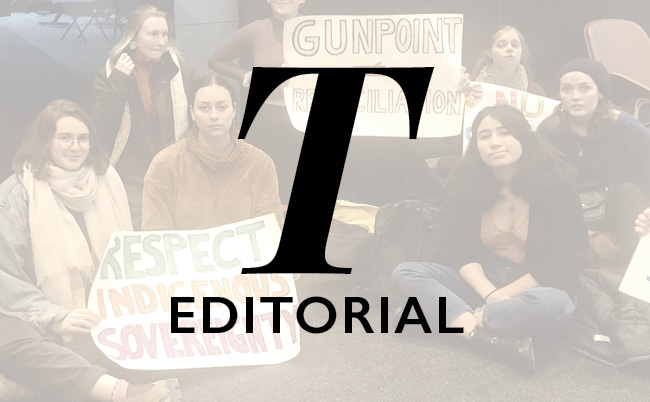
In The McGill Tribune’s Jan. 21 editorial, a photo that I had taken earlier in the month at a demonstration was used to accompany the article, without my permission and without credit.

It is true that, at student publications, mistakes are often made, and without a journalism school at McGill, they are more likely to occur. I too am guilty of making journalistic errors. But, it is unacceptable to use a photo for an article without first asking for permission.

When a newspaper does not ask a photographer about using their photo and fails to credit them, especially when they display it as the symbol of an article with which the photographer may hold concerns, it feels really disrespectful. In a Facebook post summarizing the editorial, the Tribune purports an understanding that “it is imperative to highlight the experiences of McGill students who are directly affected by jarring political events,” yet the Board used my photo, that of an Iranian-American journalist–someone whose family is affected by the ramifications of the American government’s decisions and whose mental health has suffered this past month–without permission or credit.

Asking the photographer if they are comfortable with their image being displayed as the visual representation of an article is crucial. But, there is also more to it than showing respect and courtesy; without giving credit, it is plagiarism, and it is especially ironic given my lived experience and the Tribune’s claims to be uplifting marginalized voices.

In an industry that heavily underrepresents racialized women, it is imperative that publications, even student ones such as the Tribune, respect our work. It is not enough to claim that one supports marginalized peoples–it must be consistently demonstrated through concrete actions.

Features

Excluded voices

It begins on the first day of the semester: The syllabus is monopolized by white men. When universities emphasize privileged voices, they dominate classroom conversations and textbooks, leaving little space for marginalized groups’ experiences. While academic institutions like McGill continue to enact policies against discrimination, these initiatives raise questions of what kinds of discrimination ought to be recognized within the university context.

Research Briefs, Science & Technology

Solving the mysteries of Earth’s Cryogenian ice age

Typically, one wouldn’t think to ask a geologist about the most pressing issues in evolutionary biology. Yet, for some biologists, rock formations and fossil records—which have only gained the attention of natural scientists in the last 50 years—provide a plentiful source of untapped information about the history of life on Earth.

A recent study released in the journal Proceedings of the National Academy of Sciences applies geological theory to questions of how some of Earth’s earliest eukaryotes—tiny, multicellular organisms—survived one of the coldest periods of Earth’s history. 

Using the presence of mineral deposits in rock formations across the globe, Maxwell Lechte, lead author of the study and postdoctoral fellow in McGill’s Department of Earth and Planetary Sciences, and his colleagues proved that liquid water containing a relatively high abundance of oxygen was present underneath the ice masses of what scientists now call ‘Snowball Earth.’ A tumultuous period in Earth’s geological history, Snowball Earth occurred over 700 million years ago during the Cryogenian ice age. During this period, ice was almost everywhere. The proliferation of ice masses across the globe caused the separation of the oceans from the atmosphere, blocking out the sun and plunging earth under ice sheets up to two miles thick. 

“Reconstructing ice ages using geology is quite a well-established technique because they are quite apparent in the geological record,” Lechte said in an interview with The McGill Tribune. “Ice sheets are extremely powerful erosive forces […] and are quite distinctive in the rock record.” 

The eternal frigid waste of the Cryogenian Period presents a perplexing question for evolutionary biologists: How complex eukaryotic life, which requires oxygen to live, survived though 100 million years of frozen temperatures when the waters of the ocean contained little to no oxygen.  

Luckily for baffled biologists, a geologist was asking the same thing. 

“The question I was interested in is [was] what effect this would have on the biosphere,” Lechte said. “There is no doubt that covering the whole planet in ice would reduce the amount of habitable area.” 

Scientific consensus has approximated that complex eukaryotic life was first evolving around the same time that Earth was becoming covered in ice. 

“If you cover the whole oceans in ice, that separates them from the atmosphere, and so all these more complex life forms should have been killed off,” Lechte said. 

The authors assumed that since eukaryotes survived the ice age, complex life living underneath massive ice shelves must have gotten oxygen from a source other than the atmosphere. 

“Iron is soluble in sea water under anoxic conditions, so when there is no oxygen around, iron can dissolve,” Lechte said. “But as soon as you have any oxygen around, iron rusts out of the water and becomes insoluble and deposits out as solid iron oxides. The fact we had found all these [iron oxides] in glacial deposits suggests that something interesting was going on with oxygen.” 

From these observations, Lechte, along with researchers at the University of Melbourne, proposed that meltwater may be the key to supplementing oxygen to organisms living under the ice’s surface. They suggested that air bubbles from the atmosphere had become trapped in the ice shelves as they were forming. These air bubbles, which contained ample oxygen, then became a vital lifeline for marine eukaryotes that could survive off of meltwater that contained much higher levels of oxygen. 

The implication that oxygen stores could be found on Earth hundreds of millions of years ago is an invaluable link in the evolutionary chain of events. These questions about the long-term evolution of complex life date back as far as Darwin himself.

“A lot of our understanding of the past Earth is based on modern Earth,” Lechte said. “People historically have assumed Earth has just always been this way, but we have come to understand these changes as a recent phenomenon.”


Layers of iron-rich glacial deposits exposed in the desert illustrate the history of marine environments during Snowball Earth (Death Valley, California). (Maxwell Lechte / The McGill Tribune)

A small dropstone within marine sediments with red layers of iron oxides tells the tale of marine oxygenation during Snowball Earth (Ikara-Flinders Ranges, South Australia). (Ashleigh Hood / The McGill Tribune)

Read the latest issue

Read the latest issue