Latest News

Campus Spotlight, Local Stories, Student Life

Fair Trade at McGill: Why your purchases matter

A variety of tabling events often take place on campus, each aimed at promoting and raising awareness for diverse causes. On March 27, The Tribune spoke with the Fair Trade tabling event organizers outside the McConnell Engineering Building. The information booth, identifiable by its red tent and “Spin the Wheel” game, offered chocolate and coffee to participants. 

The event was organized to educate students about McGill’s Fair Trade Campus designation and to raise awareness of the real-world implications of fair trade practices.

“We are trying to educate students on how fair trade helps farmers in developing countries fight climate change,” Goktug Bender, sustainability coordinator at McGill Student Housing and Hospitality Services, explained in an interview with The Tribune.  

Bender elaborated on how Fair Trade establishes a minimum price that every retailer or buyer must pay, in addition to a Fairtrade premium. This premium is paid to farmers above the minimum price and is designed to help communities invest in sustainable development for their local organizations.

“We basically invest in them by building infrastructures or having initiatives and investments in their communities and buildings,” Bender stated. 

Zach Suhl, associate director for McGill Food and Dining Services, delved into the challenges farmers face in the context of climate change. He pointed out how larger companies often fail to implement tangible initiatives to ensure producers get a fair value for their products. 

“For example, bananas have had the same price for many years compared to everything else,” Suhl explained. “Our consumption habits are generally always looking for something cheaper to the point that we need to ask ourselves: How is it possible that a banana from Costa Rica can come here and only cost 39 cents? You need to ask yourself who is getting paid to produce this and who is being paid to take care of this.” 

Suhl also emphasized the need for purchasers to be conscientious when buying goods, as price discrepancies reflect the underlying issues farmers face when making profits for their businesses.

“The minimum price established by Fair Trade helps farmers purchase more tools and technologies to fight climate change,” Bender added. 

This is increasingly important, as modern technology is a key implement for farmers to address new and unpredictable weather conditions in a changing climate.

In addition to Fair Trade, Suhl made suggestions for how McGill students can particularly contribute to this cause. His first recommendation is to be aware of these global trade dynamics, and be critical of low prices of goods. 

“I think that students should be very selective in their purchasing. If they are at a [shop] that is not selling fair trade products, it would be good to inquire as to why, what are the issues, why are they not able to carry out fair trade,” Suhl proposed.

Calling on students for more collective awareness, in turn, leads to their second objective, which is to make selective purchasing decisions. Suhl and Bender encouraged students to act on their knowledge of the Fair Trade impacts on farmers. 

“Yes, everyone has a limited amount of disposable income, but the best way to support these initiatives is through your own pocket,” Suhl said.

The Fair Trade tabling event reminded students that everyday choices—like questioning prices or choosing fair trade—can have a real impact, especially on small farmers who already face the obstacle of surviving against the competition of massive agricultural corporations. With greater awareness and intentional purchasing, students can support more just and sustainable systems, on campus and beyond.

All Things Academic, Student Life

How to support your friends (and yourself) during finals

March is the Trojan horse of the semester. While the end of midterms and the start of spring lull us into a false sense of security, final exams are lurking just out of sight. In April, when they do arrive, it’s crucial to put yourself first—but that doesn’t mean forgetting those around you. Fostering a sense of community can make this stressful time a little easier for everyone. As finals season approaches, The Tribune has put together a few simple ways to support your friends. After all, the whole student community thrives when we look out for each other.

Respect their study style

Not everyone works best in the same study environment. Some people need absolute silence, while others focus better in a lively café or with background noise. Before inviting a friend to a group study session or quizzing them on course material, check in on what works best for them. Even the best of friends may not be compatible study buddies—and that’s okay. It’s also important to recognize when someone needs space. If a friend declines your invitation to study together or prefers to work alone, don’t take it personally. Respecting everyone’s study preference shows real consideration and helps everyone stay productive.  

Encourage breaks

In a culture that valorizes productivity, many of us mistakenly try to maximize our work time by taking as few breaks as possible. Oftentimes, breaks can feel unnecessary or even counterproductive. However, regular study breaks can lower stress and even improve recall, helping you make the most out of your time in the long run. Encourage your friends to avoid burnout by stepping away from their desks for a while. Remind your friends (and yourself) that breaks don’t have to be long—it can take as little as five minutes to refresh the mind and body. Prompt them to get some fresh air, grab a snack, or relocate to a new study spot. 

Offer practical help

Support doesn’t have to come in grand gestures—sometimes, the smallest acts of kindness make the biggest difference. If a friend is drowning in assignments, offer to proofread an essay, help organize their notes, or create flashcards for key concepts. If they’re struggling to stay motivated, suggest studying together for accountability or remind them to set a few manageable goals for the day. Even simple gestures, like saving your friend a library seat during peak hours, grabbing an extra snack, or reminding them of an upcoming deadline, can lighten their load. By offering practical help, you can lessen their burden and show them they’re not alone.

Celebrate small wins

Finals season can feel like an endless grind, with one major task blurring into the next. That’s why celebrating small victories is so important—it helps break the cycle of stress and reminds us of all the progress we’ve made. Whether a friend submits a tough paper, powers through a challenging study session, or endures another taxing group project, acknowledging their effort can make a huge difference. Send a quick message of encouragement, treat them to a coffee, or plan a short study break to unwind together. Recognizing these wins, no matter how small, helps make finals feel a little less overwhelming.

Direct them to on-campus resources

Sometimes, the best way to support a friend is by connecting them with the right resources. At McGill, students can navigate exam season with a range of free academic assistance and mental health support. Student associations often host group study sessions, providing a collaborative learning environment, while the Student Wellness Hub offers stress-relief activities like animal therapy, Mount Royal walks, and Art Hive open studios. A quick reminder about these services can make all the difference in easing a friend’s stress.

McGill, News

Checking in on McGill’s Wi-Fi: Students report connection issues disrupting academic work 

When Ryan Taylor, U0 Science, logged onto Zoom for a job interview earlier this semester, he was unexpectedly met with the McGill Wi-Fi cutting out. He had been gunning for an internship with Scotiabank, and the interview would determine how he spent his summer. 

“I tried to log onto Zoom on my computer, but the Wi-Fi was totally out,” said Taylor in an interview with The Tribune. “I almost missed the interview, which was pretty stressful. I had to run to my room and use my hotspot to get through it.” 

Ryan’s experience is not a one-off. Among the many students who use McGill’s network every day in libraries and other campus buildings, several others have reported outages. In interviews with The Tribune, some students stressed the importance of maintaining a reliable Wi-Fi connection, as many rely on McGill’s Wi-Fi to contact family and do time-sensitive schoolwork. 

“The Wi-Fi has gone out multiple times throughout my first year at McGill. Most times, it’s fixed within an hour or two, but there was one time [when] it was out for about four hours. I assume that disrupted a lot of students’ studying and ability to get work done,” said Olivia Sampson, U0 Arts. 

Extended outages can create unnecessary stress for students like Sampson, especially during busy academic periods such as exam season when deadlines loom. 

“The outage frustrated me a lot, as I was hoping to work on my assignments and had multiple deadlines approaching. It would have been fine if it was only a short outage, but it ended up lasting so long that it completely disrupted my study schedule,” Sampson said. 

In a statement to The Tribune, the McGill Relations Office (MRO) said that the university’s wireless service is “very stable” and provides “strong coverage across all buildings,” with more than 7,700 access points across 250 locations. MRO acknowledged that they typically receive a few complaints yearly, primarily due to brief Wi-Fi outages caused by renovation projects. 

Despite the occasional hiccups, MRO explained that McGill’s IT team remains proactive in monitoring and maintaining the network. Regular maintenance and long-term upgrades aim to prevent future disruptions and ensure that students can depend on stable internet access throughout their time at McGill. 

According to MRO, occasional outages can also be attributed to issues with McGill’s firewall, which both protects and manages traffic across McGill’s Wi-Fi network. The firewall is undergoing an upgrade spanning the next 12 to 18 months, which should improve security and enhance network performance. 

“This upgrade is part of our ongoing efforts to enhance network infrastructure,” MRO wrote. “Additionally, we recently completed a campus-wide network upgrade that spanned five years, improving both wired and wireless performance across all McGill buildings. The goal of this upgrade is to ensure that both Wi-Fi and overall network performance continue to remain stable and secure for everyone.” 

MRO also encouraged students to reach out to the IT Service Desk for support with Wi-Fi disruptions.

“The network is actively monitored and we often identify and address issues before they become widespread,” the Office wrote.

For any updates on Wi-Fi maintenance or interruptions, students can visit the IT Support site.

Behind the Bench, Sports

Varsity Report Card: Winter 2025

Martlets Artistic Swimming: A

Synchronized swimming had an outstanding season marked by dominance, consistency, and poise in the pool. The Martlets brought home 17 titles, culminating in a silver medal finish at the Canadian University Artistic Swimming League (CUASL) nationals in Victoria, B.C. They made waves at every invitational they entered, earning multiple golds in all varieties of routines. Led by standout swimmer and serial medalist Sonia Dunn, McGill proved to be a force each time. Dunn was recognized individually on March 23 for her triple-medal performance at nationals. Head coach Lindsay Duncan won the Anne Smeeton Award for significant contributions to the CUASL. Despite a season this decorated, and a national podium finish to cap it off, Martlets Artistic Swimming are used to bringing home the gold. For that reason, the team earns a solid A for 2024-2025.

Martlets Badminton (10–2): A-

Martlets Badminton had an impressive season and finished with a second-place spot in the Réseau du sport étudiant du Québec (RSEQ) behind the Université de Montréal (UdeM) Carabins. They started strong, sweeping their first meet in October, and in November, they triumphed over most of their competitors but fell to UdeM. At the RSEQ Championships in February, they lost in the semifinals to Université Laval (ULaval) for the first time this season in a close 2-3 loss. Senior Eliana Zhang was triumphant in the individual category, demolishing the competition and securing the final match in two straight sets (21-6 and 21-9). Zhang was named RSEQ Player of the Year and is a first-team all-star

Redbirds Badminton (5–7): B

The Redbirds competed in six inter-Quebec tournaments, including two RSEQ tournaments, before making an appearance at the YONEX Canadian College Championships in March. They started the season flying, with Captain Nicholas Germain taking home a silver medal in the A-elite men’s doubles division at the first individual tournament. From there, the Redbirds went 3-3 at home, 2-4 at Université de Montréal (UdeM), and placed third at Sherbrooke. McGill achieved third place at the RSEQ provincial championships, the weekend before nationals. There, the Redbirds took seventh place. The encore may have been disappointing, but it was not for lack of trying. McGill has not won the national championships since the 1981-82 season, when both Redbirds and Martlets took home the gold.

Martlets Basketball (13–12): B-

The Martlets started off the preseason with narrow wins against York University and the University of New Brunswick, but also faced tough losses to Toronto Metropolitan University and the University of Ottawa. Their performance during the McGill Basketball Classic was strong, winning two of three games, including a significant 75-50 victory over the University of Northern British Columbia. Once regular RSEQ play began, the team showed some resilience. A highlight was their 66-55 win over the Concordia Stingers and a close 66-64 victory on the road at Bishop’s University. However, they also faced challenging losses to ULaval, falling in both their home and away matchups. Overall, the Martlets have demonstrated solid potential, with a balanced record reflecting both promising wins and opportunities for growth. 

Redbirds Basketball (6–22): C-

It was a sputtering season for the Redbirds. Following the preseason, they went 4-17  in all competitions, finally managing to take off with a win—by one point—in the season’s final game, away at Université du Québec à Montréal (UQÀM). This was one of their four wins after the pre-season. Two players, Noah Sincere and Georges Lefebvre, managed to shine, earning conference rookie of the year and all-star status, respectively. The 2025 Canadian Elite Basketball League (CEBL) draft reveal, set for April 10, will hopefully combine with an undeniably disappointing season to fuel a successful 2025-2026 campaign.

Martlets Hockey (7–24–0): C

The Martlets hockey team faced a challenging 2024-25 season, finishing with a 7–24 record. Despite showing effort and resilience, they struggled to close out games and fought through a losing streak of four matches. Offensive leaders included Taylor Garcia, who topped the scoreboard with 22 points, and Mika Chang with 13 points. Olivia Pridham and Syrine Kacem each contributed 12 points. Goaltenders Sophie Lajeunesse and Jade Rivard-Coulombe shared the workload but were under pressure in most matchups. Though the team managed to win a few tough games, they were not fully able to turn the momentum for the majority of the season. But despite the circumstances, the Martlets showed resilience and stayed competitive throughout the season. 

Redbirds Hockey (25–16–0): A-

Redbirds Hockey had a great run in their gruelling 41-game season. They battled past the Université du Québec à Trois-Rivières (UQTR) in the Ontario University Athletics East Quarter-finals to face off against the rival Concordia Stingers in the semis, but their season ended in a heartbreaking 4-5 loss in game three of the three-game series. The season saw impressive opportunities for some star Redbirds; centers William Rouleau and Mathieu Gagnon, along with Coach David Urquhart, competed in the Fédération Internationale du Sport Universitaire World University Winter Games in Torino, Italy, in January. Additionally, forward Brandon Frattaroli earned first team all-star pick and defenceman Igor Mburanumwe secured all-rookie. Most recently, Zach Gallant was called up to the American Hockey League for the Wilkes-Barre/Scranton Penguins. Though the season did not end with a new RSEQ banner, Redbirds Hockey has fostered some incredible players this season. 

Martlets Volleyball (16–12): B+

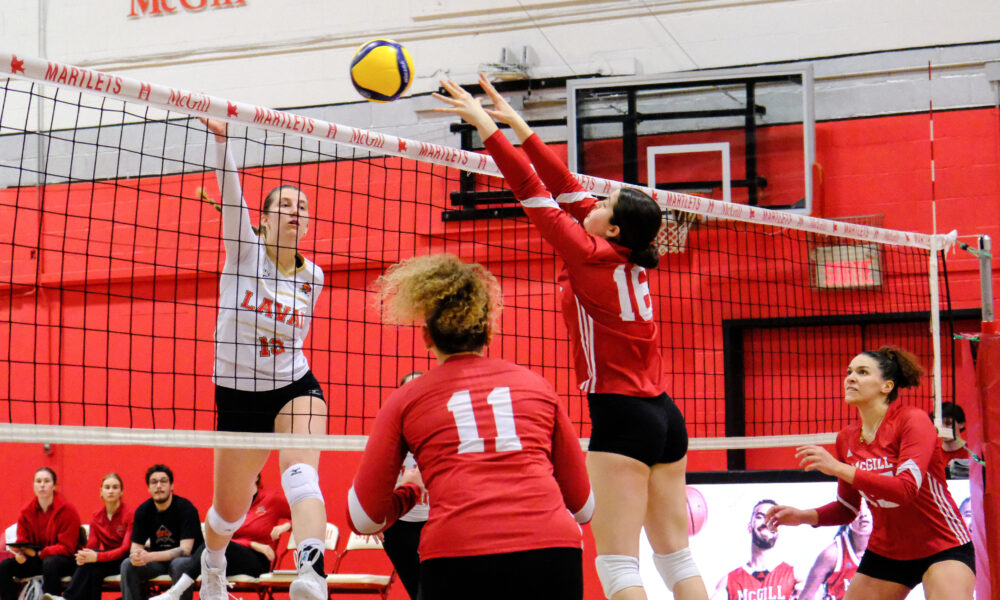
The Martlets’ volleyball season may not have gone as planned—with the team narrowly missing a ticket to the RSEQ Finals—but it is a season that showed great progress. The regular season started strong with a home-court victory against UQTR, but the Martlets, unable to gain traction, fell short for the next five games. Despite these losses, the team persevered; coming back after New Year’s, they were poised to achieve an eight-game win streak in early 2025. Their triumphs were captained by pin hitter Elyssa Lajmi, who led the team with 336 points and 290 kills. They gained a spot in the RSEQ playoffs and attempted to win their second championship in the 53 years of tournament history. Unfortunately, the Martlets fell on the third of a three-game semifinal series to the reigning champions, the UdeM Carabins. Their 16–12 record does not capture the full story of this season; the Martlets’ retiring coach, Rachèle Béliveau, has much to be proud of. 

Track and Field: Martlets B / Redbirds A-

The McGill Redbirds had a fruitful season, winning the McGill Team Challenge, their first team victory at the meet since 2002, edging out ULaval in a tight finish. Standout performances of the season included Markus Geiger’s school record in the 600m, Samuel Hepworth shattering the McGill record for the 1,000m race at the Valentine Invitational, and a top-10 national time in the 4x400m relay​. The Redbirds placed second at the RSEQ Championships, while the Martlets placed third. Placing 16th out of 27 teams at the U SPORTS national championship, Donna Ntambue put the Martlets on the board with a phenomenal performance in the 60m dash. While they opened the season strong, the Martlets struggled to place highly in track events at nationals and did not have entries in several relays, which limited their overall impact at major meets. 

Swimming: Martlets A+/ Redbirds A

Both Martlets and Redbirds Swimming could not manage to lose this season and came out in the gold medal spot for every regular season cup they competed in. The combined team dominated, breaking 1,000 points and winning by a margin of at least 200 points in every regular season cup. Their success was highlighted by a group of especially strong swimmers, including seniors Naomie Lo and Elizabeth Ling, who earned five and six gold medals, respectively, at the RSEQ Championships. The future of McGill Swim looks just as bright, with rookie Loïc Courville-Fortin and sophomore Mats Baradat both earning silver and breaking school records at the National Championships. Junior Emilia Mastromatteo cannot be forgotten, as she broke multiple school records throughout the season, earned McGill Athlete of the Week four times and RSEQ Athlete of the Week. With a final standing of first in the RSEQ for both teams, as well as second in the nation for women’s and fourth for men’s, McGill Swimming has rightfully received top ratings, and The Tribune cannot wait to see what they accomplish next season. 

News, SSMU

Recap: McGill allows SSMU VP University Affairs to remain in their position following disciplinary case

A precarious few weeks have come to an end as the Interim Dean of Students Tony Mittermaier communicated that Students’ Society of McGill University (SSMU) Vice-President (VP) University Affairs Abe Berglas could remain in their position. The decision follows the Committee on Student Discipline’s finding that Berglas had violated the Code of Student Conduct and Disciplinary Procedures at the start of the school year for passing out flyers detailing what they claimed were professor Douglas Farrow’s transphobic and homophobic published works. Under a new clause of the Memorandum of Agreement (MoA) between SSMU and the University, this violation could have deemed Berglas ineligible to be in their executive position at SSMU.

The new MoA, signed on Feb. 28, included section 14.4, which states that executives and directors at SSMU cannot have a disciplinary record at the University, including an infraction of the Code of Student Conduct. While Berglas’ demonstration took place months before the new MoA was signed, it was unclear whether or not they would be allowed to stay in their position. 

Berglas told The Tribune the stated reasoning not to remove them was that the disciplinary charge and the start of their term at SSMU occurred before the MoA was signed. Because of this, McGill will allow SSMU to decide how to proceed. The McGill Media Relations Office (MRO) declined to comment on the specifics of Berglas’ case. However, the Office noted that this case would not set a precedent for how future violations of section 14.4 will be handled.

To Berglas, this situation highlights fundamental flaws within the Code of Student Conduct, including the amount of discretion left to the committee when determining disciplinary action and a lack of specificity in certain clauses such as 10.c, the one they were found to violate. They also noted a concern for the slow timeline of their case.

“The fact that my handing out flyers happened on the first day of class and the hearing itself was […] mid-March […] I think is inappropriate,” Berglas said. “And when these students are in limbo after being accused of a disciplinary charge but not being able to have closure on the case, it can create a chilling effect.”

McGill, News

Recap: McGill to lay off an estimated 99 people to help offset $45 million CAD deficit

On March 19, McGill announced it will lay off approximately 99 people as part of an effort to decrease its $45 million CAD operating deficit. The university will notify individuals affected by the layoffs by the end of April.

At the university’s Feb. 7 Town Hall, Provost and Executive Vice-President (Academic) Christopher Manfredi communicated that around 250-500 jobs would have to be vacated to address McGill’s deficit, since 80 per cent of the university’s operating costs come from its combined salary mass.

McGill has since adjusted the estimated number of positions it will cut to 350-500. According to McGill’s Media Relations Office (MRO), it is unclear at the moment whether more layoffs can be expected for the coming year.

“Unfortunately, we don’t yet know [whether there will be additional layoffs],” the MRO wrote to The Tribune. “At the February Town Hall, it was mentioned that a series of budget measures would be required to avoid a $45-million deficit in the fiscal year starting May 1, 2025. One necessary measure involves vacating 350-500 positions through attrition and, unfortunately, layoffs. The estimated 99 layoffs are part of that number.”

According to the MRO, decisions about who will be affected by layoffs are made by deans and academic unit heads tasked with implementing budget targets. Their decision-making regarding layoffs is ongoing but will be finalized by the end of April.

At the moment, it is unclear how the layoffs announced on March 19 will affect the student body. The MRO reiterated that the university is committed to reducing the impact the layoffs will have on students.

“Since teaching and learning [are] fundamental to our mission, we are doing everything possible to ensure minimal impacts on students and courses,” the MRO wrote.

Arts & Entertainment, Books

A&E on the most impactful novels they’ve encountered in the classroom

Eugene Onegin by Alexander Pushkin (RUSS 223: Russian Literary Giants 1) – Isobel Bray, Contributor

Eugene Onegin is a timeless novel-in-verse set in 19th-century Russia. It follows the titular aristocrat, who, after inheriting his uncle’s estate, retreats to the countryside. Eugene is bored with high society and indifferent to those around him. He meets personalities like the poet Vladimir Lensky and young, intelligent Tatyana Larina. The verse form only enhances the story, as Pushkin blends social commentary with his melodic and emotional writing. His portrayal of Russian high society is sharp and often ironic, yet never fully devoid of empathy. What stood out to me was the realism of the characters—flawed, human, and heartbreakingly self-aware. Onegin, with his cynicism, is both frustrating and strangely familiar. Lensky, the doomed romantic, is his foil: Idealistic and earnest in a world that doesn’t reward it. The narrator is a character unto himself, breaking the fourth wall with asides that feel surprisingly modern. Pushkin reflects on his own youth, writing, and memory with a tone that is both playful and melancholic. Despite being written two centuries ago, Eugene Onegin is filled with moments that speak to the present about identity, image, and the consequences of not acting when it matters.

Lolita  by Vladimir Nabokov (ENGL 227: American Fiction after 1945) – Bianca Sugunasiri, Staff Writer

Content warning: Pedophilia, Kidnapping, Sexual Assault

Fresh out of high school and heady with literary ignorance, I was met with a rude awakening in the form of Vladimir Nabokov’s Lolita. I was thrown from my comfortable world of sheltered grade-school literature into one of the most viscerally disturbing novels I have ever encountered. The thought of devoting time to dissecting the first-person account of a repulsive pedophile was terrifying. I was further disturbed by the Vanity Fair review quote printed on the back of my copy: “The only convincing love story of our century.” Everything in me was primed to reject the novel. But one class, my professor said something that turned my perspective on its head. He challenged the notion that Lolita was a sick fantasy, but was instead designed as a rebellion from the modernist notion of “art for art’s sake.” The novel is widely known for its unexpectedly embellished prose that flows artfully like poetry. Contrasted with the uncomfortable ideas that Nabokov presents, it makes a sadistic mockery of the Aesthetic Movement. All of a sudden, the novel went from a glorification of inhuman immorality to a meticulously crafted protest for me. Although it is impossible to know what Nabokov truly intended, the man insisted that there should not be a child anywhere in the book design. This is not a love story, but an exposé of the parts of humans we deign to forget: Discomfort deliberately wielded to elicit change.

Jazz by Toni Morrison (ENGL 505: Sound, Voice, Music, Noise) – Kellie Elrick, Arts & Entertainment Editor

Content warning: Violence, feminicide

Last summer, I was on a transatlantic flight from Rome to Toronto when a fuse blew, knocking out the electricity in my part of the plane. This is how I first read Jazz—in one sitting, in close quarters, hurtling at top speed over the sea in a lightly malfunctioning airplane. It knocked me out. The narrative twisted and turned, screaming, singing, breathing. I encountered it again in a seminar in the fall and remained enraptured by the text. Jazz changed what I thought a novel could be. The narrative speaks to itself, echoing between chapters, calling and responding in non-chronological order. The present moves forward into the past, which in turn responds to the present, engaging in an oral tradition that rebels against its written form, speaking at once from Harlem in 1926 and Virginia in 1888. Morrison’s novel sings of Black womanhood, history, modernity, music, enslavement, violence, what’s unspoken, what’s heard, freedom to act, freedom to speak, freedom to be; Joe shoots his young lover Dorcas; his wife Violet slashes Dorcas’s face in her casket, and the novel shoots off into the present, past, and future all at once. It begins with a sound—sth—and ends with a call: “Say make me, remake me. You are free to do it, and I am free to let you because look, look. Look where your hands are. Now.”

Crime and Punishment by Fyodor Dostoevsky (RUSS 224: Russian Literary Giants 2) – Charlotte Hayes, Arts & Entertainment Editor

On a Wednesday night in the dead of February sometime last year, I came to a sudden, horrible realization: I needed to be on page 300-and-something of Crime and Punishment by 11 a.m. the next day—and I had yet to crack open the book. Although I’m not proud of this (and by no means endorse the following actions), what transpired over the next 16 hours was nothing short of transcendent. I sat down on my couch and just started reading. The floorboards of my empty Plateau apartment creaked. Cold air squealed through its barely sealed doors. I sat hunched on the couch, eyes glued to the page. Hours passed in a blur of plot twists, coffee, and sleep-deprived delirium. Maybe it was heart-pounding guilt-by-proxy brought on by Dostoevsky’s prose, or maybe it was just 5 a.m. Still, I’ve never felt more connected to an objectively awful person than to Rodion Raskolnikov. Reading Crime and Punishment shifted how I view literary canons. For the first time—outside of Shakespeare or a few biblical parables—I grasped how a piece of writing can ripple across art forms. From later Russian novels to the moral puzzles of ‘70s Hollywood cinema, Dostoevsky’s tale of guilt, greed, and moral ambiguity in redemption has proved enduring and unsettling. I may not have known it then, but sitting groggy in a conference on four-ish hours of sleep the next morning was exactly what I needed to round out my university experience.

Arts & Entertainment, Film and TV, Pop Rhetoric

Sheep are having a Pop Culture moment—and it’s unsettling

They’re baaaaaack—and not in a cute nursery rhyme kind of way. Sheep have tiptoed their way back into the cultural frame, not just as pastoral props but as full-blown characters, metaphors, and messengers. From a blood-streaked Icelandic hybrid in Lamb to the soft-eyed flocks in Bergers, the modern media sheep is anything but innocent.

Sophie Deraspe’s Bergers (or Shepherds) features numerous sheep, but none are quite as unsettling as the humans around them. The film follows a disillusioned Montreal advertisement executive, Mathyas, who escapes the corporate grind to become a shepherd in rural Provence. This might sound like millennial burnout-turned-farmer fantasy, but Deraspe doesn’t romanticize. Instead, she places her protagonist face-to-face with an uncompromising truth: Nature doesn’t care about your spiritual awakening​.

In Bergers, the sheep aren’t mythical, magical, or symbolic. They are bodies—vulnerable and ultimately commodified. As Mathyas learns, even this so-called simple life turns out to be unstable, challenged by a shifting climate and economic strain. He is initially drawn to the romantic notion of a pastoral life. However, he soon faces the harsh realities of herding and the struggles of adapting to a new way of life. Nature is harsh, indifferent, and, at times, violent.

Lamb (Valdimar Jóhannsson), on the other hand, could not strike a more contrasting tone. The Icelandic folk horror follows a couple adopting a half-human, half-sheep creature named Ada. On paper, it’s absurd; in execution, it’s devastating. What begins as a tender attempt to reclaim lost love spirals into horror with the arrival of Ada’s ram father. This isn’t just folklore gone feral; Lamb unfolds like a dark environmental fable: Nature, again, refuses to be rewritten.

So, why sheep? And why now?

In pop culture, sheep have long signified docility—“sheeple” being used as an insult towards conformists. But as Lamb and Bergers portray, that connotation is ready—and even destined—to change. These stories portray sheep not simply as the symbol of innocence we know from nursery rhymes or nativity scenes, nor as a symbol of docility. Instead, they use the animals to critique how humans project their desires—whether for control, comfort, or escape—onto the world around them.

A man trades his desk job for a field of bleating livestock, or a family dresses a sheep-child in baby clothes: Beneath all the absurdity lies a real discomfort. These images are too close to fantasy to be real but too grounded to dismiss. The sheep reveal just how anxious we can be about agency, autonomy, and belonging. They reflect the quiet fear of wanting to escape the systems we’re born into but having nowhere to run. Whether shepherded or anthropomorphized, sheep expose our need to make sense of disconnection through control, care, or even delusion. The unease comes not from the sheep themselves but from the human need to reshape them into what we want them to be.

The cultural fascination with sheep is never only about cinematic allegory, nor is it new. Sheep have long been used as a symbol in both fashion and pop culture. From Princess Diana’s iconic “black sheep” sweater to Lamb Chop, a 20th-century sock puppet known for her surprisingly sassy comebacks, they’ve made their mark. The image of the sheep constantly sways between conformity and defiance, obedience and disruption. Maybe that’s the point. In a media landscape increasingly obsessed with binaries—good vs. evil, tech vs. nature, us vs. them—the sheep offers something more blurred and possibly more real.

They aren’t just back—they never really left. It’s just now that they are stepping into the centre, not to lead or to follow, but to remind us that meaning often comes dressed in wool.

Private

Rethinking environmental risk assessment for Indigenous communities

Read the latest issue

Read the latest issue