


Latest News

Science & Technology

Coding in the deep

“Programming a computer to be clever is harder than programming it to learn to be clever,” Hugo Larochelle, a researcher at Google Brain and adjunct professor at Université de Sherbooke, said during his “Beyond Artificial Intelligence: Deep Learning” presentation at SUS Academia Week on Jan. 31.

Deep learning is a subset of Artificial Intelligence (AI) that attempts to mimic the human brain’s ability to comprehend abstract notions. For example, when a human sees a dog, even if it is an unfamiliar breed, they are often still able to recognize the creature as a dog. This is likely because they have seen many dogs before, and their brain has developed a complex algorithm that runs through a series of checklist questions: Does it walk on four legs? Does it have a snout? Does it have a tail it can wag? If it only has one eye, is it a dog with a missing eye or a different creature altogether?

As part of his presentation, Larochelle explained the science behind deep learning where artificial networks of ‘neurons’ are grouped into various layers, each dedicated to processing a particular piece of information. In the case of recognizing a dog, each of the initial questions could be a layer, with one layer considering whether the creature walks on four legs and another considering whether it has a snout. Larochelle’s team aims to provide a deep learning machine with a rich diversity of similar problems in the hopes of training the system to learn a new recognition task faster.

While researchers have studied neural networks and deep learning for over 50 years, the recent buzz around the topics is attributable to the improvement in technology infrastructure and the ability to give machines mass amounts of high-quality training data. Canada, in particular, has led the way in the recent AI advancements. Industry pioneers, such as McGill alumnus Yoshua Bengio under whom Larochelle was a student, are responsible for many of novel AI innovations. Bengio developed a revolutionary language translation system that now forms the basis of Google Translate.

Despite these breakthroughs, Larochelle believes that we still have a long way to improve the efficiency of AI and deep learning.

“A computer is essentially like a really, really dedicated student that will do lots of exercises but is sort of dumb and not learning particularly fast,” Larochelle said.

Deep learning technology has the potential to be applicable in a variety of industries. Larochelle described a particular case in the agricultural industry wherein an engineer trained a neural network system to recognize the shape and size of cucumbers, so that they could be run through an automated process instead of sorted manually. Applications for deep learning can even be found in art, including in musical composition and in tools such as the website deepart.io, where users can upload photographs to transform them into paintings of various styles.

The powerful potential of deep learning also comes with great responsibility.

“We have to be mindful about biases the systems might have that often will come from badly collected data,” Larochelle said.  

To illustrate his point, Larochelle described cases where facial recognition software was better at detecting white males than women or people of colour, due to the unrepresentative data sets which the system received while in training.

The opportunity to learn about the rapidly-growing and increasingly-influential industry of deep learning was exciting for students in attendance.

“We’re really lucky to get to see such people speak at McGill and to get an idea of what we can do with our degrees,” Lily Carson, Arts student, said.


Science & Technology

Love on the brain

Everyone knows the story: Boy meets girl, boy encounters obstacle; they fight to overcome it, but something goes wrong and someone runs away crying. Ultimately, love prevails, they share a passionate kiss, get married, and live happily ever after. This, Hollywood claims, is love.

Valentine’s Day is marketed as a celebration of love but, for many people, it can also be a source of stress. If they are in a relationship, they might feel pressured to visibly display their affection, or else risk disappointing their partner. If they are single, the day might be a lonely reminder that they don’t have someone to spend their time with. Clearly, love is a lot more complicated than Hallmark makes it out to be.

The Western notion of romantic love, the one that glorifies gender roles and promises hedonic fulfillment after meeting the perfect person, may have originated in the Middle Ages; however, this is somewhat disputed. The Ancient Greeks held a septenary theory of love, which encompassed love for friends, family, the universe, and oneself. Modern scientists look at love as both a biological and socio-cultural phenomenon, that is divisible into three distinct categories: Lust, attraction, and attachment.

The system of love is one of reproduction. Sexual attraction leads to sex, which leads to offspring, which allows the genome, and the species, to continue into the future. Testosterone and estrogen, the two basic sex hormones, initiate feelings of lust and subsequent physical intimacy.

But, with humans, sex is rarely ‘just sex.’ The social and cultural aspects embedded in the act of reproduction usually create complications. Sex often leads to attraction, the second, scientific category of love, stimulated by the reward pathway in the brain. The release of neurotransmitters, including dopamine, serotonin, and norepinephrine, are what lead to the addictive tendencies young lovers might develop in the beginning of relationships.

The passionate love we initially fall into is like an obsession: It is characterized by the intense channeling of our attention, affection, and desire toward specific people[….] at the expense of just about everything else,” Samuel Veissiere, assistant professor in McGill’s Department of Psychiatry, wrote in //Psychology Today//.

Evolutionary psychologists posit that the rationale behind attraction has less to do with the needs of the adult and more to do with the needs of human offspring. Unlike many other animals, human children aren’t born ready to go out into the worldthey need time and care to mature properly. Having two parents around to raise them is very beneficial for development and this will only happen if the parents stay together after sex.

Attachment, the third, and arguably most important, category of love, is the force that allows for long-term relationships. Attachment is what binds families, friends, and communities together, largely thanks to the hormones oxytocin and vasopressin. It is difficult to overstate the importance of attachment, with studies showing that the production of oxytocin can even help heal fractured interpersonal relationships.

At the end of the day, the infatuation of romantic love is fleeting. Only love built on a foundation of trust and respect will endure over time. For many, love is the best part of life, and it’s worth celebrating, but it doesn’t have to be a rom-com to be meaningful.


Out on the Town, Student Life

Cafés condusive to studying: Downtown edition

Café Leaves

Address: 2051 Rue de la Montagne

Hours: 8 a.m. – 7 p.m. Monday – Friday, 9 a.m. – 7 p.m. Saturday – Sunday

Price: $$

Café Leaves serves vegan food and beverages in a modest setting. This eatery only uses plant-based milk and offers a variety of specialties, such as végé lattés that are prepared from special powders and do not contain any coffee. In addition, they offer amazing pastries, salads, and snacks. Café Leaves is a perfect spot to take Instagram pictures because its decor is aesthetically-pleasing: The walls are painted with colourful flower designs while potted cactuses add a unique flavour to the space. It is not a loud environment, so it is a good studying spot; however, it is quite small, so try to avoid mid-day hours for the best chance to find space.

Wifi?    Laptops
allowed?   
Accessible
outlets?
Quiet?  

Kréma

Address: 900 René-Lévesque Blvd W

Hours: 6:30 a.m. – 5 p.m. Monday – Friday, 6.30 a.m. – 4 p.m. Saturday – Sunday

Price: $$

Kréma’s elegant decor sets it apart from most typical coffee shops. Situated inside the Fairmont the Queen Elizabeth hotel, it feels like a common area rather than a closed space. And, with its contemporary interior design, the atmosphere feels more formal than a regular coffee shop. Thanks to its experienced baristas, Kréma’s aesthetically-pleasing lattes taste as good as they look. There is also a variety of food and snack choices, including vegan options. The only downside is that the space is not quiet: Working people from the surrounding area come to the café to chat over a beverage, so the space gets too loud to be productive. However, for students who do not need silence to work, Kréma’s atmosphere and coffee are worth checking out.

Wifi?    Laptops
allowed?   
Accessible
outlets?
Quiet?  x


La Finca Café & Bureau

Address: 1067 Rue de Bleury

Hours: 7 a.m. – 6 p.m. Monday – Friday, 7 a.m. – 5 p.m. Saturday – Sunday

Price: $$

This cute café is the ideal spot for students who want to enjoy the food and ambiance as they study. La Finca Café has a warm and welcoming environment with pastel-coloured decorations. It offers a diverse selection of drinks from  coffees to smoothies. The food is comforting, with a menu that includes a variety of pastries as well as healthier options such as salads, sandwiches, and soups. The space is not huge, but there are private meeting rooms which patrons can book for group studying.

Wifi?    Laptops
allowed?   
Accessible
outlets?  
Quiet?  


Ambrose Cafe

Address: 3422 Stanley St

Hours: open from 7:30 a.m. Monday – Sunday

Price: $$

Situated in the lounge of Hotel Ambrose, Ambrose Cafe is one of the downtown area’s most comfortable spots for studying. The interior design is a mix of modern and mid-century aesthetics, and the space is both elegant and trendy. With a relaxing atmosphere and light music playing in the background, students can easily feel detached from the daily rush. Sometimes, the lighting can be a bit dim, making it difficult to read; however, it does not affect those who study on their computers. This place is ideal for both solitary and group study, as there is a couch for those who want to read their books and relax, and there are shared tables for collaborative work. The café also offers a tasty menu: At breakfast, they serve eggs and waffles, and vegan soup at lunchtime.


Wifi?    Laptops
allowed?   
Accessible
outlets?  
Quiet?  


McGill, News

McGill hosts guest lecturer and author to discuss the complexities of freedom of speech on campus

Over the past few years, a number of high-profile universities in North America have experienced brawls, protests, and fires from students objecting certain guest speakers invited to their campuses. Sigal Ben-Porath, author of Free Speech on Campus and professor at the University of Pennsylvania, spoke to the issues surrounding free speech on university campuses at an event hosted by the Institute of Liberal Studies (ILS) and the Research Group for Constitutional Studies (RGCS) on Feb. 7.

According to Ben-Porath, universities require different norms and interpretations of free speech than the general public does.

“Within the legal framework in which we operate, we need separate rules [on campuses] because the role of speech on a college campus is different than in a public sphere in a democracy,” Ben-Porath said.

She argued that laws in the public sphere need to remain neutral to differing opinions because, in a democracy, the ability to express one’s opinion is a fundamental right that preserves citizens’ equality. Universities are still subject to those legal norms, but their academic and research goals alter the meaning of free speech within their walls.

“Historically, [the mission of universities] relates to the search for knowledge, pushing the boundaries of what is known, trying to understand more about the world and self, and disseminating this information publicly and for students,” Ben-Porath said. “Today, the university’s mission has expanded, including educating more diverse students.”

Ben-Porath noted that balancing their roles as educational institutions and proponents of diversity is a modern challenge for universities. Her solution for reconciling the two identities involved a framework she called ‘inclusive freedom.’

“My general effort is to create an inclusive climate,” Ben-Porath said. “One which protects and defends open expression while addressing the tensions, concerns, and burdens it creates.”

Ben-Porath suggested that universities should use a hands-off approach when managing student discourse about free speech on campus. At the same time, the administration has a responsibility to address any tensions that emerge out of controversial speech by ensuring that students feel dignitary safety, meaning they feel recognized as equal members of the university community.

Ben-Porath saw her solution as applicable to a variety of campuses, creating a safe environment without restricting students’ ability to engage with difficult questions. She pointed to several administrations that have effectively built ‘inclusive freedom’ into their policies.

“Classes are essential for intellectual risk-taking and honesty,” Ben-Porath said. “The professor has the responsibility to create the conditions for an open and honest exchange [….] I also think student groups are central to creating an atmosphere where views that are not common on campus can be brought in and discussed.”

However, not all students agree to such a hands-off approach. Caterina Pacifico, U0 Science, attended the guest lecture and thought differently.

“When a known racist or someone promoting truly harmful speech is invited to campuses I feel like administration can take a more proactive role than Ben-Porath suggests,” Pacifico said. “Who is it benefitting [besides] the speaker that gets to spread hate speech?”

The most recent case of student protest at McGill is the #ChangeTheName campaign supporting the removal of a racial slur from the men’s varsity team name. Students’ Society of McGill University (SSMU) Indigenous Affairs Commissioner and leader of the campaign Tomas Jirousek credits the campaign’s headway to his rights for free speech and assembly on campus.

“Freedom of speech laws can have a huge impact on campaigns such as mine,” Jirousek wrote in an email to The McGill Tribune. “It’s been important to understand that both support and opposition to my campaign to change the name also complies with freedom of speech laws or the spirit in which they were crafted, specifically the right to free speech under reasonable limits [….] I’ve tried to be incredibly respectful of those on the other side of the dialogue, and avoiding any demonization or discussion that could prove hurtful or painful for everyone involved.”

Science & Technology

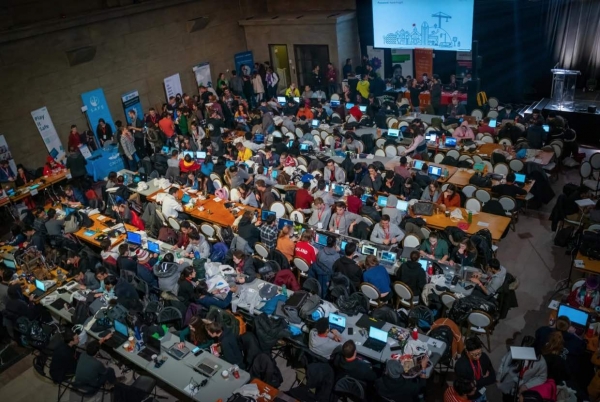
McHacks 6 attracts diverse talent from across Canada

From Feb. 2 to 3, students from across Canada and the United States hunched over their laptops at McGill’s annual McHacks competition. With cash awards and Nintendo switches at stake, the participating ‘hackers’ had 24 hours to program an original project.

Students have organized and run the competition since 2013, with this year’s committee being staffed by 26 organizers and 60 volunteers.

As Canada’s oldest collegiate hackathon, McHacks sets the scene for the Canadian hackathon community. Many Canadian universities have followed in its footsteps by organizing hackathons of their own, but McHacks continues to differentiate itself.

“We try to make our [hackathon] very beginner-friendly,” Kyle Rubenok, co-director of McHacks 6, said. “It’s a really great way to [get] someone from zero to something tangible in a weekend, and there’s not really many ways you can learn something that quickly.”

The breadth of projects this year ranged from tackling imminent world issues to a computer game that generated a recorded meow every time an attendee clickled an animated cat.

One of this year’s top projects was ‘H2Onow,’ a web application that gives live updates on water supplies to populations that have to walk long distances for their water.

“[We] are looking [for] creativity, completeness, technical difficulty, and originality,” Kayla Branson, the director of McHacks 5 and a judge at this year’s competition, said.

Hackathons help competitors develop a wide range of useful programming and presentation skills. The breadth of experience which the event provides participants with has led them to suggest that the events become mandatory in computer science curriculum.

“McGill is mostly theory,” Kevin Gi, U1 Engineering,  said. “There’s not really a lot of practical things we learn on assignments.”

In a team with three other software engineers, Gi created a 3D-printed catapult while also designing a software program that can throw an object using projection data.

“I already learned more in 24 hours than I did the entire last semester,” Edwin Pan , U1 Engineering, and a teammate of Gi’s, said.

Hackers appreciate hackathons as opportunities to develop their own skills.

“Computer science education around the world has a lot of different forms,” Rubenok said. “McGill takes a very theoretical stance, Waterloo takes a more practical approach, [and] Queens is somewhere in the middle. Hackathons are a chance for students to take something and practically apply it in a short amount of time with no real limitations on resources and plenty of support.”

Diversity at hackathon events further bolsters their importance to tech education. The disproportionately low representation of women in STEM is commonly linked to Imposter Syndrome, a psychological pattern of believing one does not deserve their education or job, one does not belong, and ones’ accomplishments are the result of luck.

“I’m definitely battling [Imposter Syndrome],” Dunja Tomic, a second-year student at the University of Waterloo, said. “It’s been an uphill battle I’d say, but the more I learn, and the more I get myself out to events like this I find that I belong here.”

McGill’s computer science program is one of the most gender-diverse in North America, with a 36 per cent enrollment rate for female-identifying students. This year’s McHacks committee made gender diversity a priority when selecting applicants.

“We wanted McHacks to represent the excellent diversity McGill Computer Science has,” Rubenok said. “We worked very hard to promote McHacks to [diverse] groups in computer science.”

While the committee fell short of its goal of a 50-50 gender split of hackers, 31 per cent of the participants were female, compared to 19 per cent in 2018.

For the McHacks of years to come, Rubenok hopes the competition can become a gateway for more non-computer science students to access the tech industry.

“We want to encourage employers to value the diversity of opinions and skill sets,” Rubenok said. “Events like hackathons allow students from non-traditional backgrounds to still interact with these companies and expose their skills and CVs.”

Art, Arts & Entertainment

Community art and social justice: A conversation

On Feb. 5, University of the Streets Café hosted an inclusive discussion about visual art as a tool for community building and its contributions to social justice. The talk was broad in scope and touched on subjects such as art’s commodification, subsequent impacts on gentrification, and the limits of art’s accessibility. Panelists also discussed art’s potential as a site of resistance against violence, racism, and other forms of oppression. Local visual artist Emma Harake, the talk’s moderator, raised concerns about the nonprofit artistic sector and the role of established institutions in both viewing and producing art. Guest speakers contributed compelling thoughts to the talk, drawing on their personal and professional experiences with community-organizing and visual art.

Johnny El-Hage, a multidisciplinary artist and founder of Abjad Howse, a creative space that encourages Arabic artists in Canada, discussed building inclusive spaces for marginalized artists to showcase their work outside of traditional gallery spaces. He also discussed his experiences with hosting inclusive events for racialized artists in Montreal. These events can take the form of open mics and celebrations of music, poetry, and talent in racialized neighbourhoods.

El-Hage analyzed the problematic nature of a homogenized national identity, systemic discrimination, and how art can be used to empower marginalized communities.

“Art and public practices play a significant role in reproducing and reconstructing racial, gender, and class difference in a way that is positive,” El-Hage said. “Art is so powerful when it operates outside the state and its dominating power, forming a power of its own. When we talk of meaningful art, it is an art that meets people in their communities and opens democratic spaces that allow experimentation and imagination.”

Similarly, artist and McGill Social Work graduate student Salima Punjani spoke about spreading multiculturalism within Montreal. Punjani explained the themes of her work, such as family storytelling, as emblematized in her photography project, Moms of Montreal. Moms of Montreal offers a glimpse into different family lives through photography to build a sense of community and appreciation for diversity.

Saskatoon-based artist Jane Reväe McWhirter uses art to promote personal growth and community healing in at-risk youth. McWhirter brought up her past struggles with substance abuse and self-worth, describing her work as an artist at Saskatoon Community Youth Arts Programming (SCYAP) as pivotal in her journey of self-acceptance.

“[Working at SCYAP] was the first time in my life that I really felt a sense of confidence, and [it] sparked me with wanting more in life,” McWhirter said. “This program really gave me the space to be vulnerable [by] using art as a powerful tool to push us forward. It started with something as small as a painting where you can start small, see something that you make, feel proud of it, and then continue to build your confidence.”

McWhirter and the other guest speakers did not shy away from discussing the fact visual art has often been commodified and can be publicly inaccessible. Panelists were hopeful, however, that community organizers can still use art as a tool to empower the marginalized by offering an outlet for expression.


McGill, News

Media experts consider anti-elite sentiments in rising populism

McGill’s new Max Bell School of Public Policy hosted a panel discussion on Feb. 5 titled “Does Rising Populism Threaten Good Public Policy?” According to its panellists, the answer is yes.

The sold-out event took place in the Faculty Club ballroom with Pittsburgh Post-Gazette Executive Editor and Pulitzer-Prize-winner David Shribman moderating. The panellists offered a range of perspectives from Canada and the U.S.: Veteran journalist Chantal Hébert and Abacus Data Chairman Bruce Anderson analyzed the Canadian political landscape while Washington Post columnist E.J. Dionne Jr. and Politico reporter Eliana Johnson answered questions about Capitol Hill.

The event began with an introduction from McGill Department of Economics Associate Professor and Max Bell Director Christopher Ragan, who offered a definition of populism.

“The subject of this evening is populism, what it is, where it comes from, and why it matters,” Ragan said. “[Populism is defined as] a political approach that is focused on ordinary citizens and [their] concerns, especially when there is a perception that the elites aren’t taking them seriously.”

Anderson, the first panellist to speak, was skeptical about populism being a major force in Canadian politics, citing non-committed voters as a more significant part of Doug Ford’s 2018 Ontario election victory.

“If we’re doing populism, I think we’re doing it badly,” Anderson said. “Every once in a while, we do see situations where a politician who kind of challenges the man is victorious, but, for most of those situations, you can see another possible outcome [….The 2018 Ontario election] could have gone to the [New Democratic Party].”

Hébert offered a contrasting view on populism in Canada, arguing that political influencers have lost touch with the average citizens’ priorities.

“Populism runs high when something is broken, and I think [it] is a symptom of a broken political conversation,” Hébert said. “And one that we are, those of us who are the so-called ‘chattering class,’ responsible for.”

Hébert described how this disconnect has shifted public perceptions of expert opinions.

“It used to be that when politicians were […] handling crises, what they would do to [seem] on top of things would be to call what I call ‘whitecoats’ to the rescue, people who were experts in their fields,” Hébert said. “Today, […politicians]  make their point by proving that they are against whitecoats: ‘Those experts want to tell you this, but we know better.’ ”

According to Anderson, poll results give conflicting evidence for this phenomenon, which he dubs the “reversal of the white coat advantage.:”

“77 per cent [of respondents] say elites have too much power in Canada, but 69 per cent say ‘I like to listen to experts before I make up my mind,’” Anderson said.

According to Anderson, the best explanation for the success of politicians like Doug Ford and Alberta United Conservative Party leader Jason Kenney is not anti-elitism but anger and a lack of political knowledge.

“It’s shocking how many times I ask people in polls […] about contemporary policy discussions […and receive] reflexive and emotional responses, rather than considered, rational, thoughtful ones,” Anderson said.

While he conceded that economic anxieties make populist movements more appealing, Anderson argued that voters still have a responsibility to be informed.

“What are people doing with their anxiety?” Anderson said. “Are they learning more about the issues? Are they studying what the choices are? Or are they hearing somebody say, ‘I think we should put tariffs on everything because tariff wars are easy to win?’ It’s not very sensible policy, but people are gravitating toward [protectionist policy] because it sounds simple, it is reflexive, [and] it is emotional.”

Anderson emphasized the importance of compromise in a healthy political culture.

“We’ve lost the belief in the value of compromise […as a way to]  settle our differences,” Anderson said. “I’d like to see politicians champion that idea a little more.”

Martlets, Sports, Volleyball

Martlets beat Rouge et Or in straight sets in season’s final home game

McGill Martlet volleyball (15-3) took home a win on Feb. 8 in an exciting victory over the Laval Rouge et Or (10-8). The Martlets won in three sets, securing their position as RSEQ pennant winners for the first time in 17 years.

“This is a project of [several] years,” Head Coach Rachèle Béliveau said. “We started this group really young on the court with a lot of potential to grow [….] We have improved a lot, and that’s what I’m pleased with.”

McGill dominated the first two sets, winning 25-16 and 25-15, respectively. Laval led for much of the third set, but the Martlets closed the gap and won the final set 25-23 to claim victory in their final home game of the season.

“Laval is a really good team: A team we have to respect,” Béliveau said. “I thought it would be a difficult game that might go to five sets, so I’m pleased that we won in three.”

McGill was strong on both offence and defence throughout the match. Third-year power hitter Claire Vercheval recorded 13 of McGill’s 37 kills for the game, while fifth-year power hitter Émilie Matte de Grasse delivered six aces. First-year middle blocker Charlène Robitaille added another nine kills to the scoresheet for the Martlets. McGill also displayed solid defence with 60 digs to Laval’s 49 and 11 blocks to Laval’s two.

“We applied the game plan really well and kept the momentum on our side,” Vercheval said. “Even in the third set, we stuck together, and we knew that we needed to keep the energy on our side.”

The Martlets have now clinched home-court advantage for the first round of the RSEQ provincial championship semi-finals—the first step to qualifying for nationals in Edmonton. McGill will host the first round of the semi-finals against the yet-to-be-determined fourth-place team in the RSEQ standings.

“[The home-court advantage] helps a lot,” third-year middle blocker Elisabeth Perrault said. “Big crowds like this are especially good.”

The Martlets have been building toward the playoffs all season and are feeling confident going into the semi-finals.

“The team has never felt so close,” Vercheval said. “This is a great time to feel like this. We’re all feeling competitive, we all want to win, and we’re feeling really driven.”

Béliveau spoke to the Martlets’ improvement over the season.

“I’m pleased to see that we can play more consistently throughout the game,” Beliveau said. “[Even with] a bad moment at the beginning of the third set, we were able to come back and catch up.”

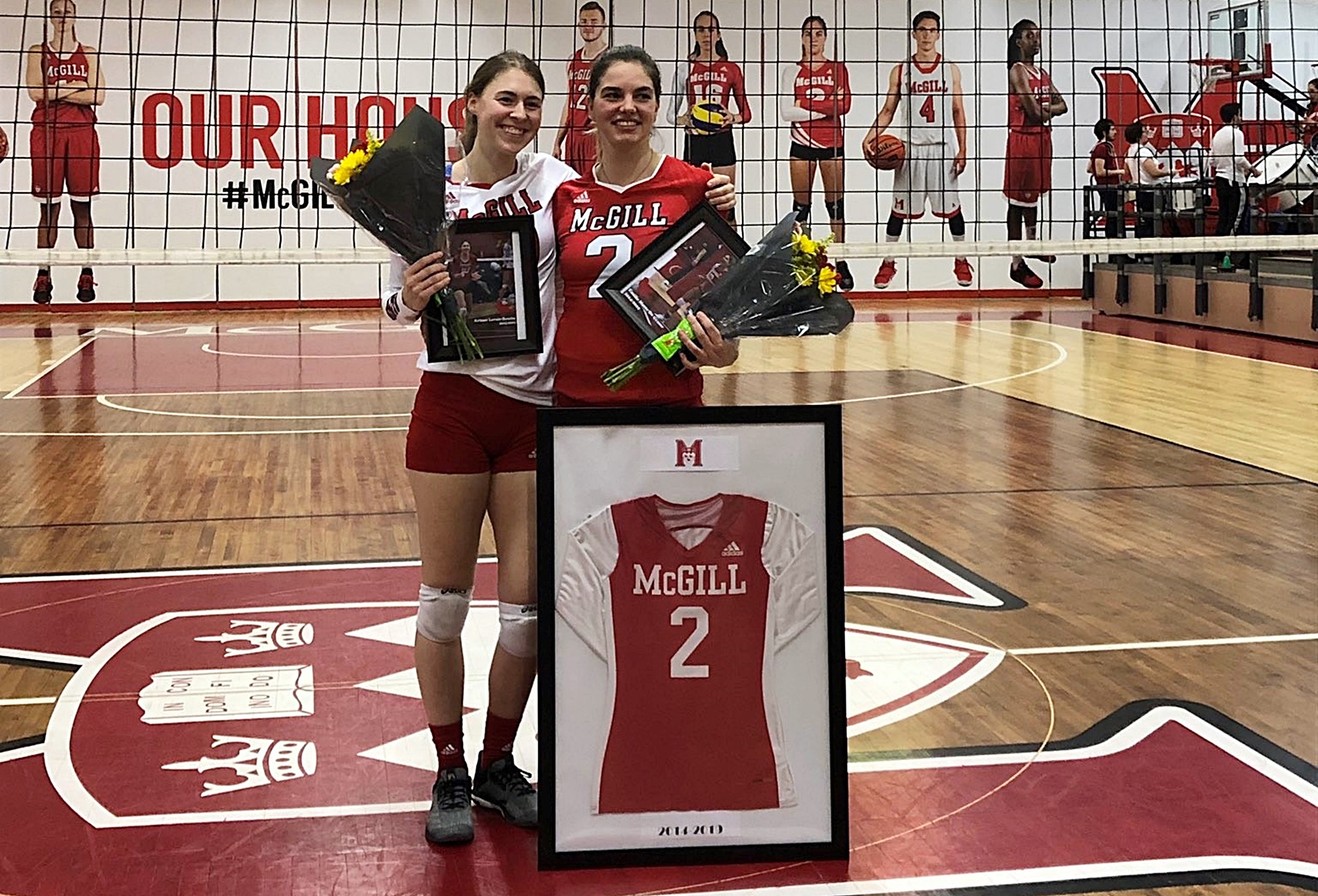
The evening ended with an emotional ceremony, which recognized graduating seniors power hitter Ariane Lavoie-Boutin and Matte de Grasse for their contributions to the McGill women’s volleyball program over the years.

“I have no clue what I’m doing next year,” Matte De Grasse said in an interview with The McGill Tribune in November 2018. “I’m not sure I’m ready to fully commit to being a grown-up.”

The Martlets finish the regular season with games against Sherbrooke (5-11) on Feb. 15 and Université du Québec à Montréal (9-8) on Feb. 17.

Moment of the Game

With the score tied at 22-22 in a tense third set, third-year power hitter Claire Vercheval delivered three kills in the last four plays to help McGill pull ahead and claim the last-minute victory.  

Quotable

“We’ve improved a lot over the season. We’ve built a lot of chemistry, and we had first-years on the court.” – Third-year middle blocker Elisabeth Perrault on the team’s progress from the beginning of the season.

Stat Corner

McGill accumulated 37 kills, while Laval managed just 26.


Arts & Entertainment, Music

Igloofest is still cold in its 13th iteration

Most people spend January and February huddled up indoors trying to avoid any contact with the frigid, brutal elements. Not Montrealers, though—for three weekends every year, hordes of ravers dressed in 90s ski-jackets and spacesuits brave the winter, fill up Quai Jacques-Cartier, and dance the night away. This year was no exception: Despite bitter cold temperatures and icy dance floors, Igloofest unfolded as planned, booking a genre-diverse and well-rounded line-up.

The McGill Tribune took full advantage of the festivities and got the scoop on the 13th iteration of this infamous event.

Polo & Pan—Night one: Jan. 17

This endearing French DJ duo isn’t typical for Igloofest’s lineup: They produce electro-pop, sampling musical styles across genres and eras. Their funky, suave, and downright-weird music electrified the audience, leaving the crowd happy, mesmerized, and sore from dancing all night.

Skatebård—Night one: Jan. 17

Straight out of Norway, Skatebård’s stocky frame and gruff beard makes him look like a modern-day Viking, well-equipped for the bleak Montreal winter. Skatebård’s music falls within a sub-genre of house called Italo-disco—the B-movie of the disco genre—making for a surprisingly melodic and funky set. Spontaneous dance circles ensued, providing audience members with the perfect opportunity to showcase their most creative moves. 

Nina Las Vegas—Night two: Jan. 18

Opening for the very popular Diplo to a mostly student-populated crowd unfamiliar with her music, Australian producer and DJ Nina Las Vegas had a lot to prove. Laying down one of the most technically-proficient dance sets at the festival and lining up perfectly curated tracks over one another, Nina infused the whole crowd with energy.

Four Tet—Night three: Jan. 19

Igloofest is branded as “the coldest music festival in the world,” but even Montrealers were unprepared for when the temperatures stooped to -24°C. Somehow, the venue filled up for Four Tet with groups huddled together on the dance floor for warmth, taking intermittent breaks at the firepits to defrost frozen toes, fingers, and eyelashes. Maceo Plex, the opener, warmed  up the crowd with his signature blend of techno and experimental music, laying down hard bass lines and strange time signatures that made for an off-brand, intense performance.

AC Slater—Night six: Jan. 26

AC Slater, the L.A.-raised DJ pioneering the British genre of Bassline, touts himself as the champion of ‘nightbass’ and has made it his mission to expose North America to UK Bassline. He appears to have succeeded; his rich basslines and built-up drops invigorated the crowd, which pumped its fists and ‘gun fingers’ in the air. His act perfectly led into the headlining deep-house demigod: Chris Lake.

Chris Lake—Night six: Jan. 26

Since his debut  in 2002, U.K.-native Chris Lake has played at every major music festival venue. His track selection featured a blend of fan favorites like “Lose My Mind” and “Deceiver” and new boundary-pushing lyrical tracks that truly separated him from the ever-growing pack of house DJs.

Maceo Plex—Night nine: Feb. 2

Maceo Plex closed out Igloofest with a strong three-hour set. He brought the music, and Montreal brought the energy and increasingly bizarre antics. There was a shirtless man dancing his heart out, and one fervent fan made it their prerogative to shout “Maceo Plex is my dad,” repeatedly. His smooth, groovy techno made for the perfect end to a successful festival. Still, when the lights came on at the end of his set, Igloofest was over. Everybody was smiling, and could not help but look forward to next year’s festivities.


Student Life

Outdated: How technology has changed romance

In recent years, societal perceptions of dating have changed dramatically. With the advent of online dating, individuals have more options when it comes to whom to date and how. Despite the increase in prospective partners, dating is complicated, and it has become even more muddled by the ambiguity that online dating can cause. With the emergence of the internet, virtual courtship has overturned the once-rigid rules of traditional romance.

Many young people have found meaningful connections via smartphone applications. According to a 2018 survey, 28 per cent of users between the ages of 18 and 29 have gone on one or more dates with someone they met online. This is, in part, because the dating pool has broadened: Technology gives users the impression that they are connecting with thousands, or millions, of potential matches. However, online dating has altered the types of relationships people pursue—especially for students. In an age of online dating and an influx of casual meetups, dating has begun to seem antiquated.

With apps like Tinder and Bumble, where upwards of hundreds of matches can accumulate in an hour and one third of the user demographic is between the ages of 18 and 24, it is clear that such dating apps have provided university students with an efficient and timely way to meet new people. Dating apps offer a seemingly quick fix to students’ longing to feel connected. Catherine Carson, U2 Arts, explained that, in her experience, dating apps have appeared to encourage hookup culture and result in primarily casual, short-term relationships as opposed to more serious committal ones.

“While these apps probably help those who are looking for a relationship find [a partner] to go on dates with, I think the majority of people who use online dating apps are usually looking for hookups,” Carson said.

Carson embraced social media in her dating life, as it helped her connect more deeply to her long-distance partner, whom she met through social media. Though she and her partner did not share the convenience meeting regularly in-person, being able to talk daily via technology allowed her relationship to flourish at a distance.

“[My boyfriend and I] live in different cities, [but we…] decided to go on a date, as we had been talking on social media for a few weeks,” Carson said. “We ended up talking every day until we eventually decided to be exclusive.”

Carson’s experience exemplifies the way in which social media can facilitate unlikely relationships and strengthen connections via virtual communication.

However, dating apps also allow students to hide behind their phone screens. In Mar. 2018, one man matched with 53 potential mates, but, after suggesting meeting up, only four people accepted the invitation. The “getting to know each other” phase of romantic relationships has transferred from in-person communication to browsing profiles and texting. Chloe Gherardi, BSc’18, found that technology has made dating feel superficial.

“[In my experience], people are much more willing to put themselves out there due to dating apps,” Gherardi said. “But, dating [seems to have changed] toward basing compatibility off of physical appearance rather than actually getting to the know the person.”

As Gherardi observes, dating apps end up encouraging unrealistic expectations, especially about the types of relationships that users pursue. Students who set out in hopes of finding a relationship may, instead, be met with an overwhelming amount of casual hookup prospects. Miruna Coca Nica, U1 Arts, has also observed that social media encourages casual interactions, rather than long-term relationships.

“[In my experience], online apps seem to set some unspoken expectations of hooking up casually rather than being in a relationship,” Coca Nica said. “Also, [the apps seem to discourage] people from getting to know each other in real life before [deciding if] they want to date.”

This casual attitude toward dating absolves students of the responsibility of adhering to a strict set of social rules. Gherardi finds that informal methods of getting to know people have replaced this traditional kind of courtship, which involves going on dates and meeting friends and families. This not only has made dating feel obsolete to her, but has also made the process more confusing.

“Dating [appears] more simplified [today] in that there isn’t so much courting but just getting to know a person,” Gherardi said. “I, personally, think dating has become much more complicated due to social media.”

Students more often hesitate to formally define their relationships because there are more types of relationships that daters can now choose to pursue. Frank Kermit, a Montreal-based dating coach, explained that individuals can feel overwhelmed by the numerous potential matches and the relationship styles to choose between.

“People have more choice [in types of relationships] than they have ever had before. They can choose to stay out of [one relationship and] pursue multiple [relationships…], a whole umbrella,” Kermit said. “The power of choice without the skill set to manage all this choice is leading a number of people to being miserable.”

With the advent of alternative dating options, students often elect to keep their relationships undefined, which can blur the perception of what romantic partners want. As evidenced by the emerging terminology for casual hookups such as ‘Netflix and chill’ and ‘cuffing season,’ Kermit has observed that young people are less interested in putting formal labels on their romantic relationships.

“If people use terminology because it makes them more comfortable to find the companionship that they are looking for, then so be it,” Kermit said. “As long as everyone involved is a consenting adult and not lying to each other about expectations.”

Ambiguity makes some people feel comfortable, while others remain frustrated. Students dissatisfied with the uncertainty are often left wondering about the status of their relationships and their exclusivity.

“Yes, it’s a good means of getting comfortable with someone,” Gherardi said. “But, it can make determining the status of a relationship more difficult, since it [tends to] keep things very open.”

Despite these annoyances, young people have ditched formal courtship. However, this is not a signal of the end of dating altogether. Apps and terminology allow people to pursue their desires more directly. Kermit offered a glimpse of what he expects to come from this new age in the long run, as seen through his clients.

“I anticipate [… that] people who flourish in the hookup culture [… will] learn that fun does not equal fulfillment in the long-term,” Kermit said. “Eventually, fun just becomes novelty, [and] once people reach that point, what they tend to desire is something more meaningful [….] When the day comes [that people] want something more serious, dating will be the category that most people will fall into.”

Read the latest issue

Read the latest issue