Latest News

Arts & Entertainment, Books, Internet

Goodreads Choice Awards prioritizes sameness over diversity

Most people have heard of the Grammys and the Oscars, but unless you’re an avid reader, the Goodreads Choice Awards may be less well-known. Goodreads is a social media platform dedicated to books and those who read them. Since 2009, the website has hosted its annual Choice Awards, allowing users to vote on their favourite reads of the year. To qualify, the selected books must have been published within the voting year in the United States in English—although books in translation are included—and have an average rating between 3.50 and 5.00 stars. Voting happens in two rounds, opening with 20 books and cutting down to 10 in the final. This year, the voting started on Nov. 14, and the final winners will be revealed on Dec. 7. 

While I don’t always vote in every category, I still search through the nominees for titles to add to my ever-growing, overly optimistic to-read list. The categories usually encompass a variety of genres, from Historical Fiction to Horror, appealing to readers across the board. However, in an update on Nov. 12, Goodreads announced that their categories would be adjusted. 

Goodreads introduced the category of “Romantasy,” a subgenre of Fantasy with a prominent romantic subplot. This addition seems unnecessary given the pre-existing categories of Fantasy, Romance, and Young Adult Fantasy. However, the logic behind this decision makes sense. Romance and Romantasy have become especially popular on BookTok, a niche literary community on TikTok. Romantasy books typically follow Fantasy conventions but have simpler world-building—unlike many high fantasy novels—and a greater emphasis on romance, which contributes to their growing appeal.

Goodreads also decided to remove three categories: Children’s and Middle-Grade Fiction, Poetry, and Graphic Novels. This change has sparked outrage and confusion online, especially because these categories have suffered from low book sales in recent years. Additionally, recent reports reveal that kids in North America are reading less for pleasure, accompanied by a decrease in their reading scores, causing concern among publishers and librarians.

People have taken to X (formerly Twitter) to voice their frustrations. User pagesofhayley writes: “Removing children’s/middle grade from the goodreads choice awards is making sure a whole age group for books won’t get visibility now.” Jnetalee says: “In a year where #kidlit is really struggling with book bans, you decide to eliminate middle grade, children’s, and graphic novels from the awards categories?”

These responses are justified, given that internet trends have increasingly influenced the literary world, making it harder for less popular genres to break into the mainstream. Removing categories geared toward young readers reduces the visibility of both authors and books. As a form that encourages self-expression, Poetry’s removal is also very concerning.

Faye Bender of The Book Group, a literary agency, posted a petition on Nov. 17 requesting Goodreads to reinstate Children’s and Middle Grade and Graphic Novels. The petition states, “If we don’t encourage and support younger readers by bolstering the visibility of books written and published for them, who will grow up to read adult books?”

Goodreads has also been criticized in recent years for awarding predominantly white authors. Unfortunately, the stories themselves are similarly lacking in diversity: this year’s Romance lineup—one of the most popular genres—is remarkably lacking in Black and Indigenous voices, writers of colour, and 2SLGBTQIA+ stories. This issue carries over from the predominantly white publishing industry, where a lack of diversity persists from hiring to acquisitions.

Goodreads influences what works readers are exposed to, and thus, what gets published. Last year’s Goodreads Awards saw over 5.7 million votes cast. By neglecting to highlight marginalized authors and underrepresented genres, the platform prevents them from getting the exposure they need to thrive. The industry has always been demand-driven, so if people express a desire for inclusivity, we can hope publishers will circulate more diverse works. If you’re looking to diversify your reading list in 2024, instead, start with these lists from Little Free Library, or ask your friends for their recommendations. The Goodreads awards should not be your place to start.

Editorial, Opinion

2023 PGSS executive midterm reviews

The Tribune’s editorial board presents its midterm reviews of the Post-Graduate Students’ Society (PGSS) executives. Tribune editors researched and communicated with each executive before leading an editorial board discussion on the executives’ work and accomplishments. Editors with conflicts of interest abstained from discussing, writing, and editing relevant reviews.

Secretary-General: Satish Kumar Tumulu

Tumulu has been the PGSS Secretary-General since June 24 and is in charge of representing PGSS to other university bodies, including the McGill Senate and Board of Governors, overseeing the PGSS governance documents, and chairing the executive committee. He entered the position concerned that students were not able to get in touch with their PGSS representatives when they needed to and believes that PGSS has successfully improved communication with constituents during his tenure. Tumulu sees funding as one of the most pressing issues facing post-graduate students—PGSS’ recently-published 2022-2023 McGill Graduate Student Funding Report states that 88 per cent of McGill graduate students make “less than a sustainable income”—and advocates for better funding and grant opportunities for post-graduate students. He also meets with the Association of Graduate Students Employed at McGill—which is currently bargaining with McGill over a new collective agreement for teaching assistants—to stay up to date on their work. Next semester, Tumulu has important goals to tackle: He hopes to increase attendance at the Feb. 7 General Meeting (GM), as this semester’s GM did not reach quorum, to tackle structural issues within the Society, and to potentially simplify the insurance process for students. Tumulu’s goal of increasing funding and grant opportunities for post-graduate students is crucial; The Tribune urges further coalition-building and the wielding of Tumulu’s spots on McGill’s highest governing bodies to better students’ working and living conditions, and to hold the university administration accountable. 

External Affairs Officer: Ansley Gnanapragasam

As External Affairs Officer, Gnanapragasam aims to enhance the organization’s involvement in provincial and federal political affairs. His noteworthy accomplishments include fostering ties with other student unions, like the Concordia Student Union, and exploring PGSS re-joining the Quebec Student Union. Gnanapragasam has initiated discussions on student and research funding, with a potential town hall with a Member of Parliament in the works. His main priorities for the upcoming semester are continuing ongoing projects and establishing “interdisciplinary inter-university sessions,” such as a case competition across various Quebec universities. Gnanapragasam explained that PGSS avoids taking firm stances on global political issues, such as the ongoing conflict in Gaza, to avoid stoking tensions among a diverse student population. Ongoing and future initiatives include addressing French translation costs and exploring collaborations with other universities while balancing both francophone and anglophone student needs. Looking forward to the next half of his term, Gnanapragasam emphasized careful planning as he is diligently working on completing the projects that he has undertaken to ensure that all McGill graduate students feel adequately represented. Overall, Gnanapragasam’s work to build connections and improve funding is important, but The Tribune calls for PGSS to reconsider its position on political statements and take a stand for human rights when geopolitical crises arise.

Internal Affairs Officer: Cindy García

The Internal Affairs Officer is in charge of organizing and marketing PGSS events in response to constituent feedback, overseeing the PGSS orientation, communicating with Post-Graduate Students’ Associations, and recruiting to PGSS committees. García recently assumed the role on Nov. 6 and has been focused on going through student feedback and brainstorming events in her first weeks on the job. Next semester, García hopes to run events with a focus on environmental, financial, and social sustainability and is particularly focused on finding ways to better immerse post-graduate students in the university community. While she is still in her first weeks on the job and knows she still has a lot to learn—for example, about student unions’ advocacy around tuition hikes—García’s commitment to catering to students’ needs, listening to feedback, and sustainability are admirable.

Financial Affairs Officer: Faezeh Pazoki

As Financial Affairs Officer, Pazoki has undertaken responsibilities pivotal to the organization’s financial health. Pazoki’s overarching goals have focused on optimizing the PGSS budget for equity and inclusion, notably implementing transparency measures such as including monthly budget actuals in her council reports. Her accomplishments this semester include successful crowdfunding for travel awards and need-based bursaries, demonstrating effective budget management without resorting to fee increases. Challenges, such as navigating the effects of inflation as well as Memorandum of Agreement negotiations with Macdonald Campus Graduate Student Society, were met with careful planning and collaborative approaches. As her term concludes in December 2023, Pazoki is prioritizing a seamless transition for the incoming Financial Affairs Officer. It is imperative that the transparency Pazoki has created through tangible action continues under the next Financial Affairs Officer. 

Member Services Officer: Sabrina Yusuf

The PGSS Member Services Officer manages services offered to PGSS members and issues related sustainability. They are responsible for the Grants Program, the Member Legal Defence Fund, the Health and Dental Insurance Plan, and the PGSS annual handbook. At the start of her term, Yusuf hoped to bring back services that had been cut during the pandemic and strengthen the PGSS’s health and dental insurance coverage. However, she came into her role not knowing the full extent of how nuanced insurance is, and found it challenging to find an option that balanced the need for more complete coverage with the need for affordability. Even without any changes, the insurance plan has become more expensive annually for the past few years because of the sheer volume of claims that have been put in, especially those related to mental health. Yusuf has been looking into ways to prevent students from needing to put in so many claims, including the possibility of offering different providers to provide telehealth psychotherapy—making it not only less costly but more accessible to students in general. Yusuf has also been involved in PGSS’s transition from Desjardins to a new insurer, GreenShield, which she noted was not as smooth as the team would have liked. In this process, she noticed the need for transparency with PGSS members, and has been working to keep members informed on the switch, why they made it, problems that arose and their solutions, and any other updates. As a part of this initiative, she helps run a town hall focusing on the insurer transition, which PGSS publicized through their listserv, flyers, their website, and presidents of different Post-Graduate Students’ Associations. Yusuf wants to focus on improved transparency within the Society for the rest of her term. She also works directly with the BIPOC Coordinator, the International Student Caucus, and the Mental Health Coordinator in supporting students affected by ongoing geopolitical crises.

University Affairs Officer: Racchana Ramamurthy

As University Affairs Officer, Ramamurthy takes on a host of responsibilities to ensure that graduate students’ voices are heard at all levels of the university. Coming into the semester, Ramamurthy’s main priorities included improving graduate student funding and rectifying issues with supervisors—both of which she has made significant progress on. Her biggest accomplishment to date is her success in garnering the McGill administration’s acceptance of the recommendations detailed in the 2022-2023 McGill Graduate Student Funding Report, developed by the Funding Working Group. The accepted recommendations include providing students who receive external awards with a 10 per cent increase in funding, encouraging supervisors to provide cash advances for conference fees and speeding up reimbursements, and working towards ensuring that all students receive the provincial minimum wage rate. Ramamurthy strives to educate constituents on the avenues available to them to address issues with supervisors, including using the required progress tracking system to report bad conduct by supervisors. Ramamurthy has also done an impressive job advancing the interests of graduate students within the university administration and moving forward, she hopes to address communication issues that have led to a lack of recruitment for university committees. Given her success on the funding front, recruitment should be a priority in the upcoming semester to ensure that all student voices are represented.

Editorial, Opinion

2023 SSMU executive midterm reviews

The Tribune’s editorial board presents its midterm reviews of the Students’ Society of McGill University (SSMU) executives. Tribune editors researched and communicated with each executive before leading an editorial board discussion on the executives’ work and accomplishments. Editors with conflicts of interest abstained from discussing, writing, and editing relevant reviews.

President: Alexandre Ashkir

Ashkir ran on a platform focused on policy reform, increased accessibility of SSMU support and resources, and transparency. While Ashkir has little to point to in terms of achieving these goals, he says that this is due to his position requiring that he prioritize supporting all other executives. He also said that many of his goals, such as reforming SSMU policies, take longer than a semester to accomplish. Although he has yet to make policy changes, he is working with the Governance Reform Committee to create clearer and more institutionalized policies within SSMU. He aims to finish these projects by the end of the year or to set out a work plan for his successor. Ashkir has been able to slightly expand the SSMU Grocery Program, which his predecessor Risann Wright launched, and hopes to integrate it within a larger coalition of food accessibility programs on campus. One of Ashkir’s biggest accomplishments of the semester has been the steps taken toward increasing SSMU’s transparency. At the beginning of the year, he spearheaded a meeting with student media and created more accessible and reliable avenues for contact. He plans to increase transparency, hoping to regain student trust and engagement with SSMU. Overall, Ashkir has made good progress on his goals given the time constraints; however, as he goes forward, having more specific plans would be an asset to himself and his constituents.

VP Student Life: Nadia Dakdouki

Going into this position, Dakdouki sought to boost engagement with SSMU, increase clubs’ visibility, and ultimately improve students’ and student groups’ experiences interacting with the Society. Her biggest challenge so far has been initiating new projects while both she and SSMU have been overloaded with work. That said, she put together a very successful Activities Night, organized an Activities Night Lite, and created a Clubs Guidebook. She has also maintained good communication with students via office hours, event advertising, emails, and the Vice President (VP) Student Life Instagram. Additionally, Dakdouki is helping to develop a financial how-to guide for clubs, creating a SSMU insurance guide for students, and starting a student volunteer program at the SSMU daycare. In the winter semester, Dakdouki plans to run more club events and will bring back Mental Health Action Week. She is also looking into creating a relaxation area on campus, as well as new mental health services with Keep.meSAFE that would be tailored to students affected by the ongoing Israel-Palestine conflict. As was mentioned in her campaign, she hopes to increase in-class announcements and student group tabling. So far, Dakdouki has made strides in bolstering student groups while mental health and family care, which are also under her portfolio, seem to have been given less attention; this will be resolved if Dakdouki accomplishes what she has planned for this upcoming semester.

VP Finance: Amina Kudrati-Plummer

Following the resignation of former VP Finance Alice Fang in Aug. 2023, SSMU held a by-election resulting in the election of Kudrati-Plummer on Oct. 20 with 60.6 per cent of the vote. Kudrati-Plummer underwent two weeks of training and only officially assumed the position on Nov. 13. SSMU had to divide the responsibilities of the VP Finance position between the other executives prior to Nov. 13, meaning that Kudrati-Plummer is still consolidating her responsibilities in the role. Kudrati-Plummer has a clear vision for reforming SSMU’s internal accounting processes. Improving financial transparency within SSMU is her main goal, an endeavour she believes is crucial to restoring the student base’s faith in the governing body. She also hopes to develop cost-saving programs for students to alleviate financial stressors and re-evaluate the SSMU’s internal accounting process, specifically concerning tracking services and budgets. Regarding complaints from SSMU clubs about difficulties accessing their finances, Kudrati-Plummer explained that this is due to issues with the Royal Bank of Canada—SSMU’s bank—that SSMU cannot directly control. She further explained that this went unaddressed before she stepped into the position, as immediate tasks such as re-budgeting and SSMU’s financial audit needed to be prioritized. With improving the current banking system as her top priority, Kudrati-Plummer will hopefully be able to address this pressing issue next semester.  The Tribune sees these goals as critical, especially given the SSMU’s claims of “financial peril” that prompted the request for a 71 per cent base fee increase in the fall referendum. The Tribune hopes that Kudrati-Plummer will emphasize financial transparency and accessibility in the coming months.

VP External: Liam Gaither

Gaither’s main priority going into this position was to ensure that SSMU would be able to continue supporting groups on campus and aiding in student mobilization efforts. He cites the creation of the Community Solidarity Fund fee—a $1 opt-outable fee that feeds a discretionary fund for social justice-oriented individuals and groups—as External Affairs’ biggest accomplishment of the fall semester. To promote off-campus volunteering opportunities, Gaither revived the Community Engagement Day, which took place on Oct. 26 and featured around 30 organizations from the greater Montreal area. An important part of Gaither’s work has focused on mobilizing students against tuition hikes. On the week of Nov. 20, a successful petition calling for the cancellation of tuition increases for out-of-province students that he participated in writing gathered more than 30,000 signatures and was sent to the Quebec National Assembly. This work will carry into the coming months, with an emphasis on building a better sense of student solidarity on campus. The External Affairs department will also bring forward two policies next semester: A food security policy to make the issue more actionable by executives and a union solidarity policy to provide the department with an official mandate to work with unions on campus. However, initiatives aimed at creating links between organizations on campus have been lacking, and a focus on strengthening relations between groups would be an asset in mobilizing students.

VP University Affairs: Lalia Katchelewa

The VP University Affairs is responsible for facilitating relations between the SSMU and the McGill administration, supporting and furthering equity and student advocacy as well as fostering academic innovation in the library. During her campaign, Katchelewa emphasized advocating for food security, menstrual health, and supporting student advocacy. However, she has only been able to partially stick to these goals, mainly strengthening food security initiatives on campus. A significant hurdle Katchelewa has faced is the bureaucracy and power structure of the McGill administration. In the second part of her term, Katchelewa hopes to further press the administration to take action on several critical issues facing students—especially food insecurity. She aims to foster collaboration between faculties as well as other institutions by organizing an inter-faculties summit and cooperating with the Concordia Student Union. Similarly, Katchelewa would like to double down on student outreach. She emphasized the need to be more accessible and visible on campus and proposed tabling at football games to better engage with the community. She says that the “corporate aspect” of the SSMU, as she calls it, often conflicts with its union role, and that she has been working towards striking a just balance between both. As her portfolio encompasses crucial political components, such as sitting on the Indigenous Affairs Committee, the Francophone Affairs Committee, and the Black Affairs Committee, her lack of clear accomplishments and attention to these matters is concerning. The Tribune urges Katchelewa to increase transparency on the equity and advocacy initiatives and support she provides to students.

VP Sustainability and Operations: Hassanatou Koulibaly 

After serving as last year’s VP Student Life, Koulibaly returned to the SSMU executive team this year, taking on the newly-reinstated VP Sustainability and Operations role which has not been filled since 2017. She ran on a platform that promised a thorough and thoughtful reestablishment of the role’s portfolio, an expansion of MiniCourses, and ensuring clubs follow the SSMU sustainability mandate. Koulibaly returned to SSMU prepared; although she effectively trained herself in this renewed role, she has been responsive and proactive. Already, she has laid the groundwork for athletic insurance in the SSMU building, a Gerts ambassador program starting in the Winter term, and auditing SSMU spaces to ensure clubs can operate. While Koulibaly is clearly on top of the operations aspect of her role, she had less precise action plans for integrating sustainability into executives’ portfolios. Hopefully, now that the VP Finance role has been filled, Koulibaly can better estimate sustainable resource management and put equal emphasis on that aspect of her role. 

VP Internal: Jon Barlas

As part of the VP Internal mandate of community and communication, one of Barlas’ main priorities throughout his campaign was to increase the accessibility of SSMU events by breaking away from their traditional alcohol-centred parties. In line with this goal, he organized two highly successful dry events: A Friday the 13th movie night and a thrift flip. In addition, he has worked to increase SSMU’s accountability by holding weekly travelling office hours in the Arts Undergraduate Society, Management Undergraduate Society, and Engineering Undergraduate Society offices. This has allowed Barlas to meet executives and students alike and answer their questions about SSMU. Barlas has also worked to improve alumni relations, which he did not feel were well-handled by previous VP Internal Cat Williams, by sitting on the McGill Alumni-Student Engagement Council and working with the Scarlet Key Society. Overall, Barlas is performing well in his role. Going forward, he aims to continue planning accessible events in collaboration with interfaculty organizations and hopes to create a SSMU Wiki, inspired by the EUS Wiki, to share resources with students.

Student Life

Location, location, location: How to find your perfect neighbourhood

Looking for an apartment in Montreal is no easy feat for McGill students new to the city. The unrecognizable postal codes and streets mix together to form a jumble of numbers and letters. This challenge is magnified for students when the perceived perfect apartment often hinges solely on its proximity to the university. But, the area surrounding your future apartment is just as significant as its amenities. The atmosphere of the neighbourhood influences your daily life, so finding the perfect location can be different for everyone. 

Milton-Parc

If your top priority is proximity to campus, then Milton-Parc is the ideal choice. The allure of being within a five-minute walk to most McGill buildings is particularly enticing during the bone-chilling winter months, though this proximity does come at a cost—housing in the area can be relatively expensive compared to other areas in Montreal. 

Milton-Parc is a densely student-populated area, meaning that there are various student-centric cafés and businesses. However, this vibrant energy has a downside, as there may be heightened noise levels during student events such as Frosh Week. Yet, for most, this is outweighed by having all the essentials within a couple of blocks, allowing for time saving during peak exam season. 

Le Plateau-Mont-Royal 

Located roughly a 25-minute walk from campus, the Plateau offers the best of McGill at a slightly greater distance. The distance to and from campus allows you to enjoy a refreshing walk before you’re locked into a day of classes. You can also experience living outside of the McGill bubble. 

Home to some of the city’s oldest known food and drink institutions, the Plateau is home to an array of new coffee shops, boutiques, bakeries, and supermarkets, providing a blend of historical charm and modern conveniences. The lower Plateau’s artsy atmosphere renders it a desirable, albeit still relatively pricey, location to live.

Griffintown 

Griffintown is known amongst Montrealers as an up-and-coming district. Developers have recently begun the construction of many new residential buildings. While this creates many a modern living environment, it also contributes to the problem of gentrification. 

Located only a 15-minute metro ride to campus, it’s an easy walk to downtown and Old Port. Despite its prime location, Griffintown may not exude the same vibrant atmosphere as other neighbourhoods due to the impact of high development on the community. Nevertheless, it compensates with a different type of appeal, focusing on contemporary living and accessible pathways, making it a pragmatic choice for those seeking a balance between urban convenience and a quieter escape. 

Saint-Henri 

If you’re looking for a neighbourhood outside of the McGill bubble, then Saint-Henri is definitely one to consider. This area is packed with small parks and beautiful walking and bicycle paths that line the nearby canal, making it the ideal location for those who love taking walks close to home. 

Home to the year-round Atwater market, Saint-Henri offers the best of local and gourmet food and products. This neighbourhood, characterized by its mix of iconic Montreal institutions like the market and contemporary developments, captures the essence of Montreal’s dynamic urban landscape. 

The Village 

The Village, although slightly farther away from campus, is a neighbourhood that truly encapsulates Montreal’s dynamic and lively atmosphere. Via metro, you would have a convenient commute to campus in under 25 minutes. What sets the Village apart is its affordability, with rents more budget-friendly than neighbourhoods such as Milton-Parc. 

The Village harbours a predominantly young demographic, who fill the array of cafés, restaurants, shops, and bars located in the neighbourhood. The Village stands out by offering a lively community for those looking to embrace the city’s spirit beyond the campus boundaries.

Features

McGill’s evolving faithscape: Exploring religion on campus

At twelve years old, I became acutely aware of how my family’s approach to religion diverged from that of my peers at my Christian school and church. The defining moment was when a Catholic friend visited and remarked on a unique feature in our home: A photo of Jesus facing a photo of the Buddha. My friend found it odd. But, my upbringing was marked by a belief, instilled by my parents, that all religions and forms of spirituality hold valuable insight for humanity. Although it is now obvious to me that not everyone had been taught the same, at the time, my friend’s reaction to the photos came as a shock. 

Despite recognizing religion’’s imperfections as I grew older—its polarizing potential, and its historical role in inflicting suffering—my curiosity about religious differences has persisted. Recently, while reflecting on my lack of interaction with religion since startingbeginning university, I began to ponder whether my deep fascination with religion’s impact on the world stemmed from my upbringing. How did my perspective compare to that of fellow students at McGill? 

In pursuit of answers, //The Tribune// ran a survey from Nov. 7 to Nov. 20 to gauge and understand McGill students’ sentiments regarding religion and spirituality, collecting a total of 112 responses. The results were telling: More than half of the respondents believed their peers were not religious, a presumption that aligned with the actual data. Despite the relatively small cohort of responses compared to the university population, the majority of McGill students in the survey reported not identifying with any specific religion or spirituality. 

However, the survey revealed a more nuanced picture of campus life. Nearly 60 per cent of surveyed students think that McGill has created an inclusive environment on campus where all religions are welcome without discrimination. Additionally, most students who identified with a particular faith felt that their rights to religious freedom were well protected on campus. 

The survey revealed varied perspectives on what religion and spirituality mean to McGill students. Many viewed spirituality as a personal journey and a connection to a greater force, possibly with higher powers and the supernatural. In their responses, students focused on how the practice of spirituality differentiates itself from religion because it is more personal, while others said it was just as community-based. 

Students articulated religion as an institutionalized embodiment of spirituality, offering a narrative to contextualize one’s existence and a structured belief-system for understanding life. One anonymous respondee noted: “I am not a religious person, but I see the appeal of a support system and community that religion fosters. I also see it as a source of comfort for anxiety surrounding existentialism and life-cycles.” 

With these insights in mind, I had a discussion with Gerbern Oegema, a religious studies professor at McGill, where he highlighted that there has been a significant uptick in student enrollment in the Religious Studies department over the past decade. Our conversation unearthed a crucial realization—an evident gap in early religious education. The convergence of secularization and shifts in educational policies in Canada has resulted in a generation possessing limited knowledge of religion. While prioritizing the secularization of education is imperative, I wondered whether students aspire to bridge this knowledge gap, aiming for a deeper understanding of diverse ways of life and philosophies. Oegema emphasized the rapidly-growing contingent of nursing students in the program, eager to study religion as a means to better care for patients from diverse backgrounds.

“[The nursing students] said, now, we work in hospitals with religious people who are sick or dying, and we know nothing about religion, and we want to know more about it,” Oegema said. “So that’s one very important reason why students come to [religion] classes; namely, that they know nothing about it.” 

According to Oegama, the absence of religious education at home and in schools has presented an unfed curiosity about the basics of religion, propelling students into further study. Despite the prevailing notion that society has moved beyond the realm of religion, a point solidified by the fact that polls have shown that Quebecers are least likely to believe in a God, Oegama said he has observed a resurgence of interest among young individuals. He attributed this to young people having profound questions about existence, unencumbered by the biases against marginalized groups that often accompany religious traditions. These questions, often centered around what one’s purpose is here on earth, delve into existential inquiries about the meaning of life, echoing the queries posed by ancient religious texts presented and studied in courses centered on religion. McGill’s offers an ample amount of religious studies courses across various departments, offering a plurality of perspectives within the field of study— with courses centered on Abrahamic religions and, South and East Asian religions, for instanceand more.  

The McGill’s Office of Religious and Spiritual Life, a branch of McGill Student Services, aims to provide multi-faith resources and programming for students’ religious and spiritual well-being. There are currently 32 faith clubs and organizations on campus, indicating that the university is a space where religious and spiritual plurality can thrive. 

However, despite a majority from the survey feeling their religious self-expression is protected on campus, over 67 per cent said that they did not believe McGill students displayed their religiosity publicly. And of those who were religious, around 54 per cent, expressed difficulty in finding a community of those who shared their beliefs at the university. 

Tanner Patterson, U1 Arts, captured the essence of the at times contentious nature of the religious atmosphere on campus. “Religion is an incredibly polarizing topic because it’s pretty much every single person saying that they know what the actual meaning of living is. So, everyone’s going to disagree with each other.” 

Clearly, it is not only people of differing religious groups in dispute but also those within the same faith. In the survey, the overwhelming majority of McGill students said that their social circle is not of the same religious or spiritual backgrounds as theirs. 

Delving into the social dynamics at McGill, Lucas Fuhrman, U2 Arts, described his friends’ religions, noting a mix of Catholics, individuals from various other religious backgrounds, and those with no religious affiliations. However, Fuhrman acknowledged that interfaith exchanges are  often contingent on one’s social connections on campus. Academically, Fuhrman touched upon the atmosphere the university fosters, mentioning that while the administration may take certain stances on issues, students still navigate a contested space where diverse opinions coexist. Additionally, he expressed his belief that McGill’s current cohort is less religious. Attributing this shift to the multifaceted challenges of contemporary life, Fuhrman asserted these hardships could prompt individuals to distance themselves from traditional religious teachings.

Although 55 per cent of polled students were not religious before coming to McGill, almost 10 per cent of McGill students had previously identified with a religious affiliation but no longer do so.  A common explanation I observed was finding incompatibilities with personal views and lifestyle requirements within organized religion that cause alienation in those communities. 

When asked about McGill student’s relationship to religion, Hannah Marken, U2 Arts, offered her perspective on our generation’s trajectory away from traditional religious beliefs. 

“I think that maybe there’s a stronger disbelief of what religions stand for and a lot of the ideas that are associated with it. A lot of young people don’t resonate with them anymore.” 

This phenomenon traces back to how students in the survey reported that they are opting not to display their religiosity publicly. Many choose privacy, fearing discrimination—particularly if they follow minority religions— meaning religions outside of Christianity, due to over half of the Canadian population being part of the Christian faith. Particularly in the context of Quebec legislation, Bill 21 illustrates how the province does not foster a safe environment for those part of the Islamic faith. Concerns extend to negative perceptions of various religious groups and reluctance due to complex faith relationships or safety concerns amid rising antisemitism and Islamophobia. My conversation with a U2 student in Religious Studies student, Charlie Zacks, emphasized this. 

Growing up with a Catholic mother and Jewish father, Zacks had exposure to both faiths, attending an American Christian private school, Methodist Church, Hebrew school, and synagogue. However, he identified as an atheist during his teenage years due to the prescriptive nature of religious teachings he encountered. Zacks finds McGill’s Religious Studies department diverse, featuring a wide age range and international representation, but also observes a general apathy toward religion outside an academic context. While there are well-supported on-campus religious organizations, he feels that acceptance depends on fitting into specific pre-established groups. 

“So is McGill overall accepting of people’s religiosity? Yes, insofar as it’s part of the accepted religiosity. This, in my opinion, is not a McGill problem specifically; but, McGill could do things to better this issue. This is an issue of how people view and interact with religion at large.” Zacks said.

“It’s the fact that some groups and some specific elements of certain groups are able to qualify as acceptable and because of that, anything outside of the acceptable facet of religion, or that specific religious group is then immediately disqualifying for them.” 

Zacks pinpointed a notable gap in basic understanding of religion among Canadians—particularly those born between 1995 and 2004. He attributed this to the rise of atheism during that era, with popular crusaders of atheism such as Richard Dawkins gaining fame. This trend, he noted, has led to a skeptical and unsympathetic attitude toward religion, particularly when engaging with different religious beliefs on campus. Emphasizing the need for open-mindedness, Zacks suggests that understanding religion with empathy and understanding can mitigate campus tensions and foster inclusivity. He advocates for a sympathetic approach to rReligious sStudies, seeking to bridge gaps in understanding and promote a more inclusive community. 

The impact of religion in shaping human development is often overlooked and undervalued. From the names of the days of the week to Western legal systems, humanity’s earliest beliefs about the universe have influenced various aspects of our lives. Recognizing the profound impact of religion is crucial in our daily interactions and, on a broader scale, in understanding how it influences legislation and policy. It stresses the interconnectedness between personal convictions, societal values, and the legal framework. Time and time again, personal convictions surrounding religion have allowed for divisive policies to be implemented worldwide— from Bill 21’s disproportionate the exclusion of Muslim women in the public sector in Quebec’s public sector, to the criminalization of homosexuality in Ghana. 

In the midst of shifting sentiments away from traditional religious structures, it’s crucial to acknowledge the enduring importance of religion and spirituality. While organized religion may be losing its grip, my experience speaking to students underscores the unwavering youthful quest for answers to existential questions, proving that religion and its philosophies and texts are here to stay. 

While contemporary events have a more immediate impact, a comprehensive understanding of human progress requires delving into the beliefs that shaped societies. Acknowledging not just what was believed but how deeply those beliefs were held is essential for comprehending actions and events throughout history. To reconcile with this truth, the influence of religion should be transparent rather than concealed behind rhetoric about complete secularism. Although religion is a personal matter, understanding it and its history becomes crucial in comprehending the behaviour of those around us and the societal norms that persist. Embracing the historical-religious foundations openly, particularly within an academic context, can lead to a more profound understanding of our world and foster a more accepting and informed society, where freedom of expression in various forms prevails. 

Shared questions about mortality and virtuous actions will persist across generations, though traditional avenues—churches, mosques, and synagogues, for example—no longer hold the same influence. Rather than completely losing religion, our generation appears to be shedding many aspects of organized religion and the value of its institutions. McGill students can envision a future with thriving interfaith discussions and harmonious coexistence, as long as the value of studying how religion has influenced and continues to influence the world continues to hold importance. A more empathetic approach, grounded in a profound understanding of religion, is crucial as we navigate the complexities of individual and communal beliefs. 

Editorial, Opinion

Montreal’s 2024 budget inflates a ballooning SPVM, while crucial accessibility issues go unaddressed

Announced on Nov. 15, Montreal’s 2024 budget raises serious concerns regarding the skewed allocation of funds accompanying the 3.5 per cent spending increase. The municipal government allocated the majority of the budget to investments in public transit––which is receiving a budget increase of $48.4 million, bringing it up to $715.6 million for the year––and the Service de police de la Ville de Montréal (SPVM)––whose budget will be increased by $35 million to $821 million. This tax hike however does not consider houselessness, alternatives to policing, and accessibility widely. Just shy of $7 billion, the budget will result in a 4.9 per cent hike in taxes for Montreal homeowners––an even higher rate than last year’s 4.1 per cent increase. Although raising taxes allows the government to provide vital public services, the budget’s allocation of funds grossly misuses Montrealers’ money. Despite some potential benefits for citizens, the budget not only fails to commit to accessible public services but also further empowers the abusive SPVM.  

Undoubtedly, the drastic increase in police funding is the most dangerous element of the new budget. Much of the police budget increase will go towards the hiring of 225 more police officers. The increase supports the misconception that more hiring will decrease overtime and stress, thereby improving policing practices. This overlooks the reality that the root problem resides within the policing institution itself, and that simply addressing officers’ working hours will not provide a solution. Hiring more officers contributes to over-policing wherein officers assert discretionary power under a systemically racist institution by disproportionately targeting Black and Indigenous peoples, and other racialized communities. In dialogue with mental health professionals and social workers, the city must invest in alternative methods of conflict de-escalation and care. 

Montreal does not need more police officers. This decision willfully misinterprets crime’s root causes, doubling down on the enforcement system rather than taking real action to address the underlying issues. By over-investing in policing, the Montreal government deprives other social services––such as safe injection sites, affordable housing, and shelters––of the necessary funding to provide for communities. 

The institution of policing as a whole fails to viably support many marginalized groups, including queer people, people suffering from mental illness, and sexual assault survivors—who often face violence from the police. For many officers, joining the police force represents power and control, contributing to the dangerous legacy and practices of the SPVM. When reckoning with the history of policing in Canada and North America, we must note its roots in slavery and settler colonialism. Police aim to control every aspect of individual people’s lives, producing regulated citizens. As such, police take autonomy away from individuals, imposing on communities and violently punishing those who do not conform.

One of the more positive aspects of the budget is the allocation of $34 million to provide free OPUS cards for senior citizens––an integral accessibility service for a well-planned city. However, this does not address transportation issues facing many other communities. Students, especially those who commute to school, face excessively high OPUS prices. Moreover, the recent talks about severely cutting certain transit services, including closing the Metro at 11 p.m., stopping intercity buses at 9 p.m., and withdrawing trains from the Orange, Green, and Yellow lines should concern Montrealers. These changes would drastically affect students and the general Montreal community, implementing devastating barriers to safe and accessible transportation. Although this funding matters, it cannot come at the expense of the metro’s accessibility to vulnerable populations. 

Montreal’s municipal government must re-allocate this budget to other services that work toward addressing the root issues causing crime and increasing the accessibility of public services for everyone. Premier Legault must immediately revoke his denials of systemic racism and prejudice in Quebec to take tangible steps toward redressing the inequalities that marginalized communities face every day. In this process, McGill students must lead the charge by getting involved in the communities around them, listening, learning, and taking action.

Commentary, Opinion

A snapshot of the perils of our phone-first recollection era 

Photographs serve as timeless reminders of our lives and permanent homes for our precious memories. Without them, recollections fade unnoticed; so we snap pictures through joy and sorrow, to create a visual record of our journey through life. As cameras embedded in our cellphones have become an omnipresent part of our daily routines, the excessive capture of countless photos has damaged our ability to retain that journey at all. When we take pictures, we are transferring the duty of remembering what really happened to an external device. This proliferation of photographic documentation threatens to reshape the foundation of our memories. If these patterns continue, we risk compromising the way we recall life experiences, particularly during pivotal stages of life such as university years.

Our generation is the first one to have the unique privilege of documenting its own youth digitally. No longer solely relying on oral stories from elders; now, intergenerational groups can effortlessly share thousands of pictures capturing real, lived experiences. As university students, the urge to capture every second through the various photo-focused apps on our phones can be overwhelming and almost irresistible in face of the desire for mementos that will be cherished for years to come. But equally pressing is the longing to have real, tangible memories of what being a student at McGill has felt like. 

While there’s no harm in snapping a photo of friends enjoying a sunny day outside Redpath, taking 20 more during the same hour might be excessive. Curating a small, meaningful collection of photos holds its own unique beauty. 

Take a cherished photo of your grandparents, for example. A faded, yellowing polaroid of a smiling face, such a gift because there is only one like it. We imbue these images with significance and value specifically because they are rare and precious. Now imagine what your children will see of your life: Thousands upon thousands of selfies and TikToks, every stage of your adolescence documented in gnarly detail, every piece of documentation made more derivative by the sheer quantity of the rest. 

For those who find this argument too sentimental, you can direct your attention to a more immediate and significant concern: The actual remoulding of our memories under the influence of photography. Have you ever attempted to recall an event from a few weeks or months back, and turned to your camera roll to recreate it in your mind? But what happens when, instead of recalling a beautiful experience as it happened, we can only grasp it through the pictures we took of it?

This might seem far-fetched, but our phones are one step ahead of us, employing vocabulary that ontologically relates photographs to our process of memory retention. Photos saved on Snapchat are called “memories,” and the platform notifies users of daily “flashbacks” from their camera roll, serving as reminders of past events. This vocabulary may seem harmless, but with so many lives lived through phone screens, what is there to separate a real memory from one crafted for you by an app? 

Research from Yale University indicates that documenting experiences via photography can enhance one’s connection to them by encouraging deeper immersion in the moment. Yet, the smartphone era’s photo abundance risks diluting authenticity as constant picture-taking prioritizes quantity over genuine immersion, potentially compromising the memories formed.

While using a camera as a visual diary is a helpful documentarian practice, it is inevitable that this culture of digital recording will pervade our psychology. Moving through the day with phone in hand, ready to mindlessly snap photos of anything, might seem beneficial to later recollection, but it will only cause harm to our memories in the long run. There is a saying about taking pictures of your food in restaurants: “The phone eats first.” When reflecting on a life documented through the lens of a camera, it may well be that the phone remembers first too. 

Commentary, Opinion

An Ode to Studio Art and why McGill’s curriculum needs it

At the beginning of this semester, I found myself eating lunch with a new dorm acquaintance, and making the usual small talk about classes. Add-drop deadlines were coming up, exacerbating the already-nagging sense of directionlessness that is so fundamental to collegiate studentdom, and the two of us felt just as lost as everyone else.

But it was with surprising resolution that my lunchmate told me she had dropped one of her classes, and in its place signed up for an art class held outside of McGill. McGill doesn’t have any studio art courses, she told me, so she thought it made more sense to put that tuition money toward a class she really wanted to take.

While I felt just as confused about my own path and future career as anyone else, I left the table feeling certain that McGill’s curriculum is in desperate need of studio art. 

Despite the central reason behind McGill’s lack of studio art being that UQÀM and Concordia University receive government funding to support their respective programs, many at McGill have felt similarly about the void in the university’s curriculum. In Art History and Communications Studies (AHCS), students and faculty have worked to combat this by transitioning the course ARTH 474––Studies in Later 18th and 19th Century Art 3––to include a “Drawing for Art Historians” component. 

Odd as it may seem, taking studio arts classes have gone hand-in-hand with my academic success. My notetaking, for instance, has become functional on both an informational and a visual level, where I give colour, format, and illustration as much validity as the denotations of words themselves. 

On a formulaic level, studio art is fundamental to so many of McGill’s strongest disciplines: civil engineering, mechanical engineering, and architecture, to name a few. Studio art classes would give McGill’s curriculum––and its students––an essential foundation of creativity, innovation, and three-dimensionalism (both literally and figuratively). Studio art practice would be useful in a range of fields, whether that be for architectural conceptualization, for mechanical trial and error, or simply for a break from content-heavy courses with a paintbrush and a canvas.

The importance of thinking with one’s hands––using tangible materials like clay, oil paint, steel, or wire––cannot be stressed enough. Navigating physical relationships of materials and their properties engages the body and the mind simultaneously in a way that any other kind of thesis-building, book-reading, project-proposing, or derivation-taking does not. Any student who takes a sculpture class will find their range of conceptualization suddenly much broader, more original, and both more aesthetically and mechanically impressive.

On a psychological level, studio art is healthy. Walking away from a computer is a good start unto itself, but the frustrations and victories that occur in a studio are of a different species than those encountered anywhere else. In my own case, though I never considered pursuing art, I always considered it important to be able to work long hours on something I was proud of, without feeling like my work was another inevitable hurdle in the longer path towards a career.

In a prestigious, academically-distilled environment such as McGill, coursework often feels stiflingly pervasive. Studio art gives the mind a chance to exercise different cognitive muscles. In the same way an athlete must let their muscles rest in between high-intensity workouts in order to get stronger, the brain, too, needs a rest from the whirlwinds of papers and lab work in order to maintain its highest quality. 

Many schools recognize the applicability of studio art, such as Northwestern University, where they offer a structural art course as part of their civil engineering program. This course emphasizes the connection between form and mechanics, which is essential to quality civil engineering. In tune with the initiatives taken by AHCS faculty at McGill, Northwestern provides an example of integrating studio art into an existing curriculum. For the sake of the quality and efficacy of McGill’s entire curriculum, as well as the general wellbeing and creativity of its students, the university would benefit from the addition of studio art. 

Off the Board, Opinion

Grounds for delight

As winter rolls in, my gait has begun to resemble the shuffle of a dejected penguin. Head permanently bowed for fear that one poorly planned step will result in death by slippage, my walks to campus now provoke a deep sense of mourning for warmer, and more posturally vertical, days gone by. These long consultations with the Milton sidewalk, however, have enlivened my affection for all things ground-related.

The establishment (romantics, well-being experts, my mother) is adamant about the importance of looking upward. Look at the sky, they say–quit slouching and ditch that grumpy aura. Sure, the sky has its perks—the sun, for instance—but can we stop with the looking-down slander? The ground is where life is!

The sky may be magnificent in its grandness, but the ground houses endless intricacy, from the cushiness of rich soil to the dotted coarseness of asphalt. Tiny creatures can, at any moment, crawl over a pebble and into one’s view. Even the scratchy gray of a sidewalk square is, in my view, far more texturally interesting than a spotless slice of clear blue. In the fall, I love to see leaves descend from their pompous treetop perch and gather playfully at my feet, and to hear their snicker as I sweep them aside.

The summer camp I went to as a kid laid claim to a large rocky ledge looking out on Georgian Bay. Slightly removed from the main grounds, it was a special space for reflection and commemoration. Laying flat on its sandy surface with my cabin-mates as we peered down at the lake, the momentousness of our girlhood and friendship would wash over me with all the drama of a coming-of-age movie. We staked our entire life’s trust in that big rock, our bodies glued to it as it held us above the drop in mighty stillness. 

In more recent times, some of my fondest memories have been formed sitting slumped on rocks after a night of outdoor dancing, suddenly so much more aware of their comfort. Leaning on one another in silent exhaustion, my friends and I would watch the new day materialize from the safety of this sturdy, ancient surface. So often depicted as unwelcoming and harsh, rocky terrain can offer the peace of constancy in a world of haste.

Winter grounds, covered in snow and ice, have their own ways of communicating life. Criss-crossing tire marks on snow-dusted roads, diverse in their density and opacity, tell us about the directions in which people have been travelling. Sled marks and scattered pilings of snow reveal a world of people making space for themselves and their kin. A mess of footprints on a busy street corner, a rare animal track on a doorstep. Every day, new paths and patterns can be seen stretching all around. The winter ground offers us an ephemeral tracing of life as it is lived and skirts away.

While I miss being able to plop down on an outdoor surface of my choosing without immediately turning into an icicle, I have found the floor of my apartment to be a respectable substitute during the colder months. Being at the bottom of a room summons a feeling of cocoonedness, of being held by the walls and furniture that tower on all sides. Sitting in a chair, legs hidden underneath a table, or sinking into a couch, I tend to grow irritated by the feeling that I am abandoning my corporeality. Cross-legged on the floor, I find myself whole and compact. Additionally, a migration to floor-level always generates a more satisfying feeling of closeness with whomever one is sitting, removing all possibility for stiffness or pretension. Knee-to-knee on our living room rug, silliness and vulnerability flourish together.

What was the point of all this mushy recounting? I want us to build a world of curiosity and affection from the ground up. Armed with an appreciation for what is too often cast as mundane, cold, and rigid, there is very little that can bring you down… except for the boundless allure of the ground, of course. The floor is yours!

Arts & Entertainment, Theatre

TNC Theatre brings ‘Importance of Being Earnest’ out of the closet

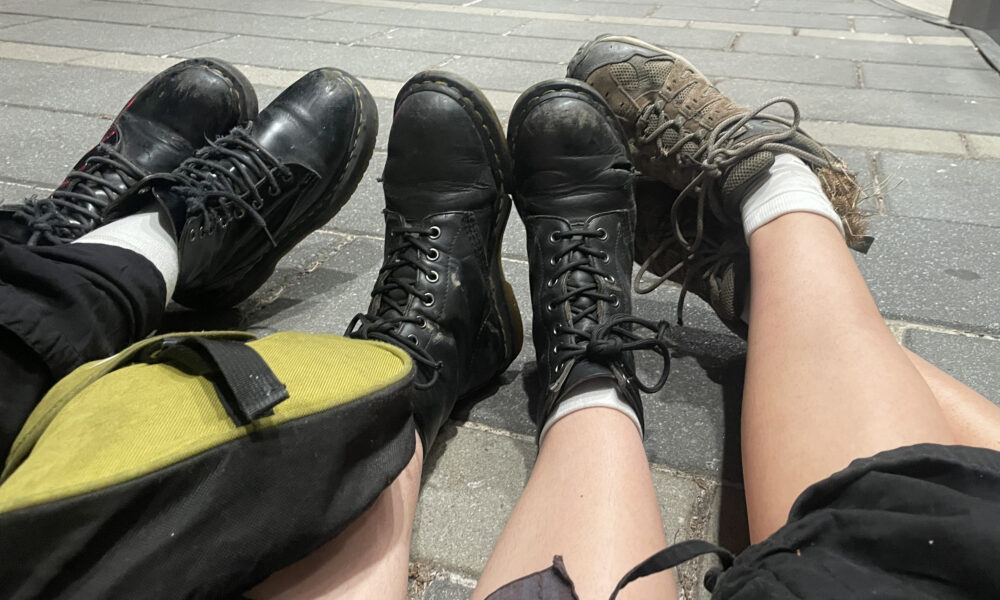
As I took my seat among a sea of Doc Martens and flamboyantly vintage clothing, I began to feel underdressed for this performance where everything from the audience to the antique couch was stylish, carefully chosen, and, above all, queer. 

Tuesday Night Café (TNC) Theatre’s contemporary, lesbian rendition of Oscar Wilde’s 1895 comedy The Importance of Being Earnest brought Wilde’s queer subtext into the spotlight. The colourful script centres on two upper-class dandies who both lead elaborate double-lives in order to split their time between the country and the city. The twist: Both leading male characters are delightfully recast as women for this production. Jack (Maite Kramarz, U3 Arts) resides at his country estate along with her ward, Cecily (Jaimie Coplan, U1 Arts), and uses the alter ego Earnest to sneak off to New York City and cover for her extravagant exploits. On the other hand, Algernon (Celeste Gunnell-Joyce, U1 Arts) relies on her imaginary long-suffering friend Bunbury, whose poor health always requires her to escape into the country. 

Kramarz, who plays Jack with a tireless sense of respectability and neuroticism, serves as the perfect foil to Gunnell-Joyce’s Algernon, who hits the flamboyant, Wildean gestures of a do-nothing dandy spot on. 

When, by chance, Algernon finds out about Jack’s double life, she realizes that they both engage in what she calls “Bunburying.” She’s determined to infiltrate Jack’s country estate, posing as Jack’s reckless sister Earnest. As both of their lies begin to unravel, their contradictory personalities shine with Wilde’s witty dialogue turning increasingly back-handed. 

Throughout the play, the actors handled Wilde’s circuitous language with ease, spitting pointed insults and not-so-subtle digs at society as though it was second nature. 

“I was surprised at myself—and I was talking to all my cast members about this—that we were able to remember everything we were supposed to say in all these weirdly twisty lines,” Kramarz said in an interview with The Tribune

As Jack and Algernon’s double lives crumble around them, Lady Bracknell (Megan Danbrook, MA ‘23) stole the show with her formidable portrayal of an overbearing aristocrat’s vain attempts to maintain an honourable, Victorian facade. The love interests—Gwendolyn (Ellie Mota, U1 Arts) for Jack and Cecily for Algernon—dazzled with their spot-on takedowns of upper-class feminine stereotypes. 

After immersing myself in two hours of Wilde’s biting satire—which holds up remarkably well today—I retired to TNC Theatre’s tiny, lime-green office to speak with director Carmen Mancuso (U3 Arts) about the inspiration behind the show. 

“When we were choosing a play, we were really looking to find something really iconic and really fun that we could stage in kind of a new way,” Mancuso explained. “One thing that I really loved about [TNC] is that their mandate—their idea—is always about taking [a] traditional part of the canon and flipping it around.”

The Importance of Being Earnest presented a perfect opportunity for this, with its gay subtext begging to burst out of the closet with a more explicitly queer staging. “When I was reading through it, I kept finding moments where it was like […] ‘Oh my God. They sound so gay. This sounds like lesbians I know,’” Mancuso noted. 

While Wilde, famously sentenced to hard labour and two years of jail for his homosexuality, had to keep his play anchored within Victorian heteronormativity, TNC Theatre took the opportunity to bring queerness to the forefront by recasting the play with primarily women leads. 

“Our dream for something like this is that it’s a way of celebrating what’s in the play,” Mancuso said. “Of bringing out that very obvious—if you can even call it—subtext, and really kind of celebrating that in the open as something that’s alive and there and living.”

Arts and Entertainment Editor Dana Prather is Executive Director of Tuesday Night Café Theatre and was not involved in the publication of this article.

Read the latest issue

Read the latest issue