

Latest News

Commentary, Opinion

Why regulating short-term rentals was a must for Montreal

Following a series of deadly fires in two short-term rental units in Old Montreal, city council passed a bylaw heavily restricting the short-term rental market, most principally limiting the timing and duration for which rental properties can be listed. Despite criticism from some homeowners and Quebec’s tourism department, these regulations are a necessary step in mitigating rent increases and addressing the housing crisis.

Montrealers are now able to rent out their primary residences only during the summer tourist season—for no more than 31 consecutive days—and require a permit to do so. Year-round Airbnb units are only allowed on certain streets. Quebec’s Tourism Department has expressed concern about potential cooling effects on tourism, while homeowners are worried about the loss of income generated by renting out their residences through platforms such as Airbnb. Despite these drawbacks, it is the government’s responsibility to prioritize its own citizens’ access to affordable housing.

Montreal, along with the rest of Canada, is experiencing a housing crisis, manifesting in an extreme surge in rent prices in the city. Between 2019 and the first quarter of 2025, average asking rent for two-bedroom apartments in the Montreal metropolitan area increased by 70.8 per cent, from $1,130 CAD to $1,930 CAD. For comparison, the metropolitan areas of Toronto and Vancouver saw average rent prices rise by 5.1 per cent and 27.3 per cent, respectively. 

Although housing in Montreal is generally cheaper overall than both aforementioned cities, the government’s decision to regulate short-term rentals is nonetheless necessary in its potential to slow down rent increases. Studies show that as Airbnb investors turn what was once long-term housing for a city’s residents into short-term rental properties, rents rise for the locals due to a decrease in supply. In New York City, for example, estimates indicate Airbnb may have increased average rents by $400 USD per year.

Even those who already have an apartment are not safe from evictions exacerbated by short-term rentals. In a phenomenon known as renoviction, landlords have begun evicting their tenants to make room for short-term rental properties. 

Students, who rely on affordable rentals during their studies, will particularly benefit from the implementation of a policy designed to address rent crises. As a city with over 180,000 university students, Montreal’s municipal government must do all it can to rein in this increase in rent prices; regulating platforms like Airbnb is a good starting point.

While a policy regulating Airbnb and other short-term rentals is not sufficient to fully fix Montreal’s high rent prices and housing crisis, it is a good first step to take. Limiting the ubiquity of short-term housing in Montreal will ease pressures on rent, while simultaneously preventing ‘ghost-town’ neighbourhoods and ensuring the safety of tourists.

Perhaps most importantly, these regulations will ensure both tourists’ and locals’ safety and prevent future tragedies similar to the two fires in Old Montreal. Both fires occurred in illegal Airbnbs, which were located in areas of the city where short-term rentals had been prohibited but unregulated. 

Before the implementation of the new law, owners would falsely claim properties as their primary residences to make renting them out easier. By January, over half of the short-term rental properties in Montreal did not comply with housing regulations. Since short-term rental platforms leave the detective work up to the cities they operate in, Montreal had trouble cracking down on rule-breaking properties. Now, in order to obtain the permit needed to rent part-time, owners must first prove that the property is their principal residence. Whether owners are renting their property outside of the allowed season, or renting without a permit, the new rules make it much easier to spot and stop illegal short-term rentals. 

As more and more housing units transform into profit-focused short-term rentals, communities and neighbourhoods suffer. The commodification of housing in Montreal has the potential to quickly turn charming, community-focused neighbourhoods into ghost towns full of empty Airbnb units in the off-season. You cannot have a neighbourhood if you do not have neighbours.  

McGill, News, SSMU

SSMU BoD discusses meeting rules, member eligibility, and building protocol

The Students’ Society of McGill University (SSMU) held its first Board of Directors (BoD) meeting of the academic year on Sept. 16. 

The meeting began with Deputy Speaker Yasmin Beeai adopting the meeting agenda with zero opposition. Susan Aloudat, SSMU Vice-President (VP) University Affairs, successfully moved to postpone Beeai’s approval of the minutes until the next scheduled BoD meeting, as the minutes were not posted early enough for the Directors to review them in advance. 

Next, SSMU President Dymetri Taylor announced that Director Dylan Seiler resigned from the BoD the week prior, without reason for his resignation. Taylor also reported that VP Internal Zeena Zahida resigned from her position on Sept. 12, and a subsequent discussion on hiring a replacement will occur during the SSMU Legislative Council (LC) meeting on Sept. 25. 

The BoD then moved to discuss three motions, brought forward by Taylor, for approval. 

The first was about the 2025-2026 standing rules for the BoD, which outline the Board’s meeting operations and regulations. After the motion received no questions or debate in response, Beeai put the motion to a vote, which was unanimously approved. 

Taylor next introduced a motion disallowing the LC’s motion to appoint Councillor Meghan Lai to the BoD. SSMU regulations require BoD members to have completed 18 months at the university before joining, disqualifying Lai, who has only completed a year at McGill. 

Aloudat spoke on Lai’s promise as a candidate. 

“Councillor Lai would have been a great Director on the Board,” Aloudat said. “She’s been super engaged so far on [the] Senate Caucus, and she has been really responsive and great over the summer. So, if any of you are in SSMU in the future and you see that name, Meghan Lai, definitely keep her around.”

The disallowance motion was then approved unanimously. 

The Board moved to the third motion to approve building protocols for the University Centre. Taylor explained that these protocols are meant to ensure that the building has “rules regarding its usage, access rights, operating conditions, […] space agreements, tenancy, renovations, et cetera.” This motion was, again, approved unanimously, with no questions or debate. 

The BoD spent the rest of the meeting in confidential session. 

A previous version of this article stated that Dylan Seiler resigned from the SSMU Vice-President Finance role the week of Sept. 8, 2025. In fact, Seiler was never the VP Finance of SSMU, and instead resigned from his position on the Board of Directors the week of Sept. 8. The Tribune regrets this error.

Arts & Entertainment, Made at McGill

Made at McGill: ‘Scrivener Creative Review’ revives its past

Scrivener Creative Review doesn’t save the good china for special occasions. Whilst sitting down over candlelit tea with Izzi Holmes, Jacob Sponga, and Isabella McBride, the respective Editors-in-Chief and Managing Editor of McGill’s oldest literary magazine, one thing was clear: This is a publication deeply invested in creating and maintaining a timeless aesthetic. 

The conversation began with a brief history of Scrivener.

Scrivener was founded in 1980 […] in the department of English. In our first few years, we published the likes of Leonard Cohen, Margaret Atwood, Louis Dudek, F.R. Scott, and P.K. Page. Scrivener seems to have continued pretty steadily throughout the 80s, 90s, and early 2000s, picking up such eminence as Anne Carson, Seamus Heaney, [and] Michael Ondaatje. It continued throughout the 2010s […] and then went dormant during the pandemic,” Sponga told The Tribune.

The current team relaunched its first issue last April and plans to release two new issues this year—one in the fall and one in the winter. They also seek to honour the magazine’s past, while looking towards the future, through its website. The Scrivener team digitally publishes key archival work, including an interview with Anne Carson from 1997 and four poems by Leonard Cohen from 1982. 

But their vision goes beyond nostalgia; they strive to build a community that connects readers and writers alike.

“We’re hoping to cultivate literary excellence, and perhaps even more than that, a sense of community both in Montreal and beyond,” Holmes said. 

Part of that vision is visual. Scrivener’s current design embraces a monochrome, minimalist, and intentional style that equally captures both its artistic value and literary merit. Sponga mentioned that the team is still experimenting with the design of the magazine, but it is clear that aesthetic cohesiveness remains key in their creative direction. 

But it is the team dynamic that best embodies the spirit of the magazine. With Scrivener’s storied history looming over the team, they delved into how it felt suited to take on this responsibility. In the spirit of true teamwork, each member answered for the other.

“Izzi, ever the industrious socialite, is a good fit for the magazine because she lends it a certain tempo,” said Sponga.

Homes in turn said, “I find Jacob’s care for language and aesthetics alike very impressive, and truly value his attentiveness to detail. Both make our magazine all the better.”

Holmes also singled out McBride, commenting on her work ethic.

 “I had Isabella in mind for Managing Editor because she puts the same amount of care into everything she does, whether that be sending emails, making schedules, or discussing the sentence structure of a short story.”

Scrivener’s expansive and diligent editorial board currently includes undergraduate students, graduate students, and PhD candidates across a number of disciplines at McGill. They collaborate over four sections: design, poetry, fiction, and nonfiction/interviews. 

A key moment for the team—and the culmination of their months of persistent work—was the launch party held on April 24, 2025, at Cardinal Tea Room.

Holmes said, “The launch was proof that what we were doing had worked and that we could reach an audience in real time. Everyone was excited about the contributors, with poems by Medrie Purdham and Derek Webster, as well as interviews with Montreal icons like Dimitri Roussopoulos and Gabrielle Drolet.” 

As someone who attended the launch, I completely understood Holmes; it was the perfect encapsulation of what it meant to be part of Montreal’s rich and dynamic literary community. The invited contributors, who had the chance to read their work aloud, were introduced by editors who had worked on the respective pieces, exemplifying the collaborative effort that went into publishing the magazine. Scrivener also invited other Montreal magazines—including Ahoy, Stimulant, and Soliloquies—to sell their own work. The launch truly showed Scrivener’s investment in art, literature, and most importantly, cultivating a sense of community with others who share these interests. 

Scrivener is accepting submissions for poetry, fiction, nonfiction, and art until October 6th. Copies of issue 46 are available at The Word Bookstore. For more, head to https://scrivenerreview.com.

Arts & Entertainment, Film and TV

‘Adolescence’ swept the Emmys and made history

The 77th annual Emmy Awards had its usual share of glamour and viral moments, from stunning red carpet looks to controversial money countdowns. But the most memorable of all were the eight Emmys awarded to the Netflix limited series, Adolescence.

Adolescence is a reflection on how life for today’s youth has changed since the  COVID-19 pandemic. Consisting of four episodes all taken in one shot, the show focuses on a 13-year-old boy named Jamie (Owen Cooper) who is arrested as a suspect for the murder of his classmate. The show dives into several topics, including increased knife violence in the U.K. and how misogynistic content impacts the behaviour of young boys on the internet. The show discusses Jamie’s beliefs about women, originating from this misogynistic Red Pill content

The use of consecutive one-shot episodes throughout the mini-series immerses the audience in this boy’s mindset. When Jamie’s underlying issues of self-loathing are revealed, he abruptly switches from acting scared to angry and manipulative. With the audience still unsure of Jamie’s innocence, Cooper is able to create sympathy for his character. Acting in a single take requires perfect memorization of lines without making mistakes for an entire hour, a testament to his strong acting skills. 

Cooper won an Emmy for Outstanding Supporting Actor in a Limited Series, making history as the youngest man to win at just 15 years old. Many TV series cast adult actors as teenagers, resulting in a lack of authentic teenage representation. Cooper’s performance as Jamie takes a realistic look at the mindsets of teenage boys with unlimited internet access. Many teens were left on their own during the pandemic, and online media usage dramatically increased. Because Owen Cooper was also a young boy during the pandemic, he can relate to this online childhood culture unlike an older actor. 

The series writer and co-editor Stephen Graham wanted to cast an unknown northern English boy to play Jamie, increasing the impact of Cooper’s win. Cooper said during his acceptance speech: “When I started these drama classes, I didn’t expect to be in the United States, never mind here.” Cooper’s win emphasizes that you do not need to be born with powerful connections or have film credits to your name to become successful in the acting world.

Graham won the categories of Best Lead Actor in a Limited Series, playing Jamie’s father, and Outstanding Limited Series with co-creator Jack Thorne. Actress Erin Doherty, who played Jamie’s psychologist Briony, won Best Supporting Actress in a Limited Series

In the series, Briony attempts to understand Jamie’s mindset, leading him to express a variety of emotions, ranging from arrogance to aggravation. The third episode depicts the last meeting between the accused and his psychologist, creating a sense of exigency in their conversation. The episode begins with her questioning Jamie, which soon turns into a conversation about the stabbing of his classmate Katie. Their final scene shows Briony breaking down into tears after Jamie reveals information about his consumption of disturbing online content. This final scene elicits an emotional response from the audience, grasping the impacts of the Red Pill content that many young boys consume.

The show generated popularity on its own; it became Netflix’s second most-watched English-language series ever. It has been shown across schools in the U.K. as a way to spark conversations with young people about harmful social media use. 

Stephen Graham told the Associated Press that he wanted to focus on the “relatively normal” life of people accused of crimes similar to Jamie’s. Graham said, “We’re all maybe accountable. School. Society. Parents. Community.” 

Hopefully, this recognition can provoke similar action among schools in other countries—especially in North America, where the Emmys are filmed and originate. With 7.4 million people viewing this ceremony, it may guide more people to educate themselves on the extremely relevant issues among youth today that are brought up in the show: Issues that can mean life or death.

Student Life

Blues on Blues’ policies 

After Open Air Pub’s two-week bender of socialization, drinks, barbecuing, and dancing, students are looking to continue the party. While 4à7, Bar Des Arts, and Gerts are all up and running with the same schedule and system as last year, Blues Pub decided to switch things up.

This year, non-Engineering students interested in attending Blues are required to either RSVP for a ticket on Thursday to enter the pub on Friday, or be the plus-one of an Engineering student. This new system, intended to control capacity and reduce security implementation, seems to be stirring up controversy among the McGill student body—some approving, some neutral, and many disappointed. 

Frequent Blues participants like Dena Mathilde, U3 Arts, voiced strong sentiments against the new policy in an interview with The Tribune

“I absolutely do not support this decision […] because no other faculty bar is discriminating actively against other faculties with some sort of ‘legislation.’ In what world are you only allowing 100 [non-Engineering students]? What happens if 50 people come and it’s just lame? What are you gonna do?”

Mathilde stressed that adding a cap to entrees may disrupt the overall “fun and liveliness” of the event. She further explained that Blues is fun and popular because it’s “more [of] a spontaneous thing” to attend, and not a long ordeal that one has to prepare for days in advance. 

Juliette Whitecross, U2 Science, similarly questioned such faculty division.

“None of the other student bars have done this, so I don’t understand why they are doing it to [Blues] specifically. I know a lot of the Science kids will be disappointed, since Science students don’t have a designated bar that they can fall back [on].”

On the opposite side of the spectrum, Engineering students yielded mixed opinions. 

Aidan McKibbon, U3 Civil Engineering, detailed his approval of the new system, adding more context as to why Blues implemented these new rules in the first place. 

“I generally support the new admission system. I have non-Engineering friends and they just come with me and my Engineering friends. I like the idea that it’ll be less busy and I also enjoy spending time with my Engineering community so [….] I think it will encourage me to go more and see my Engineering buddies.”

Other Engineering students feel differently. In an interview with The Tribune, Romain Le Galliard, U3 Civil Engineering, said, “I’m against the policy because I feel like it’s just more fun when all faculties can get into Blues without tickets. I know that some people had trouble getting tickets because they sold out immediately when they came out.”

Le Galliard’s point suggests that the large number of interdisciplinary demographic students attending is what adds to the charm of the Blues experience. Once this barrier is in place, this diversity disappears. 

Across Engineering, Science, and Arts, students have mixed critiques of this system, voicing both costs and benefits. Most who expressed disapproval of the RSVP system also mentioned how this will discourage them from future appearances at Blues.

Mathilde added, “I actually don’t think that I will ever remember to [RSVP], and if this [system] continues I think that we will see a lot of people not be able to get in or make it to Blues this semester, which sucks because it’s really fun.” 

Only time will reveal the outcome of the new admission policy: Whether it succeeds in its mission, affects future turnout, or pushes Blues to evolve further into an Engineer-centric event.

Cycling, Sports

UAE Team Emirates wins Grand Prix de Cycliste Montréal for second consecutive year

Both cycling fans and pro-Palestine demonstrators gathered in Montréal’s Mont-Royal Park and its surrounding area for the 14th annual Grands Prix Cycliste de Montréal (GPC de Montréal) on Sept. 14.

The GPC de Montréal is the only top-ranked professional cycling series hosted in North America, and is a Union Cycliste Internationale (UCI) registered road race. It consists of two events: a 216 km race in Quebec City and a 209.1 km race through Montreal. The Montreal course features 17 laps of steep, winding roads on Mont-Royal, with a total elevation of 4,573 m. This year, 207 riders competed, including nine Canadians—seven of them representing the Canadian National Team.

Teammates Brandon McNulty and Tadej Pogačar of UAE Team Emirates were the first to cross the finish line. The duo completed the race in five hours and 14 minutes. McNulty, an American racer, crossed ahead of the famed Slovenian cyclist, Pogačar, by a friendly few milliseconds. Pogačar, a two-time winner of the GPC de Montréal—in 2022 and 2024—also holds the 2025 Tour de France title, the 2024 UCI World Road Championship, and an arguable position as one of the greatest cyclists of all time. Pogačar’s performance on Sept. 14 shaved 14 minutes off his winning GPC de Montréal time last year, despite disruptions caused by a protest along the av. du Parc race section.

The top Canadian result came from Hugo Houle of Israel—Premier Tech (IPT), who finished 45th, 15 minutes and one second behind McNulty. IPT was at the center of the day’s demonstrations, where an estimated 200 protesters gathered along the race barriers on av. du Parc to call on the UCI to exclude IPT from competition in light of Israel’s continuous acts of genocide in Gaza. 

Israel—Premier Tech has close ties to Montréal. Sylvan Adams, who has since moved to Israel, is a Quebec-born billionaire with a strong affiliation with McGill University and co-ownership of the IPT team. Adams has heavily contributed to the development of IPT since its inception in 2014, and has long been the subject of criticism from pro-Palestinian groups, notably for his publicly made declaration as a “self-appointed ambassador to Israel.”

The IPT’s connection to the province also derives from its title partner and sponsor, Premier Tech, a Quebec-based agricultural technology company. Further, these ties echo a $29 million CAD donation made by Adams in 2022 to McGill University to establish the Sylvan Adams Sports Science Institute (SASSI). This funding established a partnership between McGill, Adams, and Tel Aviv University, drawing further concerns from pro-Palestinian campus advocates as they push the university to cut all financial ties to Israel

Supported by various pro-Palestine and Gaza-affiliated Montreal cycling clubs, such as Bikers for Palestine—who shared details about the protest through their social media accounts—the demonstration at the GPC de Montréal also garnered support from Montreal’s chapters of Students for Palestine’s Honour and Resistance (SPHR). 

The Montreal protest followed demonstrations at the Vuelta a España, a three-week UCI race across Spain, where a crowd of nearly 100,000 called for Israel to be barred from international sporting events. Following the disruptions, which cut the championship race short, Spanish Prime Minister Pedro Sánchez Pérez-Castejón publicly urged for Israel’s exclusion from global competitions. The team stripped its uniforms of any direct references to Israel in response to the protests at the Vuelta. They wore their adapted uniforms in Montreal on Sunday. 

Looking ahead, Montreal will host the UCI World Championship from Sept. 20-27, 2026. Last held in Montreal in 1974, the event is expected to be the largest sporting competition in the city since the 1976 Olympic Games, bringing together 1,000 elite cyclists from more than 75 countries

This year’s GPC de Montréal highlighted the city’s prominent role in international cycling in two important ways: Its world-class competition, and the political debates at play within the sport. As Montreal prepares to host the 2026 UCI World Championship, it faces the challenge of balancing athletic excellence with questions of accountability beyond the race course. 

McGill, Montreal, News

“Palestine on Campus” screening highlights security crackdown on Montreal student activists

On Sept. 16, The Rover—an independent, reader-funded news outlet in Montreal—hosted a screening and panel discussion to showcase their first-ever documentary, Palestine on Campus, at Collectif MTL’s St. Catherine location. The 30-minute film, created by The Rover’s managing editor Savannah Stewart and producer and videographer Justin Khan, follows the recent hostilities inflicted on pro-Palestine student activists by their own university administrations.

Through interviews with McGill and Concordia students—including former Vice-President External of the Students’ Society of McGill University Hugo-Victor Solomon, professors at McGill and Dawson College, and legal experts—Palestine on Campus portrays a recent security crackdown across Montreal higher education that targets pro-Palestine activists. 

The screening began with The Rover’s founder, Christopher Curtis, addressing the crowd of approximately 40 attendees about the importance of Palestine on Campus’s investigation.

“Almost all of the mainstream news stories about the Gaza encampment in Montreal perform mental gymnastics to avoid talking about the role that our institutions play in supporting genocide,” he said.

The documentary was followed by a panel, moderated by Stewart. One panelist, Gwendolyn Schulman, is a McGill alum who helped lead the successful anti-South African apartheid movement on campus in the 1980s and co-founded CKUT‘s long-running Amandla! program.

On the panel, Schulman noted the troubling differences between the anti-apartheid struggle and pro-Palestine activism for divestment from companies complicit in the genocide of Palestinians on McGill’s campus today.

“Even when we did our sit-ins and our demonstrations, […] the one thing McGill did not do ever was [call] the police, and it never used private security firms against us,” she stated. “In fact, it was the exact opposite. They were so concerned about their public image that they wouldn’t let the police anywhere close. [….] We were never criminalized for what we did. We were never threatened with being expelled.”

Joining Schulman on the panel was Rine Vieth, a sociolegal scholar who contextualized how the increasing risks university student and faculty activists for Palestine face are unfolding just as much in Canada as they are, very visibly, in the United States. They also discussed how McGill’s recent austerity measures have been accompanied by an incongruous increase in the amount of private security employed by McGill, reflecting the “neoliberalization of higher education.”

“McGill is ostensibly a public university,” Vieth stated. “These are our tax dollars being used to fund this.”

Vieth and Schulman spoke alongside Danna Ballantyne, the Concordia Student Union (CSU)’s External Affairs & Mobilization Coordinator. Ballantyne discussed the struggles the union has faced since Concordia launched an ongoing investigation into the CSU for allegedly violating administrative policies during a Special General Meeting in January 2025. During the meeting, approximately 94 per cent of attending undergraduates voted in favour of Boycott, Divestment, and Sanctions (BDS) protocols for Palestine. 

“There is absolutely nothing more dehumanizing than asking someone to talk bureaucracy while their friends and family are being murdered,” Ballantyne said. “The investigation is really not the main thing here. There’s a genocide happening. [….] Our friends are still dying at the end of the day. [….] You know, they call us a fringe minority, [but] most of us showed up to that meeting and [voted in favour of the BDS motion] when they said, ‘Do you want to divest?’”

Ballantyne concluded by describing how to address burnout as an activist, advising that “the more people in [one’s] entourage care, the less tired” they will feel continuing the fight for Palestine.

“If there’s one thing that all of us have, that everyone in Gaza needs right now, is connection,” she implored. “Please just make a friend from Gaza and talk to them. [….] Answer someone’s [Instagram] story […] and say, ‘We’re with you.’ [….] It makes every difference to them, and it’ll remind you what’s going on.”

Schulman also noted the importance of holding university communities accountable by preserving institutional memory.

“McGill celebrates itself for being the first Canadian university to divest. They never point out that they fought us tooth and nail and we won,” she proclaimed. “Eventually, [pro-Palestine activists] are going to win [the fight for divestment], […] and McGill is going to claim credit [again]. [….] We know what McGill was and what McGill has become, and what it needs to become down the road.”

Fact or Fiction, Science & Technology

Fact or fiction: Is your brain wired for a specific learning style?

You have likely encountered the idea that everyone learns best through a specific ‘learning style.’ Social media, classroom discussions, and even online quizzes often promote this claim, categorizing students as auditory, visual, writing and reading, or kinesesthetic learners. This conception sounds convincing, and after many years in the educational system, you may have identified a style for yourself.

However, according to neuroscience, the belief in fixed learning styles is a neuromyth—a misconception about the brain stemming from a misunderstanding of scientific facts that has been endorsed by the public and educators.

In an email to The Tribune, Armin Yazdani, academic associate with the Office of Science Education (OSE), and OSE’s resident neuroscientist, explained why this widely believed idea fails under scientific scrutiny.

“While we may have a preference for receiving information in one modality, we do not have good evidence that these preferences actually predict better learning. While brain cells in the eye may only respond to photons of light or brain cells in the ear may only respond to pressure waves, the brain as a system is multi-sensory,” Yazdani wrote. “Learning involves neuroplasticity or the creation of neural connections in various brain regions. Memory is distributed across brain regions that are highly interconnected in networks, and retrieving something requires the activation of these networks based on task demand, not [a] learner’s single sensory channel.”

Yazdani further dispelled this myth by pointing to a popular psychological experiment known as the Stroop effect.

“Imagine if I show you the word “RED” written in blue ink and ask you for the ink colour. To get to the correct answer, the brain recruits a wide range of neurons in the visual cortex, language areas, and attention networks.”

Learning works in a similar way: It involves the integration of information from distributed brain regions rather than dependence on a single sensory modality, despite the impression that only one sensory channel is at work.

Given that this theory is false, students may wonder how it still remains popular. Yazdani wrote that its appeal lies in its simplicity, making it easy for educators to disseminate.

“This myth is so pervasive because teachers propagate it mostly [….] It feels intuitive, which means teachers understand it and can explain it well to students. It’s also actionable, which means they can tailor their instruction to a student’s ‘learning style.’ Misinformation spreads faster and farther than facts, and we have been in a losing battle against this one.”

If learning styles aren’t the answer, what does neuroscience say improves learning, and how can students discover what works best for them? Yazdani highlighted three evidence-based strategies supported by cognitive neuroscience.

“It is context dependent, but we have evidence that dual coding may work better. This is where we use multiple complementary representations—visual and auditory—to create stronger memory traces.”

Yazdani also recommended spacing out study sessions to support memory consolidation.

 “If you are a student, I would highly recommend two other strategies. One is to space out your study sessions: Three one hour sessions are better than one three hour session. The second one is retrieval practice, where you actively recall information from memory—practice tests, flashcards.”

To help put these strategies into practice, the OSE offers a neuroscience-based program called SciLearn. Open to all undergraduates, participants explore research on the neuroscience of learning via workshops, lectures, and study sessions. SciLearn also focuses on debunking neuromyths, such as the theory of specific preferential learning styles.

“We have evidence that participating in even a short SciLearn guest lecture is beneficial. We start with unlearning by dispelling common myths and misconceptions. We then discuss evidence based study strategies based on neuroscience and our own research, which many students adopt. We know that SciLearners may also shift their mindset and better plan, assess, and monitor their learning,” Yazdani wrote.

Therefore, fact or fiction: Is your brain wired for a specific learning style? Neuroscience says no. Learning isn’t a fixed trait, but rather a skill.

Science & Technology, STEM EVENTS

Lava planets: Where oceans of magma rage and wind breaks the speed of sound

One side of these planets sits at temperatures hot enough not only to melt, but to vaporize their solid rocky surface, creating oceans of molten lava and an atmosphere of vaporized rock. On the other side, the cold is unrelenting—temperatures reach well below -200 degrees Celsius, allowing its surface to remain solid. These extremes are among some of the strange features of lava planets

On Sept. 19, at the third Physics Society Colloquium of the 2025-2026 academic year, Nicolas B. Cowan, associate professor of Physics and Earth & Planetary Sciences at McGill, gave a lecture on the physics of lava planets. Lava planets are a kind of exoplanet—a planet outside of our solar system—that have permanent oceans of liquid hot magma raging at the surface. Cowan began by describing just how hot lava planets get—somewhere around 2,700 degrees Celsius, or 3,000 degrees kelvin.

“To put that in perspective, 3,000 kelvin is actually the median surface temperature of stars in the galaxy,” Cowan said. “That’s like your run-of-the-mill average star, [which] is a mid-M dwarf star, and it’s got a surface temperature of 3,000 kelvin, so the surface of this planet is actually that temperature. It’s pretty hot.”

As with any planet orbiting a star, lava planets have day and night sides, with the former directly facing the star and the latter facing the cold, dark void of space. They orbit so closely to their star that they can complete a whole revolution in a mere few hours—something which Earth takes 365 days to achieve. 

Similarly to our moon, lava planets are tidally locked, meaning the same side is always facing its star: It is on this day side where magma oceans rage. 

Cowan noted that magma oceans have been a topic of discussion long before they were discovered on existing planets.

“Magma oceans are not some [newly] made up thing. People talked about magma oceans before lava planets, and that’s because we think that all rocky worlds, including the Earth, the moon, Mercury, whatever, all the planets start off molten.”

Rocky planets go through a period of being molten as a result of the energy dissipated when they first form. As layers of space dust and particulate matter come together, the pressure increases, thus increasing temperature and creating a molten state. The difference between planets like Earth and planets like K2-141B—a known lava planet—is that the latter’s molten lava ocean is a permanent fixture. On planets like Earth, the lava ocean eventually solidifies.

Cowan then went on to describe the atmosphere of lava planets. In every atmosphere—whether it surrounds Earth or K2-141B—winds are caused by air moving from areas of high to low pressure. Temperature and pressure are directly proportional; thus, the stark temperature difference between the day and night sides of lava planets results in abnormally fast winds emerging from the day side, in some cases travelling 1.75 kilometres per second—or five times the speed of sound. 

Coming down from the atmosphere, Cowan then discussed lava planets’ interior. Rock—which makes up a lava planet’s outer layer—is composed of a variety of chemical substances, the most abundant of which is silicon dioxide. Because of its complex chemical make-up, the rocky surface does not melt and solidify uniformly. The section between the approximately 100-kilometre-deep magma ocean and the planet’s solid iron core is in a state scientifically known as ‘mush’—a mixture of solid and liquid phases. 

Cowan concluded his lecture by explaining why lava planets end up orbiting so closely to their star. These planets could not have formed in such intense heat, as the temperatures in these close orbits would have vaporized any rocky material, thereby preventing it from solidifying and forming a planet. Cowan instead proposed that lava planets obtained their orbit by way of high eccentricity migration—a process by which a space body’s orbit shrinks and circularizes because of the effects of a nearby space body. In other words, these planets likely formed farther away and moved inward over time. 

Ultimately, the study of lava planets improves our understanding of the universe and the processes of planet formation and development, both within and beyond our solar system.

Arts & Entertainment, Film and TV

‘The Missing Image Is: Gaza’ counter-screening calls attention to absence

“To omit Palestine is a political act.” 

These words, drawn from a public statement by Montreal-based film collective Regards Palestiniens, call out the 2025 edition of the Biennale d’art contemporain, In Praise of the Missing Image. On its website, the Biennale boasts that its diverse programming, which seeks to “amplify emancipatory voices” and invite reflection on “gaps in individual and collective memory,” features works by Canadian and international artists from a vast array of countries, provinces, and communities. Yet in both the programming and the curatorial statement, Palestine is distinctly absent. 

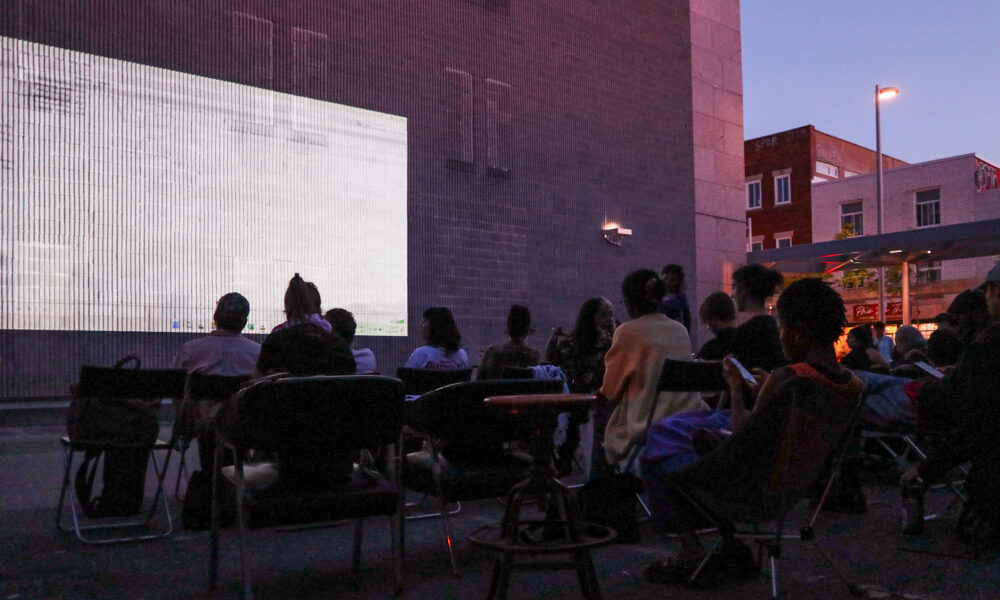
This flagrant exclusion is what inspired the Regards Palestiniens’ counter-screening, The Missing Image Is: Gaza. On the crisp evening of Tuesday, Sept. 16, over 100 people gathered with camping chairs, blankets, and keffiyehs in the parking lot across from articule Gallery. The 65-minute program “seeks to restore meaning” to the Biennale’s title, originally drawn from Rithy Panh’s film The Missing Picture about the Cambodian genocide and Khmer Rouge regime

The first screening and the most recent of the four films, Firas Shehadeh’s Final Hour Log – Handala, firmly asserts the theme’s pertinence. Using mostly livestream footage, Shehadeh reconstructs the final hour of the Freedom Flotilla Coalition’s civilian vessel Handala before it was seized by the Israeli Navy on July 26, 2025. A rapid escalation follows as, within minutes, the team scrambles to hide their memory cards and raise their hands in a display of peace. Nonetheless, Israeli naval officers storm the vessel, and one turns off the CCTV camera that was livestreaming. The film understands the power of images—the importance of “preserving what was meant to be erased,” as the website states. 

Footage in the other three films spans seven decades, weaving together a spectrum of time and experience in Palestine. The steady current through all of them, though, is the dualism of Palestinian life. Sweet scenes of children and family are cast against a plea for help recorded after the Shuja’iyah massacre in Hadeel Assali’s Shuja’iyah: Land of the Brave. Sunny shores of Gaza peppered with flowers contrast a thoughtful reflection on the role of televised media in Oraib Toukan’s Offing. The personal and the political become inextricable as a frantic mother mourns her home destroyed by bombing in Mustafa Abu Ali’s Scenes of the Occupation from Gaza

The Regards Palestiniens counter-screening thus begs the question: Are images of Gaza actually missing, or just ignored? While social media platforms like Instagram and Facebook continue to systematically censor Palestinian content, since Oct. 7, some Palestinian creators have broken through the algorithm, documenting their stories and struggles on their own terms. The fact that images and stories from Palestine now permeate far beyond social media is a testament to the unwavering determination of these journalists, whose voices have successfully drawn Palestine into the international limelight. The same day as the Regards Palestiniens screening, a UN Commission found that Israel is committing genocide in the Gaza Strip. 

In the social media age, it’s less likely that images of suffering are totally missing and more often that they are short-lived or turned into spectacle in the popular consciousness and ignored by actors capable of enacting real change.

The Missing Image Is: Gaza is acutely and solemnly aware of this because it is precisely what makes the Biennale’s exclusion of Palestine really bite. “This exclusion is not accidental but the result of deliberate curatorial silence,” insists the Regards Palestinians team in their statement. Art has the potential to reach broad audiences and the power to introduce and elevate new perspectives. When exhibitions adopt radical aesthetics, they must earnestly believe in and bravely commit to them.

Read the latest issue

Read the latest issue