Latest News

Arts & Entertainment, Film and TV

Fictionalized adaptations of real-life serial killers should not exist

As announced earlier this month, Netflix has extended its new Monster anthology series past its first installment, The Jeffrey Dahmer Story, which was released on Sept. 21. With at least two more projects in the works, the creators hope to follow the stories of “other monstrous figures who have impacted society. 

The Jeffrey Dahmer Story, coming from the minds of Ryan Murphy and Ian Brennan, has emerged as one of Netflix’s most commercially successful TV shows. Within 28 days of its release, it became the streaming platform’s second-most-watched English-language series of all time. The fictional re-enactment explores the psyche of American serial killer Jeffrey Dahmer (Evan Peters), who committed numerous horrific murders between 1978 and 1991—all of the victims were men and adolescent boys, most of whom were people of colour. 

Despite its high viewership, its release was riddled with controversy. From initially being categorized under the LGBTQ+ tag on Netflix to more general criticism regarding the show’s quality, the show has been under continuous scrutiny. Yet, perhaps the largest cloud hanging above its conception is the outrage expressed by the families of Dahmer’s victims.  

Rita Isabell, sister of victim Errol Lindsey, wrote a personal essay for Insider to express her anger regarding her portrayal in one of its episodes despite the show’s producers never having contacted her. She describes the experience of watching the events of her life occur on TV, writing that “it felt like reliving it all over again.” She goes on to denounce the lack of compensation provided to the victims’ families, stating that “it’s sad they’re making money off of this tragedy. That’s just greed.” In the adaptation of this history, Netflix asserts its ownership of the victims’ experiences. 

Two more seasons, with two more serial killers, will bring about two more groups of people directly impacted by real-life events and potentially retraumatized by a television portrayal. Whether Netflix plans to ask permission or provide compensation is still unclear. But even if they do, the re-creation of serial killers to be consumed as entertainment presents a multitude of ethical concerns. 

Following the release of Monster, there was an increased romanticization on social media of Dahmer himself, as viewers sympathized with Peters’ troubled character and conflated Murphy’s creative interpretation with reality. Not only that, but the trend of dressing up as Jeffrey Dahmer for Halloween circulated online. Costumes relating to him were eventually banned from various sites, such as eBay, due to subsequent backlash. Several Milwaukee bars, where Dahmer met many of his victims, announced that they would deny entrance to those dressing up as him on Halloween night. 

The danger of portraying serial killers on-screen is the inability to resist the inherent creative urge to immerse the viewers into their minds. It will inspire the viewers to create motive, to charitably explain their actions, and ultimately glorify their image. The moment they are presented under the guise of fiction, and especially when played by familiar, attractive actors, they enter the realm of pop culture—a space that, in most instances, cannot take itself seriously and cannot escape a profit-oriented mindset. Even calling it a Story reduces its materiality—it’s a story that is not to be told by just anyone. While there may be many factors contributing to the commercial success of such adaptations, one cannot argue against the morbid fascination viewers may have with such dark stories—a fascination Netflix is well aware of and seems intent on exploiting.

As the next two seasons’ production of Netflix’s Monster anthology series begins, viewers should keep in mind what is at stake: Those who are not compensated, those who are retraumatized, and those who are glorified.

Behind the Bench, Sports

Off the diving board and into the world

My first-ever diving lesson ended with a 20-minute cry on the three-metre springboard and then a tearful drive home where I begged my dad not to make me go back. 

I have three main defences of myself here: I was eight years old, terrified of heights, and there against my will. My older sister wanted to try diving and my dad is a strict believer in “if one of you goes, both of you go,” so that’s how I ended up sobbing in the London, Ontario aquatic centre on a fateful Wednesday night in September. Whether he had my embarrassingly intense fear of being above the fifth floor of a building in mind when he signed us up, I’ll probably never know. What I do know is that in the years that followed, I easily spent hours crying on pool decks. While that might not sound like a positive experience, diving equipped me with a confidence and trust in myself that I carry with me to this day. 

The unique thing about diving is that the longer you’re involved in the sport, the scarier it tends to get.  You are the only person affecting your performance and you pay for every mistake physically. Didn’t lock your elbows on the way in off of 10-metre? I hope your shoulder is still in its socket. Did you lean forward for your knees instead of bringing them to your chest in a reverse 1½? Be sure to ice those welts, but not now because you have to try again so you don’t develop a lifelong fear of this dive. Every painful mistake unlocks a new fear, one that is based on something you know can happen, that has happened. 

At age nine, I watched an older diver get hurt doing a simple inward dive—one of the four foundational dives. The image of this girl smacking the water created a mental block in me that lasted years, and I found myself unable to learn this dive. In diving competitions, at least in my time, to move up from the very first competition level, you needed to perform a minimum of one variation of each of the four foundational dives. This meant that no matter how much I progressed in my front, back, and reverse dives, not having an inward dive meant I could never advance competition-wise. This also meant that I spent hours at practice, standing on the end of the board, willing myself to just jump. The mental battle of standing in one spot, with coaches and teammates cheering you on, but just being unable to convince yourself to go is gruelling. The only thing worse than standing there is having to climb off the board because everyone has given up for the night. 

After one of these particularly frustrating practices, I got into my dad’s car, slammed the door, and announced I was quitting forever. I didn’t know how to deal with the fact that I was standing in my own way, that the block was completely mental. I was steadfast in my decision until my dad pulled away from hugging me and softly said, “I didn’t know you were a quitter.”

While I wish I could write that I went into the next practice and threw the dive, it’s just not true. But I also didn’t quit. I kept going to practice and I kept standing on that board and one day, I had two realizations that propelled me forward through the entirety of my diving career. First, either I do it and it works or I get hurt so badly that I never have to do it again. Secondly, and most importantly, all I needed was one split second of complete, unabashed, almost delusional faith in myself even if it went against all my instincts. So I did, and god, did it feel good. 

I haven’t dove in years. It’s hard when such a huge part of your life becomes reduced to a hobby you had before university. But I know that that part of my life is not constrained to a pool deck. I feel it. When I get really anxious or second-guess myself, whenever I stand in my own way, I’m back on the end of that diving board, I close my eyes, I internalize that delusional self-trust, and I jump. 

Basketball, Sports

McGill basketball hosts double-header home opener

On Nov. 17, the McGill men’s and women’s basketball teams returned to the court for their home opening games against the Université du Québec à Montréal (UQÀM).

Martlets vs UQAM 

55-48 (L)

The Martlets (0–4) opened up the evening’s play against the Citadins (3–0) facing some tough defence from UQÀM’s high-powered frontcourt. Despite eight points from third-year guard Emma-Jane Scotten to bolster McGill’s scoring, UQÀM took the first quarter, outscoring the Martlets 17-10.

The second quarter was a different story, as the Martlets buckled down and played hard-nosed defence to bring themselves back into the game. Scotten took over ball-handling duties as the Martlets drove into the key, drawing fouls and nabbing defensive rebounds to dictate the pace of play. Second-year forward Charlotte Guerin snagged many of her game-leading 14 rebounds in McGill’s comeback effort. The half ended 25-21 with McGill in the lead.

The third opened with both teams playing to their respective strengths, vying for the game’s momentum. McGill committed to perimeter play while UQÀM stuck to its strong frontcourt, whose efforts were met by Guerin and fourth-year centre Amélie Rochon

In a post-game interview with The McGill Tribune, Rochon stressed that the Martlets’ comeback relied on slowing down the Citadin bigs.

“Getting control of the rebounds, especially on the defensive end, to stop them from getting second chances […] really helped us keep our momentum,” Rochon said.

The Martlets’ strong third quarter pressured UQÀM to change its tactics to start the fourth, implementing a full-court press to force McGill’s ball handlers into making mistakes. UQÀM’s defence created several turnovers, highlighting the Martlets’ lack of a floor general and allowing the Citadins to grab a clutch lead. Despite back-to-back threes from guards Jessica Salanon and Daniella Mbengo, the Citadins’ defence overpowered the Martlets and UQÀM took the game 55-48.

Scotten, who played a team-high 38 out of 40 minutes, expressed her concern about the team’s ball-handling vulnerabilities. 

“We have been struggling with our turnovers this season, so we definitely need to work on taking care of the ball […] not rushing it,” Scotten told the Tribune. “That’s where we started to drop in the fourth quarter.”

Redbirds vs UQÀM 

87-76 (L)

The defending RSEQ champion Redbirds (0–4) took on the Citadins (1–2) in a game that echoed that of the Martlets in intensity and excitement. McGill came out the gate strong with steadfast defence and a solid presence on the boards from third-year centre Haris Elezovic. Despite the promising start, efficient shooting and fouls drawn by UQÀM gave the Citadins a 17-13 lead to close the first quarter.

The second quarter, however, marked a crushing point differential as the Citadins outscored the Redbirds 29-14 over 10 minutes. Due to UQÀM’s high-flying pace, electric shooting splits, and turnover generations, they took the half 46-27.

In a post-game chat with the Tribune, sixth-year guard Sam Jenkins spoke to the Redbirds’ lack of scoring opportunities. 

 “The second quarter was tough because we had a string of really bad mistakes […] that led to points in transition, and we couldn’t stop the bleeding there, but that changed in the third.”

The third marked a positive change for McGill as Elezovic, Jenkins, and fourth-year wing Zachary Lavoie-Toure worked hard to bring the Redbirds back into the game. Despite a highlight reel of plays from UQÀM, McGill buckled down with defensively oriented play to steal the quarter away and bring the game within reach—64-54 with UQÀM still in the lead.

The fourth was defined by a similar mentality from the Redbirds as they worked to bring it back within four, punctuated by a hyped-up three from first-year guard Samuel Chaput. Despite McGill’s remarkable efforts, UQÀM doubled down, winning the game 87-76.

Jenkins, who scored a game-high 24 points, knows his team has more in the tank. 

 “We haven’t played a full 40 minutes yet—we haven’t played hard the entire way through,” Jenkins told the Tribune. “We’ve shown we can really play that way, we just have to do it the full game.”

Both the Martlets and Redbirds hope to bounce back on Nov. 26 against Laval (1–2) in another double-header at home.

News, PGSS

PGSS Fall General Meeting discusses expansion of gender-affirming care

Content warning: Mention of sexual violence

On Nov. 16, the Post-Graduate Student Society (PGSS) held its Fall General Meeting to update members on the upcoming winter referendum, the 2023 executive election, and to discuss current PGSS initiatives. The meeting, however, did not meet its quorum requirement of one per cent of the total graduate membership. The motions presented could therefore not be passed and will instead reappear in the form of referendum questions in March 2023. 

Studentcare, which provides opt-outable healthcare coverage to PGSS members, is extending its legal protection program to include consultation and representation for survivors of sexual violence. The goal of the initiative is to expand sexual violence care. The PGSS speaker broached the topic of how to ensure that the care provided would be comprehensive and inclusive to all graduate students.

Vegas Hodgins, a second-year PhD candidate in the Department of Psychology, would like to see Studentcare make sexual violence care accessible to all students, regardless of gender.

“I think that something that will be really important to engage with the Studentcare people [about] is [if] the […] legal representatives they would be referring people to are ready to engage with victims of sexual violence who aren’t cisgender women,” Hodgins said. “When it comes to treating the needs of transgender or even male victims of rape, there isn’t that degree of understanding and it can be retraumatizing to engage with people who are just not understanding you in that way.”

The meeting also addressed a new PGSS initiative to increase access to gender-affirming care, which would help cover the costs of materials, medications, and gender-affirming surgeries for transgender graduate students. Rine Vieth, a PhD candidate in anthropology, suggested that the extra costs incurred that are indirectly tied to health care services should also be covered by the fund. Vieth cited a personal experience in which McGill Human Resources failed to respond to their requests to correspond with the Department of Anthropology, forcing Vieth to teach in person shortly after a mastectomy.

“I would also encourage that fund to go towards not just materials or medication, but things like the fact that people might not be able to work, and working with McGill to figure out ways to secure accommodations,” Vieth said. “I was forced to work [two and a half] weeks after my top surgery because McGill HR told me that I wasn’t eligible to take time off and that if I wasn’t able to do my job immediately after that, I would lose it.”

Many attendees also agreed that other gender-affirming costs, such as facial hair removal, or changing names and gender markers on legal documents, should be covered by the fund. PGSS Member Services Officer Naga Thovinakere assured attendees that these concerns would all be taken into consideration.

“It’s still in preliminary stages and the hope is that we reach out and ask for feedback at every step of the way,” Thovinakere said. “That way, we are setting this up in the most efficient way possible, as well as serving the needs of the people that need it the most.”

Other topics of discussion included health care accessibility issues, the PGSS social media and website presence, and the need to fill available committee positions for graduate students.

Moment of the Meeting:

Prior to the General Meeting, the PGSS Council held a meeting of its own. While the general meeting was supposed to begin at 7:15 p.m, extended voting and discussion within the Council forced it to begin at 8:06 p.m.

Soundbite:

“We really need people to serve on committees [….] They sound small, they sound unglamorous, they are certainly not as sexy as writing ‘Senate’ on your CV, but [they are] actually where important decisions that do directly impact people’s day-to-day lives as students happen.”

—PGSS Secretary General Kristi Kouchakji 

McGill, News

McGill Senate wrangles over ‘academic excellence’, New Vic, and donations

The McGill Senate convened in room 232 of the Leacock Building for the third meeting of the academic year on Nov. 16. Senators delved into reports from the Senate Nominating Committee and Academic Policy Committee, and participated in an open discussion on the university’s evaluation of “academic excellence” among professors. After several Senate committees presented their annual reports, conversation turned to recent donations and McGill’s New Vic Project.

Christopher Manfredi, Interim Principal and Vice-Chancellor, opened the meeting by addressing the recent provincial elections and expressed his wishes for better engagement with the re-elected government. Discussion then broke into tables of senators, who were asked to ponder how the university community conceptualizes “academic excellence for academic staff.” 

Senator Patrick Hansen, an associate professor at the Schulich School of Music, pointed out that measures of “excellence” will be evaluated uniquely in every discipline. Terri Givens, professor of political science and the Provost’s Academic Lead and Advisor on McGill’s Action Plan to Address Anti-Black Racism, elaborated on how traditional measures of “excellence” can work against those in marginalized fields.

“I’ve experienced this personally, when you are working in areas that are considered, you know, on the sidelines of a discipline, it’s often difficult to publish in the top journals,” Givens said. “We have to be very careful about […] how we assess these things like h-scores, [which] don’t necessarily apply. Somebody can be seen as a really top scholar in a field that just doesn’t get a lot of the same traction as other fields.”

Senator Sam Baron, a student representative for the Faculty of Arts, pointed out the importance of centring the student experience by hiring good lecturers, not just good researchers.

“The professors who are going to be here permanently in such a capacity should, of course, be the best of the best at passing their knowledge on to the next generation of students who are coming into the field,” Baron said.

In response, Manfredi admitted that McGill has not yet found the perfect mechanism for evaluating both the research achievements and the teaching prowess of teaching staff. 

The Senate then moved to the Annual Report on University Advancement, which outlined the donations made to McGill during the 2022 fiscal year, over which a total of $241.8 million was raised in gifts and pledges.

“Donors have helped us build the number one student aid program in Canada, allowing us to welcome the second largest proportion of students from lower socio-economic backgrounds in the province of Quebec,” said Vice-Principal (University Advancement) Mark Weinstein. “We also launched, during the pandemic, the student emergency fund, and in the past year we received over $130,000 in gifts from over 1,000 donors for this important cause.” 

David Vaillancourt, a senator representing undergraduates from the Faculty of Engineering, questioned how the university will fundraise for the New Vic Project in the wake of McGill’s recent loss to the Kanien’kehá:ka Kahnistensera in the Superior Court of Quebec.

“It’s obvious to me that fundraising is completely inherent to the university’s continued existence and excellence,” Vaillancourt stated. “But I would caution, specifically with the fundraising of the New Vic, to really read the room and fundraise in ways that are socially appropriate given the situation.”

Moment of the meeting: 

When presenting the Annual Report on the Investigation of Research Misconduct, Dr. Christina Wolfson mentioned a general rise in cases flagged for investigation, with funding now being spared for a Research Integrity Officer. Wolfson described an “increase in the number of anonymous allegations from colleagues,” which was met with nervous laughter amongst many in the Senate.

Soundbite: 

“I would really like to thank the disciplinary officers for their service, this is not a fun job to do.” — Dean of Students and professor Robin Beech, upon presenting his first in-person Annual Report on the Code of Student Conduct

McGill, News, SSMU

Students vote to continue financing Daily Publications Society and the Sustainability Projects Fund

The Students’ Society of McGill University (SSMU) held its Fall 2022 Referendum from Nov. 14 to Nov. 18. The two questions on the online ballot were whether McGill’s undergraduate student body was still in favour of funding the Daily Publications Society (DPS) and the Sustainability Projects Fund (SPF). Both motions passed, safeguarding the DPS and SPF’s current operations until the next referendum in five years. 

The DPS is responsible for the publication of the independent student newspapers The McGill Daily and Le Délit, the latter being the only francophone paper on campus. The DPS is entirely funded by student fees, and its existence is dictated by a Memorandum of Agreement (MoA) with McGill. In order to renew its MoA with the DPS, which expires in 2023, the administration requires that a referendum be conducted to prove continued financial support from students.

The SPF, created in 2010, is used to fund sustainability-related projects at the university. It is jointly subsidized by McGill and students, with the school matching what students pay. The SPF student fee is outlined in the MoA between SSMU and the administration.

Noème Fages is the chief elections officer of Elections SSMU, the organization that runs the Society’s referenda. In a statement to The McGill Tribune, Fages described the newly tweaked schedule that was implemented this past election, which was intended to increase discussion and, ultimately, voter turnout among students.

“For this Fall Referendum, we chose to have overlapping campaign and polling periods to maximize student engagement with the referendum and make sure all students know about the referendum and its implications,” Fages wrote.

Last week, 22.6 per cent of eligible voters cast their ballots—the highest turnout achieved in a fall referendum since 2018, which had seven questions compared to this most recent election’s two.

Still, only about 5,000 students out of 23,542 eligible voters cast their ballots. Elliott Kalt, U1 Science, told the Tribune why he ended up not voting.

“I think most students tend to ignore SSMU emails because they send so many of them,” Kalt said. “I really believe that the newspaper[s] should be funded, however I understand that a lot of students might not have the financial ability to [continue paying the DPS fee], so it’s a very hard topic to vote on.”

On the ballot this fall was SPF’s mandatory fee of $0.55 per academic credit, up to 15 credits, which subsidizes the program. The Fund’s Governance Council (GC) distributes its million-dollar annual budget to students, faculty, and staff whose sustainability projects are approved. Shona Watt, a sustainability manager at the McGill Office of Sustainability (MOOS), was excited to see continued support for the SPF from students. 

“[The Fund] is a resource for all McGill community members to launch or grow a sustainability initiative on campus [and] spark positive change in their own learning and work environment,” Watt said. “We are thrilled by the level of enthusiasm reflected in the results of the SSMU referendum.”

Ryan Stainsby, U0 Arts, ultimately voted “Yes” on financing the SPF for the remainder of his time at McGill.

“[The SPF] funds projects that work on making our campus more sustainable, more environmentally friendly [….] I think that’s really phenomenal,” Stainsby said. “I still understand if someone voted no for monetary reasons [….] Every dollar counts, you know.” 

Voters also decided to uphold the DPS’s $6, non-opt-outable fee, which has been charged to all undergraduates once per term since 2010 and is responsible for their nearly $300,000 budget.
Throughout the campaign and polling periods, both DPS papers stressed the importance of their continued existence, releasing editorials chronicling the publications’ work, tabling around campus, and posting testimonials from alumni on social media to encourage students to vote. The editorial boards of both publications thanked students for their support over Instagram after the referendum results were published.

Laughing Matters, Opinion

Why McGill needs a uniform

There goes one. Oh, and another—and another. Sorry, don’t mind me, I’m just sitting on the benches outside McLennan counting the number of McGill students dressed like extroverted, self-obsessed melons. 

Have you noticed McGill students have this rather psychotic fixation on dressing uniquely? Well, of course you have. The pathway through Redpath is practically a catwalk for Eva B hippie zombies to flaunt their new ‘unique’ look. 

In our fight to stay original, we’re quickly led into the realm of the ridiculous. Wacky adornments, with little actual value, become the new norm. And each week there’s a new one: Oversized jackets? Because who needs clothes that actually fit? Silly hats with fur on the outside? Because the warmth of fur on the inside is so cliche. Woolly leg warmers? These are basically woolly sweaters for your calves. And before you butt in—no, this phase will age like milk. 

Without question, though, the worst I’ve heard was recently in Redpath Café: “T-shirts are the new dresses.” Yep, that will do me. Pour me a drink and bash me over the head with the bottle. 

First off: No, they’re not. Because if they were, they’d be, well, they’d just be dresses, wouldn’t they? And second: If t-shirts are dresses today, what’s next? Skirts as t-shirts tomorrow? Socks as earmuffs the week after? Enough. E-fucking-nuf. This obsession with dressing uniquely has all gone a bit HBO. We need to pack it in. We need a uniform.

What we choose to wear is not just a reflection of who we are, but who we think we are. So, judging by our outfits, we think we’re fucking idiots.

Look, I sympathize with you. I do. The only thing more frustrating than trying to dress uniquely and looking like a total twit is purposefully dressing like one, and then arriving on campus only to find someone else dressed in the exact same twitty outfit. And I admit, I have my moments of inspiration, too. Some days I might even dress like I’m actually happy. But it’s so much effort. 

A school uniform solves these problems. No longer will we have to spend hours in the morning deciding which hat goes with our coat. We won’t have to worry about our parents raising an eyebrow at our latest ‘phase.’ It will make McGill students even more visible to the local community, so our good deeds don’t go unrecognized—if there are any, of course.

School uniforms will let us focus on the more important issues. Instead of showing our uniqueness through accessories, we can show it by distinguishing ourselves through standardized exams. We will also have more time to raise the issues that matter outside of the classroom. God forbid, we could start voicing our opinions and participating in student and local elections! 

It isn’t just about what a school uniform does directly, but also what it represents. Was it not the great Gandhi who said, “College kids in Canada really ought to have a uniform. They’re 7,500 miles away, and they’re still pissing me off!” 

By enforcing conformity, we can take our distracting narcissistic traits out of the equation, at least for now. At least until we stop thinking our calves need sweaters. 

FAQ

Why do you personally want a uniform?

I’m offended by vibrant colors. 

“But my own clothes are more comfortable!!?” 

Do you think Margaret Thatcher wore sweatpants? 

What’s in it for McGill?

A profitable uniform shop. The profits can be reinvested into our community, like buying all the Deans a Porsche so they can get to school faster. 

What would be the new uniform? 

I’m open to all ideas. Maybe something grey. Pitch your ideas!

How much would this new uniform cost?

If you shit money, you should be fine.

Research Briefs, Science & Technology

Introducing neuromaps, a Python toolbox for neuroscience research

A team of McGill researchers published a paper in Nature Methods showcasing neuromaps, an open-source Python toolbox that allows neuroscientists to analyze brain imaging data using a consistent set of tools and compare it with a curated brain-map database. PhD candidate Justine Hansen, one of the paper’s first authors, spoke with the The McGill Tribune about how neuromaps works and what she hopes it will accomplish. 

Neuromaps gives researchers a set of software tools to transform data from one format to another without having to perform the calculations themselves. At the same time, it pulls together a database of about 40 standard brain maps that researchers can compare their data to, and a set of “spatial nulls,” which are tests for statistical significance in the data. Combined, these features make the process of analyzing, comparing, and drawing conclusions from data more streamlined and reliable.

At its core, neuromaps aims to simplify brain imaging data, as the data is incredibly complex with lots of different variables. To make matters worse, each brain-scanning machine produces data stored in a different way or using different coordinate systems. This leaves researchers with the task of data transformations across systems, which is both time-consuming and error-prone. 

“If everyone is doing their own pipeline, developed on their own, and we’re not cross-referencing them to one another, it makes it easier for bugs to find their way in,” Hansen explained. 

Hansen and a team of researchers at The Montreal Neurological Institute-Hospital noticed these obstacles in their own work and decided to build a Python program to address them. 

“When it comes to a lot of software toolboxes, it’s best to make one if you think it’s going to be useful to yourself,” Hansen said. “It was like, we have this problem, probably other people have this problem too.”

Since neuromaps is open-source and publicly accessible on GitHub, other researchers have been able to make use of it for their own projects. Others can see the code it employs and suggest changes based on bugs they encounter or use-cases they have found. 

“[Users] would let us know, like, very specific bugs or things that we hadn’t caught, because it’s just […] not how we would have used it,” Hansen said. “So we were getting a better idea of how people were using it and that helped us develop it further. That’s definitely an ongoing process.” 

According to Hansen, development and collaboration with other researchers, and even across disciplines, is critical to projects like neuromaps. In order to develop the software, they needed not just expertise in neuroscience, but also computer science, mathematics, and data management. 

For the team behind neuromaps, the philosophy of collaboration and prioritizing multidisciplinary approaches goes beyond the development of the software itself. 

“We’re definitely hoping that it’s going to help spark more multidisciplinary, cross-modal research. So that is to say, researchers being able to make bridges to many different disciplines, but also many different types of data,” Hansen said.

By allowing researchers to look across different types of data, even those collected by scientists in other branches of neuroscience, neuromaps allows researchers to connect with other labs and examine larger research trends.

“I think there’s a lot of value to looking at things very zoomed in, because that’s how we get the best image quality and depth. But then what neuromaps tries to do is also give us that zoomed-out perspective,” Hansen said. “So now let’s bring everything together and see, can we see these big-picture relationships?”

Features

Rolling the dice on academic freedom

McGill University bears the name of its founder James McGill, but this honorific was a condition tied to James’s large donations that were used to establish the institution. His gift, however, cannot be isolated from the colonial violence which produced it. He was only able to formalize the higher education system in Canada—albeit for white men only—by exploiting and enslaving Black and Indigenous people on stolen land. In addition to casting light on the colonial structures of Canadian universities, McGill’s depraved founding exemplifies an issue that lingers today: The power that donors can exert over campuses. 

Though public funding constitutes the majority of the total revenue for most Canadian universities, the decline in government spending on postsecondary education along with campuses’ increasing operational costs have forced universities to pursue other sources of income. In the 2019-2020 year, more than 70 per cent of  total university revenue was publicly funded in most Canadian provinces and territories, including Quebec. Yet, total public investment in universities has been on a gradual decline across Canada since 2008-2009, decreasing from 67.0 per cent to 54.7 per cent in 2019-2020. Spikes in tuition fees, reliance on international students, and private donations are compensating for this decline. At McGill, the revenue generated by donations and investment interest on endowed gifts for the 2021 fiscal year was approximately $170.2 million of its total revenue of $1.47 billion. 

Derek Cassoff, managing director of communications at McGill’s University Advancement (UA) office, explained that the university accepts two kinds of donations: Direct-spend gifts that are spent all at once, and endowed gifts that establish an investment fund and exist in perpetuity.

“We have gifts at the university that go back to the 19th century donors […] 150 years ago, that are still […] operating today because of [the McGill Endowment Fund],” Cassoff said. “The university’s endowment right now is about $1.8 billion, which is pretty high by Canadian standards, [and] just shows the level of generosity that McGill donors have shown over time.”

As donations compose more and more of universities’ funding landscape, concerns grow for how the interests of third-party funding can cross the line into academic and campus life.

In 2020, the University of Toronto (UofT) rescinded a directorship offer to Valentina Azarova, a human rights lawyer and scholar. The withdrawal had been prompted by a phone call from a tax judge and major donor to the Faculty of Law named David Spiro. In it, Spiro had expressed apprehension about Azarova’s recruitment due to her previous papers on the Israeli occupation of Palestine. Spiro’s controversial intervention in the university’s hiring decision led the Canadian Association of University Teachers (CAUT) to censure the UofT administration in April 2021, a rare and last-resort sanction in which academic staff are asked to decline appointments, speaking engagements, and awards. The censure successfully pressured the university to re-offer the position to Azarova, who declined it the second time around. Experts attributed the infringement of academic freedom at UofT to a reliance on donations in the wake of public funding cuts, arguing that this financial model undermines campus autonomy. 

Azarova’s mistreatment at UofT is not an isolated story. Jennifer Berdahl joined the University of British Columbia (UBC)’s Sauder School of Business in 2014 as the Montalbano Professor of Leadership Studies, a position dedicated to gender equality in the workplace. When Arvind Gupta, UBC’s president and vice-chancellor, resigned only a year into his five-year contract, Berdahl shared a blog post theorizing that Gupta’s sudden departure was due to the toxic “masculinity contest” at the university. John Montalbano, the former chair at UBC’s Board of Governors (BoG), whose $2 million donation funded Sauder’s Montalbano Centre for Responsible Leadership Development and created Berdahl’s professorship, was infuriated by Berdahl’s post. 

“He basically eventually called me up at home on a Sunday morning and just really chewed me a new one and told me my reputation was shit now and […] I would lose my funding,” Berdahl said in an interview with the Tribune. “Later that night, he sent an Associate Dean after me [who] sat me down, and basically told me that I better shut up.”  

The UBC administration took away funding for Berdahl’s professorship, removed her from all committees, and debilitated her from fulfilling her positional duties, research, and outreach. 

“A bunch of women in Vancouver who were executives and high up in […] industry had been on this Board of Advisors for me,” Berdahl said. “They all stopped talking to me and that board got dissolved because they were Montalbano’s connections and friends. Basically, they literally took away my position and the support behind it.”

Berdahl took to her blog once more to publicize this infringement on her academic freedom. “They were going to kill me quietly or they could kill me publicly, and I chose the public killing,” she told me. Following the post, the UBC Faculty Association began an 18-months-long grievance process, after which Berdahl recovered half of her funding. Former British Columbia Supreme Court Justice Lynn Smith conducted an investigation that concluded “Dr. Berdahl reasonably felt reprimanded, silenced and isolated” by the UBC administrators, though Montalbano was not found guilty of violating any of UBC’s policies. While Montalbano stepped down as the chair of the university’s BoG, the scandal shows the murky waters of undue influence that can accompany donations. Berdahl claims that a fundraising employee revealed to her in confidence that there was an implicit understanding between the university and Montalbano that his donation would grant him the BoG chair position. 

“[As] our public universities become increasingly reliant upon donors for funding, donors are playing an outsized role in influencing the direction of universities in ways that they shouldn’t,” Berdahl said. “[T]hat’s really threatening the current state of universities today.”

The rivalry between UofT, UBC, and McGill extends beyond rankings; violating academic freedom seems to be another sport for Canada’s top universities. In 2017, Andrew Potter stepped down as the director of the McGill Institute for the Study of Canada (MISC) three days after publishing an essay in which he characterized Quebec as an “almost pathologically alienated and low-trust society.” Six hundred and eighty-eight pages of internal emails revealed that Potter was pressured to step down by former Principal and Vice-Chancellor Suzanne Fortier, following public backlash and donors threatening to cut funding to the institute. Andrew Potter declined the Tribune’s request for a comment on the matter. 

McGill never admitted to infringing on Potter’s academic freedom. Fortier insisted that academics in managerial and administrative roles at the university should not enjoy the same level of academic freedom as academics outside such positions. Yet, a report by the CAUT concluded that the university had violated the McGill Statement of Academic Freedom and challenged Fortier’s claim, which has since been known as the Fortier Doctrine and was in fact the same argument that UofT used to justify revoking Azarova’s directorship offer. 

Berdahl finds that public underfunding of universities has created a corporate culture of prioritizing fundraising over academic values. 

“If you think about people’s position, [their] ability to please donors and raise money is a huge part of [their] evaluation as a leader now, right? […] And in fact, the Associate Dean, who was probably most invoked in violating my academic freedom, is now the Dean. He was basically rewarded for prioritizing the donor’s feelings over my academic freedom.”

Renee Sieber, the President of the McGill Association of University Teachers (MAUT), also finds that there is a culture at universities to solicit donors for donations that are rarely unconditional. 

“[University Advancements] are very protective of donors, who they nurture throughout the lifetime of the donor,” Sieber told the Tribune. “McGill spends considerable time trying to facilitate that loyalty from people who eventually become donors. The general public might see it as, ‘hello, wealthy person out there, we’re going to go after you for money.’ It usually is, ‘you have an existing connection to the university, because you went there, you sent your kids there.’ And that loyalty is nurtured over time.”

McGill, too, admits that there are “ongoing conversations between the university, its fundraising team, and […] loyal donors,” according to Cassoff, who says that gift negotiations can take up to a decade at times. Universities turn increasingly to donors as an unfortunate survival mechanism. Treating campuses as playgrounds for capitalist exchanges is a quicksand that threatens the very existence and purpose of higher education. David Robinson, executive director at the CAUT, argues that the influx of specific donations creates “a distortion within academic priorities,” where certain programs or initiatives receive more resources than others depending on the desires and interests of private donors. 

“[T]hey’re going to be interested in things that they have a personal interest in, or that [are] aligned with their business interests, [or] profile,” Robinson told the Tribune. “We’re going to see lots of funding for the kind of […] corporate responsibility issues or things that are of interest to the corporate world, but we’re not going to see a lot of donations going to the […] study of child poverty in Canada […] to […] theoretical physics.” ”

McGill’s income from endowed gifts must be used for the specific purposes laid out in the donation contract. Donations can, therefore, dictate the future of a university for decades. Andrew Kirk, a professor in the Department of Electrical and Computer Engineering, served as Interim Dean at the Faculty of Engineering from 2011 to 2013 and was privy to this oft-camouflaged force. According to Kirk, there were century-old legacy donations at the faculty that funded out-of-date research and had to be renegotiated with the successors of the late donor. 

“You’ve really got to steer donors away from locking us into doing something that seems great right now, but it’s so specific that it’s not going to be useful in the future,” Kirk said in an interview with the Tribune. “[We] want to make sure that donations have got as much flexibility as possible so that they can be used to benefit the university for many years to come.”

While external pressures and interventions in university affairs grow with private donations, a larger threat ensues when administrations internalize sycophancy. Robinson believes that universities tend to unconsciously appease donors following large donation sums out of fear that offending them will jeopardize future partnerships and fundraising. 

“If a pharmaceutical company had given money to a health institute and the health institute wanted to put on a series of lectures talking about the harms caused by certain pharmaceutical drugs, would that be something that people might be shy to pursue? It’s certainly possible. And I think that’s more of the kind of subtle influence that the donors have,” Robinson told the Tribune

Robinson’s example is not hypothetical. Almost two decades before the Azarova scandal, UofT had similarly revoked a job offer to psychiatry professor David Healy, who questioned the safety of Prozac and the pharmaceutical company Eli Lilly, a corporate donor to the university. In addition, a Global News investigation revealed that the pharmaceutical industry invests millions of dollars each year in Canadian universities to help shape medical education. At McGill, for instance, pharmaceutical company Merck & Co Inc. donated $4 million to the Faculty of Medicine and Health Sciences in 2013 as part of its five-year project to inject $100 million into biopharmaceutical research and development in Quebec. Environmentally extractive companies have also crept into the university’s administrative skeleton. The Faculty of Engineering actively partners with Suncor Energy Foundation, a fossil fuel company, and the two mining companies Rio Tinto and ArcelorMittal Mining Canada Gross Profit (G.P.). McGill’s BoG hosts members with direct ties to various corporations, such as the pharmaceutical company Knight Therapeutics Inc. or Petro-Canada. As private corporate donors pump money into the university, McGill reciprocates with a sense of duty to protect the interests of its financial supporters over the faculty and students—the neglected beating hearts of the campus. 

The administration’s repeated refusal to divest from fossil fuel companies, despite student and faculty pleas, is a telling example. Greg Mikkelson, a former professor in the School of Environment and the Department of Philosophy, who resigned when the BoG opposed his divestment motion, finds McGill’s obstinacy to be an extension of its priorities. 

“Back when the clique who run the McGill Board [of Governors] were trying to justify their second refusal to divest from fossil fuel, they [demonstrated] what seemed to be greater loyalty to other wealthy donors (i.e., their own peers) than to McGill students, faculty, staff, Quebec society, or even Canadian society, let alone the larger biotic community,”   Mikkelson wrote in a statement to the Tribune

Divest McGill, a climate activism group on campus, also claims that “if your project doesn’t fit the BoG’s agenda, it will not go through.” Yet, Divest has looked to ways to circumvent the university’s favouring of money over student and faculty democracy.  

“One interesting strategy taken by the folks at Fossil Fuel Divest Harvard was to collect donations from alumni in Harvard’s stead that they would then give to Harvard only if they divested,” Divest McGill wrote to the Tribune. “This is an avenue that could be taken at McGill too, and if they still refuse to divest then that money could become a ready-made seed fund for reinvestment projects.”Not only the university’s name, but the titles of several buildings on campus bear the reminder of wealth too often tied to private motivations. Eliminating unwelcome donor influence, however, is an effort not without hope. Leverage campaigns like Divest’s may help achieve short-term results, but cannot solve the root issue. Capitalist dynamics of competition for funds have taken over the university. Increased public funding best serves as a weapon to safeguard academic freedom and student democracy, especially in Quebec, where underfunding universities has been a persistent problem. If the fragile financial state of universities continues due to government negligence, and the university continues to prioritize capital at the expense of students, private interests will monopolize campuses to the point where they will cease to exist as public-serving, intellectual entities.


Campus Spotlight, Student Life

Community spirit thrives at Chabad’s Shabbat dinner

Every Friday night, Chabad at McGill hosts its weekly Shabbat dinner for the local student and downtown Jewish community. This is something I’ve always wanted to write about. There’s nothing more cultural than food—and the occasion it brings. 

So, this week, my friend Maya and I joined the other 100-something mostly students for the Shabbat dinner at the Chabad Jewish centre on Rue Peel. It is free for McGill students and $50 per person if you’re not affiliated with McGill. Shabbat is a day of rest and celebration in Judaism that lasts from the sunset of Friday to the following evening. Chabad is one of the largest Jewish organizations globally, with around 3,500 locally funded institutions in 100 different countries. Each one hosts its own Shabbat for its local Jewish community. 

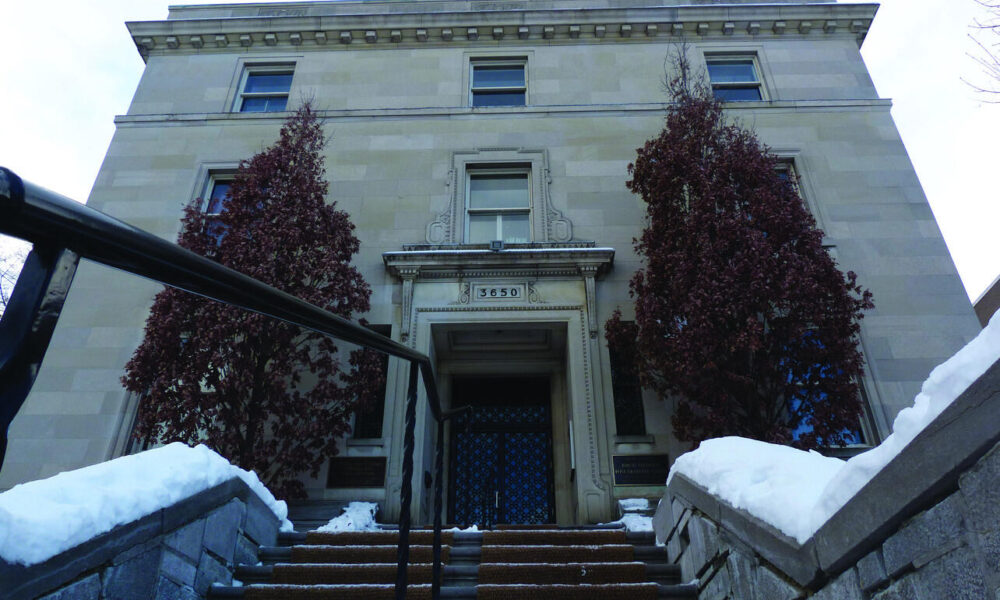
We arrive at 7:45 pm—15 minutes late. The house sits tall and narrowly between a row of semi-detached buildings, with a stately Chabad plaque in stone and an enormous glass door. The dinner takes place upstairs in a long, grey-walled congregation room.

The evening begins with Kabbalat, or Shabbat services, involving hymns and prayers. Men and women are separated by a divider called a mechitza. Men must also wear a kippah, which they provide—but most wear their own. 

Rabbi Shmuly, a brown-haired bearded man, leads the service from the men’s side. He’s dressed in a long black coat, a white dress shirt, smart black pants, a black hat, and tzitzits. The service is sung in Hebrew. My knowledge of Hebrew is like a Brit’s of baseball, so I mumble along. As we sing, the Rabbi sways passionately, lifting up his front foot slightly, and back again.

After, there’s a mad dash and I’m not quite sure where to go. A collective of students ready the tables for the feast. They organize seven long white-clothed tables, with 16 seats or so. Maya and I, panicking, choose to sit at the end of one of the central tables. 

Before we sit down, there is a blessing (Kiddush) to toast that Shabbat has begun. The Rabbi drinks a cup of wine, the more Orthodox practice, while everyone else has a half-shot of grape juice. 

We sit down and the feast begins: Starter, soup, meat, dessert, drinks, and a lesson from the Rabbi. Excited as I was to eat traditional Jewish food, it’s Mexican night.

To start, we enjoy chips, salad, and dips, including pico de gallo and salsa verde. There’s also Challah bread—a Jewish speciality. 

More people funnel in now. The atmosphere is lively. 

“There are lots of people to talk to, lots of food, everyone wants to socialize,” Joey Hershklop, U2 Engineering, says.  “I almost always meet someone new.”

Erik Mas, U2 Arts, emphasizes the importance for new international students.

“As an international student […] Chabad helps you feel welcome in this new environment,” Mas says. 

Unusually, Maya and I don’t end up sitting opposite students, but rather an Israeli couple in their fifties who tell us how it’s their first time in Montreal. The gentleman then asks, lowering his voice: “Are you Jewish?” Ah, you caught me. I explain I’m not but that I’m writing a piece on Shabbat and Jewish food. He then points down with this jocular, cheeky-chappy grin and says: “But this is Mexican?” Before the grin could simmer, Maya adds: “And the best Mexican you’ll have in a while, so enjoy.” His grin turns into a rosy, infectious smile. 

As the tortilla soup arrives, the Rabbi gives the d’Var Torah (a lesson of the week): “It’s never too late to learn something new,” he says. We raise a glass before tucking into the meat: Huge platters of chicken, salad, tomato pasta-bake, and rice. And after this, dessert: Brownies. 

It’s now 10:30 p.m. and I don’t think my stomach has room for more. But I wish it did. The food is endless. The sense of community is tangible. 

Reflecting on the weekly occasion, Rose Noskwith, U3 Arts, puts it: “Through Chabad, I feel lucky to have found a supportive Jewish community away from home.”

Read the latest issue

Read the latest issue