
Latest News

Science & Technology

Lesbians Who Tech are what’s missing from the industry

Unless you are a very specific type of person (white, straight, and male), the tech industry is a frustrating place to work. The fact that one of the world’s fastest growing, most influential fields is so overwhelmingly male is concerning, because the growth and evolution of so many other related industries and many aspects of our daily lives rest in the hands of a single, khaki-clad demographic. Just ask your female-identifying friends in engineering—the STEM fields are a boys club. Women, particularly those who are not straight-identifying, can easily be made to feel unwelcome. Enter: Lesbians Who Tech.

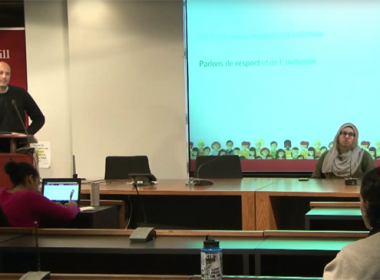
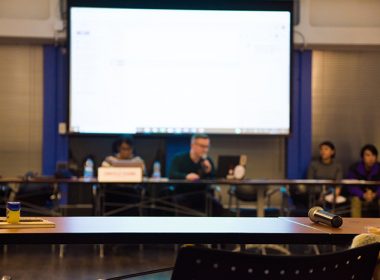
Lesbians Who Tech was founded in 2012 in San Francisco by Leanne Pittsford in an effort to connect and empower queer and lesbian women working in technology. Since its conception, the organization has gone international, with branches active in 41 cities worldwide. Rebecca Woodmass and Rachel Jean Pierre run the Montreal chapter. Their most recent summit, held at Studio XX on Jan. 17, featured four panelists involved in Montreal’s LGBTQ+ community, focusing on the innovative and often unlikely ways that technology and art intersect.

Concordia graduate Nichole A. Lee holds a Bachelor of Fine Arts in art education and uses tech-based art projects to overcome the “digital divide” in low-income communities. Her work with queer youth and ally communities encourages self-expression while teaching practical skills such as computer literacy and photography. Likewise, Karine Robichaud is using her experience in the tech industry for community outreach, and her website KingCom.ca allows young entrepreneurs to connect and promote their products.

Multidisciplinary artist Julia Dyck, a regular on Studio XX’s weekly CKUT show, “The XX Files,” first got her start with the organization when she submitted a feminist science-fiction radio documentary called “Manage Your Emojis,” starring herself and Apple’s Siri. Dyck has since written and spoken extensively on the intersection of feminism and technology. She is also an experimental musician, performance artist, and freelance hairdresser.

The final panelist of the evening was Bleue Liverpool, a multimedia artist specializing in projection mapping and video. Liverpool was the 2017 recipient of the Mary Ellen Mark Scholarship. Her work involves interactive video projection and photography that explores what she calls “a diasporic third-world feminism.” Her work privileges the voices of immigrant women in marginalized communities.

“Being a woman and an authority in tech is really rewarding but really hard,” Liverpool said during the Q&A portion of the evening. “I can’t tell you how many times I’ve been the only queer, black woman in the room.”

All four panelists were invited to discuss not only their work, but the implications and possibilities of being a queer woman working in the tech industry. Much like sexuality, our definitions of art and technology are dynamic, vast, and ever-changing. Because of this fluidity, the tech industry—despite its flaws—is rife with opportunity.

“There has been a really specific set of people in charge of the technology we are producing, and what we have right now reflects a really specific set of values,” Dyck said. She believes that the merging of art and technology has produced what she calls “a rebellious daughter of capitalism and liberalism.”

Dyck’s work is heavily inspired by Donna Haraway’s 1984 essay “The Cyborg Manifesto,” a piece that explores the idea that science is a “rhetoric” that we are made to believe is objective.

Acknowledging sexuality in the workplace challenges our notions of what belongs where. Introducing different identities into a notoriously-homogenous industry has highlighted different needs and perspectives. Technology has been a driving force behind social change not only because of its ability to connect us but because it has expanded the existing definitions of art, education, and commerce.

“Sexuality [is reflected in] our art making,” Lee said. ”It reflects our creative selves and there’s no limit to expression.”

Although sexism and heteronormativity in tech remain prevalent issues, Lesbians Who Tech is a celebration of what’s right with the industry. The organization places enormous emphasis on the value of community and collaboration, both for its ability to connect artists and professionals, and include as many different voices as possible. Step by revolutionary step, Lesbians Who Tech is moving the tech industry forward.

Commentary, Opinion

Time’s Up—on campus sexual violence

On Jan. 7, black gowns dominated the red carpet at the 75th annual Golden Globes, as stars displayed their solidarity for Time’s Up, a movement dedicated to ending sexual assault, harassment, and inequality in the workplace. It arose out of a wave of feminist activism in 2017 that bred similar movements, most prominently #MeToo.

Despite the increased attention that issues regarding sexual assault in Hollywood and other industries have gained over the past year, movements like Time’s Up and #MeToo need to translate into local change. While Hollywood is making immense progress, McGill and other institutions must use the momentum from global movements to address sexual violence in their own communities, rather than letting the entertainment industry hog the spotlight.

According to Statistics Canada, 635,000 sexual assaults were reported in 2014. Between 2009 and 2014, 117,238 sexual assaults were reported to police. The majority of sexual assaults go unreported and campuses are no exception to this epidemic—one in five women will experience sexual violence while attending a post-secondary institution.

Rampant sexual assault plagues university campuses across Canada, and McGill is not immune. From the alleged sexual assault of a student by a dentist in the Faculty of Dentistry in 2016; the allegations of sexual misconduct against the Students’ Society of McGill University (SSMU) Vice-President (VP) External in 2017 and by a professor in the Institute of Islamic Studies in 2017; or when three former members of the Redmen football team were accused of sexual assault and forcible confinement in 2012; McGill clearly has not yet solved its own issues with sexual violence. These examples are just some of the few that garnered national media coverage; however, as statistics reflect, the vast majority of cases do not receive the same magnitude of attention.

In order to work towards ending sexual violence on campus, McGill must treat it as a public health epidemic. Sexual assault is not only a crime, but it can also cause or exacerbate lasting mental health issues such as Post Traumatic Stress Disorder (PTSD), depression, and anxiety. In some cases, it can even lead to suicide. The dark reality is that too many survivors, on and off campus, are forced to live this trauma every day.

McGill has policies in place regarding sexual violence; specifically, the Policy on Harassment, Sexual Harassment and Discrimination Prohibited by Law, and the Policy against Sexual Violence, which was implemented in Fall 2016. However, such policies are not sufficient to adequately protect survivors. The National Our Turn Action Plan, founded by students at Carleton University and signed onto by SSMU, gave McGill a C- rating for its sexual violence policy. Despite McGill including the entire “McGill Community” in its framework, faculty and students are technically processed differently, compromising comprehensive, clear complaint procedures when allegations arise against faculty members.

Other preventative sexual assault initiatives include, but are not limited to, Rez Project, “How To Frosh” videos before faculty frosh registration, and the Rape Aggression Defence Course (RAD). Although these initiatives are crafted with good intentions, they do not sufficiently address the problem on campus. Rez Project only targets students in residence, which neglects the majority of the McGill student body and all of the faculty. The short “How to Frosh” video only targets students who participate in faculty froshes. The RAD is not being offered this semester and its $20 registration fee makes it less accessible to some students. McGill treats issues such as plagiarism with enough weight to create a mandatory undergraduate and graduate course titled the Academic Integrity Tutorial (AAA 100). In comparison, there is no such mandatory sexual violence prevention training for McGill students.

McGill should capitalize on the impetus of the #MeToo and Time’s Up movements by working to prioritize the health of survivors of sexual violence. In the same way that plagiarism is considered a campus-wide issue that requires the help of the Academic Integrity Tutorial, McGill should consider sexual violence an issue with enough weight to create mandatory workshops or courses for all students and faculty. Furthermore, McGill needs to revise and refine its sexual violence policies to better protect students, such as addressing the differences between processing students and faculty, or expanding initiatives like Rez Project, “How To Frosh,” and RAD to better accommodate and address all of the McGill community. Time’s Up and #MeToo have given a voice to survivors of sexual violence to share their trauma, and McGill has a responsibility to listen to the voices of students that are suffering here, too.

Art, Arts & Entertainment

Odd Stumble’s Archipelago dunks on traditional gallery experiences

With increasing museum and gallery admission fees in more formal spaces, many spectators look to smaller events to discover artists, pushing the envelope of what it means to make art. From Jan. 11 to 14, Odd Stumble, in collaboration with Théâtre Rialto, organized Archipelago, a collection of interdisciplinary performances and art installations. With an emphasis on collaboration and improvisation, visitors embarked on an interactive experience with a map of the theatre as a guide. Traveling through the different areas of the venue, it was easy to immerse oneself into the various performances, regardless of the medium.

On the main stage, Nicolas Royer Artuso of Thought Experiment Productions performed “4’33 in Baghdad,” presenting his reflections on important socio-political themes. Inspired by John Cage’s “4’33,” he guided his audience to listen to the silence within the theatre. As video clips of a Baghdad neighbourhood flash onto the screen, he announced a festival celebration accompanied by fireworks. Sounds of explosions filled the space, with the neighbourhood being demolished right in front of us. Conflating aesthetics and politics, Artuso left audiences with the simple question: “How can we stay silent?”

In the adjacent room, Aquil Virani’s Sit with me invites the audience to sit in front of his developing portrait series, CelebrateHer. Accompanying the portrait was a soundscape in which a woman speaks to the audience, bringing the portrait to life with her own words.

Théâtre Rialto’s beauty is overwhelming. An operating “theatre palace” until the 1990s, the building itself was modelled after the Paris Opera House, distinct for its neo-baroque interior design. Leaving no space unexplored, I ventured into the restroom. Stepping inside, I entered artmaker Jessica Rae’s The Green Room, which visualized a dream-like world with puppets and bright colours, establishing a certain slight uneasiness as schools of fish jumped from sink to sink. In the adjacent restroom, multidisciplinary artist Naomi Aldrich presented Trace (72): “Evidence or an indication of the former presence or existence of something,” a performance exploring mark making. At first glance, Aldrich’s positioning in between the bathroom stalls seemed off-putting. As she reapplied paint on her feet and hands, she began to count along with the voice that booms above the listener. Within this physical narrative, the passing of time, as well as her repetition of the markings, reinforced her performance.

These performances appeared to be independent of one another, but all somehow made the viewer think about how to interact with the various installations. In the Piccolo room downstairs, Maggie Winston began her performance of Wolf Tea, combining handmade masks, puppets, physical theatre, digital projections, and soundscapes. Combining the mundane with fantasy, Winston visualized how they intertwine in this constructed reality. Across the room, Carlo Polidoro Lopez presented several artworks, visualizing complex socio-political experiences. In a secret staircase, he illustrated the defining moment of his life: Witnessing the deaths of several family members at a young age. Using various discarded materials, Lopez’s artworks demonstrated that you don’t need much to make beautiful art.

A definite highlight of the art funhouse was KyAzMa, an electronic-bass-folk hybrid, creating a cinematic sonic experience like no other. Members William Moon and Christina Enigma cited numerous influences for this project, such as Radiohead, Boards of Canada, and Fleetwood Mac. The band filled the room with a healing energy, providing a needed calm-down within Archipelago’s sensory overload.

Unlike a traditional trip to a gallery, Odd Stumble’s art extravaganza demanded the viewer to actively participate in experiencing the art. Whether it was juxtaposing the mundane with the violent or exploring the healing potential of vocal harmonies, Archipelago reflected a refusal to stay silent, and reworked the definition of how art can be experienced by the everyday viewer.


Science & Technology

Fast radio bursts tangle with unknown forces

Streaking across the sky with a luminosity far greater than the sun’s, fast radio bursts (FRBs) remain powerful yet mysterious phenomena. They were discovered in 2007 when curiosity inspired the astronomer Duncan Lorimer to search the farthest reaches of space, with the FRBs being powerful enough to surpass the typical limitations of scientific equipment. Over a decade later, these transient radio phantoms remain a puzzle for modern astronomers; they travel for billions of years with no discernable pattern, only to emit waves for milliseconds. They are reminiscent of the radio waves emitted by pulsars, rotating stars that release waves of electromagnetic radiation like a lighthouse. However, FRBs are much brighter, travel much further, and had not been found to occur in the same spot twice until FRB 121102 was observed in 2012.

“Fast radio bursts are like flashes, they occur randomly in the sky,” Shriharsh Tendulkar, postdoctoral fellow at the McGill Space Institute, said. “We don’t know where the next one will occur so we search a large area of the sky, [however, with FRB 121102,] we knew the location very precisely and we knew this thing repeats, so we knew that we could point at it and keep recording data.”

An international team of astronomers—whose ranks included Tendulkar and Victoria Kaspi, professor of physics and director of the McGill Space Institute—conducted a study of FRB 121102 and found evidence of huge distortions in the direction of the radio waves. The astronomers concluded earlier this month that this “twisting” or “rotation” of the radio waves can be sourced to the Faraday effect, a phenomenon describing the influence of  magnetic fields on waves.

“[FRB 121102] had to have propagated through a strong magnetic field to see that kind of twisting in the electric field,” Kaspi said. “Nobody’s ever seen anything that strong except near really massive black holes like the one in the center of the galaxy.”

There are no known phenomena that can rival the magnetic influence of black holes, which can have a million times more mass than the sun. This suggests that the radio waves pass near a black hole. However, this theory is the result of applying familiar understandings to the observable effects, rather than observations of the environment actually surrounding FRB 121102. Thus, it remains unclear what exactly is exerting the immense magnetic field.

“We’re sure the magnetic field is really high, but we don’t know what causes it,” Tendulkar said. “It is possible that there is some other exotic shell around [FRB 121102] which we don’t completely understand. There are theoretical models where, if you have a supernova explode, the shell that remains after the explosion—in certain cases—could cause a rotation measure that high.”

The next tool for unshrouding the mysteries of FRBs will come in the form of the Canadian Hydrogen Intensity Mapping Experiment (CHIME). Although CHIME was originally conceived to study dark energy, it is incidentally perfect for detecting FRBs; whereas only 27 of these anomalies have been observed so far, Tendulkar predicts that CHIME will enable between 5 and 50 detections per day. However, as CHIME is currently still under construction in British Columbia, the recently damaged Arecibo Observatory telescope in Puerto Rico remains crucial for locating FRBs.

“We’re really proud they put the telescope on the front page [of the academic journal Nature] because Puerto Rico got really devastated by Hurricane Maria, and the telescope in particular suffered quite a bit of damage,” Kaspi said, referencing awareness for victims of the hurricane and her team’s findings being published on the cover of Nature. “It’s a really bad scene in Puerto Rico but they’ve been working around the clock to get the observatory back up and running in addition to many other basic needs.”

Scientists are eager to see how new technologies and substantive data will help unravel the mysteries of the FRBs.

“It’s always fun to have a brand new problem to work on,” Kaspi said. “Nature didn’t have to give us this lovely gift, but nature gave us the gift and we were in the right place at the right time to be able to make progress.”


Montreal, News

Montreal Women’s March returns with empowering intersectional messages

On Jan. 20, the Manif des Femmes Montréal, or Women’s March on Montreal, returned to Place-des-Arts for the first anniversary of 2017’s international Women’s March. Organized by leaders of the Centre des Femmes de l’UQÀM, Stella, and Black Lives Matter, the rally called for increasing representation and inclusivity in nonviolent activist movements. Donning pink knit pussy hats and wielding hand-made posters, hundreds of people participated in the rally.

Last year, Montreal’s Women’s March was organized in solidarity with the Women’s March on Washington in response to the election and inauguration of United States President Donald Trump. This year however, the Montreal march focused less on American politics and more broadly on intersectionality and the fight for the rights of women of all races, political perspectives, sexual orientations, and gender identities globally.

Sandra Wesley, an organizer and executive director of sex worker rights group Stella, strove for the march to be inclusive for those who typically feel marginalized and excluded from political activism, including sex workers, immigrants, and transgender individuals.

“Last year, the march was tied to the inauguration of Donald Trump, which overshadowed the demands of women and clouded the scene with anger rather than progression,” Wesley said. “This year, the rally was less tied to specific events than it was shedding light on sexism, discrimination, and violence that will not be tolerated any longer.”

During the rally, leaders of the three organizer groups gave speeches. Barbara Chin, a feminist performer, also spoke, sharing statistics about the marginalization and sexualization of women, and asking the crowd to join hands as she applauded the historical resilience of women.

“As a community, as we are here for each other, for ourselves and for the world,” Chin said. “As women, we are made to believe that we are second class citizens [….] We are not respected, therefore we are exploited.”

The rise of the #MeToo movement this past year gave prominence to conversations surrounding sexual violence at the march. Protesters also referenced newer hashtags such as #thisisnolongertolerated and #timetoact to promote political involvement.

For activist Elise Van Leer, U1 Science, who attended the Women’s March on Washington last year, the focus on #MeToo and hashtag activism made this year’s march in Montreal stand out.

“I think the 20th of January will always be significant for me since attending the march in my hometown, D.C., last year,” Van Leer said. “The rally on Saturday, while much smaller, was a really eye-opening experience because you could really feel the energy and passion of the speakers. It almost felt less commercialized and more authentic. It was really meaningful to have the emphasis on intersectionality and the ‘#MeToo’ movement and you could tell everyone there really wanted to be there. I felt empowered in a way I hadn’t before within the city.”


Basketball, Sports

Dribble basketballs, not heads

After the dust settled, Houston Rockets forwards Trevor Ariza and Gerald Green were revealed to be the masterminds behind a plan to enter the Los Angeles Clippers’ locker room to settle a dispute. Using a backdoor passage that connects the two teams’ locker rooms, the two found their way into the Clippers dressing room and started a ruckus. Both were suspended two games each for their roles in the commotion, which came after a chippy ending to a game on Jan. 15.

All in all, it’s been a crazy last few weeks for fighting in the NBA. Three straight nights, players were ejected for verbal and physical assault. The final damage count was 21 technical fouls and five ejections handed out across 11 games.

NBA figures like San Antonio Spurs Coach Gregg Popovich have a point when they laugh off these tussles—they almost always come across as melodramatic and drawn-out. However, there’s a reason the league has reached this point, and it doesn’t have to be this way. Players are growing increasingly frustrated with referees, whose de-escalation techniques have failed to control the game, and have even contributed to the disorder at times.

As players across the league—superstars included—receive discipline, the NBA is starting to face a crisis. To keep all of its talent available to play, the NBA must devote proper attention to how its officiating de-escalates issues, the root of much of the issue.

Following Golden State Warriors player Shaun Livingston’s protest to a call by referee Courtney Kirkland on Dec. 3, Kirkland approached Livingston in a head-to-head confrontation that resembled a boxing weigh-in more than a basketball game. If the referees’ mistakes encourage aggressive behaviour, it’s no surprise that players get pushed over the edge.

Referees make the call regarding game atmosphere, and even when they’re not physically involved in an altercation, that decision often makes the difference between smooth play and conflict. They must do a better job of establishing and maintaining order without disturbing game flow.

Referees have struggled with when exactly to blow their whistle, and sometimes they are too early to make a call. For fans, it’s disappointing to tune into a game only for one of its star players to get disqualified midway through; for a player, not much is more annoying than an early whistle.

However, late whistles can be dangerous, too, perhaps indirectly causing fights like the one between the Clippers and Rockets. The teams have been lashing out at each other—with physical violence and verbal taunts—but the hostility is really driven by poor officiating. Announcers often tag this as “letting the players play.” But, this has consequences: When referees let players push, it’s no surprise that players will eventually come to shove. The problem has been gradually escalating across the NBA, and now tensions have risen to the point where the athletes have no qualms about calling officials out by name.

Staying level and consistent can be difficult for a referee—especially with rowdy fans on their back—but it is crucial to walking the fine line between the right and wrong game atmosphere. Of course, star athletes are bound to get testy. By nature, they’re intense competitors. The good news is that it’s not an impossible problem for refs to fix. Just like the rest of the league’s members, NBA referees are the best at what they do, even when it doesn’t feel that way. If they work on keeping a professional level of conversation and a Brad Stevens-esque calm, tensions will begin to dissipate.

As it stands, the referee-player relationship is on shaky ground. But, with an All-Star weekend meeting between players and referees on the horizon—a prime opportunity for reconciliation—fans can hold onto hope for a peaceful tomorrow.

Off the Board, Opinion

In appreciation of home—sweet, unremarkable home

“You’re not in Kansas anymore!”

In the limited introductions I’ve made since the start of this semester, I’ve elicited this response four times. Mind you, I can’t blame anyone for failing to think of anything better. The most distinctive piece of trivia about my hometown, Kansas City, is that most of it isn’t actually in Kansas. To mention I live in a suburb called “Prairie Village” means I must promptly add that my Friday nights did not consist of mudding and cow-tipping.

Upon arriving in Montreal, I was disappointed that my peers showed so little interest in my roots. It seemed to indicate how comparatively banal my background was. But, in time, I’ve started to appreciate my entirely ordinary upbringing for all that it has given me beneath the surface.

A childhood environment is more than a set of surroundings—it molds one’s personality. Growing up in a quiet suburb leaves me inclined to take the low-key lifestyle to its logical extreme; between my casual, deadpan speech and hesitance to say anything controversial, my formal interactions are decidedly understated, no matter how hard I try to change. Some friends tell me that I display a strangely hilarious blend of sass, folksiness, and blunt stoicism. This is the consequence of growing up in the geographical melting pot of people from the American South, Great Lakes, and agricultural areas in between. Apparently, it sets me apart from the McGill crowd.

The thing is, my experience isn’t unique. We all have plenty of memories from our hometowns that give us goosebumps. These places can make us smile simply by driving by.

What’s better is that these circumstantial influences help to establish fundamental life skills. I’ve learned patience from growing up in a world that, for whatever reason, just moves more slowly. I’ve learned humility and appreciation from a culture that celebrates contributions from big people and little people—the executives and the farmers of the world. I’ve realized that the Midwestern “blue collar work ethic” is more than some fetishized rallying cry; it’s taught me to demand the absolute best from myself.

An upbringing is also special for the memories it offers. In high school, I won a state championship in football, still my favourite memory after 20 years on Earth. Arthur Bryant’s—for my money, the greatest barbecue joint in Kansas City, and thus, the world—hangs a picture of my father, A Guy Who Loved Barbecue, next to its front door. These snippets from my childhood are two of the most cherished pieces of my life.

The thing is, my experience isn’t unique. We all have plenty of memories from our hometowns that give us goosebumps. These places can make us smile simply by driving by—while also shaping our personalities and core values. Rural life teaches independence. Poverty and the struggle to make ends meet breed perseverance.

What makes a place great is if it lends happiness and virtues to its inhabitants, not if it can boast about its tourism and iconic landmarks. One’s home provides both those benefits in almost every case, through one means or another. For that reason, just about anyone’s hometown is worthy of celebration—and requires no further burden of proof to justify its greatness.


Ultimately, I’ve come to terms with the fact that the most defining characteristic of my home state is that a fictional farmgirl from a 79 year-old movie grew up there. That place, in conjunction with my hometown, is worthy of celebration for all it’s given me. That’s why I will demand that Tech N9ne’s “Hood Go Crazy” be played at any party I attend. That’s why I will subsequently yell “KANSAS CITY NATIVES AND WE ALL A LITTLE COOCOO” with Tech at the end of his first verse. Regardless of where you’re from, I encourage everyone to celebrate their hometown all the same, and appreciate the memories, people, and values that come from it—but lay off Tech. He’s ours.


Stephen Gill is a Tribune Sports editor, a U1 Statistics for Management student, and aspires to steal the Declaration of Independence.


Arts & Entertainment, Film and TV

“Kanehsatake: 270 Years of Resistance” explores a conflict still unresolved

During the summer of 1990, a centuries-long land dispute between Mohawk members of the Kanehsatà:ke community and the Canadian government developed into an armed confrontation that would last for almost three months. The conflict broke out because of a proposed golf course expansion in Oka, a small town roughly 60 kilometers west of downtown Montreal. Abenaki filmmaker Alanis Obomsawin was present at the time of what has now come to be known as the Oka Crisis, and recorded over 250 hours of film from the protesters’ side of barricades erected to block outside access to the contested land. On Jan. 15, as the first part of its Indigeneity & Solidarity Event Series, SSMU Indigenous Affairs screened the final product of Obomsawin’s work covering the Crisis: The 1993 feature-length documentary and winner of 18 Canadian and international awards, Kanehsatake: 270 Years of Resistance.

The film certainly deserves its accolades. It serves as a mosaic of the Crisis’ chronology, from its origins in French colonialism and the (in)actions of Oka Mayor Jean Ouellete, to the eventual end of the standoff in September 1990. While including every single bit of minutia may be difficult, Obomsawin effectively presents as much detail as humanly possible in two hours.

The style employed throughout the film sorts the chaos of clashing perspectives into a cohesive, digestible format for its viewers. Unlike other documentaries which feature a narrator to guide their audiences with supplemental exposition, Obomsawin simply lets individual people and their actions speak for themselves. She depicts the tensions between Mohawk protesters and members of the Canadian Army in vivid detail. At one moment, the audience witnesses a confrontation that culminates in the beatdown of a protester; at another, protesters plead with the government to send an ambulance for another victim of police brutality.

The use of state violence works as a central theme throughout the film. While Obomsawin focuses largely on the atrocities as they occurred, Kanehsatake’s final scenes look back on the Oka Crisis after its first anniversary. Oka’s population re-elected Jean Ouellete as mayor. Many suffered physical injuries and trauma from their experiences. Despite everything that has transpired, the land claim dispute that prefaced the entire ordeal remains unresolved to this day.

SSMU Indigenous Affairs used this screening to draw attention not just to the Crisis and the aftermath of government actions on the Kanehsatà:ke community, but also to reflect on the legacy that colonial history has on Canadian society. After the screening, a discussion took place with Mohawk journalist Taiorenhote Daniel David, who shared some of his own experiences at Oka. Participants also talked about present-day resistance in the Internet-era.

In a Facebook post on the event’s page, SSMU Indigenous Affairs described the reasoning behind the screening and discussion.

“Although the documentary focuses on the events of 1990,” the post read. “We are talking about systemic issues which persist today. An important step forward is to be aware – of what has happened in the past, of what continues to this day, and of the work of those fighting for a better future.”

Here at McGill, they hope that the Indigeneity & Solidarity Event Series will enable both Indigenous and non-Indigenous students to “learn about and reflect on Indigenous identity and solidarity both inside and outside of the university setting.”

The Series will feature several more events throughout this semester, culminating in an all-day conference hosted in partnership with the Indigenous Student Alliance on March 24.

Student Life

Five ways to make life a little easier this semester

With the add-drop period coming to a close, the reality of the back-to-school season has begun to set in. With the inevitable stress and pile-on of assignments, days grow more hectic and small parts of life may begin to unravel. To calm fears about present and future stress, The McGill Tribune has compiled a few tried-and-true ways to stay feeling in control of each day.

1. Freeze your meals

Be it after a tiring trek home in the bitter Montreal cold or right before a long day at the library, a healthy meal can work wonders in keeping you energetic and motivated. Yet, finding the time to cook every day is a challenge. In order to make sure you always have a hot and healthy meal on hand, plan your meals in advance, and give your future self some time off. Before the semester gets too hectic, spend a few hours preparing one or two hearty meals that you can keep in the freezer for up to a few months—think chilli, lasagna, and smoothies. Then, when the time comes, you can take them out, pop them in the microwave, and you’ve got a no-stress meal ready to go. You’ll thank yourself later.

2. Plan small breaks into your schedule—and respect them

Studies show that taking regular study breaks improves productivity and overall mental health. Try taking multiple short breaks over the course of a long day of studying. The Pomodoro Technique—a study strategy that involves alternating between 25 minutes of studying and five minutes of rest—is a good way to do this. Chrome extensions like Strict Workflow, Break Timer, and Micro Breaks also help with remembering to take short breaks while working.

You may also want to incorporate longer breaks into your weekly schedule. Allocate one specific day and time per week to explore a new part of Montreal or watch a movie you would typically not give yourself the time to see. Make sure to respect this date every week and plan your work schedule around it so you don’t resort to studying through it during busier weeks.

3. Assign yourself early deadlines

Before you get lost in a pile of homework and assignments, take some time to look ahead and schedule your semester. Try putting all of your assignments into your planner and colour-coding each week based on how busy it is. If you see that your workload is particularly light one week, assign yourself a fake deadline to complete an assignment or two from a heavier week early in order to get ahead. By planning out your time in advance, you can mitigate some of the anxiety of cramming to do your work at the last minute. With a bit of foresight, you can rearrange your workload to be more manageable, and avoid painful coffee-driven all-nighters at McLennan.

4. Make your bed

Studies show that making your bed when you wake up leads to an all-around more productive day. This practice not only forces you to get out of bed, it also ensures that you don’t get back in it once the sheets are pulled up and pillows neatly arranged. The feeling of accomplishing this small task will put you in a better mood for the rest of the day.

5. Review course material for a few minutes each day

While it’s tempting to leave studying to the last minute, going over your notes from your daily courses before going to sleep will help you retain information you may have forgotten during the day. If you find that you’re too tired to read before going to sleep, consider finding other down times during your day to review lectures or readings; you can record yourself talking through course material and listen to it on your walks home, for example. Staying on top of your studying will help alleviate stress when you get to midterms and finals season as you will already be familiar with all the course material.


These strategies are not an alternative to proper mental health treatment. If you are struggling with a chronic mental illness, on-campus support and therapy is available to you at McGill Counselling Services. The Students’ Society of McGill University (SSMU) also offers many peer support programs including the Peer Support Center and the McGill Students’ Nightline.

Read the latest issue

Read the latest issue