

Latest News

Arts & Entertainment, Film and TV, Internet, Music

What we liked this summer: Pandemic edition

With the start of virtual classes, it feels like we’ve been jolted out of a limbo. Still, with Netflix binges about to be replaced by Zoom classes, we can at least say that our five months indoors have given us plenty to watch, listen to, and read. The pandemic aside, here are some favourites that helped us through the summer.

You’re Wrong About, Podcast – Erika Mackenzie 

Summer is the season of podcasts, and this one is definitely worth the listen. Freelance reporters Sarah Marshall and Michael Hobbes dive into memorable events, people, and random phenomena throughout history, questioning popular preconceived notions. Rather than a simple debunking, You’re Wrong About delves into the social implications of widely held beliefs. Exploring topics from Stockholm syndrome to the O.J. Simpson trial, You’re Wrong About has no boundaries on what it will cover. Marshall and Hobbes are not only informative, but they also have an excellent sense of humour and keep listeners on their toes.

SAWAYAMA, Album – Jonathan Giammaria

Rina Sawayama cackles her way into the nu-metal chorus of her pop album’s third track, “STFU!” On paper, this eclectic mix of genre and vocals seems bizarre; however, when listening, it becomes one of the album’s most memorable performances. SAWAYAMA is full of bold creative choices: “Paradisin’” is set to the beat of a hyper 8-bit video game; “Comme Des Garçons (Like The Boys)” pairs a fashion brand roll call with groovy disco. And with songs covering climate change, family heritage, platonic breakups, and consumerism, SAWAYAMA’s subject matter is as varied as its sound. Though the album isn’t beholden to thematic or sonic cohesion, it nevertheless soars as a wholly original work from a singular, new voice.

TikTok, App – Deana Korsunsky

From viral dances to lifehack tutorials, the video app TikTok became a worldwide phenomenon thanks to the quarantine of Summer 2020.  Although the video app started as Musical.ly in 2016, TikTok now hosts communities from tweens to baby boomers, offering content as relatable as pandemic confinement, to those as niche as canned beans fan videos. The TikTok feed is an endless void of passion and creativity. What may start as a simple scroll through one’s feed will undoubtedly evolve into a 40-minute session of chuckling, liking, and commenting. The platform provides a convenient and much-needed source of both amusement and education, allowing those of different walks of life to share their creativity and stories with the world.

Da 5 Bloods, Film – Julian Miller

A mid-June Netflix release brimming with lushness and fury, Da 5 Bloods is both Spike Lee’s latest masterwork and, heartbreakingly, Chadwick Boseman’s last film released before his passing. The film follows five ageing veterans of an all-Black platoon as they journey back into the Vietnamese jungle in search of a twofold treasure: Buried gold and the remains of a beloved comrade left behind long ago. The men’s foray into the jungle ultimately becomes a volatile yet deeply compassionate exploration of the many faces of trauma, the impossible burden of loyalty, and the irreconcilable paradox of fighting and dying in the name of your oppressor.

Boys State, Film – Angelica Voutsinas

Documenting a week-long leadership camp run by the American Legion, directors Amanda McBaine and Jesse Moss set out to study the deep-rooted polarization that is so intrinsically tied to American politics. Boys State follows four out of one thousand participants in the 2018 Texas Boys State, where 16-year-olds play mock government for a week: Electing government officials, enacting laws, and running election campaigns that parallel the dirty politics of real life. The film is a cynical snapshot of the next generation of American politicians, but also shows the growing minority of youth in politics who genuinely want to better the lives of others. Boys State is emotional, captivating, and a must-watch for anyone casting their ballots on Nov. 3.
Out on the Town, Student Life

Reinventing a life of leisure

Since the Quebec government declared a public health emergency in March 2020, Montreal, the province’s largest city, has lost hundreds of millions in tourism revenue. Many of Montreal’s major cultural events, such as the Montreal International Jazz Festival, the Just for Laughs Comedy Festival, and Osheaga, which altogether bring in an estimated $374 million to the local economy, have been postponed or cancelled until 2021. 

In light of the COVID-19 pandemic, Montreal has focused on new ways of bringing people to the city in order to make up some of the approximately $4.5 billion that tourism generates for the local economy annually. According to the City of Montreal, $400,000 is being invested into stimulating the downtown core’s economy. Events and activities, such as apple tasting at the Botanical Gardens and the reopening of the Montreal Biodome, were offered throughout the summer and will continue into the fall. An additional $200,000 has been put toward the Relancez l’été campaign, which encourages Montreal and Quebec residents to explore the city’s downtown. 

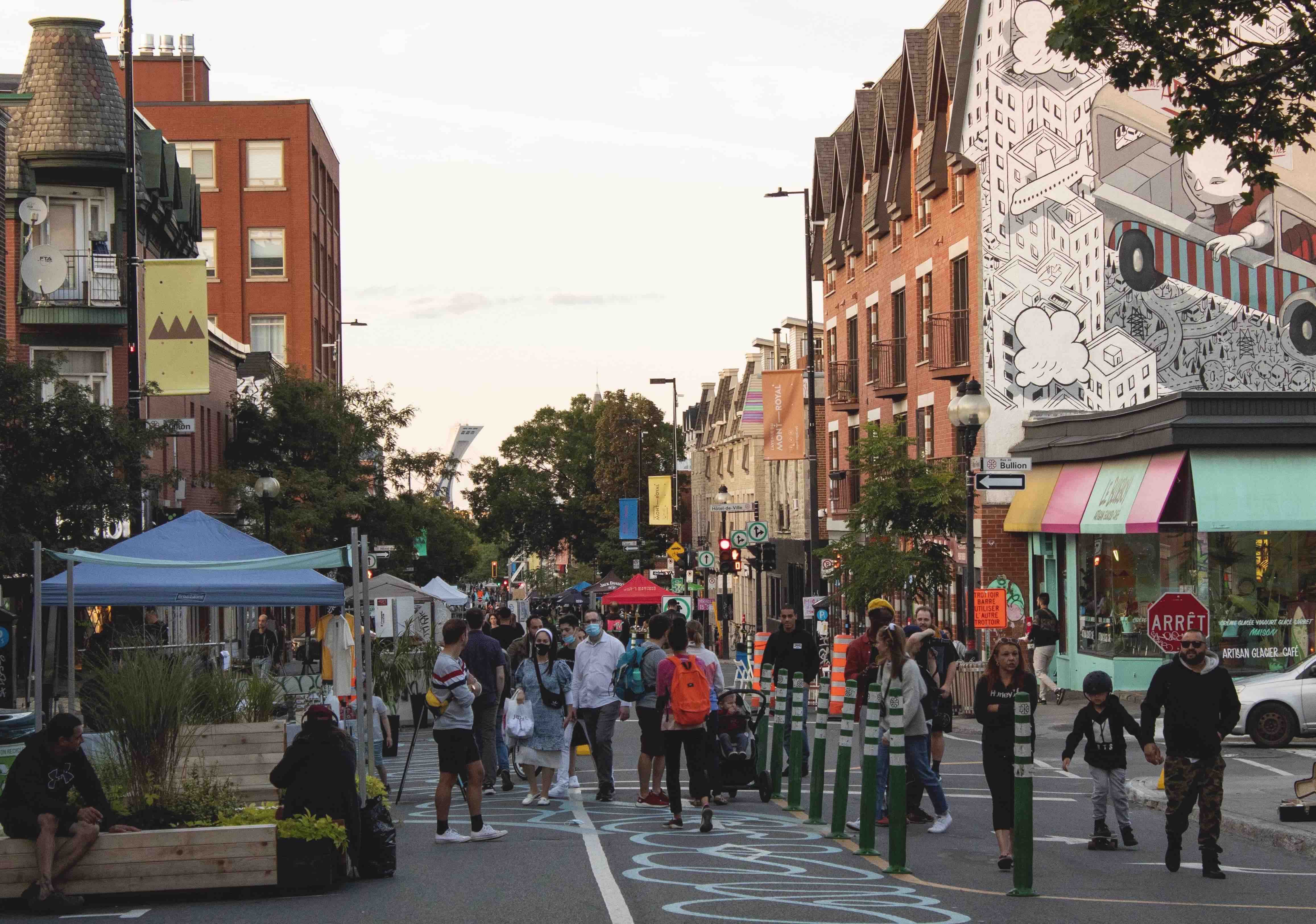
Further, Mayor Valérie Plante has introduced newly pedestrianized streets and cycling lanes. These changes aim to draw Montrealers to the shops and activities while maintaining a safe distance from others along Mont-Royal Avenue, St-Laurent Boulevard, St-Catherine St. W., St-Denis St., and de la Commune St., and will persist until the end of October. 

Most public spaces, such as parks, public markets, and businesses have been permitted to open by Quebec’s provincial health authorities, allowing for patrons to safely peruse and shop. Visitors are reminded to stay at least two meters apart when possible. Masks and other types of face coverings were made mandatory in all indoor public spaces and public transit as of July 18. 

Slowly, museums throughout Montreal have reopened with safety measures put into place. Running at limited capacity, many museums require visitors to book a time slot online to visit in person. Maude Béland, Media Relations Officer for the Montreal Museum of Fine Arts (MMFA) highlighted the importance of patron safety at the museum.

“Safety measures are indeed very important for us. [We have] worked very hard and put every measure in place to ensure visits are highly enjoyable […] yet intimate, and, above all, safe,” Béland wrote in an email to //The McGill Tribune//. “All of the recommendations of the Government of Quebec and the Commission des normes, de l’équité, de la santé et de la sécurité du travail (CNESST) have been implemented so that the public feels at ease and entertained during their museum outing.”

Safety measures implemented at the museum include a one-way exhibition path, free audio guides on the MMFA mobile app, and the suspension of permanent exhibition spaces.

Likewise, Montreal’s historic Old Port has taken steps to accommodate its visitors. One novel addition are the blue Bienvenue/Entrezinitiative decals, which allow shoppers to identify which local businesses are open and to show when businesses are at capacity. Signs with up-to-date public health measures and hand sanitizer stations have also been placed throughout Old Port. 

More kinetic Old Port attractions remain adaptable and open. Both the MTL Zipline and the Montreal Observation Wheel have been opened to the public with increased sanitation and social distancing. Sam Cadotte, president of the MTL Zipline, is thankful for the ability to provide a safe and fun experience for the attraction’s customers.

“In general, we are very pleased with the way our customers respect our sanitary measures,” Cadotte said. “We consider ourselves lucky to be allowed to operate in these special times and understand that we have an important role to play in keeping our customers safe.”

As we continue to learn how to live with COVID-19, business owners and event organizers are hoping that the safety measures they have put in place will encourage people to get outside and explore Montreal this fall. With fewer tourists, the next few months may be the perfect opportunity for students, residents of Montreal, and Quebeckers to rediscover the history and charm of Quebec’s metropolis.

Student Life

Spotlight on the Canadian Advisory of Women Immigrants

Since the beginning of the COVID-19 pandemic in March 2020, immigrant women in Canada have experienced considerable negative impacts in areas such as employment, home life, social networks, and health. In response, Hani Rukh E Qamar, U1 Psychology and Neuroscience, founded the Canadian Advisory of Women Immigrants (CAWI) to empower immigrant women with services such as English classes, networking events, and mental health resources. 

Qamar was inspired to create CAWI after noticing a clear disparity between immigrant and non-immigrant women in both Montreal and her hometown of Regina, Saskatchewan. 

There is always a divide between immigrants [and non-immigrants], not to mention the divide within the immigrant community as well,” Qamar said. “So, I really wanted to put an emphasis on the importance of diversity and create a network of women immigrants who are willing to offer opportunities to other women, as well as take [away] some leadership skills from our initiative.”

The pandemic has created additional financial strain for immigrant women, as many have lost their sources of income. In April 2020, Canadians lost nearly 2 million jobs—affecting certain employment sectors that many immigrants occupy. These sectors include accommodation and food services, for which immigrants accounted for 34.7 percent of the employed population in 2017. 

While unemployment rates have risen during the pandemic, the issue of securing employment in Canada is not new to immigrant women. Immigrants faced higher rates of unemployment from 2006 to 2010 than both Canadian-born women and male immigrants, according to the Labour Force Survey.

Historically, immigrant women have struggled to have the education or job experiences obtained in their home countries recognized in Canada. A 2005 study of 15,400 immigrant women between the ages of 25 and 44 found that 37 per cent of women surveyed reported an inability to secure employment in Canada because of difficulties in transferring their foreign qualifications. Many also said that they lacked adequate Canadian job experience. 

Qamar believes that systemic racism plays a significant role in the employment gap between immigrants and non-immigrants. 

“Women immigrants face racism, systemic racism and other inequalities that prohibit them from getting the jobs they want,” Qamar said. “Although it is hard for women in general to get jobs, it is [especially] harder for women immigrants.” 

Qamar also explained that lack of social networking is one of the biggest challenges that immigrant women face in employment security. To help overcome this obstacle, CAWI offers a number of networking programs, including the Sisterhood Project. The Sisterhood Project is designed to bring immigrant women together through activities such as café meet-ups, board game events, and reading nights. The goal is to foster relationships among immigrant women of different backgrounds. 

In addition to the financial strain of COVID-19, immigrant women also face a greater risk of domestic violence during the pandemic. In a recent Statistics Canada survey, 12 per cent of immigrants reported concerns about violence in the home during the pandemic compared to seven per cent of non-immigrants. Qamar described this phenomenon as “the shadow pandemic.”

“The ‘shadow pandemic’ is basically how the pandemic is worsening the situations for women facing abuse, as many women are confined to their homes,” Qamar said. “They cannot go to school nor escape the horror realities that is their home, so COVID-19 has worsened [their] conditions.” 

Furthermore, immigrant women have reported greater concern about their health during the pandemic than non-immigrants. In particular, non-status women working as frontline workers are at greater risk of poor working conditions, such as low pay, lack of paid sick leave, and a heightened risk of contracting COVID-19. 

Organizations like CAWI are spreading awareness about the challenges that immigrant women face and offer invaluable support through their programming. At a time when many people are experiencing turmoil caused by the pandemic, it is important to recognize the ways in which gender, nationality, and legal status intersect to create additional barriers in employment opportunities, safety, and health.

Commentary, Opinion

McGill cannot leave incoming first years behind

The end of the last academic year was extraordinary: COVID-19 barrelled through our lives and took the world by storm, instruction moved online at many universities, and the entire education system was uprooted. Unfortunately, the pandemic’s effects were particularly harsh on graduating high school seniors—students who will now be burdened with a steep transition from secondary to post-secondary studies. It is time for McGill to break from its cold, imposing reputation, which is purported by students on college admissions forums, McGill’s unofficial subreddit, and former CEGEP students. In these uncertain times, the administration must step in to provide extensive support for the incoming cohort. 

Assistance is necessary because there are gaping discrepancies in the academic preparedness of incoming first-years. The Canadian educational response has been incredibly diverse as it is organized at the provincial level. Studies show that disparities in post-lockdown instruction methods have had detrimental impacts on students’ achievement levels in the United States. It may be fair to imagine, therefore, that this year’s new students will not be as prepared for first-year as their counterparts in upper-years were. 

McGill has the steepest minimum entry grade requirements of any Canadian university. Normally, this helps ensure that admitted students are adequately prepared. After all, to get into McGill, students have to be among the highest achievers at their secondary schools. But in light of the rollercoaster semester that incoming students have experienced, it may be a stretch to assume that most students will be ready for classes. 

Other universities have acknowledged this reality. For example, the University of British Columbia offers free academic essentials courses to help support its freshmen. If McGill does not take further measures to support new students, they could leave first years at a disadvantage. McGill has many options for giving incoming students support. For example, this last semester, students were allowed to exercise the Satisfactory/Unsatisfactory (S/U) grading option for all their courses. However, at the moment, this will not extend to the Fall 2020 semester. A high school course online is not the same as an online university course, much less one at a top institution. To throw students into this new environment without any sort of cushion could be disastrous. And although resources exist to help new students understand what the Fall semester’s course offering will look like, they may not sufficiently ensure the smoothness of students’ transitions to post-secondary learning. 

McGill should adopt new policies to assist first-years. Reinstating the S/U format from the Winter semester, for instance, could level the playing field and help to ensure that students are not penalized for gaps in their knowledge resulting from events beyond their control. While some graduate programs, medical schools, and law schools may frown upon the pass/fail grading structure, McGill can counter by allowing new students to convert their S/U to a letter grade after the semester is completed, thereby mitigating concerns. Administrators could also mimic the response of Duke University, and include a designation denoting exceptional circumstances on the transcripts of incoming students. This way, students can feel confident as they enter online learning at McGill, equipped with some experience and aware of the academic expectations that will be required of them. 

The McGill Media Relations Office has confirmed that there are no plans at the moment to offer any of these options. Instead, McGill will conduct short workshops during orientation week to teach students new learning strategies, how to navigate Zoom instruction, and use library resources. Rather than offering in depth courses like UBC or special designations on student transcripts like Duke, McGill has once again opted to stick by its frigid reputation and only offer the bare necessities. It is imperative that new students are not left behind. More resources are needed to support incoming students, and there is a clear path for the administration to help. McGill cannot leave incoming first-years behind. 

News, SSMU

Judicial Board renders 2020 SSMU Winter Constitution invalid, SSMU responds

In a unanimous decision made on Aug. 17, the SSMU Judicial Board (J-Board) rendered the 2020 SSMU Winter Constitution, which was put to vote without a French translation, invalid. During a Board of Directors (BoD) meeting on Aug. 20, SSMU voted not to ratify the J-Board’s decision, sending the judgment back to appeal. 

The J-Board’s decision came after a spring petition that demanded the suspension of the new constitution, citing the absence of a French version that was included during the 2020 SSMU Winter Referendum. The petitioner, Daniel Benjamin Miller, U3 Arts, noticed that the new constitution adopted after the referendum was illegitimate because it neglected a SSMU regulation that states that all SSMU constitutional amendments must be provided in both French and English.

“At the time, I wrote to Chief Electoral Officer, Pooja Patel,” Miller said. “I asked for a copy of the French version, and she told me it didn’t exist, which raised a red flag to me. I think that rules need to mean something. Every member of McGill has the right to see that constitution in French.”

The J-Board ruled with the petitioner, appealing to the right of French constituents to a fair vote and asserting that doing otherwise would imply a refusal to make meaningful change. The J-Board also noted that not providing a French translation violated French-language rights protections, as stipulated in the Board’s own constitution and in SSMU’s Internal Regulations.

During the Sept. 3 BoD meeting, two members voted not to ratify the decision, one voted against, and seven, including SSMU President Jemark Earle, abstained from the vote. Explaining his choice to abstain, Earle said that while he recognizes that the lack of a French translation during the referendum was a mistake, he also wanted to highlight one of the consequences of the constitution’s reversal: The removal of councillors that were elected under the new constitution to represent marginalized voices, as their contracts needed to be renewed under the new document.

“[This omission] shouldn’t have happened last year,” Earle said. “No one disputes that fact. I abstained because [although] I understand the Judicial Board’s rationale, I [also] believe more weight should have been given to the fact that we would have to remove four legislative councillors [elected under the 2020 SSMU Winter Constitution], most notably, the SSMU Equity, Francophone Affairs, and Indigenous Affairs councillors.”

In addition to addressing the petition, the J-Board’s decision also recalled broader sociolinguistic issues, such as SSMU’s promise to serve its sizeable French student body, and the treatment of Francophones as minority constituents on campus. 

These larger principles advanced in the J-Board’s decision were noted by Marco-Antonio Hauwert Rueda, U2 Arts, who believes that there must be improvements in the way McGill treats its Francophone community, as he feels victories such as this are few and far between. 

“Francophone students’ concerns at SSMU have always been dismissed as inconvenient,” Rueda wrote in an email to the Tribune. “[SSMU does not] deliver in practice, whether it is regarding translations, student services, or funding. This is not only the case at SSMU, but also among the wider McGill community. Students at McGill absolutely love diversity in principle, but shy away when they have to make the slightest concession to favour that diversity in practice.”

The J-Board is allowed 21 days to decide whether to uphold or change its decision before delivering its final judgment. Should the J-Board choose to maintain its initial decision, Earle stated that SSMU will move forward with the ruling.

Earle explained that SSMU is working on passing new measures that will prevent the issuing of any constitutional amendments that are not available in both English and French.

“Something that we are [working on] is bringing forth a motion that automatically strikes down changes to the constitution that [are not also] made in French,” Earle said. “I know we, our new executives, have learned [and] we are committed to ensuring that this doesn’t happen again.”

Chill Thrills, Student Life

Battle of the bandwidths

When the COVID-19 pandemic began this March and governments mandated self-isolation to limit the spread of the virus, smart devices became the primary means for people to stay connected. For students, digital platforms are essential for remaining in touch with loved ones, working, and balancing school responsibilities. Some platforms, such as WhatsApp and FaceTime, were already popular. Others, such as Zoom, saw a boost in popularity following the start of the pandemic. With so many options to choose from, it’s easy to get overwhelmed. But fear not—The McGill Tribune has ranked these digital platforms based on accessibility, group capacity, and unique features, so that you’ll never be stuck in a dud, glitchy video call again. 

7–Houseparty: Houseparty is great for socializing with a small number of friends. However, this app can only accommodate group calls with eight people, and does not offer asynchronous options—like text chats—for communicating with others. Houseparty is great for talking to a few friends, but its limited features make it impractical for larger groups or more formal purposes. 

6–Skype: Skype is one of the original video calling platforms and remains useful as a means of meeting “face-to-face.” Users create groups by adding Skype contacts to a text chat or call. Video calls are free for up to 50 members, but different paid subscriptions or pay-as-you-go options allow users to make unlimited calls to landlines or have “Skype numbers” that enable them to pick up phone calls using the Skype app. 

5–iMessage/FaceTime: iMessage and FaceTime are only available to those with Apple products, and allows to chat with up to 24 other users (though FaceTime notoriously glitches with large groups). Any member of a group chat can initiate a FaceTime call that available members can join. iMessage texts can include voice memos, file sharing using iCloud, and virtual games through GamePigeon, making Apple’s platforms great for one-on-one or small group conversations.

4–WhatsApp: WhatsApp is free and includes international texting. Group creators can create a link for people to join so members don’t have to be added directly, making it an extremely popular platform for students to chat about courses. Unlike iMessage, users can reply to a specific message, a useful tool when there are many members contributing to the conversation at different times. When initiating a WhatsApp call, however, a user can only call people who are in their device’s contact app, which could lead to some difficulties.  

3–Zoom: Zoom has recently gained popularity as a means of hosting meetings for work and school, and can be used on almost any smart device. The meeting’s “host” can send a meeting ID or a link to join, with up to a maximum of 100 participants on the free plan. A “waiting room” can be added to assure that only host-approved members are allowed into the meeting. There are a myriad of features available to members: Screen sharing, virtual backgrounds, and a chat feature that expires at the end of the meeting. 

2–Google Hangouts: Google Hangouts combines features similar to iMessage, FaceTime, and Zoom. Members simply need a free Google account to access the chat feature, which can accommodate 250 people. Users can video chat with up to 25 people from a pre-existing chat group or by sending a link, in which case participants do not need a Google account to join. Under utilized, Google Hangouts is a great option for student groups looking for a simple and reliable way to communicate.

1–Facebook Messenger: Facebook Messenger offers some of the best features: It is free across the world, can be used with almost any device, and offers both asynchronous texting and instant video chats. Further, it allows members to respond or react to specific messages, and can accommodate up to 250 group members. Aside from its practical features, Facebook Messenger has customizable aesthetics and a straightforward interface, making it the ideal platform for many study groups or clubs to connect.

McGill, News

McGill faculties host first ever virtual frosh

McGill’s Campus Life and Engagement hosted its first virtual Frosh the week of Aug. 27 – 30 2020. With public health restrictions imposed on every facet of student life this year, the usually boisterous Frosh festivities were replaced by online events. Hosted over Zoom, each faculty’s Frosh included a range of activities from escape rooms to restaurant tours around the university to welcome the new class. 

Led by two to three Frosh leaders per group, incoming students participated in events in groups of 13, though attendance fluctuated throughout the week. Frosh leaders organized activities such as trivia via Kahoot, academic seminars, virtual yoga, interfaculty concerts, talent-optional showcases, and other group bonding exercises.

 Several faculties filmed virtual ‘field-trips’ of popular areas on campus, and Science Frosh leaders organized a digital iteration of the university’s Frosh tradition: The ‘McGill Crawl.’ Frosh participants were shown prerecorded YouTube video tours of various eateries and student hotspots near McGill, such as McGill Pizza and Freshii. The videos included interviews conducted by the organizers with the owners of the establishments.

Alexander Achcar, U1 Engineering, participated in Science Frosh, where he claimed to have had an enjoyable experience despite the virtual format.

“[The tour included] places that people would normally visit during Frosh, which was a little bit dead because obviously we were not going to these places,” Achcar said. “So it was kind of weird, people getting hyped around Chef on Call while we were all sitting [on Zoom] in the morning, drinking coffee.”

Discounts were offered by the restaurants as rewards for the winners of the various Zoom challenges. Among the challenges was a virtual escape room experience, where Frosh participants co-operated with their team members to solve puzzles and locate clues in competition with other Frosh groups. Achcar believes that the escape room experience provided a great way for the students to bond with one another.

“[The escape room activity] was really sick,” Achar said. “Everyone thought it was going to be the dumbest thing in the world, but [Frosh leaders] sourced it from an outside company, and it was really well put together. I think it was a really good way for the group to bond initially, because the challenges weren’t super difficult, but you had to think a little bit, so we were all talking and discussing things.”

Logan Pecht, U0 Arts, who attended Arts Frosh, commended his Frosh leaders for their efforts in maintaining the spirit of Frosh week.

“With the expectation that it wasn’t going to be the same experience, Frosh allowed me to grow comfortable meeting friends and socializing in a virtual setting with the aid of my enthusiastic leaders,” Pecht said.

Olivia Mendelson, chair of the Arts & Science Frosh committee, spoke about the initial uncertainty and challenge of organizing the events.

“At the beginning of our planning, it was difficult to envision what the events would be like, but we came up with ideas along the way and figured out how to make them happen,” Mendelson said. “We saw our hard work pay off when our events unfolded smoothly, and we got positive feedback from participants saying they were having fun and thanking us for organizing something for them.”

Mendelson appreciated the unique nature of this experience, and how the limitations of a virtual semester did not prevent the participants from engaging with their peers.

“There was something special about having people participate from different places around the world,” Mendelson said “It really made it feel like we were all coming together despite the difficult and non-ideal circumstances. Overall, virtual Frosh was a success, and I hope it helped set a precedent for future online events at McGill.”

McGill, News

Online learning forces professors to reconsider virtual teaching platforms

The past six months have brought unprecedented change to McGill as institutions worldwide transition to online learning platforms. Given the changes brought by online learning, teachers are being forced to develop new ways of delivering lectures, promoting discussion, and creating assessments.

The COVID-19 pandemic shut schools down in March 2020, and caused an abrupt shift from in-person classes to online learning. This transition to virtual platforms has persisted as McGill ramps up its Fall 2020 activities.

Associate Provost (Teaching & Academic Programs) Christopher Buddle explained McGill’s approach to adapting to an online format. A strategy that emphasizes support for each instructor’s particular approach to teaching.

“What [the McGill administration] decided to do was invest a lot of […] time, money, and resources over the summer to really [support] instructors on thinking about teaching remotely in a different way,” Buddle said. “[We wanted instructors to] understand from a pedagogical standpoint [that] an individual professor [can] take the tools available and create a rich and robust […] quality learning experience for students.”

Buddle noted the challenges with recreating a quality learning experience online, most notably with how instructors will administer assessments in a new online format. As closed-book, time-restricted, in-person assessments are no longer possible, the new online exams will have to take into account students’ different time zones and professors’ inability to supervise students writing exams. 

“I think actually, the biggest, most revolutionary changes we’ve seen as an institution is rethinking how we look at assessments,” Buddle said. “[The assessments are] much less about facts and much more about integrated thinking, synthetic thinking, and actually assessing in a way that gets to the heart of a class itself.”

Kanella Basilion, U2 Arts, found the online assessment formats to be better suited to her learning style, but experienced difficulties engaging with online lectures.

“Adapting to different circumstances is something that will always be helpful, but conversely with remote learning, there are less organic opportunities to build connections [with professors and peers],” Basilion said.

Once the country has moved past the pandemic, Buddle believes that McGill will return to the traditional model, where a proctor’s oversight is involved with assessments and examinations. Buddle views the changing nature of assessments, due to the loss of the traditional exam period, as a benefit. 

“I would like to see [this situation] as the end of a traditional final exam,” Buddle said. “We can’t just proceed in saying we’re going to continue certain parts of online [education] without also thinking about how we make sure access and equity are part of the conversation. That is why we’ve been pretty clear as an institution in talking about student support as being critical because it’s not a one-size-fits-all [solution].”

Professor Aziz Choudry of the Department of Integrated Studies in Education argues for a more nuanced perspective regarding the accessibility of remote education. 

Many McGill students have had real struggles to continue with their education and to survive, pay rent, eat, complete their program online, and deal with a whole range of crises […] exacerbated by travel [bans and] job losses,” Choudry wrote in an email to The McGill Tribune. “While there are fine educators and instructors who work hard to critically engage students, […] the university models itself more and more like a corporation. The quality of learning suffers through the managerial models that dominate university governance and runs McGill like a business, rather than a public university.”

The shift to a greater reliance on technology for education is leaving behind students who do not have access to high speed internet or personal computers that are essential for an online learning.

Professor Choudry commented on these potential setbacks, which could impact the skills of professors and students alike.“There are real concerns that [making] course delivery remote on [a] more permanent basis by automating instruction leads to the deskilling and displacing of professors,” Choudry wrote. The discussions, networks and social aspects of being on campus […] are really important spaces and places to learn skills—including student activism that has often held the university’s feet to the fire over important issues.”

Sports

It will all workout: Exercising in a cramped student apartment

As gyms around the world closed in March to limit the spread of the COVID-19, bodybuilders and casual gym-goers alike were forced to recreate fitness centres in their homes. Though some Montreal gyms reopened in June, many people still do not feel safe returning. For some, this means adapting their workout routines from an expansive space with professional equipment to a bedroom with a yoga mat. Here’s how some McGill students have continued exercising in their apartments throughout quarantine.

HIIT Workouts

Tabata—a form of High Intensity Interval Training (HIIT) that alternates 20 seconds of work and 10 seconds of rest—provides a balance between rigour and recovery that makes it great for casual fitness enthusiasts and competitive athletes alike. Tabata routines cycle through many different exercises, allowing people to build strength while also working on endurance. Designed to be accessible to anyone with a yoga mat and water bottle, hundreds of tabata workouts are available for free online.

Dance Workouts

Staying fit during quarantine can seem impossible, and for those who do not enjoy exercise, being in quarantine is a great excuse to skip working out. Dance music routines, however, are a fantastic alternative for those who want to work out to good music, but are unmotivated by traditional exercises. Online personalities like YouTuber MadFit post weekly dance workouts featuring various popular artists. The workouts range from five to 30 minutes, and demonstrate dance moves that can turn a dance party into a full cardio workout. Don’t let quarantine keep you stationary: Get up and get dancing.

Gymnastics Rings

Have you ever watched Olympic gymnasts performing their routines on the rings and thought to yourself, “I bet I can do that?” Unfortunately, you probably can’t, but you can buy a set of rings and straps at a fairly reasonable price and start practising. Rings bring versatility and mobility to your workouts; you can set them up on anything from a pullup bar to a tree in the park. According to self-proclaimed fitness gurus on YouTube, ring workouts can leave you feeling drained. You’ll see quick progress, and best of all: Your friends, family, and random strangers in the park will be in awe of your new-found gymnastic abilities. 

Yoga

Yoga studios have started to reopen at limited capacity, but many may choose not to return to enclosed spaces they once frequented before the pandemic. Yoga offers a range of physical and mental exercises that allows one to focus on breathing, flexibility, and strength. Whether you’re practicing yoga as a solitary morning de-stresser, a virtual online session, or outside in a socially-distanced class, yoga is a great way to stay active and grounded during tumultuous times.

Biking

Biking is usually an outdoor sport, but as winter closes in, that stops being an option for Montreal cyclists. Fortunately, with a few quick modifications and a stationary stand, you can still get a good spin in. Previously, this may have been a boring and sweaty endeavor, but apps like Zwift allows you to ride virtually with other users, making the experience much more engaging and competitive. The app lets you ride anywhere in the world through your TV screen, and even with professional cyclists.

Hockey, Sports

Last ones standing: NHL final four predictions

As the NHL resumes in the bubble cities of Edmonton and Toronto, eight teams are vying for semifinal spots, and it’s anyone’s guess which team will go all the way. Hockey is notorious for its upsets, and with all teams coming off of a four-month hiatus, it is more likely than ever that the unpredictable happens. Here are The McGill Tribunes predictions for the “Final Four” teams most likely to make the conference finals in the 2020 NHL Playoffs.

Boston Bruins

Fresh off a Stanley Cup Finals appearance last season, the Boston Bruins are a strong defensive team at the top of their division. Having acquired two versatile pieces in Ondřej Kaše and Nick Ritchie, this is a hard team to beat. They have the depth of some of the best wingers in the game and present their opponents with a tough defensive strategy. They are as safe a bet as any for the Final Four.

Washington Capitals 

This pick is more dubious; however, the Caps still have Ovechkin. While he is aging, he is still a star player in the league, having scored 89 and 87 points in each of the past two seasons respectively. The Caps also have a healthy T.J. Oshie, who was instrumental in their 2018 Stanley Cup victory. Moreover, the team has more than enough offensive depth, and their first string defence is supreme, including stalwarts John Carlson and Dmitri Orlov. The second and third string defence was lacking early in the season, but the addition of Brenden Dillon seems to have made them a more cohesive unit. The only major risk factor is goalkeeping. Ilya Samsonov is injured, forcing Brandon Holtby to be the team’s main netminder. His save percentage of .897 this season leaves significant room for improvement. 

Colorado Avalanche

The Avalanche were just two points behind the St. Louis Blues when play stopped due to the COVID-19 pandemic. At the same time they faced a slew of injuries that stopped them from putting their best roster on the ice. Most of their players have since recovered, leaving only Nathan Mackinnon and Colin Wilson on the injured list. Cale Makar, an integral part of the Avalanche defence and contender for the Calder trophy, will be returning after spending much of the season injured. Additionally, Phillip Grubauer is an exceptional goalie, and the Avalanche’s offence is phenomenal. Playing together as a team, they are quick on the break, and have proven themselves capable sharpshooters. The return of Makar and Samuel Girard has made their defence one of the best in the league. It also doesn’t hurt that the Avalanche are a young and hungry team—it’s hard to prove statistically, but pure willpower and grit may carry the team all the way to a Stanley Cup victory.

Vegas Golden Knights 

The return of Mark Stone, Max Pacioretty, and Alex Tuch has improved the Golden Knights’ championship chances. Both Pacioretty and Stone lead the Knights in points, and their return makes their starting line-up one of the best in hockey. They were already 15–5–2 under the helm of Coach Peter DeBoer, but now he and his new staff have had time to get to know the players and implement his system: Getting defencemen more involved in the offensive game. Before DeBoer arrived, the defence had 1.63 points per game; they now average 2.41. This translates to heavy and consistent offensive pressure, and in playoff hockey, that’s enough to win those extra-critical games. Not only do they have one of the best netminders in Marc-André Fleury, but they also have a strong backup in Robin Lehner, making for one of the best goalie tandems in hockey. All this, coupled with a stingy defence and some sharpshooters on the wings, makes for a true Stanley Cup contender.

Read the latest issue

Read the latest issue